Time Day 1 Day 2 Day 3
2:30 LT Opening Prototyping and Testing I Implementation & Scaling I
3:00 LT Introduction Prototyping and Testing I …
4:30 LT Break Break Break
5:00 LT Understanding Problem Prototyping and Testing I Implementation & Scaling I
6:30 LT Lunch Lunch Lunch
8:00 LT Understanding Problem Prototyping and Testing II Discussion
8:30 LT Break Break Break
9:00 LT Ideation and & Creativity Prototyping and Testing II Pitching
5:00pm End of day reflections
• Ask each participant to think of two true
statements about themselves and one false
statement.
• In a round-robin style, have each participant
share their statements, and the group guesses
which statement is the lie.
• After guessing, the participant reveals the lie
and shares a brief story or explanation about
each statement.
EXPECTATION
S
. . .
A Training Guide
The “S&P 500" refers to the Standard & Poor's
500 Index, which is one of the most widely
followed stock market indices in the United States
and globally
+ Don’t get attached to
a solution or an idea
+ No idea is off limit
+ Ask as many question
as possible
+ Keep on Refining
++Start small and flexible
+++ Collaboration is key
+ Remember, users are
the final judges
+++ Including Bonuses
The 5 times why situation
Understand your users-assumption vs
reality
• What do you see happening?
• How would you find out the real
reason?
• What might be the reason for
this behavior?
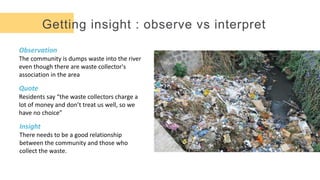
Getting insight : observe vs interpret
Observation
The community is dumps waste into the river
even though there are waste collector's
association in the area
Quote
Residents say “the waste collectors charge a
lot of money and don’t treat us well, so we
have no choice”
Insight
There needs to be a good relationship
between the community and those who
collect the waste.
,Apple Inc.
Shadowing: involves immersing oneself in the other person's emotional state and trying to empathize with their thoughts and reactions.

Mystery shopping: a technique where individuals covertly evaluate businesses by posing as regular customers to assess service quality, compliance, and overall
customer experience.
Scenario 1: Why are customers complaining about slow
website loading times?
1. Why are customers complaining about slow website loading
times?
• Because the website's homepage takes too long to load.
2. Why does the homepage take too long to load?
• Because it contains high-resolution images and videos that
increase page size.
3. Why are high-resolution images and videos used on the
homepage?
• Because the marketing team prioritized visual appeal to
attract customer attention.
4. Why did the marketing team prioritize visual appeal over page
loading speed?
• Because they received feedback that customers
appreciate visually engaging content.
5. Why wasn't page loading speed considered alongside visual
appeal?
• Because the development team wasn't involved in the
initial content planning discussions, leading to a
disconnect between design and performance priorities.
This analysis uncovers deeper issues related to website
performance and decision-making processes within the
organization. It highlights the importance of collaboration between
teams (such as marketing and development) to balance user
experience elements like visual appeal and page loading speed
effectively. By asking "why" multiple times, organizations can
identify underlying causes and implement solutions that address
EX. The 5 times why
scenarios Scenario 2: Interviewing a team member about a recent project failure.
1. Why did the project encounter difficulties?
• Because we missed the deadline and key deliverables weren't met.
2. Why did we miss the deadline and deliverables?
• Because team members were unclear about their roles and
responsibilities.
3. Why were roles and responsibilities unclear?
• Because communication channels within the team were not effective,
leading to misunderstandings.
4. Why were communication channels ineffective?
• Because team meetings were infrequent and lacked clear agendas or
follow-up actions.
5. Why were team meetings lacking in frequency and structure?
• Because team members were overwhelmed with individual tasks and
didn't prioritize collaborative efforts.
Through this analysis:
• You identify a breakdown in communication as a root cause of the project
failure.
• You understand that individual workload management and team collaboration
are interconnected.
• You recognize the importance of regular, structured communication and role
clarity in project success.
During the interview process, asking open-ended questions and probing deeper
with each "why" helps build empathy by gaining insight into the interviewee's
experiences, challenges, and perspectives related to the situation. It fosters a
more meaningful conversation that goes beyond surface-level issues.
BUT WHEN
YOU ASK
• An active engagement with target users aimed at
getting specific insights on what they think about
products, processes…
• Unlike focus groups these are one on one with an
in-depth discussion.
• This is not a sales pitch but a research session!
• Go in with a specific thing to learn about like “how
do delivery drivers find out the best route”.
• Construct leading question that prime the user!
Closed questions Leading questions
• Do you use the products in the morning? • Can you tell me how you use the product ?
• Do you like to use the product? • What do you like about the products?
• What product do you use? • Why do you use this product rather than the others?
!!!
a holiday maker is an
individual who is
enjoying time away
from work or regular
responsibilities to relax,
explore new places,
and engage in
enjoyable activities
during their holiday
period(It may be in
tourism and hospitality
industries to refer to
customers or guests
who are visiting hotels,
resorts, tourist
attractions, or
destinations for
vacation purposes.
ACTIVITY
1 Fill The
Empathy Map
ACTIVITY
1 Fill The
Empathy Map
Understanding the
problem
Root Causes
Core Problem
Consequences
The Core problem should describe
• What is the problem
• Who is it a problem for
The Root Causes should describe
• The main factors that causes the core
problem
The Consequences should describe
• The implications for the individual and
society if the core problem goes unaddressed
Problem cause and effect
Source: embarkservices.com
• your solution is framed by how you see the problem
• The way you define a problem determine the path you take to solve it
• You have to challenge your assumptions about the problem
• Identify attributes of the problem, who are player and individuals…
What is the problem you are trying to solve
Defining the problem accurately provides clarity and focus on
what needs to be solved and ensures that the design process
focuses on addressing real user needs, pain points, and
aspirations.
EX. ADDIS ABEBA
TRAFIC PROBLEM
Image Source : mameethiopia.blogpost.com
• This is a statement with which should never contain any specific
solutions, nor it should contain any indication as to how to fulfill
your users needs- illustrates a gap that need to be filled
• A good statement that communicates a need and inspire a solution
• It is a concise description of an issue that you are working on
• It needs to be convincing
Problem statement
ACTIVITY
2
Explore and define your point of view
from your empathy map
R e f l e c t i o n s

Design thinking on how to solve problems.pptx

  • 1.
    Time Day 1Day 2 Day 3 2:30 LT Opening Prototyping and Testing I Implementation & Scaling I 3:00 LT Introduction Prototyping and Testing I … 4:30 LT Break Break Break 5:00 LT Understanding Problem Prototyping and Testing I Implementation & Scaling I 6:30 LT Lunch Lunch Lunch 8:00 LT Understanding Problem Prototyping and Testing II Discussion 8:30 LT Break Break Break 9:00 LT Ideation and & Creativity Prototyping and Testing II Pitching 5:00pm End of day reflections
  • 2.
    • Ask eachparticipant to think of two true statements about themselves and one false statement. • In a round-robin style, have each participant share their statements, and the group guesses which statement is the lie. • After guessing, the participant reveals the lie and shares a brief story or explanation about each statement.
  • 3.
  • 4.
  • 17.
    The “S&P 500"refers to the Standard & Poor's 500 Index, which is one of the most widely followed stock market indices in the United States and globally
  • 21.
    + Don’t getattached to a solution or an idea + No idea is off limit + Ask as many question as possible + Keep on Refining ++Start small and flexible +++ Collaboration is key + Remember, users are the final judges +++ Including Bonuses
  • 25.
    The 5 timeswhy situation
  • 27.
    Understand your users-assumptionvs reality • What do you see happening? • How would you find out the real reason? • What might be the reason for this behavior?
  • 28.
    Getting insight :observe vs interpret Observation The community is dumps waste into the river even though there are waste collector's association in the area Quote Residents say “the waste collectors charge a lot of money and don’t treat us well, so we have no choice” Insight There needs to be a good relationship between the community and those who collect the waste.
  • 30.
    ,Apple Inc. Shadowing: involvesimmersing oneself in the other person's emotional state and trying to empathize with their thoughts and reactions. Mystery shopping: a technique where individuals covertly evaluate businesses by posing as regular customers to assess service quality, compliance, and overall customer experience.
  • 31.
    Scenario 1: Whyare customers complaining about slow website loading times? 1. Why are customers complaining about slow website loading times? • Because the website's homepage takes too long to load. 2. Why does the homepage take too long to load? • Because it contains high-resolution images and videos that increase page size. 3. Why are high-resolution images and videos used on the homepage? • Because the marketing team prioritized visual appeal to attract customer attention. 4. Why did the marketing team prioritize visual appeal over page loading speed? • Because they received feedback that customers appreciate visually engaging content. 5. Why wasn't page loading speed considered alongside visual appeal? • Because the development team wasn't involved in the initial content planning discussions, leading to a disconnect between design and performance priorities. This analysis uncovers deeper issues related to website performance and decision-making processes within the organization. It highlights the importance of collaboration between teams (such as marketing and development) to balance user experience elements like visual appeal and page loading speed effectively. By asking "why" multiple times, organizations can identify underlying causes and implement solutions that address EX. The 5 times why scenarios Scenario 2: Interviewing a team member about a recent project failure. 1. Why did the project encounter difficulties? • Because we missed the deadline and key deliverables weren't met. 2. Why did we miss the deadline and deliverables? • Because team members were unclear about their roles and responsibilities. 3. Why were roles and responsibilities unclear? • Because communication channels within the team were not effective, leading to misunderstandings. 4. Why were communication channels ineffective? • Because team meetings were infrequent and lacked clear agendas or follow-up actions. 5. Why were team meetings lacking in frequency and structure? • Because team members were overwhelmed with individual tasks and didn't prioritize collaborative efforts. Through this analysis: • You identify a breakdown in communication as a root cause of the project failure. • You understand that individual workload management and team collaboration are interconnected. • You recognize the importance of regular, structured communication and role clarity in project success. During the interview process, asking open-ended questions and probing deeper with each "why" helps build empathy by gaining insight into the interviewee's experiences, challenges, and perspectives related to the situation. It fosters a more meaningful conversation that goes beyond surface-level issues.
  • 32.
    BUT WHEN YOU ASK •An active engagement with target users aimed at getting specific insights on what they think about products, processes… • Unlike focus groups these are one on one with an in-depth discussion. • This is not a sales pitch but a research session! • Go in with a specific thing to learn about like “how do delivery drivers find out the best route”. • Construct leading question that prime the user! Closed questions Leading questions • Do you use the products in the morning? • Can you tell me how you use the product ? • Do you like to use the product? • What do you like about the products? • What product do you use? • Why do you use this product rather than the others? !!!
  • 33.
    a holiday makeris an individual who is enjoying time away from work or regular responsibilities to relax, explore new places, and engage in enjoyable activities during their holiday period(It may be in tourism and hospitality industries to refer to customers or guests who are visiting hotels, resorts, tourist attractions, or destinations for vacation purposes.
  • 34.
  • 35.
  • 36.
    Understanding the problem Root Causes CoreProblem Consequences The Core problem should describe • What is the problem • Who is it a problem for The Root Causes should describe • The main factors that causes the core problem The Consequences should describe • The implications for the individual and society if the core problem goes unaddressed Problem cause and effect Source: embarkservices.com
  • 37.
    • your solutionis framed by how you see the problem • The way you define a problem determine the path you take to solve it • You have to challenge your assumptions about the problem • Identify attributes of the problem, who are player and individuals… What is the problem you are trying to solve Defining the problem accurately provides clarity and focus on what needs to be solved and ensures that the design process focuses on addressing real user needs, pain points, and aspirations.
  • 38.
    EX. ADDIS ABEBA TRAFICPROBLEM Image Source : mameethiopia.blogpost.com
  • 39.
    • This isa statement with which should never contain any specific solutions, nor it should contain any indication as to how to fulfill your users needs- illustrates a gap that need to be filled • A good statement that communicates a need and inspire a solution • It is a concise description of an issue that you are working on • It needs to be convincing Problem statement
  • 40.
    ACTIVITY 2 Explore and defineyour point of view from your empathy map
  • 41.
    R e fl e c t i o n s