Winter 2010 • STANFORD SOCIAL INNOVATION REVIEW 31
In an area outsideHyderabad,India,betweenthesuburbsandthecountryside,ayoung
woman—we’ll call her Shanti—fetches water daily from the always-open local borehole that is
about 300 feet from her home. She uses a 3-gallon plastic container that she can easily carry on
her head. Shanti and her husband rely on the free water for their drinking and washing, and though
they’ve heard that it’s not as safe as water from the Naandi Foundation-run community treatment
plant, they still use it. Shanti’s family has been drinking the local water for generations, and al-
though it periodically makes her and her family sick, she has no plans to stop using it.
ShantihasmanyreasonsnottousethewaterfromtheNaanditreatmentcenter,butthey’renot
the reasons one might think. The center is within easy walking distance of her home—roughly a
third of a mile. It is also well
knownandaffordable(roughly
10 rupees, or 20 cents, for 5
gallons). Being able to pay the
small fee has even become a
status symbol for some villag-
ers. Habit isn’t a factor, either.
Shanti is forgoing the safer
water because of a series of
flaws in the overall design of
the system.
Although Shanti can walk
to the facility, she can’t carry
the5-gallonjerricanthatthefa-
cilityrequireshertouse.When
filled with water, the plastic
rectangular container is sim-
ply too heavy. The container
isn’tdesignedtobeheldonthe
hiporthehead,whereshelikes
tocarryheavyobjects.Shanti’s
husband can’t help carry it, ei-
ther. He works in the city and
doesn’treturnhomeuntilafter
the water treatment center is
closed. The treatment center
also requires them to buy a
monthly punch card for 5 gal-
lons a day, far more than they
need.“WhywouldIbuymore
thanIneedandwastemoney?”
asks Shanti, adding she’d be
more likely to purchase the
Naandi water if the center al-
lowed her to buy less.
Thecommunitytreatment
center was designed to pro-
duce clean and potable water,
and it succeeded very well at
doingjustthat.Infact,itworks
well for many people living
in the community, particu-
larly families with husbands
or older sons who own bikes
and can visit the treatment
By Tim Brown
& Jocelyn Wyatt
Illustration by
John Hersey
DESIGNERS HAVE TRADI-
TIONALLY FOCUSED ON
ENHANCING THE LOOK
AND FUNCTIONALITY OF
PRODUCTS. RECENTLY, THEY
HAVE BEGUN USING DESIGN
TOOLS TO TACKLE MORE
COMPLEX PROBLEMS, SUCH
AS FINDING WAYS TO
PROVIDE LOW-COST HEALTH
CARE THROUGHOUT THE
WORLD. BUSINESSES WERE
FIRST TO EMBRACE THIS
NEW APPROACH—CALLED
DESIGN THINKING—NOW
NONPROFITS ARE BEGIN-
NING TO ADOPT IT TOO.
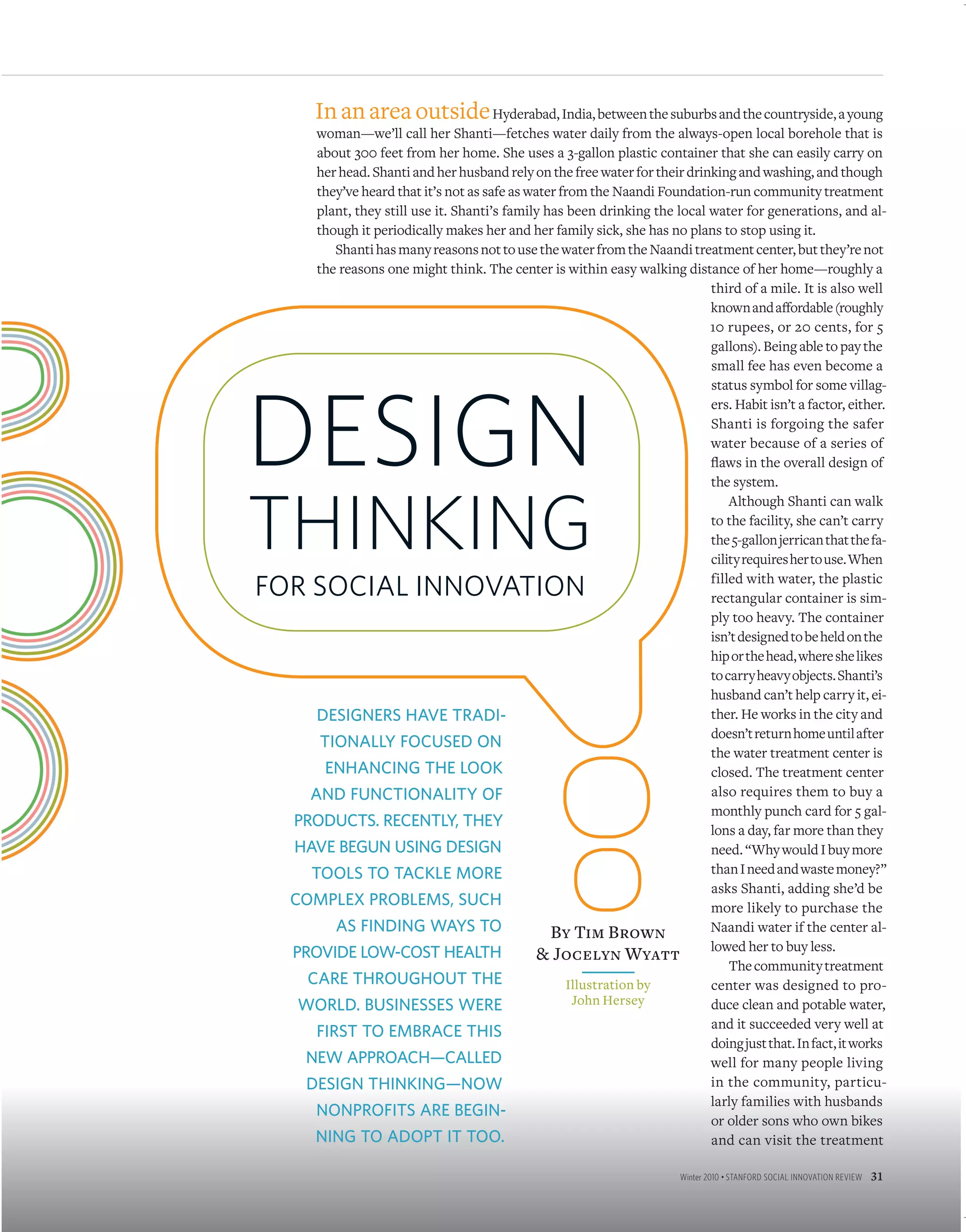
DESIGN
THINKING
FOR SOCIAL INNOVATION
32 STANFORD SOCIAL INNOVATION REVIEW • Winter 2010
plant during working hours. The designers of the center, however,
missed the opportunity to design an even better system because
they failed to consider the culture and needs of all of the people
living in the community.
This missed opportunity, although an obvious omission in hind-
sight, is all too common. Time and again, initiatives falter because
theyarenotbasedontheclient’sorcustomer’sneedsandhavenever
beenprototypedtosolicitfeedback.Evenwhenpeopledogointothe
field, they may enter with preconceived notions of what the needs
and solutions are. This flawed approach remains the norm in both
the business and social sectors.
As Shanti’s situation shows, social challenges require systemic
solutionsthataregroundedintheclient’sorcustomer’sneeds.This
iswheremanyapproachesfounder,butitiswheredesignthinking—
a new approach to creating solutions—excels.
Traditionally,designersfocusedtheirattentiononimprovingthe
look and functionality of products. Classic examples of this type of
designworkareAppleComputer’siPodandHermanMiller’sAeron
chair. In recent years designers have broadened their approach, cre-
ating entire systems to deliver products and services.
Design thinking incorporates constituent or consumer insights
in depth and rapid prototyping, all aimed at getting beyond the
assumptions that block effective solutions. Design thinking—in-
herently optimistic, constructive, and experiential—addresses the
needs of the people who will consume a product or service and the
infrastructure that enables it.
Businessesareembracingdesignthinkingbecauseithelpsthem
bemoreinnovative,betterdifferentiatetheirbrands,andbringtheir
productsandservicestomarketfaster.Nonprofitsarebeginningto
usedesignthinkingaswelltodevelopbettersolutionstosocialprob-
lems. Design thinking crosses the traditional boundaries between
public,for-profit,andnonprofitsectors.Byworkingcloselywiththe
clientsandconsumers,designthinkingallowshigh-impactsolutions
to bubble up from below rather than being imposed from the top.
D E S I G N T H I N K I N G AT W O R K
JerrySternin,founderofthePositiveDevianceInitiativeandaprofes-
sor at Tufts University until he died last year, was skilled at identify-
ingwhathecalledoutsidersolutionstolocalproblems.Hisapproach
to social innovation is a good example of design thinking in action.1
In 1990, Sternin and his wife, Monique, were working in Vietnam
to decrease malnutrition among children in 10,000 villages. At the
time, 65 percent of Vietnamese children under age 5 suffered from
malnutrition, and most solutions relied on government donations
ofnutritionalsupplements.Butthesupplementsneverdeliveredthe
hoped-for results.2 As an alternative, the Sternins used an approach
calledpositivedeviance,whichlooksforsolutionsamongindividuals
and families in the community who are already doing well.3
The Sternins and colleagues from Save the Children surveyed
four local Quong Xuong communities in the province of Than Hoa
andaskedforexamplesof“very,verypoor”familieswhosechildren
were healthy. They then observed the food preparation, cooking,
and serving behaviors of these six families, called “positive devi-
ants,” and found a few consistent yet rare behaviors. Parents of
well-nourished children collected tiny shrimps, crabs, and snails
fromricepaddiesandaddedthemtothefood,alongwiththegreens
from sweet potatoes. Although these foods were readily available,
they were typically not eaten because they were considered unsafe
for children. The positive deviants also fed their children multiple
smaller meals, which allowed small stomachs to hold and digest
more food each day.
The Sternins and the rest of their group worked with the posi-
tive deviants to offer cook-
ing classes to the families
of children suffering from
malnutrition. By the end
of the program’s first year,
80 percent of the 1,000
children enrolled in the
program were adequately
nourished. In addition, the
effort had been replicated
within 14 villages across
Vietnam.4
The Sternins’ work is a
good example of how pos-
itive deviance and design
thinking relies on local
expertise to uncover local
solutions. Design thinkers
look for work-arounds and
improvise solutions—like
the shrimps, crabs, and
snails—and they find ways
to incorporate those into the offerings they create. They consider
what we call the edges, the places where “extreme” people live dif-
ferently, think differently, and consume differently. As Monique
Sternin, now director of the Positive Deviance Initiative, explains:
“Bothpositivedevianceanddesignthinkingarehuman-centeredap-
proaches. Their solutions are relevant to a unique cultural context
and will not necessarily work outside that specific situation.”
One program that might have benefited from design thinking
is mosquito net distribution in Africa. The nets are well designed
and when used are effective at reducing the incidence of malaria.5
The World Health Organization praised the nets, crediting them
with significant drops in malaria deaths in children under age 5: a
51 percent decline in Ethiopia, 34 percent decline in Ghana, and 66
percent decline in Rwanda.6 The way that the mosquito nets have
been distributed, however, has had unintended consequences.
In northern Ghana, for instance, nets are provided free to preg-
nant women and mothers with children under age 5. These women
can readily pick up free nets from local public hospitals. For every-
one else, however, the nets are difficult to obtain. When we asked a
Tim Brown is the ceo and president of ideo, a global innovation and design
firm. He is author of Change by Design: How Design Thinking Transforms Organi-
zations and Inspires Innovation (HarperBusiness, 2009), a newly published book
about how design thinking transforms organizations and inspires innovation.
Jocelyn Wyatt leads ideo’s Social Innovation group, which works with enter-
prises, foundations, nongovernmental organizations, and multinationals to build
capabilities in design thinking and design innovative offerings that meet the needs
of local customers.
Design thinkers look
for work-arounds and
improvise solutions
and find ways to in-
corporate those into
the offerings they
create. They con-
sider what we call
the edges, the places
where “extreme”
people live differently,
think differently, and
consume differently.
Winter 2010 • STANFORD SOCIAL INNOVATION REVIEW 33
well-educatedGhanaiannamedAlbert,whohadrecentlycontracted
malaria,whetherhesleptunderamosquitonet,hetoldusno—there
wasnoplaceinthecityofTamaletopurchaseone.Becausesomany
peoplecanobtainfreenets,itisnotprofitableforshopownerstosell
them. But hospitals are not equipped to sell additional nets, either.
As Albert’s experience shows, it’s critical that the people design-
ingaprogramconsidernotonlyformandfunction,butdistribution
channels as well. One could say that the free nets were never in-
tendedforpeoplelikeAlbert—thathewassimplyoutofthescopeof
theproject.Butthatwouldbemissingahugeopportunity.Without
consideringthewholesystem,thenetscannotbewidelydistributed,
which makes the eradication of malaria impossible.
T H E O R I G I N O F D E S I G N T H I N K I N G
ideo was formed in 1991 as a merger between David Kelley Design,
which created Apple Computer’s first mouse in 1982, and ID Two,
whichdesignedthefirstlaptopcomputer,alsoin1982.Initially,ideo
focusedontraditionaldesignworkforbusiness,designingproducts
like the Palm V personal digital assistant, Oral-B toothbrushes, and
Steelcase chairs. These are the types of objects that are displayed in
lifestyle magazines or on pedestals in modern art museums.
By 2001, ideo was increasingly being asked to tackle problems
that seemed far afield from traditional design. A health care foun-
dation asked us to help restructure its organization, a century-old
manufacturingcompanywantedtobetterunderstanditsclients,and
a university hoped to create alternative learning environments to
traditionalclassrooms.ThistypeofworktookIDEOfromdesigning
consumer products to designing consumer experiences.
To distinguish this new type of design work, we began referring
to it as “design with a small d.” But this phrase never seemed fully
satisfactory.DavidKelley,alsothefounderofStanfordUniversity’s
Hasso Plattner Institute of Design (aka the “d.school”), remarked
that every time someone asked him about design, he found himself
inserting the word “thinking” to explain what it was that designers
do. Eventually, the term design thinking stuck.7
As an approach, design thinking taps into capacities we all have
butthatareoverlookedbymoreconventionalproblem-solvingprac-
tices.Notonlydoesitfocusoncreatingproductsandservicesthatare
humancentered,buttheprocessitselfisalsodeeplyhuman.Design
thinking relies on our ability to be intuitive, to recognize patterns,
to construct ideas that have emotional meaning as well as being
functional, and to express ourselves in media other than words or
symbols.Nobodywantstorunanorganizationonfeeling,intuition,
andinspiration,butanover-relianceontherationalandtheanalyti-
cal can be just as risky. Design thinking, the integrated approach at
the core of the design process, provides a third way.
The design thinking process is best thought of as a system of
overlapping spaces rather than a sequence of orderly steps. There
are three spaces to keep in mind: inspiration, ideation, and imple-
mentation. Think of inspiration as the problem or opportunity that
motivates the search for solutions; ideation as the process of gener-
ating, developing, and testing ideas; and implementation as the path
that leads from the project stage into people’s lives.
The reason to call these spaces, rather than steps, is that they
are not always undertaken sequentially. Projects may loop back
through inspiration, ideation, and implementation more than once
as the team refines its ideas and explores new directions. Not sur-
prisingly, design thinking can feel chaotic to those doing it for the
firsttime.Butoverthelifeofaproject,participantscometoseethat
the process makes sense and achieves results, even though its form
differs from the linear, milestone-based processes that organiza-
tions typically undertake.
I N S P I R AT I O N
Although it is true that designers do not always proceed through
each of the three spaces in linear fashion, it is generally the case
thatthedesignprocessbeginswiththeinspirationspace—theprob-
lem or opportunity that motivates people to search for solutions.
And the classic starting point for the inspiration phase is the brief.
The brief is a set of mental constraints that gives the project team
a framework from which to begin, benchmarks by which they can
measure progress, and a set of objectives to be realized—such as
price point, available technology, and market segment.
Butjustasahypothesisisnotthesameasanalgorithm,thebrief
is not a set of instructions or an attempt to answer the question be-
fore it has been posed. Rather, a well-constructed brief allows for
serendipity,unpredictability,andthecapriciouswhimsoffate—the
creativerealmfromwhichbreakthroughideasemerge.Tooabstract
and the brief risks leaving the project team wandering; too narrow
a set of constraints almost guarantees that the outcome will be in-
cremental and, likely, mediocre.
Once the brief has been constructed, it is time for the design
team to discover what people’s needs are. Traditional ways of do-
ing this, such as focus groups and surveys, rarely yield important
insights. In most cases, these techniques simply ask people what
they want. Conventional research can be useful in pointing toward
incrementalimprovements,butthosedon’tusuallyleadtothetype
ofbreakthroughsthatleaveusscratchingourheadsandwondering
why nobody ever thought of that before.
Henry Ford understood this when he said, “If I’d asked my cus-
tomers what they wanted, they’d have said ‘a faster horse.’” 8 Al-
though people often can’t tell us what their needs are, their actual
behaviors can provide us with invaluable clues about their range
of unmet needs.
A better starting point is for designers to go out into the world
and observe the actual experiences of smallholder farmers, school-
children,andcommunityhealthworkersastheyimprovisetheirway
through their daily lives. Working with local partners who serve as
interpretersandculturalguidesisalsoimportant,aswellashaving
partnersmakeintroductionstocommunities,helpingbuildcredibil-
ityquicklyandensuringunderstanding.Through“homestays”and
shadowing locals at their jobs and in their homes, design thinkers
become embedded in the lives of the people they are designing for.
Earlierthisyear,KaraPecknold,astudentatEmilyCarrUniversity
ofArtandDesigninVancouver,BritishColumbia,tookaninternship
withawomen’scooperativeinRwanda.HertaskwastodevelopaWeb
sitetoconnectruralRwandanweaverswiththeworld.Pecknoldsoon
discovered that the weavers had little or no access to computers and
the Internet. Rather than ask them to maintain a Web site, she re-
framedthebrief,broadeningittoaskwhatservicescouldbeprovided
34 STANFORD SOCIAL INNOVATION REVIEW • Winter 2010
tothecommunitytohelpthemimprovetheir
livelihoods. Pecknold used various design
thinking techniques, drawing partly from
hertrainingandpartlyfromideo’sHuman
Centered Design toolkit, to understand the
women’saspirations.(See“ToolkitforDesign
Thinking” at right.)
BecausePecknolddidn’tspeakthewom-
en’slanguage,sheaskedthemtodocument
theirlivesandaspirationswithacameraand
draw pictures thatexpressed whatsuccess
looked like in their community. Through
these activities, the women were able to
seeforthemselveswhatwasimportantand
valuable,ratherthanhavinganoutsidermakethoseassumptionsfor
them. During the project, Pecknold also provided each participant
with the equivalent of a day’s wages (500 francs, or roughly $1) to
see what each person did with the money. Doing this gave her fur-
ther insight into the people’s lives and aspirations. Meanwhile, the
womenfoundthatamere500francsadaycouldbeasignificant,life-
changingsum.ThisvisualizationprocesshelpedbothPecknoldand
the women prioritize their planning for the community.9
I D E AT I O N
The second space of the design thinking process is ideation. After
spending time in the field observing and doing design research, a
teamgoesthroughaprocessofsynthesisinwhichtheydistillwhat
theysawandheardintoinsightsthatcanleadtosolutionsoroppor-
tunities for change. This approach helps multiply options to create
choices and different insights about human behavior. These might
be alternative visions of new product offerings, or choices among
various ways of creating interactive experiences. By testing com-
peting ideas against one another, the likelihood that the outcome
will be bolder and more compelling increases.
AsLinusPauling,scientistandtwo-timeNobelPrizewinner,put
it, “To have a good idea you must first have lots of ideas.” 10 Truly
innovative ideas challenge the status quo and stand out from the
crowd—they’re creatively disruptive. They provide a wholly new
solution to a problem many people didn’t know they had.
Ofcourse,morechoicesmeanmorecomplexity,whichcanmake
life difficult, especially for those whose job it is to control budgets
andmonitortimelines.Thenaturaltendencyofmostorganizations
is to restrict choices in favor of the obvious and the incremental. Al-
thoughthistendencymaybemoreefficientintheshortrun,ittends
tomakeanorganizationconservativeandinflexibleinthelongrun.
Divergent thinking is the route, not the obstacle, to innovation.
To achieve divergent thinking, it is important to have a diverse
group of people involved in the process. Multidisciplinary people—
architects who have studied psychology, artists with MBAs, or engi-
neers with marketing experience—often demonstrate this quality.
They’re people with the capacity and the disposition for collabora-
tion across disciplines.
Tooperatewithinaninterdisciplinaryenvironment,anindividual
needs to have strengths in two dimensions—the “T-shaped” person.
On the vertical axis, every member of the team needs to possess a
depthofskillthatallowshimorhertomaketangiblecontributionsto
the outcome. The top of the “T” is where the design thinker is made.
It’sabout empathy for peopleand for disciplines beyond one’s own.It
tends to be expressed as openness, curiosity, optimism, a tendency
towardlearningthroughdoing,and experimentation.(Thesearethe
same traits that we seek in our new hires at ideo.)
Interdisciplinary teams typically move into a structured brain-
storming process. Taking one provocative question at a time, the
group may generate hundreds of ideas ranging from the absurd to
the obvious. Each idea can be written on a Post-it note and shared
with the team. Visual representations of concepts are encouraged,
as this generally helps others understand complex ideas.
One rule during the brainstorming process is to defer judgment.
It is important to discourage anyone taking on the often obstruc-
tive,non-generativeroleofdevil’sadvocate,asTomKelleyexplains
in his book The Ten Faces of Innovation.11 Instead, participants are
encouragedtocomeupwithasmanyideasaspossible.Thisletsthe
groupmoveintoaprocessofgroupingandsortingideas.Goodideas
naturally rise to the top, whereas the bad ones drop off early on.
InnoCentive provides a good example of how design thinking
can result in hundreds of ideas. InnoCentive has created a Web site
that allows people to post solutions to challenges that are defined
byInnoCentivemembers,amixofnonprofitsandcompanies.More
than175,000people—includingscientists,engineers,anddesigners
from around the world—have posted solutions.
The Rockefeller Foundation has supported 10 social innovation
challengesthroughInnoCentiveandreportsan80percentsuccess
rate in delivering effective solutions to the nonprofits posting chal-
lenges.12 The open innovation approach is effective in producing
lots of new ideas. The responsibility for filtering through the ideas,
field-testing them, iterating, and taking them to market ultimately
falls to the implementer.
AnInnoCentivepartnershipwiththeGlobalAllianceforTBDrug
DevelopmentsoughtatheoreticalsolutiontosimplifythecurrentTB
treatmentregimen.“Theprocessisaprimeexampleofdesignthink-
ing contributing to social innovation,” explained Dwayne Spradlin,
InnoCentive’s ceo. “With the TB drug development, the winning
solver was a scientist by profession, but submitted to the challenge
becausehismother—thesoleincomeproviderforthefamily—devel-
opedTBwhenhewas14.Shehadtostopworking,andhetookonthe
responsibilityofworkingandgoingtoschooltoprovideforthefamily.”
In 2008, the Bill & Melinda Gates Foundation asked IDEO
to codify the process of design thinking, so that it could
be easily used by grassroots nongovernmental organiza-
tionsworkingwithsmallfarmersinthedevelopingworld.A
team of IDEO designers spent three months working with
Heifer International, the International Center for Research
on Women, and International Development Enterprises to
understand their processes for designing new products, ser-
vices, and programs and integrate them with IDEO’s own processes.
The result of this effort was the Human Centered Design toolkit, a methodology
organizations can use to undertake the design thinking process themselves. The toolkit
is available as a free download at www.hcdtoolkit.com. —T.B. & J.W.
TOOLKIT FOR
DESIGN
THINKING
Winter 2010 • STANFORD SOCIAL INNOVATION REVIEW 35
SpradlinfindsthatprojectswithintheInnoCentivecommunityoften
benefit from such deep and motivating connections.13
I M P L E M E N TAT I O N
The third space of the design thinking process is implementation,
when the best ideas generated during ideation are turned into a
concrete,fullyconceivedactionplan.Atthecoreoftheimplementa-
tionprocessisprototyping,turningideasintoactualproductsand
services that are then tested, iterated, and refined.
Through prototyping, the design thinking process seeks to un-
coverunforeseenimplementationchallengesandunintendedconse-
quences in order to have more reliable long-term success. Prototyp-
ing is particularly important for products and services destined for
the developing world, where the lack of infrastructure, retail chains,
communication networks, literacy, and other essential pieces of the
system often make it difficult to design new products and services.
Prototyping can validate a component of a device, the graphics
onascreen,oradetailintheinteractionbetweenablooddonorand
a Red Cross volunteer. The prototypes at this point may be expen-
sive,complex,andevenindistinguishablefromtherealthing.Asthe
project nears completion and heads toward real-world implementa-
tion, prototypes will likely become more complete.
After the prototyping process is finished and the ultimate prod-
uctorservicehasbeencreated,thedesignteamhelpscreateacom-
municationstrategy.Storytelling,particularlythroughmultimedia,
helps communicate the solution to a diverse set of stakeholders in-
side and outside of the organization, particularly across language
and cultural barriers.
VisionSpring, a low-cost eye care provider in India, provides a
good example of how prototyping can be a critical step in imple-
mentation. VisionSpring, which had been selling reading glasses to
adults, wanted to begin providing comprehensive eye care to chil-
dren.VisionSpring’sdesigneffortincludedeverythingotherthanthe
designoftheglasses,frommarketing“eyecamps”throughself-help
groups to training teachers about the importance of eye care and
transporting kids to the local eye care center.
WorkingwithVisionSpring,ideodesignersprototypedtheeye-
screening process with a group of 15 children between the ages of
8 and 12. The designers first tried to screen a young girl’s vision
throughtraditionaltests.Immediately,though,sheburstintotears—
the pressure of the experience was too great and the risk of failure
too high. In hopes of diffusing this stressful situation, the design-
ers asked the children’s teacher to screen the next student. Again,
the child started to cry. The designers then asked the girl to screen
her teacher. She took the task very seriously, while her classmates
looked on enviously. Finally, the designers had the children screen
each other and talk about the process. They loved playing doctor
and both respected and complied with the process.
By prototyping and creating an implementation plan to pilot
and scale the project, ideo was able to design a system for the eye
screenings that worked for VisionSpring’s practitioners, teachers,
and children. As of September 2009, VisionSpring had conducted
in India 10 eye camps for children, screened 3,000 children, trans-
ported 202 children to the local eye hospital, and provided glasses
for the 69 children who needed them.
“Screeningandprovidingglassestokidspresentsmanyuniqueprob-
lems,soweturnedtodesignthinkingtoprovideuswithanappropriate
structuretodevelopthemostappropriatemarketinganddistribution
strategy,” explained Peter Eliassen, vice president of sales and opera-
tionsatVisionSpring.EliassenaddedthatprototypingletVisionSpring
focusontheapproachesthatputchildrenateaseduringthescreening
process.“Nowthatwehavebecomeadesignthinkingorganization,we
continuetouseprototypestoassessthefeedbackandviabilityofnew
market approaches from our most important customers: our vision
entrepreneurs [or salespeople] and end consumers.” 14
S Y S T E M I C P R O B L E M S
N E E D S Y S T E M I C S O L U T I O N S
Manysocialenterprisesalreadyintuitivelyusesomeaspectsofdesign
thinking, but most stop short of embracing the approach as a way to
move beyond today’s conventional problem solving. Certainly, there
are impediments to adopting design thinking in an organization. Per-
hapstheapproachisn’tembracedbytheentireorganization.Ormaybe
the organization resists taking a human-centered approach and fails
to balance the perspectives of users, technology, and organizations.
One of the biggest impediments to adopting design thinking
is simply fear of failure. The notion that there is nothing wrong
with experimentation or failure, as long as they happen early and
act as a source of learning, can be difficult to accept. But a vibrant
designthinkingculturewillencourageprototyping—quick,cheap,
and dirty—as part of the creative process and not just as a way of
validating finished ideas.
As Yasmina Zaidman, director of knowledge and communica-
tions at Acumen Fund, put it, “The businesses we invest in require
constant creativity and problem solving, so design thinking is a
real success factor for serving the base of the economic pyramid.”
Design thinking can lead to hundreds of ideas and, ultimately, real-
world solutions that create better outcomes for organizations and
the people they serve. ■
Notes
“In Memoriam: Jerry Sternin,” Positive Deviance Initiative.1
“Nutrition in Viet Nam,” Positive Deviance Initiative.2
“What Is Positive Deviance?” Positive Deviance Initiative.3
“The Viet Nam Story: Narrated by Jerry Sternin,” Positive Deviance Initiative.4
Kevin Starr, “Go Big or Go Home,”5 Stanford Social Innovation Review, fall 2008.
J.R. Minkel, “Net Benefits: Bed Netting, Drugs Stem Malaria Deaths: Proactive Afri-6
can Countries See Fewer Children Felled by the Mosquito-Borne Disease,” Scientific
American, February 4, 2008.
Tim Brown,7 Change by Design: How Design Thinking Transforms Organizations and
Inspires Innovation, New York: HarperBusiness, 2009.
Tim Brown,8 Change by Design.
Jocelyn Wyatt, E-mail correspondence with Kara Pecknold, September 23, 2009.9
Linus Pauling, Barclay Kamb, Linda Pauling Kamb, et al.,10 Linus Pauling: Selected Sci-
entific Papers, Volume II—Biomolecular Sciences, London: World Scientific Publishing,
2001.
Tom Kelley and Jonathan Littman,11 The Ten Faces of Innovation: IDEO’s Strategies for
Defeating the Devil’s Advocate and Driving Creativity Throughout Your Organization,
New York: Random House, 2005.
“Accelerating Innovation for Development: The Rockefeller Foundation and Inno-12
Centive Renew Partnership Linking Nonprofit Organizations to World-Class Scien-
tific Thinkers,” Rockefeller Foundation, June 23, 2009.
Jocelyn Wyatt, E-mail correspondence with Dwayne Spradlin, September 18, 2009.13
Jocelyn Wyatt, E-mail correspondence with Peter Eliassen, August 10, 2009.14
Reproduced with permission of the copyright owner. Further reproduction prohibited without permission.

Design thinking for social innovation

  • 1.
    Winter 2010 •STANFORD SOCIAL INNOVATION REVIEW 31 In an area outsideHyderabad,India,betweenthesuburbsandthecountryside,ayoung woman—we’ll call her Shanti—fetches water daily from the always-open local borehole that is about 300 feet from her home. She uses a 3-gallon plastic container that she can easily carry on her head. Shanti and her husband rely on the free water for their drinking and washing, and though they’ve heard that it’s not as safe as water from the Naandi Foundation-run community treatment plant, they still use it. Shanti’s family has been drinking the local water for generations, and al- though it periodically makes her and her family sick, she has no plans to stop using it. ShantihasmanyreasonsnottousethewaterfromtheNaanditreatmentcenter,butthey’renot the reasons one might think. The center is within easy walking distance of her home—roughly a third of a mile. It is also well knownandaffordable(roughly 10 rupees, or 20 cents, for 5 gallons). Being able to pay the small fee has even become a status symbol for some villag- ers. Habit isn’t a factor, either. Shanti is forgoing the safer water because of a series of flaws in the overall design of the system. Although Shanti can walk to the facility, she can’t carry the5-gallonjerricanthatthefa- cilityrequireshertouse.When filled with water, the plastic rectangular container is sim- ply too heavy. The container isn’tdesignedtobeheldonthe hiporthehead,whereshelikes tocarryheavyobjects.Shanti’s husband can’t help carry it, ei- ther. He works in the city and doesn’treturnhomeuntilafter the water treatment center is closed. The treatment center also requires them to buy a monthly punch card for 5 gal- lons a day, far more than they need.“WhywouldIbuymore thanIneedandwastemoney?” asks Shanti, adding she’d be more likely to purchase the Naandi water if the center al- lowed her to buy less. Thecommunitytreatment center was designed to pro- duce clean and potable water, and it succeeded very well at doingjustthat.Infact,itworks well for many people living in the community, particu- larly families with husbands or older sons who own bikes and can visit the treatment By Tim Brown & Jocelyn Wyatt Illustration by John Hersey DESIGNERS HAVE TRADI- TIONALLY FOCUSED ON ENHANCING THE LOOK AND FUNCTIONALITY OF PRODUCTS. RECENTLY, THEY HAVE BEGUN USING DESIGN TOOLS TO TACKLE MORE COMPLEX PROBLEMS, SUCH AS FINDING WAYS TO PROVIDE LOW-COST HEALTH CARE THROUGHOUT THE WORLD. BUSINESSES WERE FIRST TO EMBRACE THIS NEW APPROACH—CALLED DESIGN THINKING—NOW NONPROFITS ARE BEGIN- NING TO ADOPT IT TOO. DESIGN THINKING FOR SOCIAL INNOVATION
  • 2.
    32 STANFORD SOCIALINNOVATION REVIEW • Winter 2010 plant during working hours. The designers of the center, however, missed the opportunity to design an even better system because they failed to consider the culture and needs of all of the people living in the community. This missed opportunity, although an obvious omission in hind- sight, is all too common. Time and again, initiatives falter because theyarenotbasedontheclient’sorcustomer’sneedsandhavenever beenprototypedtosolicitfeedback.Evenwhenpeopledogointothe field, they may enter with preconceived notions of what the needs and solutions are. This flawed approach remains the norm in both the business and social sectors. As Shanti’s situation shows, social challenges require systemic solutionsthataregroundedintheclient’sorcustomer’sneeds.This iswheremanyapproachesfounder,butitiswheredesignthinking— a new approach to creating solutions—excels. Traditionally,designersfocusedtheirattentiononimprovingthe look and functionality of products. Classic examples of this type of designworkareAppleComputer’siPodandHermanMiller’sAeron chair. In recent years designers have broadened their approach, cre- ating entire systems to deliver products and services. Design thinking incorporates constituent or consumer insights in depth and rapid prototyping, all aimed at getting beyond the assumptions that block effective solutions. Design thinking—in- herently optimistic, constructive, and experiential—addresses the needs of the people who will consume a product or service and the infrastructure that enables it. Businessesareembracingdesignthinkingbecauseithelpsthem bemoreinnovative,betterdifferentiatetheirbrands,andbringtheir productsandservicestomarketfaster.Nonprofitsarebeginningto usedesignthinkingaswelltodevelopbettersolutionstosocialprob- lems. Design thinking crosses the traditional boundaries between public,for-profit,andnonprofitsectors.Byworkingcloselywiththe clientsandconsumers,designthinkingallowshigh-impactsolutions to bubble up from below rather than being imposed from the top. D E S I G N T H I N K I N G AT W O R K JerrySternin,founderofthePositiveDevianceInitiativeandaprofes- sor at Tufts University until he died last year, was skilled at identify- ingwhathecalledoutsidersolutionstolocalproblems.Hisapproach to social innovation is a good example of design thinking in action.1 In 1990, Sternin and his wife, Monique, were working in Vietnam to decrease malnutrition among children in 10,000 villages. At the time, 65 percent of Vietnamese children under age 5 suffered from malnutrition, and most solutions relied on government donations ofnutritionalsupplements.Butthesupplementsneverdeliveredthe hoped-for results.2 As an alternative, the Sternins used an approach calledpositivedeviance,whichlooksforsolutionsamongindividuals and families in the community who are already doing well.3 The Sternins and colleagues from Save the Children surveyed four local Quong Xuong communities in the province of Than Hoa andaskedforexamplesof“very,verypoor”familieswhosechildren were healthy. They then observed the food preparation, cooking, and serving behaviors of these six families, called “positive devi- ants,” and found a few consistent yet rare behaviors. Parents of well-nourished children collected tiny shrimps, crabs, and snails fromricepaddiesandaddedthemtothefood,alongwiththegreens from sweet potatoes. Although these foods were readily available, they were typically not eaten because they were considered unsafe for children. The positive deviants also fed their children multiple smaller meals, which allowed small stomachs to hold and digest more food each day. The Sternins and the rest of their group worked with the posi- tive deviants to offer cook- ing classes to the families of children suffering from malnutrition. By the end of the program’s first year, 80 percent of the 1,000 children enrolled in the program were adequately nourished. In addition, the effort had been replicated within 14 villages across Vietnam.4 The Sternins’ work is a good example of how pos- itive deviance and design thinking relies on local expertise to uncover local solutions. Design thinkers look for work-arounds and improvise solutions—like the shrimps, crabs, and snails—and they find ways to incorporate those into the offerings they create. They consider what we call the edges, the places where “extreme” people live dif- ferently, think differently, and consume differently. As Monique Sternin, now director of the Positive Deviance Initiative, explains: “Bothpositivedevianceanddesignthinkingarehuman-centeredap- proaches. Their solutions are relevant to a unique cultural context and will not necessarily work outside that specific situation.” One program that might have benefited from design thinking is mosquito net distribution in Africa. The nets are well designed and when used are effective at reducing the incidence of malaria.5 The World Health Organization praised the nets, crediting them with significant drops in malaria deaths in children under age 5: a 51 percent decline in Ethiopia, 34 percent decline in Ghana, and 66 percent decline in Rwanda.6 The way that the mosquito nets have been distributed, however, has had unintended consequences. In northern Ghana, for instance, nets are provided free to preg- nant women and mothers with children under age 5. These women can readily pick up free nets from local public hospitals. For every- one else, however, the nets are difficult to obtain. When we asked a Tim Brown is the ceo and president of ideo, a global innovation and design firm. He is author of Change by Design: How Design Thinking Transforms Organi- zations and Inspires Innovation (HarperBusiness, 2009), a newly published book about how design thinking transforms organizations and inspires innovation. Jocelyn Wyatt leads ideo’s Social Innovation group, which works with enter- prises, foundations, nongovernmental organizations, and multinationals to build capabilities in design thinking and design innovative offerings that meet the needs of local customers. Design thinkers look for work-arounds and improvise solutions and find ways to in- corporate those into the offerings they create. They con- sider what we call the edges, the places where “extreme” people live differently, think differently, and consume differently.
  • 3.
    Winter 2010 •STANFORD SOCIAL INNOVATION REVIEW 33 well-educatedGhanaiannamedAlbert,whohadrecentlycontracted malaria,whetherhesleptunderamosquitonet,hetoldusno—there wasnoplaceinthecityofTamaletopurchaseone.Becausesomany peoplecanobtainfreenets,itisnotprofitableforshopownerstosell them. But hospitals are not equipped to sell additional nets, either. As Albert’s experience shows, it’s critical that the people design- ingaprogramconsidernotonlyformandfunction,butdistribution channels as well. One could say that the free nets were never in- tendedforpeoplelikeAlbert—thathewassimplyoutofthescopeof theproject.Butthatwouldbemissingahugeopportunity.Without consideringthewholesystem,thenetscannotbewidelydistributed, which makes the eradication of malaria impossible. T H E O R I G I N O F D E S I G N T H I N K I N G ideo was formed in 1991 as a merger between David Kelley Design, which created Apple Computer’s first mouse in 1982, and ID Two, whichdesignedthefirstlaptopcomputer,alsoin1982.Initially,ideo focusedontraditionaldesignworkforbusiness,designingproducts like the Palm V personal digital assistant, Oral-B toothbrushes, and Steelcase chairs. These are the types of objects that are displayed in lifestyle magazines or on pedestals in modern art museums. By 2001, ideo was increasingly being asked to tackle problems that seemed far afield from traditional design. A health care foun- dation asked us to help restructure its organization, a century-old manufacturingcompanywantedtobetterunderstanditsclients,and a university hoped to create alternative learning environments to traditionalclassrooms.ThistypeofworktookIDEOfromdesigning consumer products to designing consumer experiences. To distinguish this new type of design work, we began referring to it as “design with a small d.” But this phrase never seemed fully satisfactory.DavidKelley,alsothefounderofStanfordUniversity’s Hasso Plattner Institute of Design (aka the “d.school”), remarked that every time someone asked him about design, he found himself inserting the word “thinking” to explain what it was that designers do. Eventually, the term design thinking stuck.7 As an approach, design thinking taps into capacities we all have butthatareoverlookedbymoreconventionalproblem-solvingprac- tices.Notonlydoesitfocusoncreatingproductsandservicesthatare humancentered,buttheprocessitselfisalsodeeplyhuman.Design thinking relies on our ability to be intuitive, to recognize patterns, to construct ideas that have emotional meaning as well as being functional, and to express ourselves in media other than words or symbols.Nobodywantstorunanorganizationonfeeling,intuition, andinspiration,butanover-relianceontherationalandtheanalyti- cal can be just as risky. Design thinking, the integrated approach at the core of the design process, provides a third way. The design thinking process is best thought of as a system of overlapping spaces rather than a sequence of orderly steps. There are three spaces to keep in mind: inspiration, ideation, and imple- mentation. Think of inspiration as the problem or opportunity that motivates the search for solutions; ideation as the process of gener- ating, developing, and testing ideas; and implementation as the path that leads from the project stage into people’s lives. The reason to call these spaces, rather than steps, is that they are not always undertaken sequentially. Projects may loop back through inspiration, ideation, and implementation more than once as the team refines its ideas and explores new directions. Not sur- prisingly, design thinking can feel chaotic to those doing it for the firsttime.Butoverthelifeofaproject,participantscometoseethat the process makes sense and achieves results, even though its form differs from the linear, milestone-based processes that organiza- tions typically undertake. I N S P I R AT I O N Although it is true that designers do not always proceed through each of the three spaces in linear fashion, it is generally the case thatthedesignprocessbeginswiththeinspirationspace—theprob- lem or opportunity that motivates people to search for solutions. And the classic starting point for the inspiration phase is the brief. The brief is a set of mental constraints that gives the project team a framework from which to begin, benchmarks by which they can measure progress, and a set of objectives to be realized—such as price point, available technology, and market segment. Butjustasahypothesisisnotthesameasanalgorithm,thebrief is not a set of instructions or an attempt to answer the question be- fore it has been posed. Rather, a well-constructed brief allows for serendipity,unpredictability,andthecapriciouswhimsoffate—the creativerealmfromwhichbreakthroughideasemerge.Tooabstract and the brief risks leaving the project team wandering; too narrow a set of constraints almost guarantees that the outcome will be in- cremental and, likely, mediocre. Once the brief has been constructed, it is time for the design team to discover what people’s needs are. Traditional ways of do- ing this, such as focus groups and surveys, rarely yield important insights. In most cases, these techniques simply ask people what they want. Conventional research can be useful in pointing toward incrementalimprovements,butthosedon’tusuallyleadtothetype ofbreakthroughsthatleaveusscratchingourheadsandwondering why nobody ever thought of that before. Henry Ford understood this when he said, “If I’d asked my cus- tomers what they wanted, they’d have said ‘a faster horse.’” 8 Al- though people often can’t tell us what their needs are, their actual behaviors can provide us with invaluable clues about their range of unmet needs. A better starting point is for designers to go out into the world and observe the actual experiences of smallholder farmers, school- children,andcommunityhealthworkersastheyimprovisetheirway through their daily lives. Working with local partners who serve as interpretersandculturalguidesisalsoimportant,aswellashaving partnersmakeintroductionstocommunities,helpingbuildcredibil- ityquicklyandensuringunderstanding.Through“homestays”and shadowing locals at their jobs and in their homes, design thinkers become embedded in the lives of the people they are designing for. Earlierthisyear,KaraPecknold,astudentatEmilyCarrUniversity ofArtandDesigninVancouver,BritishColumbia,tookaninternship withawomen’scooperativeinRwanda.HertaskwastodevelopaWeb sitetoconnectruralRwandanweaverswiththeworld.Pecknoldsoon discovered that the weavers had little or no access to computers and the Internet. Rather than ask them to maintain a Web site, she re- framedthebrief,broadeningittoaskwhatservicescouldbeprovided
  • 4.
    34 STANFORD SOCIALINNOVATION REVIEW • Winter 2010 tothecommunitytohelpthemimprovetheir livelihoods. Pecknold used various design thinking techniques, drawing partly from hertrainingandpartlyfromideo’sHuman Centered Design toolkit, to understand the women’saspirations.(See“ToolkitforDesign Thinking” at right.) BecausePecknolddidn’tspeakthewom- en’slanguage,sheaskedthemtodocument theirlivesandaspirationswithacameraand draw pictures thatexpressed whatsuccess looked like in their community. Through these activities, the women were able to seeforthemselveswhatwasimportantand valuable,ratherthanhavinganoutsidermakethoseassumptionsfor them. During the project, Pecknold also provided each participant with the equivalent of a day’s wages (500 francs, or roughly $1) to see what each person did with the money. Doing this gave her fur- ther insight into the people’s lives and aspirations. Meanwhile, the womenfoundthatamere500francsadaycouldbeasignificant,life- changingsum.ThisvisualizationprocesshelpedbothPecknoldand the women prioritize their planning for the community.9 I D E AT I O N The second space of the design thinking process is ideation. After spending time in the field observing and doing design research, a teamgoesthroughaprocessofsynthesisinwhichtheydistillwhat theysawandheardintoinsightsthatcanleadtosolutionsoroppor- tunities for change. This approach helps multiply options to create choices and different insights about human behavior. These might be alternative visions of new product offerings, or choices among various ways of creating interactive experiences. By testing com- peting ideas against one another, the likelihood that the outcome will be bolder and more compelling increases. AsLinusPauling,scientistandtwo-timeNobelPrizewinner,put it, “To have a good idea you must first have lots of ideas.” 10 Truly innovative ideas challenge the status quo and stand out from the crowd—they’re creatively disruptive. They provide a wholly new solution to a problem many people didn’t know they had. Ofcourse,morechoicesmeanmorecomplexity,whichcanmake life difficult, especially for those whose job it is to control budgets andmonitortimelines.Thenaturaltendencyofmostorganizations is to restrict choices in favor of the obvious and the incremental. Al- thoughthistendencymaybemoreefficientintheshortrun,ittends tomakeanorganizationconservativeandinflexibleinthelongrun. Divergent thinking is the route, not the obstacle, to innovation. To achieve divergent thinking, it is important to have a diverse group of people involved in the process. Multidisciplinary people— architects who have studied psychology, artists with MBAs, or engi- neers with marketing experience—often demonstrate this quality. They’re people with the capacity and the disposition for collabora- tion across disciplines. Tooperatewithinaninterdisciplinaryenvironment,anindividual needs to have strengths in two dimensions—the “T-shaped” person. On the vertical axis, every member of the team needs to possess a depthofskillthatallowshimorhertomaketangiblecontributionsto the outcome. The top of the “T” is where the design thinker is made. It’sabout empathy for peopleand for disciplines beyond one’s own.It tends to be expressed as openness, curiosity, optimism, a tendency towardlearningthroughdoing,and experimentation.(Thesearethe same traits that we seek in our new hires at ideo.) Interdisciplinary teams typically move into a structured brain- storming process. Taking one provocative question at a time, the group may generate hundreds of ideas ranging from the absurd to the obvious. Each idea can be written on a Post-it note and shared with the team. Visual representations of concepts are encouraged, as this generally helps others understand complex ideas. One rule during the brainstorming process is to defer judgment. It is important to discourage anyone taking on the often obstruc- tive,non-generativeroleofdevil’sadvocate,asTomKelleyexplains in his book The Ten Faces of Innovation.11 Instead, participants are encouragedtocomeupwithasmanyideasaspossible.Thisletsthe groupmoveintoaprocessofgroupingandsortingideas.Goodideas naturally rise to the top, whereas the bad ones drop off early on. InnoCentive provides a good example of how design thinking can result in hundreds of ideas. InnoCentive has created a Web site that allows people to post solutions to challenges that are defined byInnoCentivemembers,amixofnonprofitsandcompanies.More than175,000people—includingscientists,engineers,anddesigners from around the world—have posted solutions. The Rockefeller Foundation has supported 10 social innovation challengesthroughInnoCentiveandreportsan80percentsuccess rate in delivering effective solutions to the nonprofits posting chal- lenges.12 The open innovation approach is effective in producing lots of new ideas. The responsibility for filtering through the ideas, field-testing them, iterating, and taking them to market ultimately falls to the implementer. AnInnoCentivepartnershipwiththeGlobalAllianceforTBDrug DevelopmentsoughtatheoreticalsolutiontosimplifythecurrentTB treatmentregimen.“Theprocessisaprimeexampleofdesignthink- ing contributing to social innovation,” explained Dwayne Spradlin, InnoCentive’s ceo. “With the TB drug development, the winning solver was a scientist by profession, but submitted to the challenge becausehismother—thesoleincomeproviderforthefamily—devel- opedTBwhenhewas14.Shehadtostopworking,andhetookonthe responsibilityofworkingandgoingtoschooltoprovideforthefamily.” In 2008, the Bill & Melinda Gates Foundation asked IDEO to codify the process of design thinking, so that it could be easily used by grassroots nongovernmental organiza- tionsworkingwithsmallfarmersinthedevelopingworld.A team of IDEO designers spent three months working with Heifer International, the International Center for Research on Women, and International Development Enterprises to understand their processes for designing new products, ser- vices, and programs and integrate them with IDEO’s own processes. The result of this effort was the Human Centered Design toolkit, a methodology organizations can use to undertake the design thinking process themselves. The toolkit is available as a free download at www.hcdtoolkit.com. —T.B. & J.W. TOOLKIT FOR DESIGN THINKING
  • 5.
    Winter 2010 •STANFORD SOCIAL INNOVATION REVIEW 35 SpradlinfindsthatprojectswithintheInnoCentivecommunityoften benefit from such deep and motivating connections.13 I M P L E M E N TAT I O N The third space of the design thinking process is implementation, when the best ideas generated during ideation are turned into a concrete,fullyconceivedactionplan.Atthecoreoftheimplementa- tionprocessisprototyping,turningideasintoactualproductsand services that are then tested, iterated, and refined. Through prototyping, the design thinking process seeks to un- coverunforeseenimplementationchallengesandunintendedconse- quences in order to have more reliable long-term success. Prototyp- ing is particularly important for products and services destined for the developing world, where the lack of infrastructure, retail chains, communication networks, literacy, and other essential pieces of the system often make it difficult to design new products and services. Prototyping can validate a component of a device, the graphics onascreen,oradetailintheinteractionbetweenablooddonorand a Red Cross volunteer. The prototypes at this point may be expen- sive,complex,andevenindistinguishablefromtherealthing.Asthe project nears completion and heads toward real-world implementa- tion, prototypes will likely become more complete. After the prototyping process is finished and the ultimate prod- uctorservicehasbeencreated,thedesignteamhelpscreateacom- municationstrategy.Storytelling,particularlythroughmultimedia, helps communicate the solution to a diverse set of stakeholders in- side and outside of the organization, particularly across language and cultural barriers. VisionSpring, a low-cost eye care provider in India, provides a good example of how prototyping can be a critical step in imple- mentation. VisionSpring, which had been selling reading glasses to adults, wanted to begin providing comprehensive eye care to chil- dren.VisionSpring’sdesigneffortincludedeverythingotherthanthe designoftheglasses,frommarketing“eyecamps”throughself-help groups to training teachers about the importance of eye care and transporting kids to the local eye care center. WorkingwithVisionSpring,ideodesignersprototypedtheeye- screening process with a group of 15 children between the ages of 8 and 12. The designers first tried to screen a young girl’s vision throughtraditionaltests.Immediately,though,sheburstintotears— the pressure of the experience was too great and the risk of failure too high. In hopes of diffusing this stressful situation, the design- ers asked the children’s teacher to screen the next student. Again, the child started to cry. The designers then asked the girl to screen her teacher. She took the task very seriously, while her classmates looked on enviously. Finally, the designers had the children screen each other and talk about the process. They loved playing doctor and both respected and complied with the process. By prototyping and creating an implementation plan to pilot and scale the project, ideo was able to design a system for the eye screenings that worked for VisionSpring’s practitioners, teachers, and children. As of September 2009, VisionSpring had conducted in India 10 eye camps for children, screened 3,000 children, trans- ported 202 children to the local eye hospital, and provided glasses for the 69 children who needed them. “Screeningandprovidingglassestokidspresentsmanyuniqueprob- lems,soweturnedtodesignthinkingtoprovideuswithanappropriate structuretodevelopthemostappropriatemarketinganddistribution strategy,” explained Peter Eliassen, vice president of sales and opera- tionsatVisionSpring.EliassenaddedthatprototypingletVisionSpring focusontheapproachesthatputchildrenateaseduringthescreening process.“Nowthatwehavebecomeadesignthinkingorganization,we continuetouseprototypestoassessthefeedbackandviabilityofnew market approaches from our most important customers: our vision entrepreneurs [or salespeople] and end consumers.” 14 S Y S T E M I C P R O B L E M S N E E D S Y S T E M I C S O L U T I O N S Manysocialenterprisesalreadyintuitivelyusesomeaspectsofdesign thinking, but most stop short of embracing the approach as a way to move beyond today’s conventional problem solving. Certainly, there are impediments to adopting design thinking in an organization. Per- hapstheapproachisn’tembracedbytheentireorganization.Ormaybe the organization resists taking a human-centered approach and fails to balance the perspectives of users, technology, and organizations. One of the biggest impediments to adopting design thinking is simply fear of failure. The notion that there is nothing wrong with experimentation or failure, as long as they happen early and act as a source of learning, can be difficult to accept. But a vibrant designthinkingculturewillencourageprototyping—quick,cheap, and dirty—as part of the creative process and not just as a way of validating finished ideas. As Yasmina Zaidman, director of knowledge and communica- tions at Acumen Fund, put it, “The businesses we invest in require constant creativity and problem solving, so design thinking is a real success factor for serving the base of the economic pyramid.” Design thinking can lead to hundreds of ideas and, ultimately, real- world solutions that create better outcomes for organizations and the people they serve. ■ Notes “In Memoriam: Jerry Sternin,” Positive Deviance Initiative.1 “Nutrition in Viet Nam,” Positive Deviance Initiative.2 “What Is Positive Deviance?” Positive Deviance Initiative.3 “The Viet Nam Story: Narrated by Jerry Sternin,” Positive Deviance Initiative.4 Kevin Starr, “Go Big or Go Home,”5 Stanford Social Innovation Review, fall 2008. J.R. Minkel, “Net Benefits: Bed Netting, Drugs Stem Malaria Deaths: Proactive Afri-6 can Countries See Fewer Children Felled by the Mosquito-Borne Disease,” Scientific American, February 4, 2008. Tim Brown,7 Change by Design: How Design Thinking Transforms Organizations and Inspires Innovation, New York: HarperBusiness, 2009. Tim Brown,8 Change by Design. Jocelyn Wyatt, E-mail correspondence with Kara Pecknold, September 23, 2009.9 Linus Pauling, Barclay Kamb, Linda Pauling Kamb, et al.,10 Linus Pauling: Selected Sci- entific Papers, Volume II—Biomolecular Sciences, London: World Scientific Publishing, 2001. Tom Kelley and Jonathan Littman,11 The Ten Faces of Innovation: IDEO’s Strategies for Defeating the Devil’s Advocate and Driving Creativity Throughout Your Organization, New York: Random House, 2005. “Accelerating Innovation for Development: The Rockefeller Foundation and Inno-12 Centive Renew Partnership Linking Nonprofit Organizations to World-Class Scien- tific Thinkers,” Rockefeller Foundation, June 23, 2009. Jocelyn Wyatt, E-mail correspondence with Dwayne Spradlin, September 18, 2009.13 Jocelyn Wyatt, E-mail correspondence with Peter Eliassen, August 10, 2009.14
  • 6.
    Reproduced with permissionof the copyright owner. Further reproduction prohibited without permission.