DESIGN THINKING
December 2017
INTRODUCTION TO
Welcome
Intro, background context & goals for today
2
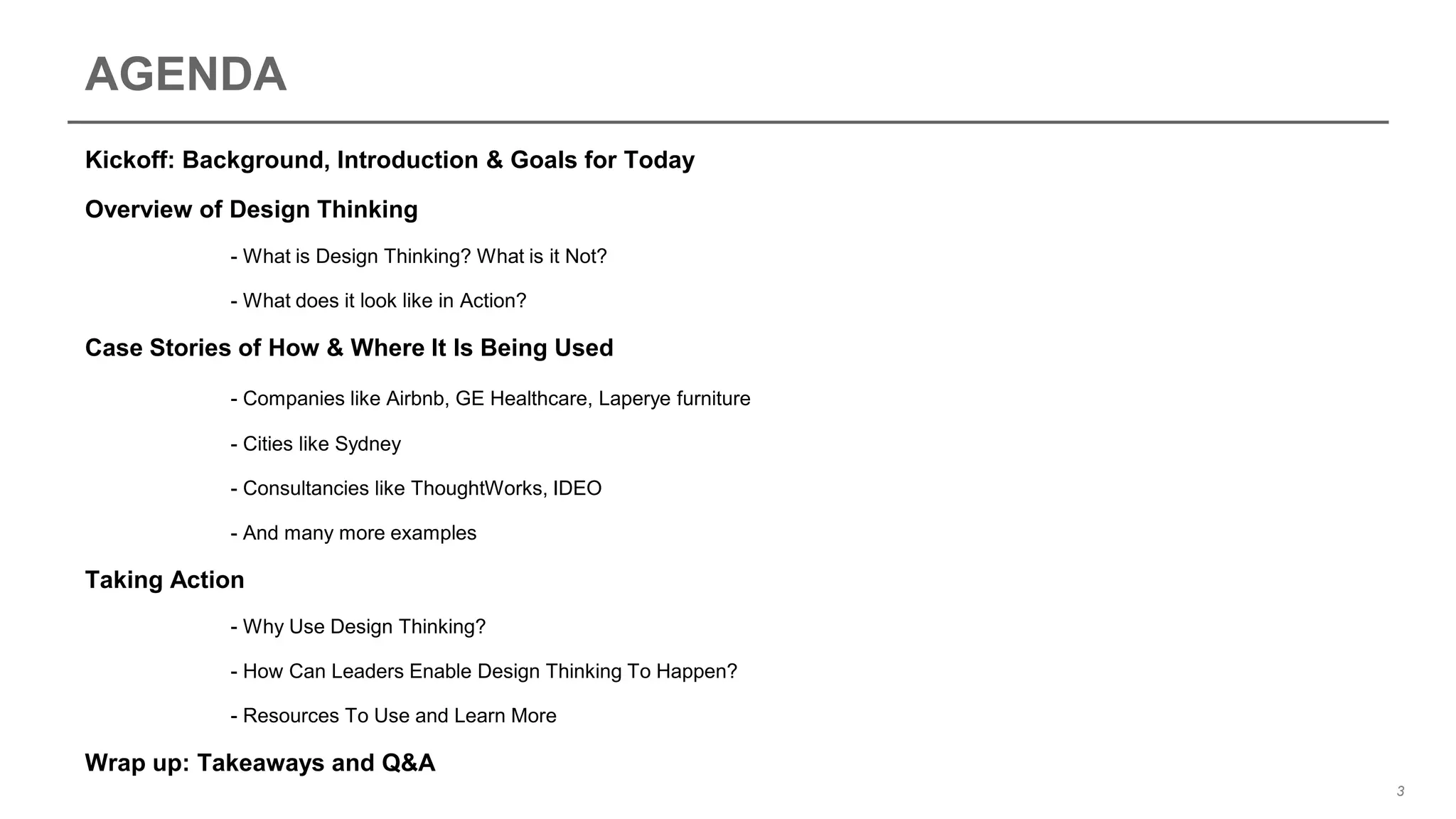
AGENDA
Kickoff: Background, Introduction & Goals for Today
Overview of Design Thinking
- What is Design Thinking? What is it Not?
- What does it look like in Action?
Case Stories of How & Where It Is Being Used
- Companies like Airbnb, GE Healthcare, Laperye furniture
- Cities like Sydney
- Consultancies like ThoughtWorks, IDEO
- And many more examples
Taking Action
- Why Use Design Thinking?
- How Can Leaders Enable Design Thinking To Happen?
- Resources To Use and Learn More
Wrap up: Takeaways and Q&A
3
TODAY’S WORKSHOP
• No laptops or phones
• Interactive discussion - Full participation
• Parking Lot
• Good is the enemy of great (time)
4
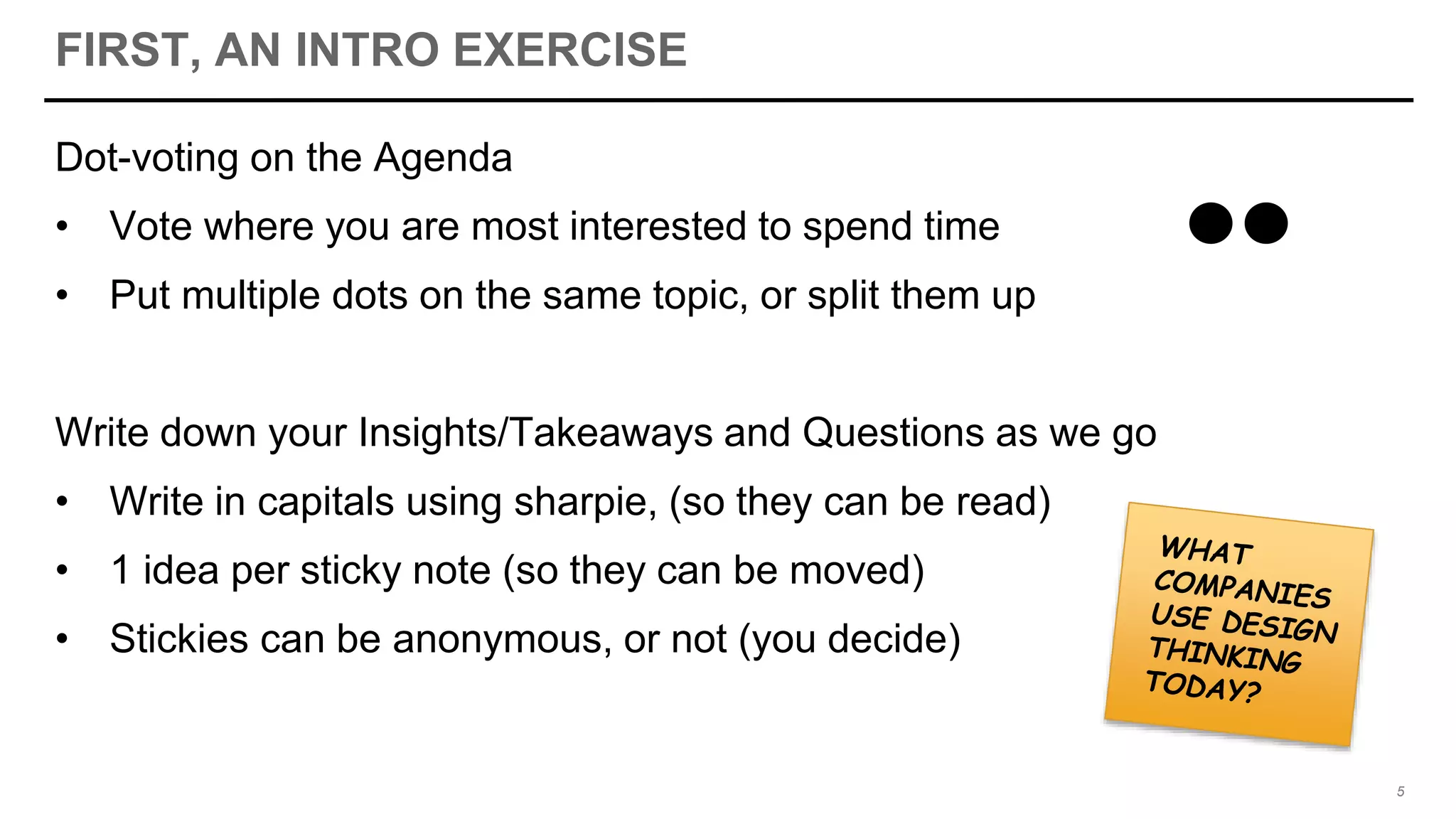
FIRST, AN INTRO EXERCISE
Dot-voting on the Agenda
• Vote where you are most interested to spend time
• Put multiple dots on the same topic, or split them up
Write down your Insights/Takeaways and Questions as we go
• Write in capitals using sharpie, (so they can be read)
• 1 idea per sticky note (so they can be moved)
• Stickies can be anonymous, or not (you decide)
5
Overview of
Design Thinking
Natalie Hollier, Product & Design Principal at ThoughtWorks
6
7
Tell me: What is design?
8
A solution to a problem or need,
within set constraints.
DESIGN IN CONTEXT
• Architects design living environments within the
constraints of space and material
• Civil engineers design infrastructure within the constraints
material
• Graphic artists at advertising agencies design messages
within the constraints of media
• City planners design public transport services within the
constraints of traffic and movement
9
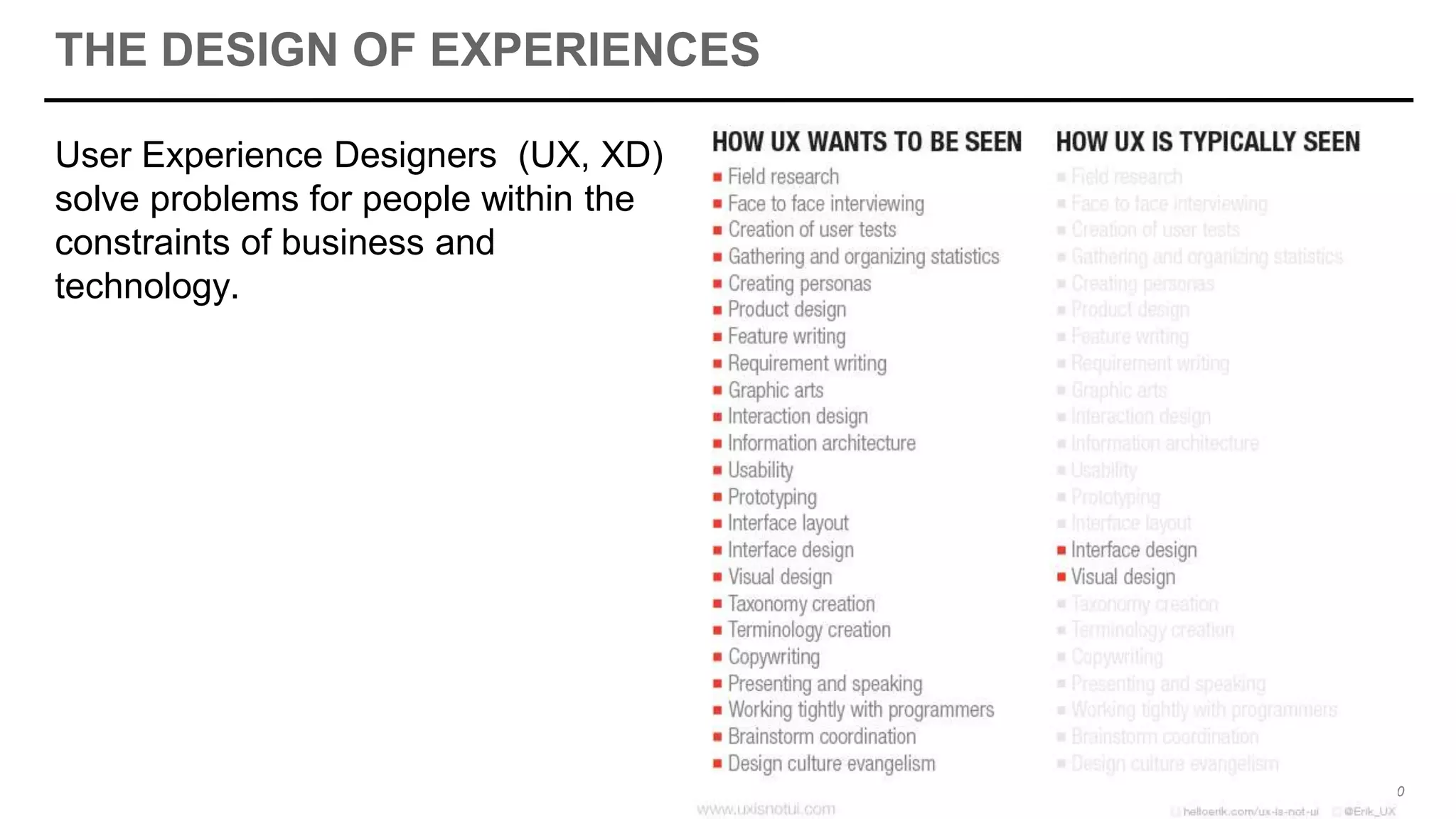
THE DESIGN OF EXPERIENCES
User Experience Designers (UX, XD)
solve problems for people within the
constraints of business and
technology.
10
EMBRACE CONSTRAINT
“When forced to work within a strict framework
the imagination is taxed to its utmost - and will
produce its richest ideas. Given total freedom
the work is likely to sprawl.” -T.S. Eliot
11
1
2
Tell me: What is design?
Design Thinking
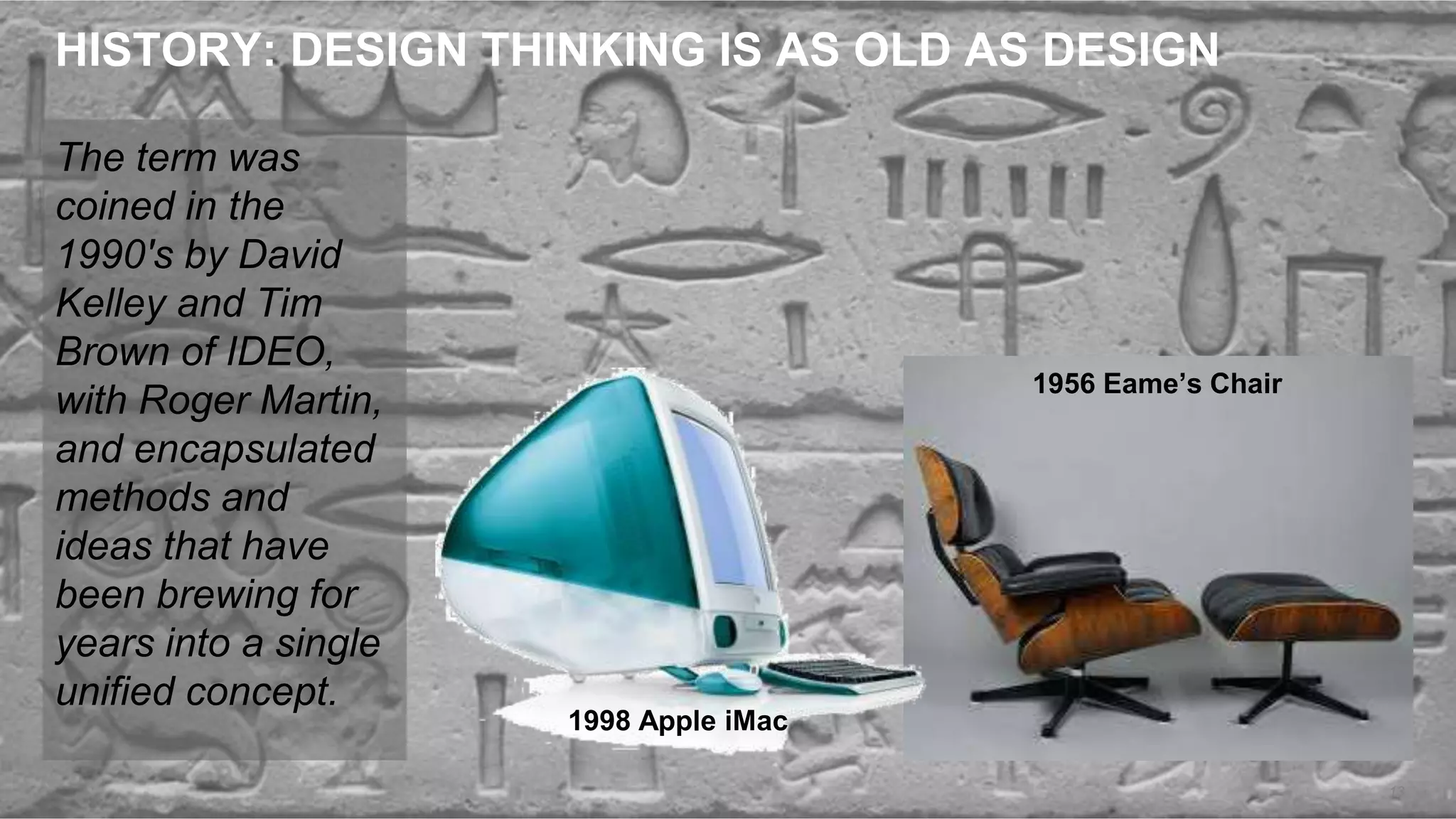
HISTORY: DESIGN THINKING IS AS OLD AS DESIGN
The term was
coined in the
1990's by David
Kelley and Tim
Brown of IDEO,
with Roger Martin,
and encapsulated
methods and
ideas that have
been brewing for
years into a single
unified concept.
13
1956 Eame’s Chair
1998 Apple iMac
Design Thinking is the discipline that uses
the designer’s sensibility and methods to
match people’s needs with what is
technologically feasible and what a viable
business strategy can convert into
customer value and market opportunity.
Tim Brown, IDEO
The mission of design thinking is to
translate observations into insights and
insights into products and services that
will improve lives.
Tim Brown, CEO IDEO
Change by Design
HOW?
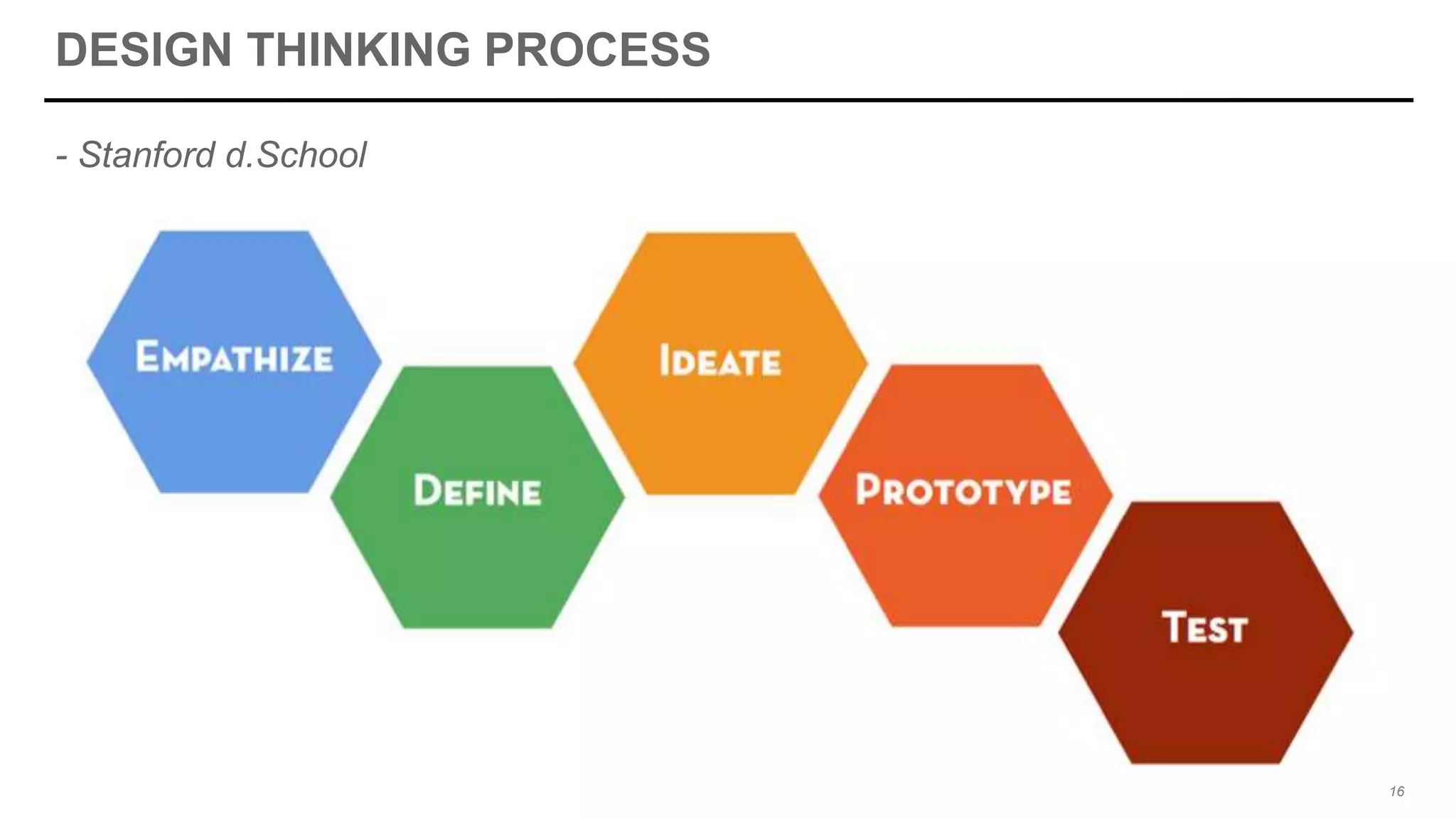
DESIGN THINKING PROCESS
- Stanford d.School
16
1
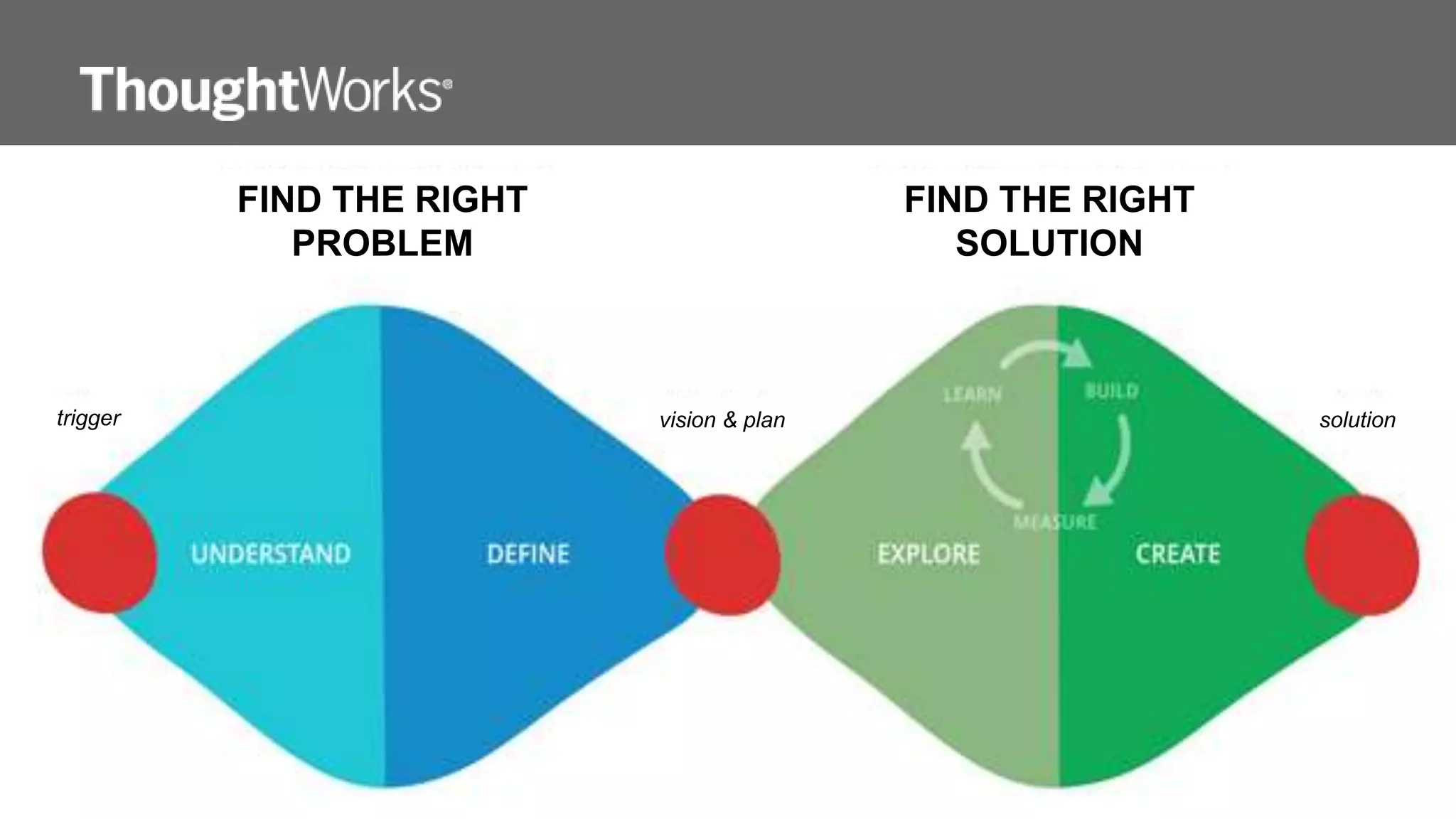
FIND THE RIGHT
PROBLEM
FIND THE RIGHT
SOLUTION
trigger vision & plan solution
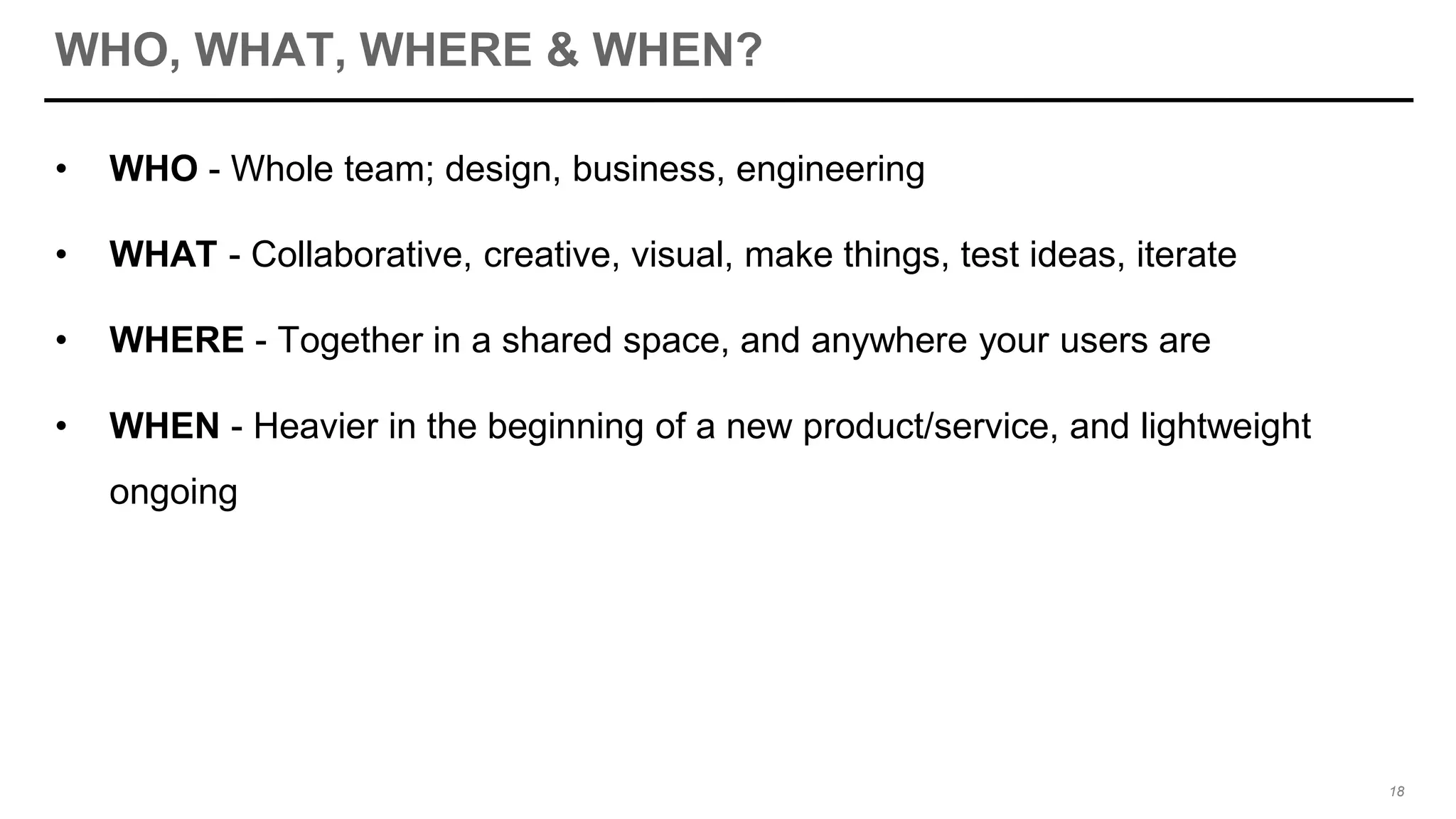
WHO, WHAT, WHERE & WHEN?
• WHO - Whole team; design, business, engineering
• WHAT - Collaborative, creative, visual, make things, test ideas, iterate
• WHERE - Together in a shared space, and anywhere your users are
• WHEN - Heavier in the beginning of a new product/service, and lightweight
ongoing
18
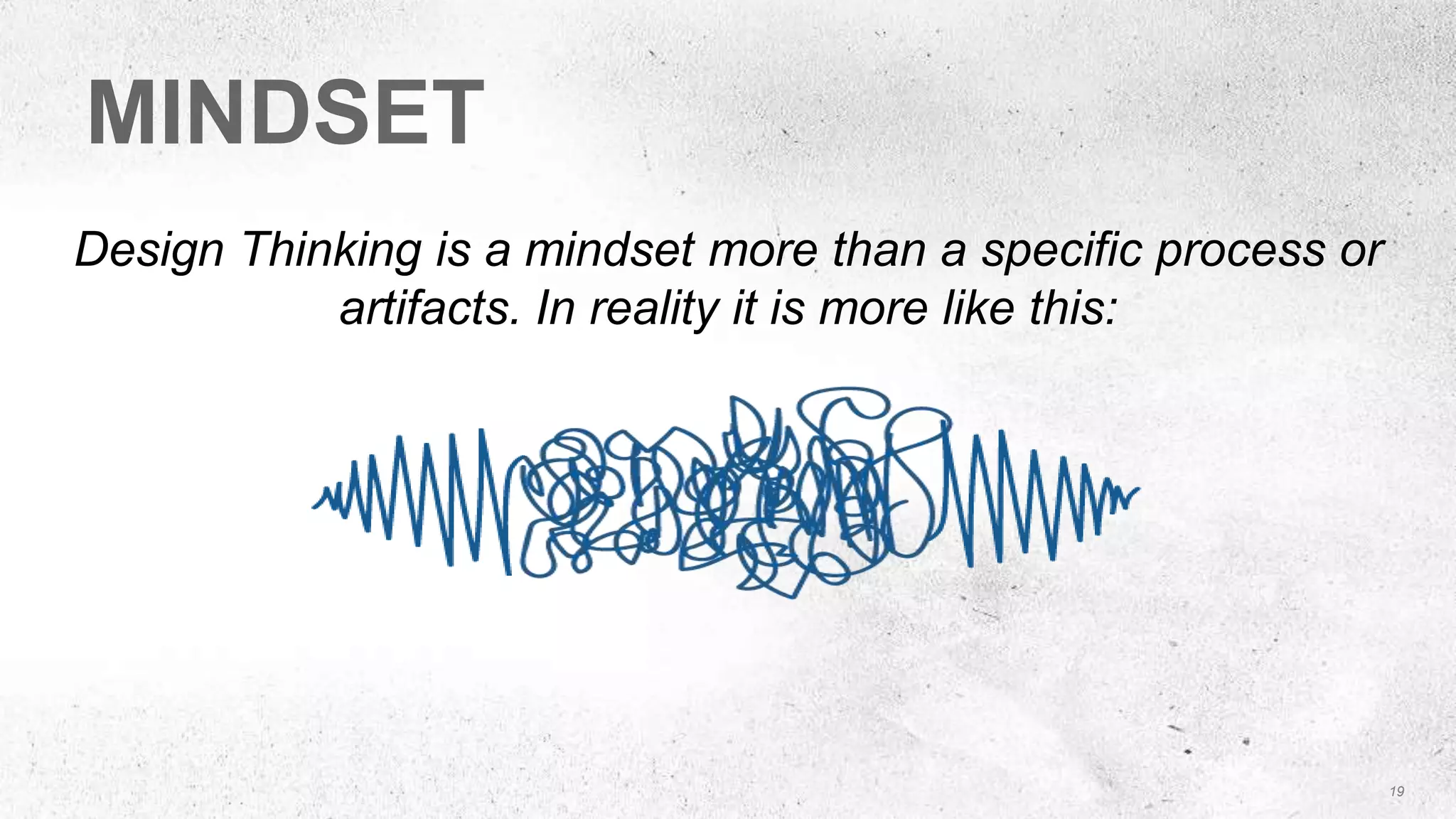
MINDSET
Design Thinking is a mindset more than a specific process or
artifacts. In reality it is more like this:
19
WHAT DESIGN THINKING IS NOT
• Workshops with sticky notes
• Creating design artifacts
• Only for designers
• Only for products (or only for services)
• Lean, Agile or Waterfall methods – it can be independent of or
combined with any development methodology
20
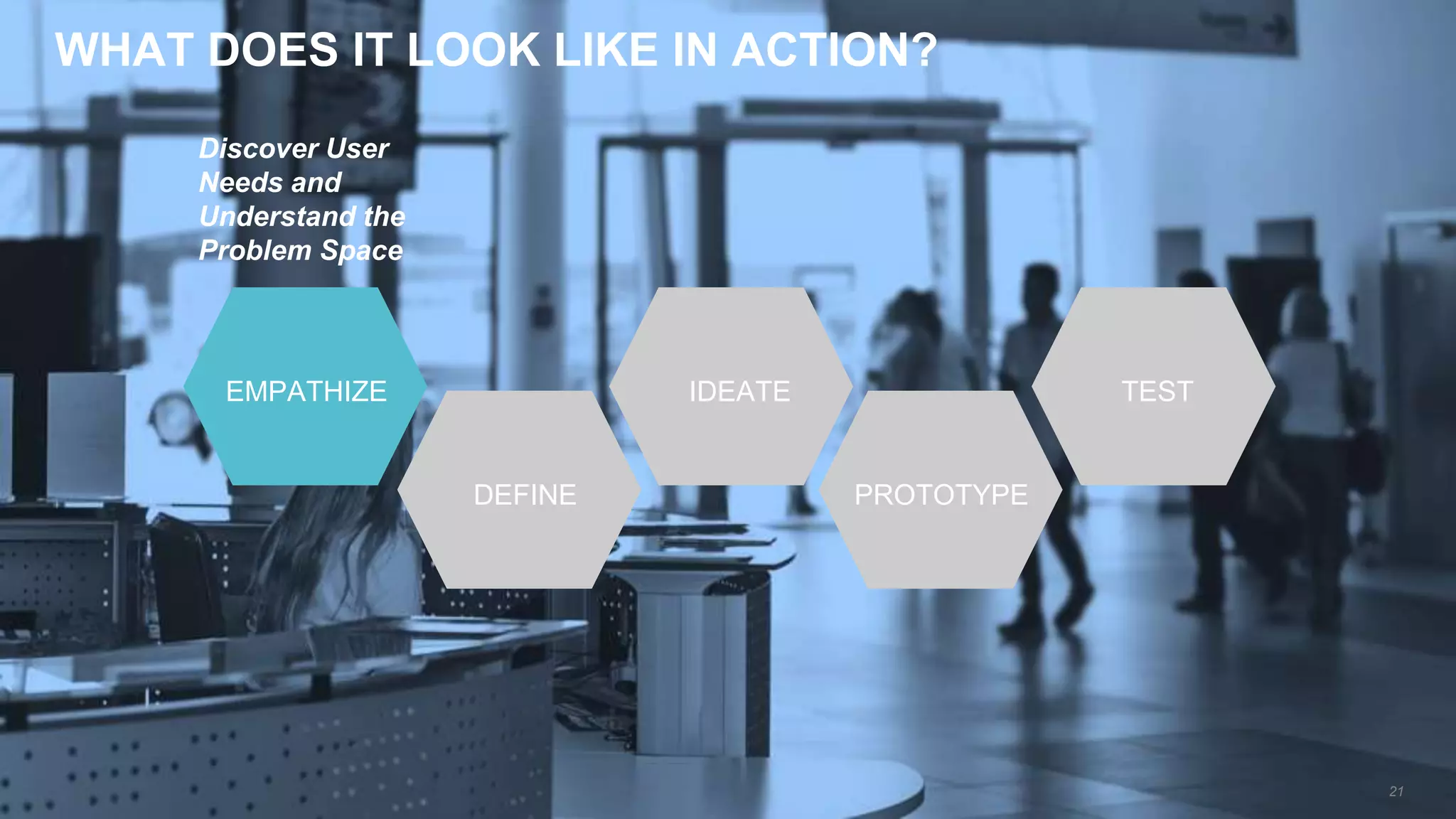
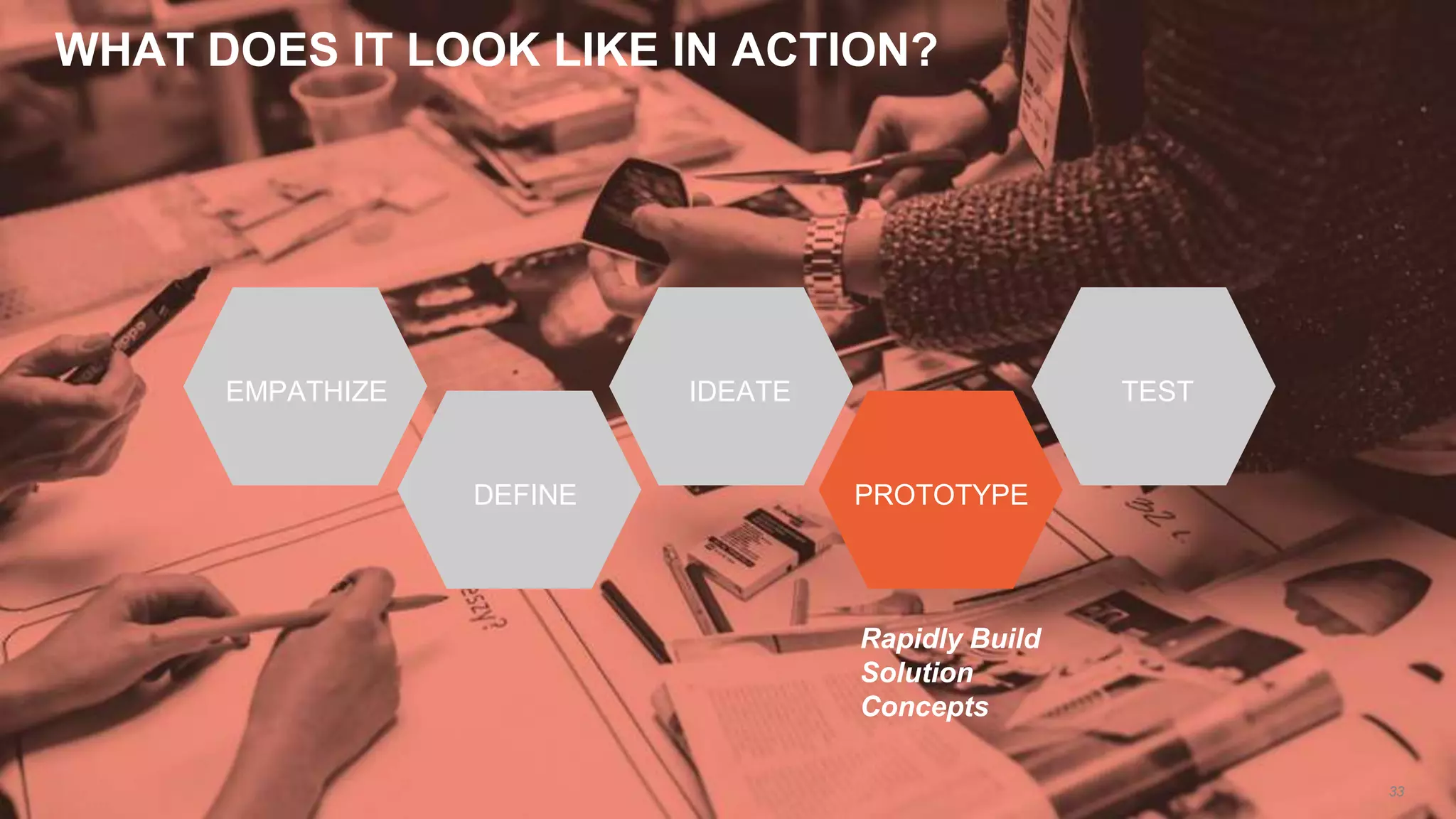
WHAT DOES IT LOOK LIKE IN ACTION?
21
EMPATHIZE
DEFINE
IDEATE
PROTOTYPE
TEST
Discover User
Needs and
Understand the
Problem Space
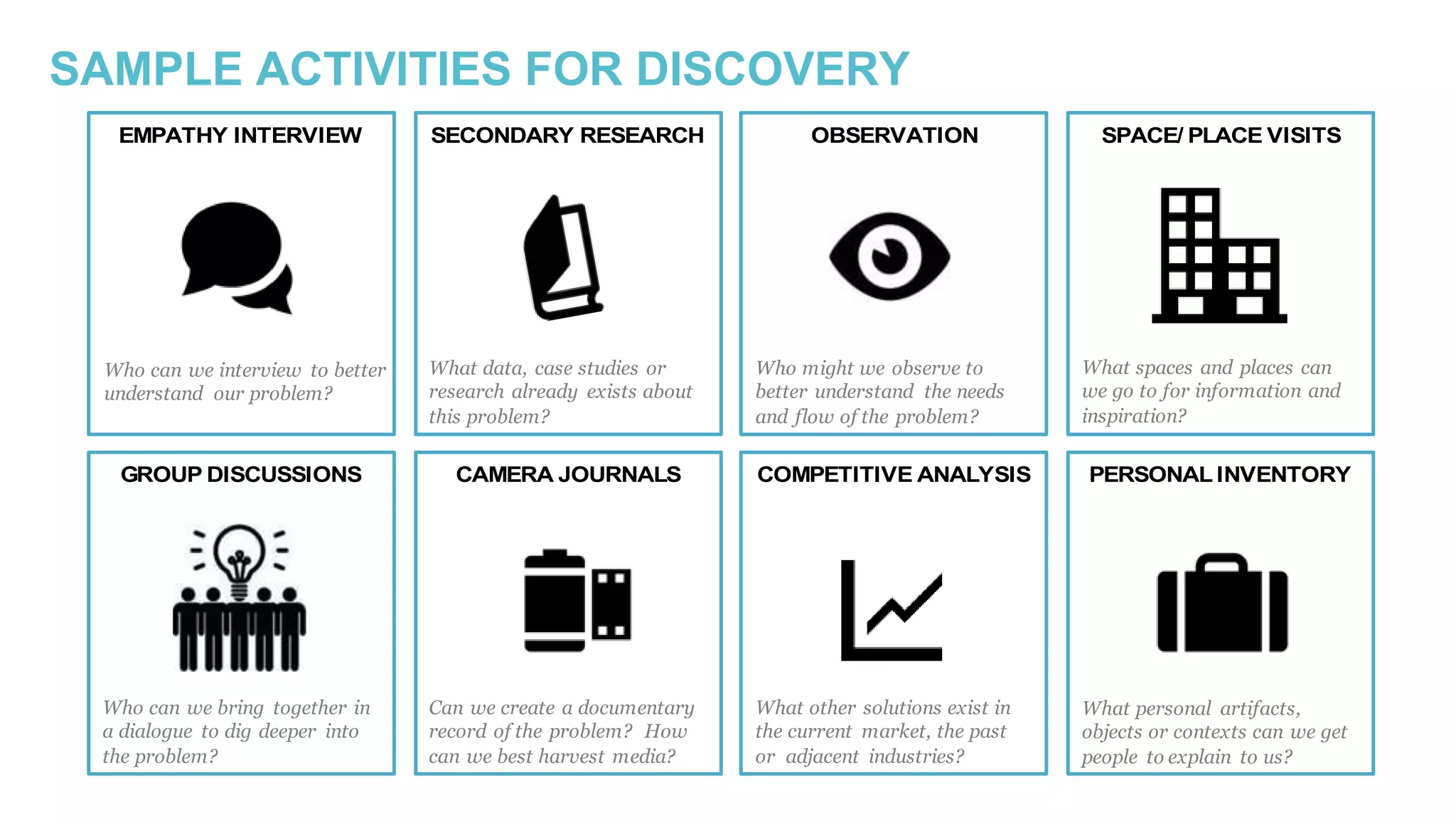
SAMPLE ACTIVITIES FOR DISCOVERY
EMPATHY INTERVIEW
GROUP DISCUSSIONS
SECONDARY RESEARCH
COMPETITIVE ANALYSIS PERSONAL INVENTORY
OBSERVATION SPACE/ PLACE VISITS
CAMERA JOURNALS
Who can we interview to better
understand our problem?
What data, case studies or
research already exists about
this problem?
Who might we observe to
better understand the needs
and flow of the problem?
What spaces and places can
we go to for information and
inspiration?
Who can we bring together in
a dialogue to dig deeper into
the problem?
Can we create a documentary
record of the problem? How
can we best harvest media?
What other solutions exist in
the current market, the past
or adjacent industries?
What personal artifacts,
objects or contexts can we get
people to explain to us?
LOW-BARRIER ACTIVITIES
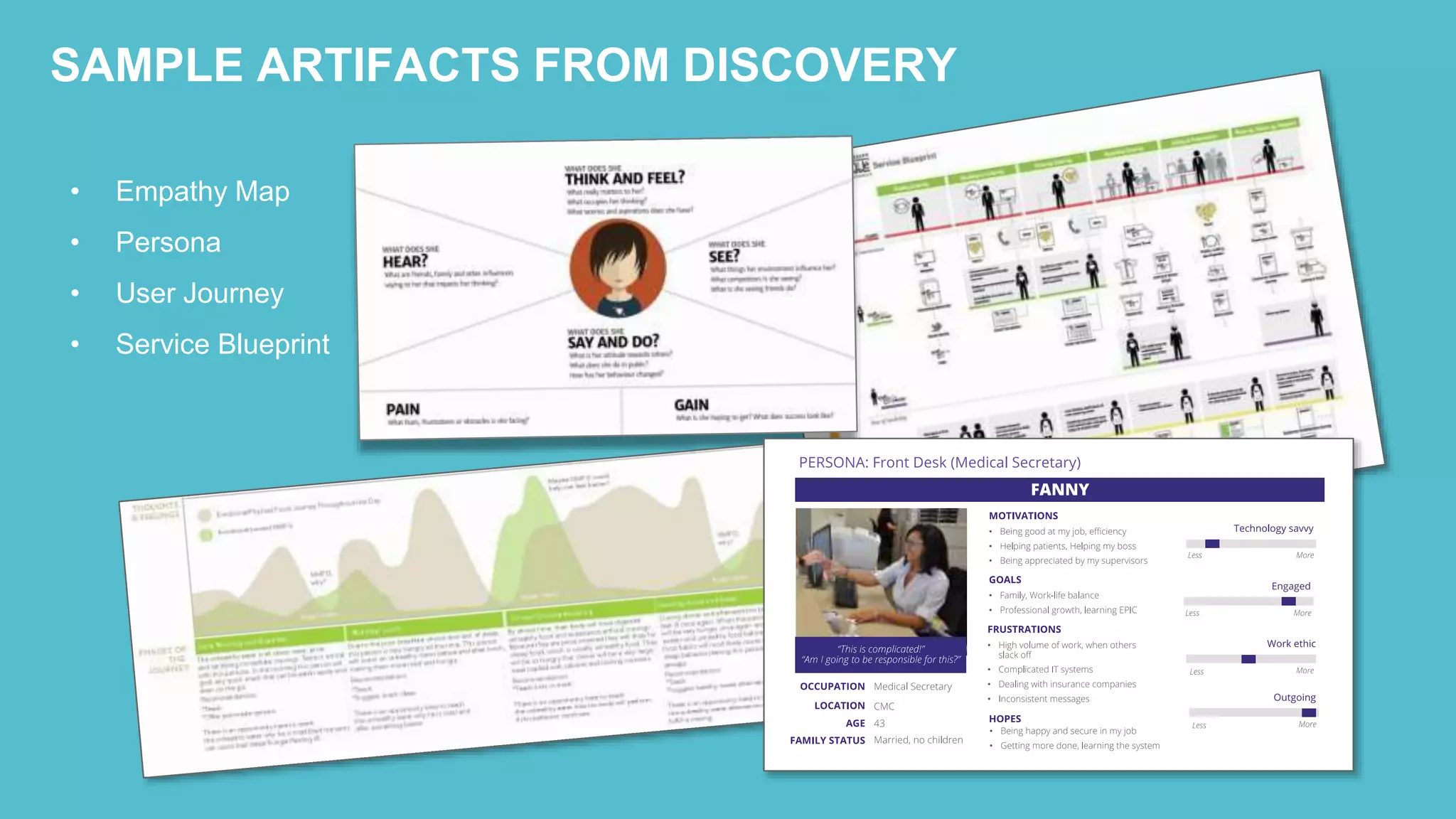
SAMPLE ARTIFACTS FROM DISCOVERY
• Empathy Map
• Persona
• User Journey
• Service Blueprint
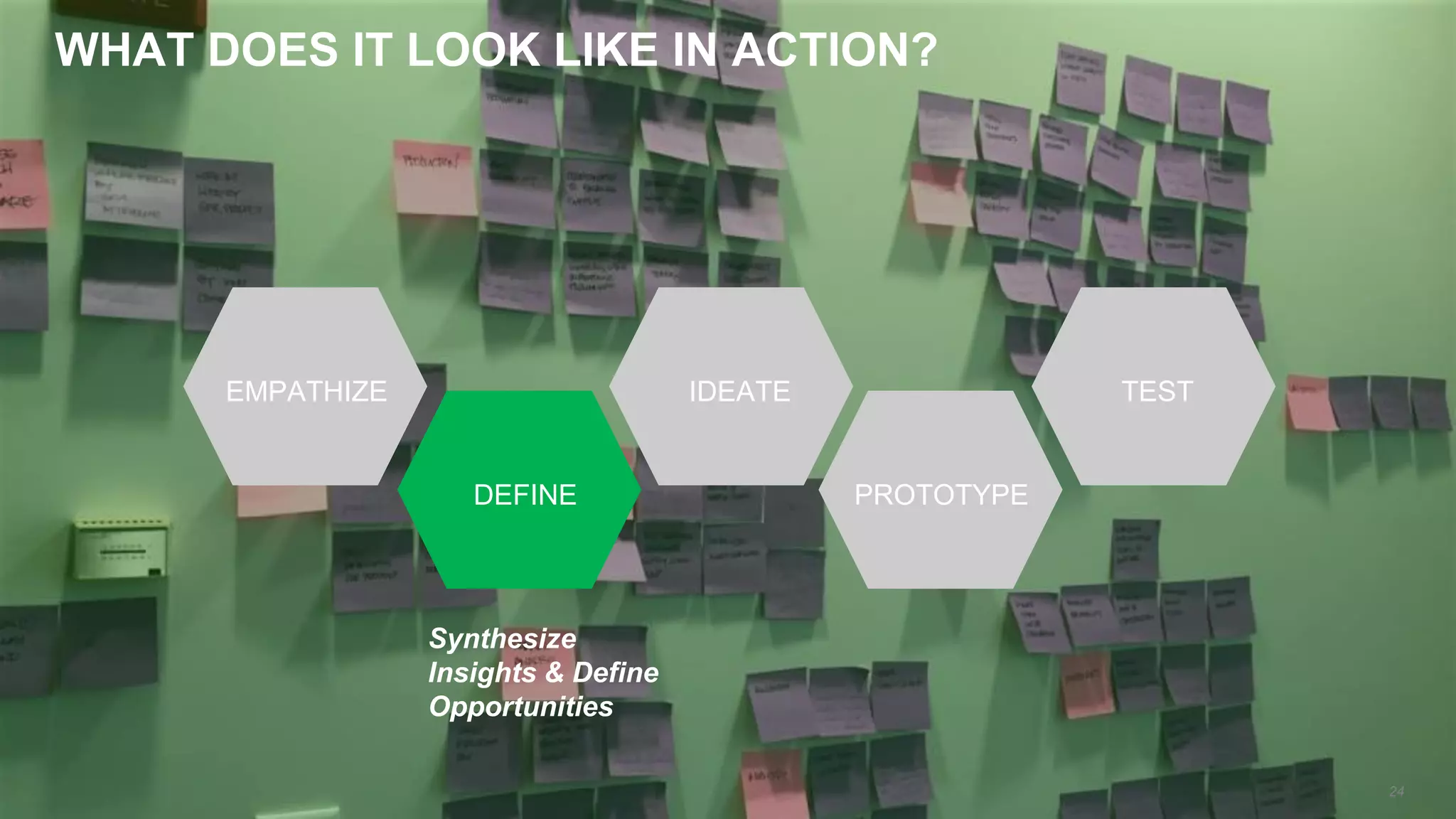
WHAT DOES IT LOOK LIKE IN ACTION?
24
EMPATHIZE
DEFINE
IDEATE
PROTOTYPE
TEST
Synthesize
Insights & Define
Opportunities
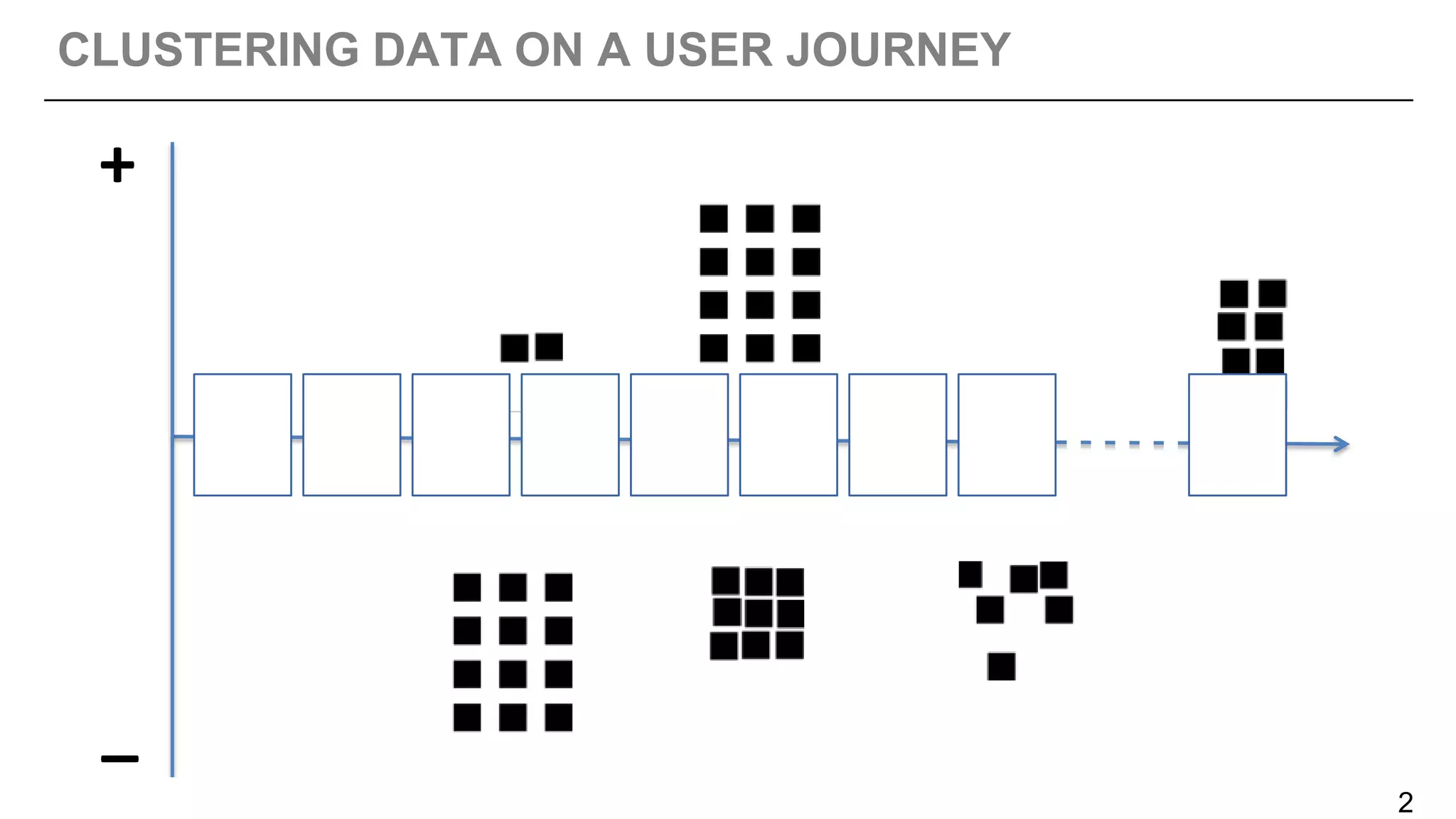
CLUSTERING DATA ON A USER JOURNEY
ENTICE ENTER ENGAGE EXIT EXTEND
CUSTOMER JOURNEY MAP
+
_
2
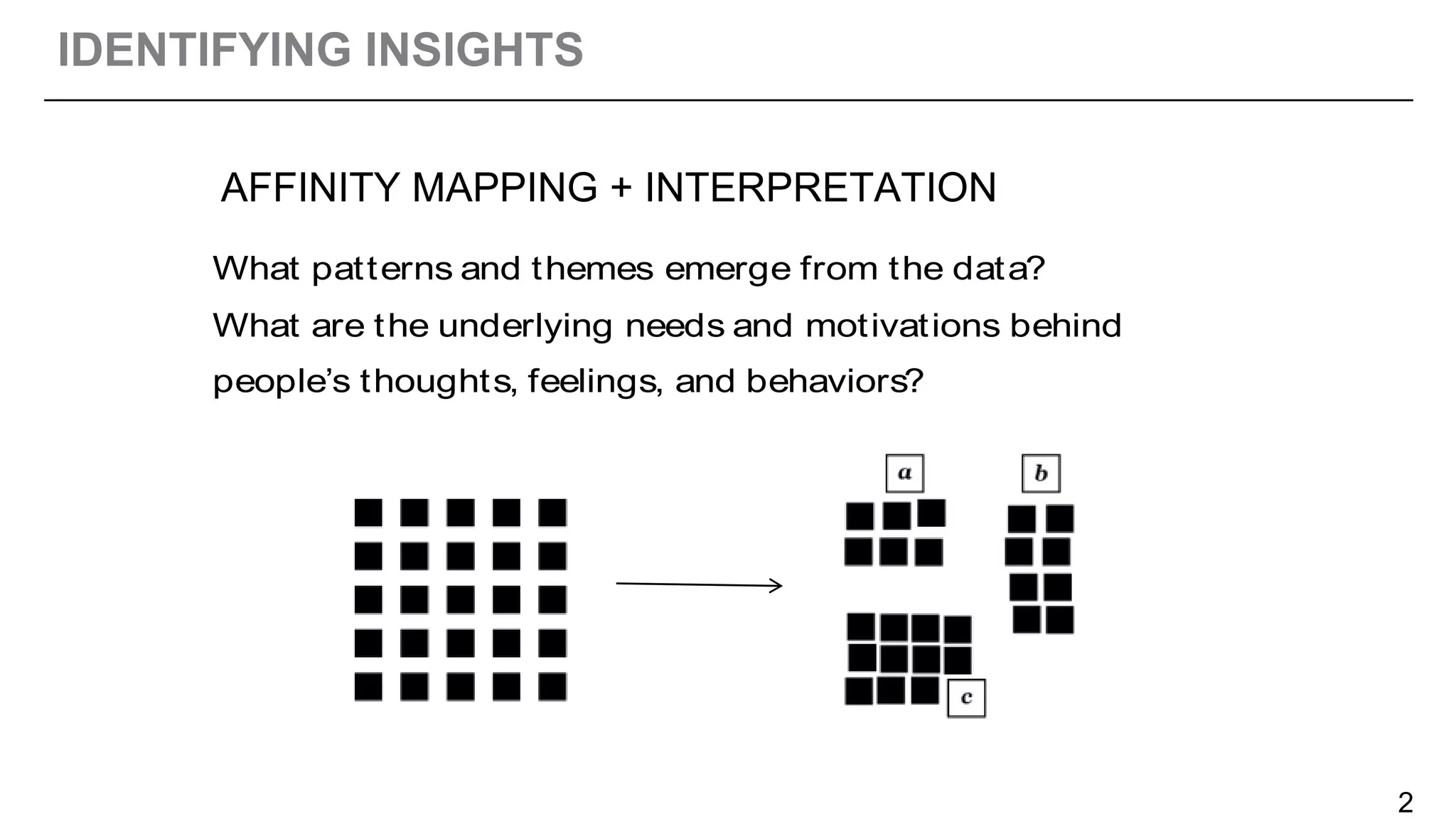
IDENTIFYING INSIGHTS
INSIGHTS IN THE DATA
Cluster + Interpret
What patterns and themes emerge from the data?
What are the underlying needs and motivations behind
people’s thoughts, feelings, and behaviors?
2
AFFINITY MAPPING + INTERPRETATION
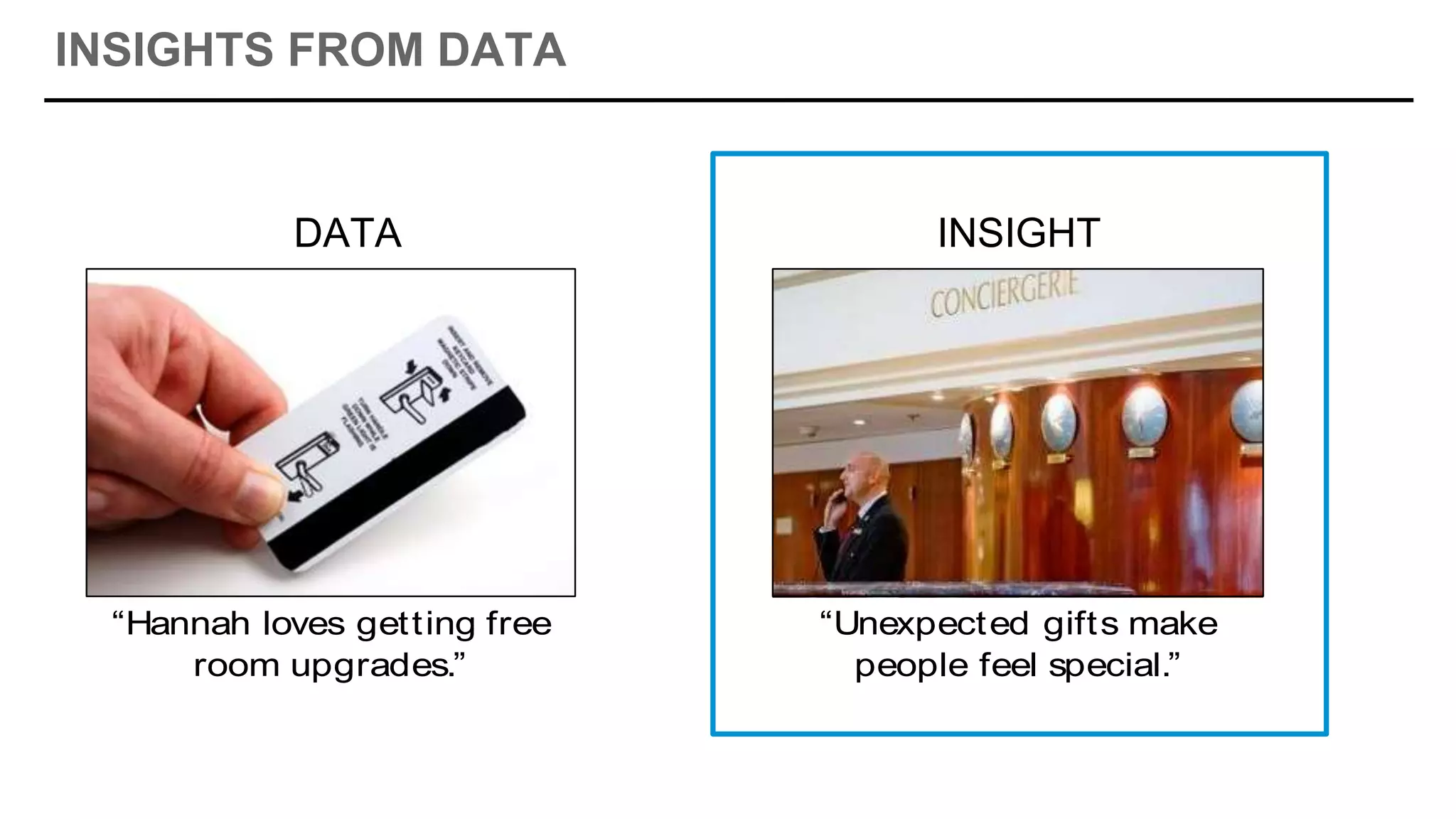
INSIGHTS FROM DATA
DATA VS. NEEDS
DATA NEED
“Hannah loves getting free
room upgrades.”
“Unexpected gifts make
people feel special.”
DATA INSIGHT
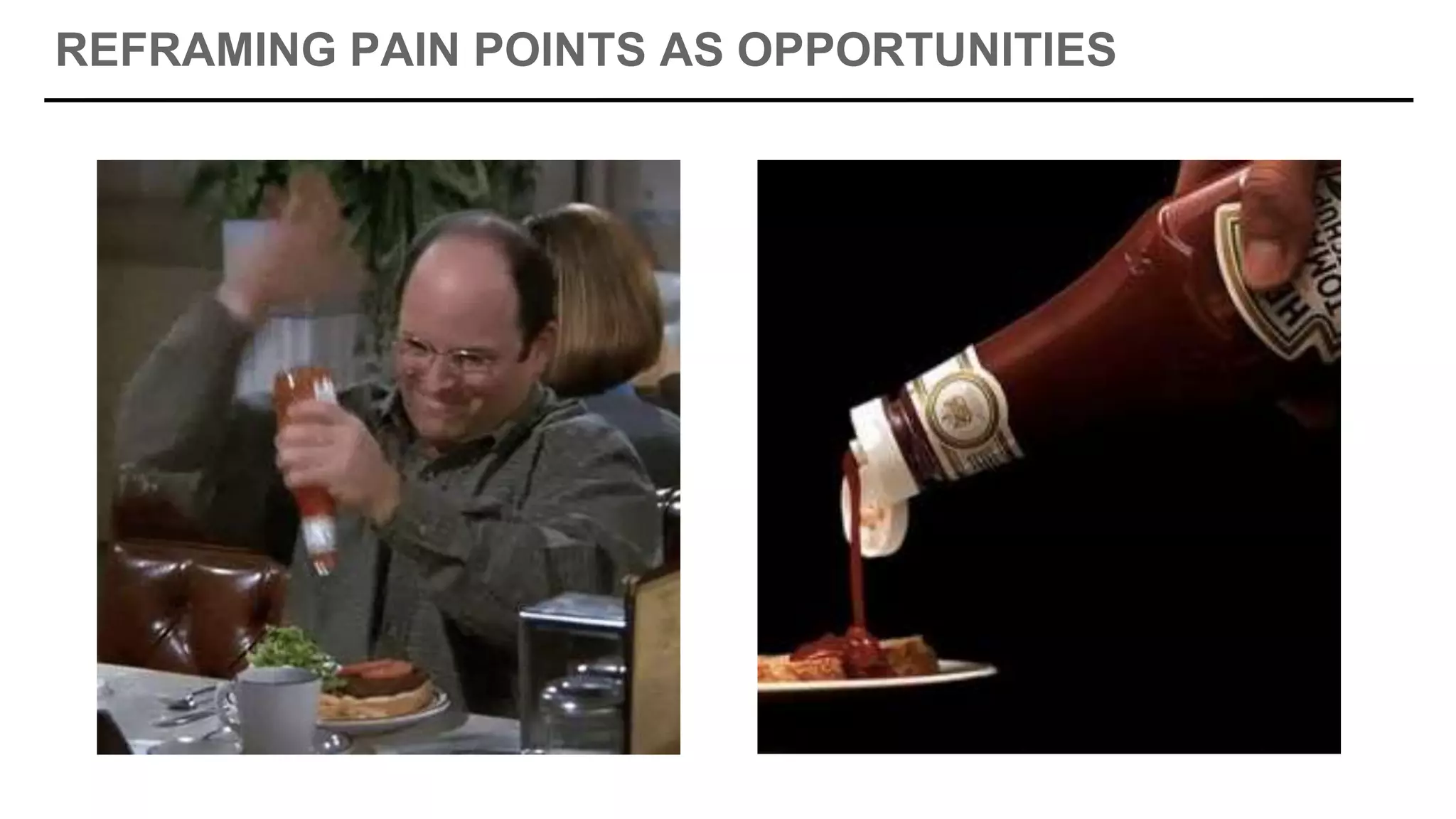
REFRAMING PAIN POINTS AS OPPORTUNITIES
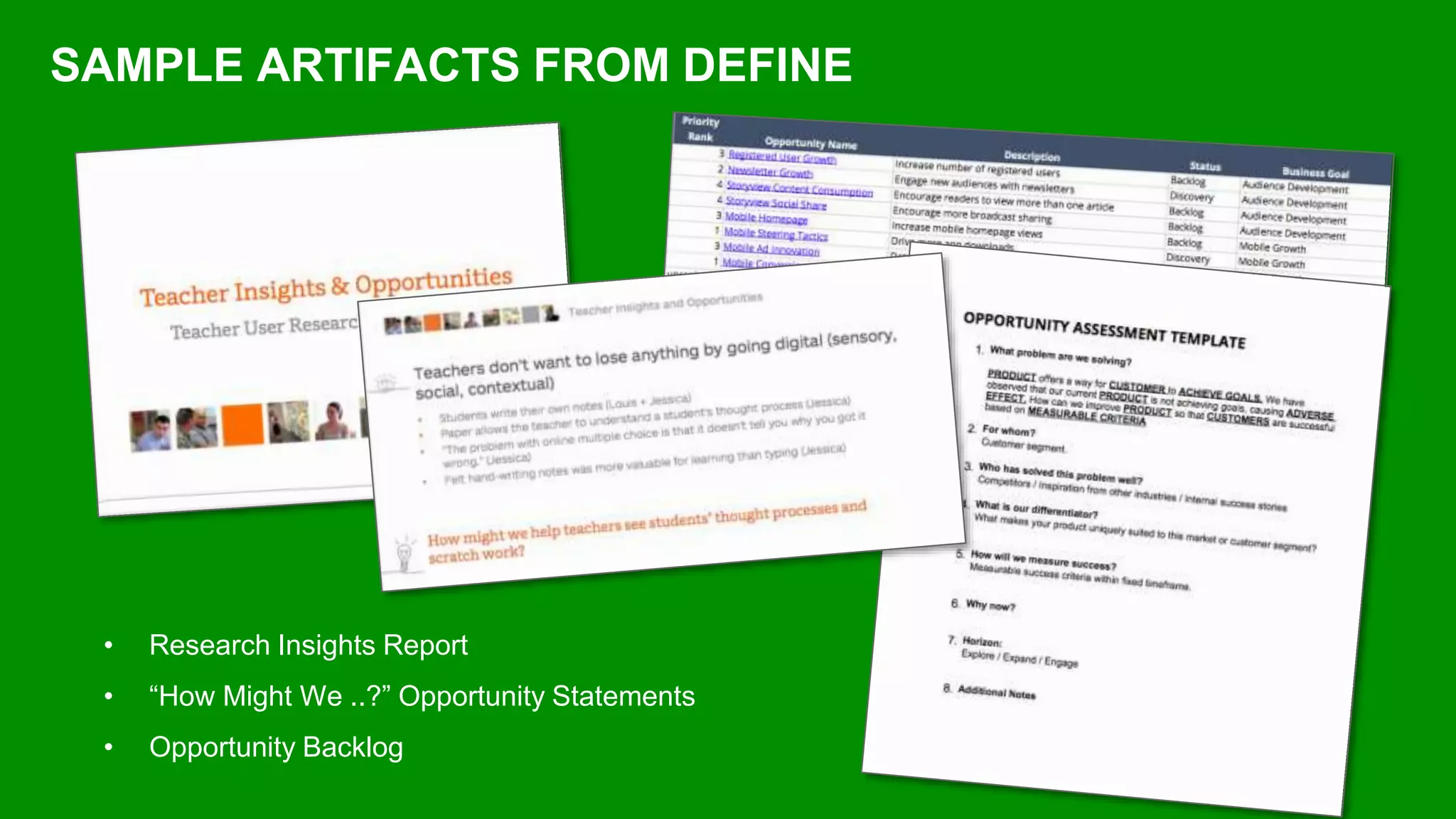
SAMPLE ARTIFACTS FROM DEFINE
• Research Insights Report
• “How Might We ..?” Opportunity Statements
• Opportunity Backlog
WHAT DOES IT LOOK LIKE IN ACTION?
30
EMPATHIZE
DEFINE
IDEATE
PROTOTYPE
TEST
Divergent
Ideation of
Solution
Concepts
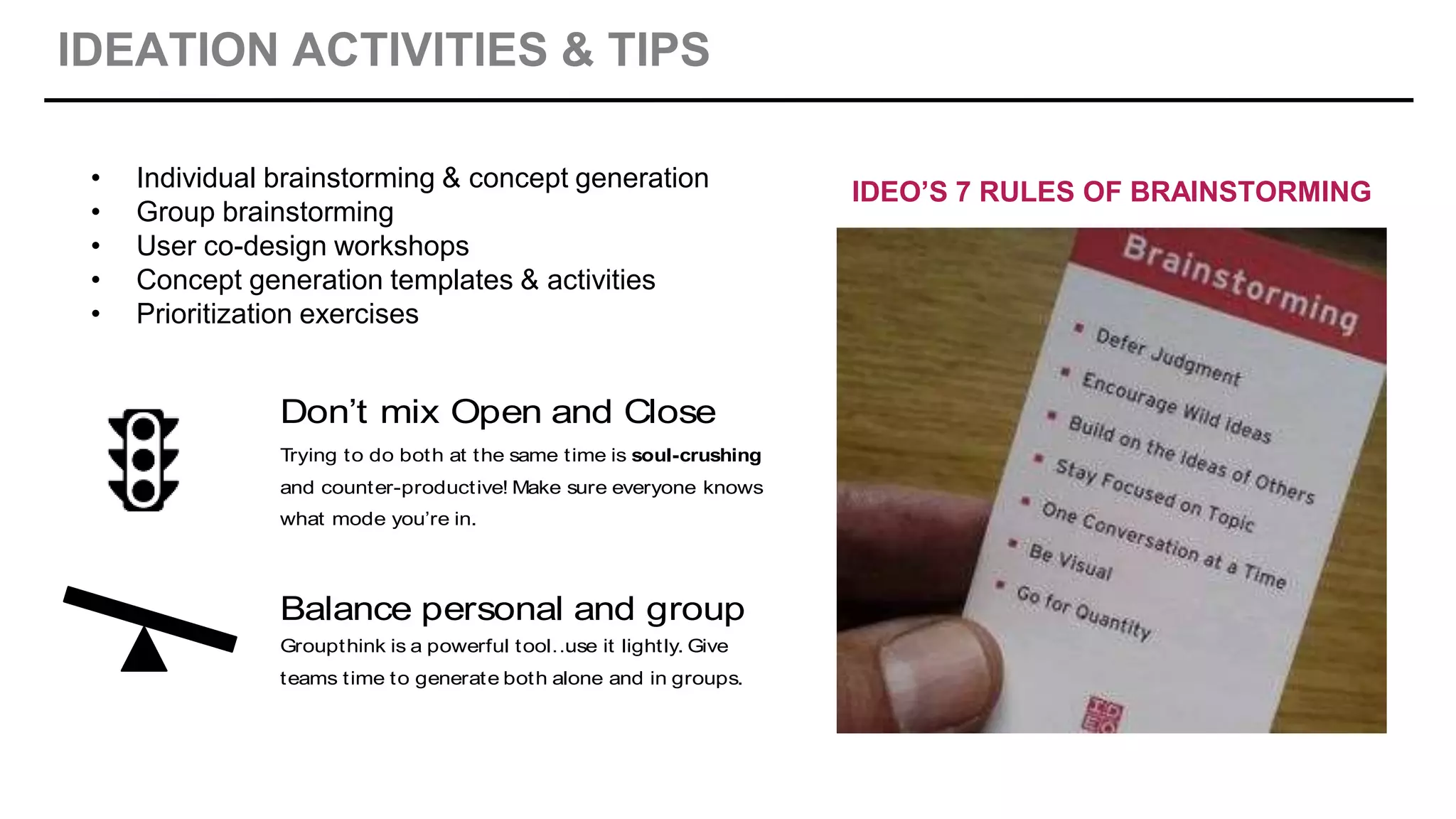
IDEATION ACTIVITIES & TIPS
IDEATE: TIPS
Don’t mix Open and Close
Trying to do both at the same time is soul-crushing
and counter-productive! Make sure everyone knows
what mode you’re in.
Balance personal and group
Groupthink is a powerful tool…use it lightly. Give
teams time to generate both alone and in groups.
• Individual brainstorming & concept generation
• Group brainstorming
• User co-design workshops
• Concept generation templates & activities
• Prioritization exercises
IDEO’S 7 RULES OF BRAINSTORMING
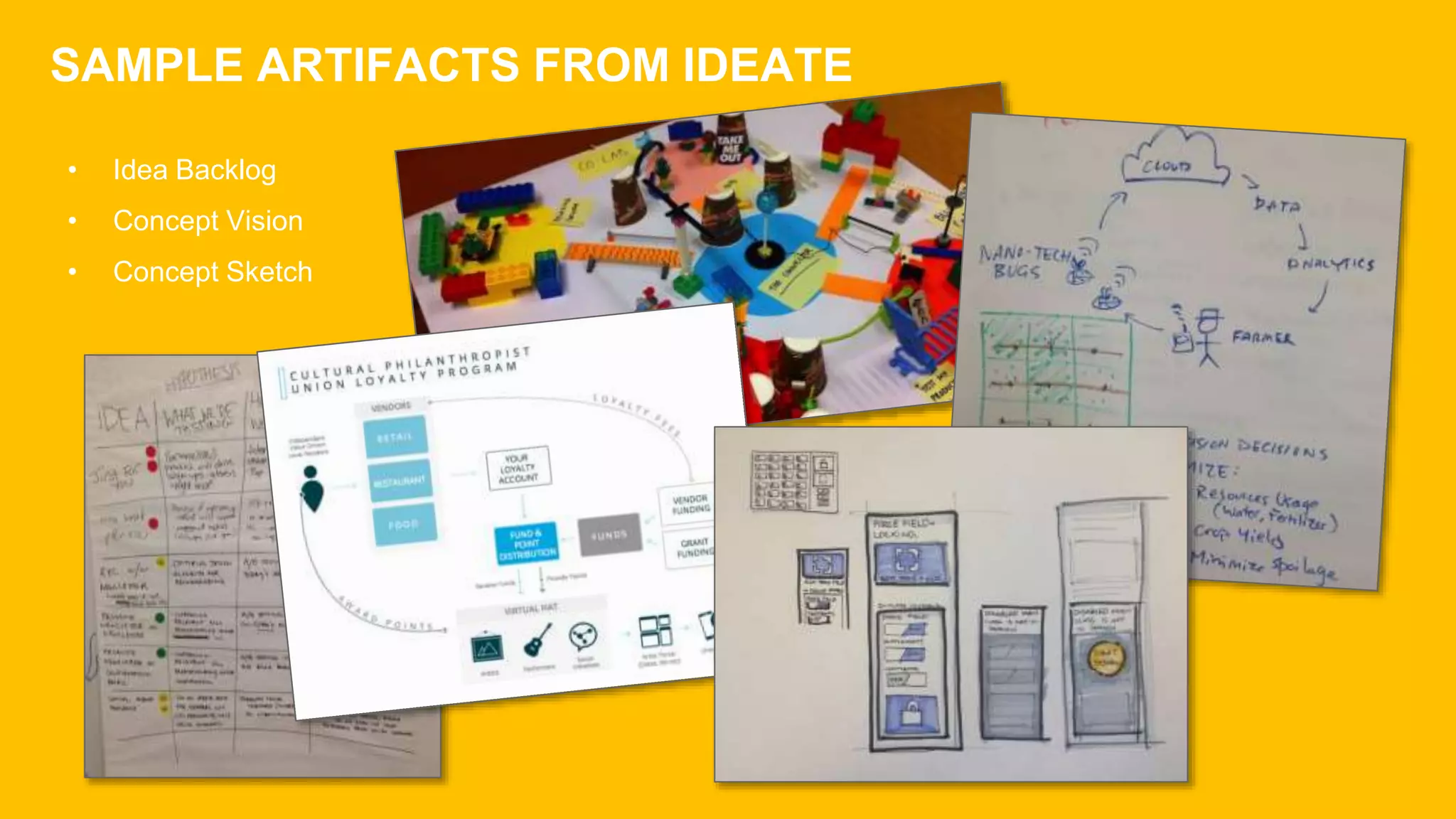
SAMPLE ARTIFACTS FROM IDEATE
• Idea Backlog
• Concept Vision
• Concept Sketch
@thedesigngym
WHAT DOES IT LOOK LIKE IN ACTION?
33
EMPATHIZE
DEFINE
IDEATE
PROTOTYPE
TEST
Rapidly Build
Solution
Concepts
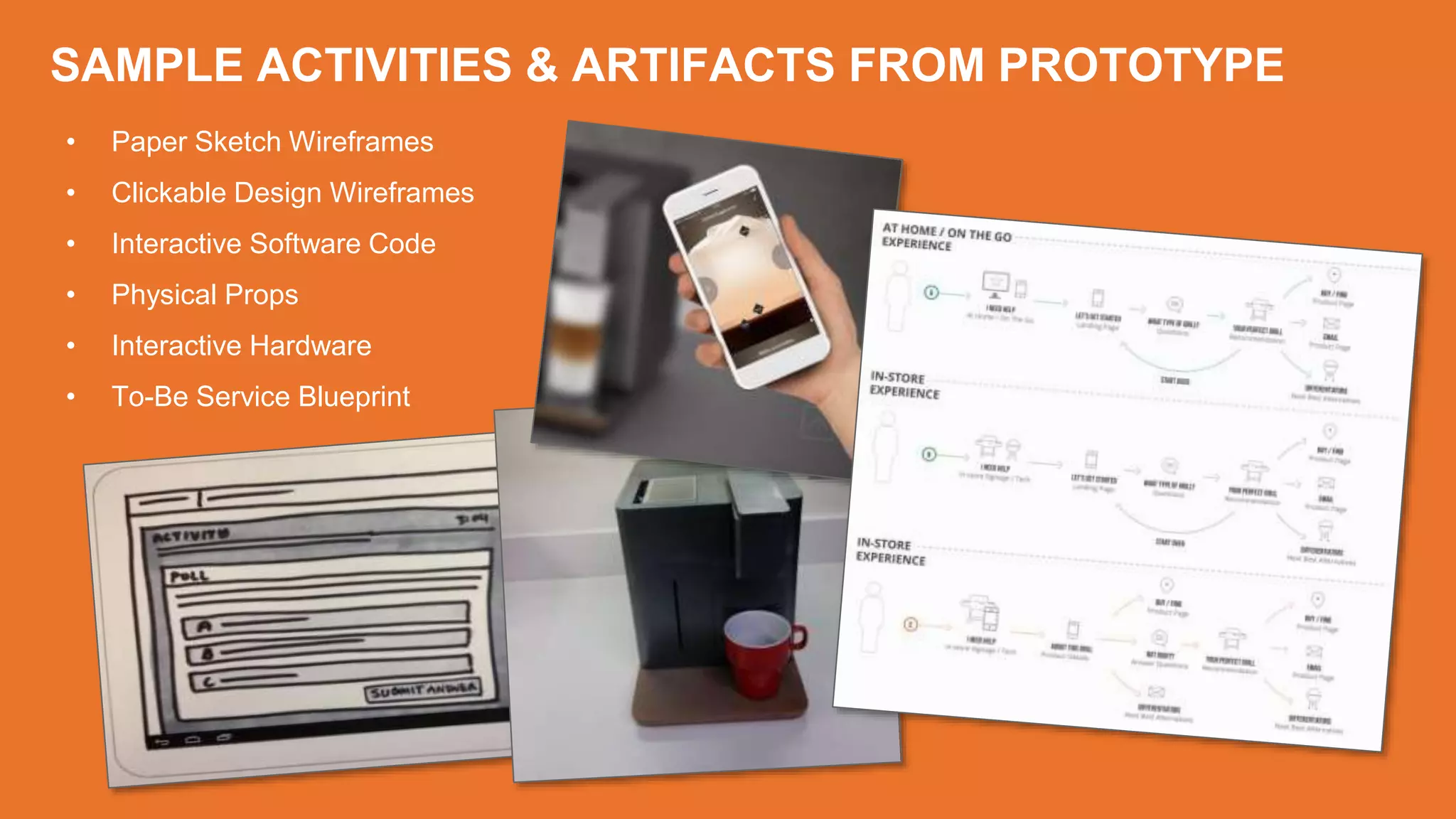
SAMPLE ACTIVITIES & ARTIFACTS FROM PROTOTYPE
• Paper Sketch Wireframes
• Clickable Design Wireframes
• Interactive Software Code
• Physical Props
• Interactive Hardware
• To-Be Service Blueprint
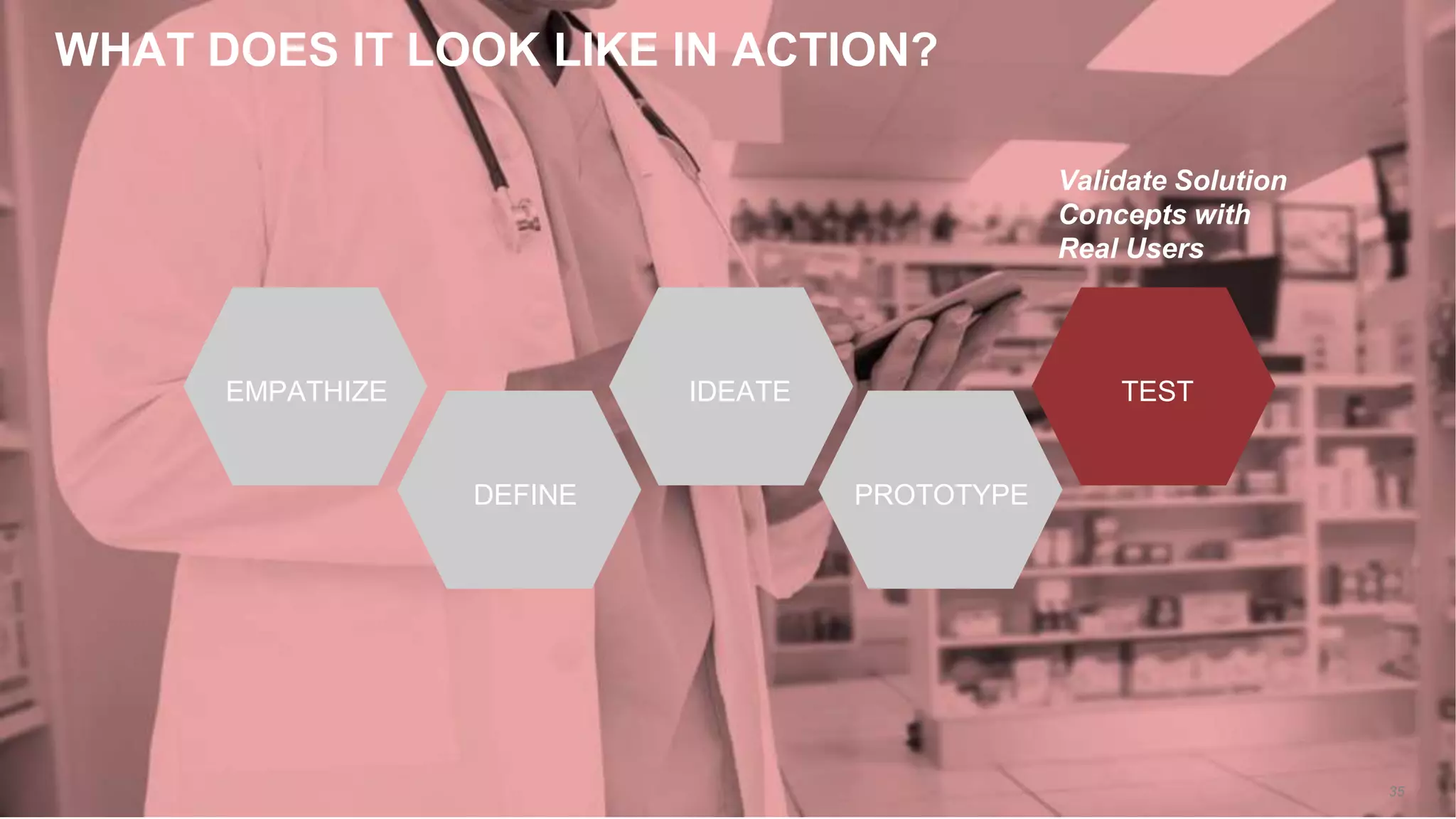
WHAT DOES IT LOOK LIKE IN ACTION?
35
EMPATHIZE
DEFINE
IDEATE
PROTOTYPE
TEST
Validate Solution
Concepts with
Real Users
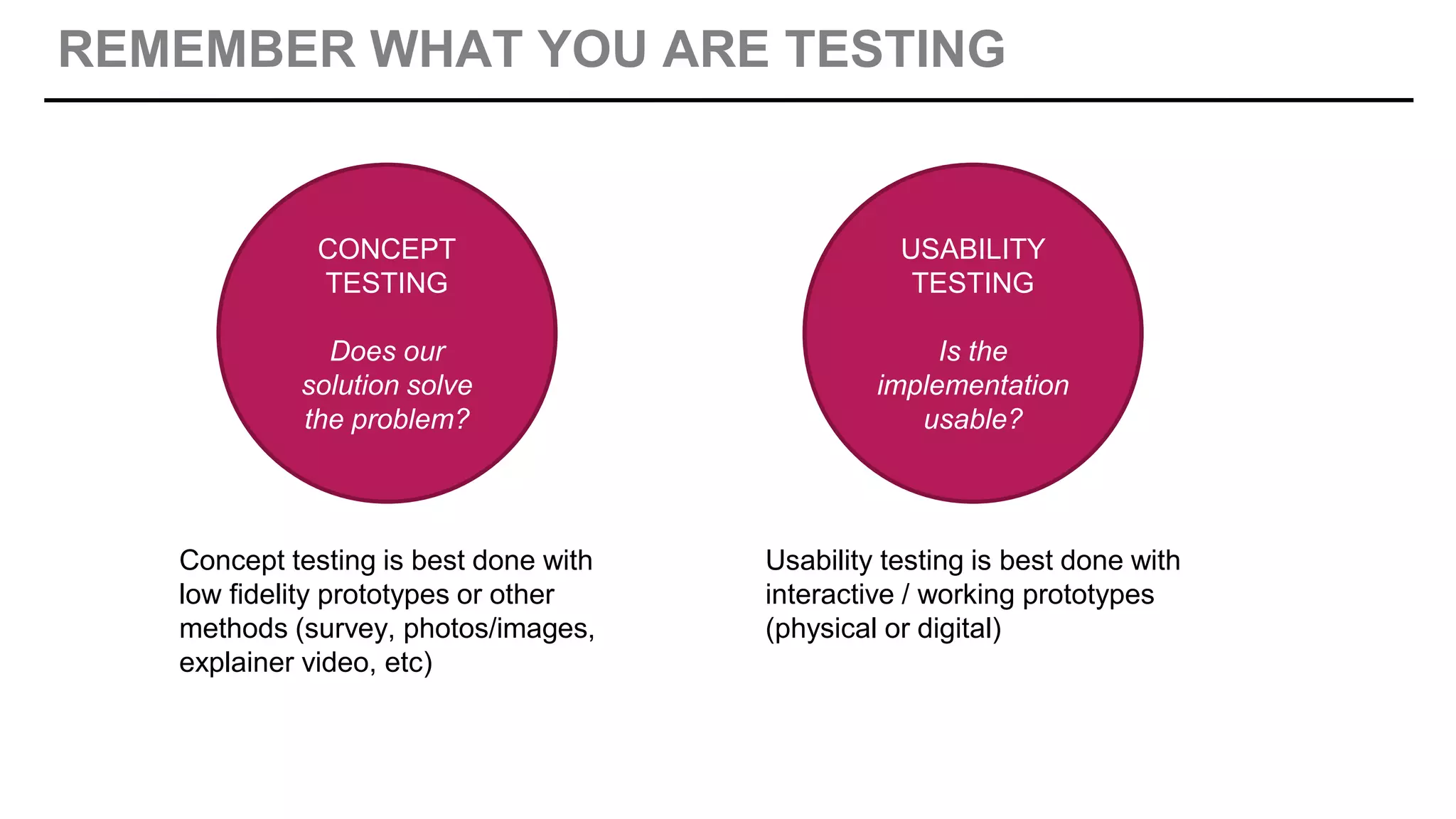
REMEMBER WHAT YOU ARE TESTING
CONCEPT
TESTING
Does our
solution solve
the problem?
USABILITY
TESTING
Is the
implementation
usable?
Concept testing is best done with
low fidelity prototypes or other
methods (survey, photos/images,
explainer video, etc)
Usability testing is best done with
interactive / working prototypes
(physical or digital)
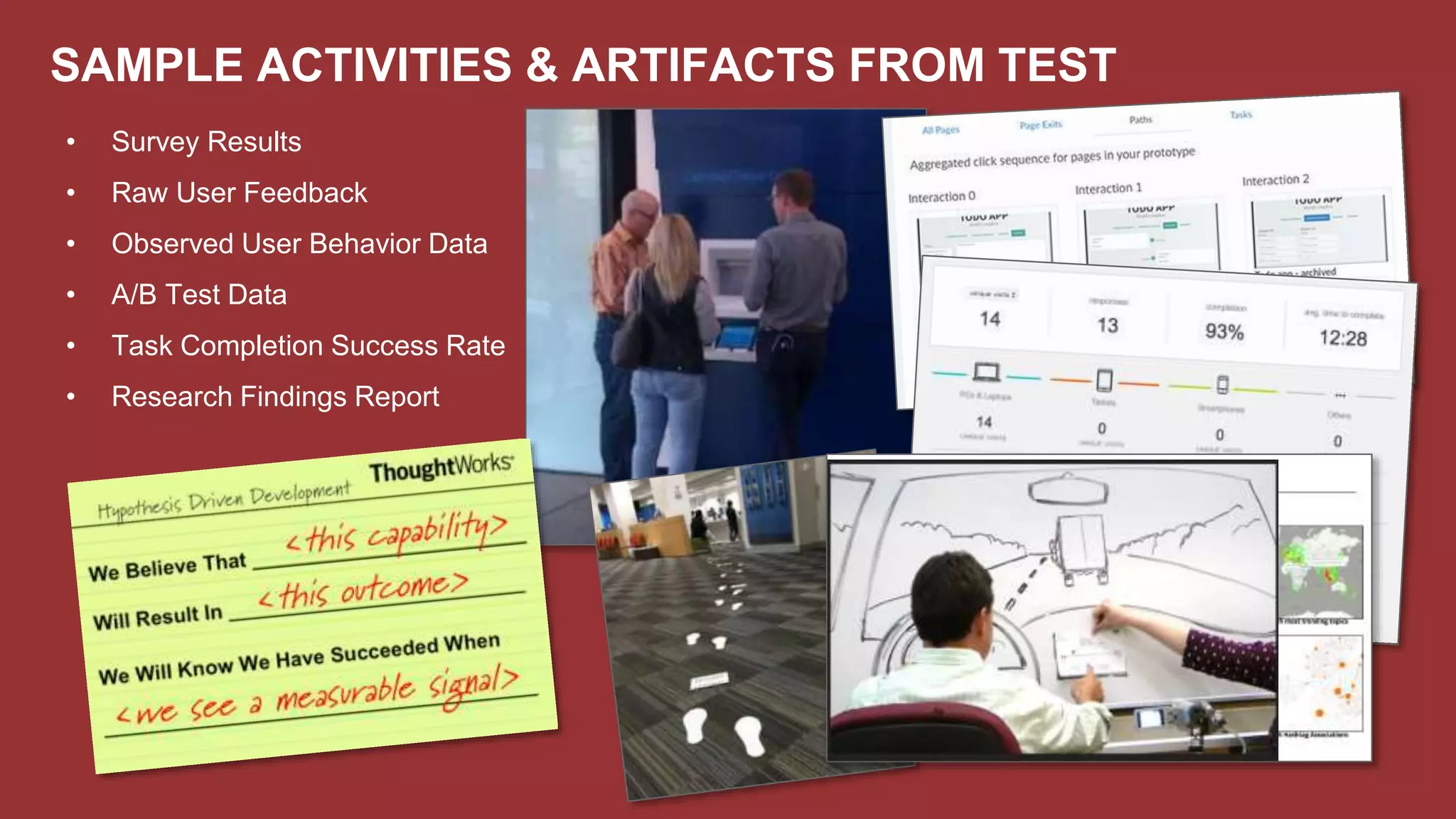
SAMPLE ACTIVITIES & ARTIFACTS FROM TEST
• Survey Results
• Raw User Feedback
• Observed User Behavior Data
• A/B Test Data
• Task Completion Success Rate
• Research Findings Report
Case Stories of
Design Thinking
How and where is it being used?
38
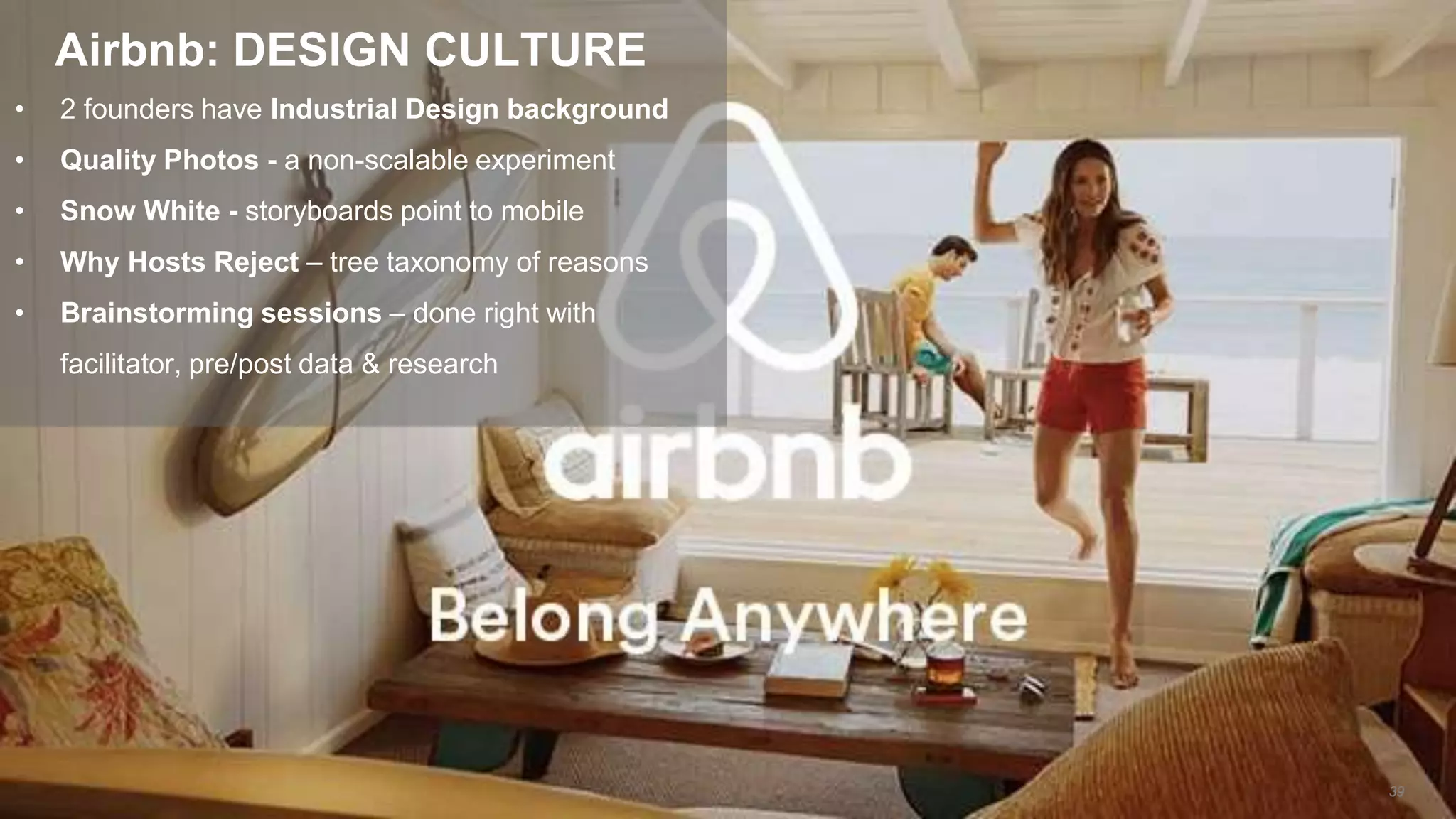
• 2 founders have Industrial Design background
• Quality Photos - a non-scalable experiment
• Snow White - storyboards point to mobile
• Why Hosts Reject – tree taxonomy of reasons
• Brainstorming sessions – done right with
facilitator, pre/post data & research
Airbnb: DESIGN CULTURE
39
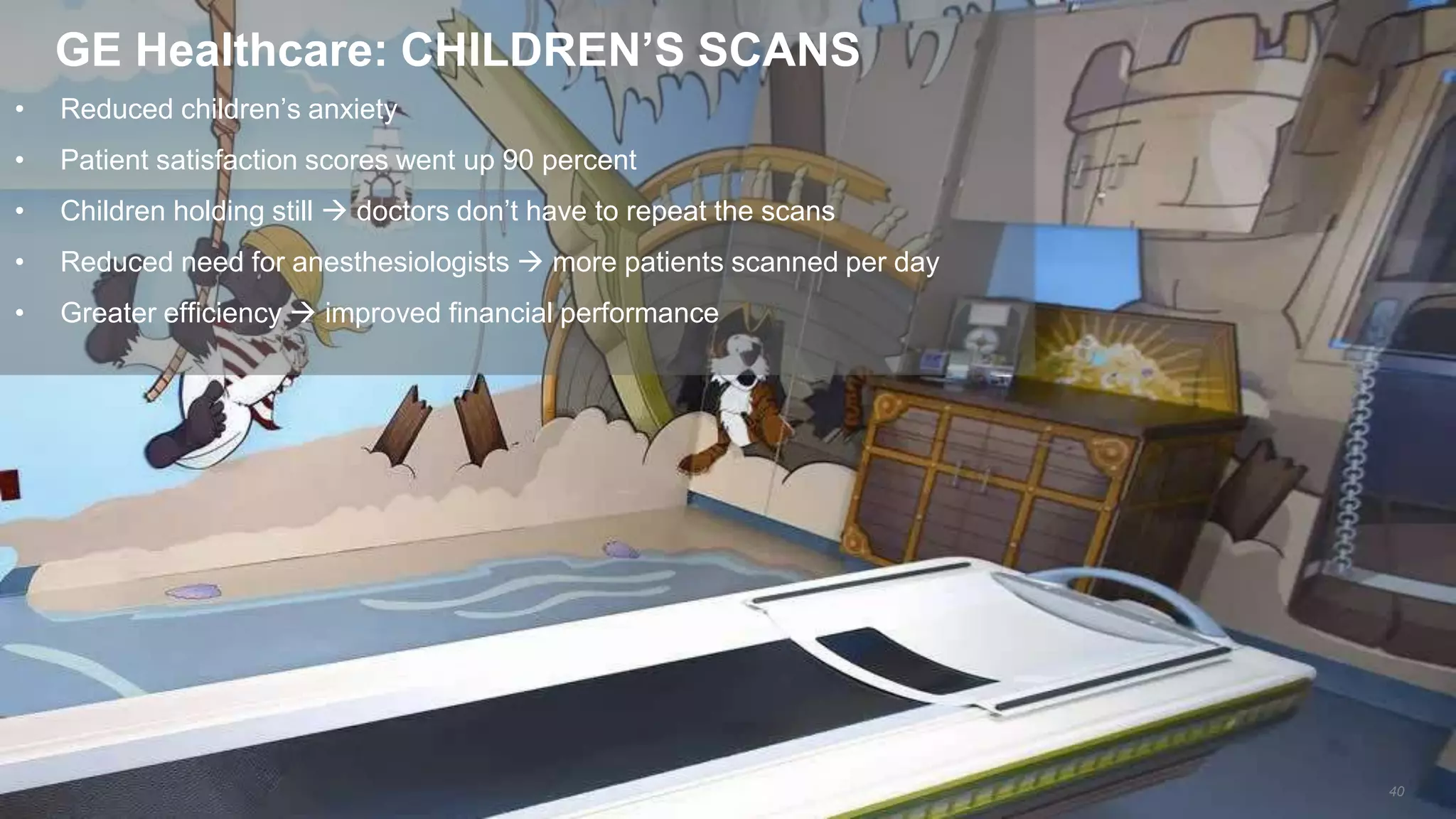
• Reduced children’s anxiety
• Patient satisfaction scores went up 90 percent
• Children holding still  doctors don’t have to repeat the scans
• Reduced need for anesthesiologists  more patients scanned per day
• Greater efficiency  improved financial performance
GE Healthcare: CHILDREN’S SCANS
40
City of Sydney: DESIGNING OUT CRIME
41
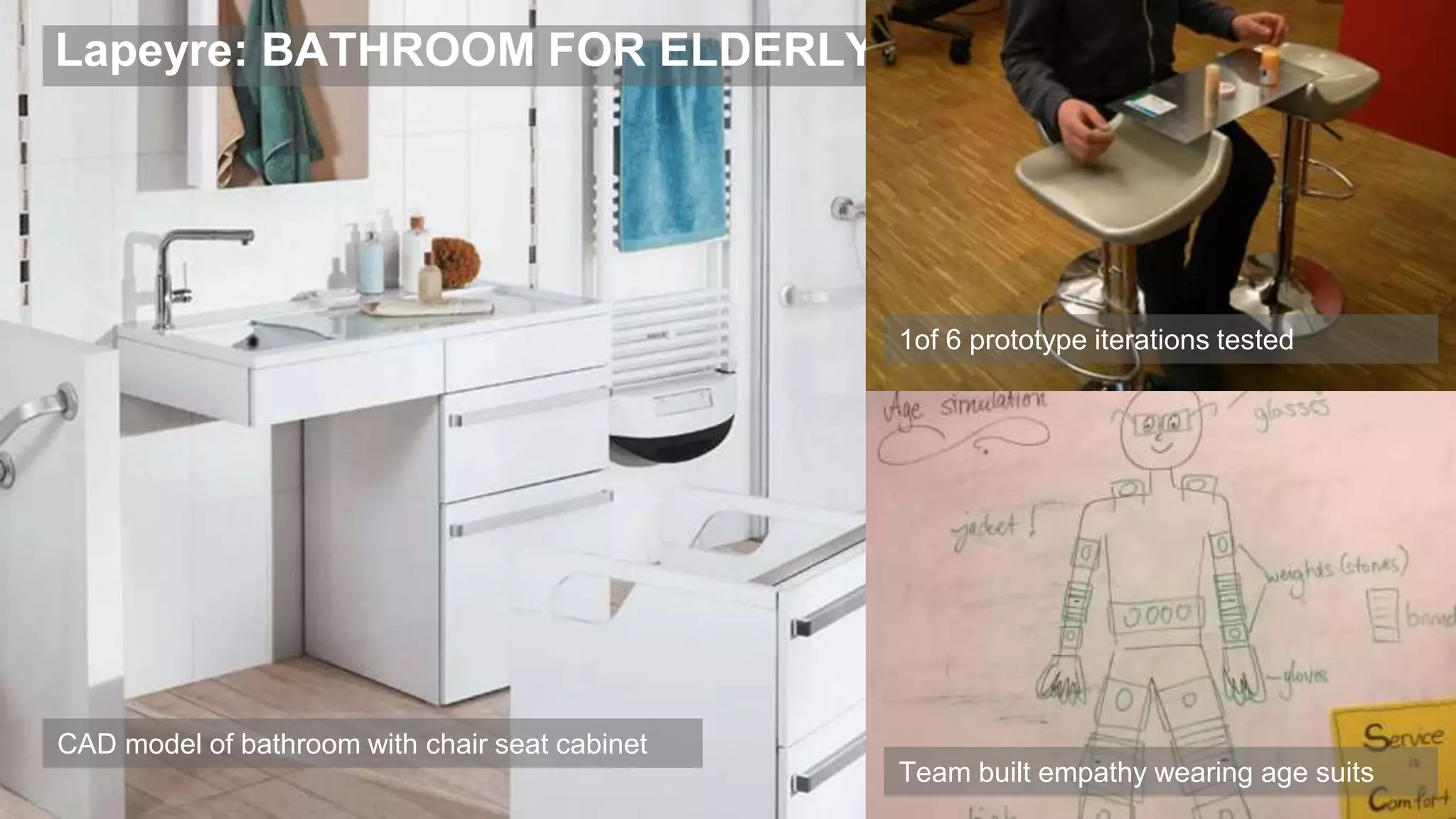
Lapeyre: BATHROOM FOR ELDERLY
42
1of 6 prototype iterations tested
CAD model of bathroom with chair seat cabinet
Team built empathy wearing age suits
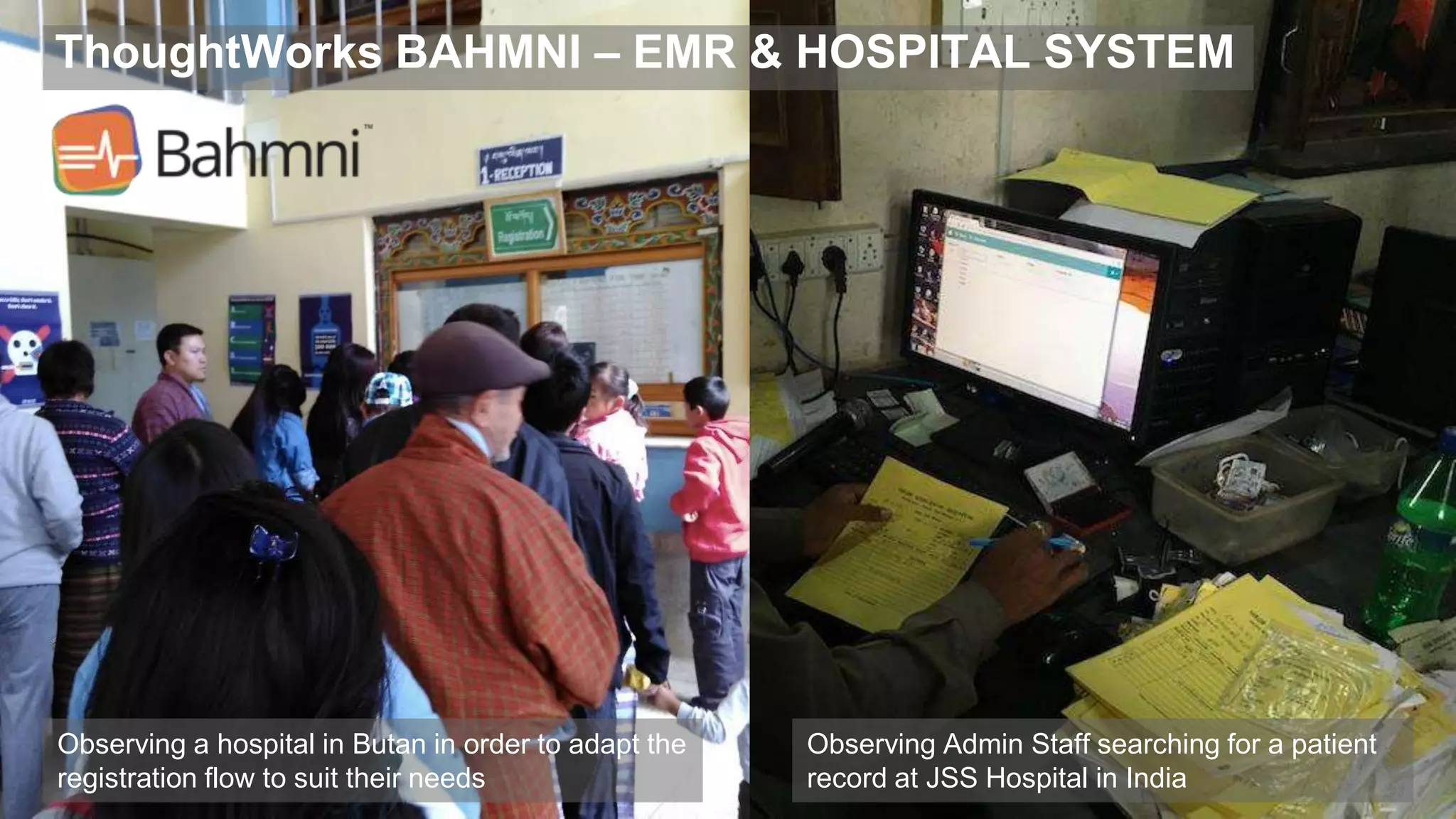
ThoughtWorks BAHMNI – EMR & HOSPITAL SYSTEM
43
Observing Admin Staff searching for a patient
record at JSS Hospital in India
Observing a hospital in Butan in order to adapt the
registration flow to suit their needs
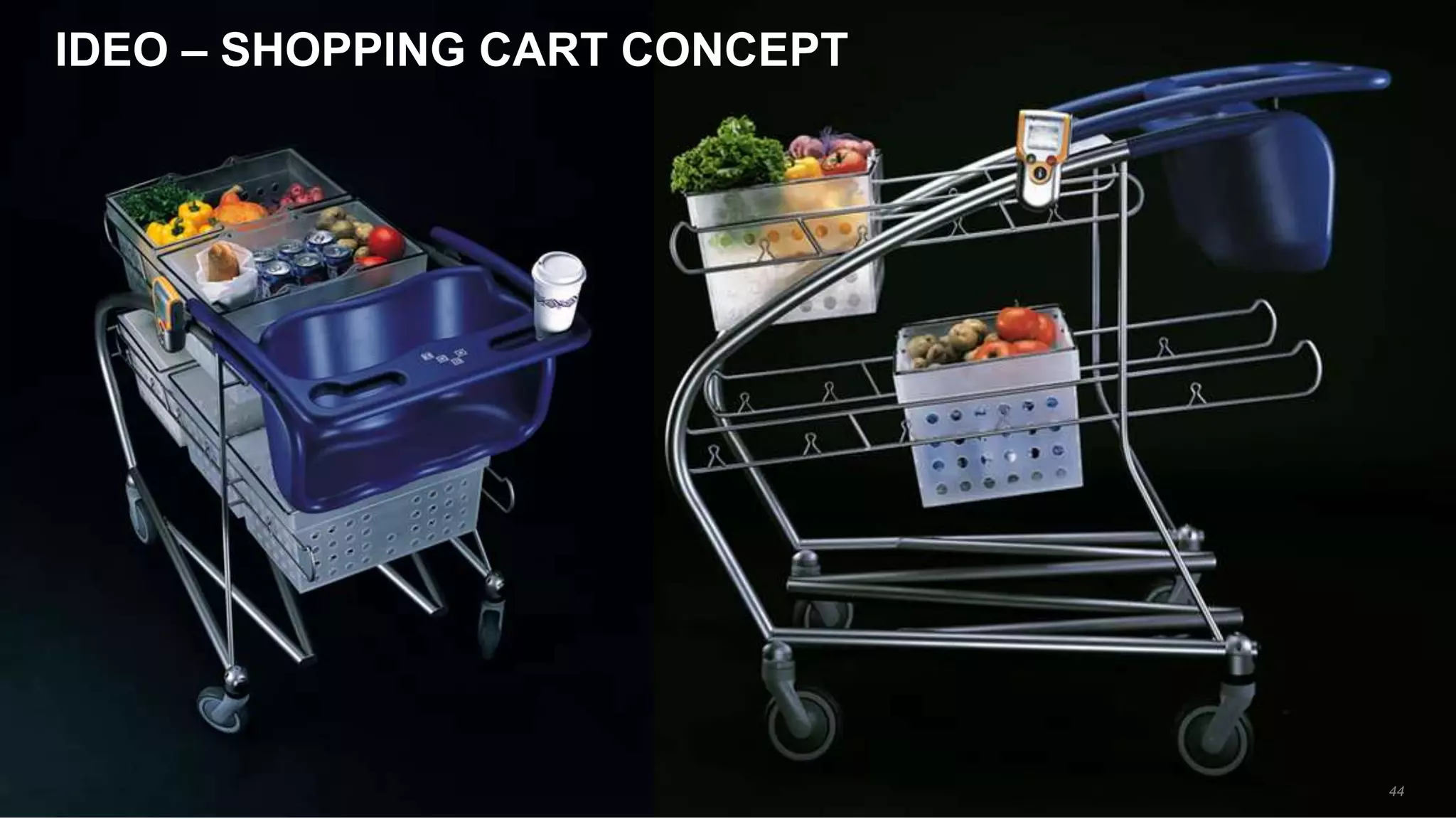
IDEO – SHOPPING CART CONCEPT
44
MORE CASE STORIES
• IBM https://www.ibm.com/design/thinking/
• Procter & Gamble – Olay https://hbr.org/video/4443548301001/the-explainer-design-thinking
• Capital One Bank https://www.forbes.com/sites/alfresco/2017/03/10/capital-one-embraces-design-
thinking/
• Mayo Clinic Healthcare http://centerforinnovation.mayo.edu/
• Rotterdam Eye Hospital https://hbr.org/2017/11/how-design-thinking-is-improving-patient-caregiver-
conversations and http://thisisdesignthinking.net/2017/01/rotterdam-eye-hospital/
• John Hopkins Hospital https://hbr.org/2017/08/health-care-providers-can-use-design-thinking-to-
improve-patient-experiences
• Kaiser Permanente Hospital, Shimano Bicycles and others https://hbr.org/2008/06/design-thinking
• And many, many more http://thisisdesignthinking.net/category/cases/
45
Taking Action
Implementing Design Thinking in your organization
46
WHY USE DESIGN THINKING?
• You are not your users; blind spots from expert bias, employee
context, familiarity
• Better products & services, customer experience
• Save time & money by building the right solution first time. A beautiful
design solving the wrong problem will fail
• Innovation from divergent thinking, exploring multiple solutions
• Design-centered companies achieve better results (e.g. higher stock
price)
47
HOW CAN LEADERS ENABLE DESIGN THINKING?
• Condone the process: Empower team to have space, timeline, resources
• Enable the team: promote, organize, or reimburse team training
• Remove blockers: Help provide access to users
• Lead by example: encourage diversity of opinions, exploring multiple possible
solutions, validating with users
• Reframe what you ask for: Provide requirements in terms of goals and
constraints rather than solutions/features
• Hold them accountable to results: Focus on achieving and measuring
outcomes over outputs
• Champion the mindset: Love the problem not the solution
48
RESOURCES TO USE NOW
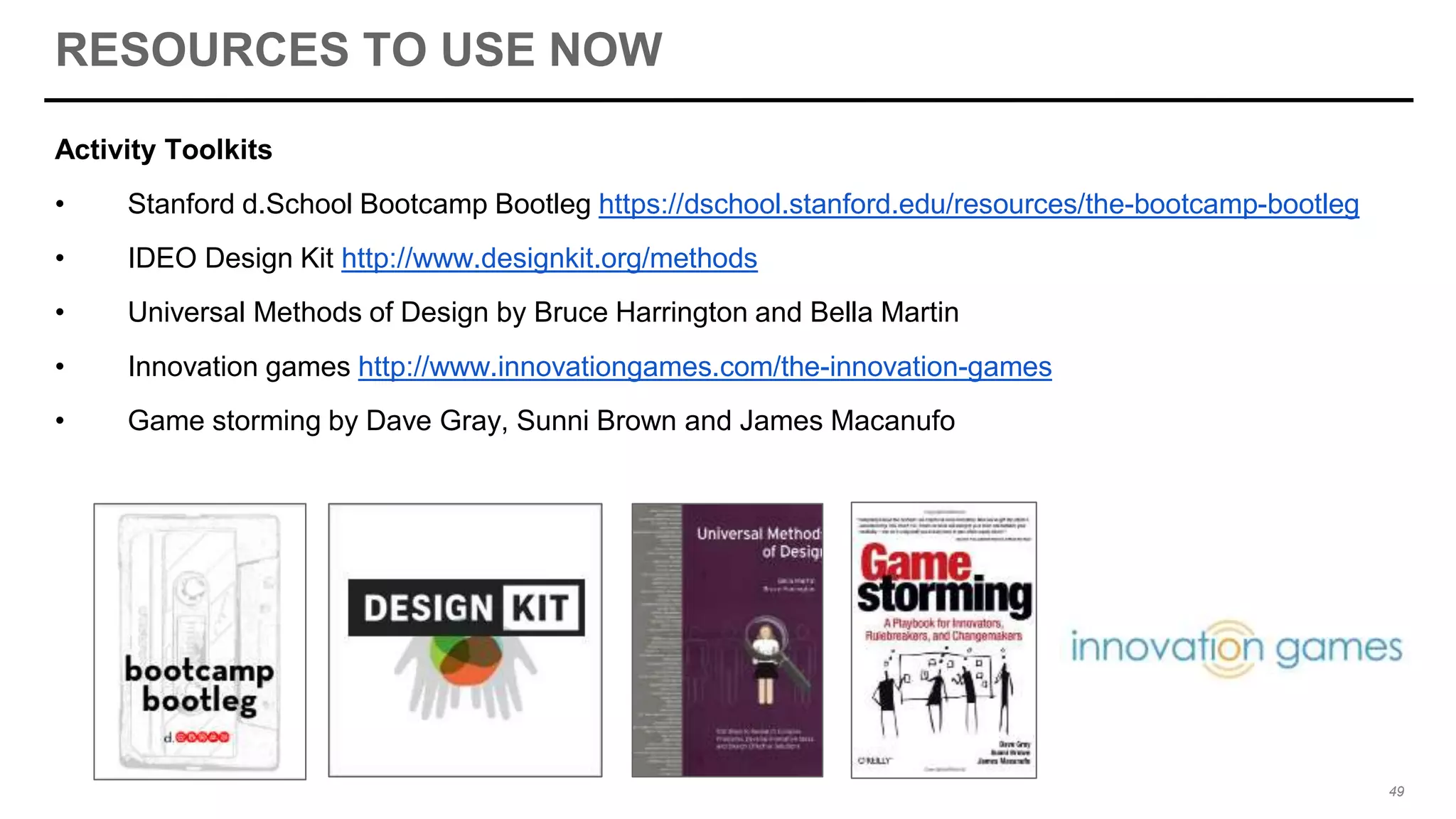
Activity Toolkits
• Stanford d.School Bootcamp Bootleg https://dschool.stanford.edu/resources/the-bootcamp-bootleg
• IDEO Design Kit http://www.designkit.org/methods
• Universal Methods of Design by Bruce Harrington and Bella Martin
• Innovation games http://www.innovationgames.com/the-innovation-games
• Game storming by Dave Gray, Sunni Brown and James Macanufo
49
RESOURCES TO LEARN MORE
Articles
• Design Thinking 101 https://www.nngroup.com/articles/design-thinking/
• Design Thinking Comes of Age https://hbr.org/2015/09/design-thinking-comes-of-age
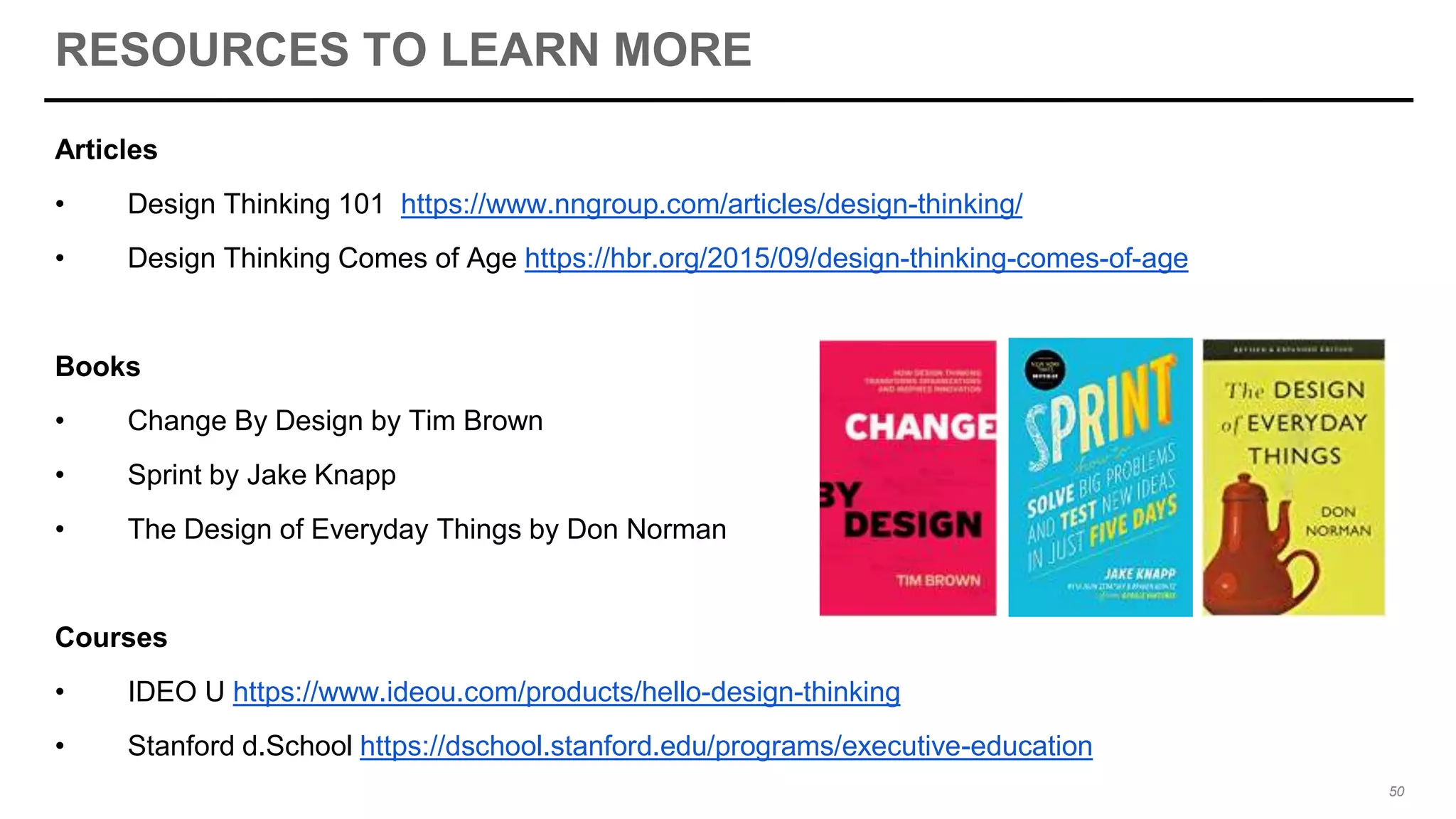
Books
• Change By Design by Tim Brown
• Sprint by Jake Knapp
• The Design of Everyday Things by Don Norman
Courses
• IDEO U https://www.ideou.com/products/hello-design-thinking
• Stanford d.School https://dschool.stanford.edu/programs/executive-education
50
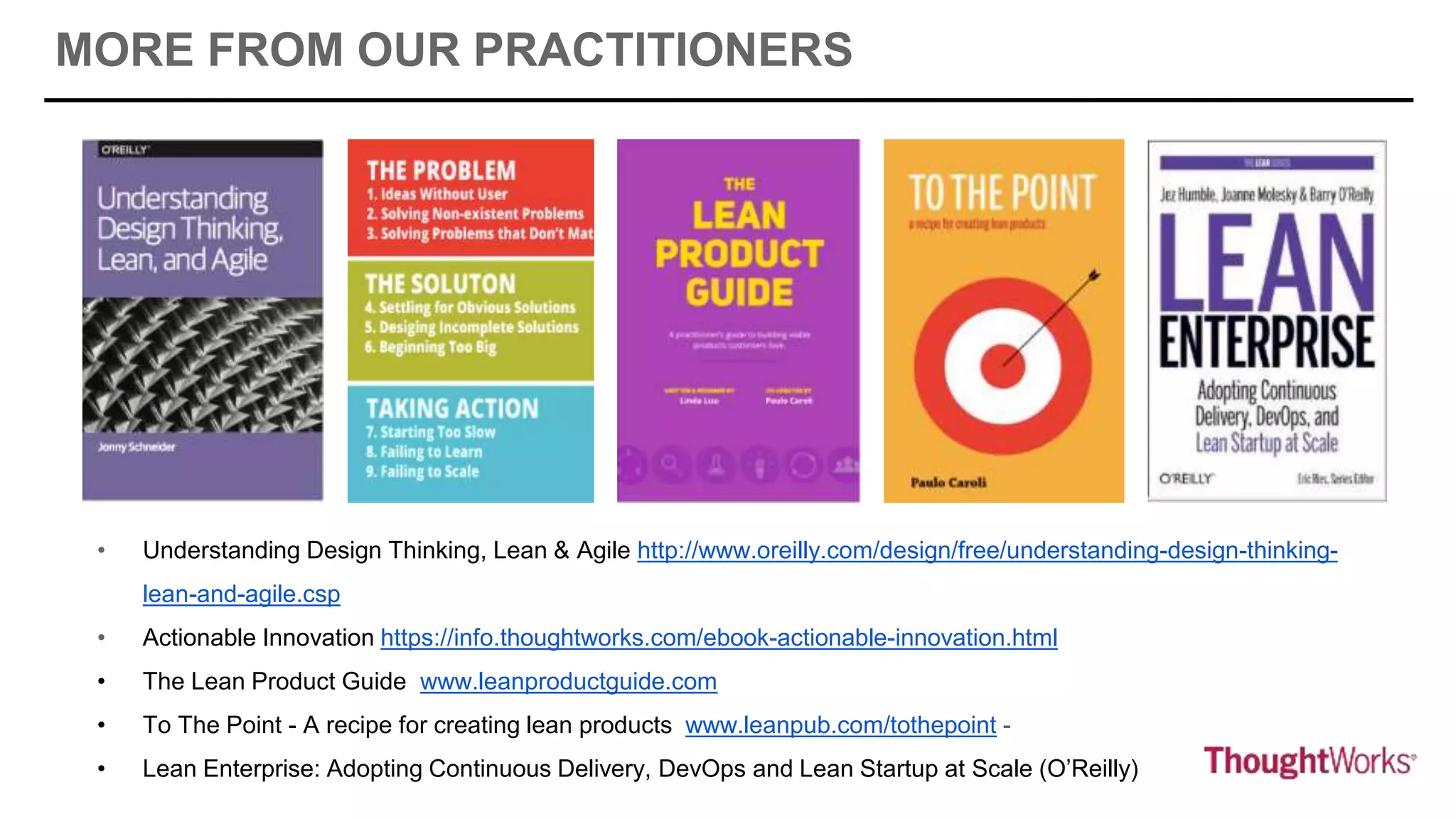
• Understanding Design Thinking, Lean & Agile http://www.oreilly.com/design/free/understanding-design-thinking-
lean-and-agile.csp
• Actionable Innovation https://info.thoughtworks.com/ebook-actionable-innovation.html
• The Lean Product Guide www.leanproductguide.com
• To The Point - A recipe for creating lean products www.leanpub.com/tothepoint -
• Lean Enterprise: Adopting Continuous Delivery, DevOps and Lean Startup at Scale (O’Reilly)
MORE FROM OUR PRACTITIONERS
Takeaways + Q&A
Insights from today’s workshop
52
ABOUT THAT STICKY EXERCISE …
What effect did dot-voting and clustering (affinity grouping) on Agenda,
Q&A and Takeaways have on today’s workshop?
53
THANK YOU
Natalie Hollier
North America Product & Design Principal
ThoughtWorks
nhollier@thoughtworks.com
54

Design Thinking 101 Workshop

  • 1.
  • 2.
  • 3.
    AGENDA Kickoff: Background, Introduction& Goals for Today Overview of Design Thinking - What is Design Thinking? What is it Not? - What does it look like in Action? Case Stories of How & Where It Is Being Used - Companies like Airbnb, GE Healthcare, Laperye furniture - Cities like Sydney - Consultancies like ThoughtWorks, IDEO - And many more examples Taking Action - Why Use Design Thinking? - How Can Leaders Enable Design Thinking To Happen? - Resources To Use and Learn More Wrap up: Takeaways and Q&A 3
  • 4.
    TODAY’S WORKSHOP • Nolaptops or phones • Interactive discussion - Full participation • Parking Lot • Good is the enemy of great (time) 4
  • 5.
    FIRST, AN INTROEXERCISE Dot-voting on the Agenda • Vote where you are most interested to spend time • Put multiple dots on the same topic, or split them up Write down your Insights/Takeaways and Questions as we go • Write in capitals using sharpie, (so they can be read) • 1 idea per sticky note (so they can be moved) • Stickies can be anonymous, or not (you decide) 5
  • 6.
    Overview of Design Thinking NatalieHollier, Product & Design Principal at ThoughtWorks 6
  • 7.
    7 Tell me: Whatis design?
  • 8.
    8 A solution toa problem or need, within set constraints.
  • 9.
    DESIGN IN CONTEXT •Architects design living environments within the constraints of space and material • Civil engineers design infrastructure within the constraints material • Graphic artists at advertising agencies design messages within the constraints of media • City planners design public transport services within the constraints of traffic and movement 9
  • 10.
    THE DESIGN OFEXPERIENCES User Experience Designers (UX, XD) solve problems for people within the constraints of business and technology. 10
  • 11.
    EMBRACE CONSTRAINT “When forcedto work within a strict framework the imagination is taxed to its utmost - and will produce its richest ideas. Given total freedom the work is likely to sprawl.” -T.S. Eliot 11
  • 12.
    1 2 Tell me: Whatis design? Design Thinking
  • 13.
    HISTORY: DESIGN THINKINGIS AS OLD AS DESIGN The term was coined in the 1990's by David Kelley and Tim Brown of IDEO, with Roger Martin, and encapsulated methods and ideas that have been brewing for years into a single unified concept. 13 1956 Eame’s Chair 1998 Apple iMac
  • 14.
    Design Thinking isthe discipline that uses the designer’s sensibility and methods to match people’s needs with what is technologically feasible and what a viable business strategy can convert into customer value and market opportunity. Tim Brown, IDEO
  • 15.
    The mission ofdesign thinking is to translate observations into insights and insights into products and services that will improve lives. Tim Brown, CEO IDEO Change by Design HOW?
  • 16.
    DESIGN THINKING PROCESS -Stanford d.School 16
  • 17.
    1 FIND THE RIGHT PROBLEM FINDTHE RIGHT SOLUTION trigger vision & plan solution
  • 18.
    WHO, WHAT, WHERE& WHEN? • WHO - Whole team; design, business, engineering • WHAT - Collaborative, creative, visual, make things, test ideas, iterate • WHERE - Together in a shared space, and anywhere your users are • WHEN - Heavier in the beginning of a new product/service, and lightweight ongoing 18
  • 19.
    MINDSET Design Thinking isa mindset more than a specific process or artifacts. In reality it is more like this: 19
  • 20.
    WHAT DESIGN THINKINGIS NOT • Workshops with sticky notes • Creating design artifacts • Only for designers • Only for products (or only for services) • Lean, Agile or Waterfall methods – it can be independent of or combined with any development methodology 20
  • 21.
    WHAT DOES ITLOOK LIKE IN ACTION? 21 EMPATHIZE DEFINE IDEATE PROTOTYPE TEST Discover User Needs and Understand the Problem Space
  • 22.
    SAMPLE ACTIVITIES FORDISCOVERY EMPATHY INTERVIEW GROUP DISCUSSIONS SECONDARY RESEARCH COMPETITIVE ANALYSIS PERSONAL INVENTORY OBSERVATION SPACE/ PLACE VISITS CAMERA JOURNALS Who can we interview to better understand our problem? What data, case studies or research already exists about this problem? Who might we observe to better understand the needs and flow of the problem? What spaces and places can we go to for information and inspiration? Who can we bring together in a dialogue to dig deeper into the problem? Can we create a documentary record of the problem? How can we best harvest media? What other solutions exist in the current market, the past or adjacent industries? What personal artifacts, objects or contexts can we get people to explain to us? LOW-BARRIER ACTIVITIES
  • 23.
    SAMPLE ARTIFACTS FROMDISCOVERY • Empathy Map • Persona • User Journey • Service Blueprint
  • 24.
    WHAT DOES ITLOOK LIKE IN ACTION? 24 EMPATHIZE DEFINE IDEATE PROTOTYPE TEST Synthesize Insights & Define Opportunities
  • 25.
    CLUSTERING DATA ONA USER JOURNEY ENTICE ENTER ENGAGE EXIT EXTEND CUSTOMER JOURNEY MAP + _ 2
  • 26.
    IDENTIFYING INSIGHTS INSIGHTS INTHE DATA Cluster + Interpret What patterns and themes emerge from the data? What are the underlying needs and motivations behind people’s thoughts, feelings, and behaviors? 2 AFFINITY MAPPING + INTERPRETATION
  • 27.
    INSIGHTS FROM DATA DATAVS. NEEDS DATA NEED “Hannah loves getting free room upgrades.” “Unexpected gifts make people feel special.” DATA INSIGHT
  • 28.
    REFRAMING PAIN POINTSAS OPPORTUNITIES
  • 29.
    SAMPLE ARTIFACTS FROMDEFINE • Research Insights Report • “How Might We ..?” Opportunity Statements • Opportunity Backlog
  • 30.
    WHAT DOES ITLOOK LIKE IN ACTION? 30 EMPATHIZE DEFINE IDEATE PROTOTYPE TEST Divergent Ideation of Solution Concepts
  • 31.
    IDEATION ACTIVITIES &TIPS IDEATE: TIPS Don’t mix Open and Close Trying to do both at the same time is soul-crushing and counter-productive! Make sure everyone knows what mode you’re in. Balance personal and group Groupthink is a powerful tool…use it lightly. Give teams time to generate both alone and in groups. • Individual brainstorming & concept generation • Group brainstorming • User co-design workshops • Concept generation templates & activities • Prioritization exercises IDEO’S 7 RULES OF BRAINSTORMING
  • 32.
    SAMPLE ARTIFACTS FROMIDEATE • Idea Backlog • Concept Vision • Concept Sketch @thedesigngym
  • 33.
    WHAT DOES ITLOOK LIKE IN ACTION? 33 EMPATHIZE DEFINE IDEATE PROTOTYPE TEST Rapidly Build Solution Concepts
  • 34.
    SAMPLE ACTIVITIES &ARTIFACTS FROM PROTOTYPE • Paper Sketch Wireframes • Clickable Design Wireframes • Interactive Software Code • Physical Props • Interactive Hardware • To-Be Service Blueprint
  • 35.
    WHAT DOES ITLOOK LIKE IN ACTION? 35 EMPATHIZE DEFINE IDEATE PROTOTYPE TEST Validate Solution Concepts with Real Users
  • 36.
    REMEMBER WHAT YOUARE TESTING CONCEPT TESTING Does our solution solve the problem? USABILITY TESTING Is the implementation usable? Concept testing is best done with low fidelity prototypes or other methods (survey, photos/images, explainer video, etc) Usability testing is best done with interactive / working prototypes (physical or digital)
  • 37.
    SAMPLE ACTIVITIES &ARTIFACTS FROM TEST • Survey Results • Raw User Feedback • Observed User Behavior Data • A/B Test Data • Task Completion Success Rate • Research Findings Report
  • 38.
    Case Stories of DesignThinking How and where is it being used? 38
  • 39.
    • 2 foundershave Industrial Design background • Quality Photos - a non-scalable experiment • Snow White - storyboards point to mobile • Why Hosts Reject – tree taxonomy of reasons • Brainstorming sessions – done right with facilitator, pre/post data & research Airbnb: DESIGN CULTURE 39
  • 40.
    • Reduced children’sanxiety • Patient satisfaction scores went up 90 percent • Children holding still  doctors don’t have to repeat the scans • Reduced need for anesthesiologists  more patients scanned per day • Greater efficiency  improved financial performance GE Healthcare: CHILDREN’S SCANS 40
  • 41.
    City of Sydney:DESIGNING OUT CRIME 41
  • 42.
    Lapeyre: BATHROOM FORELDERLY 42 1of 6 prototype iterations tested CAD model of bathroom with chair seat cabinet Team built empathy wearing age suits
  • 43.
    ThoughtWorks BAHMNI –EMR & HOSPITAL SYSTEM 43 Observing Admin Staff searching for a patient record at JSS Hospital in India Observing a hospital in Butan in order to adapt the registration flow to suit their needs
  • 44.
    IDEO – SHOPPINGCART CONCEPT 44
  • 45.
    MORE CASE STORIES •IBM https://www.ibm.com/design/thinking/ • Procter & Gamble – Olay https://hbr.org/video/4443548301001/the-explainer-design-thinking • Capital One Bank https://www.forbes.com/sites/alfresco/2017/03/10/capital-one-embraces-design- thinking/ • Mayo Clinic Healthcare http://centerforinnovation.mayo.edu/ • Rotterdam Eye Hospital https://hbr.org/2017/11/how-design-thinking-is-improving-patient-caregiver- conversations and http://thisisdesignthinking.net/2017/01/rotterdam-eye-hospital/ • John Hopkins Hospital https://hbr.org/2017/08/health-care-providers-can-use-design-thinking-to- improve-patient-experiences • Kaiser Permanente Hospital, Shimano Bicycles and others https://hbr.org/2008/06/design-thinking • And many, many more http://thisisdesignthinking.net/category/cases/ 45
  • 46.
    Taking Action Implementing DesignThinking in your organization 46
  • 47.
    WHY USE DESIGNTHINKING? • You are not your users; blind spots from expert bias, employee context, familiarity • Better products & services, customer experience • Save time & money by building the right solution first time. A beautiful design solving the wrong problem will fail • Innovation from divergent thinking, exploring multiple solutions • Design-centered companies achieve better results (e.g. higher stock price) 47
  • 48.
    HOW CAN LEADERSENABLE DESIGN THINKING? • Condone the process: Empower team to have space, timeline, resources • Enable the team: promote, organize, or reimburse team training • Remove blockers: Help provide access to users • Lead by example: encourage diversity of opinions, exploring multiple possible solutions, validating with users • Reframe what you ask for: Provide requirements in terms of goals and constraints rather than solutions/features • Hold them accountable to results: Focus on achieving and measuring outcomes over outputs • Champion the mindset: Love the problem not the solution 48
  • 49.
    RESOURCES TO USENOW Activity Toolkits • Stanford d.School Bootcamp Bootleg https://dschool.stanford.edu/resources/the-bootcamp-bootleg • IDEO Design Kit http://www.designkit.org/methods • Universal Methods of Design by Bruce Harrington and Bella Martin • Innovation games http://www.innovationgames.com/the-innovation-games • Game storming by Dave Gray, Sunni Brown and James Macanufo 49
  • 50.
    RESOURCES TO LEARNMORE Articles • Design Thinking 101 https://www.nngroup.com/articles/design-thinking/ • Design Thinking Comes of Age https://hbr.org/2015/09/design-thinking-comes-of-age Books • Change By Design by Tim Brown • Sprint by Jake Knapp • The Design of Everyday Things by Don Norman Courses • IDEO U https://www.ideou.com/products/hello-design-thinking • Stanford d.School https://dschool.stanford.edu/programs/executive-education 50
  • 51.
    • Understanding DesignThinking, Lean & Agile http://www.oreilly.com/design/free/understanding-design-thinking- lean-and-agile.csp • Actionable Innovation https://info.thoughtworks.com/ebook-actionable-innovation.html • The Lean Product Guide www.leanproductguide.com • To The Point - A recipe for creating lean products www.leanpub.com/tothepoint - • Lean Enterprise: Adopting Continuous Delivery, DevOps and Lean Startup at Scale (O’Reilly) MORE FROM OUR PRACTITIONERS
  • 52.
    Takeaways + Q&A Insightsfrom today’s workshop 52
  • 53.
    ABOUT THAT STICKYEXERCISE … What effect did dot-voting and clustering (affinity grouping) on Agenda, Q&A and Takeaways have on today’s workshop? 53
  • 54.
    THANK YOU Natalie Hollier NorthAmerica Product & Design Principal ThoughtWorks nhollier@thoughtworks.com 54