Design Principles
Contrast & Dominance
RONALDI
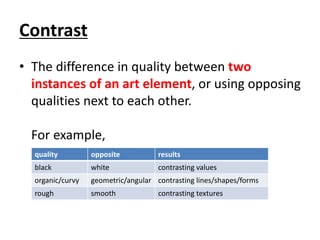
Contrast
• The difference in quality between two
instances of an art element, or using opposing
qualities next to each other.
For example,
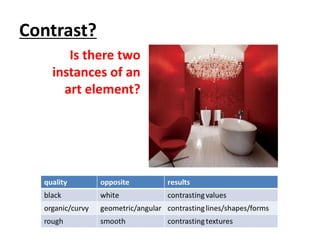
quality opposite results
black white contrasting values
organic/curvy geometric/angular contrasting lines/shapes/forms
rough smooth contrasting textures
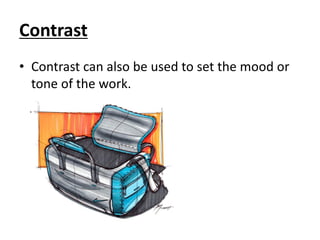
Contrast
• Contrast can also be used to set the mood or
tone of the work.
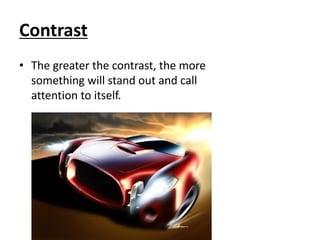
Contrast
• The greater the contrast, the more
something will stand out and call
attention to itself.
Contrast
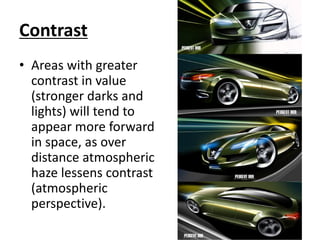
• Areas with greater
contrast in value
(stronger darks and
lights) will tend to
appear more forward
in space, as over
distance atmospheric
haze lessens contrast
(atmospheric
perspective).
Contrast
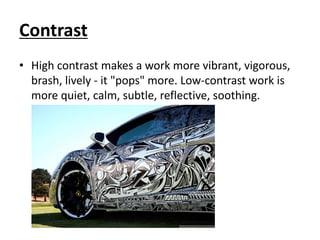
• High contrast makes a work more vibrant, vigorous,
brash, lively - it "pops" more. Low-contrast work is
more quiet, calm, subtle, reflective, soothing.
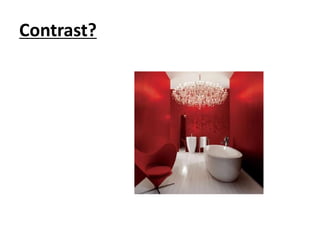
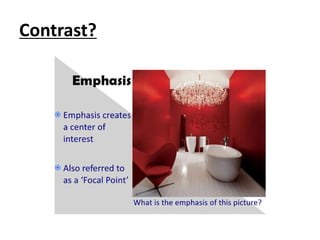
Contrast?
Contrast?
Is there two
instances of an
art element?
Contrast?
Emphasis
• Emphasis is the area
of interest where the
viewer's eyes skip the
other areas
• We visually
reinforcing
something we want
to pay attention
Strategies used
Isolation
leading lines and convergence
contrast
anomaly, size
placement
framing
focus
depth of field
absence of focal points
Emphasis
• Emphasis is the area
of interest where the
viewer's eyes skip the
other areas
• We visually
reinforcing
something we want
to pay attention
Strategies used
Isolation
leading lines and convergence
contrast
anomaly, size
placement
framing
depth of field
absence of focal points
Emphasis
Strategies used
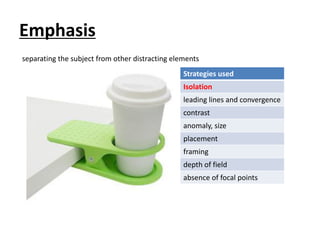
Isolation
leading lines and convergence
contrast
anomaly, size
placement
framing
depth of field
absence of focal points
separating the subject from other distracting elements
Emphasis
Strategies used
Isolation
leading lines and convergence
contrast
anomaly, size
placement
framing
depth of field
absence of focal points
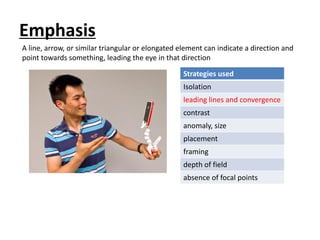
A line, arrow, or similar triangular or elongated element can indicate a direction and
point towards something, leading the eye in that direction
Emphasis
Strategies used
Isolation
leading lines and convergence
contrast
size
placement
framing
depth of field
absence of focal points
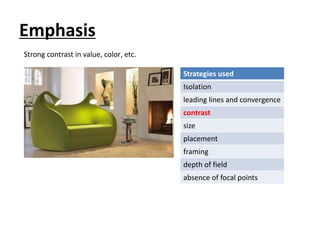
Strong contrast in value, color, etc.
Emphasis
Strategies used
Isolation
leading lines and convergence
contrast
size
placement
framing
depth of field
absence of focal points
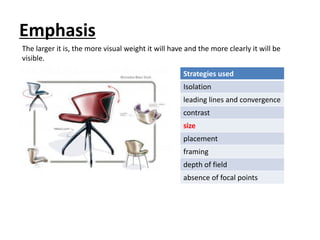
The larger it is, the more visual weight it will have and the more clearly it will be
visible.
Emphasis
Strategies used
Isolation
leading lines and convergence
contrast
size
placement
framing
depth of field
absence of focal points
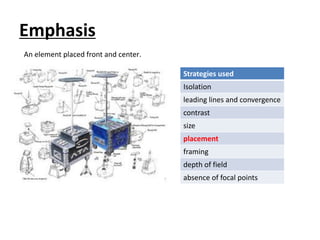
An element placed front and center.
Emphasis
Strategies used
Isolation
leading lines and convergence
contrast
size
placement
framing
depth of field
absence of focal points
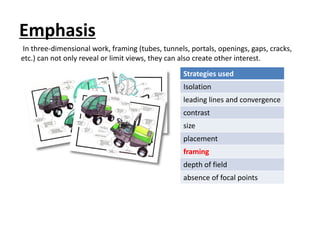
In three-dimensional work, framing (tubes, tunnels, portals, openings, gaps, cracks,
etc.) can not only reveal or limit views, they can also create other interest.
Emphasis
Strategies used
Isolation
leading lines and convergence
contrast
size
placement
framing
depth of field
absence of focal points
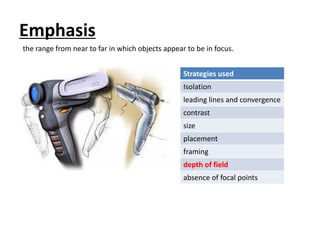
the range from near to far in which objects appear to be in focus.
Emphasis
Strategies used
Isolation
leading lines and convergence
contrast
size
placement
framing
depth of field
absence of focal points
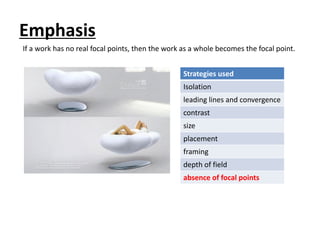
If a work has no real focal points, then the work as a whole becomes the focal point.
Emphasis
Strategies used
Isolation
leading lines and convergence
contrast
size
placement
framing
depth of field
absence of focal points
If a work has no real focal points, then the work as a whole becomes the focal point.
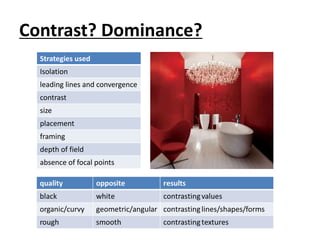
Contrast? Dominance?
Strategies used
Isolation
leading lines and convergence
contrast
size
placement
framing
depth of field
absence of focal points
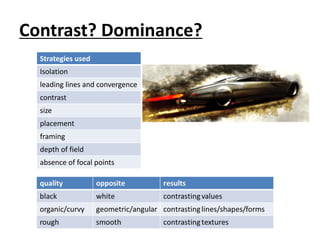
Contrast? Dominance?
Strategies used
Isolation
leading lines and convergence
contrast
size
placement
framing
depth of field
absence of focal points
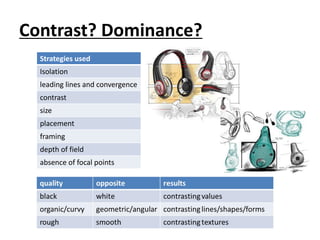
Contrast? Dominance?
Strategies used
Isolation
leading lines and convergence
contrast
size
placement
framing
depth of field
absence of focal points

Design Principles ContrastDominanceBalance.pdf