
Seminar-2
ROSHAN SAH
USN :- 17AE60R01
M.Tech (1st Year)
Dept. of AerospaceEngineering,
Indian Institute of Technology
Karagpur (IITKGP)30/08/2017 IIT KGP 1
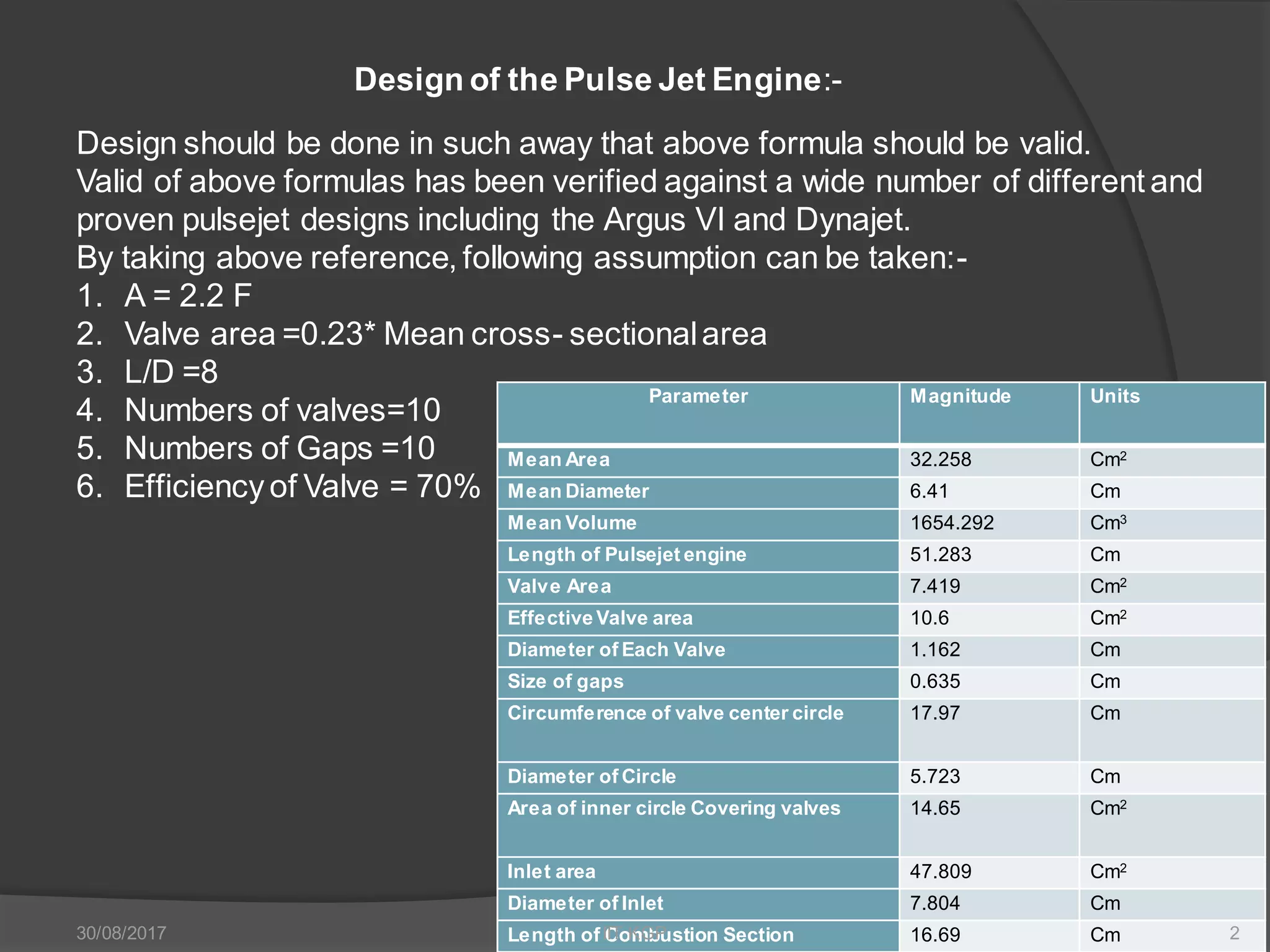
Design of the Pulse Jet Engine:-
Design should be done in such away that above formula should be valid.
Valid of above formulas has been verified against a wide number of different and
proven pulsejet designs including the Argus VI and Dynajet.
By taking above reference, following assumption can be taken:-
1. A = 2.2 F
2. Valve area =0.23* Mean cross- sectionalarea
3. L/D =8
4. Numbers of valves=10
5. Numbers of Gaps =10
6. Efficiencyof Valve = 70%
Parameter Magnitude Units
Mean Area 32.258 Cm2
Mean Diameter 6.41 Cm
Mean Volume 1654.292 Cm3
Length of Pulsejet engine 51.283 Cm
Valve Area 7.419 Cm2
Effective Valve area 10.6 Cm2
Diameter of Each Valve 1.162 Cm
Size of gaps 0.635 Cm
Circumference of valve center circle 17.97 Cm
Diameter of Circle 5.723 Cm
Area of inner circle Covering valves 14.65 Cm2
Inlet area 47.809 Cm2
Diameter of Inlet 7.804 Cm
Length of Combustion Section 16.69 Cm30/08/2017 IIT KGP 2
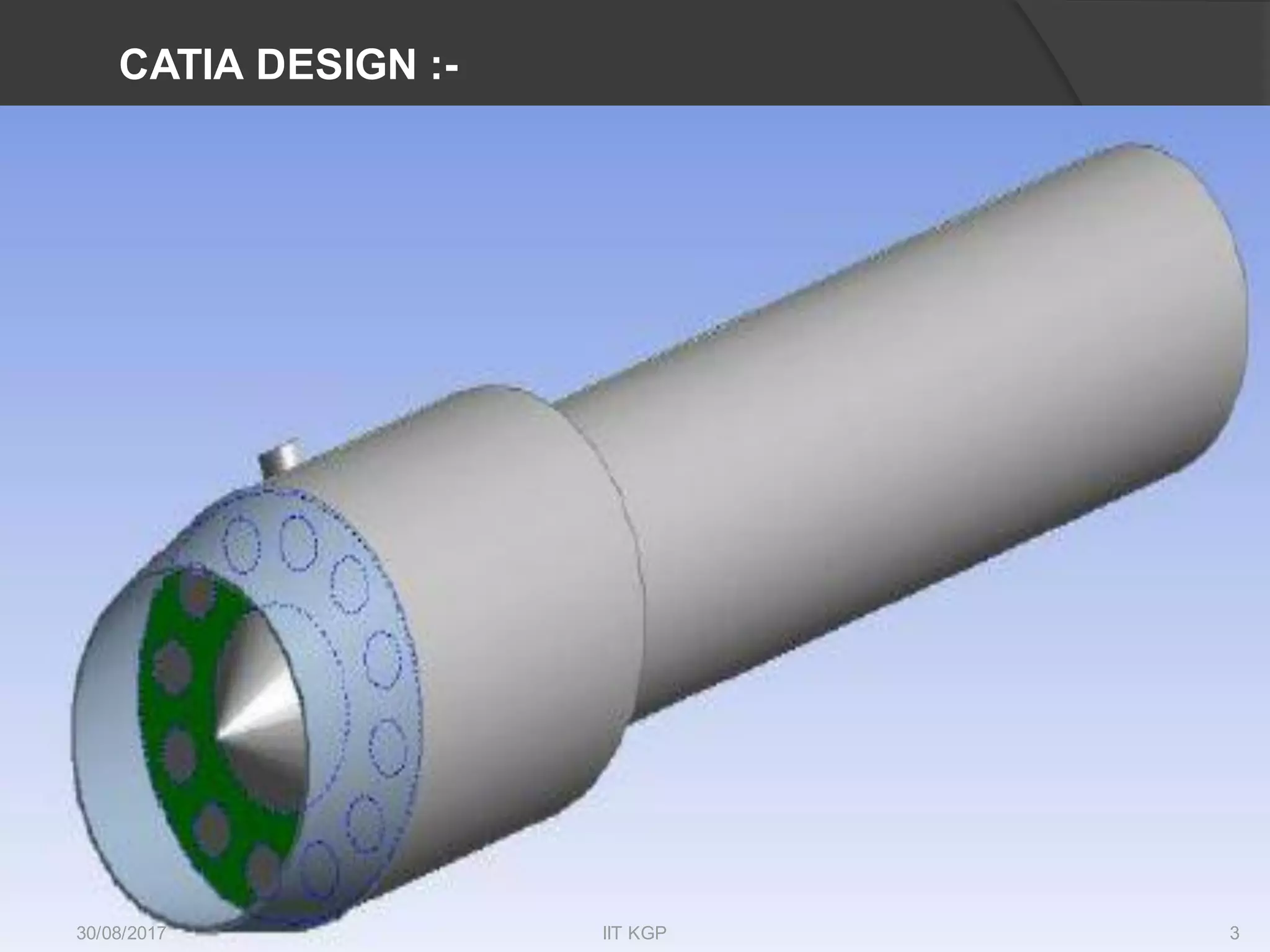
CATIA DESIGN :-
30/08/2017 IIT KGP 3
Meshing:-
Meshing of PJE
• Meshing process carriedout through the body of the designed pulse jet
engine. ICEM CFD is used to do the meshing of the design Pulse jet
engine
• Type of Meshing:-
1.Structured Meshing
2.Unstructured Meshing
30/08/2017 IIT KGP 4
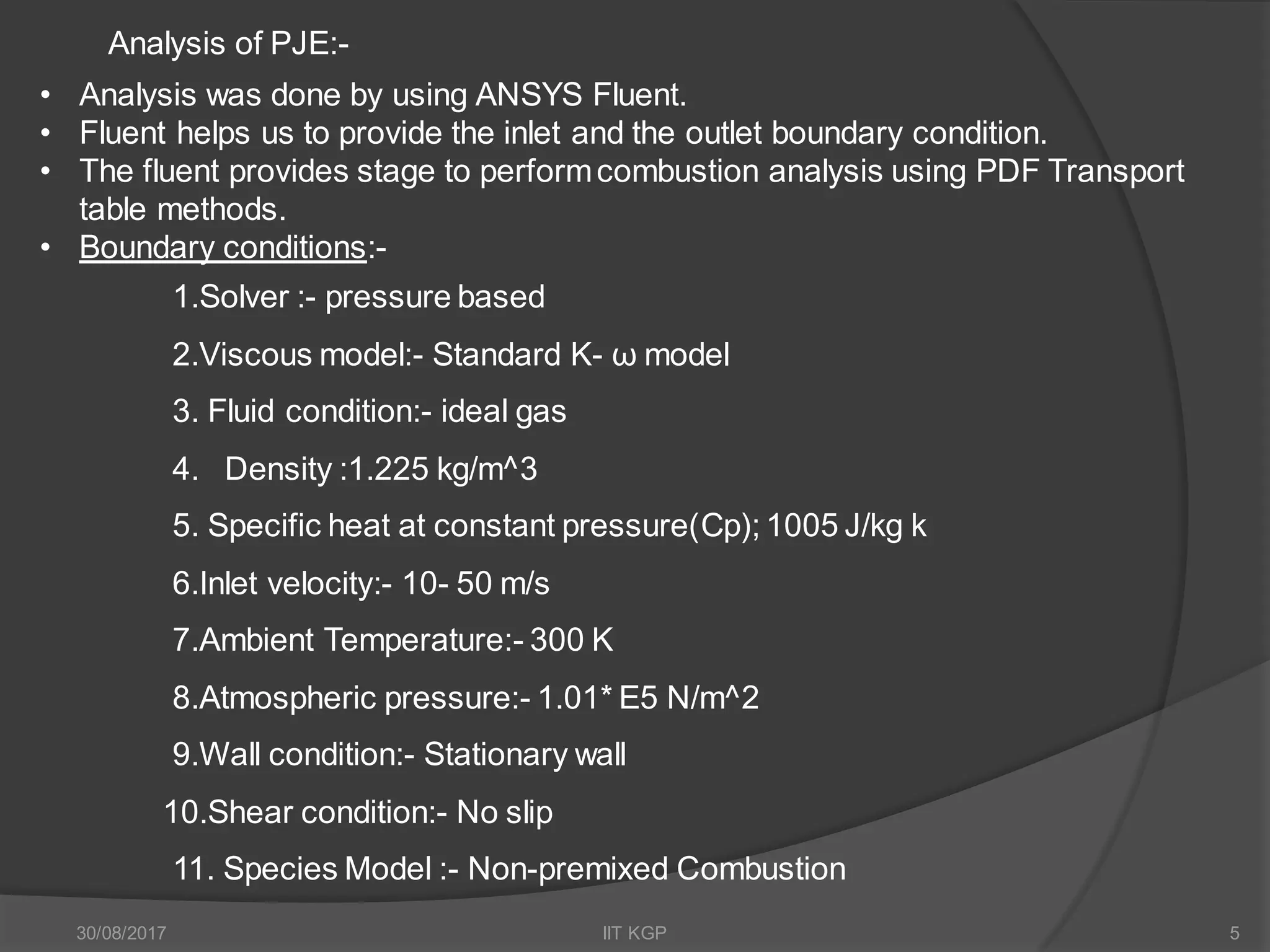
Analysis of PJE:-
• Analysis was done by using ANSYS Fluent.
• Fluent helps us to provide the inlet and the outlet boundary condition.
• The fluent provides stage to performcombustion analysis using PDF Transport
table methods.
• Boundary conditions:-
1.Solver :- pressure based
2.Viscous model:- Standard K- ω model
3. Fluid condition:- ideal gas
4. Density :1.225 kg/m^3
5. Specific heat at constant pressure(Cp); 1005 J/kg k
6.Inlet velocity:- 10- 50 m/s
7.Ambient Temperature:- 300 K
8.Atmospheric pressure:- 1.01* E5 N/m^2
9.Wall condition:- Stationary wall
10.Shear condition:- No slip
11. Species Model :- Non-premixed Combustion
30/08/2017 IIT KGP 5
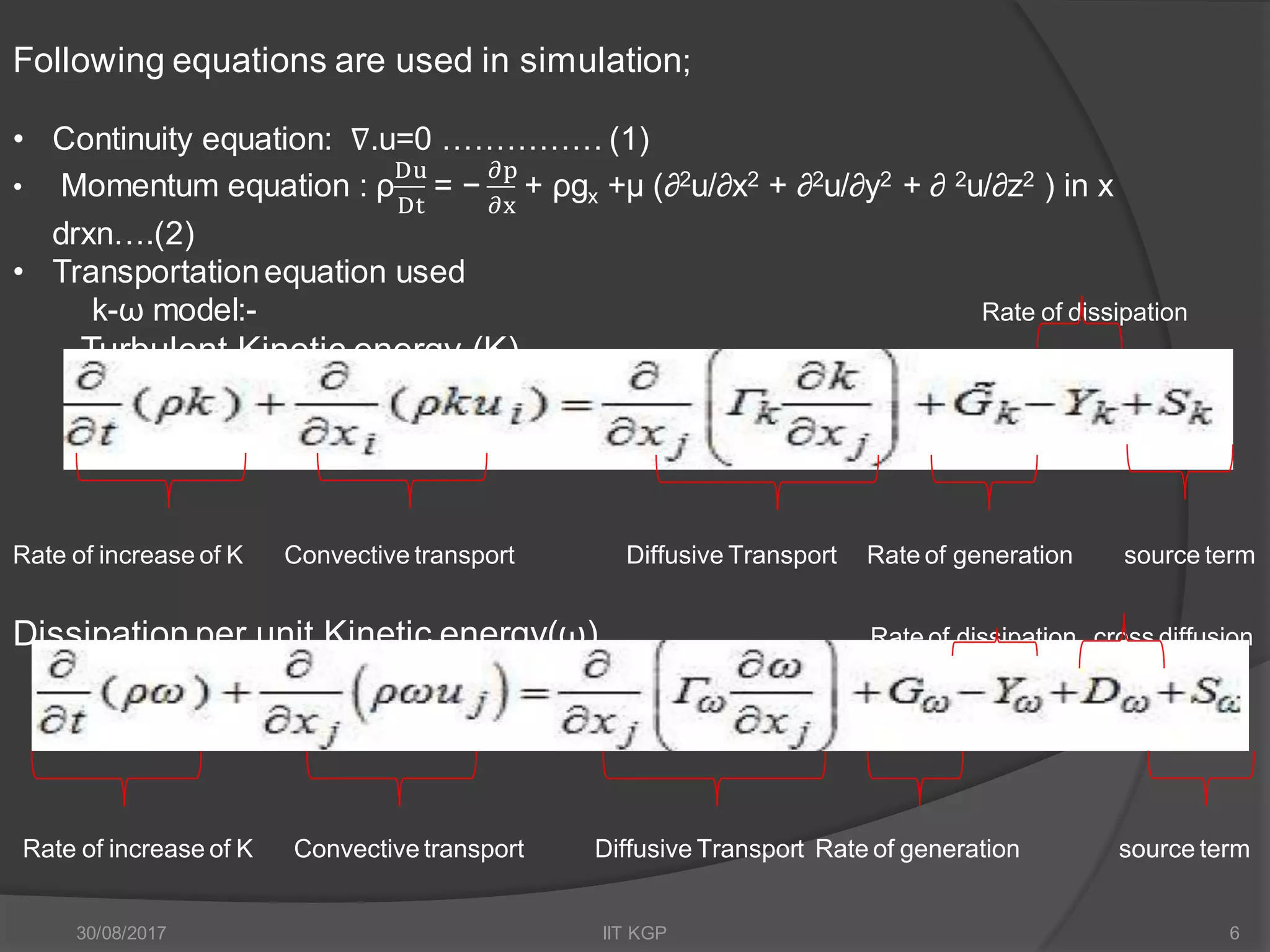
Following equations are used in simulation;
• Continuity equation: ∇.u=0 …………… (1)
• Momentum equation : ρ
Du
Dt
= −
𝜕p
𝜕x
+ ρgx +µ (∂2u/∂x2 + ∂2u/∂y2 + ∂ 2u/∂z2 ) in x
drxn….(2)
• Transportationequation used
k-ω model:- Rate of dissipation
Turbulent Kinetic energy (K)
Rate of increase of K Convective transport Diffusive Transport Rate of generation source term
Dissipation per unit Kinetic energy(ω) Rate of dissipation cross diffusion
Rate of increase of K Convective transport Diffusive Transport Rate of generation source term
30/08/2017 IIT KGP 6
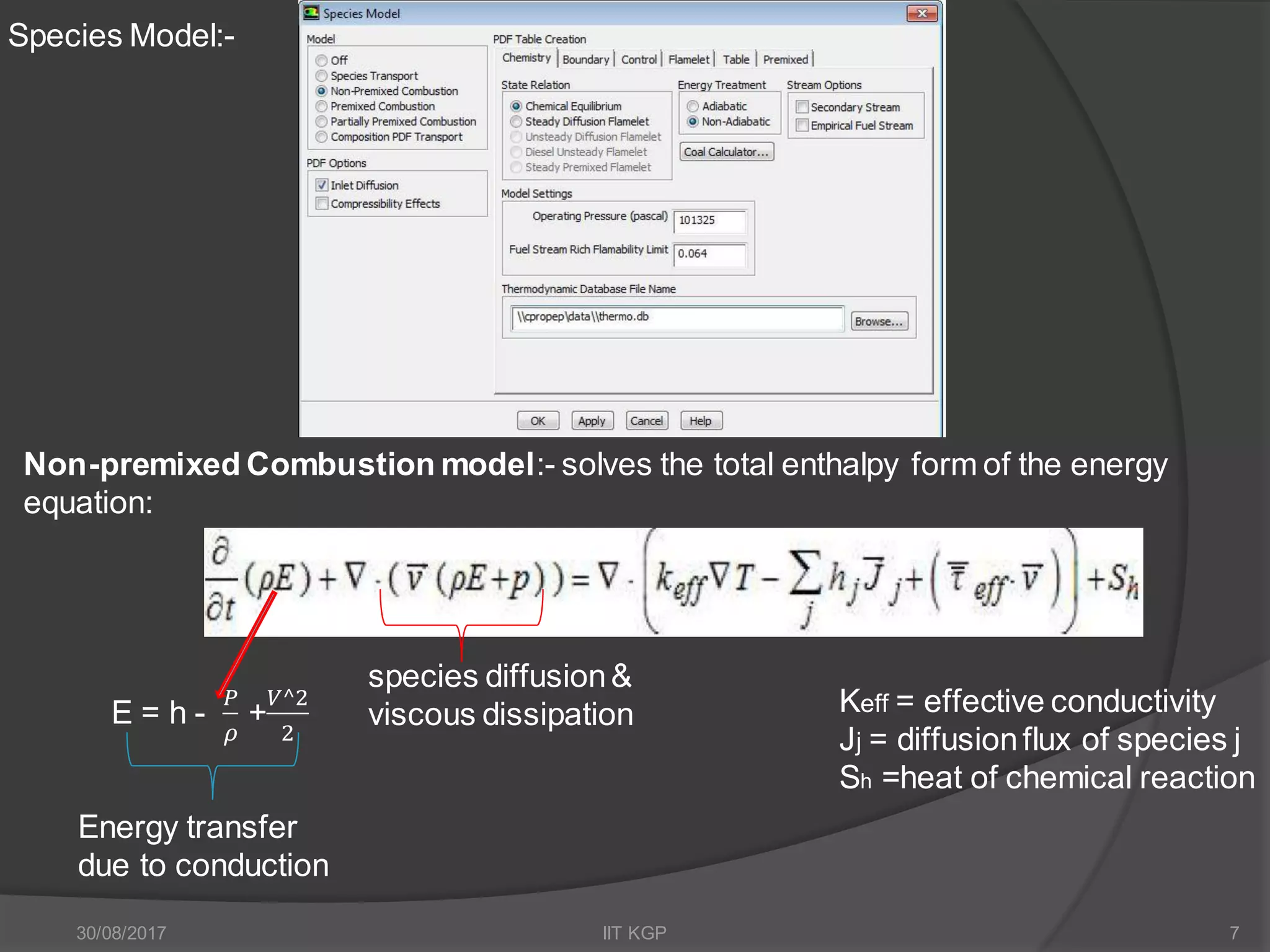
Species Model:-
Non-premixed Combustion model:- solves the total enthalpy form of the energy
equation:
Keff = effective conductivity
Jj = diffusionflux of species j
Sh =heat of chemical reaction
Energy transfer
due to conduction
E = h -
𝑃
𝜌
+
𝑉^2
2
species diffusion&
viscous dissipation
30/08/2017 IIT KGP 7
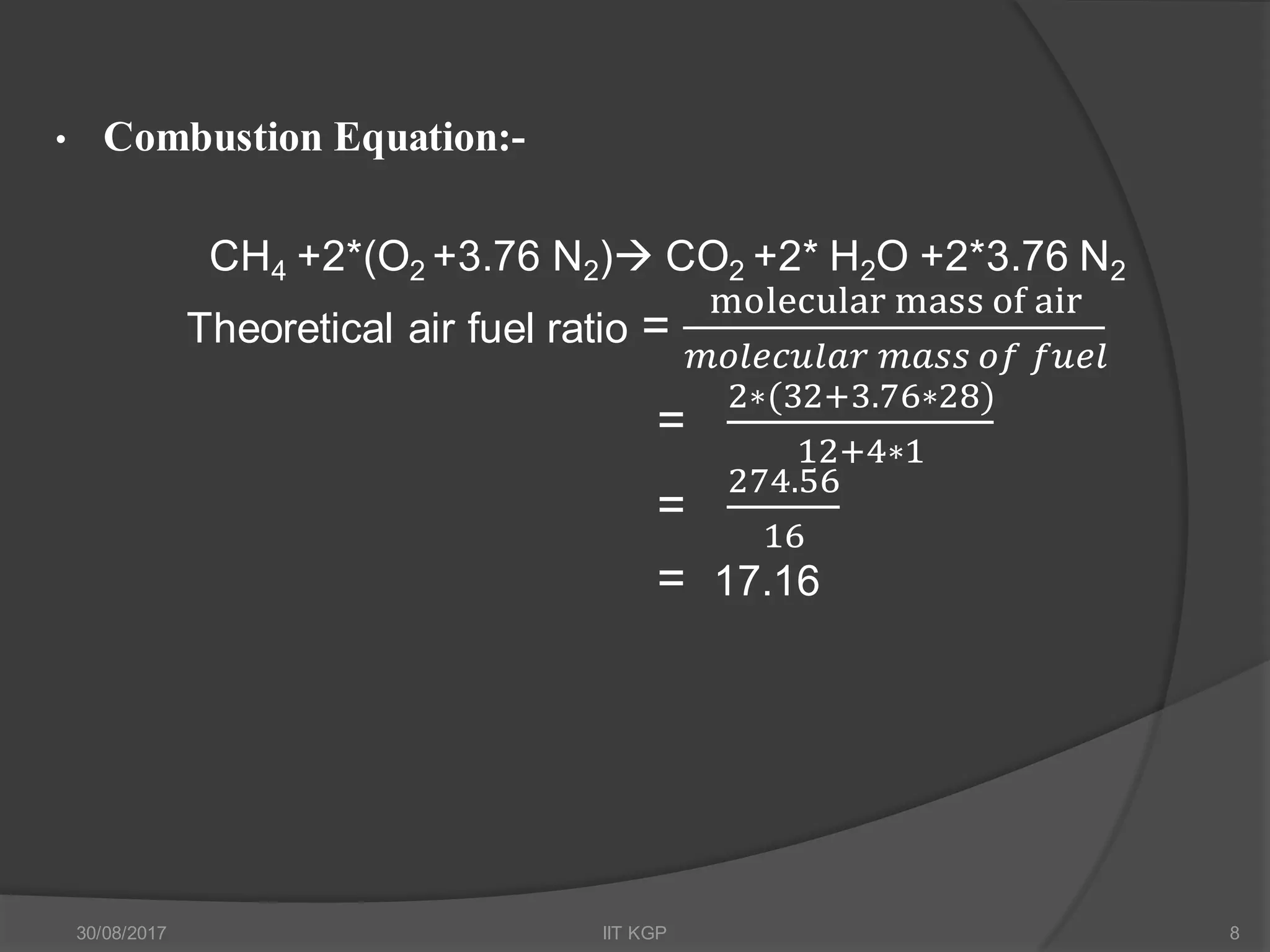
• Combustion Equation:-
CH4 +2*(O2 +3.76 N2) CO2 +2* H2O +2*3.76 N2
Theoretical air fuel ratio =
molecular mass of air
𝑚𝑜𝑙𝑒𝑐𝑢𝑙𝑎𝑟 𝑚𝑎𝑠𝑠 𝑜𝑓 𝑓𝑢𝑒𝑙
=
2∗(32+3.76∗28)
12+4∗1
=
274.56
16
= 17.16
30/08/2017 IIT KGP 8
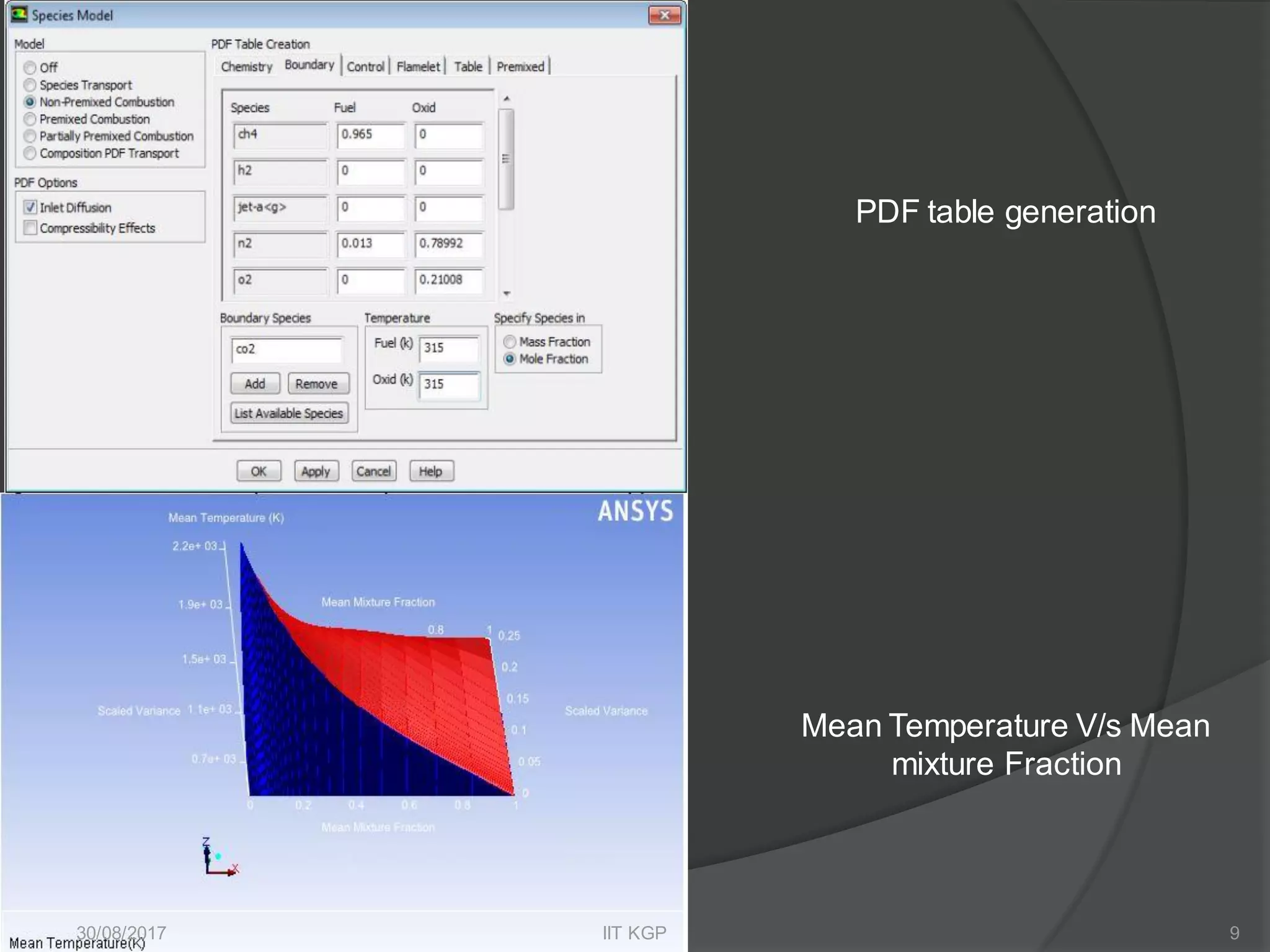
Mean Temperature V/s Mean
mixture Fraction
PDF table generation
30/08/2017 IIT KGP 9
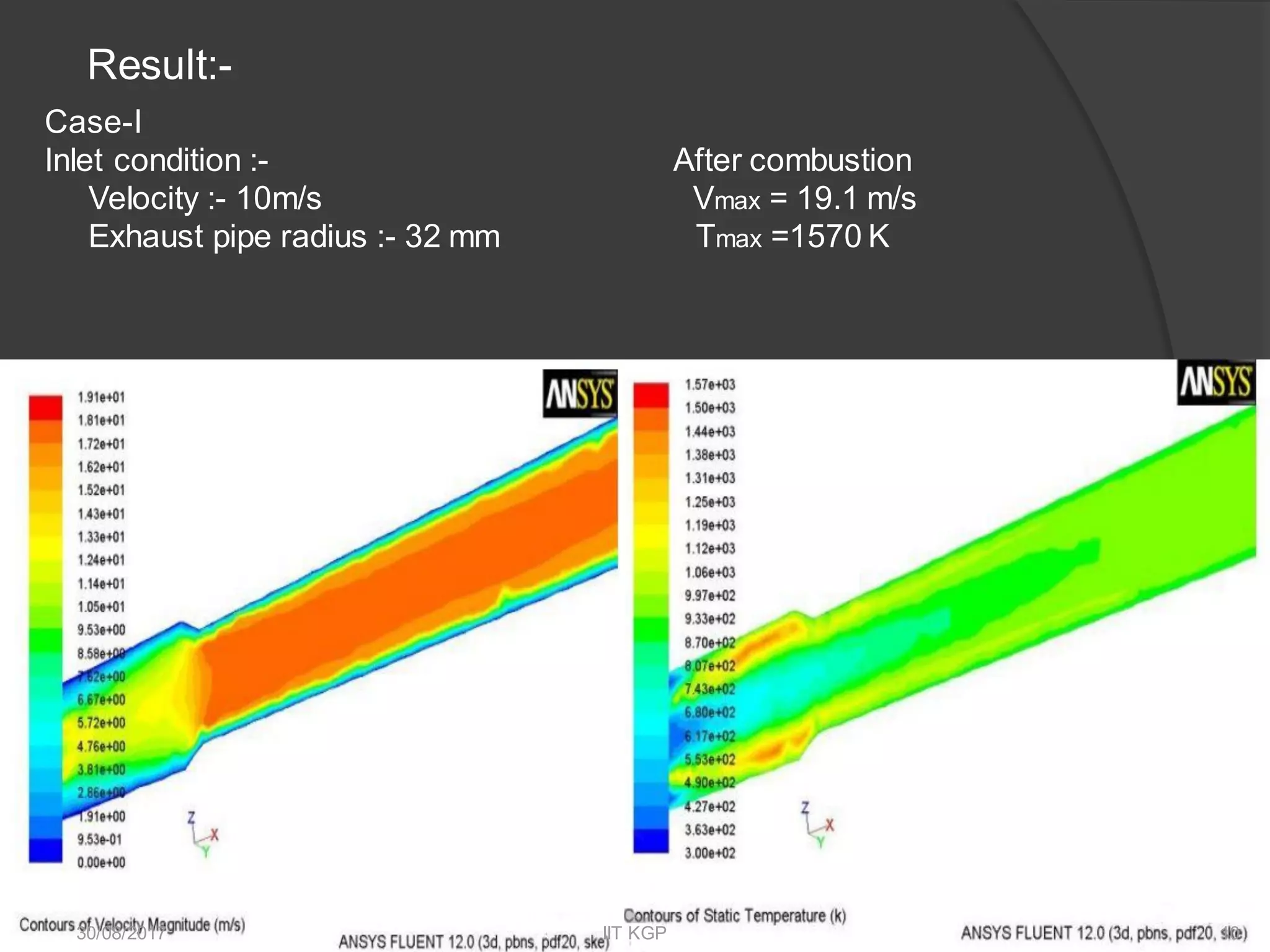
Result:-
Case-I
Inlet condition :- After combustion
Velocity :- 10m/s Vmax = 19.1 m/s
Exhaust pipe radius :- 32 mm Tmax =1570 K
30/08/2017 IIT KGP 10
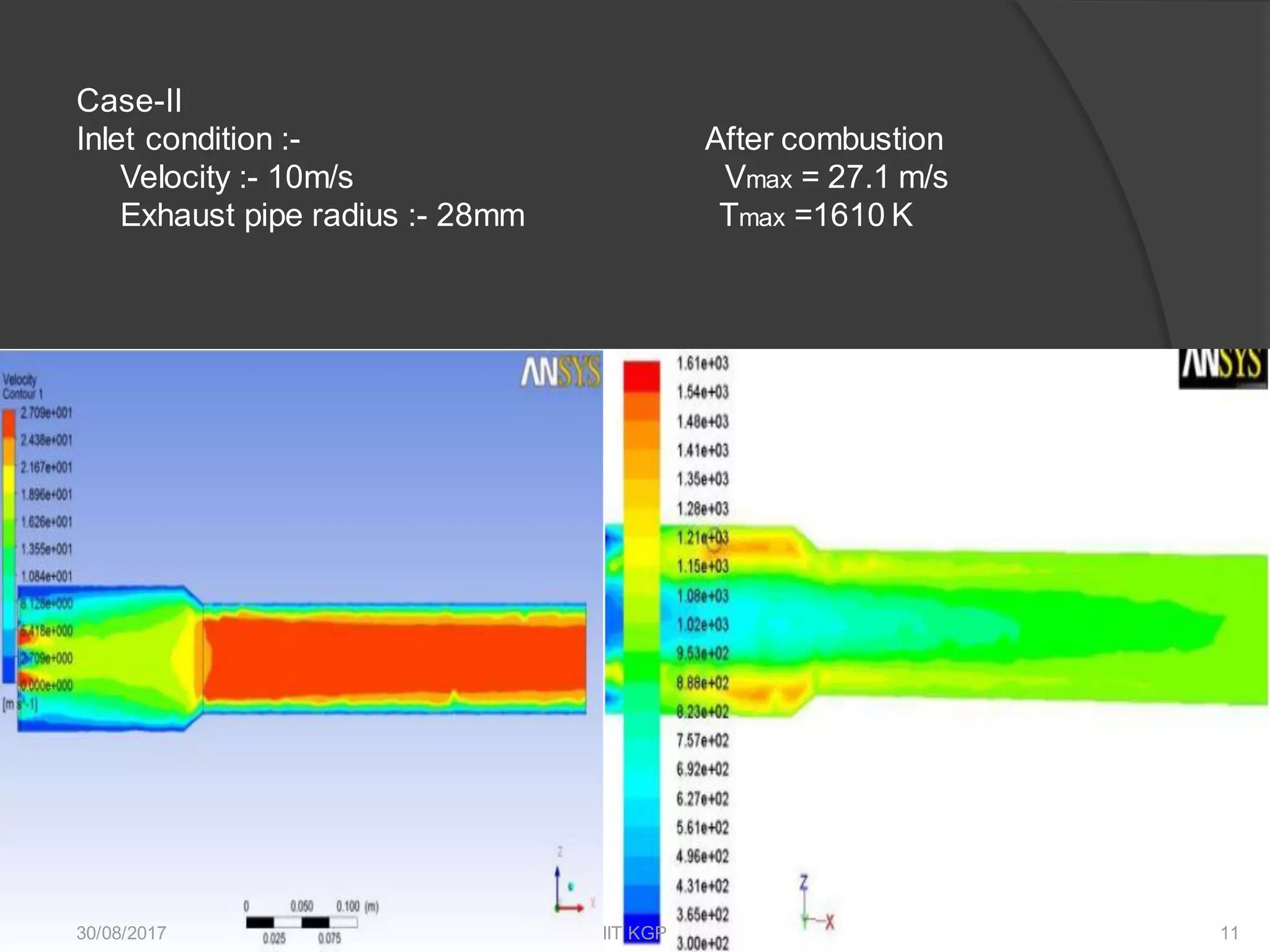
Case-II
Inlet condition :- After combustion
Velocity :- 10m/s Vmax = 27.1 m/s
Exhaust pipe radius :- 28mm Tmax =1610 K
30/08/2017 IIT KGP 11
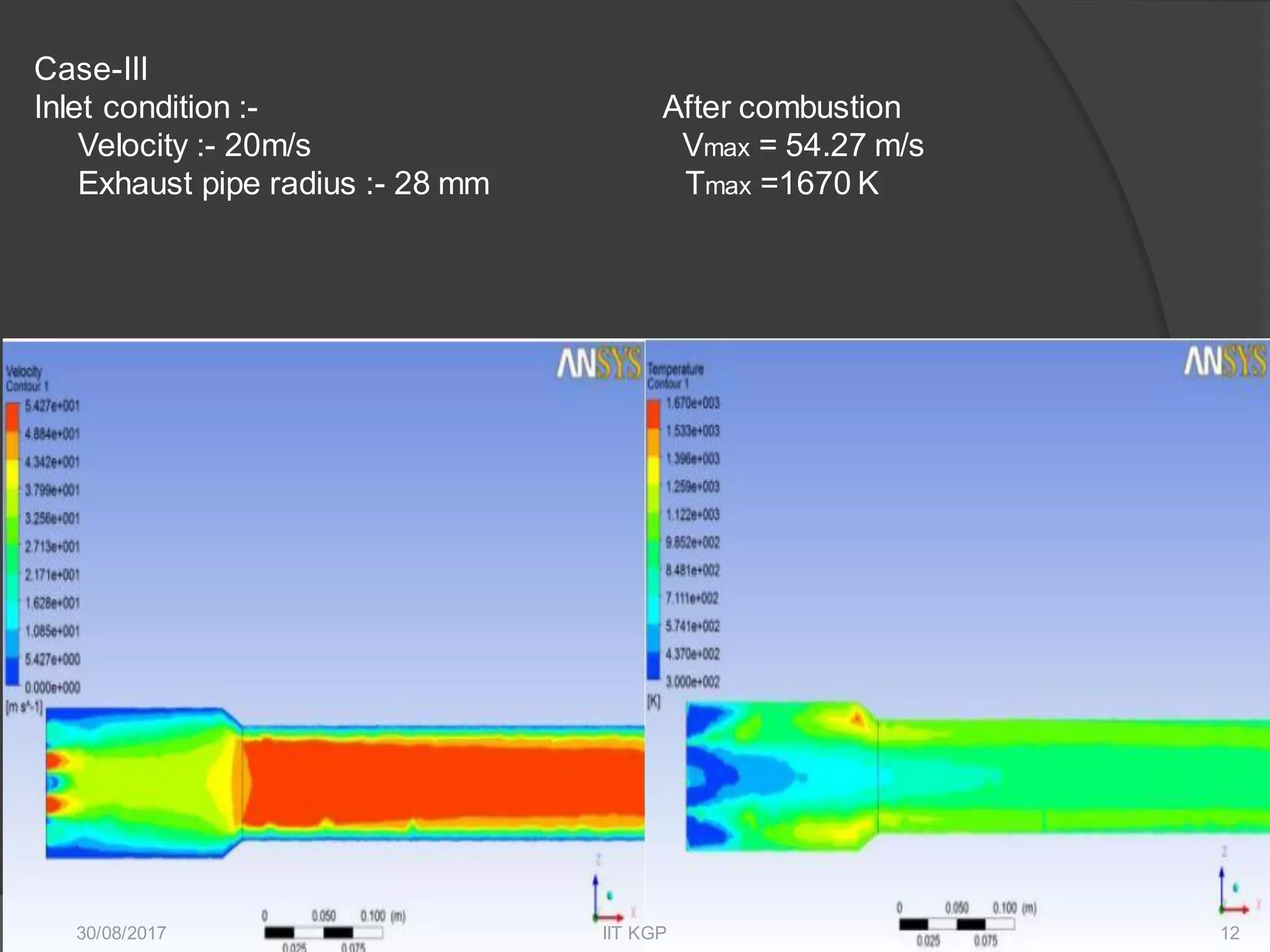
Case-III
Inlet condition :- After combustion
Velocity :- 20m/s Vmax = 54.27 m/s
Exhaust pipe radius :- 28 mm Tmax =1670 K
30/08/2017 IIT KGP 12
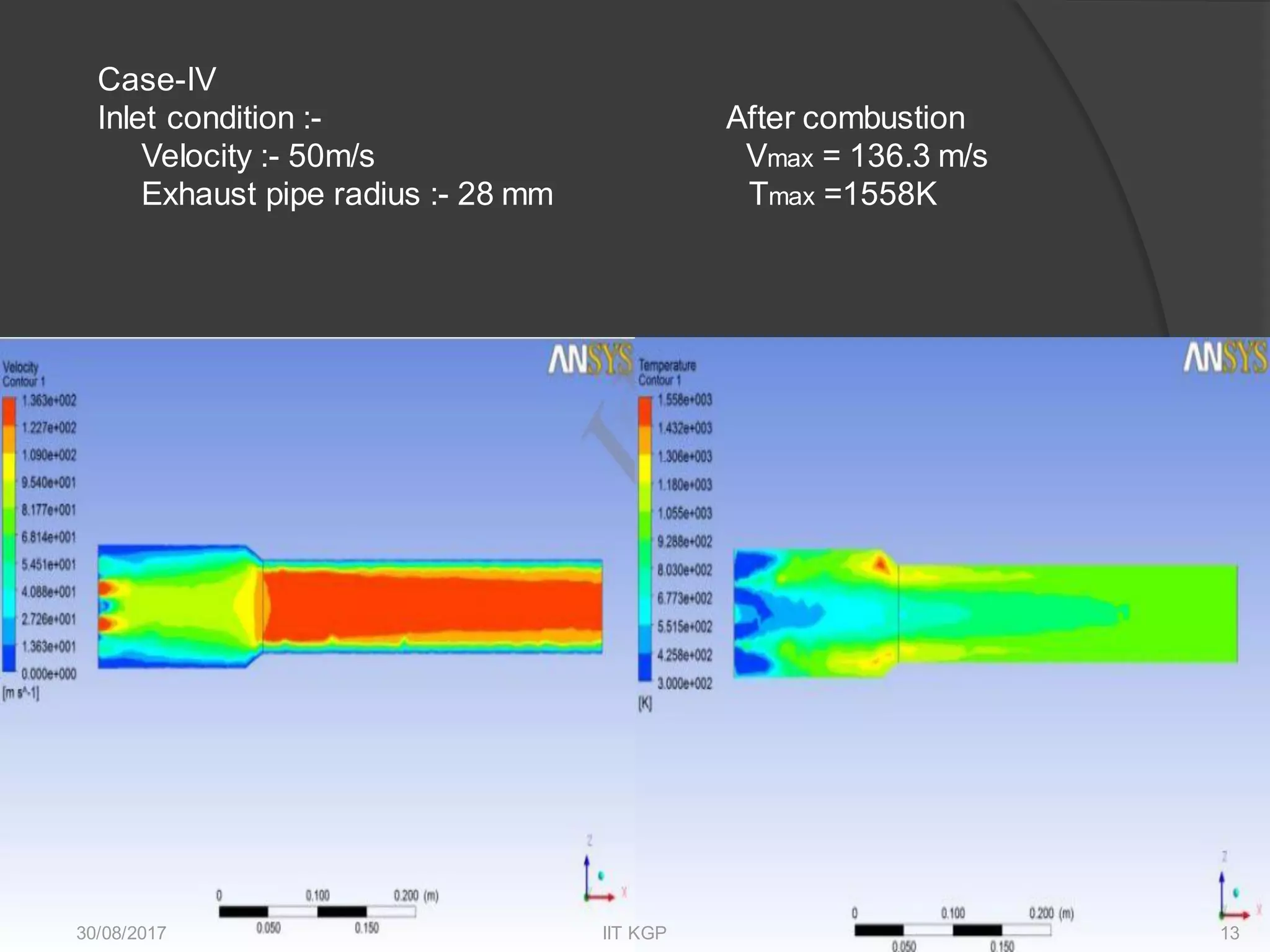
Case-IV
Inlet condition :- After combustion
Velocity :- 50m/s Vmax = 136.3 m/s
Exhaust pipe radius :- 28 mm Tmax =1558K
30/08/2017 IIT KGP 13
CONCLUSION:-
• It is able to maintain a stable pressure , with the minimum pressure below
atmospheric pressure.
• Design of small size Pulsejet Engines is easy as large numbers of
complex equations are eliminated.
• The thrust can be increasedwith decrease in the diameter of exhaust
pipe for same operating condition.
• For Modeling the running pulsejet in a wind tunnel on a sting is very
feasible and when compared with the experimental wind tunnel data.
• CFD tests show feasibility of building a Pulsejet Engine.
• They are inefficient when operated at low flight velocities.
30/08/2017 IIT KGP 14
REFERENCES
[1] Artt, D, Blair, G, RichardsonJ 1982, ‘A Computer Model of a Pulsejet Engine’,
SAE Technical Paper Series, Volume 82 No. 953.
[2] Artt, D, Blair, G, RichardsonJ 1984, ‘Observations on the Design and
Operation of Pulsejet Engines as Derivedfrom an Experimental and Theoretical
Investigation’, SAE Technical Paper Series, Volume 84 No. 422.
[3] Benson, R, Garg, R, Woollatt, D 1964 ‘A Numerical Solution of Unsteady Flow
Problems’, Journal of Mechanical Sciences, Pergamum Press Ltd., Vol. 6.
[4] Fan, Y, Li, J, Wang, J, Zhang, J, Zhang, Y, Experimental investigation on
kerosene/air pneumatic valve pulse detonation engine, Journal of Aerospace
Power. International Journal of Engineering Research& Technology (IJERT)
IJERTIJERT ISSN: 2278-0181 IJERTV3IS090544 Kentfield, J ‘The Potential of
Valveless Pulsejets for Small UAV Propulsion Applications’ AIAA
Journal 1998, No. 3879 .
[6] Ogorelec, B 2005, Valveless Pulsejet Engines 1.5 – a historical review of
valveless pulsejet designs, Terna Information Services, Zagreb Croatia.
[7] Reynst, F H 1961, Pulsating Combustion, Pergamon Press, London ,UK.
[8] Tharatt, C ‘The Propulsive Duct’ Aircraft Engineering, November 1965, pp 327-
337, December 1965, p 359-371 .
[9] Sunnhordvik, A 2007, Valveless Pulse Jet, Accessed 10May 2007.
[10] Simpson, B 2007, The Valveless Pulse Jet, Accessed15April 2007 .
30/08/2017 IIT KGP 15
[11] Geng, Tao, Numerical simulation of pulsejet engines., 2007
[12] Zh eng, Fei, Computational investigations of high speed pulsejets., 200 9
[13] Tao Geng ,Comparison between Numerically Simulated and Experimentally
MeasuredFlow field Quantities behind a Pulsejet , Daniel E Paxson, 200 8
[14] http://aardvark.co.nz/pjet/valveless.html
[15] www.pulsejetbook.com
30/08/2017 IIT KGP 16

Design of pulse jet engine for UAV - 2

  • 1.
    Seminar-2 ROSHAN SAH USN :-17AE60R01 M.Tech (1st Year) Dept. of AerospaceEngineering, Indian Institute of Technology Karagpur (IITKGP)30/08/2017 IIT KGP 1
  • 2.
    Design of thePulse Jet Engine:- Design should be done in such away that above formula should be valid. Valid of above formulas has been verified against a wide number of different and proven pulsejet designs including the Argus VI and Dynajet. By taking above reference, following assumption can be taken:- 1. A = 2.2 F 2. Valve area =0.23* Mean cross- sectionalarea 3. L/D =8 4. Numbers of valves=10 5. Numbers of Gaps =10 6. Efficiencyof Valve = 70% Parameter Magnitude Units Mean Area 32.258 Cm2 Mean Diameter 6.41 Cm Mean Volume 1654.292 Cm3 Length of Pulsejet engine 51.283 Cm Valve Area 7.419 Cm2 Effective Valve area 10.6 Cm2 Diameter of Each Valve 1.162 Cm Size of gaps 0.635 Cm Circumference of valve center circle 17.97 Cm Diameter of Circle 5.723 Cm Area of inner circle Covering valves 14.65 Cm2 Inlet area 47.809 Cm2 Diameter of Inlet 7.804 Cm Length of Combustion Section 16.69 Cm30/08/2017 IIT KGP 2
  • 3.
  • 4.
    Meshing:- Meshing of PJE •Meshing process carriedout through the body of the designed pulse jet engine. ICEM CFD is used to do the meshing of the design Pulse jet engine • Type of Meshing:- 1.Structured Meshing 2.Unstructured Meshing 30/08/2017 IIT KGP 4
  • 5.
    Analysis of PJE:- •Analysis was done by using ANSYS Fluent. • Fluent helps us to provide the inlet and the outlet boundary condition. • The fluent provides stage to performcombustion analysis using PDF Transport table methods. • Boundary conditions:- 1.Solver :- pressure based 2.Viscous model:- Standard K- ω model 3. Fluid condition:- ideal gas 4. Density :1.225 kg/m^3 5. Specific heat at constant pressure(Cp); 1005 J/kg k 6.Inlet velocity:- 10- 50 m/s 7.Ambient Temperature:- 300 K 8.Atmospheric pressure:- 1.01* E5 N/m^2 9.Wall condition:- Stationary wall 10.Shear condition:- No slip 11. Species Model :- Non-premixed Combustion 30/08/2017 IIT KGP 5
  • 6.
    Following equations areused in simulation; • Continuity equation: ∇.u=0 …………… (1) • Momentum equation : ρ Du Dt = − 𝜕p 𝜕x + ρgx +µ (∂2u/∂x2 + ∂2u/∂y2 + ∂ 2u/∂z2 ) in x drxn….(2) • Transportationequation used k-ω model:- Rate of dissipation Turbulent Kinetic energy (K) Rate of increase of K Convective transport Diffusive Transport Rate of generation source term Dissipation per unit Kinetic energy(ω) Rate of dissipation cross diffusion Rate of increase of K Convective transport Diffusive Transport Rate of generation source term 30/08/2017 IIT KGP 6
  • 7.
    Species Model:- Non-premixed Combustionmodel:- solves the total enthalpy form of the energy equation: Keff = effective conductivity Jj = diffusionflux of species j Sh =heat of chemical reaction Energy transfer due to conduction E = h - 𝑃 𝜌 + 𝑉^2 2 species diffusion& viscous dissipation 30/08/2017 IIT KGP 7
  • 8.
    • Combustion Equation:- CH4+2*(O2 +3.76 N2) CO2 +2* H2O +2*3.76 N2 Theoretical air fuel ratio = molecular mass of air 𝑚𝑜𝑙𝑒𝑐𝑢𝑙𝑎𝑟 𝑚𝑎𝑠𝑠 𝑜𝑓 𝑓𝑢𝑒𝑙 = 2∗(32+3.76∗28) 12+4∗1 = 274.56 16 = 17.16 30/08/2017 IIT KGP 8
  • 9.
    Mean Temperature V/sMean mixture Fraction PDF table generation 30/08/2017 IIT KGP 9
  • 10.
    Result:- Case-I Inlet condition :-After combustion Velocity :- 10m/s Vmax = 19.1 m/s Exhaust pipe radius :- 32 mm Tmax =1570 K 30/08/2017 IIT KGP 10
  • 11.
    Case-II Inlet condition :-After combustion Velocity :- 10m/s Vmax = 27.1 m/s Exhaust pipe radius :- 28mm Tmax =1610 K 30/08/2017 IIT KGP 11
  • 12.
    Case-III Inlet condition :-After combustion Velocity :- 20m/s Vmax = 54.27 m/s Exhaust pipe radius :- 28 mm Tmax =1670 K 30/08/2017 IIT KGP 12
  • 13.
    Case-IV Inlet condition :-After combustion Velocity :- 50m/s Vmax = 136.3 m/s Exhaust pipe radius :- 28 mm Tmax =1558K 30/08/2017 IIT KGP 13
  • 14.
    CONCLUSION:- • It isable to maintain a stable pressure , with the minimum pressure below atmospheric pressure. • Design of small size Pulsejet Engines is easy as large numbers of complex equations are eliminated. • The thrust can be increasedwith decrease in the diameter of exhaust pipe for same operating condition. • For Modeling the running pulsejet in a wind tunnel on a sting is very feasible and when compared with the experimental wind tunnel data. • CFD tests show feasibility of building a Pulsejet Engine. • They are inefficient when operated at low flight velocities. 30/08/2017 IIT KGP 14
  • 15.
    REFERENCES [1] Artt, D,Blair, G, RichardsonJ 1982, ‘A Computer Model of a Pulsejet Engine’, SAE Technical Paper Series, Volume 82 No. 953. [2] Artt, D, Blair, G, RichardsonJ 1984, ‘Observations on the Design and Operation of Pulsejet Engines as Derivedfrom an Experimental and Theoretical Investigation’, SAE Technical Paper Series, Volume 84 No. 422. [3] Benson, R, Garg, R, Woollatt, D 1964 ‘A Numerical Solution of Unsteady Flow Problems’, Journal of Mechanical Sciences, Pergamum Press Ltd., Vol. 6. [4] Fan, Y, Li, J, Wang, J, Zhang, J, Zhang, Y, Experimental investigation on kerosene/air pneumatic valve pulse detonation engine, Journal of Aerospace Power. International Journal of Engineering Research& Technology (IJERT) IJERTIJERT ISSN: 2278-0181 IJERTV3IS090544 Kentfield, J ‘The Potential of Valveless Pulsejets for Small UAV Propulsion Applications’ AIAA Journal 1998, No. 3879 . [6] Ogorelec, B 2005, Valveless Pulsejet Engines 1.5 – a historical review of valveless pulsejet designs, Terna Information Services, Zagreb Croatia. [7] Reynst, F H 1961, Pulsating Combustion, Pergamon Press, London ,UK. [8] Tharatt, C ‘The Propulsive Duct’ Aircraft Engineering, November 1965, pp 327- 337, December 1965, p 359-371 . [9] Sunnhordvik, A 2007, Valveless Pulse Jet, Accessed 10May 2007. [10] Simpson, B 2007, The Valveless Pulse Jet, Accessed15April 2007 . 30/08/2017 IIT KGP 15
  • 16.
    [11] Geng, Tao,Numerical simulation of pulsejet engines., 2007 [12] Zh eng, Fei, Computational investigations of high speed pulsejets., 200 9 [13] Tao Geng ,Comparison between Numerically Simulated and Experimentally MeasuredFlow field Quantities behind a Pulsejet , Daniel E Paxson, 200 8 [14] http://aardvark.co.nz/pjet/valveless.html [15] www.pulsejetbook.com 30/08/2017 IIT KGP 16