International Journal of Mechanical Engineering and Technology (IJMET), ISSN 0976 – 6340(Print),
ISSN 0976 – 6359(Online), Volume 5, Issue 12, December (2014), pp. 110-117 © IAEME
110
DESIGN AND TESTING OF STIRLING TYPE COAXIAL
PULSE TUBE CRYOCOOLER
Sandeep S.Patil
Department of Mechanical Engineering, Walchand College of Engineering,
Sangli, Maharashtra-416414, India
B S.Gawali
Department of Mechanical Engineering, Walchand College of Engineering,
Sangli, Maharashtra-416414, India
ABSTRACT
Pulse Tube refrigerators have the potential to be widely applied for producing low
temperatures. The most common cryocoolers are either of recuperative or regenerative type. Based
on the relative position of regenerator and pulse tube we have various configurations like, inline, u-
shaped, coaxial and annular. Our area of interest is designing and developing a stirling type, split
coaxial pulse tube and suitable linear compressor. The aim is to achieve 80K temperature .The model
used for preliminary design is isothermal. Design and fabrication was done in Walchand college and
testing was done in Cryogenics lab, IIT, Powai,Mumbai.The results in hand show that the lowest
temperature achieved is 94k, with 100W of input power and 92K, with 150W of input power,
without any heat load. Exprimental investigations and optimization is done with design and
operating parameters. A suitable linear motor compressor, moving coil type is in final stage of
manufacturing.
Key words: Coaxial, Inertance Tube, Pulse tube, Regenerator, Stirling.
1. INTRODUCTION
Considerable work has been reported on the Pulse Tube cryocoolers. Currently lot of work is
going on Pulse Tube cryocoolers. Because of the improvements in the Pulse Tube performance its
application area is increasing very fast. Mostly the Pulse Tube cryocoolers are taking the place of
INTERNATIONAL JOURNAL OF MECHANICAL ENGINEERING AND
TECHNOLOGY (IJMET)
ISSN 0976 – 6340 (Print)
ISSN 0976 – 6359 (Online)
Volume 5, Issue 12, December (2014), pp. 110-117
© IAEME: www.iaeme.com/IJMET.asp
Journal Impact Factor (2014): 7.5377 (Calculated by GISI)
www.jifactor.com
IJMET
© I A E M E
International Journal of Mechanical Engineering and Technology (IJMET), ISSN 0976 – 6340(Print),
ISSN 0976 – 6359(Online), Volume 5, Issue 12, December (2014), pp. 110-117 © IAEME
111
Stirling cycle cryocooler in miniature cryocoolers. New applications of cryocoolers are appearing,
and the requirements for old applications are often undergoing changes. These new and changing
cryocooler requirements have been the impetus for the recent developments in cryocoolers. The lack
of a suitable cryocooler to meet the requirements of a particular application has hampered the
advancement of many applications. The main problems associated with cryocoolers are: reliability,
efficiency, size, weight, vibration and cost. The seriousness of each of these problems depends on the
application. Within the last 15 years satellite applications for cooled infrared sensors have become
much more important. Obviously these applications require a cryocooler with very high reliability,
high efficiency, small size, low weight, and low vibrations. A significant amount of cryocooler
development in the last 15 years has been focused on space applications. Most of the new
developments on Stirling cryocoolers have been focused towards the techniques to improve
reliability. The rapid growth of research and development on Pulse Tube cryocoolers in the last
decade has been because of its potential for improved reliability, simplicity and low cost.
2. COAXIAL GEOMETRICAL ARRANGEMENT OF PTC
Based on geometrical arrangement, Richardson [1] classified Pulse Tube cryocoolers as:
linear,U- tube, Annular and Coaxial Pulse Tube cryocooler. Out of these, each one has it’s own
advantages and disadvantages. The coaxial design overcomes the problem of viscous effect by
accommodating the regenerator in the annular space and using the central cylinder as the pulse tube.
In Walchand College of Engineering, lot of research work is currently going on in Cryogenics field.
But this is the first time that a Coaxial Pulse Tube cryocooler is developed. The present research
work aims to develop a stirling type, split, coaxial pulse tube and a linear compressor (moving coil
type), with 100W of input power. At first the coaxial setup was developed, and later the suitable
compressor, therefore the pulse tube setup was first tested in Cryogenics lab IIT Powai. A
indigenously build compressor[2,3] of 300W capacity was used for testing at IIT,Powai,Mumbai.
3. DESIGN & ANALYSIS OF COAXIAL PTC.
The modeling techniques range in degree of difficulty from the back-of-the-envelop
calculation, to sophisticated nodal network analyses. First order analyses are good for preliminary
design purposes. The classical analysis of the operation of Stirling machines is due to Schmidt. The
second order approach is basically applying the ideal Schmidt analysis [4] (First Order Analysis)
with coupled loss terms. Atrey et al. [5, 6] presented more realistic approach for the analysis of
Stirling cycle liquefier. Zhu and Chen [7] developed isothermal model for analysis of Pulse Tube
cryocooler. The above models are used to design the coaxial PTC, but some losses which arise due to
1800
turn of the gas are not taken into account.
4. FABRICATION AND ASSEMBLY OF COAXIAL PTC.
Fabrication and assembly was done in Walchand college of Engineering and nearby
industries. This setup consists of components which need very close tolerance. Manufacturing of
Pulse tube of very thin thickness was a challenge, but it was accomplished. Regenerator and Pulse
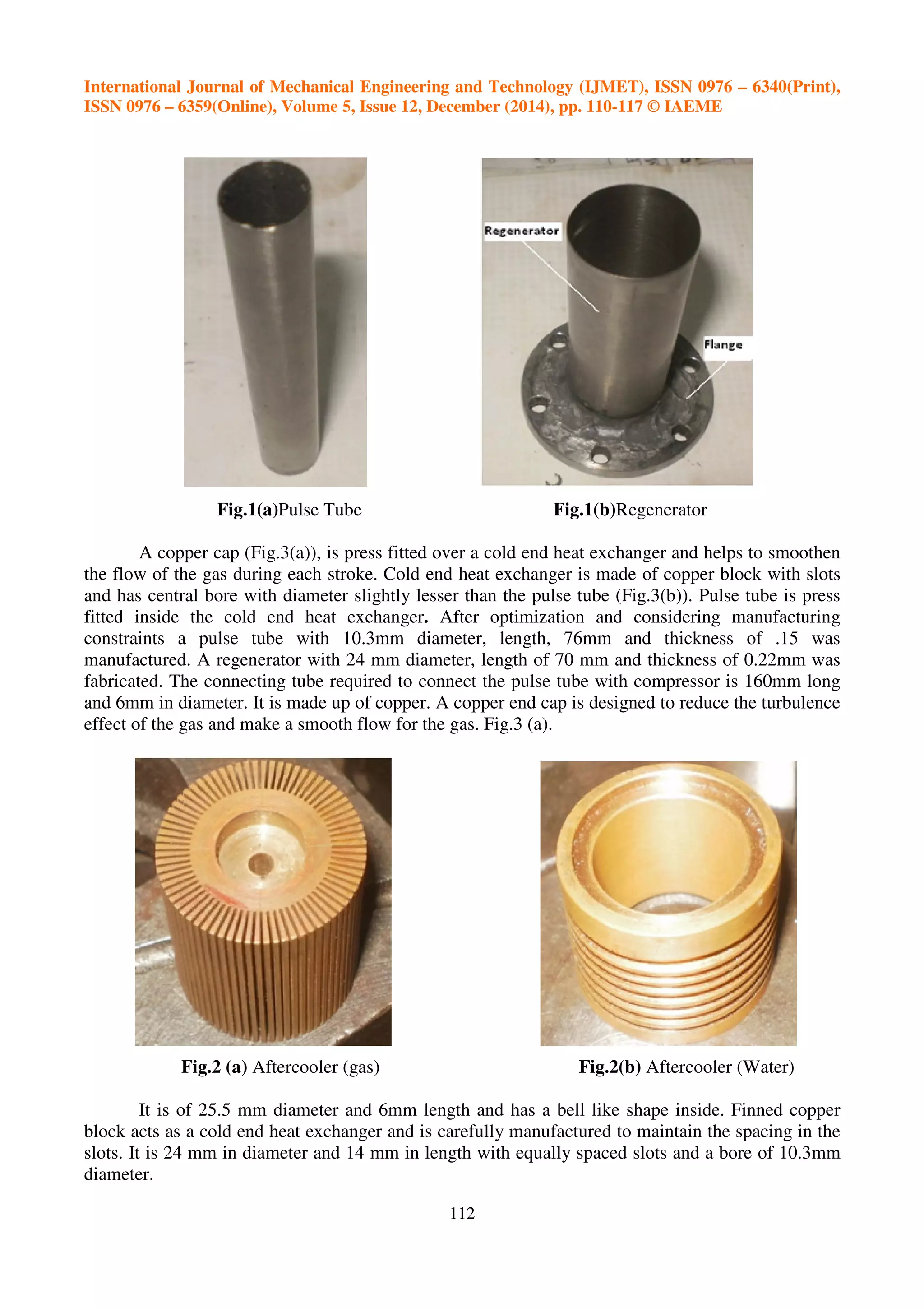
tube are made up of stainless steel. As shown in fig. 1. (a& b).
International Journal of Mechanical Engineering and Technology (IJMET), ISSN 0976 – 6340(Print),
ISSN 0976 – 6359(Online), Volume 5, Issue 12, December (2014), pp. 110-117 © IAEME
112
Fig.1(a)Pulse Tube Fig.1(b)Regenerator
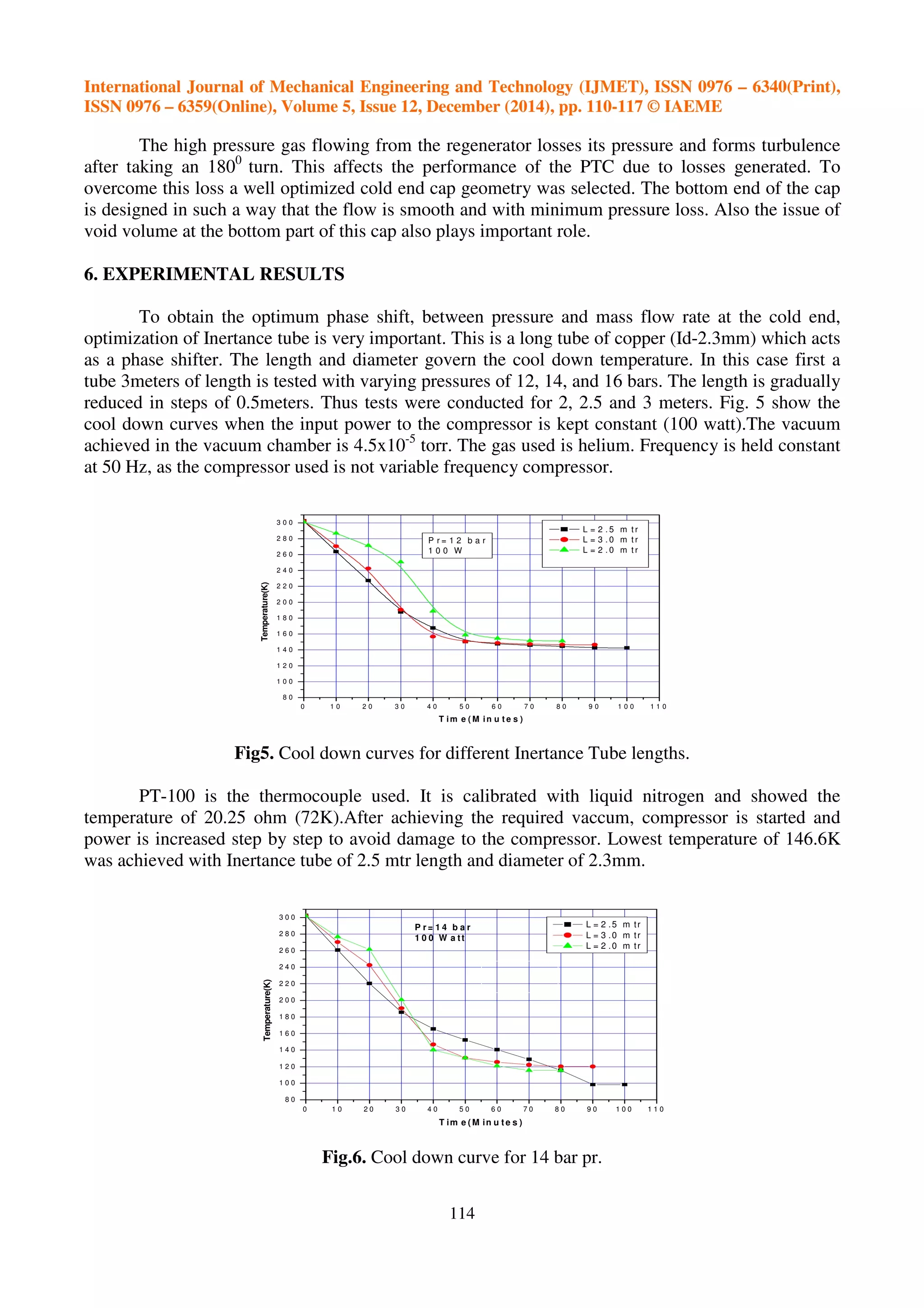
A copper cap (Fig.3(a)), is press fitted over a cold end heat exchanger and helps to smoothen
the flow of the gas during each stroke. Cold end heat exchanger is made of copper block with slots
and has central bore with diameter slightly lesser than the pulse tube (Fig.3(b)). Pulse tube is press
fitted inside the cold end heat exchanger. After optimization and considering manufacturing
constraints a pulse tube with 10.3mm diameter, length, 76mm and thickness of .15 was
manufactured. A regenerator with 24 mm diameter, length of 70 mm and thickness of 0.22mm was
fabricated. The connecting tube required to connect the pulse tube with compressor is 160mm long
and 6mm in diameter. It is made up of copper. A copper end cap is designed to reduce the turbulence
effect of the gas and make a smooth flow for the gas. Fig.3 (a).
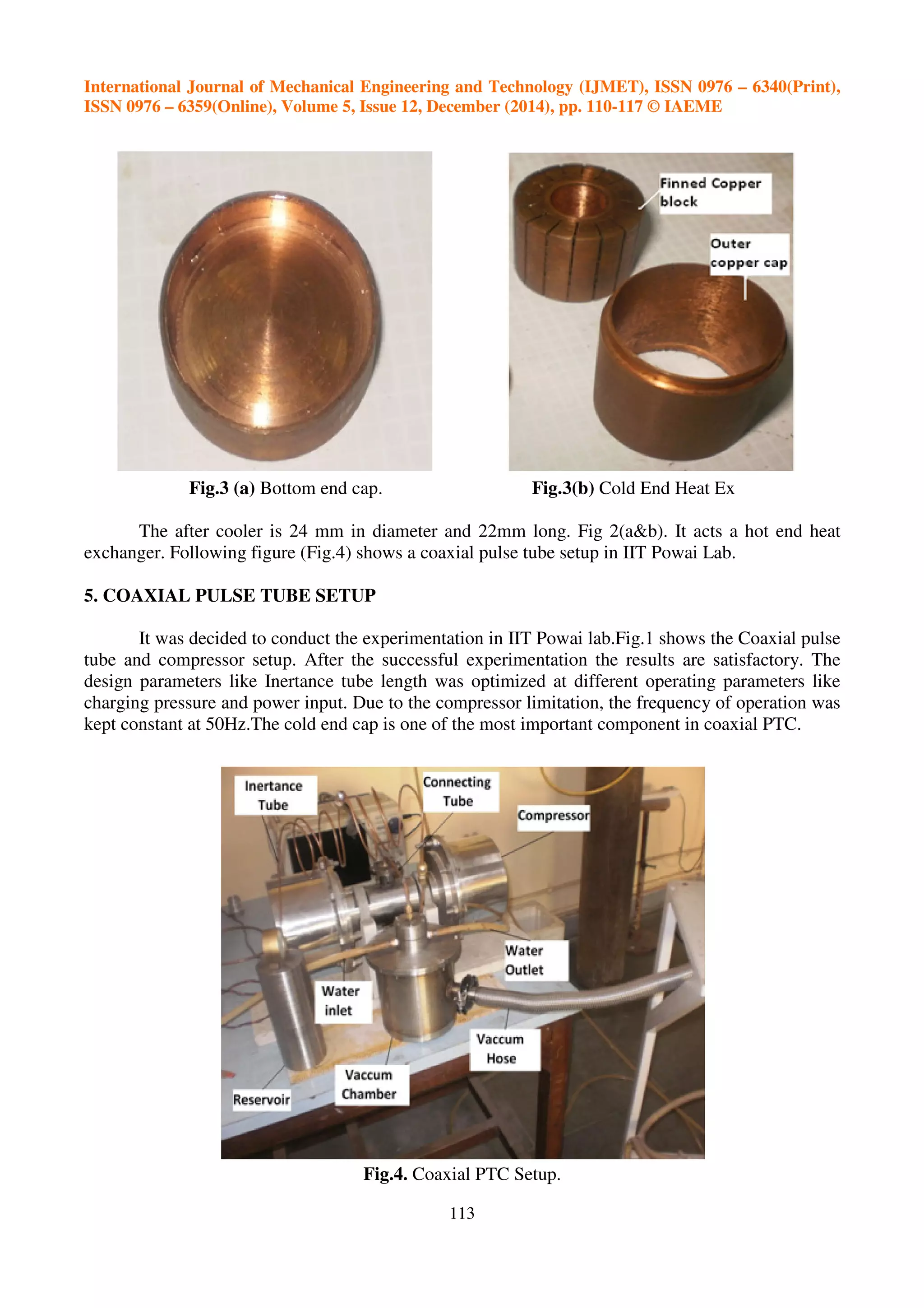
Fig.2 (a) Aftercooler (gas) Fig.2(b) Aftercooler (Water)
It is of 25.5 mm diameter and 6mm length and has a bell like shape inside. Finned copper
block acts as a cold end heat exchanger and is carefully manufactured to maintain the spacing in the
slots. It is 24 mm in diameter and 14 mm in length with equally spaced slots and a bore of 10.3mm
diameter.
International Journal of Mechanical Engineering and Technology (IJMET), ISSN 0976 – 6340(Print),
ISSN 0976 – 6359(Online), Volume 5, Issue 12, December (2014), pp. 110-117 © IAEME
113
Fig.3 (a) Bottom end cap. Fig.3(b) Cold End Heat Ex
The after cooler is 24 mm in diameter and 22mm long. Fig 2(a&b). It acts a hot end heat
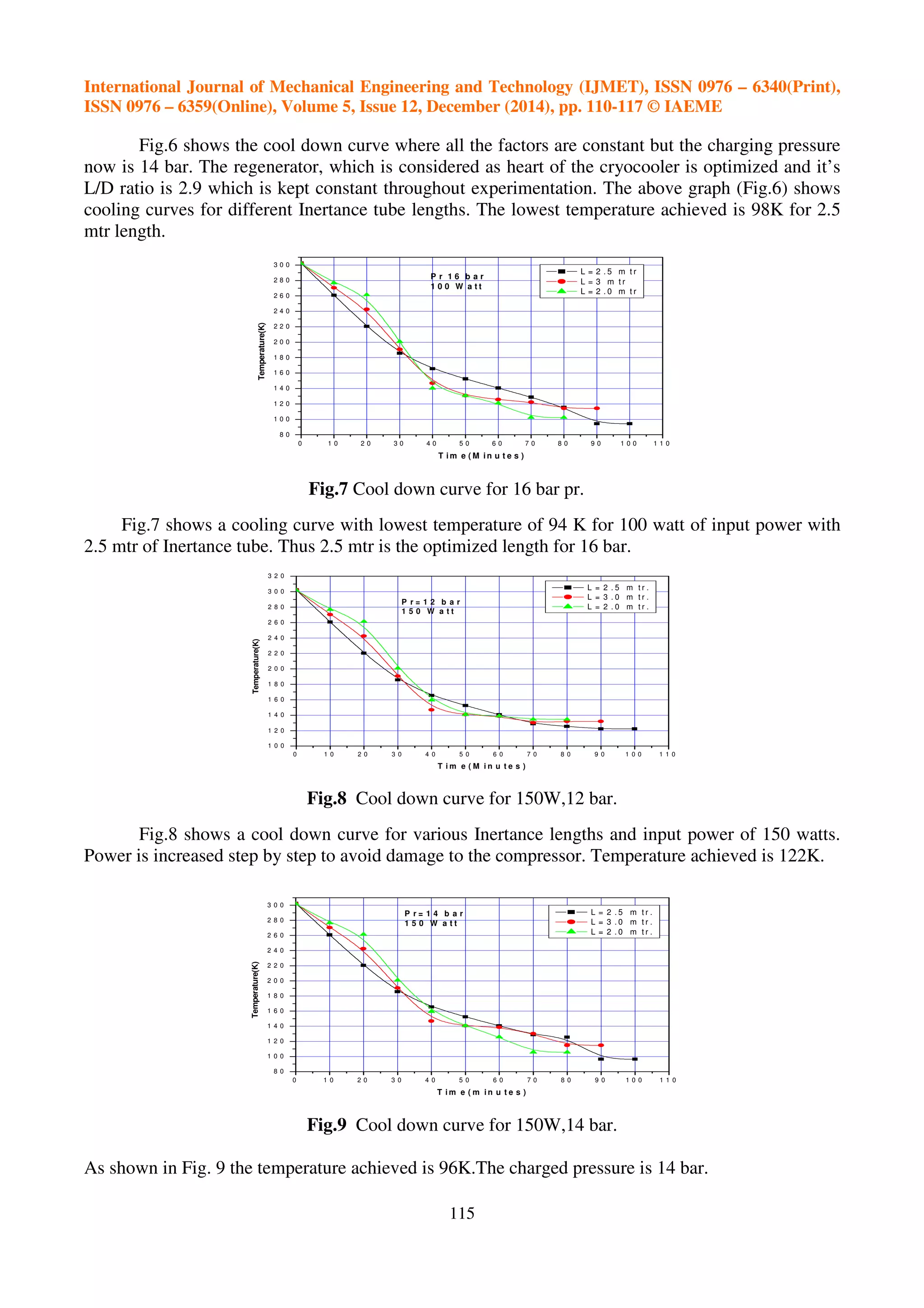
exchanger. Following figure (Fig.4) shows a coaxial pulse tube setup in IIT Powai Lab.
5. COAXIAL PULSE TUBE SETUP
It was decided to conduct the experimentation in IIT Powai lab.Fig.1 shows the Coaxial pulse
tube and compressor setup. After the successful experimentation the results are satisfactory. The
design parameters like Inertance tube length was optimized at different operating parameters like
charging pressure and power input. Due to the compressor limitation, the frequency of operation was
kept constant at 50Hz.The cold end cap is one of the most important component in coaxial PTC.
Fig.4. Coaxial PTC Setup.
International Journal of Mechanical Engineering and Technology (IJMET), ISSN 0976 – 6340(Print),
ISSN 0976 – 6359(Online), Volume 5, Issue 12, December (2014), pp. 110-117 © IAEME
114
The high pressure gas flowing from the regenerator losses its pressure and forms turbulence
after taking an 1800
turn. This affects the performance of the PTC due to losses generated. To
overcome this loss a well optimized cold end cap geometry was selected. The bottom end of the cap
is designed in such a way that the flow is smooth and with minimum pressure loss. Also the issue of
void volume at the bottom part of this cap also plays important role.
6. EXPERIMENTAL RESULTS
To obtain the optimum phase shift, between pressure and mass flow rate at the cold end,
optimization of Inertance tube is very important. This is a long tube of copper (Id-2.3mm) which acts
as a phase shifter. The length and diameter govern the cool down temperature. In this case first a
tube 3meters of length is tested with varying pressures of 12, 14, and 16 bars. The length is gradually
reduced in steps of 0.5meters. Thus tests were conducted for 2, 2.5 and 3 meters. Fig. 5 show the
cool down curves when the input power to the compressor is kept constant (100 watt).The vacuum
achieved in the vacuum chamber is 4.5x10⁻⁵
torr. The gas used is helium. Frequency is held constant
at 50 Hz, as the compressor used is not variable frequency compressor.
0 1 0 2 0 3 0 4 0 5 0 6 0 7 0 8 0 9 0 1 0 0 1 1 0
8 0
1 0 0
1 2 0
1 4 0
1 6 0
1 8 0
2 0 0
2 2 0
2 4 0
2 6 0
2 8 0
3 0 0
P r = 1 2 b a r
1 0 0 W
Temperature(K)
T im e ( M in u t e s )
L = 2 . 5 m t r
L = 3 . 0 m t r
L = 2 . 0 m t r
Fig5. Cool down curves for different Inertance Tube lengths.
PT-100 is the thermocouple used. It is calibrated with liquid nitrogen and showed the
temperature of 20.25 ohm (72K).After achieving the required vaccum, compressor is started and
power is increased step by step to avoid damage to the compressor. Lowest temperature of 146.6K
was achieved with Inertance tube of 2.5 mtr length and diameter of 2.3mm.
0 1 0 2 0 3 0 4 0 5 0 6 0 7 0 8 0 9 0 1 0 0 1 1 0
8 0
1 0 0
1 2 0
1 4 0
1 6 0
1 8 0
2 0 0
2 2 0
2 4 0
2 6 0
2 8 0
3 0 0
P r = 1 4 b a r
1 0 0 W a tt
Temperature(K)
T im e ( M in u t e s )
L = 2 .5 m tr
L = 3 .0 m tr
L = 2 .0 m tr
Fig.6. Cool down curve for 14 bar pr.
International Journal of Mechanical Engineering and Technology (IJMET), ISSN 0976 – 6340(Print),
ISSN 0976 – 6359(Online), Volume 5, Issue 12, December (2014), pp. 110-117 © IAEME
115
Fig.6 shows the cool down curve where all the factors are constant but the charging pressure
now is 14 bar. The regenerator, which is considered as heart of the cryocooler is optimized and it’s
L/D ratio is 2.9 which is kept constant throughout experimentation. The above graph (Fig.6) shows
cooling curves for different Inertance tube lengths. The lowest temperature achieved is 98K for 2.5
mtr length.
0 1 0 2 0 3 0 4 0 5 0 6 0 7 0 8 0 9 0 1 0 0 1 1 0
8 0
1 0 0
1 2 0
1 4 0
1 6 0
1 8 0
2 0 0
2 2 0
2 4 0
2 6 0
2 8 0
3 0 0
P r 1 6 b a r
1 0 0 W a t t
Temperature(K)
T i m e ( M i n u t e s )
L = 2 . 5 m t r
L = 3 m t r
L = 2 . 0 m t r
Fig.7 Cool down curve for 16 bar pr.
Fig.7 shows a cooling curve with lowest temperature of 94 K for 100 watt of input power with
2.5 mtr of Inertance tube. Thus 2.5 mtr is the optimized length for 16 bar.
0 1 0 2 0 3 0 4 0 5 0 6 0 7 0 8 0 9 0 1 0 0 1 1 0
1 0 0
1 2 0
1 4 0
1 6 0
1 8 0
2 0 0
2 2 0
2 4 0
2 6 0
2 8 0
3 0 0
3 2 0
P r = 1 2 b a r
1 5 0 W a t t
Temperature(K)
T i m e ( M i n u t e s )
L = 2 . 5 m t r .
L = 3 . 0 m t r .
L = 2 . 0 m t r .
Fig.8 Cool down curve for 150W,12 bar.
Fig.8 shows a cool down curve for various Inertance lengths and input power of 150 watts.
Power is increased step by step to avoid damage to the compressor. Temperature achieved is 122K.
0 1 0 2 0 3 0 4 0 5 0 6 0 7 0 8 0 9 0 1 0 0 1 1 0
8 0
1 0 0
1 2 0
1 4 0
1 6 0
1 8 0
2 0 0
2 2 0
2 4 0
2 6 0
2 8 0
3 0 0
P r = 1 4 b a r
1 5 0 W a t t
Temperature(K)
T i m e ( m i n u t e s )
L = 2 . 5 m t r .
L = 3 . 0 m t r .
L = 2 . 0 m t r .
Fig.9 Cool down curve for 150W,14 bar.
As shown in Fig. 9 the temperature achieved is 96K.The charged pressure is 14 bar.
International Journal of Mechanical Engineering and Technology (IJMET), ISSN 0976 – 6340(Print),
ISSN 0976 – 6359(Online), Volume 5, Issue 12, December (2014), pp. 110-117 © IAEME
116
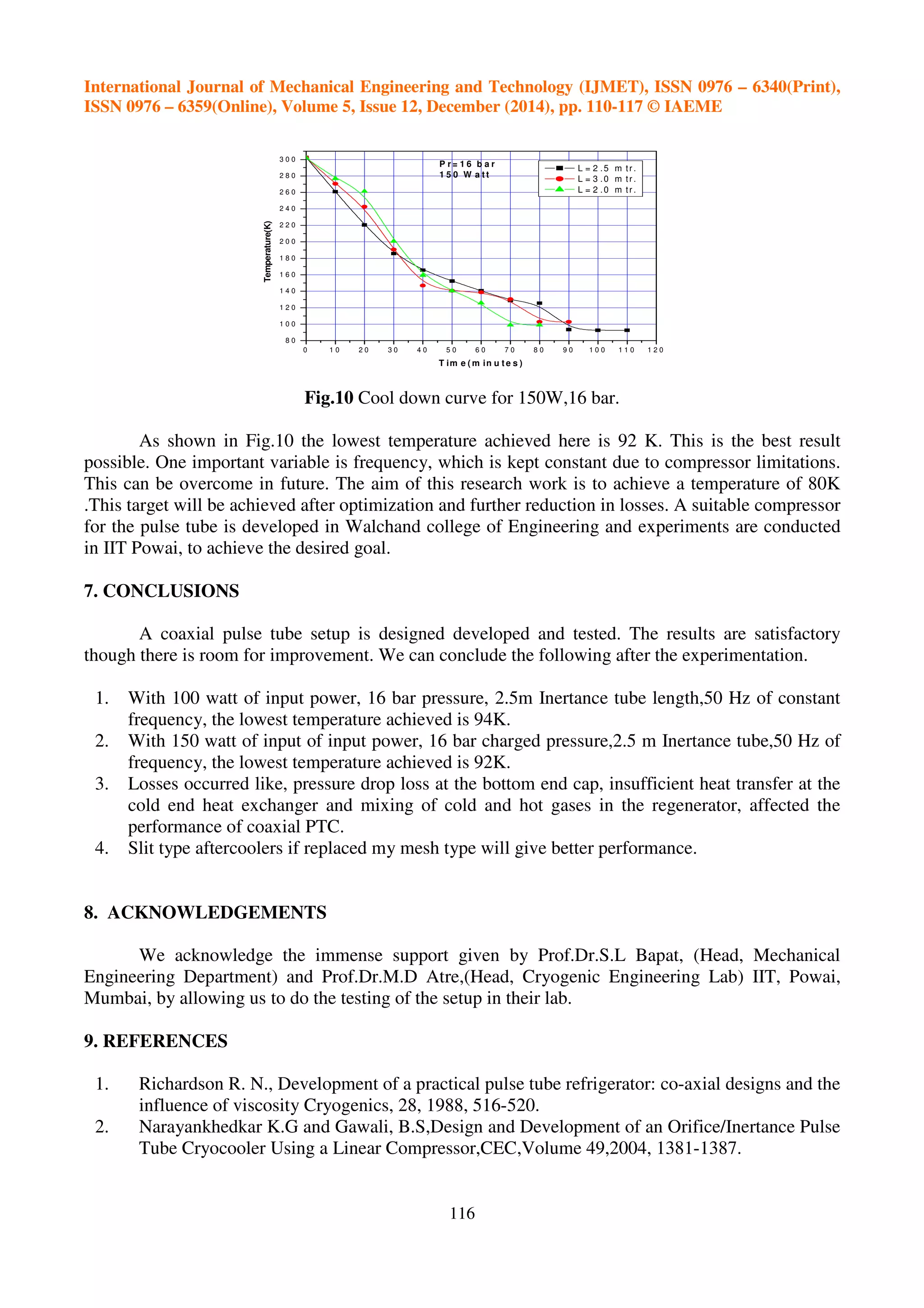
0 1 0 2 0 3 0 4 0 5 0 6 0 7 0 8 0 9 0 1 0 0 1 1 0 1 2 0
8 0
1 0 0
1 2 0
1 4 0
1 6 0
1 8 0
2 0 0
2 2 0
2 4 0
2 6 0
2 8 0
3 0 0
P r = 1 6 b a r
1 5 0 W a t t
Temperature(K)
T im e ( m in u t e s )
L = 2 .5 m tr .
L = 3 .0 m tr .
L = 2 .0 m tr .
Fig.10 Cool down curve for 150W,16 bar.
As shown in Fig.10 the lowest temperature achieved here is 92 K. This is the best result
possible. One important variable is frequency, which is kept constant due to compressor limitations.
This can be overcome in future. The aim of this research work is to achieve a temperature of 80K
.This target will be achieved after optimization and further reduction in losses. A suitable compressor
for the pulse tube is developed in Walchand college of Engineering and experiments are conducted
in IIT Powai, to achieve the desired goal.
7. CONCLUSIONS
A coaxial pulse tube setup is designed developed and tested. The results are satisfactory
though there is room for improvement. We can conclude the following after the experimentation.
1. With 100 watt of input power, 16 bar pressure, 2.5m Inertance tube length,50 Hz of constant
frequency, the lowest temperature achieved is 94K.
2. With 150 watt of input of input power, 16 bar charged pressure,2.5 m Inertance tube,50 Hz of
frequency, the lowest temperature achieved is 92K.
3. Losses occurred like, pressure drop loss at the bottom end cap, insufficient heat transfer at the
cold end heat exchanger and mixing of cold and hot gases in the regenerator, affected the
performance of coaxial PTC.
4. Slit type aftercoolers if replaced my mesh type will give better performance.
8. ACKNOWLEDGEMENTS
We acknowledge the immense support given by Prof.Dr.S.L Bapat, (Head, Mechanical
Engineering Department) and Prof.Dr.M.D Atre,(Head, Cryogenic Engineering Lab) IIT, Powai,
Mumbai, by allowing us to do the testing of the setup in their lab.
9. REFERENCES
1. Richardson R. N., Development of a practical pulse tube refrigerator: co-axial designs and the
influence of viscosity Cryogenics, 28, 1988, 516-520.
2. Narayankhedkar K.G and Gawali, B.S,Design and Development of an Orifice/Inertance Pulse
Tube Cryocooler Using a Linear Compressor,CEC,Volume 49,2004, 1381-1387.
International Journal of Mechanical Engineering and Technology (IJMET), ISSN 0976 – 6340(Print),
ISSN 0976 – 6359(Online), Volume 5, Issue 12, December (2014), pp. 110-117 © IAEME
117
3. Gawali B.S, Design and Development of a Miniature Integral Pulse Tube Nitrogen Liquefier,
PhD thesis, IIT Mumbai, 2005.
4. Martini, W., Stirling engine design manual.(NASA report,1978).
5. Atrey M. D., Bapat S. L., and Narayankhedkar K. G., Cyclic simulation of Stirling
cryocoolers. Cryogenics 29, 1990, 341-347.
6. Atrey M. D. and Narayankhedkar K. G., Development of second order isothermal model of
orifice type Pulse Tube refrigerator(OPTR) with linear compressor, Proc. ICEC-18,2000.519-
522.
7. Zhu S. W. and Chen Z. Q., Isothermal model of Pulse Tube refrigerator. Cryogenics 34,
1994, 519-595.
8. Asif Sha.A and Shaleena Manafuddin, “Temperature Prediction of A Two Stage Pulse Tube
Cryocooler by Neural Network” International Journal of Advanced Research in Engineering
& Technology (IJARET), Volume 5, Issue 9, 2014, pp. 11 - 21, ISSN Print: 0976-6480, ISSN
Online:0976-6499.

DESIGN AND TESTING OF STIRLING TYPE COAXIAL PULSE TUBE CRYOCOOLER

  • 1.
    International Journal ofMechanical Engineering and Technology (IJMET), ISSN 0976 – 6340(Print), ISSN 0976 – 6359(Online), Volume 5, Issue 12, December (2014), pp. 110-117 © IAEME 110 DESIGN AND TESTING OF STIRLING TYPE COAXIAL PULSE TUBE CRYOCOOLER Sandeep S.Patil Department of Mechanical Engineering, Walchand College of Engineering, Sangli, Maharashtra-416414, India B S.Gawali Department of Mechanical Engineering, Walchand College of Engineering, Sangli, Maharashtra-416414, India ABSTRACT Pulse Tube refrigerators have the potential to be widely applied for producing low temperatures. The most common cryocoolers are either of recuperative or regenerative type. Based on the relative position of regenerator and pulse tube we have various configurations like, inline, u- shaped, coaxial and annular. Our area of interest is designing and developing a stirling type, split coaxial pulse tube and suitable linear compressor. The aim is to achieve 80K temperature .The model used for preliminary design is isothermal. Design and fabrication was done in Walchand college and testing was done in Cryogenics lab, IIT, Powai,Mumbai.The results in hand show that the lowest temperature achieved is 94k, with 100W of input power and 92K, with 150W of input power, without any heat load. Exprimental investigations and optimization is done with design and operating parameters. A suitable linear motor compressor, moving coil type is in final stage of manufacturing. Key words: Coaxial, Inertance Tube, Pulse tube, Regenerator, Stirling. 1. INTRODUCTION Considerable work has been reported on the Pulse Tube cryocoolers. Currently lot of work is going on Pulse Tube cryocoolers. Because of the improvements in the Pulse Tube performance its application area is increasing very fast. Mostly the Pulse Tube cryocoolers are taking the place of INTERNATIONAL JOURNAL OF MECHANICAL ENGINEERING AND TECHNOLOGY (IJMET) ISSN 0976 – 6340 (Print) ISSN 0976 – 6359 (Online) Volume 5, Issue 12, December (2014), pp. 110-117 © IAEME: www.iaeme.com/IJMET.asp Journal Impact Factor (2014): 7.5377 (Calculated by GISI) www.jifactor.com IJMET © I A E M E
  • 2.
    International Journal ofMechanical Engineering and Technology (IJMET), ISSN 0976 – 6340(Print), ISSN 0976 – 6359(Online), Volume 5, Issue 12, December (2014), pp. 110-117 © IAEME 111 Stirling cycle cryocooler in miniature cryocoolers. New applications of cryocoolers are appearing, and the requirements for old applications are often undergoing changes. These new and changing cryocooler requirements have been the impetus for the recent developments in cryocoolers. The lack of a suitable cryocooler to meet the requirements of a particular application has hampered the advancement of many applications. The main problems associated with cryocoolers are: reliability, efficiency, size, weight, vibration and cost. The seriousness of each of these problems depends on the application. Within the last 15 years satellite applications for cooled infrared sensors have become much more important. Obviously these applications require a cryocooler with very high reliability, high efficiency, small size, low weight, and low vibrations. A significant amount of cryocooler development in the last 15 years has been focused on space applications. Most of the new developments on Stirling cryocoolers have been focused towards the techniques to improve reliability. The rapid growth of research and development on Pulse Tube cryocoolers in the last decade has been because of its potential for improved reliability, simplicity and low cost. 2. COAXIAL GEOMETRICAL ARRANGEMENT OF PTC Based on geometrical arrangement, Richardson [1] classified Pulse Tube cryocoolers as: linear,U- tube, Annular and Coaxial Pulse Tube cryocooler. Out of these, each one has it’s own advantages and disadvantages. The coaxial design overcomes the problem of viscous effect by accommodating the regenerator in the annular space and using the central cylinder as the pulse tube. In Walchand College of Engineering, lot of research work is currently going on in Cryogenics field. But this is the first time that a Coaxial Pulse Tube cryocooler is developed. The present research work aims to develop a stirling type, split, coaxial pulse tube and a linear compressor (moving coil type), with 100W of input power. At first the coaxial setup was developed, and later the suitable compressor, therefore the pulse tube setup was first tested in Cryogenics lab IIT Powai. A indigenously build compressor[2,3] of 300W capacity was used for testing at IIT,Powai,Mumbai. 3. DESIGN & ANALYSIS OF COAXIAL PTC. The modeling techniques range in degree of difficulty from the back-of-the-envelop calculation, to sophisticated nodal network analyses. First order analyses are good for preliminary design purposes. The classical analysis of the operation of Stirling machines is due to Schmidt. The second order approach is basically applying the ideal Schmidt analysis [4] (First Order Analysis) with coupled loss terms. Atrey et al. [5, 6] presented more realistic approach for the analysis of Stirling cycle liquefier. Zhu and Chen [7] developed isothermal model for analysis of Pulse Tube cryocooler. The above models are used to design the coaxial PTC, but some losses which arise due to 1800 turn of the gas are not taken into account. 4. FABRICATION AND ASSEMBLY OF COAXIAL PTC. Fabrication and assembly was done in Walchand college of Engineering and nearby industries. This setup consists of components which need very close tolerance. Manufacturing of Pulse tube of very thin thickness was a challenge, but it was accomplished. Regenerator and Pulse tube are made up of stainless steel. As shown in fig. 1. (a& b).
  • 3.
    International Journal ofMechanical Engineering and Technology (IJMET), ISSN 0976 – 6340(Print), ISSN 0976 – 6359(Online), Volume 5, Issue 12, December (2014), pp. 110-117 © IAEME 112 Fig.1(a)Pulse Tube Fig.1(b)Regenerator A copper cap (Fig.3(a)), is press fitted over a cold end heat exchanger and helps to smoothen the flow of the gas during each stroke. Cold end heat exchanger is made of copper block with slots and has central bore with diameter slightly lesser than the pulse tube (Fig.3(b)). Pulse tube is press fitted inside the cold end heat exchanger. After optimization and considering manufacturing constraints a pulse tube with 10.3mm diameter, length, 76mm and thickness of .15 was manufactured. A regenerator with 24 mm diameter, length of 70 mm and thickness of 0.22mm was fabricated. The connecting tube required to connect the pulse tube with compressor is 160mm long and 6mm in diameter. It is made up of copper. A copper end cap is designed to reduce the turbulence effect of the gas and make a smooth flow for the gas. Fig.3 (a). Fig.2 (a) Aftercooler (gas) Fig.2(b) Aftercooler (Water) It is of 25.5 mm diameter and 6mm length and has a bell like shape inside. Finned copper block acts as a cold end heat exchanger and is carefully manufactured to maintain the spacing in the slots. It is 24 mm in diameter and 14 mm in length with equally spaced slots and a bore of 10.3mm diameter.
  • 4.
    International Journal ofMechanical Engineering and Technology (IJMET), ISSN 0976 – 6340(Print), ISSN 0976 – 6359(Online), Volume 5, Issue 12, December (2014), pp. 110-117 © IAEME 113 Fig.3 (a) Bottom end cap. Fig.3(b) Cold End Heat Ex The after cooler is 24 mm in diameter and 22mm long. Fig 2(a&b). It acts a hot end heat exchanger. Following figure (Fig.4) shows a coaxial pulse tube setup in IIT Powai Lab. 5. COAXIAL PULSE TUBE SETUP It was decided to conduct the experimentation in IIT Powai lab.Fig.1 shows the Coaxial pulse tube and compressor setup. After the successful experimentation the results are satisfactory. The design parameters like Inertance tube length was optimized at different operating parameters like charging pressure and power input. Due to the compressor limitation, the frequency of operation was kept constant at 50Hz.The cold end cap is one of the most important component in coaxial PTC. Fig.4. Coaxial PTC Setup.
  • 5.
    International Journal ofMechanical Engineering and Technology (IJMET), ISSN 0976 – 6340(Print), ISSN 0976 – 6359(Online), Volume 5, Issue 12, December (2014), pp. 110-117 © IAEME 114 The high pressure gas flowing from the regenerator losses its pressure and forms turbulence after taking an 1800 turn. This affects the performance of the PTC due to losses generated. To overcome this loss a well optimized cold end cap geometry was selected. The bottom end of the cap is designed in such a way that the flow is smooth and with minimum pressure loss. Also the issue of void volume at the bottom part of this cap also plays important role. 6. EXPERIMENTAL RESULTS To obtain the optimum phase shift, between pressure and mass flow rate at the cold end, optimization of Inertance tube is very important. This is a long tube of copper (Id-2.3mm) which acts as a phase shifter. The length and diameter govern the cool down temperature. In this case first a tube 3meters of length is tested with varying pressures of 12, 14, and 16 bars. The length is gradually reduced in steps of 0.5meters. Thus tests were conducted for 2, 2.5 and 3 meters. Fig. 5 show the cool down curves when the input power to the compressor is kept constant (100 watt).The vacuum achieved in the vacuum chamber is 4.5x10⁻⁵ torr. The gas used is helium. Frequency is held constant at 50 Hz, as the compressor used is not variable frequency compressor. 0 1 0 2 0 3 0 4 0 5 0 6 0 7 0 8 0 9 0 1 0 0 1 1 0 8 0 1 0 0 1 2 0 1 4 0 1 6 0 1 8 0 2 0 0 2 2 0 2 4 0 2 6 0 2 8 0 3 0 0 P r = 1 2 b a r 1 0 0 W Temperature(K) T im e ( M in u t e s ) L = 2 . 5 m t r L = 3 . 0 m t r L = 2 . 0 m t r Fig5. Cool down curves for different Inertance Tube lengths. PT-100 is the thermocouple used. It is calibrated with liquid nitrogen and showed the temperature of 20.25 ohm (72K).After achieving the required vaccum, compressor is started and power is increased step by step to avoid damage to the compressor. Lowest temperature of 146.6K was achieved with Inertance tube of 2.5 mtr length and diameter of 2.3mm. 0 1 0 2 0 3 0 4 0 5 0 6 0 7 0 8 0 9 0 1 0 0 1 1 0 8 0 1 0 0 1 2 0 1 4 0 1 6 0 1 8 0 2 0 0 2 2 0 2 4 0 2 6 0 2 8 0 3 0 0 P r = 1 4 b a r 1 0 0 W a tt Temperature(K) T im e ( M in u t e s ) L = 2 .5 m tr L = 3 .0 m tr L = 2 .0 m tr Fig.6. Cool down curve for 14 bar pr.
  • 6.
    International Journal ofMechanical Engineering and Technology (IJMET), ISSN 0976 – 6340(Print), ISSN 0976 – 6359(Online), Volume 5, Issue 12, December (2014), pp. 110-117 © IAEME 115 Fig.6 shows the cool down curve where all the factors are constant but the charging pressure now is 14 bar. The regenerator, which is considered as heart of the cryocooler is optimized and it’s L/D ratio is 2.9 which is kept constant throughout experimentation. The above graph (Fig.6) shows cooling curves for different Inertance tube lengths. The lowest temperature achieved is 98K for 2.5 mtr length. 0 1 0 2 0 3 0 4 0 5 0 6 0 7 0 8 0 9 0 1 0 0 1 1 0 8 0 1 0 0 1 2 0 1 4 0 1 6 0 1 8 0 2 0 0 2 2 0 2 4 0 2 6 0 2 8 0 3 0 0 P r 1 6 b a r 1 0 0 W a t t Temperature(K) T i m e ( M i n u t e s ) L = 2 . 5 m t r L = 3 m t r L = 2 . 0 m t r Fig.7 Cool down curve for 16 bar pr. Fig.7 shows a cooling curve with lowest temperature of 94 K for 100 watt of input power with 2.5 mtr of Inertance tube. Thus 2.5 mtr is the optimized length for 16 bar. 0 1 0 2 0 3 0 4 0 5 0 6 0 7 0 8 0 9 0 1 0 0 1 1 0 1 0 0 1 2 0 1 4 0 1 6 0 1 8 0 2 0 0 2 2 0 2 4 0 2 6 0 2 8 0 3 0 0 3 2 0 P r = 1 2 b a r 1 5 0 W a t t Temperature(K) T i m e ( M i n u t e s ) L = 2 . 5 m t r . L = 3 . 0 m t r . L = 2 . 0 m t r . Fig.8 Cool down curve for 150W,12 bar. Fig.8 shows a cool down curve for various Inertance lengths and input power of 150 watts. Power is increased step by step to avoid damage to the compressor. Temperature achieved is 122K. 0 1 0 2 0 3 0 4 0 5 0 6 0 7 0 8 0 9 0 1 0 0 1 1 0 8 0 1 0 0 1 2 0 1 4 0 1 6 0 1 8 0 2 0 0 2 2 0 2 4 0 2 6 0 2 8 0 3 0 0 P r = 1 4 b a r 1 5 0 W a t t Temperature(K) T i m e ( m i n u t e s ) L = 2 . 5 m t r . L = 3 . 0 m t r . L = 2 . 0 m t r . Fig.9 Cool down curve for 150W,14 bar. As shown in Fig. 9 the temperature achieved is 96K.The charged pressure is 14 bar.
  • 7.
    International Journal ofMechanical Engineering and Technology (IJMET), ISSN 0976 – 6340(Print), ISSN 0976 – 6359(Online), Volume 5, Issue 12, December (2014), pp. 110-117 © IAEME 116 0 1 0 2 0 3 0 4 0 5 0 6 0 7 0 8 0 9 0 1 0 0 1 1 0 1 2 0 8 0 1 0 0 1 2 0 1 4 0 1 6 0 1 8 0 2 0 0 2 2 0 2 4 0 2 6 0 2 8 0 3 0 0 P r = 1 6 b a r 1 5 0 W a t t Temperature(K) T im e ( m in u t e s ) L = 2 .5 m tr . L = 3 .0 m tr . L = 2 .0 m tr . Fig.10 Cool down curve for 150W,16 bar. As shown in Fig.10 the lowest temperature achieved here is 92 K. This is the best result possible. One important variable is frequency, which is kept constant due to compressor limitations. This can be overcome in future. The aim of this research work is to achieve a temperature of 80K .This target will be achieved after optimization and further reduction in losses. A suitable compressor for the pulse tube is developed in Walchand college of Engineering and experiments are conducted in IIT Powai, to achieve the desired goal. 7. CONCLUSIONS A coaxial pulse tube setup is designed developed and tested. The results are satisfactory though there is room for improvement. We can conclude the following after the experimentation. 1. With 100 watt of input power, 16 bar pressure, 2.5m Inertance tube length,50 Hz of constant frequency, the lowest temperature achieved is 94K. 2. With 150 watt of input of input power, 16 bar charged pressure,2.5 m Inertance tube,50 Hz of frequency, the lowest temperature achieved is 92K. 3. Losses occurred like, pressure drop loss at the bottom end cap, insufficient heat transfer at the cold end heat exchanger and mixing of cold and hot gases in the regenerator, affected the performance of coaxial PTC. 4. Slit type aftercoolers if replaced my mesh type will give better performance. 8. ACKNOWLEDGEMENTS We acknowledge the immense support given by Prof.Dr.S.L Bapat, (Head, Mechanical Engineering Department) and Prof.Dr.M.D Atre,(Head, Cryogenic Engineering Lab) IIT, Powai, Mumbai, by allowing us to do the testing of the setup in their lab. 9. REFERENCES 1. Richardson R. N., Development of a practical pulse tube refrigerator: co-axial designs and the influence of viscosity Cryogenics, 28, 1988, 516-520. 2. Narayankhedkar K.G and Gawali, B.S,Design and Development of an Orifice/Inertance Pulse Tube Cryocooler Using a Linear Compressor,CEC,Volume 49,2004, 1381-1387.
  • 8.
    International Journal ofMechanical Engineering and Technology (IJMET), ISSN 0976 – 6340(Print), ISSN 0976 – 6359(Online), Volume 5, Issue 12, December (2014), pp. 110-117 © IAEME 117 3. Gawali B.S, Design and Development of a Miniature Integral Pulse Tube Nitrogen Liquefier, PhD thesis, IIT Mumbai, 2005. 4. Martini, W., Stirling engine design manual.(NASA report,1978). 5. Atrey M. D., Bapat S. L., and Narayankhedkar K. G., Cyclic simulation of Stirling cryocoolers. Cryogenics 29, 1990, 341-347. 6. Atrey M. D. and Narayankhedkar K. G., Development of second order isothermal model of orifice type Pulse Tube refrigerator(OPTR) with linear compressor, Proc. ICEC-18,2000.519- 522. 7. Zhu S. W. and Chen Z. Q., Isothermal model of Pulse Tube refrigerator. Cryogenics 34, 1994, 519-595. 8. Asif Sha.A and Shaleena Manafuddin, “Temperature Prediction of A Two Stage Pulse Tube Cryocooler by Neural Network” International Journal of Advanced Research in Engineering & Technology (IJARET), Volume 5, Issue 9, 2014, pp. 11 - 21, ISSN Print: 0976-6480, ISSN Online:0976-6499.