Analysis of Algorithms
•The present day algorithms are based on the
RAM (Random Access Machine) model.
• In RAM model, instructions execute one after
another with no concurrent operations.
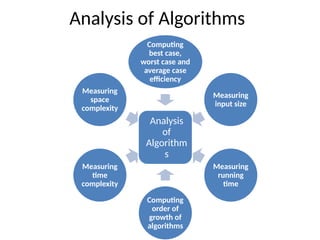
4.
Analysis
of
Algorithm
s
Computing
best case,
worst caseand
average case
efficiency
Measuring
input size
Measuring
running
time
Computing
order of
growth of
algorithms
Measuring
time
complexity
Measuring
space
complexity
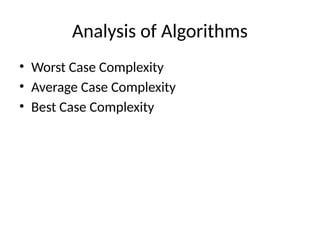
Analysis of Algorithms
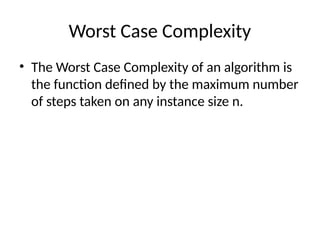
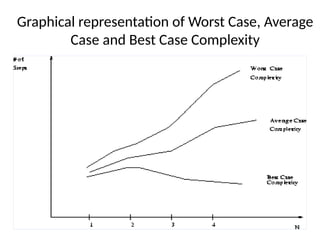
Worst Case Complexity
•The Worst Case Complexity of an algorithm is
the function defined by the maximum number
of steps taken on any instance size n.
7.
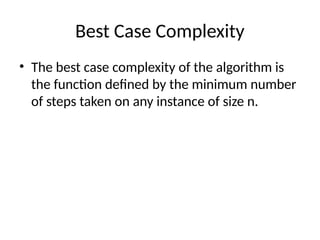
Best Case Complexity
•The best case complexity of the algorithm is
the function defined by the minimum number
of steps taken on any instance of size n.
8.
Average Case Complexity
•The average case complexity of the algorithm
is the function defined by an average number
of steps taken on an instance of size n.
Performance Evaluation ofAlgorithms
• Performance evaluation can be divided into
two major phases.
– 1) Priori estimates (Performance analysis)
– 2) Posteriori testing (Performance measurement)
11.
Performance Analysis
• Theefficiency of an algorithm can be decided
by measuring the performance of an
algorithm.
• The performance of an algorithm depends
upon two factors.
– 1) Amount of time required by an algorithm to
execute (known as time complexity).
– 2) Amount of storage required by an algorithm
(known as Space complexity).
12.
Space Complexity
The spacecomplexity of an
algorithm is the amount of memory
it needs to run to completion.
13.
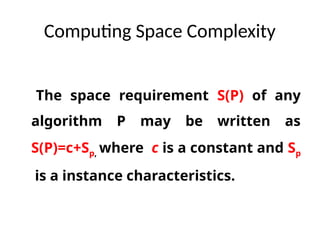
Computing Space Complexity
Thespace requirement S(P) of any
algorithm P may be written as
S(P)=c+Sp, where c is a constant and Sp
is a instance characteristics.
14.
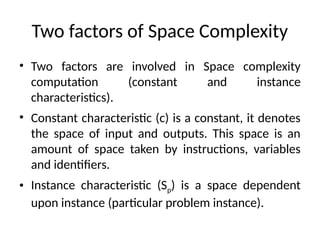
Two factors ofSpace Complexity
• Two factors are involved in Space complexity
computation (constant and instance
characteristics).
• Constant characteristic (c) is a constant, it denotes
the space of input and outputs. This space is an
amount of space taken by instructions, variables
and identifiers.
• Instance characteristic (Sp) is a space dependent
upon instance (particular problem instance).
15.
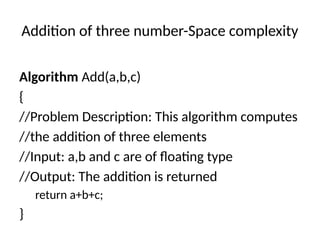
Addition of threenumber-Space complexity
Algorithm Add(a,b,c)
{
//Problem Description: This algorithm computes
//the addition of three elements
//Input: a,b and c are of floating type
//Output: The addition is returned
return a+b+c;
}
16.
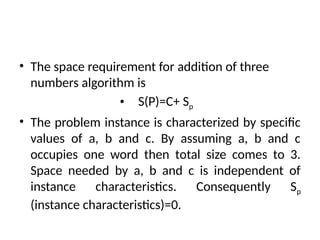
• The spacerequirement for addition of three
numbers algorithm is
• S(P)=C+ Sp
• The problem instance is characterized by specific
values of a, b and c. By assuming a, b and c
occupies one word then total size comes to 3.
Space needed by a, b and c is independent of
instance characteristics. Consequently Sp
(instance characteristics)=0.
17.
Sum of ‘n’numbers
Algorithm Sum(a,n)
{
S<-0.0;
for i<-1 to n do
S<-S+a[i];
return s;
}
The Space requirement
for sum of n numbers
algorithm is
S(P)>=(n+3)
The ‘n’ space required
for a[], one unit space
for n, one unit for i and
one unit for S.
18.
Sum of ‘n’numbers using Recursion
Algorithm Rsum(a,n)
{
if(n<=0) then return 0.0;
else return Rsum(a, n-1)+a[n]; }
The Space requirement is S(P)>=3(n+1)
The internal stack used for recursion includes space for
formal parameters, local variables and return address. The
space required by each call to function Rsum requires
atleast three words (space for n values + space for return
address + pointer to a[]). The depth of recursion is n+1 ( n
times call to function and one return call). The recursion
stack space will be >=3(n+1).
19.
Time Complexity
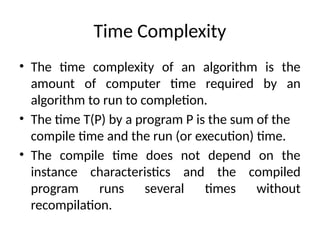
• Thetime complexity of an algorithm is the
amount of computer time required by an
algorithm to run to completion.
• The time T(P) by a program P is the sum of the
compile time and the run (or execution) time.
• The compile time does not depend on the
instance characteristics and the compiled
program runs several times without
recompilation.
20.
Run time complexity
•Run time complexity of a program will be
determined by tp ( instance characteristics).
• Run time complexity depends upon so many
factors.
21.
Issues in TimeComplexity
• It is difficult to compute the time complexity in
terms of physically clocked time or instance in
multiuser system, executing time depends on
may factors such as:
• System load
• Number of other programs running
• Instruction set used
• Speed of underlying hardware
22.
Frequency count
• Thetime complexity is therefore given in terms of
frequency count.
• Frequency count is a count denoting number of
times of execution of statement.
• Time efficiency is analyzed by determining the
number of repetitions of the basic operation as a
function of input size.
23.
sum of ‘n’numbers -Time complexity
Statement Steps per
execution
Frequency Total
steps
Algorithm Sum(a,n) 0 - 0
{ 0 - 0
S<-0.0; 1 1 1
for i<-1 to n do 1 n+1 n+1
S<-S+a[i]; 1 n n
return s; 1 1 1
} 0 -- 0
Total 2n+3
24.
Sum of ‘n’using Recursion-Time Complexity
Statement Steps per
execution
Frequency
n=0 n>0
Total steps
n=0 n>0
Algorithm RSum(a,n) 0 - - - -
{
if(n<=0) then 1 1 1 1 1
return 0.0; 1 1 0 1 0
else return
Rsum(a,n-1)+a[n]; 1+x 0 1 0 1+x
}
Total 2 2+x
X=tRsum(n-1)
25.
Basic operation
• Basicoperation is nothing but core operation,
generally basic operation resides in inner loop.
Example in Sorting algorithm the basic
operation is comparing the elements and
placing them in appropriate position.
26.
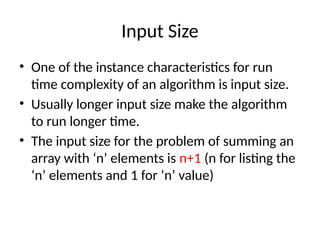
Input Size
• Oneof the instance characteristics for run
time complexity of an algorithm is input size.
• Usually longer input size make the algorithm
to run longer time.
• The input size for the problem of summing an
array with ‘n’ elements is n+1 (n for listing the
‘n’ elements and 1 for ‘n’ value)
27.
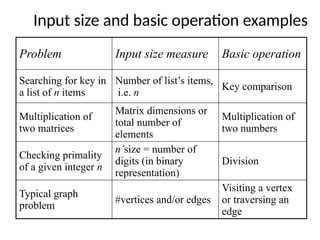
Input size andbasic operation examples
Problem Input size measure Basic operation
Searching for key in
a list of n items
Number of list’s items,
i.e. n
Key comparison
Multiplication of
two matrices
Matrix dimensions or
total number of
elements
Multiplication of
two numbers
Checking primality
of a given integer n
n’size = number of
digits (in binary
representation)
Division
Typical graph
problem
#vertices and/or edges
Visiting a vertex
or traversing an
edge
28.
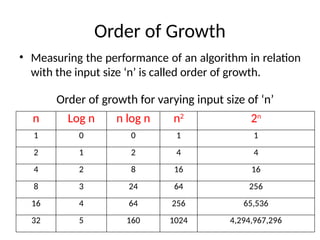
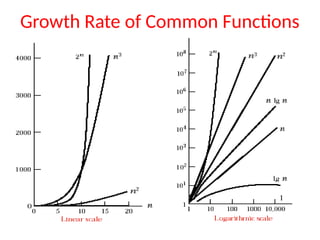
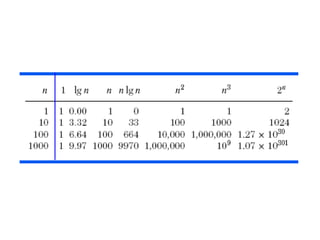
Order of Growth
•Measuring the performance of an algorithm in relation
with the input size ‘n’ is called order of growth.
n Log n n log n n2
2n
1 0 0 1 1
2 1 2 4 4
4 2 8 16 16
8 3 24 64 256
16 4 64 256 65,536
32 5 160 1024 4,294,967,296
Order of growth for varying input size of ‘n’
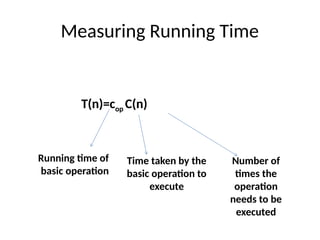
T(n)=cop C(n)
Measuring RunningTime
Running time of
basic operation
Time taken by the
basic operation to
execute
Number of
times the
operation
needs to be
executed
32.
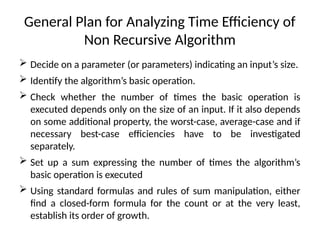
General Plan forAnalyzing Time Efficiency of
Non Recursive Algorithm
Decide on a parameter (or parameters) indicating an input’s size.
Identify the algorithm’s basic operation.
Check whether the number of times the basic operation is
executed depends only on the size of an input. If it also depends
on some additional property, the worst-case, average-case and if
necessary best-case efficiencies have to be investigated
separately.
Set up a sum expressing the number of times the algorithm’s
basic operation is executed
Using standard formulas and rules of sum manipulation, either
find a closed-form formula for the count or at the very least,
establish its order of growth.
33.
Asymptotic Notations
• Asymptoticrunning time of an algorithm is defined in
terms of functions.
• Asymptotic notation is useful describe the running
time of the algorithm.
• Asymptotic notations give time complexity as “fastest
possible”, “slowest possible” or “average time”.
• Bigh Oh (Ο) , Omega (Ω) and Theta (Θ) notations are
useful to represent the asymptotic complexity of
algorithms.

![Sum of ‘n’ numbers
Algorithm Sum(a,n)
{
S<-0.0;
for i<-1 to n do
S<-S+a[i];
return s;
}
The Space requirement
for sum of n numbers
algorithm is
S(P)>=(n+3)
The ‘n’ space required
for a[], one unit space
for n, one unit for i and
one unit for S.](https://image.slidesharecdn.com/class-2-250312114946-f5ba0cda/85/Analysis-of-Algorithms_Under-Graduate-Class-Slide-17-320.jpg)
![Sum of ‘n’ numbers using Recursion
Algorithm Rsum(a,n)
{
if(n<=0) then return 0.0;
else return Rsum(a, n-1)+a[n]; }
The Space requirement is S(P)>=3(n+1)
The internal stack used for recursion includes space for
formal parameters, local variables and return address. The
space required by each call to function Rsum requires
atleast three words (space for n values + space for return
address + pointer to a[]). The depth of recursion is n+1 ( n
times call to function and one return call). The recursion
stack space will be >=3(n+1).](https://image.slidesharecdn.com/class-2-250312114946-f5ba0cda/85/Analysis-of-Algorithms_Under-Graduate-Class-Slide-18-320.jpg)
![sum of ‘n’ numbers -Time complexity
Statement Steps per
execution
Frequency Total
steps
Algorithm Sum(a,n) 0 - 0
{ 0 - 0
S<-0.0; 1 1 1
for i<-1 to n do 1 n+1 n+1
S<-S+a[i]; 1 n n
return s; 1 1 1
} 0 -- 0
Total 2n+3](https://image.slidesharecdn.com/class-2-250312114946-f5ba0cda/85/Analysis-of-Algorithms_Under-Graduate-Class-Slide-23-320.jpg)
![Sum of ‘n’ using Recursion-Time Complexity
Statement Steps per
execution
Frequency
n=0 n>0
Total steps
n=0 n>0
Algorithm RSum(a,n) 0 - - - -
{
if(n<=0) then 1 1 1 1 1
return 0.0; 1 1 0 1 0
else return
Rsum(a,n-1)+a[n]; 1+x 0 1 0 1+x
}
Total 2 2+x
X=tRsum(n-1)](https://image.slidesharecdn.com/class-2-250312114946-f5ba0cda/85/Analysis-of-Algorithms_Under-Graduate-Class-Slide-24-320.jpg)