The Desert Voice is an authorized publication for members of the Department of Defense. Contents of the Desert Voice are
not necessarily the official views of, or endorsed by, the U.S. Government or Department of the Army. The editorial content of
this publication is the responsibility of the U.S. Army Central Public Affairs Office. This magazine is published by Al-Qabandi
United, a private firm, which is not affiliated with USARCENT. All copy will be edited. The Desert Voice is produced twice a
month by the 27th Public Affairs Detachment. Find us online at www.arcent.army.mil.
Col. Gerald O’Hara
Third Army Public Affairs Officer
Lt. Gen. William G. Webster
Third Army Commanding General
Command Sgt. Maj. John D. Fourhman
Third Army Command Sgt. Maj.
Sgt. Maj. Christopher J. Fletcher
Third Army Public Affairs Sgt. Maj.
Sgt. M. Benjamin Gable
Desert Voice Editor
Cpl. Ryan Hohman
Staff Writer
Spc. Eric Guzman
Layout and Design
Pfc. Dan Rangel
Staff Writer
Lt. Col. Wayne Marotto
Third Army Deputy PAO (FWD)
Sgt. 1st Class Jon Wiley
Third Army PAO NCOIC
Capt. Russell E. Varnado
27th PAD Commander
Staff Sgt. Mark Matthews
27th PAD NCOIC
2
ReadyTonight....SustaintheFight....ShapetheFuture
CONTENTS
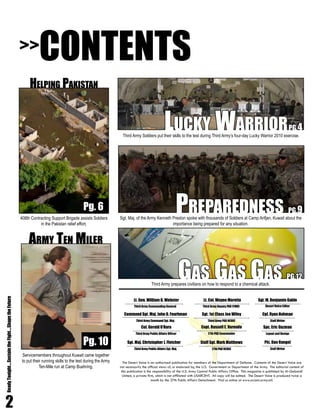
Helping Pakistan
Pg. 6
Gas Gas Gas PG.12
Preparedness PG.9
>>
Pg. 10
Lucky WarriorPG.4
Army Ten Miler
Servicemembers throughout Kuwait came together
to put their running skills to the test during the Army
Ten-Mile run at Camp Buehring.
408th Contracting Support Brigade assists Soldiers
in the Pakistan relief effort.
Sgt. Maj. of the Army Kenneth Preston spoke with thousands of Soldiers at Camp Arifjan, Kuwait about the
importance being prepared for any situation.
Third Army Soldiers put their skills to the test during Third Army’s four-day Lucky Warrior 2010 exercise.
Third Army prepares civilians on how to respond to a chemical attack.
3
ReadyTonight....SustaintheFight....ShapetheFuture
During the Month of November we observe two important dates, traced back to World War
I, that reaffirm the importance of Mission, People and Teamwork: Veterans Day and the Third
Army Birthday. The foundation of Third Army’s success, as ingrained in our past as it is relevant
to our future, is our Soldiers working as a Team.
Soldiers. Nov. 11 marks our 91st observance of Veterans Day. Originally established as
Armistice Day in 1919, marking the first anniversary of the signing of the armistice that ended
World War I, this holiday evolved into a national day of appreciation for all U.S. veterans.
Renamed as Veterans Day in 1954, this day honors America’s veterans for their patriotism, love of
country and willingness to serve and sacrifice for the common good of our Nation.
Teamwork. Since its inception, Third Army has etched its name in American history through
two World Wars, Desert Shield/Desert Storm, Operation Enduring Freedom and Operation Iraqi
Freedom. Activated in France Nov. 7, 1918, Third Army initially served as an army of occupation
in post-war Germany. During the subsequent 92 years of our existence, Third Army has led
America’s fighting forces through combat in Europe and Southwest Asia. We celebrate Third
Army’s birthday Nov. 7, in recognition of the proud history of our team of teams.
Mission. Credited with seven wartime campaigns, Third Army has a distinguished history of
mission accomplishment. We continue that success today as we refine our operational capabilities
to be Ready Tonight, as demonstrated through our recent and successful exercises: Internal Look
and Lucky Warrior. We’re Shaping the Future by conducting Theater Security Cooperation
events in 16 countries across Southwest and Central Asia. We Sustain the Fight as we support
16 Brigade Combat Teams, a ground force population of more than
120,000 personnel, and operations in Afghanistan, Iraq, Kuwait and
throughout our area of responsibility. And we continue to carry out
Operation Nickel II, the largest logistical operation since World War
II, as we perform the Responsible Drawdown of Forces in Iraq and
support to Afghanistan.
As we look to the future, we build upon the successes of our past.
Take time this month to honor our history and to thank our veterans
for 92 years of Mission success. Honor the legacy of our Team by
remembering the 92nd birthday of our Third Army on November
7th. Thank and pay due respect to our People by recognizing
Veterans’ Day on November 11th.
	
Patton’s Own!	
To the Third Army/ARCENT Team,
From the Top
4
ReadyTonight....SustaintheFight....ShapetheFuture
The Third Army team conducted
an exercise at Camp Arifjan Oct. 16-
19. The focus of the four-day mission
was to ensure Third Army’s ability to
react to any possible situations within
the U.S. Central Command area of
responsibility.
The Lucky Warrior exercise
has been conducted periodically
throughout the years to maintain
readiness for contingency operations
throughout the Middle East.
“This exercise brings the team
together and poises them for a
mission-setting focus to gather
intelligence, assessments, data and
holistic information that is shared as a
team,” said Sgt. Maj. William Hayes,
Third Army aviation sergeant major
and native of Memphis, Tenn.
The focus is geared toward training
the command-post staff to be ready
and effective if called.
“Lucky Warrior is an exercise
designed to train the Third Army
command post to conduct different
contingency operations in our area
of responsibility,” said Col. Paul
Humphreys, Third Army chief of
future operations.
“These exercises ensure we are
ready for real-world contingencies,”
Humphreys said. “The exercises
we’re going through right now
identify tactics, techniques and
procedures and battle drills that we
could use in a real-world situation
later on.”
The Third Army team consists of
more than Soldiers and has a joint-
service structure.
“We have Soldiers, Sailors, Airmen
and Marines,” Humphreys said. “We
also have Department of the Army
Civilians. We also have contractors
who are working with us.”
Humphreys was pleased with the
results of the exercise.
“It’s going very well,” he said.
“There’s a lot of hard learning going
on. We’re feeling our way through
some things at the same time we’re
building some strong relationships
within the staff and our supporting
units, which will enable us to get
better each day.”
Exercises of this type aren’t
expected to run flawlessly. Team
members are expected to make
mistakes and learn from them.
“The mistakes we make today we
are correcting, and we’re improving
what we do so that we don’t make
the same mistakes again tomorrow,”
Humphreys said.
Third Army exercise leaders
are also happy with their Soldiers
performance.
“Our Soldiers did a great
job … I couldn’t be prouder of
them,” said Maj. Tom Moran, the
communications officer in charge for
Third Army showcases its
readiness at Lucky Warrior 2010
Story by
Pfc. Dan Rangel
Third Army Public Affairs
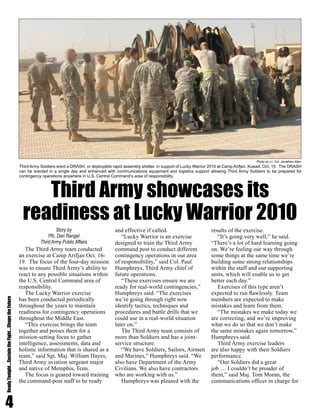
Third Army Soldiers erect a DRASH, or deployable rapid assembly shelter, in support of Lucky Warrior 2010 at Camp Arifjan, Kuwait, Oct. 15. The DRASH
can be erected in a single day and enhanced with communications equipment and logistics support allowing Third Army Soldiers to be prepared for
contingency operations anywhere in U.S. Central Command’s area of responsibility.
Photo by Lt. Col. Jonathan Allen
the contingency command
outpost and native of
Fairport, N.Y.
“We work together really
well … we were flexible
to adapt to new changes,”
Moran said. “Everybody had
a really good attitude putting
up the tents and running
cables, so I declare it a
success.”
Physically, the Lucky
Warrior exercise has
grown from being just
a handful of tents in the
desert to an intricate web
of communications and
operations cells linked
together to form a first-class
command post.
“I’ve been at Third Army
for four years. I’ve been
doing exercises for the last
three,” said Chief Warrant
Officer Christopher Crozier,
a communications chief
from Fairfield, Calif. “The
command post has grown.
It’s changed from what we
used to have. We’ve gone
from just the deployable, expandable
shelters, which we’ve moved into the
tent complex here now.”
Humphreys also expressed the
significance of exercises like Lucky
Warrior and just how relevant they
are to real-world events.
“I went through a Lucky Strike
exercise back in 2002 we used to
prepare for Operation Iraqi Freedom.
We went through it in November
of 2002 and in March of 2003 we
were actually conducting real-world
operations based on the exercise we
had done in November,” Humphreys
said.
So what is the status of Third
Army’s readiness?
“This command is ready to serve in
this area for whatever the contingency
might be,” Humphreys said.
5
ReadyTonight....SustaintheFight....ShapetheFuture
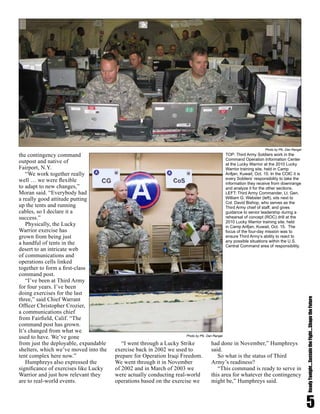
TOP: Third Army Soldiers work in the
Command Operation Information Center
at the Lucky Warrior at the 2010 Lucky
Warrior training site, held in Camp
Arifjan, Kuwait, Oct. 15. In the COIC it is
every Soldiers’ responsibility to take the
information they receive from downrange
and analyze it for the other sections.
LEFT: Third Army Commander, Lt. Gen.
William G. Webster (left), sits next to
Col. David Bishop, who serves as the
Third Army chief of staff, and gives
guidance to senior leadership during a
rehearsal of concept (ROC) drill at the
2010 Lucky Warrior training site, held
in Camp Arifjan, Kuwait, Oct. 15. The
focus of the four-day mission was to
ensure Third Army’s ability to react to
any possible situations within the U.S.
Central Command area of responsibility.
Photo by Pfc. Dan Rangel
6
ReadyTonight....SustaintheFight....ShapetheFuture
In July, disaster struck the people
of Pakistan after heavy monsoon
rains flooded the region and left
thousands killed or injured and
millions homeless. Within days, U.S.
Forces were on the ground ready to
help and ready to provide life-saving
services and support.
This is the second time this year
the Expeditionary Contracting
Command has exercised its
expeditionary capabilities in support
of humanitarian relief efforts.
The first response was to provide
humanitarian assistance and disaster
relief efforts in support of the
earthquake in Haiti.
The 408th Contracting Support
Brigade provides operational
contracting support to Third Army
and is designed to support Title 10
U.S Forces and their contracting
requirements in the U.S. Central
Command’s area of responsibility.
“This mission is the pinnacle
event for Contingency Contracting
Officers,” said Col. Michael J.
Rogers, who serves as the 408th
CSB commander and Principle
Assistant Responsible for Contracting
–Southwest Asia. “It’s a real-world
contingency mission.”
The 408th CSB was notified of
the need for contracting support in
Pakistan and deployed two CCOs to
the region within 48 hours, both from
the Army Contracting Command –
Kuwait offices at Camp Arifjan.
“This represents a new paradigm
shift in the expeditionary nature of
Army contracting, which provides
Contingency Contracting Teams in
Story by
Maj. Ryan E. Ocampo
408th Contacting Support Brigade
CSB provides much needed
contracting support in Pakistan
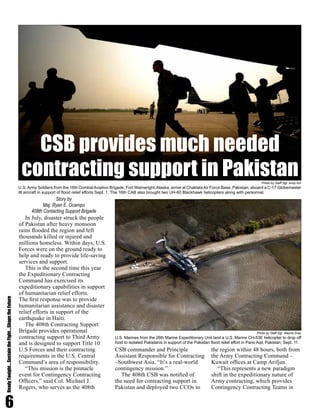
U.S.Army Soldiers from the 16th CombatAviation Brigade, Fort Wainwright,Alaska, arrive at ChaklalaAir Force Base, Pakistan, aboard a C-17 Globemaster
III aircraft in support of flood relief efforts Sept. 1. The 16th CAB also brought two UH-60 Blackhawk helicopters along with personnel.
Photo by Staff Sgt. Andy Kin
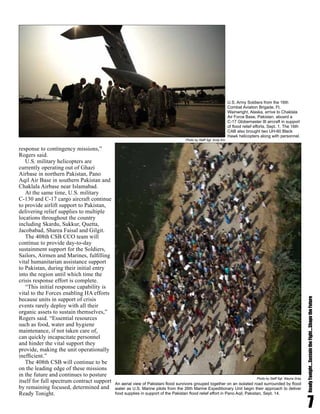
U.S. Marines from the 26th Marine Expeditionary Unit land a U.S. Marine CH-53E helicopter to drop off
food to isolated Pakistanis in support of the Pakistan flood relief effort in Pano Aqil, Pakistan, Sept. 11.
Photo by Staff Sgt. Wayne Gray
7
ReadyTonight....SustaintheFight....ShapetheFuture
response to contingency missions,”
Rogers said.
U.S. military helicopters are
currently operating out of Ghazi
Airbase in northern Pakistan, Pano
Aqil Air Base in southern Pakistan and
Chaklala Airbase near Islamabad.
At the same time, U.S. military
C-130 and C-17 cargo aircraft continue
to provide airlift support to Pakistan,
delivering relief supplies to multiple
locations throughout the country
including Skardu, Sukkur, Quetta,
Jacobabad, Sharea Faisal and Gilgit.
The 408th CSB CCO team will
continue to provide day-to-day
sustainment support for the Soldiers,
Sailors, Airmen and Marines, fulfilling
vital humanitarian assistance support
to Pakistan, during their initial entry
into the region until which time the
crisis response effort is complete.
“This initial response capability is
vital to the Forces enabling HA efforts
because units in support of crisis
events rarely deploy with all their
organic assets to sustain themselves,”
Rogers said. “Essential resources
such as food, water and hygiene
maintenance, if not taken care of,
can quickly incapacitate personnel
and hinder the vital support they
provide, making the unit operationally
inefficient.”
The 408th CSB will continue to be
on the leading edge of these missions
in the future and continues to posture
itself for full spectrum contract support
by remaining focused, determined and
Ready Tonight.
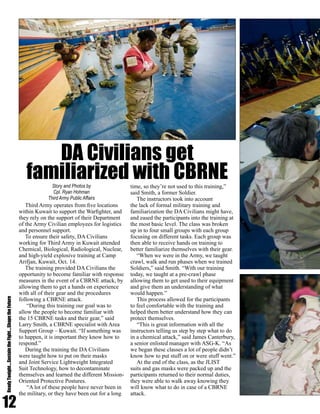
An aerial view of Pakistani flood survivors grouped together on an isolated road surrounded by flood
water as U.S. Marine pilots from the 26th Marine Expeditionary Unit begin their approach to deliver
food supplies in support of the Pakistan flood relief effort in Pano Aqil, Pakistan, Sept. 14.
Photo by Staff Sgt. Wayne Gray
Photo by Staff Sgt. Andy Kin
U.S. Army Soldiers from the 16th
Combat Aviation Brigade, Ft.
Wainwright, Alaska, arrive to Chaklala
Air Force Base, Pakistan, aboard a
C-17 Globemaster III aircraft in support
of flood relief efforts, Sept. 1. The 16th
CAB also brought two UH-60 Black
Hawk helicopters along with personnel.
8
ReadyTonight....SustaintheFight....ShapetheFuture
Volunteer
Servicmembers began
training for this year’s
Combined Federal
Campaign during sessions
held Sept. 24 and 25
throughout bases in
Kuwait.
The CFC Overseas
orchestrates the annual
charity campaign among
federal employees
working abroad. Federal
employees may choose
from thousands of charities
to give to through the CFC
Overseas.
“It’s all about personal
choice. [Servicemembers]
can direct the funds to
exactly the charity they
want their money to go,”
said Constance Baker, CFC
Overseas deputy director.
This year’s CFC
Overseas campaign begins
Oct. 4 and runs through
Dec. 3. Volunteers intend to
ask every Servicemember
overseas to make an
informed decision.
“The number one reason
someone gives to charity is
because they were asked,”
Baker said. “That is our
mission. We want to give
a 100 percent informed
opportunity to give.”
CFC Overseas recruits
vast amounts of volunteers;
in fact, organizers hope
to have one volunteer
(or keyperson, as
they are known in the
organization) for every 20
Servicemembers.
Having so many
volunteers ensures that
each Servicemembers’
contact with the CFC
Overseas is through
someone they all ready
know.
“It’s a personal
transaction. We want to
keep it personal,” Baker
said.
Many volunteers are
new to the CFC Overseas
campaign but want to get
involved with charity work.
“I’m motivated to
help people in need
and to contribute to a
good cause,” said Capt.
Sebastien Goillandeau,
Third Army surgeon cell
from Coahoma, Texas, who
attended the training.
Some Servicemembers,
such as Navy Petty Officer
1st Class Rene Barrera,
an administrative support
specialist at Kuwait
Naval Base, are more
experienced.
“I’ve been involved with
CFC before,” Barrera said.
“It was great knowing how
to touch peoples’ lives and
knowing that every little bit
helps no matter how small
the contribution.”
Experienced or not,
some volunteers are
motivated to contribute
to a good cause for very
personal reasons.
“I participate because
I have a Family Member
affected by Multiple
Sclerosis,” said Staff Sgt.
Lori Costello, an 1188
DDSB transportation
control officer.
“I hope one day they
find a cure,” she said.
Story and Photos by
Pfc. Dan Rangel
Third Army Public Affairs
Constance Baker, CFC Overseas deputy director, conducts training for CFC Overseas volunteers at Camp Arifjan
Sept. 25. This year’s CFC Overseas campaign begins Oct. 4 then runs through Dec. 3.
CFC prepares kick off
9
ReadyTonight....SustaintheFight....ShapetheFuture
Sgt. Maj. of the Army Kenneth
Preston climbed atop the trailer of a
heavy equipment transporter to address
hundreds of Third Army Soldiers who
gathered as the sun set at Camp Arifjan,
Kuwait, Sept. 29.
“We, as a fighting force, need
to be 100 percent in all phases of
preparedness,” said Sgt. Maj. of the
Army Preston. “There are Soldiers
mobilized in war zones, but there’s also
Soldiers mobilized back home helping
on the gulf coast, helping with border
patrol and helping with the floods
in Missouri,” he said stressing the
importance of preparedness at all times.
Sgt. Maj. of the Army Preston
encouraged Third Army Soldiers to go
online and take the Global Assessment
Tool training which will help enhance
preparedness.
According to Sgt. Maj. of the Army
Preston, the training will allow Soldiers
to become stronger by assessing their
spiritual, emotional, physical, social and
Family preparedness.
The Comprehensive Soldier Fitness
program, a type of Soldier fitness tracker
linked to the Global Assessment Tool,
develops and institutes a holistic fitness
program for Soldiers, Families, and
Department of the Army
Civilians in order to
enhance performance and
build resilience.
Though he spent
multiple hours addressing
crowds of Soldiers,
Sgt. Maj. of the Army
Preston’s main objective
was to meet face-to-face
with individual Third
Army Soldiers.
The Army’s top
noncommissioned
officer pinned new ranks
on three Soldiers during a promotion
ceremony with Alpha Company,
3rd Battalion, 43rd Air Defense
Artillery Regiment. Sgt. Maj. of the
Army Preston then had individual
conversations with more than 50
Soldiers with the 1st Battalion, 124th
Infantry Regiment. The 13th sergeant
major of the Army asked questions
ranging from missions to Family life and
personal goals.
After meeting with both individual
and groups of Soldiers, Sgt. Maj. of the
Army Preston fielded questions from
those in attendance.
According to one ThirdArmy Soldier,
this was a welcomed opportunity.
“It was a great experience for me to
talk directly to “the man,’” said Spc.
Anthony Wilson, an infantryman with
Delta Company, 2nd Battalion, 124th
Infantry Regiment and a native of
Orlando, Fla. “How many times in my
career will I get a chance to do that?”
After each session, Sgt. Maj. of
the Army Preston left the Third Army
Troops with praise for the job they are
doing in Kuwait with a lead role in the
Responsible Drawdown in Iraq and its
support of the increase of Troops and
resources for Afghanistan.
“[Third Army Soldiers] have been
the backbone of the operations, with
all the services they have provided
the Warfighter,” said Sgt. Maj. of the
Army Preston. “Third Army has been
magnificent and the work is transparent
to the American public.”
Sgt. Maj. of the Army Kenneth Preston participates in the promotion of
Sgt. Jason Blanco, a native of Miami, Fla. and patriot missile launching
station enhanced operator with Alpha Company, 3rd Battalion, 43rd Air
Defense Artillery Regiment, during a promotion ceremony Sept. 29, at
Camp Arifjan, Kuwait. The Army’s top noncommissioned officer pinned
three Third Army Soldiers during the ceremony.
Army’s top NCO
visits Third ArmyStory and Photos by
Sgt. M. Benjamin Gable
Third Army Public Affairs
Sgt. Maj. of the Army
Kenneth Preston addresses
more than a thousand
Third Army Soldiers during
his visit to Camp Arifjan,
Kuwait, Sept. 29.
Sand, rocks, broken pavement, heat.
Runners conquered these and more at
the Sixth Annual Association of the
United States Army Ten-Miler race on
Camp Buehring, Kuwait Oct. 3.
The desert version of the race
offered deployed personnel who
could not make it to the Ten-Miler in
Washington, D.C., the opportunity to
run – a timeless Army activity that
is part of Soldiers’lives even when
they are deployed. Volunteers from
the military; Morale, Welfare and
Recreation; the USO and Association
of the United States Army all worked
together to set up the event and provide
runners water, fruit, T-Shirts and
awards.
Runners of all ability levels came to
Buehring from more than four camps
in Kuwait. The race was a particularity
fast one, as two runners, Capt. Elias
Gonzalez and Capt. Robin Herndon,
set camp records for male and female runners. Gonzalez, a
member of the 53rd Infantry Brigade Combat Team, crossed
the finish line in less than an hour at 59 minutes, 2 seconds.
Herndon, who represented the Air Force, came in at 1:07.22.
While the speedsters stole the show, other runners set
records of their own. Petty Officer 2nd
Class Chris Esperti, a Navy Customs
agent, said he trained his way up to the
event, and the 10-mile distance was the
final test.
“I’ve been running for about six, seven
months. I got up to about eight miles a
day, so this is my longest run for a race,”
he said. When asked his time, Esperti
knew it to the second. “1 hour 15 minutes
and 32 seconds. I missed third place in
my age group by a minute.”
Other runners took on the race without
having completed an organized training
plan. Staff Sgt. Alejandro Aguilar, from
Madera, Calif., is a National Guard
Soldier with the 1836th Transportation
Company. He said he has run in Esprit de
Corps and Battalion runs, but the Ten-
Miler was his time to see what he was
made of.
“I just heard about it, and I wanted to
do it to see if I could still do it. I’m 39
years old, but I still have it in me,” he said
after the race. Aguilar crossed the finish
line in 1:24.00. “It was painful,” he said
with a smile. He declared that he passed his personal test by
finishing the race. “I’m not hurt, until tomorrow, anyway,” he
said.
Aguilar, who is a Border Patrol agent in his civilian
career, said the desert course offered unexpected surprises.
10
ReadyTonight....SustaintheFight....ShapetheFuture
Partial pavemen
Deployed runners tackle A
Runners turn the corner on a paved part of the Association of the United States Army Ten-Miler race course at Camp Buehring, Kuwait, Oct. 3. This year was the si
Capt. Elias Gonzalez holds the finish-line tape after
setting a camp record for fastest male runner in the
Sixth Annual Association of the United States Army
Ten-Miler race at Camp Buehring, Kuwait, Oct. 3.
Gonzalez, a member of the 53rd Infantry Brigade
Combat Team, crossed the finish line in less than
an hour at 59 minutes, 2 seconds.
Story by
Natalie Cole
1st Theater Sustainment Command
Photo by Pfc. Daniel Rangel
“There [were] a couple spots
where it was kind of rocky and
bumpy…. That was kind of
unexpected. I know there were
some tank trails back there
where it was really bad so you
had to find a good spot to trot
along in,” said Aguilar, who has
been deployed for six months.
The terrain was not too harsh
to slow Aguilar down, however.
“All in all, I think it was one
of the better courses I’ve ran.
There was only one major hill,
I thought. To most people it
probably wouldn’t be a hill,
but to me it was. I think it was
around the fifth mile where it
popped up,” he said.
Aguilar laughed as he recounted his thoughts during the
last mile of the race. “Honestly, I didn’t even know where the
last mile was. I just looked at the water tower ‘cuz you knew
when you saw that water tower that was basically where it
was going to finish off.”
Other runners came to the Ten-Miler with a long resume of
running experience and practice. Col. Jorge Klajnbart, deputy
surgeon for Third Army, traveled from Camp Arifjan for the
race. He placed second in the 50-plus age group with a time
of 1:18.52.
An orthopedic surgeon, Klajnbart said he has been running
for about 10 years. He said as he ran the last mile of the race,
he thought “I can’t wait
‘till it’s over. I can’t wait
to get sprinkled by the fire
truck. But I felt good. I did.
I ran it in under 80 minutes
so that was my goal. I
accomplished my goal.”
Klajnbart said the
course - with its sand, rocks
and dips - was all in the
name of the desert run. “It
was perfect. I loved it.”
Although it is an Army
event, the race had a good
mix of runners, Klajnbart
added. “It’s good to see
Army, Air Force, everybody
running together.”
Command Sgt. Maj. John
D. Fourhman, Third Army command sergeant major, ran
the race in 1:16.04. He presented awards to the top-placing
runners after the race. The desert Ten-Miler is an example of
how Third Army encourages Soldiers to stay active in support
of the mission and the physical aspect of Comprehensive
Soldier Fitness.
“Events like this are fun, but the underlying thing that goes
into this is personal fitness,” said Fourhman, who plans on
running the Ten-Miler in Washington Oct. 24.
The event had a joint-service and civilian turn out of about
500, Fourhman said, adding that in the spirit of the Army
race, “everyone left feeling Army strong.”
11
ReadyTonight....SustaintheFight....ShapetheFuture
nt? No problem:
Army 10-Miler in Kuwait
ixth annual Ten-Miler in Kuwait and it gave Servicemembers from all services the opportunity to show their support for the AUSA.
Capt. Robin Herndon (middle) smiles as she accepts her award for fastest
female runner in the Sixth Annual Association of the United States Army Ten-
Miler race at Camp Buehring, Kuwait Oct. 3. Herndon set a camp record
when she crossed the finish line in 1 hour 7 minutes 22 seconds.
Photo by Pfc. Dan Rangel
12
ReadyTonight....SustaintheFight....ShapetheFuture
Third Army operates from five locations
within Kuwait to support the Warfighter, and
they rely on the support of their Department
of the Army Civilian employees for logistics
and personnel support.
To ensure their safety, DA Civilians
working for Third Army in Kuwait attended
Chemical, Biological, Radiological, Nuclear,
and high-yield explosive training at Camp
Arifjan, Kuwait, Oct. 14.
The training provided DA Civilians the
opportunity to become familiar with response
measures in the event of a CBRNE attack, by
allowing them to get a hands on experience
with all of their gear and the procedures
following a CBRNE attack.
“During this training our goal was to
allow the people to become familiar with
the 15 CBRNE tasks and their gear,” said
Larry Smith, a CBRNE specialist with Area
Support Group – Kuwait. “If something was
to happen, it is important they know how to
respond.”
During the training the DA Civilians
were taught how to put on their masks
and Joint Service Lightweight Integrated
Suit Technology, how to decontaminate
themselves and learned the different Mission-
Oriented Protective Postures.
“A lot of these people have never been in
the military, or they have been out for a long
time, so they’re not used to this training,”
said Smith, a former Soldier.
The instructors took into account
the lack of formal military training and
familiarization the DA Civilians might have,
and eased the participants into the training at
the most basic level. The class was broken
up in to four small groups with each group
focusing on different tasks. Each group was
then able to receive hands on training to
better familiarize themselves with their gear.
“When we were in the Army, we taught
crawl, walk and run phases when we trained
Soldiers,” said Smith. “With our training
today, we taught at a pre-crawl phase
allowing them to get used to their equipment
and give them an understanding of what
would happen.”
This process allowed for the participants
to feel comfortable with the training and
helped them better understand how they can
protect themselves.
“This is great information with all the
instructors telling us step by step what to do
in a chemical attack,” said James Canterbury,
a senior enlisted manager with ASG-K. “As
we began these classes a lot of people didn’t
know how to put stuff on or were stuff went.”
At the end of the class, as the JLIST
suits and gas masks were packed up and the
participants returned to their normal duties,
they were able to walk away knowing they
will know what to do in case of a CBRNE
attack.
DA Civilians get
familiarized with CBRNEStory and Photos by
Cpl. Ryan Hohman
Third Army Public Affairs
13
ReadyTonight....SustaintheFight....ShapetheFuture
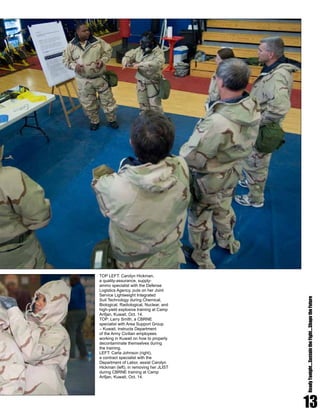
TOP LEFT: Carolyn Hickman,
a quality-assurance, supply-
ammo specialist with the Defense
Logistics Agency, puts on her Joint
Service Lightweight Integrated
Suit Technology during Chemical,
Biological, Radiological, Nuclear, and
high-yield explosive training at Camp
Arifjan, Kuwait, Oct. 14.
TOP: Larry Smith, a CBRNE
specialist with Area Support Group
– Kuwait, instructs Department
of the Army Civilian employees
working in Kuwait on how to properly
decontaminate themselves during
the training.
LEFT: Carla Johnson (right),
a contract specialist with the
Department of Labor, assist Carolyn
Hickman (left), in removing her JLIST
during CBRNE training at Camp
Arifjan, Kuwait, Oct. 14.
14
ReadyTonight....SustaintheFight....ShapetheFuture
Seventy-four Servicemembers
from both the Army and Navy
received certificates for the Unit
Victim Advocate and Deployed
Sexual Assault Coordinator courses
during a graduation ceremony held at
the Zone 1 Chapel at Camp Arifjan,
Kuwait, Sept. 25.
During the courses,
Servicemembers learned awareness
and prevention, reporting and
response guidelines and victim
advocacy. The courses these
Servicemembers participated in
ranged from Unit Victim Advocacy,
or UVA, to Deployed Sexual Assault
Response Coordinator, or DSARC.
Upon completion of the courses, the
graduates are qualified to help victims
of sexual harassment and sexual
assault.
“These courses, whether it’s the
forty-hour program or the eighty-hour
program, are extremely important,”
said Sgt. 1st Class Ara Carter,
equal opportunities operations and
administration noncommissioned
officer with Third Army. “Our
subject-matter experts give the
students a real-life picture of what
they are dealing with and how they
can best handle a situation.”
While the courses lengths vary, the
goal remains the same.
The goal of the UVA and DSAC
courses is to ensure the trained
Servicemembers have the information
needed to aptly handle any reports of
sexual harassment or sexual assault.
These Servicemembers can then be
the voice for the sexually assaulted.
The training also stresses the
importance of every sexual assault
being reported.
This program is an extension of
the I. A.M. (Intervene, Act, Motivate)
STRONG campaign. I. A.M.
STRONG is the Army’s campaign to
combat sexual assaults by informing
all Soldiers in how to prevent sexual
assaults before they occur.
The program and courses being
offered here are having a positive
effect.
According to Carter, sexual
assaults in Kuwait have decreased
significantly over the previous year.
The Sexual Assault Prevention and
Awareness Training allow the UVA’s
and DSARC’s to give victims the best
possible support.
For further information on policy,
prevention and training or the sexual
assault prevention courses, you
may contact the equal opportunity
representative at 430-6867 or visit
the official sexual harassment/assault
response and prevention program at
sexualassault.army.mil.
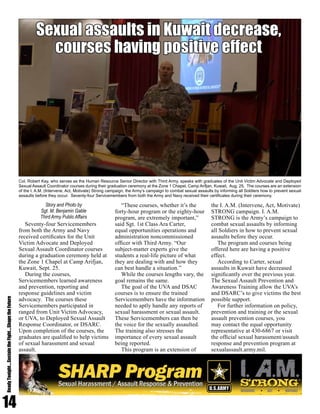
Col. Robert Kay, who serves as the Human Resource Senior Director with Third Army, speaks with graduates of the Unit Victim Advocate and Deployed
Sexual Assault Coordinator courses during their graduation ceremony at the Zone 1 Chapel, Camp Arifjan, Kuwait, Aug. 25. The courses are an extension
of the I. A.M. (Intervene, Act, Motivate) Strong campaign, the Army’s campaign to combat sexual assaults by informing all Soldiers how to prevent sexual
assaults before they occur. Seventy-four Servicemembers from both the Army and Navy received their certificates during their ceremony.
Sexual assaults in Kuwait decrease,
courses having positive effect
Story and Photo by
Sgt. M. Benjamin Gable
Third Army Public Affairs
Third Army food service personnel
and senior members of the food service
management board from multiple
countries participated in their quarterly
meeting, which was held at the Zone 1
theater here, Oct. 20.
The main goal of the meeting was
to provide a quarterly exchange of
information for the food service leaders
and receive updates on food services.
The meeting focused primarily on ways
to improve food quality and timeliness
for Troops in the war zone.
But coordination wasn’t the only
item on the menu.
The group also discussed the new
Army “Soldier Athlete” initiative
program. The “Soldier Athlete”
initiative is a new program that treats
and trains Soldiers like athletes. This
is a three-tier program that improves
upon the physical readiness program
by introducing the new Training
Circular 3.22-20, places athletic trainers
with initial military training in units
to optimize training and begins the
initiative that no longer “feeds” the
Soldier, but rather “fuels” the Soldier
by adding a menu cycle with healthier
choices and low-fat or sugar-free
alternatives.
And Third Army is meeting this
challenge, even before many others.
“We’ve remained a year ahead of
the power curb,” said CW4 David J.
Longstaff, Third Army command food
advisor. “[Third Army] is beating ‘big
Army’ to the punch.”
With this foresight, Third Army will
be implementing the changes to ensure
healthier eating for its Servicemembers.
Longstaff is at the front of the line in
ensuring Servicemembers throughout
Third Army’s area of operations have a
variety of healthier alternatives. Some
of those items will be baked goods
in the place of fried, more milks and
juices instead of sodas, whole grain
pastas and breads and even more
choices in fresh fruits.
Lasagna, for example, will be re-
formulated with better ingredients and
have a vegetarian option and gravy
bases will have less sodium than
before.
All of these are part of ongoing
processes set by Third Army food
service personnel. Many of these items
are already in circulation while others
are expected to be appearing on menus
in the coming months.
This eight-hour meeting is
indicative of strides Third Army has
made in recent years with the quality
of its food. The quarterly meeting
also demonstrates what Third Army’s
food service leadership can do with
continued coordination and fresh ideas
to ensure its Servicemembers live a
healthier lifestyle.
“We never want to take any food
options away from Third Army
Soldiers,” said Longstaff. “But we
do want to give them a lot of healthy
alternatives to help them be more
physically fit.”
15
ReadyTonight....SustaintheFight....ShapetheFuture
Story and Photo by
Sgt. M. Benjamin Gable
Third Army Public Affairs
Third Army food service looks to remain a cut
above with healthy alternatives
Capt. Steven Jackson, Third Army dietician, samples some of the healthier food choices Third Army
is scheduled to introduce into menus during the quarterly food service management board meeting
held at the Zone 1 theater at Camp Arifjan, Kuwait, Oct. 20. Third Army food service personnel and
senior members of the food service management board from multiple countries discussed the new
Army “Soldier Athlete” initiative program. Part of the program centers on the “Soldier Athlete” initiative
that no longer “feeds” the Soldier, but rather “fuels” the Soldier by adding a menu cycle with healthier
choices and low-fat or sugar-free alternatives.
16
ReadyTonight....SustaintheFight....ShapetheFuture
Whether in the mountains in
Afghanistan or training the Iraqi
Security Forces in Baghdad, Soldiers
rely heavily on their equipment,
training and living conditions.
Financial leaders throughout
Kuwait, Iraq and Afghanistan
attended a financial management
conference at Camp Arifjan, Kuwait
Oct. 28-29 to discuss lessons learned
throughout fiscal year 2010, so they
can continue effectively cutting
cost transparency and responsibility
throughout the Army.
“During the conference we will
discuss what assets we have, that
we are helping to meet the goal of
ensuring commanders have what they
need, but at the same time ensuring
we are being good stewards to the
taxpayers money,” said Brig. Gen.
Robert McCaleb, who serves as the
director of resource management for
Third Army and host for the financial
management conference.
The conference was able to act as
a platform for discussion allowing the
leaders to discuss their experiences
from the field. This allowed the
attendees to build plans to better
shape the Third Army’s financial
future by saving money but still
getting the equipment and supplies to
the Warfighter.
“We structured this conference to
be at the end of the fiscal year 2010,
so we could get everyone together
and talk about what we have learned
throughout the year,” said Brig.
Gen. McCaleb. “This conference is
a team building exercise so we come
together to discuss what we can do to
improve the Army’s audit ability in
fiscal year 2011.”
During the conference the
Honorable Mary S. Matiella, assistant
secretary of the Army, financial
management and comptroller, spoke
with financial leaders in attendance
to discuss the importance of ensuring
their financial processes run as
smoothly as possible.
“We need to keep our ears open
to requirements. What is it the
Warfighter needs to make sure they
can save lives?” said Matiella. “We
need to ensure that the Warfighter
gets what they need, not that you
have contracted for it, not that you
have planned for it, but that they get
it.”
The leaders hope the conference
will improve their processes of
supporting the Warfighter.
“The Soldiers may not directly
see the effects of the conference,”
said Brig. Gen. McCaleb. “What
they will see is the improvement of
their equipment, training and living
conditions.”
As the conference comes to a
close, the financial leaders will be
able to take what they have learned
and not only shape Third Army’s
future, but the Army as a whole, by
sustaining the force effectively, while
conserving the cost and being fiscally
accountable.
Financial leaders come together to discuss lessons learned
Show me the money:
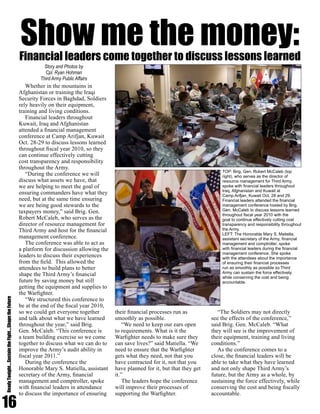
TOP: Brig. Gen. Robert McCaleb (top
right), who serves as the director of
resource management for Third Army,
spoke with financial leaders throughout
Iraq, Afghanistan and Kuwait at
Camp Arifjan, Kuwait Oct. 28 and 29.
Financial leaders attended the financial
management conference hosted by Brig.
Gen. McCaleb to discuss lessons learned
throughout fiscal year 2010 with the
goal to continue effectively cutting cost
transparency and responsibility throughout
the Army.
LEFT: The Honorable Mary S. Matiella,
assistant secretary of the Army, financial
management and comptroller, spoke
with financial leaders during the financial
management conference. She spoke
with the attendees about the importance
of ensuring their financial processes
run as smoothly as possible so Third
Army can sustain the force effectively,
while conserving the cost and being
accountable.
Story and Photos by
Cpl. Ryan Hohman
Third Army Public Affairs
17
ReadyTonight....SustaintheFight....ShapetheFuture
As we approach a new season,
I think of the children back home
who are imagining all the candy
they will receive and the tricks they
will play on each other. However,
Halloween in the Christian tradition
is about remembering the Saints
who have gone before. Regardless
of your theological or personal view
of Halloween, it is a wonderful time
to reflect upon the people of the
past. Psalms 19:14 says, “Houses
and riches are the inheritance
of fathers.” When I imagine the
costumes, I think of the great
leaders of ages past. Eisenhower,
Moore, Kennedy, Reagan, Lincoln
all have inspired in us the qualities
and character that contribute to
being great American citizens.
Perhaps we should take this time
of change in season and reflect
upon whether or not we should
make changes in our own lives.
Naturally, we are very grateful
for our families, husbands, wives,
children, but we must never forget
the hard work and inheritance that
we receive from our own “fathers”
and “mothers.” All that we have in
America was built upon the work of
those that have gone before us and
have paid for the freedoms we now
enjoy. As we seek to benefit from
this season of change, let us strive
for excellence in all we do; let’s
allow ourselves to be inspired by the
character and fortitude of those who
have helped make our nation great
and do our best to follow in their
footsteps.
Chaplain CornerStory by
Chaplain (CPT) Vince Hokkanen
2-124 IN BN, 53rd IBCT
18
ReadyTonight....SustaintheFight....ShapetheFuture
Health CornerHealth Corner
Soldier weight
control has become a
major problem for the
service. Recent articles
have been my attempt
to define this problem,
as well as describe some
things that can make
weight loss easier for
people. In this final article
devoted specifically to
weight management,
the reader is now asked
to think seriously about
his or her values in life,
with an eye toward
identifying a personal goal.
Individuals should then
ask themselves, “What
motivates me to achieve
this goal?” It’s important
to realize that different
people may have different
types of motivations
driving them to achieve
their goals.
Unfortunately, dietitians
and other healthcare
providers often miss the
boat by preaching to people
about all the long-term
health benefits of proper
weight management.
Simply knowing about a
health benefit years down
the road, generally does not
motivate people to make
changes today. In other
words, education does not
necessarily equal behavior
change. This is why each
person must find his or her
own personal driving force
to make changes and to
sustain those changes over
time.
In order to find lasting
motivation, it all comes
back to the individual’s
values, priorities and
ambitions in life. The
key to weight control is
maintaining a mental link
between one’s desired body
weight and something else
that is very important to
that person. This mental
link could be somewhat
related to future health,
such as “If I keep my
weight down, I’ll have
more energy to keep up
with my kids.” More
often, however, the mental
link relates to personal
appearance (e.g., “…I’ll
look so much better in my
uniform…or swimsuit”)
or physical ability (e.g.,
“…I’ll be able to run faster
and longer without getting
winded”). It’s important to
keep goals and motivators
freshly in mind on a daily
basis. If the mental link is
lost, it’s just too easy to fall
back into old habits.
Weight Gain – Insights to a Solution (Part 4 of 4)
Story by
Cpt. Steven Jackson, PhD, RD
Third Army Dietitian
is on the Command
Information Channel
Find out what’s going on in all branches who serve
Third Army by watching the Command Information
Channel on your local broadcast station.
The Desert VisionThe Desert Vision
19
ReadyTonight....SustaintheFight....ShapetheFuture
Emergency NumbersEmergency Numbers
Why is it important
to vote?911 Emergency DSN – 911/112
From cell phone 2389-9911
Camp Arifjan
DSN 430-3160 / PMO 430-1343
Arifjan Cell 6682-2120
Camp Buehring
DSN 438-3224 / PMO 438- 3325
Buehring Cell 9720-5396
Camp Virginia Emergency DSN 832-9111
Camp Virginia DSN 832-2559
Virginia Cell 6705-9470
LSA DSN 442-0189
LSA Cell 6682-2467
K-Crossing DSN 823-1327
K-Crossing Cell 682-0095
KCIA/APOD Cell 6706-0165
SPOD DSN 825-1314
SPOD Cell 9720-5982
KNB DSN 839-1334
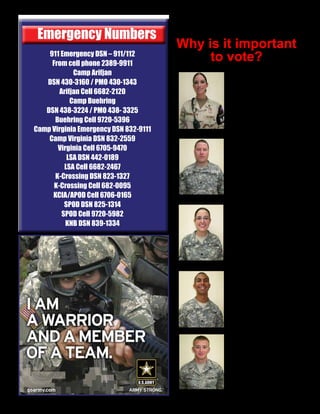
Sgt. Theodore Martin
HHD 54th Signal Battalion
“We put people into office,
so our vote matters. Getting
people involved in politics,
letting people know how im-
portant voting is can shape
the future of our country.”
“Make it easier. It’s still a
difficult process to get all
the information you need
for your state and send out
your absentee ballot.”
Petty Officer 2nd Class
Chrystle Martinez
Provost Marshal Office
“I vote for our president
because he’s our Com-
mander-in-Chief.”
Spc. Sharlene Christensen
HHD 54th Signal Battalion
“I think more people
would be motivated to
vote if they had someone
to show them how.”
Air Force Airman 1st Class
Justin D. Adkins
386 COMSQUAD
Sgt. Mark Whitaker
1st Theater Sustainment
Command
“I think it’s important
that everyone has a say
in who our leaders are.”
Just one Question?
Desert Voice Mag 1

Desert Voice Mag 1

  • 2.
    The Desert Voiceis an authorized publication for members of the Department of Defense. Contents of the Desert Voice are not necessarily the official views of, or endorsed by, the U.S. Government or Department of the Army. The editorial content of this publication is the responsibility of the U.S. Army Central Public Affairs Office. This magazine is published by Al-Qabandi United, a private firm, which is not affiliated with USARCENT. All copy will be edited. The Desert Voice is produced twice a month by the 27th Public Affairs Detachment. Find us online at www.arcent.army.mil. Col. Gerald O’Hara Third Army Public Affairs Officer Lt. Gen. William G. Webster Third Army Commanding General Command Sgt. Maj. John D. Fourhman Third Army Command Sgt. Maj. Sgt. Maj. Christopher J. Fletcher Third Army Public Affairs Sgt. Maj. Sgt. M. Benjamin Gable Desert Voice Editor Cpl. Ryan Hohman Staff Writer Spc. Eric Guzman Layout and Design Pfc. Dan Rangel Staff Writer Lt. Col. Wayne Marotto Third Army Deputy PAO (FWD) Sgt. 1st Class Jon Wiley Third Army PAO NCOIC Capt. Russell E. Varnado 27th PAD Commander Staff Sgt. Mark Matthews 27th PAD NCOIC 2 ReadyTonight....SustaintheFight....ShapetheFuture CONTENTS Helping Pakistan Pg. 6 Gas Gas Gas PG.12 Preparedness PG.9 >> Pg. 10 Lucky WarriorPG.4 Army Ten Miler Servicemembers throughout Kuwait came together to put their running skills to the test during the Army Ten-Mile run at Camp Buehring. 408th Contracting Support Brigade assists Soldiers in the Pakistan relief effort. Sgt. Maj. of the Army Kenneth Preston spoke with thousands of Soldiers at Camp Arifjan, Kuwait about the importance being prepared for any situation. Third Army Soldiers put their skills to the test during Third Army’s four-day Lucky Warrior 2010 exercise. Third Army prepares civilians on how to respond to a chemical attack.
  • 3.
    3 ReadyTonight....SustaintheFight....ShapetheFuture During the Monthof November we observe two important dates, traced back to World War I, that reaffirm the importance of Mission, People and Teamwork: Veterans Day and the Third Army Birthday. The foundation of Third Army’s success, as ingrained in our past as it is relevant to our future, is our Soldiers working as a Team. Soldiers. Nov. 11 marks our 91st observance of Veterans Day. Originally established as Armistice Day in 1919, marking the first anniversary of the signing of the armistice that ended World War I, this holiday evolved into a national day of appreciation for all U.S. veterans. Renamed as Veterans Day in 1954, this day honors America’s veterans for their patriotism, love of country and willingness to serve and sacrifice for the common good of our Nation. Teamwork. Since its inception, Third Army has etched its name in American history through two World Wars, Desert Shield/Desert Storm, Operation Enduring Freedom and Operation Iraqi Freedom. Activated in France Nov. 7, 1918, Third Army initially served as an army of occupation in post-war Germany. During the subsequent 92 years of our existence, Third Army has led America’s fighting forces through combat in Europe and Southwest Asia. We celebrate Third Army’s birthday Nov. 7, in recognition of the proud history of our team of teams. Mission. Credited with seven wartime campaigns, Third Army has a distinguished history of mission accomplishment. We continue that success today as we refine our operational capabilities to be Ready Tonight, as demonstrated through our recent and successful exercises: Internal Look and Lucky Warrior. We’re Shaping the Future by conducting Theater Security Cooperation events in 16 countries across Southwest and Central Asia. We Sustain the Fight as we support 16 Brigade Combat Teams, a ground force population of more than 120,000 personnel, and operations in Afghanistan, Iraq, Kuwait and throughout our area of responsibility. And we continue to carry out Operation Nickel II, the largest logistical operation since World War II, as we perform the Responsible Drawdown of Forces in Iraq and support to Afghanistan. As we look to the future, we build upon the successes of our past. Take time this month to honor our history and to thank our veterans for 92 years of Mission success. Honor the legacy of our Team by remembering the 92nd birthday of our Third Army on November 7th. Thank and pay due respect to our People by recognizing Veterans’ Day on November 11th. Patton’s Own! To the Third Army/ARCENT Team, From the Top
  • 4.
    4 ReadyTonight....SustaintheFight....ShapetheFuture The Third Armyteam conducted an exercise at Camp Arifjan Oct. 16- 19. The focus of the four-day mission was to ensure Third Army’s ability to react to any possible situations within the U.S. Central Command area of responsibility. The Lucky Warrior exercise has been conducted periodically throughout the years to maintain readiness for contingency operations throughout the Middle East. “This exercise brings the team together and poises them for a mission-setting focus to gather intelligence, assessments, data and holistic information that is shared as a team,” said Sgt. Maj. William Hayes, Third Army aviation sergeant major and native of Memphis, Tenn. The focus is geared toward training the command-post staff to be ready and effective if called. “Lucky Warrior is an exercise designed to train the Third Army command post to conduct different contingency operations in our area of responsibility,” said Col. Paul Humphreys, Third Army chief of future operations. “These exercises ensure we are ready for real-world contingencies,” Humphreys said. “The exercises we’re going through right now identify tactics, techniques and procedures and battle drills that we could use in a real-world situation later on.” The Third Army team consists of more than Soldiers and has a joint- service structure. “We have Soldiers, Sailors, Airmen and Marines,” Humphreys said. “We also have Department of the Army Civilians. We also have contractors who are working with us.” Humphreys was pleased with the results of the exercise. “It’s going very well,” he said. “There’s a lot of hard learning going on. We’re feeling our way through some things at the same time we’re building some strong relationships within the staff and our supporting units, which will enable us to get better each day.” Exercises of this type aren’t expected to run flawlessly. Team members are expected to make mistakes and learn from them. “The mistakes we make today we are correcting, and we’re improving what we do so that we don’t make the same mistakes again tomorrow,” Humphreys said. Third Army exercise leaders are also happy with their Soldiers performance. “Our Soldiers did a great job … I couldn’t be prouder of them,” said Maj. Tom Moran, the communications officer in charge for Third Army showcases its readiness at Lucky Warrior 2010 Story by Pfc. Dan Rangel Third Army Public Affairs Third Army Soldiers erect a DRASH, or deployable rapid assembly shelter, in support of Lucky Warrior 2010 at Camp Arifjan, Kuwait, Oct. 15. The DRASH can be erected in a single day and enhanced with communications equipment and logistics support allowing Third Army Soldiers to be prepared for contingency operations anywhere in U.S. Central Command’s area of responsibility. Photo by Lt. Col. Jonathan Allen
  • 5.
    the contingency command outpostand native of Fairport, N.Y. “We work together really well … we were flexible to adapt to new changes,” Moran said. “Everybody had a really good attitude putting up the tents and running cables, so I declare it a success.” Physically, the Lucky Warrior exercise has grown from being just a handful of tents in the desert to an intricate web of communications and operations cells linked together to form a first-class command post. “I’ve been at Third Army for four years. I’ve been doing exercises for the last three,” said Chief Warrant Officer Christopher Crozier, a communications chief from Fairfield, Calif. “The command post has grown. It’s changed from what we used to have. We’ve gone from just the deployable, expandable shelters, which we’ve moved into the tent complex here now.” Humphreys also expressed the significance of exercises like Lucky Warrior and just how relevant they are to real-world events. “I went through a Lucky Strike exercise back in 2002 we used to prepare for Operation Iraqi Freedom. We went through it in November of 2002 and in March of 2003 we were actually conducting real-world operations based on the exercise we had done in November,” Humphreys said. So what is the status of Third Army’s readiness? “This command is ready to serve in this area for whatever the contingency might be,” Humphreys said. 5 ReadyTonight....SustaintheFight....ShapetheFuture TOP: Third Army Soldiers work in the Command Operation Information Center at the Lucky Warrior at the 2010 Lucky Warrior training site, held in Camp Arifjan, Kuwait, Oct. 15. In the COIC it is every Soldiers’ responsibility to take the information they receive from downrange and analyze it for the other sections. LEFT: Third Army Commander, Lt. Gen. William G. Webster (left), sits next to Col. David Bishop, who serves as the Third Army chief of staff, and gives guidance to senior leadership during a rehearsal of concept (ROC) drill at the 2010 Lucky Warrior training site, held in Camp Arifjan, Kuwait, Oct. 15. The focus of the four-day mission was to ensure Third Army’s ability to react to any possible situations within the U.S. Central Command area of responsibility. Photo by Pfc. Dan Rangel Photo by Pfc. Dan Rangel
  • 6.
    6 ReadyTonight....SustaintheFight....ShapetheFuture In July, disasterstruck the people of Pakistan after heavy monsoon rains flooded the region and left thousands killed or injured and millions homeless. Within days, U.S. Forces were on the ground ready to help and ready to provide life-saving services and support. This is the second time this year the Expeditionary Contracting Command has exercised its expeditionary capabilities in support of humanitarian relief efforts. The first response was to provide humanitarian assistance and disaster relief efforts in support of the earthquake in Haiti. The 408th Contracting Support Brigade provides operational contracting support to Third Army and is designed to support Title 10 U.S Forces and their contracting requirements in the U.S. Central Command’s area of responsibility. “This mission is the pinnacle event for Contingency Contracting Officers,” said Col. Michael J. Rogers, who serves as the 408th CSB commander and Principle Assistant Responsible for Contracting –Southwest Asia. “It’s a real-world contingency mission.” The 408th CSB was notified of the need for contracting support in Pakistan and deployed two CCOs to the region within 48 hours, both from the Army Contracting Command – Kuwait offices at Camp Arifjan. “This represents a new paradigm shift in the expeditionary nature of Army contracting, which provides Contingency Contracting Teams in Story by Maj. Ryan E. Ocampo 408th Contacting Support Brigade CSB provides much needed contracting support in Pakistan U.S.Army Soldiers from the 16th CombatAviation Brigade, Fort Wainwright,Alaska, arrive at ChaklalaAir Force Base, Pakistan, aboard a C-17 Globemaster III aircraft in support of flood relief efforts Sept. 1. The 16th CAB also brought two UH-60 Blackhawk helicopters along with personnel. Photo by Staff Sgt. Andy Kin U.S. Marines from the 26th Marine Expeditionary Unit land a U.S. Marine CH-53E helicopter to drop off food to isolated Pakistanis in support of the Pakistan flood relief effort in Pano Aqil, Pakistan, Sept. 11. Photo by Staff Sgt. Wayne Gray
  • 7.
    7 ReadyTonight....SustaintheFight....ShapetheFuture response to contingencymissions,” Rogers said. U.S. military helicopters are currently operating out of Ghazi Airbase in northern Pakistan, Pano Aqil Air Base in southern Pakistan and Chaklala Airbase near Islamabad. At the same time, U.S. military C-130 and C-17 cargo aircraft continue to provide airlift support to Pakistan, delivering relief supplies to multiple locations throughout the country including Skardu, Sukkur, Quetta, Jacobabad, Sharea Faisal and Gilgit. The 408th CSB CCO team will continue to provide day-to-day sustainment support for the Soldiers, Sailors, Airmen and Marines, fulfilling vital humanitarian assistance support to Pakistan, during their initial entry into the region until which time the crisis response effort is complete. “This initial response capability is vital to the Forces enabling HA efforts because units in support of crisis events rarely deploy with all their organic assets to sustain themselves,” Rogers said. “Essential resources such as food, water and hygiene maintenance, if not taken care of, can quickly incapacitate personnel and hinder the vital support they provide, making the unit operationally inefficient.” The 408th CSB will continue to be on the leading edge of these missions in the future and continues to posture itself for full spectrum contract support by remaining focused, determined and Ready Tonight. An aerial view of Pakistani flood survivors grouped together on an isolated road surrounded by flood water as U.S. Marine pilots from the 26th Marine Expeditionary Unit begin their approach to deliver food supplies in support of the Pakistan flood relief effort in Pano Aqil, Pakistan, Sept. 14. Photo by Staff Sgt. Wayne Gray Photo by Staff Sgt. Andy Kin U.S. Army Soldiers from the 16th Combat Aviation Brigade, Ft. Wainwright, Alaska, arrive to Chaklala Air Force Base, Pakistan, aboard a C-17 Globemaster III aircraft in support of flood relief efforts, Sept. 1. The 16th CAB also brought two UH-60 Black Hawk helicopters along with personnel.
  • 8.
    8 ReadyTonight....SustaintheFight....ShapetheFuture Volunteer Servicmembers began training forthis year’s Combined Federal Campaign during sessions held Sept. 24 and 25 throughout bases in Kuwait. The CFC Overseas orchestrates the annual charity campaign among federal employees working abroad. Federal employees may choose from thousands of charities to give to through the CFC Overseas. “It’s all about personal choice. [Servicemembers] can direct the funds to exactly the charity they want their money to go,” said Constance Baker, CFC Overseas deputy director. This year’s CFC Overseas campaign begins Oct. 4 and runs through Dec. 3. Volunteers intend to ask every Servicemember overseas to make an informed decision. “The number one reason someone gives to charity is because they were asked,” Baker said. “That is our mission. We want to give a 100 percent informed opportunity to give.” CFC Overseas recruits vast amounts of volunteers; in fact, organizers hope to have one volunteer (or keyperson, as they are known in the organization) for every 20 Servicemembers. Having so many volunteers ensures that each Servicemembers’ contact with the CFC Overseas is through someone they all ready know. “It’s a personal transaction. We want to keep it personal,” Baker said. Many volunteers are new to the CFC Overseas campaign but want to get involved with charity work. “I’m motivated to help people in need and to contribute to a good cause,” said Capt. Sebastien Goillandeau, Third Army surgeon cell from Coahoma, Texas, who attended the training. Some Servicemembers, such as Navy Petty Officer 1st Class Rene Barrera, an administrative support specialist at Kuwait Naval Base, are more experienced. “I’ve been involved with CFC before,” Barrera said. “It was great knowing how to touch peoples’ lives and knowing that every little bit helps no matter how small the contribution.” Experienced or not, some volunteers are motivated to contribute to a good cause for very personal reasons. “I participate because I have a Family Member affected by Multiple Sclerosis,” said Staff Sgt. Lori Costello, an 1188 DDSB transportation control officer. “I hope one day they find a cure,” she said. Story and Photos by Pfc. Dan Rangel Third Army Public Affairs Constance Baker, CFC Overseas deputy director, conducts training for CFC Overseas volunteers at Camp Arifjan Sept. 25. This year’s CFC Overseas campaign begins Oct. 4 then runs through Dec. 3. CFC prepares kick off
  • 9.
    9 ReadyTonight....SustaintheFight....ShapetheFuture Sgt. Maj. ofthe Army Kenneth Preston climbed atop the trailer of a heavy equipment transporter to address hundreds of Third Army Soldiers who gathered as the sun set at Camp Arifjan, Kuwait, Sept. 29. “We, as a fighting force, need to be 100 percent in all phases of preparedness,” said Sgt. Maj. of the Army Preston. “There are Soldiers mobilized in war zones, but there’s also Soldiers mobilized back home helping on the gulf coast, helping with border patrol and helping with the floods in Missouri,” he said stressing the importance of preparedness at all times. Sgt. Maj. of the Army Preston encouraged Third Army Soldiers to go online and take the Global Assessment Tool training which will help enhance preparedness. According to Sgt. Maj. of the Army Preston, the training will allow Soldiers to become stronger by assessing their spiritual, emotional, physical, social and Family preparedness. The Comprehensive Soldier Fitness program, a type of Soldier fitness tracker linked to the Global Assessment Tool, develops and institutes a holistic fitness program for Soldiers, Families, and Department of the Army Civilians in order to enhance performance and build resilience. Though he spent multiple hours addressing crowds of Soldiers, Sgt. Maj. of the Army Preston’s main objective was to meet face-to-face with individual Third Army Soldiers. The Army’s top noncommissioned officer pinned new ranks on three Soldiers during a promotion ceremony with Alpha Company, 3rd Battalion, 43rd Air Defense Artillery Regiment. Sgt. Maj. of the Army Preston then had individual conversations with more than 50 Soldiers with the 1st Battalion, 124th Infantry Regiment. The 13th sergeant major of the Army asked questions ranging from missions to Family life and personal goals. After meeting with both individual and groups of Soldiers, Sgt. Maj. of the Army Preston fielded questions from those in attendance. According to one ThirdArmy Soldier, this was a welcomed opportunity. “It was a great experience for me to talk directly to “the man,’” said Spc. Anthony Wilson, an infantryman with Delta Company, 2nd Battalion, 124th Infantry Regiment and a native of Orlando, Fla. “How many times in my career will I get a chance to do that?” After each session, Sgt. Maj. of the Army Preston left the Third Army Troops with praise for the job they are doing in Kuwait with a lead role in the Responsible Drawdown in Iraq and its support of the increase of Troops and resources for Afghanistan. “[Third Army Soldiers] have been the backbone of the operations, with all the services they have provided the Warfighter,” said Sgt. Maj. of the Army Preston. “Third Army has been magnificent and the work is transparent to the American public.” Sgt. Maj. of the Army Kenneth Preston participates in the promotion of Sgt. Jason Blanco, a native of Miami, Fla. and patriot missile launching station enhanced operator with Alpha Company, 3rd Battalion, 43rd Air Defense Artillery Regiment, during a promotion ceremony Sept. 29, at Camp Arifjan, Kuwait. The Army’s top noncommissioned officer pinned three Third Army Soldiers during the ceremony. Army’s top NCO visits Third ArmyStory and Photos by Sgt. M. Benjamin Gable Third Army Public Affairs Sgt. Maj. of the Army Kenneth Preston addresses more than a thousand Third Army Soldiers during his visit to Camp Arifjan, Kuwait, Sept. 29.
  • 10.
    Sand, rocks, brokenpavement, heat. Runners conquered these and more at the Sixth Annual Association of the United States Army Ten-Miler race on Camp Buehring, Kuwait Oct. 3. The desert version of the race offered deployed personnel who could not make it to the Ten-Miler in Washington, D.C., the opportunity to run – a timeless Army activity that is part of Soldiers’lives even when they are deployed. Volunteers from the military; Morale, Welfare and Recreation; the USO and Association of the United States Army all worked together to set up the event and provide runners water, fruit, T-Shirts and awards. Runners of all ability levels came to Buehring from more than four camps in Kuwait. The race was a particularity fast one, as two runners, Capt. Elias Gonzalez and Capt. Robin Herndon, set camp records for male and female runners. Gonzalez, a member of the 53rd Infantry Brigade Combat Team, crossed the finish line in less than an hour at 59 minutes, 2 seconds. Herndon, who represented the Air Force, came in at 1:07.22. While the speedsters stole the show, other runners set records of their own. Petty Officer 2nd Class Chris Esperti, a Navy Customs agent, said he trained his way up to the event, and the 10-mile distance was the final test. “I’ve been running for about six, seven months. I got up to about eight miles a day, so this is my longest run for a race,” he said. When asked his time, Esperti knew it to the second. “1 hour 15 minutes and 32 seconds. I missed third place in my age group by a minute.” Other runners took on the race without having completed an organized training plan. Staff Sgt. Alejandro Aguilar, from Madera, Calif., is a National Guard Soldier with the 1836th Transportation Company. He said he has run in Esprit de Corps and Battalion runs, but the Ten- Miler was his time to see what he was made of. “I just heard about it, and I wanted to do it to see if I could still do it. I’m 39 years old, but I still have it in me,” he said after the race. Aguilar crossed the finish line in 1:24.00. “It was painful,” he said with a smile. He declared that he passed his personal test by finishing the race. “I’m not hurt, until tomorrow, anyway,” he said. Aguilar, who is a Border Patrol agent in his civilian career, said the desert course offered unexpected surprises. 10 ReadyTonight....SustaintheFight....ShapetheFuture Partial pavemen Deployed runners tackle A Runners turn the corner on a paved part of the Association of the United States Army Ten-Miler race course at Camp Buehring, Kuwait, Oct. 3. This year was the si Capt. Elias Gonzalez holds the finish-line tape after setting a camp record for fastest male runner in the Sixth Annual Association of the United States Army Ten-Miler race at Camp Buehring, Kuwait, Oct. 3. Gonzalez, a member of the 53rd Infantry Brigade Combat Team, crossed the finish line in less than an hour at 59 minutes, 2 seconds. Story by Natalie Cole 1st Theater Sustainment Command Photo by Pfc. Daniel Rangel
  • 11.
    “There [were] acouple spots where it was kind of rocky and bumpy…. That was kind of unexpected. I know there were some tank trails back there where it was really bad so you had to find a good spot to trot along in,” said Aguilar, who has been deployed for six months. The terrain was not too harsh to slow Aguilar down, however. “All in all, I think it was one of the better courses I’ve ran. There was only one major hill, I thought. To most people it probably wouldn’t be a hill, but to me it was. I think it was around the fifth mile where it popped up,” he said. Aguilar laughed as he recounted his thoughts during the last mile of the race. “Honestly, I didn’t even know where the last mile was. I just looked at the water tower ‘cuz you knew when you saw that water tower that was basically where it was going to finish off.” Other runners came to the Ten-Miler with a long resume of running experience and practice. Col. Jorge Klajnbart, deputy surgeon for Third Army, traveled from Camp Arifjan for the race. He placed second in the 50-plus age group with a time of 1:18.52. An orthopedic surgeon, Klajnbart said he has been running for about 10 years. He said as he ran the last mile of the race, he thought “I can’t wait ‘till it’s over. I can’t wait to get sprinkled by the fire truck. But I felt good. I did. I ran it in under 80 minutes so that was my goal. I accomplished my goal.” Klajnbart said the course - with its sand, rocks and dips - was all in the name of the desert run. “It was perfect. I loved it.” Although it is an Army event, the race had a good mix of runners, Klajnbart added. “It’s good to see Army, Air Force, everybody running together.” Command Sgt. Maj. John D. Fourhman, Third Army command sergeant major, ran the race in 1:16.04. He presented awards to the top-placing runners after the race. The desert Ten-Miler is an example of how Third Army encourages Soldiers to stay active in support of the mission and the physical aspect of Comprehensive Soldier Fitness. “Events like this are fun, but the underlying thing that goes into this is personal fitness,” said Fourhman, who plans on running the Ten-Miler in Washington Oct. 24. The event had a joint-service and civilian turn out of about 500, Fourhman said, adding that in the spirit of the Army race, “everyone left feeling Army strong.” 11 ReadyTonight....SustaintheFight....ShapetheFuture nt? No problem: Army 10-Miler in Kuwait ixth annual Ten-Miler in Kuwait and it gave Servicemembers from all services the opportunity to show their support for the AUSA. Capt. Robin Herndon (middle) smiles as she accepts her award for fastest female runner in the Sixth Annual Association of the United States Army Ten- Miler race at Camp Buehring, Kuwait Oct. 3. Herndon set a camp record when she crossed the finish line in 1 hour 7 minutes 22 seconds. Photo by Pfc. Dan Rangel Photo by Pfc. Dan Rangel
  • 12.
    12 ReadyTonight....SustaintheFight....ShapetheFuture Third Army operatesfrom five locations within Kuwait to support the Warfighter, and they rely on the support of their Department of the Army Civilian employees for logistics and personnel support. To ensure their safety, DA Civilians working for Third Army in Kuwait attended Chemical, Biological, Radiological, Nuclear, and high-yield explosive training at Camp Arifjan, Kuwait, Oct. 14. The training provided DA Civilians the opportunity to become familiar with response measures in the event of a CBRNE attack, by allowing them to get a hands on experience with all of their gear and the procedures following a CBRNE attack. “During this training our goal was to allow the people to become familiar with the 15 CBRNE tasks and their gear,” said Larry Smith, a CBRNE specialist with Area Support Group – Kuwait. “If something was to happen, it is important they know how to respond.” During the training the DA Civilians were taught how to put on their masks and Joint Service Lightweight Integrated Suit Technology, how to decontaminate themselves and learned the different Mission- Oriented Protective Postures. “A lot of these people have never been in the military, or they have been out for a long time, so they’re not used to this training,” said Smith, a former Soldier. The instructors took into account the lack of formal military training and familiarization the DA Civilians might have, and eased the participants into the training at the most basic level. The class was broken up in to four small groups with each group focusing on different tasks. Each group was then able to receive hands on training to better familiarize themselves with their gear. “When we were in the Army, we taught crawl, walk and run phases when we trained Soldiers,” said Smith. “With our training today, we taught at a pre-crawl phase allowing them to get used to their equipment and give them an understanding of what would happen.” This process allowed for the participants to feel comfortable with the training and helped them better understand how they can protect themselves. “This is great information with all the instructors telling us step by step what to do in a chemical attack,” said James Canterbury, a senior enlisted manager with ASG-K. “As we began these classes a lot of people didn’t know how to put stuff on or were stuff went.” At the end of the class, as the JLIST suits and gas masks were packed up and the participants returned to their normal duties, they were able to walk away knowing they will know what to do in case of a CBRNE attack. DA Civilians get familiarized with CBRNEStory and Photos by Cpl. Ryan Hohman Third Army Public Affairs
  • 13.
    13 ReadyTonight....SustaintheFight....ShapetheFuture TOP LEFT: CarolynHickman, a quality-assurance, supply- ammo specialist with the Defense Logistics Agency, puts on her Joint Service Lightweight Integrated Suit Technology during Chemical, Biological, Radiological, Nuclear, and high-yield explosive training at Camp Arifjan, Kuwait, Oct. 14. TOP: Larry Smith, a CBRNE specialist with Area Support Group – Kuwait, instructs Department of the Army Civilian employees working in Kuwait on how to properly decontaminate themselves during the training. LEFT: Carla Johnson (right), a contract specialist with the Department of Labor, assist Carolyn Hickman (left), in removing her JLIST during CBRNE training at Camp Arifjan, Kuwait, Oct. 14.
  • 14.
    14 ReadyTonight....SustaintheFight....ShapetheFuture Seventy-four Servicemembers from boththe Army and Navy received certificates for the Unit Victim Advocate and Deployed Sexual Assault Coordinator courses during a graduation ceremony held at the Zone 1 Chapel at Camp Arifjan, Kuwait, Sept. 25. During the courses, Servicemembers learned awareness and prevention, reporting and response guidelines and victim advocacy. The courses these Servicemembers participated in ranged from Unit Victim Advocacy, or UVA, to Deployed Sexual Assault Response Coordinator, or DSARC. Upon completion of the courses, the graduates are qualified to help victims of sexual harassment and sexual assault. “These courses, whether it’s the forty-hour program or the eighty-hour program, are extremely important,” said Sgt. 1st Class Ara Carter, equal opportunities operations and administration noncommissioned officer with Third Army. “Our subject-matter experts give the students a real-life picture of what they are dealing with and how they can best handle a situation.” While the courses lengths vary, the goal remains the same. The goal of the UVA and DSAC courses is to ensure the trained Servicemembers have the information needed to aptly handle any reports of sexual harassment or sexual assault. These Servicemembers can then be the voice for the sexually assaulted. The training also stresses the importance of every sexual assault being reported. This program is an extension of the I. A.M. (Intervene, Act, Motivate) STRONG campaign. I. A.M. STRONG is the Army’s campaign to combat sexual assaults by informing all Soldiers in how to prevent sexual assaults before they occur. The program and courses being offered here are having a positive effect. According to Carter, sexual assaults in Kuwait have decreased significantly over the previous year. The Sexual Assault Prevention and Awareness Training allow the UVA’s and DSARC’s to give victims the best possible support. For further information on policy, prevention and training or the sexual assault prevention courses, you may contact the equal opportunity representative at 430-6867 or visit the official sexual harassment/assault response and prevention program at sexualassault.army.mil. Col. Robert Kay, who serves as the Human Resource Senior Director with Third Army, speaks with graduates of the Unit Victim Advocate and Deployed Sexual Assault Coordinator courses during their graduation ceremony at the Zone 1 Chapel, Camp Arifjan, Kuwait, Aug. 25. The courses are an extension of the I. A.M. (Intervene, Act, Motivate) Strong campaign, the Army’s campaign to combat sexual assaults by informing all Soldiers how to prevent sexual assaults before they occur. Seventy-four Servicemembers from both the Army and Navy received their certificates during their ceremony. Sexual assaults in Kuwait decrease, courses having positive effect Story and Photo by Sgt. M. Benjamin Gable Third Army Public Affairs
  • 15.
    Third Army foodservice personnel and senior members of the food service management board from multiple countries participated in their quarterly meeting, which was held at the Zone 1 theater here, Oct. 20. The main goal of the meeting was to provide a quarterly exchange of information for the food service leaders and receive updates on food services. The meeting focused primarily on ways to improve food quality and timeliness for Troops in the war zone. But coordination wasn’t the only item on the menu. The group also discussed the new Army “Soldier Athlete” initiative program. The “Soldier Athlete” initiative is a new program that treats and trains Soldiers like athletes. This is a three-tier program that improves upon the physical readiness program by introducing the new Training Circular 3.22-20, places athletic trainers with initial military training in units to optimize training and begins the initiative that no longer “feeds” the Soldier, but rather “fuels” the Soldier by adding a menu cycle with healthier choices and low-fat or sugar-free alternatives. And Third Army is meeting this challenge, even before many others. “We’ve remained a year ahead of the power curb,” said CW4 David J. Longstaff, Third Army command food advisor. “[Third Army] is beating ‘big Army’ to the punch.” With this foresight, Third Army will be implementing the changes to ensure healthier eating for its Servicemembers. Longstaff is at the front of the line in ensuring Servicemembers throughout Third Army’s area of operations have a variety of healthier alternatives. Some of those items will be baked goods in the place of fried, more milks and juices instead of sodas, whole grain pastas and breads and even more choices in fresh fruits. Lasagna, for example, will be re- formulated with better ingredients and have a vegetarian option and gravy bases will have less sodium than before. All of these are part of ongoing processes set by Third Army food service personnel. Many of these items are already in circulation while others are expected to be appearing on menus in the coming months. This eight-hour meeting is indicative of strides Third Army has made in recent years with the quality of its food. The quarterly meeting also demonstrates what Third Army’s food service leadership can do with continued coordination and fresh ideas to ensure its Servicemembers live a healthier lifestyle. “We never want to take any food options away from Third Army Soldiers,” said Longstaff. “But we do want to give them a lot of healthy alternatives to help them be more physically fit.” 15 ReadyTonight....SustaintheFight....ShapetheFuture Story and Photo by Sgt. M. Benjamin Gable Third Army Public Affairs Third Army food service looks to remain a cut above with healthy alternatives Capt. Steven Jackson, Third Army dietician, samples some of the healthier food choices Third Army is scheduled to introduce into menus during the quarterly food service management board meeting held at the Zone 1 theater at Camp Arifjan, Kuwait, Oct. 20. Third Army food service personnel and senior members of the food service management board from multiple countries discussed the new Army “Soldier Athlete” initiative program. Part of the program centers on the “Soldier Athlete” initiative that no longer “feeds” the Soldier, but rather “fuels” the Soldier by adding a menu cycle with healthier choices and low-fat or sugar-free alternatives.
  • 16.
    16 ReadyTonight....SustaintheFight....ShapetheFuture Whether in themountains in Afghanistan or training the Iraqi Security Forces in Baghdad, Soldiers rely heavily on their equipment, training and living conditions. Financial leaders throughout Kuwait, Iraq and Afghanistan attended a financial management conference at Camp Arifjan, Kuwait Oct. 28-29 to discuss lessons learned throughout fiscal year 2010, so they can continue effectively cutting cost transparency and responsibility throughout the Army. “During the conference we will discuss what assets we have, that we are helping to meet the goal of ensuring commanders have what they need, but at the same time ensuring we are being good stewards to the taxpayers money,” said Brig. Gen. Robert McCaleb, who serves as the director of resource management for Third Army and host for the financial management conference. The conference was able to act as a platform for discussion allowing the leaders to discuss their experiences from the field. This allowed the attendees to build plans to better shape the Third Army’s financial future by saving money but still getting the equipment and supplies to the Warfighter. “We structured this conference to be at the end of the fiscal year 2010, so we could get everyone together and talk about what we have learned throughout the year,” said Brig. Gen. McCaleb. “This conference is a team building exercise so we come together to discuss what we can do to improve the Army’s audit ability in fiscal year 2011.” During the conference the Honorable Mary S. Matiella, assistant secretary of the Army, financial management and comptroller, spoke with financial leaders in attendance to discuss the importance of ensuring their financial processes run as smoothly as possible. “We need to keep our ears open to requirements. What is it the Warfighter needs to make sure they can save lives?” said Matiella. “We need to ensure that the Warfighter gets what they need, not that you have contracted for it, not that you have planned for it, but that they get it.” The leaders hope the conference will improve their processes of supporting the Warfighter. “The Soldiers may not directly see the effects of the conference,” said Brig. Gen. McCaleb. “What they will see is the improvement of their equipment, training and living conditions.” As the conference comes to a close, the financial leaders will be able to take what they have learned and not only shape Third Army’s future, but the Army as a whole, by sustaining the force effectively, while conserving the cost and being fiscally accountable. Financial leaders come together to discuss lessons learned Show me the money: TOP: Brig. Gen. Robert McCaleb (top right), who serves as the director of resource management for Third Army, spoke with financial leaders throughout Iraq, Afghanistan and Kuwait at Camp Arifjan, Kuwait Oct. 28 and 29. Financial leaders attended the financial management conference hosted by Brig. Gen. McCaleb to discuss lessons learned throughout fiscal year 2010 with the goal to continue effectively cutting cost transparency and responsibility throughout the Army. LEFT: The Honorable Mary S. Matiella, assistant secretary of the Army, financial management and comptroller, spoke with financial leaders during the financial management conference. She spoke with the attendees about the importance of ensuring their financial processes run as smoothly as possible so Third Army can sustain the force effectively, while conserving the cost and being accountable. Story and Photos by Cpl. Ryan Hohman Third Army Public Affairs
  • 17.
    17 ReadyTonight....SustaintheFight....ShapetheFuture As we approacha new season, I think of the children back home who are imagining all the candy they will receive and the tricks they will play on each other. However, Halloween in the Christian tradition is about remembering the Saints who have gone before. Regardless of your theological or personal view of Halloween, it is a wonderful time to reflect upon the people of the past. Psalms 19:14 says, “Houses and riches are the inheritance of fathers.” When I imagine the costumes, I think of the great leaders of ages past. Eisenhower, Moore, Kennedy, Reagan, Lincoln all have inspired in us the qualities and character that contribute to being great American citizens. Perhaps we should take this time of change in season and reflect upon whether or not we should make changes in our own lives. Naturally, we are very grateful for our families, husbands, wives, children, but we must never forget the hard work and inheritance that we receive from our own “fathers” and “mothers.” All that we have in America was built upon the work of those that have gone before us and have paid for the freedoms we now enjoy. As we seek to benefit from this season of change, let us strive for excellence in all we do; let’s allow ourselves to be inspired by the character and fortitude of those who have helped make our nation great and do our best to follow in their footsteps. Chaplain CornerStory by Chaplain (CPT) Vince Hokkanen 2-124 IN BN, 53rd IBCT
  • 18.
    18 ReadyTonight....SustaintheFight....ShapetheFuture Health CornerHealth Corner Soldierweight control has become a major problem for the service. Recent articles have been my attempt to define this problem, as well as describe some things that can make weight loss easier for people. In this final article devoted specifically to weight management, the reader is now asked to think seriously about his or her values in life, with an eye toward identifying a personal goal. Individuals should then ask themselves, “What motivates me to achieve this goal?” It’s important to realize that different people may have different types of motivations driving them to achieve their goals. Unfortunately, dietitians and other healthcare providers often miss the boat by preaching to people about all the long-term health benefits of proper weight management. Simply knowing about a health benefit years down the road, generally does not motivate people to make changes today. In other words, education does not necessarily equal behavior change. This is why each person must find his or her own personal driving force to make changes and to sustain those changes over time. In order to find lasting motivation, it all comes back to the individual’s values, priorities and ambitions in life. The key to weight control is maintaining a mental link between one’s desired body weight and something else that is very important to that person. This mental link could be somewhat related to future health, such as “If I keep my weight down, I’ll have more energy to keep up with my kids.” More often, however, the mental link relates to personal appearance (e.g., “…I’ll look so much better in my uniform…or swimsuit”) or physical ability (e.g., “…I’ll be able to run faster and longer without getting winded”). It’s important to keep goals and motivators freshly in mind on a daily basis. If the mental link is lost, it’s just too easy to fall back into old habits. Weight Gain – Insights to a Solution (Part 4 of 4) Story by Cpt. Steven Jackson, PhD, RD Third Army Dietitian is on the Command Information Channel Find out what’s going on in all branches who serve Third Army by watching the Command Information Channel on your local broadcast station. The Desert VisionThe Desert Vision
  • 19.
    19 ReadyTonight....SustaintheFight....ShapetheFuture Emergency NumbersEmergency Numbers Whyis it important to vote?911 Emergency DSN – 911/112 From cell phone 2389-9911 Camp Arifjan DSN 430-3160 / PMO 430-1343 Arifjan Cell 6682-2120 Camp Buehring DSN 438-3224 / PMO 438- 3325 Buehring Cell 9720-5396 Camp Virginia Emergency DSN 832-9111 Camp Virginia DSN 832-2559 Virginia Cell 6705-9470 LSA DSN 442-0189 LSA Cell 6682-2467 K-Crossing DSN 823-1327 K-Crossing Cell 682-0095 KCIA/APOD Cell 6706-0165 SPOD DSN 825-1314 SPOD Cell 9720-5982 KNB DSN 839-1334 Sgt. Theodore Martin HHD 54th Signal Battalion “We put people into office, so our vote matters. Getting people involved in politics, letting people know how im- portant voting is can shape the future of our country.” “Make it easier. It’s still a difficult process to get all the information you need for your state and send out your absentee ballot.” Petty Officer 2nd Class Chrystle Martinez Provost Marshal Office “I vote for our president because he’s our Com- mander-in-Chief.” Spc. Sharlene Christensen HHD 54th Signal Battalion “I think more people would be motivated to vote if they had someone to show them how.” Air Force Airman 1st Class Justin D. Adkins 386 COMSQUAD Sgt. Mark Whitaker 1st Theater Sustainment Command “I think it’s important that everyone has a say in who our leaders are.” Just one Question?