2nd
International Balkans Conference on Challenges of Civil Engineering, BCCCE, 23-25 May 2013, Epoka University, Tirana, Albania.
THE DESİGN OF SLENDER RC COLUMNS
Diana Lluka¹, Merita Guri², Veronika Hajdari³, Alketa Ndoj³
1
Department of Building Constructions and Transport Infrastructure, Faculty of Civil Engineering, Polytechnic
University of Tirana, Albania
2
Department of Applied and Human Sciences, Faculty of Architecture and Design, Polis University, Albania.
3
Department of Building Constructions and Transport Infrastructure, Faculty of Civil Engineering, Polytechnic
University of Tirana, Albania.
³Department of Building Constructions and Transport Infrastructure, Faculty of Civil Engineering, Polytechnic
University of Tirana, Albania.
ABSTRACT
The paper presents the design method for slender reinforced concrete column based on
design code EC2. Rarely, when the column height is longer than typical story height and/or the
column section is small relative to column height, secondary stresses become significant,
especially if end restraints are small and/or the columns are not braced against side sway. The
expressions given in this paper for the additional moments were derived by studying the moment
and curvature behavior for a member subject to bending plus axial load. The equations for
calculating the design moments are only applicable to columns of a rectangular or circular
section with symmetrical reinforcement. The slender column should be designed for an ultimate
axial load plus an increased moment.
The slenderness effect must be considered in design, over and above the sectional capacity
considerations incorporated in the interaction diagrams. Results indicate the behavior of slender
columns and the difference with short columns.
Keywords: Reinforced concrete column, slenderness ratio, eccentricity, creep ratio, capacity
reduction factor.
2nd
International Balkans Conference on Challenges of Civil Engineering, BCCCE, 23-25 May 2013, Epoka University, Tirana, Albania.
INTRODUCTION
Columns are defined as structural elements that carry loads in compression. Usually they
carry loads in compression and bending moments as well about one or both axes of the cross
sections. Two types of columns can be classification according to EC2. A short column is one in
which the ultimate load at a given eccentricity is governed only by the strength of the materials
and the dimensions of the cross-section.
A slender column is one in which the ultimate load is governed not only by the strength of
the materials and the dimensions of the cross section but also by the slenderness, which produces
additional bending moment due to lateral deformations. For eccentrically loaded the short
columns behavior will follow the linear path until intersect the interaction diagram. For
eccentrically loaded slender columns, the column will follow a non-linear path until intersects
the interaction diagram. This means that, due to the non-linear effects the actual moment on the
column is greater than the linear moment. In designing eccentrically loaded slender columns, the
second-order effects are very important parameters
Slender columns can be defined as columns with small cross sections compared to their
lengths. Generally, slender columns have lower strength when compared to short columns, for a
constant cross section, increasing the length causes a reduction in the strength.
THE BEHAVIOUR OF SLENDER COLUMN
The slenderness of a column may result in the ultimate load being reduced by lateral
deflections of the column caused by bending.
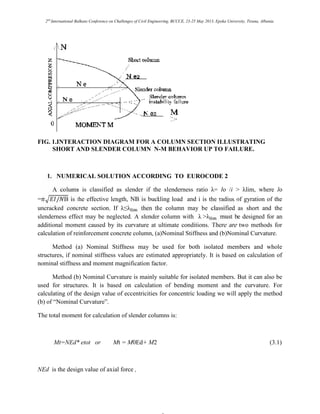
This effect is illustrated in Fig. 1 for a particular case of an initially straight column with
bending in single curvature caused by load N applied with equal eccentricity e=ee+ei at both
ends. The bending deformation of the column causes the eccentricity of the load at the critical
section to become (e + e2), where e2 is the additional eccentricity due to lateral deflection at that
section. Hence, the maximum moment increases to N (e + e2).
This is commonly referred to as the P-Δ effect. A short column is defined as one in which
the ultimate load is not reduced by the bending deformations because the additional eccentricities
Δ=e2 are negligible. A slender column is defined as one in which the ultimate load is reduced by
the amplified bending moment caused by additional eccentricity.
2nd
International Balkans Conference on Challenges of Civil Engineering, BCCCE, 23-25 May 2013, Epoka University, Tirana, Albania.
FIG. 1.INTERACTION DIAGRAM FOR A COLUMN SECTION ILLUSTRATING
SHORT AND SLENDER COLUMN N-M BEHAVIOR UP TO FAILURE.
1. NUMERICAL SOLUTION ACCORDING TO EUROCODE 2
A column is classified as slender if the slenderness ratio λ= lo /i > λlim, where lo
= / B is the effective length, NB is buckling load and i is the radius of gyration of the
uncracked concrete section. If λ≤λ then the column may be classified as short and the
slenderness effect may be neglected. A slender column with λ >λ must be designed for an
additional moment caused by its curvature at ultimate conditions. There are two methods for
calculation of reinforcement concrete column, (a)Nominal Stiffness and (b)Nominal Curvature.
Method (a) Nominal Stiffness may be used for both isolated members and whole
structures, if nominal stiffness values are estimated appropriately. It is based on calculation of
nominal stiffness and moment magnification factor.
Method (b) Nominal Curvature is mainly suitable for isolated members. But it can also be
used for structures. It is based on calculation of bending moment and the curvature. For
calculating of the design value of eccentricities for concentric loading we will apply the method
(b) of “Nominal Curvature”.
The total moment for calculation of slender columns is:
Mt=NEd* etot or Mt = M0Ed+ M2 (3.1)
NEd is the design value of axial force ,
2nd
International Balkans Conference on Challenges of Civil Engineering, BCCCE, 23-25 May 2013, Epoka University, Tirana, Albania.
M0Ed is the first order moment, including the effect of imperfections.
M2 is the nominal second order moment.
Differing first order end moments M01 and M02 may be replaced by an equivalent first order
end moment M0e:
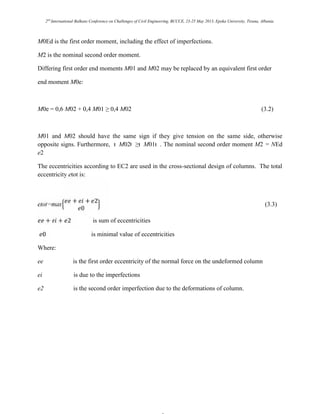
M0e = 0,6 M02 + 0,4 M01 ≥ 0,4 M02 (3.2)
M01 and M02 should have the same sign if they give tension on the same side, otherwise
opposite signs. Furthermore, 
M02≥
M01
. The nominal second order moment M2 = NEd
e2
The eccentricities according to EC2 are used in the cross-sectional design of columns. The total
eccentricity etot is:
etot=max
+ + 2
0
(3.3)
+ + 2 is sum of eccentricities
0 is minimal value of eccentricities
Where:
ee is the first order eccentricity of the normal force on the undeformed column
ei is due to the imperfections
e2 is the second order imperfection due to the deformations of column.
2nd
International Balkans Conference on Challenges of Civil Engineering, BCCCE, 23-25 May 2013, Epoka University, Tirana, Albania.
Fig. 2
The accidental eccentricity ei is given by the equation:
= ν (3.4)
l0 is the effective column height about the axis considered, which depends on the length l, and
on the boundary conditions of the column.
=
√
>
L IS THE HEIGHT OF THE COLUMN IN METERS. A CONSERVATIVE ESTIMATE
OF CAN BE GIVEN BY:
= = =
The nominal second order moment M2 = NEd e2
The second order eccentricity or the deflection e2 is calculated as:
e2= 0 [ ∗
⁄ ] = 0 [ ² ∗
⁄ ]= 0 [10 ∗
⁄ ] (3.5)
= ² ≈ 10 is a factor depending on the curvature distribution,
2nd
International Balkans Conference on Challenges of Civil Engineering, BCCCE, 23-25 May 2013, Epoka University, Tirana, Albania.
1/r is the curvature: = ∗ ∗ (3.6)
The basic value of the curvature is:
=
/
. ∗
= .
(3.7)
Es is the elastic modulus of steel, d = (h/2) + is and is is the radius of gyration of the total
reinforcement area.
The second-order eccentricity is an estimate of the deflection of the column at failure and is
given by the equation:
e2=
∗ ∗ ∗
. ²
(3.8)
Kr is a correction factor depending on axial load
Kr = (nu - n) / (nu - nbal) ≤ 1 (3.9)
n = NEd / (Ac fcd) is the relative axial force; NEd is the design value of axial force
nu = 1 + ω, where ω = As fyd / (Ac fcd)
nbal is the value of n at maximum moment resistance; the value 0,4 may be used (EC2)
Ac is the gross area of the concrete section
As is the area of longitudinal reinforcement
Kr=[1+ - ]/[1+ -0.4]≤1 (3.10)
2nd
International Balkans Conference on Challenges of Civil Engineering, BCCCE, 23-25 May 2013, Epoka University, Tirana, Albania.
Kr= .
≤1
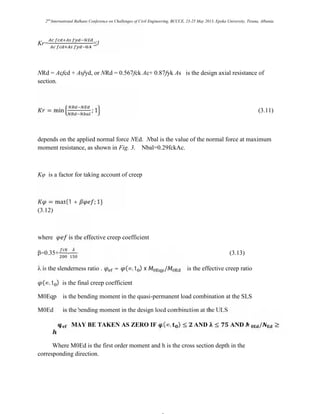
NRd = Acfcd + Asfyd, or NRd = 0.567fck Ac+ 0.87fyk As is the design axial resistance of
section.
= min ; 1 (3.11)
depends on the applied normal force NEd. Nbal is the value of the normal force at maximum
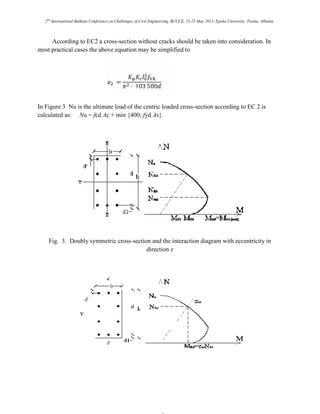
moment resistance, as shown in Fig. 3. Nbal=0.29fckAc.
Kφ is a factor for taking account of creep
= max{1 + ; 1}
(3.12)
where is the effective creep coefficient
β=0.35+ - (3.13)
λ is the slenderness ratio . = (∞, t ) x / is the effective creep ratio
(∞, t ) is the final creep coefficient
M0Eqp is the bending moment in the quasi-permanent load combination at the SLS
M0Ed is the bending moment in the design load combination at the ULS
MAY BE TAKEN AS ZERO IF (∞, ) ≤ AND ≤ AND / ≥
Where M0Ed is the first order moment and h is the cross section depth in the
corresponding direction.
2nd
International Balkans Conference on Challenges of Civil Engineering, BCCCE, 23-25 May 2013, Epoka University, Tirana, Albania.
According to EC2 a cross-section without cracks should be taken into consideration. In
most practical cases the above equation may be simplified to
=
∙ 103 500
In Figure 3 Nu is the ultimate load of the centric loaded cross-section according to EC 2 is
calculated as: Nu = fcd Ac + min {400; fyd As}.
Fig. 3. Doubly symmetric cross-section and the interaction diagram with eccentricity in
direction z
2nd
International Balkans Conference on Challenges of Civil Engineering, BCCCE, 23-25 May 2013, Epoka University, Tirana, Albania.
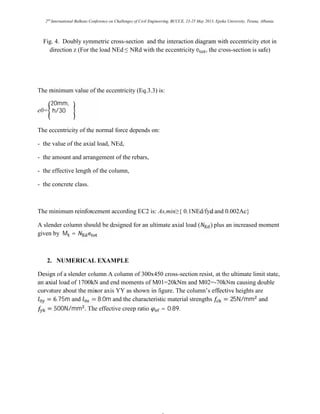
Fig. 4. Doubly symmetric cross-section and the interaction diagram with eccentricity etot in
direction z (For the load NEd ≤ NRd with the eccentricity e , the cross-section is safe)
The minimum value of the eccentricity (Eq.3.3) is:
e0=
20mm,
h/30
The eccentricity of the normal force depends on:
- the value of the axial load, NEd,
- the amount and arrangement of the rebars,
- the effective length of the column,
- the concrete class.
The minimum reinforcement according EC2 is: As,min≥{ 0.1NEd/fyd and 0.002Ac}
A slender column should be designed for an ultimate axial load ( ) plus an increased moment
given by M = e
2. NUMERICAL EXAMPLE
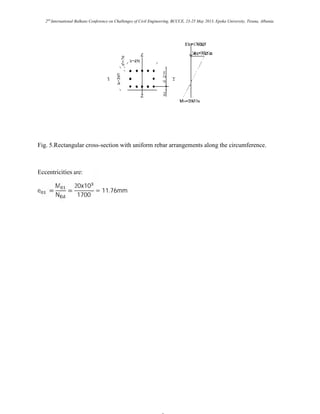
Design of a slender column A column of 300x450 cross-section resist, at the ultimate limit state,
an axial load of 1700kN and end moments of M01=20kNm and M02=-70kNm causing double
curvature about the minor axis YY as shown in figure. The column’s effective heights are
= 6.75m and = 8.0m and the characteristic material strengths = 25N/mm and
= 500N/mm . The effective creep ratio = 0.89.
2nd
International Balkans Conference on Challenges of Civil Engineering, BCCCE, 23-25 May 2013, Epoka University, Tirana, Albania.
Fig. 5.Rectangular cross-section with uniform rebar arrangements along the circumference.
Eccentricities are:
e =
M
N
=
20x10
1700
= 11.76mm
2nd
International Balkans Conference on Challenges of Civil Engineering, BCCCE, 23-25 May 2013, Epoka University, Tirana, Albania.
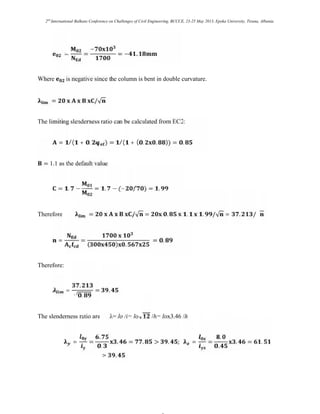
= =
−
= − .
Where is negative since the column is bent in double curvature.
= /√
The limiting slenderness ratio can be calculated from EC2:
= /( + . ) = /( + ( . . )) = .
= 1.1 as the default value
= . − = . − (− ⁄ ) = .
Therefore = /√ = . . . /√ = . /√
= =
( ) .
= .
Therefore:
=
.
√ .
= .
The slenderness ratio are λ= lo /i= lo√ /h= lox3.46 /h
= =
.
.
. = . > . ; = =
.
.
. = .
> .
2nd
International Balkans Conference on Challenges of Civil Engineering, BCCCE, 23-25 May 2013, Epoka University, Tirana, Albania.
The column is slender and is critical.
Equivalent eccentricity = . + . ≥ .
. + . = . . + . (− . ) =
. = . . = .
The equivalent eccentricity =
The accidental eccentricity is: = ⁄ = ⁄ = .
The second-order eccentricity is
=
where : = { + . + − ; }
= { + . + − . . = . ; }
= [ ] [ ]
⁄ = [ ] [
⁄ ]
= .
with = 1.0 for the initial value.
For the first iteration the total eccentricity is
= + + = + . + . = .
2nd
International Balkans Conference on Challenges of Civil Engineering, BCCCE, 23-25 May 2013, Epoka University, Tirana, Albania.
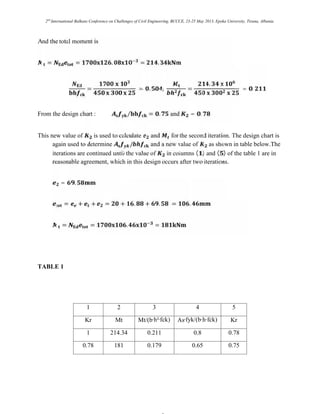
And the total moment is
= = . = .
= = . ; =
.
= .
From the design chart : ⁄ = . and = .
This new value of is used to calculate and for the second iteration. The design chart is
again used to determine / and a new value of as shown in table below.The
iterations are continued until the value of in columns ( ) and ( ) of the table 1 are in
reasonable agreement, which in this design occurs after two iterations.
= .
= + + = + . + . = .
= = . =
TABLE 1
1 2 3 4 5
Kr Mt Mt/(b∙h²∙fck) As∙fyk/(b∙h∙fck) Kr
1 214.34 0.211 0.8 0.78
0.78 181 0.179 0.65 0.75
2nd
International Balkans Conference on Challenges of Civil Engineering, BCCCE, 23-25 May 2013, Epoka University, Tirana, Albania.
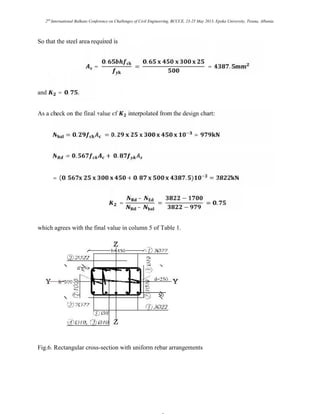
So that the steel area required is
=
.
=
.
= .
and = . .
As a check on the final value of interpolated from the design chart:
= . = . =
= . + .
= ( . + . . ) =
=
–
–
=
−
−
= .
which agrees with the final value in column 5 of Table 1.
Fig.6. Rectangular cross-section with uniform rebar arrangements
2nd
International Balkans Conference on Challenges of Civil Engineering, BCCCE, 23-25 May 2013, Epoka University, Tirana, Albania.
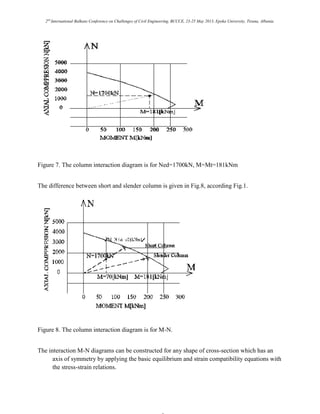
Figure 7. The column interaction diagram is for Ned=1700kN, M=Mt=181kNm
The difference between short and slender column is given in Fig.8, according Fig.1.
Figure 8. The column interaction diagram is for M-N.
The interaction M-N diagrams can be constructed for any shape of cross-section which has an
axis of symmetry by applying the basic equilibrium and strain compatibility equations with
the stress-strain relations.
2nd
International Balkans Conference on Challenges of Civil Engineering, BCCCE, 23-25 May 2013, Epoka University, Tirana, Albania.
CONCLUSION
A slender column must be design for an additional moment caused by its curvature at
ultimate condition. The expressions given in EC2 for the additional moments were derived by
studying the moment/curvature behavior for a member subject to bending plus axial load. The
equations for calculating the design moments are only applicable to columns of a rectangular or
circular section with symmetrical reinforcement.
There are four different approaches to designing slender columns accoding to EC2:
A general method based on a non-linear analysis of the structure and allowing for second-
order effects that necessitates the use of computer analysis.
A second-order analysis based on nominal stiffness values of the beams and columns
requires computer analysis using a process of iterative analysis.
The method of Nominal Stiffness may be used for both isolated members and whole
structures. It is based on calculation of nominal stiffness and moment magnification factor.
The method of Nominal Curvature is mainly suitable for isolated members but it can also
be used for whole structures. It is based on calculation of bending moment and the curvature.
These second-order moments are added to the first-order moments to give the total column
design moment.
3. REFERENCES
[1] Eurocode 2 (2004), „Design of concrete structures – Part 1-1: General rules and rules for
buildings”, EN 1992-1-1.
[2] Design of Concrete Structures, A. Nilson, D. Darwin, Ch. Dolan, New York, NY (2010).
[3] ACI 318-08, Building Code Requirements for Structural Concrete and Commentary, (2007).
[4] Design of Reinforcement Concrete, J.C.McComac, J.K.Nelson. Seventh Edition, (2004),
USA.
[5] Nonlinear Mechanics of Reinforcement Concrete, Makeawa, Pimanmas and Okamura, Spon
Press, London and New York (2003).

description and difference between short & slender columns

  • 1.
    2nd International Balkans Conferenceon Challenges of Civil Engineering, BCCCE, 23-25 May 2013, Epoka University, Tirana, Albania. THE DESİGN OF SLENDER RC COLUMNS Diana Lluka¹, Merita Guri², Veronika Hajdari³, Alketa Ndoj³ 1 Department of Building Constructions and Transport Infrastructure, Faculty of Civil Engineering, Polytechnic University of Tirana, Albania 2 Department of Applied and Human Sciences, Faculty of Architecture and Design, Polis University, Albania. 3 Department of Building Constructions and Transport Infrastructure, Faculty of Civil Engineering, Polytechnic University of Tirana, Albania. ³Department of Building Constructions and Transport Infrastructure, Faculty of Civil Engineering, Polytechnic University of Tirana, Albania. ABSTRACT The paper presents the design method for slender reinforced concrete column based on design code EC2. Rarely, when the column height is longer than typical story height and/or the column section is small relative to column height, secondary stresses become significant, especially if end restraints are small and/or the columns are not braced against side sway. The expressions given in this paper for the additional moments were derived by studying the moment and curvature behavior for a member subject to bending plus axial load. The equations for calculating the design moments are only applicable to columns of a rectangular or circular section with symmetrical reinforcement. The slender column should be designed for an ultimate axial load plus an increased moment. The slenderness effect must be considered in design, over and above the sectional capacity considerations incorporated in the interaction diagrams. Results indicate the behavior of slender columns and the difference with short columns. Keywords: Reinforced concrete column, slenderness ratio, eccentricity, creep ratio, capacity reduction factor.
  • 2.
    2nd International Balkans Conferenceon Challenges of Civil Engineering, BCCCE, 23-25 May 2013, Epoka University, Tirana, Albania. INTRODUCTION Columns are defined as structural elements that carry loads in compression. Usually they carry loads in compression and bending moments as well about one or both axes of the cross sections. Two types of columns can be classification according to EC2. A short column is one in which the ultimate load at a given eccentricity is governed only by the strength of the materials and the dimensions of the cross-section. A slender column is one in which the ultimate load is governed not only by the strength of the materials and the dimensions of the cross section but also by the slenderness, which produces additional bending moment due to lateral deformations. For eccentrically loaded the short columns behavior will follow the linear path until intersect the interaction diagram. For eccentrically loaded slender columns, the column will follow a non-linear path until intersects the interaction diagram. This means that, due to the non-linear effects the actual moment on the column is greater than the linear moment. In designing eccentrically loaded slender columns, the second-order effects are very important parameters Slender columns can be defined as columns with small cross sections compared to their lengths. Generally, slender columns have lower strength when compared to short columns, for a constant cross section, increasing the length causes a reduction in the strength. THE BEHAVIOUR OF SLENDER COLUMN The slenderness of a column may result in the ultimate load being reduced by lateral deflections of the column caused by bending. This effect is illustrated in Fig. 1 for a particular case of an initially straight column with bending in single curvature caused by load N applied with equal eccentricity e=ee+ei at both ends. The bending deformation of the column causes the eccentricity of the load at the critical section to become (e + e2), where e2 is the additional eccentricity due to lateral deflection at that section. Hence, the maximum moment increases to N (e + e2). This is commonly referred to as the P-Δ effect. A short column is defined as one in which the ultimate load is not reduced by the bending deformations because the additional eccentricities Δ=e2 are negligible. A slender column is defined as one in which the ultimate load is reduced by the amplified bending moment caused by additional eccentricity.
  • 3.
    2nd International Balkans Conferenceon Challenges of Civil Engineering, BCCCE, 23-25 May 2013, Epoka University, Tirana, Albania. FIG. 1.INTERACTION DIAGRAM FOR A COLUMN SECTION ILLUSTRATING SHORT AND SLENDER COLUMN N-M BEHAVIOR UP TO FAILURE. 1. NUMERICAL SOLUTION ACCORDING TO EUROCODE 2 A column is classified as slender if the slenderness ratio λ= lo /i > λlim, where lo = / B is the effective length, NB is buckling load and i is the radius of gyration of the uncracked concrete section. If λ≤λ then the column may be classified as short and the slenderness effect may be neglected. A slender column with λ >λ must be designed for an additional moment caused by its curvature at ultimate conditions. There are two methods for calculation of reinforcement concrete column, (a)Nominal Stiffness and (b)Nominal Curvature. Method (a) Nominal Stiffness may be used for both isolated members and whole structures, if nominal stiffness values are estimated appropriately. It is based on calculation of nominal stiffness and moment magnification factor. Method (b) Nominal Curvature is mainly suitable for isolated members. But it can also be used for structures. It is based on calculation of bending moment and the curvature. For calculating of the design value of eccentricities for concentric loading we will apply the method (b) of “Nominal Curvature”. The total moment for calculation of slender columns is: Mt=NEd* etot or Mt = M0Ed+ M2 (3.1) NEd is the design value of axial force ,
  • 4.
    2nd International Balkans Conferenceon Challenges of Civil Engineering, BCCCE, 23-25 May 2013, Epoka University, Tirana, Albania. M0Ed is the first order moment, including the effect of imperfections. M2 is the nominal second order moment. Differing first order end moments M01 and M02 may be replaced by an equivalent first order end moment M0e: M0e = 0,6 M02 + 0,4 M01 ≥ 0,4 M02 (3.2) M01 and M02 should have the same sign if they give tension on the same side, otherwise opposite signs. Furthermore,  M02≥ M01 . The nominal second order moment M2 = NEd e2 The eccentricities according to EC2 are used in the cross-sectional design of columns. The total eccentricity etot is: etot=max + + 2 0 (3.3) + + 2 is sum of eccentricities 0 is minimal value of eccentricities Where: ee is the first order eccentricity of the normal force on the undeformed column ei is due to the imperfections e2 is the second order imperfection due to the deformations of column.
  • 5.
    2nd International Balkans Conferenceon Challenges of Civil Engineering, BCCCE, 23-25 May 2013, Epoka University, Tirana, Albania. Fig. 2 The accidental eccentricity ei is given by the equation: = ν (3.4) l0 is the effective column height about the axis considered, which depends on the length l, and on the boundary conditions of the column. = √ > L IS THE HEIGHT OF THE COLUMN IN METERS. A CONSERVATIVE ESTIMATE OF CAN BE GIVEN BY: = = = The nominal second order moment M2 = NEd e2 The second order eccentricity or the deflection e2 is calculated as: e2= 0 [ ∗ ⁄ ] = 0 [ ² ∗ ⁄ ]= 0 [10 ∗ ⁄ ] (3.5) = ² ≈ 10 is a factor depending on the curvature distribution,
  • 6.
    2nd International Balkans Conferenceon Challenges of Civil Engineering, BCCCE, 23-25 May 2013, Epoka University, Tirana, Albania. 1/r is the curvature: = ∗ ∗ (3.6) The basic value of the curvature is: = / . ∗ = . (3.7) Es is the elastic modulus of steel, d = (h/2) + is and is is the radius of gyration of the total reinforcement area. The second-order eccentricity is an estimate of the deflection of the column at failure and is given by the equation: e2= ∗ ∗ ∗ . ² (3.8) Kr is a correction factor depending on axial load Kr = (nu - n) / (nu - nbal) ≤ 1 (3.9) n = NEd / (Ac fcd) is the relative axial force; NEd is the design value of axial force nu = 1 + ω, where ω = As fyd / (Ac fcd) nbal is the value of n at maximum moment resistance; the value 0,4 may be used (EC2) Ac is the gross area of the concrete section As is the area of longitudinal reinforcement Kr=[1+ - ]/[1+ -0.4]≤1 (3.10)
  • 7.
    2nd International Balkans Conferenceon Challenges of Civil Engineering, BCCCE, 23-25 May 2013, Epoka University, Tirana, Albania. Kr= . ≤1 NRd = Acfcd + Asfyd, or NRd = 0.567fck Ac+ 0.87fyk As is the design axial resistance of section. = min ; 1 (3.11) depends on the applied normal force NEd. Nbal is the value of the normal force at maximum moment resistance, as shown in Fig. 3. Nbal=0.29fckAc. Kφ is a factor for taking account of creep = max{1 + ; 1} (3.12) where is the effective creep coefficient β=0.35+ - (3.13) λ is the slenderness ratio . = (∞, t ) x / is the effective creep ratio (∞, t ) is the final creep coefficient M0Eqp is the bending moment in the quasi-permanent load combination at the SLS M0Ed is the bending moment in the design load combination at the ULS MAY BE TAKEN AS ZERO IF (∞, ) ≤ AND ≤ AND / ≥ Where M0Ed is the first order moment and h is the cross section depth in the corresponding direction.
  • 8.
    2nd International Balkans Conferenceon Challenges of Civil Engineering, BCCCE, 23-25 May 2013, Epoka University, Tirana, Albania. According to EC2 a cross-section without cracks should be taken into consideration. In most practical cases the above equation may be simplified to = ∙ 103 500 In Figure 3 Nu is the ultimate load of the centric loaded cross-section according to EC 2 is calculated as: Nu = fcd Ac + min {400; fyd As}. Fig. 3. Doubly symmetric cross-section and the interaction diagram with eccentricity in direction z
  • 9.
    2nd International Balkans Conferenceon Challenges of Civil Engineering, BCCCE, 23-25 May 2013, Epoka University, Tirana, Albania. Fig. 4. Doubly symmetric cross-section and the interaction diagram with eccentricity etot in direction z (For the load NEd ≤ NRd with the eccentricity e , the cross-section is safe) The minimum value of the eccentricity (Eq.3.3) is: e0= 20mm, h/30 The eccentricity of the normal force depends on: - the value of the axial load, NEd, - the amount and arrangement of the rebars, - the effective length of the column, - the concrete class. The minimum reinforcement according EC2 is: As,min≥{ 0.1NEd/fyd and 0.002Ac} A slender column should be designed for an ultimate axial load ( ) plus an increased moment given by M = e 2. NUMERICAL EXAMPLE Design of a slender column A column of 300x450 cross-section resist, at the ultimate limit state, an axial load of 1700kN and end moments of M01=20kNm and M02=-70kNm causing double curvature about the minor axis YY as shown in figure. The column’s effective heights are = 6.75m and = 8.0m and the characteristic material strengths = 25N/mm and = 500N/mm . The effective creep ratio = 0.89.
  • 10.
    2nd International Balkans Conferenceon Challenges of Civil Engineering, BCCCE, 23-25 May 2013, Epoka University, Tirana, Albania. Fig. 5.Rectangular cross-section with uniform rebar arrangements along the circumference. Eccentricities are: e = M N = 20x10 1700 = 11.76mm
  • 11.
    2nd International Balkans Conferenceon Challenges of Civil Engineering, BCCCE, 23-25 May 2013, Epoka University, Tirana, Albania. = = − = − . Where is negative since the column is bent in double curvature. = /√ The limiting slenderness ratio can be calculated from EC2: = /( + . ) = /( + ( . . )) = . = 1.1 as the default value = . − = . − (− ⁄ ) = . Therefore = /√ = . . . /√ = . /√ = = ( ) . = . Therefore: = . √ . = . The slenderness ratio are λ= lo /i= lo√ /h= lox3.46 /h = = . . . = . > . ; = = . . . = . > .
  • 12.
    2nd International Balkans Conferenceon Challenges of Civil Engineering, BCCCE, 23-25 May 2013, Epoka University, Tirana, Albania. The column is slender and is critical. Equivalent eccentricity = . + . ≥ . . + . = . . + . (− . ) = . = . . = . The equivalent eccentricity = The accidental eccentricity is: = ⁄ = ⁄ = . The second-order eccentricity is = where : = { + . + − ; } = { + . + − . . = . ; } = [ ] [ ] ⁄ = [ ] [ ⁄ ] = . with = 1.0 for the initial value. For the first iteration the total eccentricity is = + + = + . + . = .
  • 13.
    2nd International Balkans Conferenceon Challenges of Civil Engineering, BCCCE, 23-25 May 2013, Epoka University, Tirana, Albania. And the total moment is = = . = . = = . ; = . = . From the design chart : ⁄ = . and = . This new value of is used to calculate and for the second iteration. The design chart is again used to determine / and a new value of as shown in table below.The iterations are continued until the value of in columns ( ) and ( ) of the table 1 are in reasonable agreement, which in this design occurs after two iterations. = . = + + = + . + . = . = = . = TABLE 1 1 2 3 4 5 Kr Mt Mt/(b∙h²∙fck) As∙fyk/(b∙h∙fck) Kr 1 214.34 0.211 0.8 0.78 0.78 181 0.179 0.65 0.75
  • 14.
    2nd International Balkans Conferenceon Challenges of Civil Engineering, BCCCE, 23-25 May 2013, Epoka University, Tirana, Albania. So that the steel area required is = . = . = . and = . . As a check on the final value of interpolated from the design chart: = . = . = = . + . = ( . + . . ) = = – – = − − = . which agrees with the final value in column 5 of Table 1. Fig.6. Rectangular cross-section with uniform rebar arrangements
  • 15.
    2nd International Balkans Conferenceon Challenges of Civil Engineering, BCCCE, 23-25 May 2013, Epoka University, Tirana, Albania. Figure 7. The column interaction diagram is for Ned=1700kN, M=Mt=181kNm The difference between short and slender column is given in Fig.8, according Fig.1. Figure 8. The column interaction diagram is for M-N. The interaction M-N diagrams can be constructed for any shape of cross-section which has an axis of symmetry by applying the basic equilibrium and strain compatibility equations with the stress-strain relations.
  • 16.
    2nd International Balkans Conferenceon Challenges of Civil Engineering, BCCCE, 23-25 May 2013, Epoka University, Tirana, Albania. CONCLUSION A slender column must be design for an additional moment caused by its curvature at ultimate condition. The expressions given in EC2 for the additional moments were derived by studying the moment/curvature behavior for a member subject to bending plus axial load. The equations for calculating the design moments are only applicable to columns of a rectangular or circular section with symmetrical reinforcement. There are four different approaches to designing slender columns accoding to EC2: A general method based on a non-linear analysis of the structure and allowing for second- order effects that necessitates the use of computer analysis. A second-order analysis based on nominal stiffness values of the beams and columns requires computer analysis using a process of iterative analysis. The method of Nominal Stiffness may be used for both isolated members and whole structures. It is based on calculation of nominal stiffness and moment magnification factor. The method of Nominal Curvature is mainly suitable for isolated members but it can also be used for whole structures. It is based on calculation of bending moment and the curvature. These second-order moments are added to the first-order moments to give the total column design moment. 3. REFERENCES [1] Eurocode 2 (2004), „Design of concrete structures – Part 1-1: General rules and rules for buildings”, EN 1992-1-1. [2] Design of Concrete Structures, A. Nilson, D. Darwin, Ch. Dolan, New York, NY (2010). [3] ACI 318-08, Building Code Requirements for Structural Concrete and Commentary, (2007). [4] Design of Reinforcement Concrete, J.C.McComac, J.K.Nelson. Seventh Edition, (2004), USA. [5] Nonlinear Mechanics of Reinforcement Concrete, Makeawa, Pimanmas and Okamura, Spon Press, London and New York (2003).