LEO POLOVETS
GENERAL PARTNER AT SUSA VENTURES
#saastrannual
De-Risking Your Startup
#saastrannual
Background
Me: software engineer turned VC.
• LinkedIn ’03-’05, Google ’05-’09, Factual ’09-’12.
General Partner at Susa Ventures since late 2012.
• $75m under management.
• ~50 investments.
• Seed investing in (mostly) B2B startups. Our focus is on strong
long-term competitive advantages like network effects, proprietary
data, and/or economies of scale.
De-Risking Your Startup
#saastrannual
Common Misconception
“If I hit $2m ARR, I'll be able to
raise a nice Series A.”
De-Risking Your Startup
#saastrannual
SORRY,
NO.
De-Risking Your Startup
#saastrannual
Reality
Early-stage VCs invest based on
ideal outcome potential and odds
of success — not revenue
multiples.
De-Risking Your Startup
#saastrannual
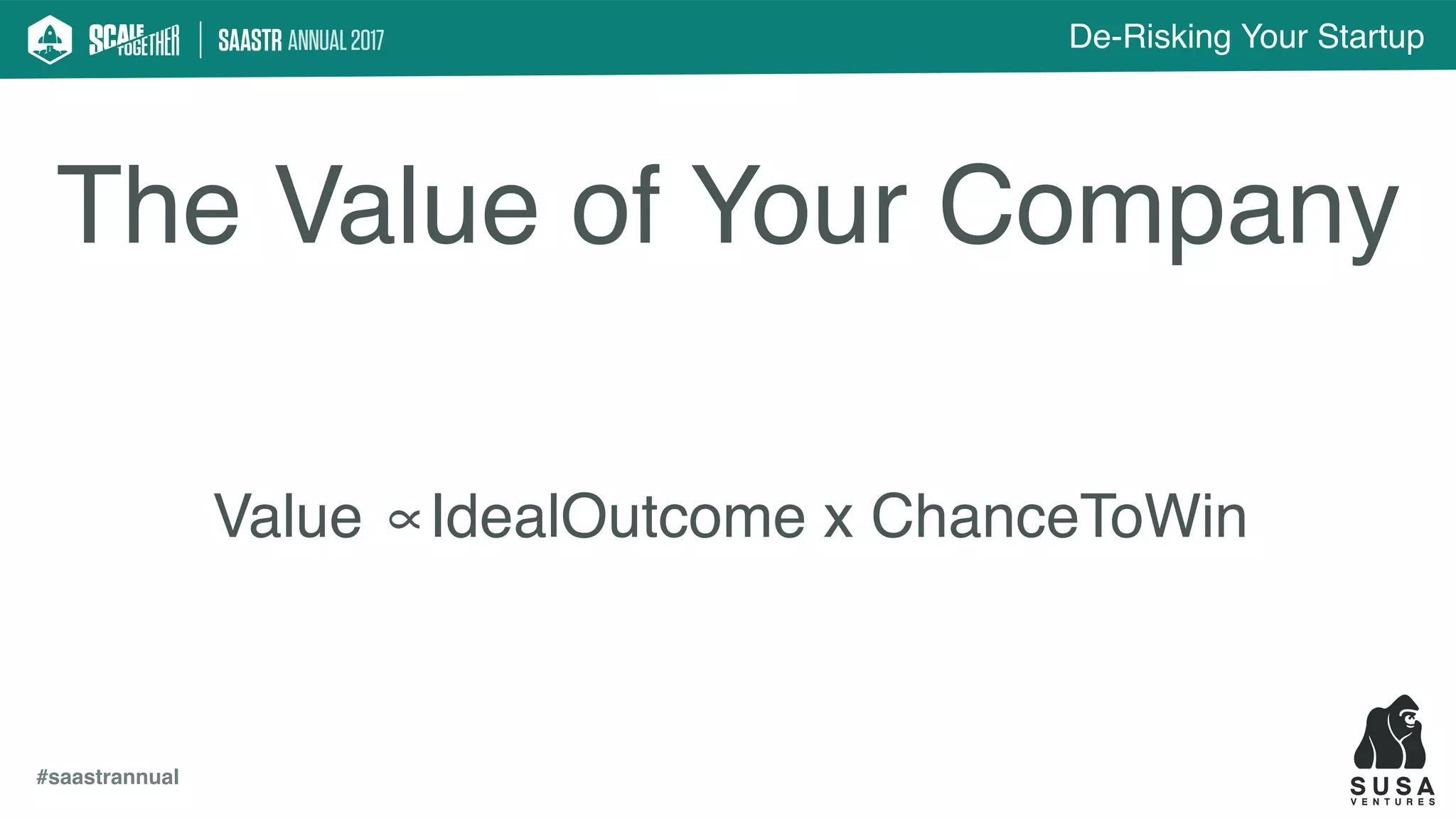
The Value of Your Company
Value ∝IdealOutcome x ChanceToWin
De-Risking Your Startup
#saastrannual
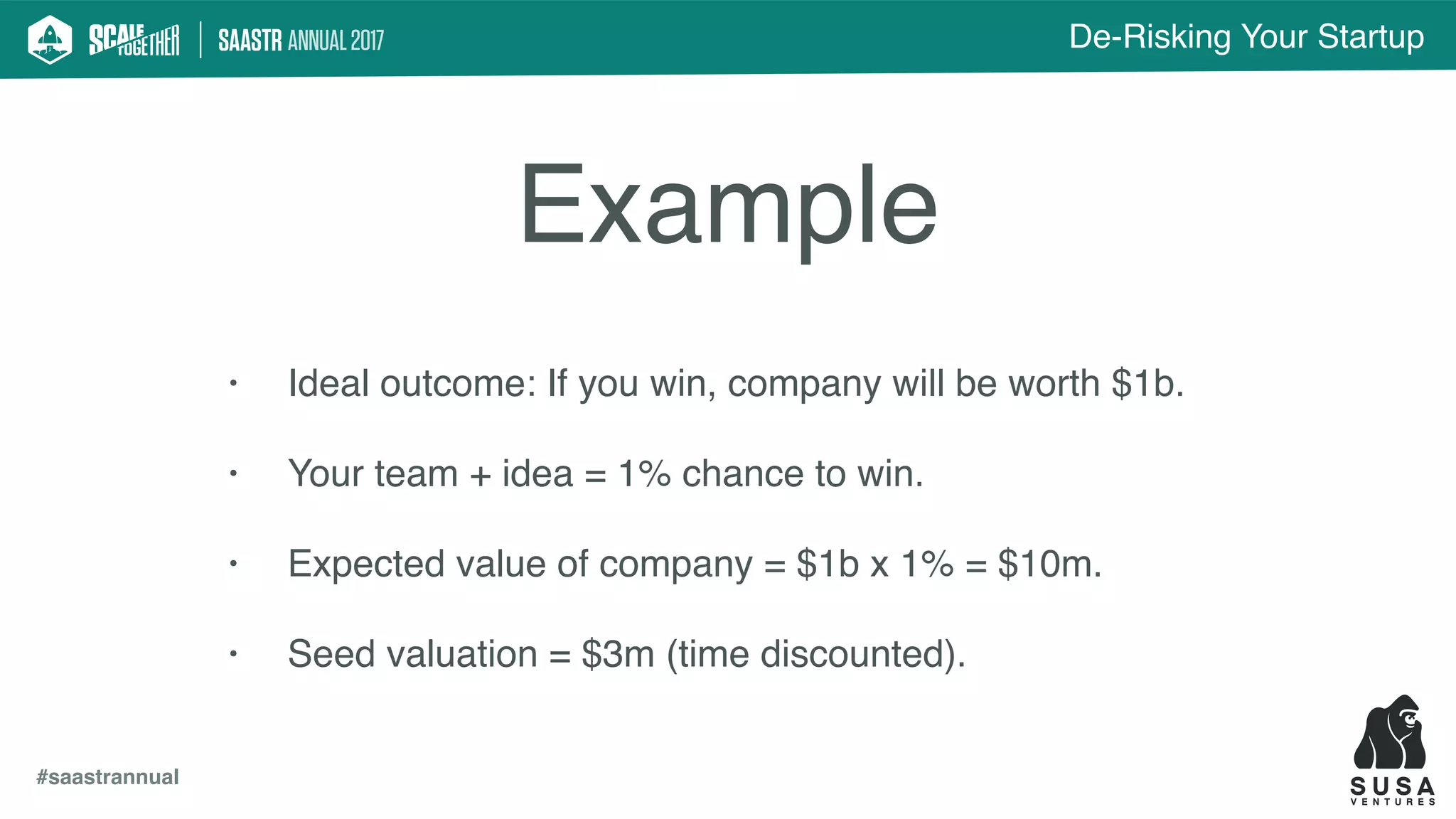
Example
• Ideal outcome: If you win, company will be worth $1b.
• Your team + idea = 1% chance to win.
• Expected value of company = $1b x 1% = $10m.
• Seed valuation = $3m (time discounted).
De-Risking Your Startup
#saastrannual
Example (cont.)
Today
Next year
ARR Chance to win Expected company value
$0m 10% $100m
$1m 10% $100m
$2m 10% $100m
$2m 4% $40m
ARR Chance to win Expected company value
$0m 1% $10m
De-Risking Your Startup
#saastrannual
How VCs Estimate Your Chance of Winning
De-Risking Your Startup
#saastrannual
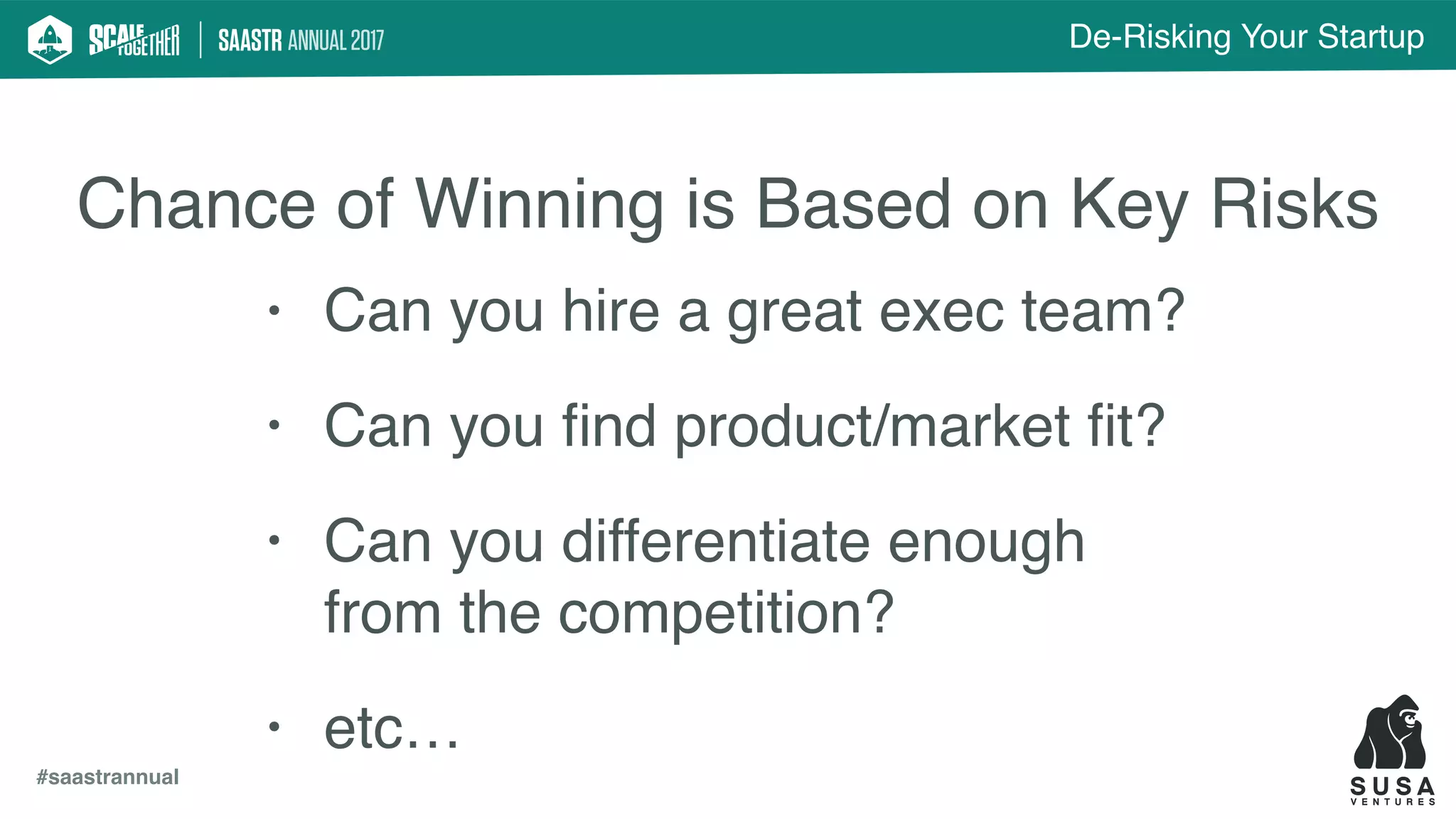
Chance of Winning is Based on Key Risks
• Can you hire a great exec team?
• Can you find product/market fit?
• Can you differentiate enough
from the competition?
• etc…
De-Risking Your Startup
#saastrannual
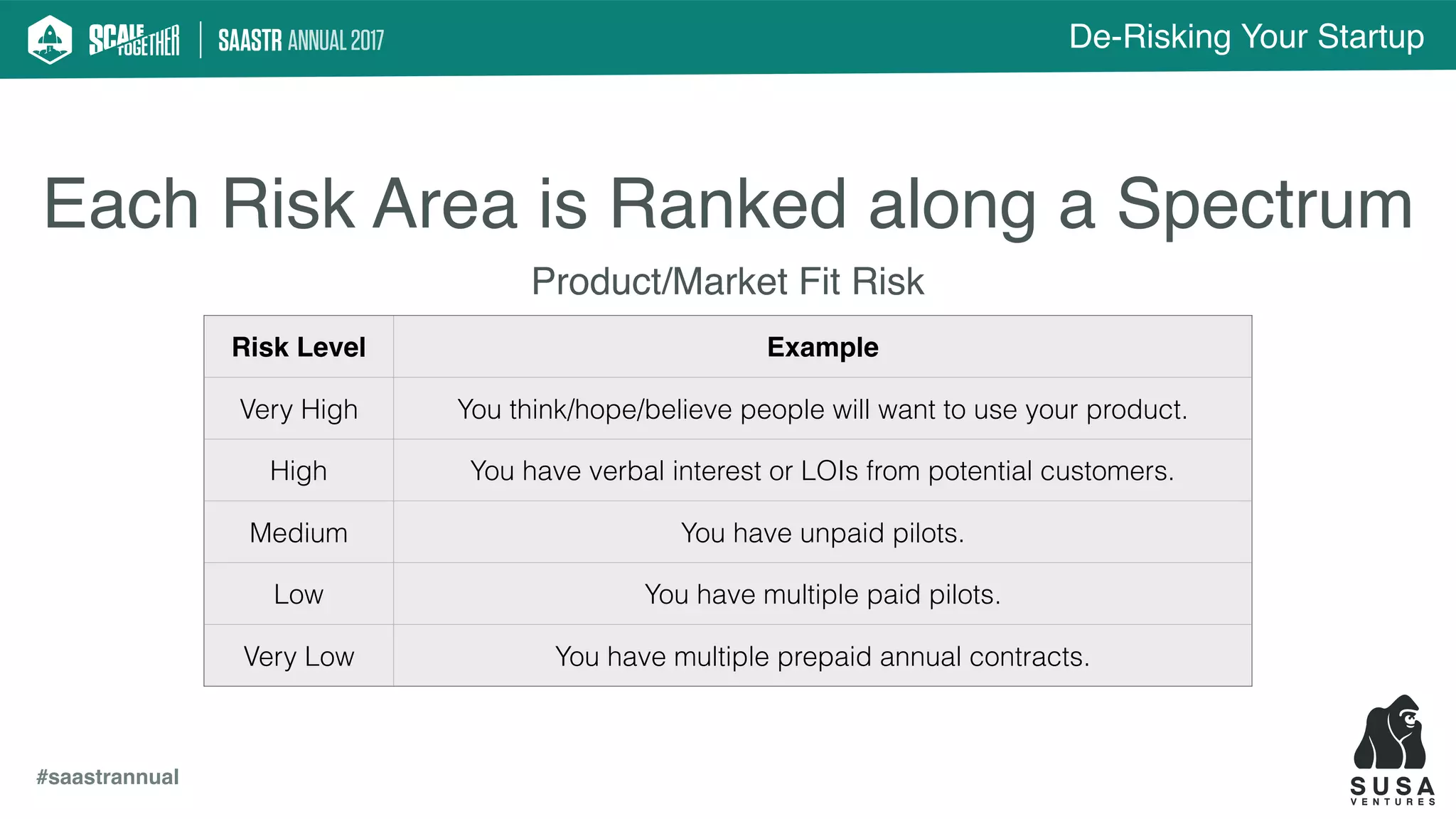
Each Risk Area is Ranked along a Spectrum
Product/Market Fit Risk
Risk Level Example
Very High You think/hope/believe people will want to use your product.
High You have verbal interest or LOIs from potential customers.
Medium You have unpaid pilots.
Low You have multiple paid pilots.
Very Low You have multiple prepaid annual contracts.
De-Risking Your Startup
#saastrannual
Each Risk Area is Ranked along a Spectrum
Short-Term Competition Risk
Risk Level Example
Very High Tons of strong competition.
High Tons of weak competition.
Medium Some competition, and you’re weakly differentiated
Low Some competition, but you’re strongly differentiated
Very Low No competition + high barrier to entry (which you have crossed).
De-Risking Your Startup
#saastrannual
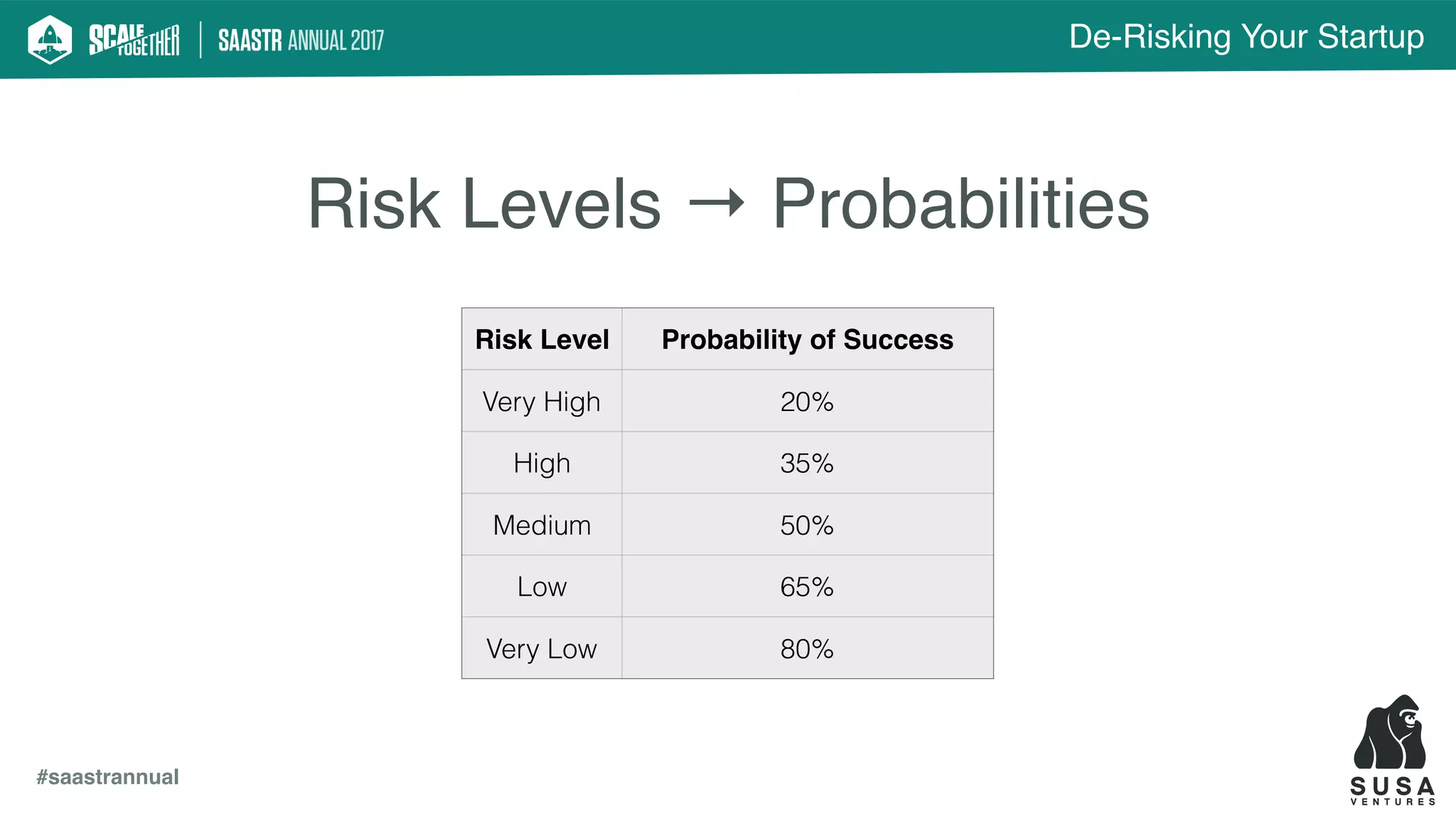
Risk Levels → Probabilities
Risk Level Probability of Success
Very High 20%
High 35%
Medium 50%
Low 65%
Very Low 80%
De-Risking Your Startup
#saastrannual
Value of Your Company
Market Size
x Probability of Success (product/market fit)
x Probability of Success (short-term competition)
x Probability of Success (hiring great exec team)
x …
De-Risking Your Startup
#saastrannual
Seed Stage Valuation Example
$1b (valuation if company is successful)
x 0.35 (high product/market fit risk)
x 0.50 (med short-term competition risk)
x 0.80 (very low exec team risk)
x …
= $10m
De-Risking Your Startup
#saastrannual
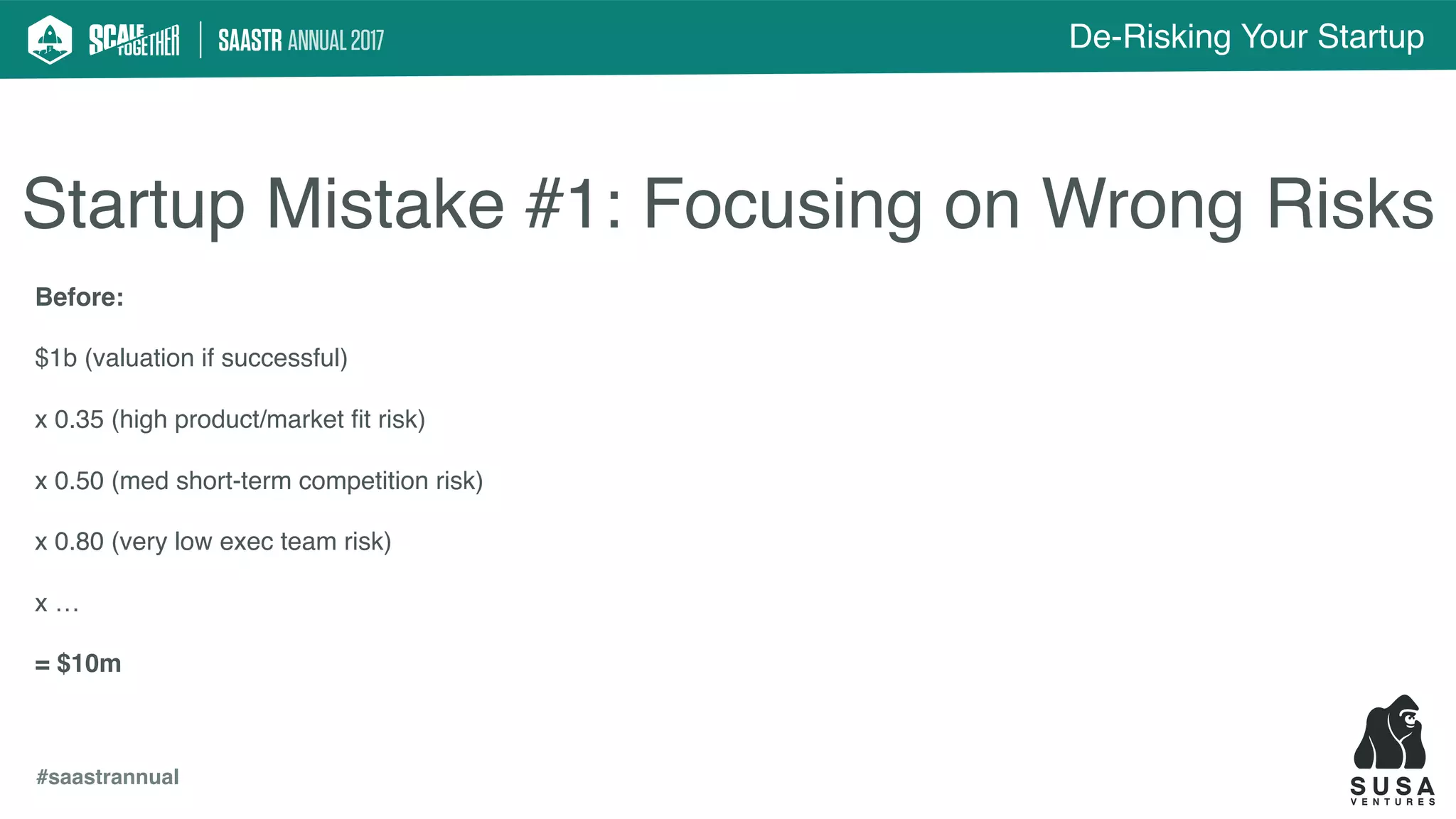
Startup Mistake #1: Focusing on Wrong Risks
Before:
$1b (valuation if successful)
x 0.35 (high product/market fit risk)
x 0.50 (med short-term competition risk)
x 0.80 (very low exec team risk)
x …
= $10m
De-Risking Your Startup
#saastrannual
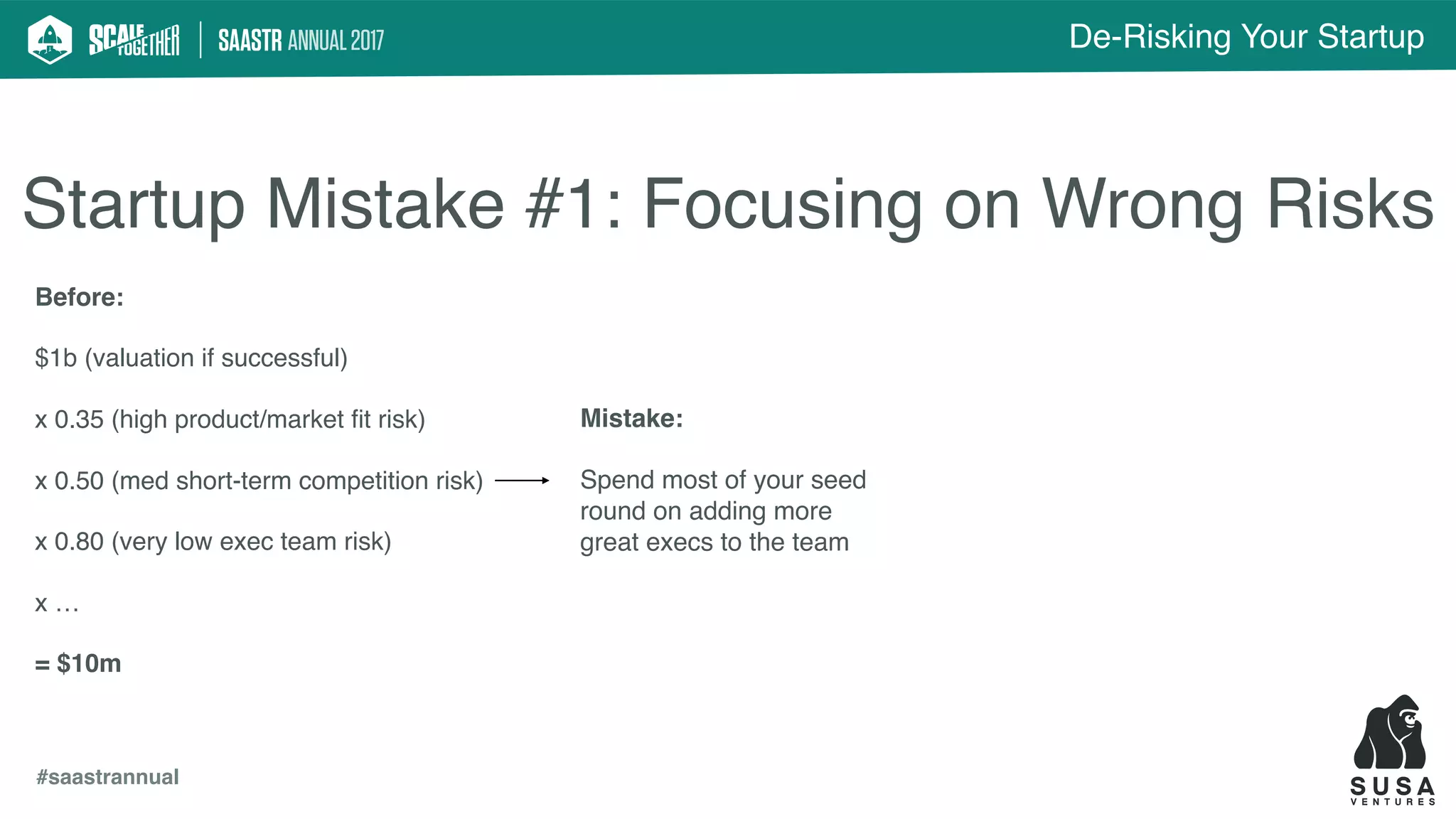
Startup Mistake #1: Focusing on Wrong Risks
Before:
$1b (valuation if successful)
x 0.35 (high product/market fit risk)
x 0.50 (med short-term competition risk)
x 0.80 (very low exec team risk)
x …
= $10m
Mistake:
Spend most of your seed
round on adding more
great execs to the team
De-Risking Your Startup
#saastrannual
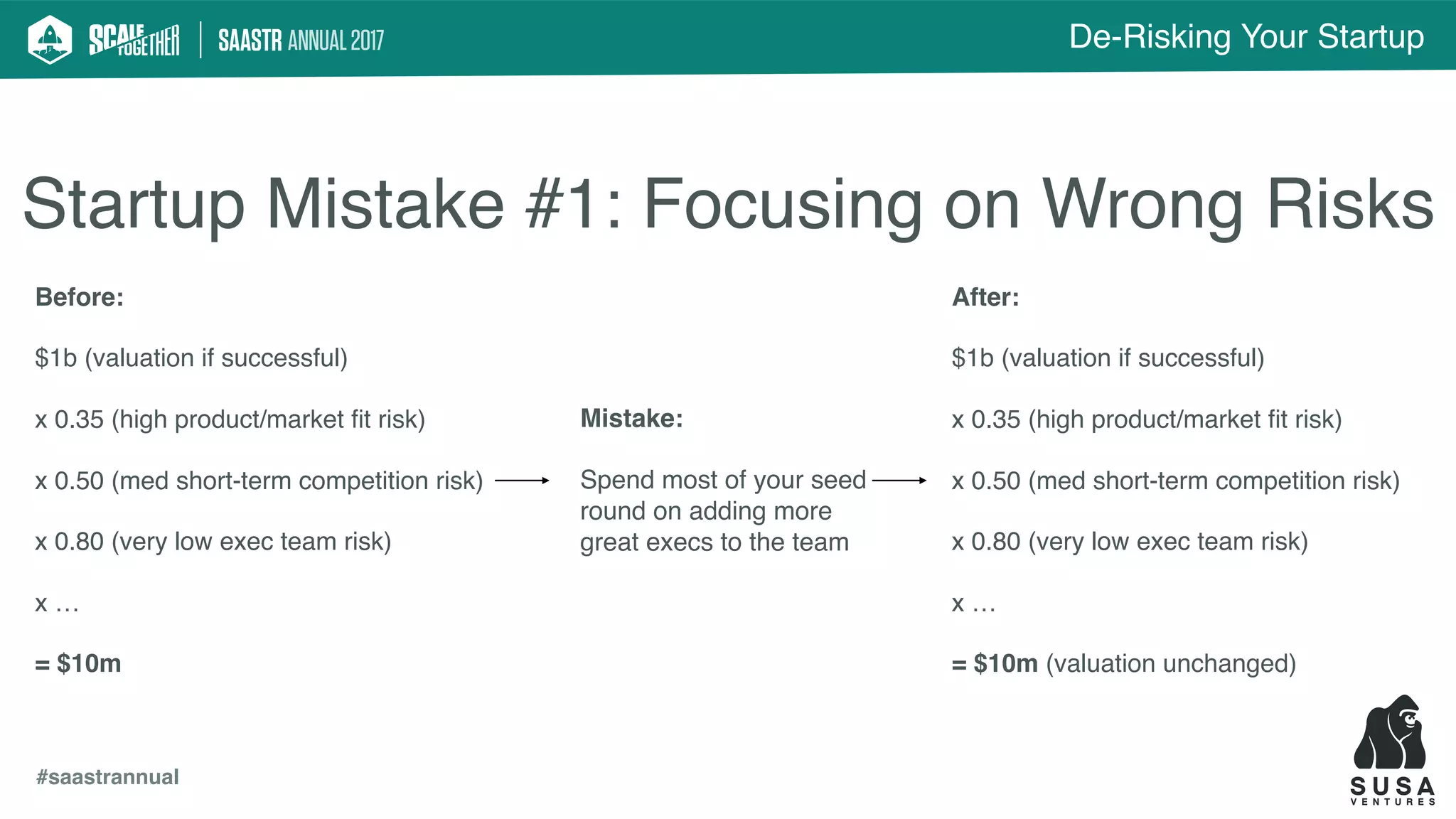
Startup Mistake #1: Focusing on Wrong Risks
Before:
$1b (valuation if successful)
x 0.35 (high product/market fit risk)
x 0.50 (med short-term competition risk)
x 0.80 (very low exec team risk)
x …
= $10m
After:
$1b (valuation if successful)
x 0.35 (high product/market fit risk)
x 0.50 (med short-term competition risk)
x 0.80 (very low exec team risk)
x …
= $10m (valuation unchanged)
Mistake:
Spend most of your seed
round on adding more
great execs to the team
De-Risking Your Startup
#saastrannual
Startup Mistake #1: Focusing on Wrong Risks
Real-world examples:
• Strong technical team spends seed round on
building product instead of proving they can sell.
• Company that’s in a crowded market makes no effort
at establishing differentiation.
• Founders with zero management and hiring
experience make progress by themselves, without
expanding the team or showing they can be leaders.
De-Risking Your Startup
#saastrannual
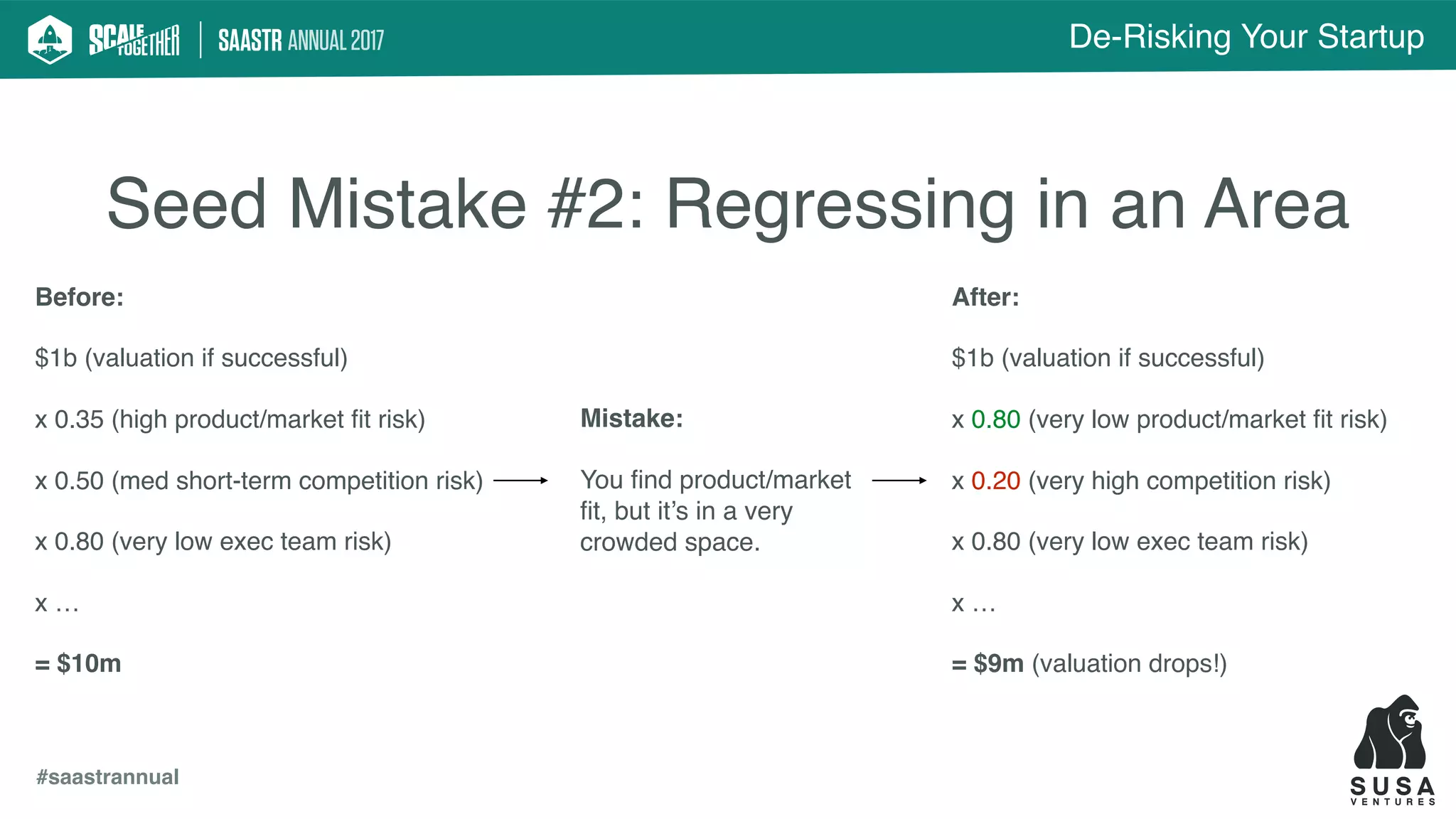
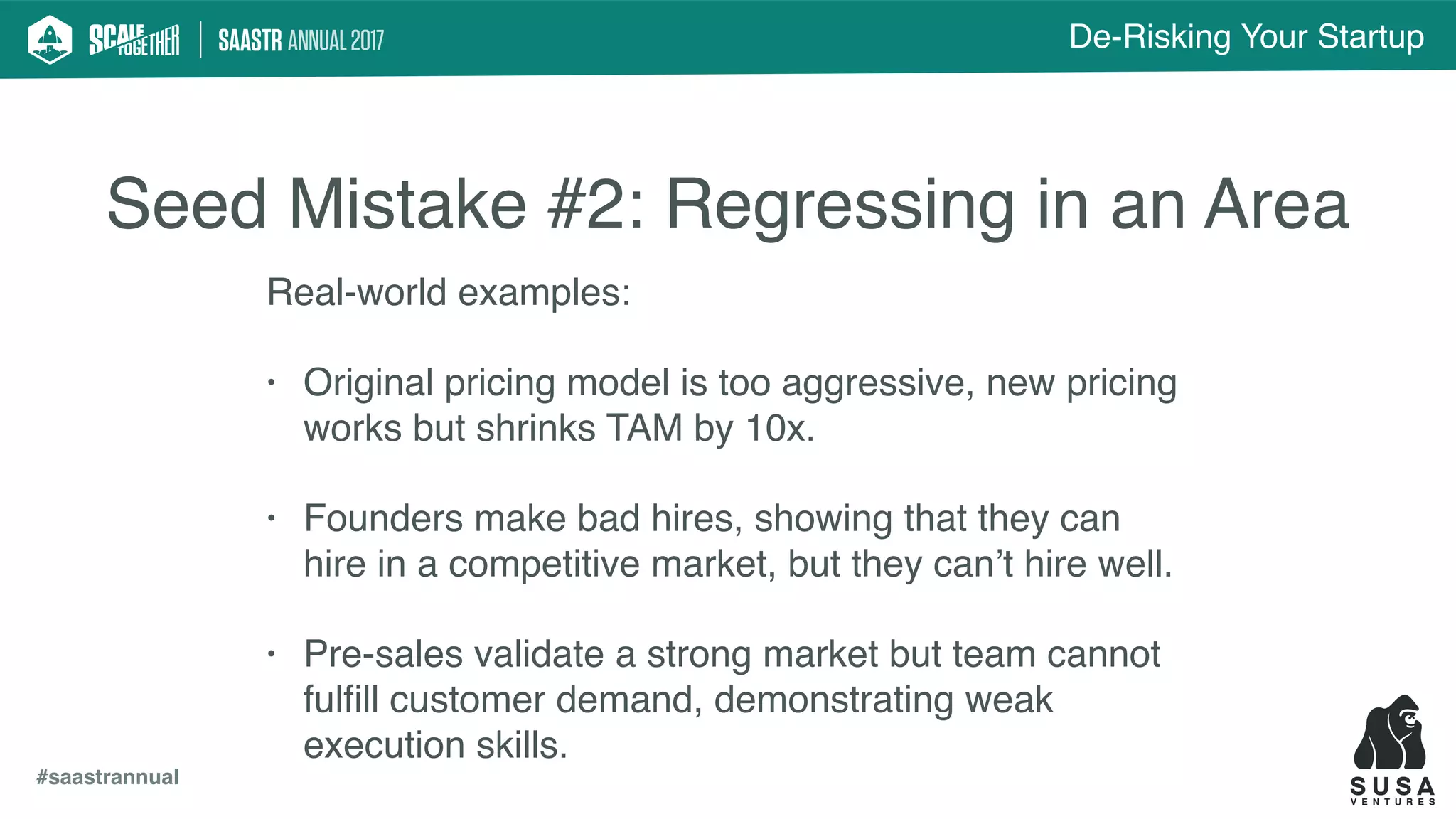
Seed Mistake #2: Regressing in an Area
Before:
$1b (valuation if successful)
x 0.35 (high product/market fit risk)
x 0.50 (med short-term competition risk)
x 0.80 (very low exec team risk)
x …
= $10m
De-Risking Your Startup
#saastrannual
Seed Mistake #2: Regressing in an Area
Before:
$1b (valuation if successful)
x 0.35 (high product/market fit risk)
x 0.50 (med short-term competition risk)
x 0.80 (very low exec team risk)
x …
= $10m
Mistake:
You find product/market
fit, but it’s in a very
crowded space.
De-Risking Your Startup
#saastrannual
Seed Mistake #2: Regressing in an Area
Before:
$1b (valuation if successful)
x 0.35 (high product/market fit risk)
x 0.50 (med short-term competition risk)
x 0.80 (very low exec team risk)
x …
= $10m
After:
$1b (valuation if successful)
x 0.80 (very low product/market fit risk)
x 0.20 (very high competition risk)
x 0.80 (very low exec team risk)
x …
= $9m (valuation drops!)
Mistake:
You find product/market
fit, but it’s in a very
crowded space.
De-Risking Your Startup
#saastrannual
Seed Mistake #2: Regressing in an Area
Real-world examples:
• Original pricing model is too aggressive, new pricing
works but shrinks TAM by 10x.
• Founders make bad hires, showing that they can
hire in a competitive market, but they can’t hire well.
• Pre-sales validate a strong market but team cannot
fulfill customer demand, demonstrating weak
execution skills.
De-Risking Your Startup
#saastrannual
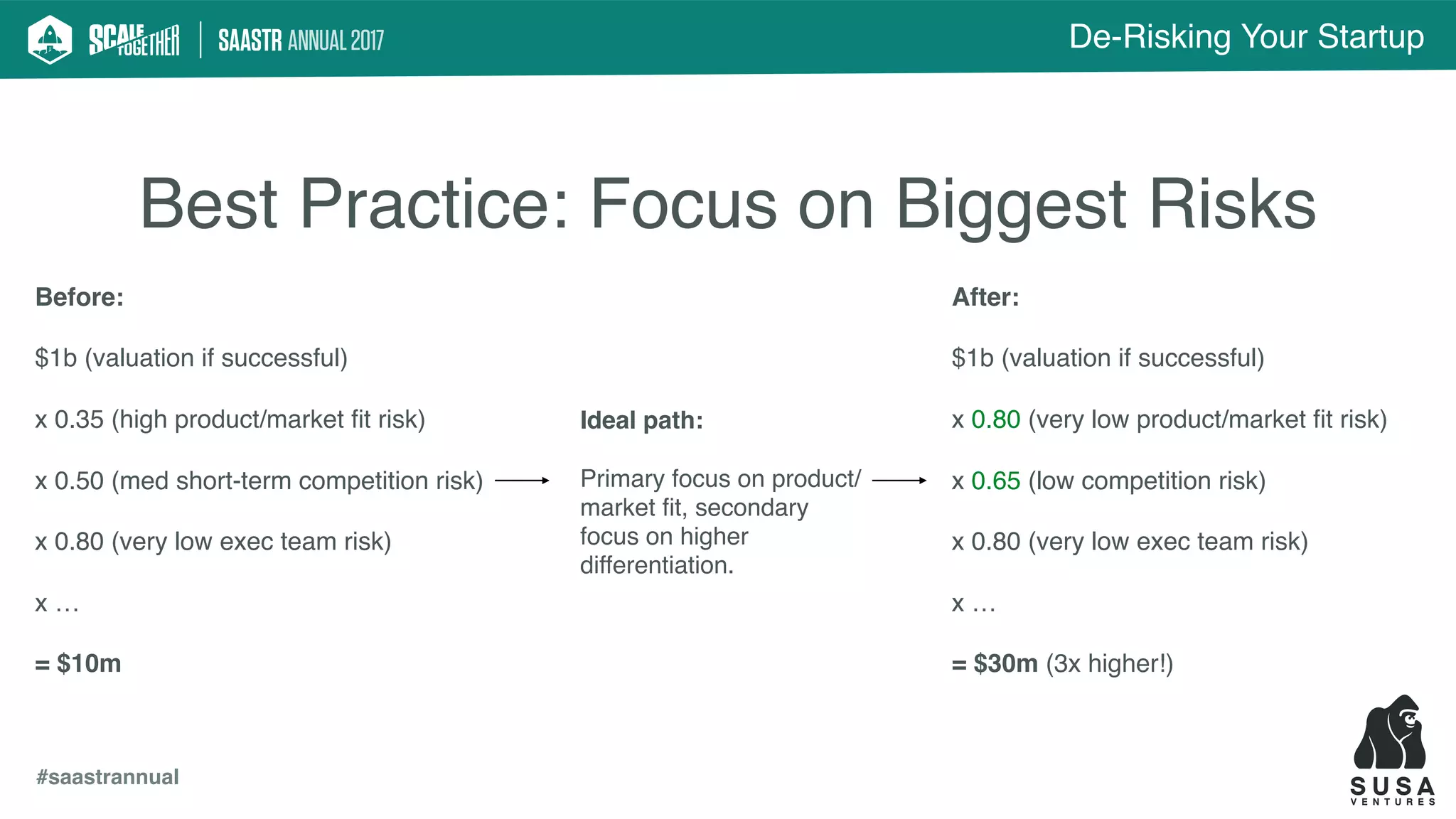
Best Practice: Focus on Biggest Risks
Before:
$1b (valuation if successful)
x 0.35 (high product/market fit risk)
x 0.50 (med short-term competition risk)
x 0.80 (very low exec team risk)
x …
= $10m
De-Risking Your Startup
#saastrannual
Best Practice: Focus on Biggest Risks
Before:
$1b (valuation if successful)
x 0.35 (high product/market fit risk)
x 0.50 (med short-term competition risk)
x 0.80 (very low exec team risk)
x …
= $10m
Ideal path:
Primary focus on product/
market fit, secondary
focus on higher
differentiation.
De-Risking Your Startup
#saastrannual
Best Practice: Focus on Biggest Risks
Before:
$1b (valuation if successful)
x 0.35 (high product/market fit risk)
x 0.50 (med short-term competition risk)
x 0.80 (very low exec team risk)
x …
= $10m
After:
$1b (valuation if successful)
x 0.80 (very low product/market fit risk)
x 0.65 (low competition risk)
x 0.80 (very low exec team risk)
x …
= $30m (3x higher!)
Ideal path:
Primary focus on product/
market fit, secondary
focus on higher
differentiation.
De-Risking Your Startup
#saastrannual
An Aside: Series A Revenue Targets
If revenue doesn’t matter, why
do most Series A investors
want to see $1m-$2m ARR?
De-Risking Your Startup
#saastrannual
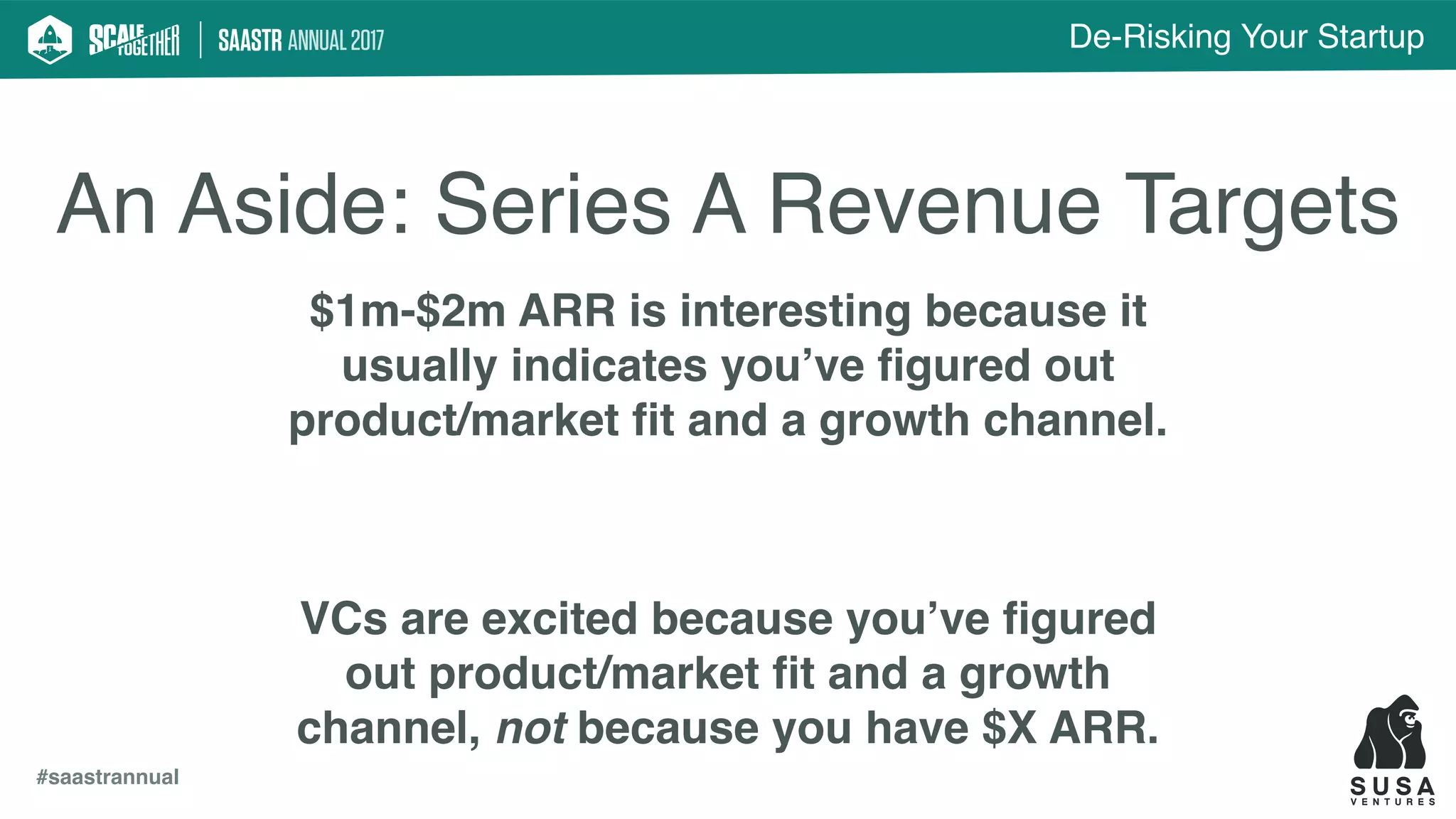
An Aside: Series A Revenue Targets
$1m-$2m ARR is interesting because it
usually indicates you’ve figured out
product/market fit and a growth channel.
VCs are excited because you’ve figured
out product/market fit and a growth
channel, not because you have $X ARR.
De-Risking Your Startup
#saastrannual
Homework: Identify Your Key Risks
1. Carefully reflect on every imaginable risk area: product/market
fit, short- and long-term competition, current team, ability to
hire, ability to sell, market size, government regulation, etc.
2. Do an honest self-assessment. Which areas are you weakest
in?
3. Ask investors, advisors, friends, cofounders, etc. to share
what they think are your weak areas.
4. Useful thought experiment: if you fast forward 5 years into the
future and find out your company failed, what would be the
reasons it failed?
De-Risking Your Startup
#saastrannual
Homework: Focus on the Right Risk Areas
1. Ignore risks that don’t apply to your stage. (E.g.
whether your team can scale from $10m ARR to
$100m ARR is irrelevant if you’re at $100k ARR.)
2. Focus on the biggest risks first. Moving from a 20%
to an 80% chance of success in some area is a 4x
improvement. Moving from 65% to 80% is barely an
improvement.
Tip: In many areas, an easy way to reduce risk is to
surround yourself with great employees, advisors, and
investors.
De-Risking Your Startup
#saastrannual
Startups are Like Triathlons
Triathlon = Swim, Bike, Run.
It doesn’t matter how great you are at cycling and
running if you can’t swim. Learn to swim before you
upgrade your bike.
De-Risking Your Startup
#saastrannual
Thank You
Leo Polovets
https://codingvc.com/saastr-2017
leo@susaventures.com
@lpolovets

De-Risking Your Startup -- SaaStr 2017 Talk

  • 1.
    LEO POLOVETS GENERAL PARTNERAT SUSA VENTURES #saastrannual De-Risking Your Startup
  • 2.
    De-Risking Your Startup #saastrannual Background Me:software engineer turned VC. • LinkedIn ’03-’05, Google ’05-’09, Factual ’09-’12. General Partner at Susa Ventures since late 2012. • $75m under management. • ~50 investments. • Seed investing in (mostly) B2B startups. Our focus is on strong long-term competitive advantages like network effects, proprietary data, and/or economies of scale.
  • 3.
    De-Risking Your Startup #saastrannual CommonMisconception “If I hit $2m ARR, I'll be able to raise a nice Series A.”
  • 4.
  • 5.
    De-Risking Your Startup #saastrannual Reality Early-stageVCs invest based on ideal outcome potential and odds of success — not revenue multiples.
  • 6.
    De-Risking Your Startup #saastrannual TheValue of Your Company Value ∝IdealOutcome x ChanceToWin
  • 7.
    De-Risking Your Startup #saastrannual Example •Ideal outcome: If you win, company will be worth $1b. • Your team + idea = 1% chance to win. • Expected value of company = $1b x 1% = $10m. • Seed valuation = $3m (time discounted).
  • 8.
    De-Risking Your Startup #saastrannual Example(cont.) Today Next year ARR Chance to win Expected company value $0m 10% $100m $1m 10% $100m $2m 10% $100m $2m 4% $40m ARR Chance to win Expected company value $0m 1% $10m
  • 9.
    De-Risking Your Startup #saastrannual HowVCs Estimate Your Chance of Winning
  • 10.
    De-Risking Your Startup #saastrannual Chanceof Winning is Based on Key Risks • Can you hire a great exec team? • Can you find product/market fit? • Can you differentiate enough from the competition? • etc…
  • 11.
    De-Risking Your Startup #saastrannual EachRisk Area is Ranked along a Spectrum Product/Market Fit Risk Risk Level Example Very High You think/hope/believe people will want to use your product. High You have verbal interest or LOIs from potential customers. Medium You have unpaid pilots. Low You have multiple paid pilots. Very Low You have multiple prepaid annual contracts.
  • 12.
    De-Risking Your Startup #saastrannual EachRisk Area is Ranked along a Spectrum Short-Term Competition Risk Risk Level Example Very High Tons of strong competition. High Tons of weak competition. Medium Some competition, and you’re weakly differentiated Low Some competition, but you’re strongly differentiated Very Low No competition + high barrier to entry (which you have crossed).
  • 13.
    De-Risking Your Startup #saastrannual RiskLevels → Probabilities Risk Level Probability of Success Very High 20% High 35% Medium 50% Low 65% Very Low 80%
  • 14.
    De-Risking Your Startup #saastrannual Valueof Your Company Market Size x Probability of Success (product/market fit) x Probability of Success (short-term competition) x Probability of Success (hiring great exec team) x …
  • 15.
    De-Risking Your Startup #saastrannual SeedStage Valuation Example $1b (valuation if company is successful) x 0.35 (high product/market fit risk) x 0.50 (med short-term competition risk) x 0.80 (very low exec team risk) x … = $10m
  • 16.
    De-Risking Your Startup #saastrannual StartupMistake #1: Focusing on Wrong Risks Before: $1b (valuation if successful) x 0.35 (high product/market fit risk) x 0.50 (med short-term competition risk) x 0.80 (very low exec team risk) x … = $10m
  • 17.
    De-Risking Your Startup #saastrannual StartupMistake #1: Focusing on Wrong Risks Before: $1b (valuation if successful) x 0.35 (high product/market fit risk) x 0.50 (med short-term competition risk) x 0.80 (very low exec team risk) x … = $10m Mistake: Spend most of your seed round on adding more great execs to the team
  • 18.
    De-Risking Your Startup #saastrannual StartupMistake #1: Focusing on Wrong Risks Before: $1b (valuation if successful) x 0.35 (high product/market fit risk) x 0.50 (med short-term competition risk) x 0.80 (very low exec team risk) x … = $10m After: $1b (valuation if successful) x 0.35 (high product/market fit risk) x 0.50 (med short-term competition risk) x 0.80 (very low exec team risk) x … = $10m (valuation unchanged) Mistake: Spend most of your seed round on adding more great execs to the team
  • 19.
    De-Risking Your Startup #saastrannual StartupMistake #1: Focusing on Wrong Risks Real-world examples: • Strong technical team spends seed round on building product instead of proving they can sell. • Company that’s in a crowded market makes no effort at establishing differentiation. • Founders with zero management and hiring experience make progress by themselves, without expanding the team or showing they can be leaders.
  • 20.
    De-Risking Your Startup #saastrannual SeedMistake #2: Regressing in an Area Before: $1b (valuation if successful) x 0.35 (high product/market fit risk) x 0.50 (med short-term competition risk) x 0.80 (very low exec team risk) x … = $10m
  • 21.
    De-Risking Your Startup #saastrannual SeedMistake #2: Regressing in an Area Before: $1b (valuation if successful) x 0.35 (high product/market fit risk) x 0.50 (med short-term competition risk) x 0.80 (very low exec team risk) x … = $10m Mistake: You find product/market fit, but it’s in a very crowded space.
  • 22.
    De-Risking Your Startup #saastrannual SeedMistake #2: Regressing in an Area Before: $1b (valuation if successful) x 0.35 (high product/market fit risk) x 0.50 (med short-term competition risk) x 0.80 (very low exec team risk) x … = $10m After: $1b (valuation if successful) x 0.80 (very low product/market fit risk) x 0.20 (very high competition risk) x 0.80 (very low exec team risk) x … = $9m (valuation drops!) Mistake: You find product/market fit, but it’s in a very crowded space.
  • 23.
    De-Risking Your Startup #saastrannual SeedMistake #2: Regressing in an Area Real-world examples: • Original pricing model is too aggressive, new pricing works but shrinks TAM by 10x. • Founders make bad hires, showing that they can hire in a competitive market, but they can’t hire well. • Pre-sales validate a strong market but team cannot fulfill customer demand, demonstrating weak execution skills.
  • 24.
    De-Risking Your Startup #saastrannual BestPractice: Focus on Biggest Risks Before: $1b (valuation if successful) x 0.35 (high product/market fit risk) x 0.50 (med short-term competition risk) x 0.80 (very low exec team risk) x … = $10m
  • 25.
    De-Risking Your Startup #saastrannual BestPractice: Focus on Biggest Risks Before: $1b (valuation if successful) x 0.35 (high product/market fit risk) x 0.50 (med short-term competition risk) x 0.80 (very low exec team risk) x … = $10m Ideal path: Primary focus on product/ market fit, secondary focus on higher differentiation.
  • 26.
    De-Risking Your Startup #saastrannual BestPractice: Focus on Biggest Risks Before: $1b (valuation if successful) x 0.35 (high product/market fit risk) x 0.50 (med short-term competition risk) x 0.80 (very low exec team risk) x … = $10m After: $1b (valuation if successful) x 0.80 (very low product/market fit risk) x 0.65 (low competition risk) x 0.80 (very low exec team risk) x … = $30m (3x higher!) Ideal path: Primary focus on product/ market fit, secondary focus on higher differentiation.
  • 27.
    De-Risking Your Startup #saastrannual AnAside: Series A Revenue Targets If revenue doesn’t matter, why do most Series A investors want to see $1m-$2m ARR?
  • 28.
    De-Risking Your Startup #saastrannual AnAside: Series A Revenue Targets $1m-$2m ARR is interesting because it usually indicates you’ve figured out product/market fit and a growth channel. VCs are excited because you’ve figured out product/market fit and a growth channel, not because you have $X ARR.
  • 29.
    De-Risking Your Startup #saastrannual Homework:Identify Your Key Risks 1. Carefully reflect on every imaginable risk area: product/market fit, short- and long-term competition, current team, ability to hire, ability to sell, market size, government regulation, etc. 2. Do an honest self-assessment. Which areas are you weakest in? 3. Ask investors, advisors, friends, cofounders, etc. to share what they think are your weak areas. 4. Useful thought experiment: if you fast forward 5 years into the future and find out your company failed, what would be the reasons it failed?
  • 30.
    De-Risking Your Startup #saastrannual Homework:Focus on the Right Risk Areas 1. Ignore risks that don’t apply to your stage. (E.g. whether your team can scale from $10m ARR to $100m ARR is irrelevant if you’re at $100k ARR.) 2. Focus on the biggest risks first. Moving from a 20% to an 80% chance of success in some area is a 4x improvement. Moving from 65% to 80% is barely an improvement. Tip: In many areas, an easy way to reduce risk is to surround yourself with great employees, advisors, and investors.
  • 31.
    De-Risking Your Startup #saastrannual Startupsare Like Triathlons Triathlon = Swim, Bike, Run. It doesn’t matter how great you are at cycling and running if you can’t swim. Learn to swim before you upgrade your bike.
  • 32.
    De-Risking Your Startup #saastrannual ThankYou Leo Polovets https://codingvc.com/saastr-2017 leo@susaventures.com @lpolovets