Depository system
History
• The first depository was setup way back in 1947 in Germany.
• In India it is a relatively new concept introduced in 1996 with the
enactment of depositories act 1996.
• Their operations are carried out in accordance with the regulations made
by SEBI, bye-laws and rules of depositories act and SEBI(depositories
and participants) regulation act 1996.
Meaning
• The term depository means a place where deposit of money, securities, property etc. is deposited
for safekeeping under the terms of depository agreement.
• A depository is an entity which helps an investor to buy or sell securities such as stocks and bonds
in a paper less manner. Securities in depository accounts are similar to the funds in bank accounts.
• The shares here are held in the form of electronic accounts i.e. dematerialized form and the
depository system revolves around the concept of paper-less or script-less trading.
• It holds the securities of the investors in the form of electronic book entries avoiding risks
associated with paper.
• It is not mandatory and is left to the investors to decide.
• A depository works as a link between the listed companies which issue shares and
shareholders.
• It issues these shares through agents associated with it called depository participants or
DPs.
• A DP can be a bank, financial institution, a broker, or any entity eligible as per SEBI
norms and is responsible for the final transfer of shares from the depository to investors.
• The investors, at the end of a transaction receives a confirmation from the depository.
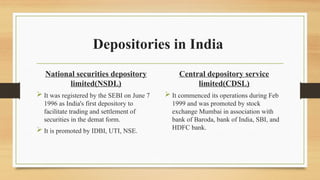
Depositories in India
National securities depository
limited(NSDL)
 It was registered by the SEBI on June 7
1996 as India's first depository to
facilitate trading and settlement of
securities in the demat form.
 It is promoted by IDBI, UTI, NSE.
Central depository service
limited(CDSL)
 It commenced its operations during Feb
1999 and was promoted by stock
exchange Mumbai in association with
bank of Baroda, bank of India, SBI, and
HDFC bank.
Regulation
• The securities and exchange board of India (SEBI) is responsible for the
registration, regulation and inspection of the depository.
• A depository is also answerable to the SEBI. It can be operational only
after registration with SEBI post recommendation by NSDL or CDSL.
Types of depositories
• The three main types of depositories institutions are:
a. Credit unions
b. Savings institutions
c. Commercial banks
The main source of funding for these institutions is through deposits from customer.
• Credit unions:- are non profit companies highly focused on customer services. Customer
make deposit into a credit union account, which is similar to buying shares in that credit
union. The credit union earnings are distributed in the form of dividend to every customer.
• Savings Institutions:- are for-profit companies also known as savings and loan
institutions. These institutions focus primarily on consumer mortgage lending
but may also offer credit cards and commercial loans. Customer deposit money
into an account, which buys shares in the company.
• Commercial banks:- are for-profit companies and are the largest type of
depository institutions. These banks offers a range of services to consumers and
businesses such as checking accounts, consumer and commercial loans, credit
cards, and investment products. These institutions accept deposits and primarily
use the deposits to offer mortgage loan, commercial loans, and real estate loans.
Functions of a depository
• Transferring the ownership of shares from one investor’s account to another account
when a trade is executed is one of the primary functions of a depository. This helps
reduce the paperwork for executing a trade and speeds up the transfer process.
• Another function of depository is the elimination of risk of holding the securities in
physical form such as theft, loss, fraud, damage, or delay in deliveries.
• These institutions accepts customer’s money and pay interest on their deposits overtime.
While holding the customer’s money, the institutions lend it to others in the form of
mortgage or business loans, generating more interest on the money than the interest paid
to customers.
• An investor who wants to purchase precious metal can purchase them in physical bullion
or paper form. Gold or silver bars can be purchased from a dealer and kept with a third
party depository.
• Depository services also include checking and saving accounts, and the transfer of funds
and electronic payments through online banking or debit cards. Customer gives their
money to a financial institution with the belief the company holds it and give it back
when the customer requests the money.
Importance of the depository system
• The first and most important advantage of the depository is it eliminates the risk of
holding physical securities. Previously, the buyers had to keep checking if the shares had
been transferred or not. But since the depository system came about such risks had been
reduced to great extent as everything is now done through electronic mode.
• Huge paperwork which was related with the same also got reduced and from 1998 demat
trading was also made compulsory. This also makes the foreign investors confident to
invest in the Indian market as it fewer the chances of any kind of forgery and delays.
• The transfer take place immediately unlike physical transfer. The beneficial owner also
transfers as soon as the shares are transferred from one account to the other.
• It only holds the security listed in particular stock exchange.
• The issue of fake certificates, the problems related to bad delivery or any kind of issue
related to signature are also reduced.
• Now there is no need to fill a transfer form and affix share transfer form in order to
transfer share.
• The electronic system is time saving.
• The fear of losing the certificate or issue of fraud certificates are also eliminated.
Thank you

Depository system.pptx FOR BBA AND MBA STUDENTS

  • 1.
  • 2.
    History • The firstdepository was setup way back in 1947 in Germany. • In India it is a relatively new concept introduced in 1996 with the enactment of depositories act 1996. • Their operations are carried out in accordance with the regulations made by SEBI, bye-laws and rules of depositories act and SEBI(depositories and participants) regulation act 1996.
  • 3.
    Meaning • The termdepository means a place where deposit of money, securities, property etc. is deposited for safekeeping under the terms of depository agreement. • A depository is an entity which helps an investor to buy or sell securities such as stocks and bonds in a paper less manner. Securities in depository accounts are similar to the funds in bank accounts. • The shares here are held in the form of electronic accounts i.e. dematerialized form and the depository system revolves around the concept of paper-less or script-less trading. • It holds the securities of the investors in the form of electronic book entries avoiding risks associated with paper. • It is not mandatory and is left to the investors to decide.
  • 4.
    • A depositoryworks as a link between the listed companies which issue shares and shareholders. • It issues these shares through agents associated with it called depository participants or DPs. • A DP can be a bank, financial institution, a broker, or any entity eligible as per SEBI norms and is responsible for the final transfer of shares from the depository to investors. • The investors, at the end of a transaction receives a confirmation from the depository.
  • 5.
    Depositories in India Nationalsecurities depository limited(NSDL)  It was registered by the SEBI on June 7 1996 as India's first depository to facilitate trading and settlement of securities in the demat form.  It is promoted by IDBI, UTI, NSE. Central depository service limited(CDSL)  It commenced its operations during Feb 1999 and was promoted by stock exchange Mumbai in association with bank of Baroda, bank of India, SBI, and HDFC bank.
  • 6.
    Regulation • The securitiesand exchange board of India (SEBI) is responsible for the registration, regulation and inspection of the depository. • A depository is also answerable to the SEBI. It can be operational only after registration with SEBI post recommendation by NSDL or CDSL.
  • 7.
    Types of depositories •The three main types of depositories institutions are: a. Credit unions b. Savings institutions c. Commercial banks The main source of funding for these institutions is through deposits from customer. • Credit unions:- are non profit companies highly focused on customer services. Customer make deposit into a credit union account, which is similar to buying shares in that credit union. The credit union earnings are distributed in the form of dividend to every customer.
  • 8.
    • Savings Institutions:-are for-profit companies also known as savings and loan institutions. These institutions focus primarily on consumer mortgage lending but may also offer credit cards and commercial loans. Customer deposit money into an account, which buys shares in the company. • Commercial banks:- are for-profit companies and are the largest type of depository institutions. These banks offers a range of services to consumers and businesses such as checking accounts, consumer and commercial loans, credit cards, and investment products. These institutions accept deposits and primarily use the deposits to offer mortgage loan, commercial loans, and real estate loans.
  • 9.
    Functions of adepository • Transferring the ownership of shares from one investor’s account to another account when a trade is executed is one of the primary functions of a depository. This helps reduce the paperwork for executing a trade and speeds up the transfer process. • Another function of depository is the elimination of risk of holding the securities in physical form such as theft, loss, fraud, damage, or delay in deliveries. • These institutions accepts customer’s money and pay interest on their deposits overtime. While holding the customer’s money, the institutions lend it to others in the form of mortgage or business loans, generating more interest on the money than the interest paid to customers.
  • 10.
    • An investorwho wants to purchase precious metal can purchase them in physical bullion or paper form. Gold or silver bars can be purchased from a dealer and kept with a third party depository. • Depository services also include checking and saving accounts, and the transfer of funds and electronic payments through online banking or debit cards. Customer gives their money to a financial institution with the belief the company holds it and give it back when the customer requests the money.
  • 11.
    Importance of thedepository system • The first and most important advantage of the depository is it eliminates the risk of holding physical securities. Previously, the buyers had to keep checking if the shares had been transferred or not. But since the depository system came about such risks had been reduced to great extent as everything is now done through electronic mode. • Huge paperwork which was related with the same also got reduced and from 1998 demat trading was also made compulsory. This also makes the foreign investors confident to invest in the Indian market as it fewer the chances of any kind of forgery and delays. • The transfer take place immediately unlike physical transfer. The beneficial owner also transfers as soon as the shares are transferred from one account to the other.
  • 12.
    • It onlyholds the security listed in particular stock exchange. • The issue of fake certificates, the problems related to bad delivery or any kind of issue related to signature are also reduced. • Now there is no need to fill a transfer form and affix share transfer form in order to transfer share. • The electronic system is time saving. • The fear of losing the certificate or issue of fraud certificates are also eliminated.
  • 13.