Departmental
communication
Here in this topic we are going to discuss about
Departmental Communication, Communication Barriers, Needs
For Departmental Communication, How To Improve
Communication, Types Of Departmental Communication, News
Letters, Circulars, Agenda, Notice and Office Memorandum
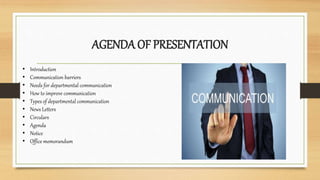
AGENDA OF PRESENTATION
โ€ข Introduction
โ€ข Communication barriers
โ€ข Needs for departmental communication
โ€ข How to improve communication
โ€ข Types of departmental communication
โ€ข News Letters
โ€ข Circulars
โ€ข Agenda
โ€ข Notice
โ€ข Office memorandum
INTRODUCTION
Departmental communication refers to communication between different
departments in an organization. Departmental communication can take many
forms including :
โ€ข Departmental meetings to go over team goals, news, updates, obstacles and
to strategize next steps.
โ€ข Interdepartmental communication about shared projects, new promotions,
changes in goods or services, sales projections, or anything else that might affect
multiple departments. This can be as simple as a departmental email update or a
more complex meeting about a shared project.
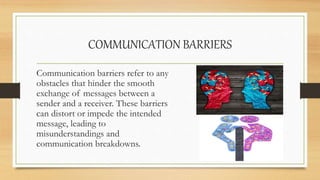
COMMUNICATION BARRIERS
Communication barriers refer to any
obstacles that hinder the smooth
exchange of messages between a
sender and a receiver. These barriers
can distort or impede the intended
message, leading to
misunderstandings and
communication breakdowns.
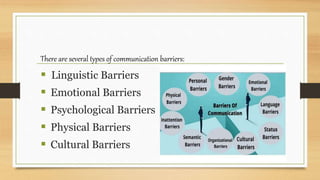
๏‚ง Linguistic Barriers
๏‚ง Emotional Barriers
๏‚ง Psychological Barriers
๏‚ง Physical Barriers
๏‚ง Cultural Barriers
There are several types of communication barriers:
๏‚ง Organisational Structure Barriers
๏‚ง Attitude Barriers
๏‚ง Perception Barriers
๏‚ง Physiological Barriers
๏‚ง Technological Barriers & Socio-religious Barriers
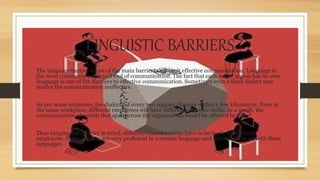
LINGUISTIC BARRIERS
The language barrier is one of the main barriers that limit effective communication. Language is
the most commonly employed tool of communication. The fact that each major region has its own
language is one of the Barriers to effective communication. Sometimes even a thick dialect may
render the communication ineffective.
As per some estimates, the dialects of every two regions changes within a few kilometres. Even in
the same workplace, different employees will have different linguistic skills. As a result, the
communication channels that span across the organization would be affected by this.
Thus keeping this barrier in mind, different considerations have to be made for different
employees. Some of them are very proficient in a certain language and others will be ok with these
languages.
Psychological Barriers
There are various mental and psychological issues that may be
barriers to effective communication. Some people have stage fear,
speech disorders, phobia, depression etc. All of these conditions are
very difficult to manage sometimes and will most certainly limit the
ease of communication.
Emotional Barriers
The emotional IQ of a person determines the ease and comfort with
which they can communicate. A person who is emotionally mature
will be able to communicate effectively. On the other hand, people
who let their emotions take over will face certain difficulties.
A perfect mixture of emotions and facts is necessary for effective
communication. Emotions like anger, frustration, humour, can blur
the decision-making capacities of a person and thus limit the
effectiveness of their communication.
Physical Barriers
They are the most obvious barriers to effective communication. These
barriers are mostly easily removable in principle at least. They include
barriers like noise, closed doors, faulty equipment used for
communication, closed cabins, etc. Sometimes, in a large office, the
physical separation between various employees combined with faulty
equipment may result in severe barriers to effective communication.
Cultural Barriers
As the world is getting more and more globalized, any large office may have people
from several parts of the world. Different cultures have a different meaning for
several basic values of society. Dressing, Religions or lack of them, food, drinks,
pets, and the general behaviour will change drastically from one culture to another.
Hence it is a must that we must take these different cultures into account while
communication. This is what we call being culturally appropriate. In many
multinational companies, special courses are offered at the orientation stages that
let people know about other cultures and how to be courteous and tolerant of
others.
Organizational Structure Barriers
As we saw there are many methods of communication at an
organizational level. Each of these methods has its own problems and
constraints that may become barriers to effective communication.
Most of these barriers arise because of misinformation or lack of
appropriate transparency available to the employees.
Attitude Barriers
Certain people like to be left alone. They are the introverts or just
people who are not very social. Others like to be social or sometimes
extra clingy! Both these cases could become a barrier to
communication. Some people have attitude issues, like huge ego and
inconsiderate behaviours. These employees can cause severe strains
in the communication channels that they are present in. Certain
personality traits like shyness, anger, social anxiety may be removable
through courses and proper training. However, problems like
egocentric behaviour and selfishness may not be correctable.
Perception Barriers
Different people perceive the same things differently.
This is a fact which we must consider during the
communication process. Knowledge of the perception
levels of the audience is crucial to effective
communication. All the messages or communique must
be easy and clear. There should not be any room for a
diversified interpretational set.
Physiological Barriers
Certain disorders or diseases or other limitations
could also prevent effective communication between
the various channels of an organization. The
shrillness of voice, dyslexia, etc are some examples
of physiological barriers to effective communication.
However, these are not crucial because they can
easily be compensated and removed.
Technological Barriers & Socio-religious Barriers
Other barriers include the technological barriers. The technology is developing fast
and as a result, it becomes difficult to keep up with the newest developments. Hence
sometimes the technological advance may become a barrier. In addition to this, the
cost of technology is sometimes very high.
Most of the organizations will not be able to afford a decent tech for the purpose of
communication. Hence, this becomes a very crucial barrier. Other barriers are
socio-religious barriers. In a patriarchal society, a woman or a transgender may face
many difficulties and barriers while communicating.
NEEDS FOR DEPARTMENTAL COMMUNICATION
โ€ข Building Trust between Teams
Accurate and efficient communication between departments builds
trust within the organization. When departments trust each other to
deliver accurate information, this eliminates the extra fact-checking
step that can slow down productivity. Departments should ensure
that the information they are giving to other departments in the
organization is reliable to help improve operational efficiency.
When inter-departmental communication is poor, customer service can
suffer. For example, if a client continues to receive a bill for an invoice
that was already paid because the accounts receivable department is not
communicating properly with accounts payable, then there is the risk of
losing repeat business. To retain clients and insure the flow of repeat
business, you need to maintain a high level of customer service. When
the departments in your company are efficiently sharing information,
then clients can be properly attended to, and customer service improves.
Better Customer Service
If your sales department loses business because the manufacturing group was
unaware of an increase in product demand, then your company suffers a loss of
revenue. The accurate exchange of information between departments improves the
ability to meet sales projections, to get product to distribution points and to have
contracts and documents reviewed by the proper people.
Information exchange allows for a productive exchange between engineering and
marketing about the release of a new product and gets information on prospective
employment candidates to the human resources department. Improving
communication between departments improves the efficiency of the overall
operation of your organization.
Increased Efficiency of Communication
Avoiding Conflict and Finger Pointing
A breakdown in communication at any point in the organization can result in
conflict. If the shipping department does not get notification of an important
shipment in time to make next day delivery, then that can cause a conflict
among several departments in the organization. Finger-pointing and arguing
accompany a breakdown in inter-departmental communication. When
departments engage in conflict, the productivity of your entire organization is
affected.
Opportunities for Professional Advancement
Effective communicators get noticed. Make it your mission to enhance
communications within your organization, with a special focus on making
sure your department is actively communicating to other company
departments. A worker or manager who can contribute the advantages of
good communication โ€“ efficiency, trust and service โ€“ and avoid the pitfalls
of unnecessary conflicts and finger-pointing is an employee whose work will
be noticed by department heads.
Good communication may not be a guarantee of quick advancement, but
poor communication can most certainly hold you back.
HOW TO IMPROVE COMMUNICATION BETWEEN
DEPARTMENTS
1. Proactively prevent team members working in silos
Silos can naturally begin to form with as few as eight team members working on a
project together. Without prompt action, a silo can devolve into toxic groupthink
and discourage the team from collaborating with colleagues in otherโ€”or even their
ownโ€”departments. To combat this, management can do the following:
โ€ข Pull everyone into the initial project planning to set a foundation of solidarity.
โ€ข Ensure department managers see how free-flow communication benefits them.
โ€ข Consider how office redesign can have an impact on collaboration.
โ€ข Relocate departmental teams to be in closer physical proximity to one
another.
โ€ข Have members from different departments sit in on each otherโ€™s meetings as
applicable.
Use collaborative customer relationship management (CRM) software that
provides equal access to information.
2. Set company-wide objectives
When individual departments put their goals first, cooperation takes a nosedive
and the whole company loses its sense of direction. The solution is to establish
company-wide, high-level goals to unite disparate teams. In doing so, this is what
management should keep in mind:
โ€ข Empower department leaders to define and communicate goals company-wide.
โ€ข Ask department leaders to explain why their goal is not only important to their
unit, but also how itโ€™s important to the organization as a whole.
โ€ข Discuss how greater company strategies can align to achieve departmental goals.
โ€ข Use emails, newsletters, and daily messaging to reinforce a shared purpose.
โ€ข Cascade communications to all teams, encouraging questions and feedback.
โ€ข Release regular statements and hold town hall meetings across departments.
โ€ข Encourage departmental heads to find ways to support each other.
โ€ข Share good news and individual or department โ€œwinsโ€ to boost morale.
3. Encourage regular team interaction
The best way to break down silos is to have departments interact with one
another on a routine basis. You may already hold regular in-person meetings,
Zoom presentations, and conferences to ensure team alignment. Introducing
communication platforms allows for immediate interactions as needed, which is
crucial to fostering a continual flow of communication throughout the
workday. Management and department leaders can do the following to put this
into practice:
โ€ข Schedule regular interactions with teams at a set time and place.
โ€ข Hold video conferences when teams canโ€™t meet in person, encouraging team
members to have their cameras on to foster connectivity.
โ€ข Allow for daily syncing through a communication platform.
โ€ข Maintain weekly leadership meetings to discuss common issues and solutions.
โ€ข Create a variety of clubs to foster shared interests outside of work-related topics.
โ€ข Hold team lunches and other social eventsโ€”picnics, happy hours, offsites,
lunches, etc.โ€”to encourage camaraderie.
โ€ข Encourage team members to meet as needed without management initiation.
4.Form cross-functional teams and adopt project
management platforms
Cross-functional teams are the linchpin of productivity and
workplace satisfaction. These synergistic teams give employees
access and exposure to different team members they may not
normally interact with. This fosters an environment where everyone
has the opportunity to broaden their skill sets while still working
toward common project and business goals. To implement these
teams within an organization, management should try these
methods:
โ€ข Build teams with diverse sets of experiences, skills, and backgrounds.
โ€ข . Establish clear roles and goals for each person involved.
โ€ข Align workflows with project-management tools (such as Taskworld, Asana,
Trello, and Wrike).
โ€ข Encourage teams to use tools like Zoom, Google Chat, or Slack to keep an open
channel of communication.
โ€ข Enable better sharing with Google Docs, Dropbox, and other cloud storage tools.
โ€ข Perform a continual re-evaluation of processes to avoid communication
breakdowns.
5.Select communication tools with a simple learning curve
While encouraging communication is an important goal businesses should prioritize, ensuring it is done in a
productive, professional manner is another hurdle in itself. Some team members may not be up-to-date on
communication best practices, and in some instances, poor communication can cause employee rifts,
frustration, and a loss in productivity.
To avoid thisโ€”while still keeping in mind everyoneโ€™s different communication skill levelโ€”management can
employ the use of a digital writing assistant like Grammarly Business. It integrates with a number of platforms
and applications, and offers suggestions to team members in real-time. In addition to providing suggestions for
grammar, spelling, and punctuation review, Grammarly Business detects and analyzes tone and compares
content to a custom style guide.
This streamlines both the adoption and learning processes, enhancing communication swiftly and efficiently at
the individual level without the need for lengthy onboarding or costly company-wide training.
Hereโ€™s how management can best introduce a tool like Grammarly Business:
โ€ข Involve team members from different departments to test-drive the new tool.
โ€ข . Offer best practice trainings as requested or needed.
โ€ข Encourage team members to share acquired tips and tricks with the company on how to
best use the writing tool.
โ€ข Review performance metrics and analytics to examine how well teams are adopting the tool
and if any areas of improvement need to be addressed.
Improved departmental communication not only affects teams and internal progress, but also
impacts other key areas of your business.
TYPES OF DEPARTMENTAL COMMUNICATION
Departmental communication plays a crucial role in organizational
effectiveness.
Letโ€™s explore the two main types of internal communication within
departments:
1. Intradepartmental Communication:
โ—‹ This type of communication occurs within the same department. It involves
interactions among team members, managers, and colleagues who work closely
together.
โ—‹ Purpose: To facilitate smooth operations, share information, coordinate tasks,
and ensure everyone is aligned toward common goals within the department.
โ—‹ Examples:
โ–ช Team Meetings: Regular team meetings where members discuss progress,
challenges, and upcoming tasks.
โ–ช Emails and Memos: Sending updates, instructions, or announcements within the
department.
โ–ช Intranet or Chat Platforms: Using internal communication tools to collaborate and
share documents.
2. Interdepartmental Communication:
โ—‹ This communication takes place between different departments within an
organization.
โ—‹ Purpose: To foster collaboration, exchange information, and address
cross-functional challenges.
โ—‹ Examples:
Cross-Departmental Meetings: Representatives from various departments
meet to discuss joint projects, resolve conflicts, or align strategies
โ–ช Project Teams: Teams formed by members from different departments to
work on specific initiatives.
โ–ช Reports and Documentation: Sharing data, reports, or project updates
across departments.
Interdepartmental Workshops or Training: Sessions to enhance
understanding and cooperation between teams.
NEWS LETTERS
Certainly! Newsletters are a valuable way to stay informed and connected. Hereโ€™s what you need to
know:
โ—‹ Definition: A newsletter is a printed or electronic report containing news related to the activities
of a business, organization, or specific topic. It is sent to members, customers, employees, or other
subscribers.
โ—‹ Purpose: Newsletters serve several purposes:
Information Sharing: They provide relevant and valuable information to a network of recipients.
* Direct Access: By landing directly in recipientsโ€™ inboxes, newsletters allow businesses to share
engaging content, promote sales, and drive traffic to their websites.
* Updates: They keep subscribers informed about the latest news, developments, and trends.
Types of Newsletters:
Industry Newsletters: These focus on specific industries or topics. For instance:
* Marketing Brew by Morning Brew: Offers insights into the industry and
social media trends.
* Bufferโ€™s Social Media Newsletter: Provides updates on platforms like
Instagram, Twitter, Pinterest, and Facebook.
* Geek out by Matt Navarra: Keeps you updated on social media changes.
* Recode by Vox: Explores digital space and industry evolutions.
Trend-Watching Newsletters:
* TheFutureParty: Tracks business, entertainment, and cultural trends through the lens
of tech and social media.
* Trends by The Hustle: Aggregates top trends in a concise email format.
โ—‹ Social Media and Creator Economy Newsletters:
* Link in Bio by Rachel Karten
* Future Social by Jack Appleby
* Creator Science
* The Publish Press
CIRCULARS
Circulars are official communications distributed to a large number of people. Hereโ€™s what you need
to know:
1. Definition: A circular is essentially a letter containing important information that is shared
with a broad audience. It serves as a mode of communication for various purposes, such as:
โ—‹ Inviting an entire department for a meeting.
โ—‹ Updating dress policies for the entire office.
โ—‹ Disseminating critical announcements or guidelines.
2. Components of a Circular:
โ—‹ Head: Contains the title or subject of the circular.
โ—‹ Opening: Introduces the purpose or context.
โ—‹ Text: Provides detailed information or instructions.
โ—‹ Signature: Includes the senderโ€™s name or organization
Advantages of Circulars:
โ—‹ Efficiency: They reach a large audience simultaneously.
โ—‹ Consistency: Ensure uniform communication across the organization.
โ—‹ Documentation: Serve as records of official announcements.
โ—‹ Clarity: Clearly convey essential information.
Remember, whether itโ€™s an office memo or an educational institutionโ€™s notice,
circulars play a crucial role in effective communication!
AGENDA
Definition Of Agenda
The term โ€œagendaโ€ has several related meanings:
1. In the context of meetings:
โ€ข
An agenda refers to a list of matters that are scheduled to be discussed during a meeting. It
outlines the topics, issues, or tasks that participants need to address. For example, an agenda for
a team meeting might include items like project updates, budget review, and upcoming
deadlines.
โ€ข
It can also include an itemized plan for the meeting, ensuring that discussions stay focused and
organized. An agenda typically includes details such as the meeting date, time, location, and the
sequence of topics to be covered.
In a broader sense:
โ€ข
Beyond meetings, an agenda can refer to a set of aims or future achievements. For instance:
โ–ก Advocacy groups may put issues like womenโ€™s rights back on the public agenda, emphasizing
their importance.
โ–ก Politicians may place certain topics, such as education, safety, or environmental concerns,
firmly on the political agenda during speeches or campaigns.
Sometimes, the term is used to describe a hidden motive or purpose behind someoneโ€™s actions,
although this usage is less common. Remember, whether itโ€™s a meeting or a broader context, an
agenda helps guide discussions and actions toward specific goals! ๐Ÿ“
Purpose Of Agenda
The purpose of an agenda in a meeting is multifaceted and essential for effective communication and productivity.
Letโ€™s explore its significance:
1. Guiding the Meeting: An agenda serves as a structured roadmap for the meeting. It outlines the topics, activities, and tasks
planned for discussion. By providing a clear framework, it ensures that participants know what to expect and helps maintain a
focused flow of conversation. Think of it as the compass that keeps everyone on track during the meeting.
2. Clarifying Objectives: Before writing an agenda, clarify the meeting objectives. Be specific about the goals you want to
achieve. Whether itโ€™s finalizing a budget or discussing new business strategies, a well-defined goal sets the tone and aligns
expectations. Participants can then come prepared with relevant data and insights, leading to more structured discussions and
productive outcomes.
3. Inclusive Preparation: Inviting input from participants before finalizing the agenda
is crucial. Reach out to potential attendees and ask if there are specific topics theyโ€™d
like to discuss. This inclusive approach ensures a comprehensive meeting plan and
allows everyone to contribute. When participants feel heard they engage more actively
during the meeting.
4. Respecting Time: A well-thought-out agenda shows that youโ€™re considerate of your
teamโ€™s time. When participants receive an agenda in advance, they can allocate time for
preparation. It prevents that feeling of uncertainty when entering a meeting without
knowing its purpose. Respect of time leads to more effective and productive meetings
Format Of Agenda
Letโ€™s create an agenda for an upcoming meeting. Hereโ€™s a sample agenda format:
Meeting Agenda: XYZ Team
Date: [Insert Date] Time: [Insert Time] Location: [Insert Location]
1. Welcome and Introductions
โ—‹ Briefly introduce attendees who may not know each other.
2. Review of Previous Meeting Minutes
โ—‹ Discuss any action items from the last meeting.
โ—‹ Confirm completion or provide updates.
3. Project Updates
โ—‹ Share progress on ongoing projects.
โ—‹ Highlight achievements, challenges, and next steps.
4. New Business
โ—‹ Discuss any new initiatives, proposals, or urgent matters.
โ—‹ Seek input and decision-making as needed.
5. Upcoming Events
Mention any upcoming events, workshops, or training sessions.
6. Open Floor
โ—‹ Allow attendees to raise additional topics or questions.
7. Next Meeting Date and Adjournment
โ—‹ Confirm the date and time for the next meeting.
โ—‹ Adjourn the current meeting.
NOTICE
ยท Definition Of Notice:
ยท A notice is a formal document in written form which is meant to provide
important information to the receivers.
ยท Notices are generally used for intradepartmental communication, i.e.
communicating messages within the department. For example, a notice can be
used to announce a meeting, a change in policy, a deadline, a reminder, etc.
ยท Purpose Of Notice:
ยท The purpose of a notice is to deliver specific information promptly and effectively to the
intended audience.
ยท Notices are designed to quickly grab the readerโ€™s attention, provide essential details, and
prompt the necessary response or action.
ยท Notices are a type of formal communication that can be used for various purposes, such as
inviting people to a meeting, announcing an event, issuing instructions, making appeals, etc.
ยท Notices are usually written or printed and displayed at a public place or published in
newspapers, where they can reach a large number of people.
ยท Components Of Notice
ยท Name of the issuing organization or authority: This is written at the top of the notice to identify the source and the relevance of the
notice.
ยท Title: This is written as โ€œNOTICEโ€ in capital letters below the name of the organization or authority to draw attention and indicate
the nature of the document
ยท Date: This is written below the title to the left-hand side to specify the date of issuing the notice and to keep a record of it.
ยท Heading: This is written below the date to the center of the page to give a suitable and eye-catching caption or description of the
purpose of the notice.
ยท Body: This is written below the heading to provide the main content of the notice, covering the five Wโ€™s: what, when, where, who, and
why. The body should be concise, clear, and complete, and should not exceed 50 words.
ยท Writerโ€™s name and designation: This is written at the end of the notice to the left-hand side to mention the name and the position of
the person who has written and authorized the notice. The notice should also be signed by the same person to lend it validity and
authority.
โ—Š Significance Of Notice
The significance of a notice is to provide a formal and effective way of communicating important information
to a specific audience.
ยท A notice can serve various purposes, such as inviting people to a meeting, announcing an event, issuing
instructions, making appeals, etc.
ยท A notice can also help in keeping a record of the communication and ensuring that the message is clear and
complete.
ยท A notice can reach a large number of people in a short time by displaying it at a public place or publishing it in
a newspaper.
ยท A notice can also help in avoiding any confusion or misunderstanding by stating the facts and details of the
information.
OFFICE MEMORANDUM
ล“
Definition Of Office Memorandum:
An office memorandum is a document that communicates important
information or decisions within an organization. It usually has a clear and
formal structure, such as a heading, an introduction, a body, a conclusion, and a
signature. It can also be used to request something, seek explanation, offer
suggestions, give instructions, or confirm arrangements.
ล“
Purpose Of Office Memorandum:
The purpose of an office memorandum is to communicate important
information or decisions within an organization. It can also be used to request
something, seek explanation, offer suggestions, give instructions, or confirm
arrangements. An office memorandum is a formal and efficient way of sharing
information with your colleagues, managers, or other internal organization
members. ๐Ÿ˜Š
Some examples of situations where you might need to write or read an office
memorandum are:
โ€ข To broadcast internal changes, such as new policies, procedures, or deadlines
โ€ข To disseminate news, such as achievements, awards, or events
โ€ข To update public safety guidelines, such as COVID-19 protocols, fire drills, or
emergency contacts
โ€ข To raise awareness about an issue, such as a problem, a challenge, or an opportunity
โ€ข To share project updates, such as progress, feedback, or results
Components Of Office Memorandum:
๏‚œ
An office memorandum is a documentthat communicates importantinformation or
decisions within an organization.It usuallyhas a clear and formal structure, such as:
A heading that includes the date, the sender, the recipient, and the subject of the memo.
โ€ข
An introductionthat states the purpose and the main point of the memo.
โ€ข
A body that provides the details, facts, or arguments that support the main point.
โ€ข
A conclusionthat summarizes the main point and suggests any action or
recommendation.
โ€ข
A signaturethat identifies the sender and their position.
โ€ข
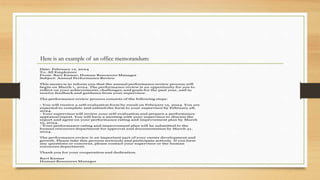
Here is an example of an office memorandum:
Date: February 12, 2024
To: All Employees
From: Ravi Kumar, Human Resources Manager
Subject: Annual Performance Review
This memo is to inform you that the annual performance review process will
begin on March 1, 2024. The performance review is an opportunity for you to
reflect on your achievements, challenges, and goals for the past year, and to
receive feedback and guidance from your supervisor.
The performance review process consists of the following steps:
- You will receive a self-evaluation form by email on February 15, 2024. You are
expected to complete and submit the form to your supervisor by February 28,
2024.
- Your supervisor will review your self-evaluation and prepare a performance
appraisal report. You will have a meeting with your supervisor to discuss the
report and agree on your performance rating and improvement plan by March
15, 2024.
- Your performance rating and improvement plan will be submitted to the
human resources department for approval and documentation by March 31,
2024.
The performance review is an important part of your career development and
growth. Please take this process seriously and participate actively. If you have
any questions or concerns, please contact your supervisor or the human
resources department.
Thank you for your cooperation and dedication.
Ravi Kumar
Human Resources Manager
Departmental communication.pptxhhhhhhhhh

Departmental communication.pptxhhhhhhhhh

  • 1.
    Departmental communication Here in thistopic we are going to discuss about Departmental Communication, Communication Barriers, Needs For Departmental Communication, How To Improve Communication, Types Of Departmental Communication, News Letters, Circulars, Agenda, Notice and Office Memorandum
  • 2.
    AGENDA OF PRESENTATION โ€ขIntroduction โ€ข Communication barriers โ€ข Needs for departmental communication โ€ข How to improve communication โ€ข Types of departmental communication โ€ข News Letters โ€ข Circulars โ€ข Agenda โ€ข Notice โ€ข Office memorandum
  • 3.
    INTRODUCTION Departmental communication refersto communication between different departments in an organization. Departmental communication can take many forms including : โ€ข Departmental meetings to go over team goals, news, updates, obstacles and to strategize next steps. โ€ข Interdepartmental communication about shared projects, new promotions, changes in goods or services, sales projections, or anything else that might affect multiple departments. This can be as simple as a departmental email update or a more complex meeting about a shared project.
  • 4.
    COMMUNICATION BARRIERS Communication barriersrefer to any obstacles that hinder the smooth exchange of messages between a sender and a receiver. These barriers can distort or impede the intended message, leading to misunderstandings and communication breakdowns.
  • 5.
    ๏‚ง Linguistic Barriers ๏‚งEmotional Barriers ๏‚ง Psychological Barriers ๏‚ง Physical Barriers ๏‚ง Cultural Barriers There are several types of communication barriers:
  • 6.
    ๏‚ง Organisational StructureBarriers ๏‚ง Attitude Barriers ๏‚ง Perception Barriers ๏‚ง Physiological Barriers ๏‚ง Technological Barriers & Socio-religious Barriers
  • 7.
    LINGUISTIC BARRIERS The languagebarrier is one of the main barriers that limit effective communication. Language is the most commonly employed tool of communication. The fact that each major region has its own language is one of the Barriers to effective communication. Sometimes even a thick dialect may render the communication ineffective. As per some estimates, the dialects of every two regions changes within a few kilometres. Even in the same workplace, different employees will have different linguistic skills. As a result, the communication channels that span across the organization would be affected by this. Thus keeping this barrier in mind, different considerations have to be made for different employees. Some of them are very proficient in a certain language and others will be ok with these languages.
  • 8.
    Psychological Barriers There arevarious mental and psychological issues that may be barriers to effective communication. Some people have stage fear, speech disorders, phobia, depression etc. All of these conditions are very difficult to manage sometimes and will most certainly limit the ease of communication.
  • 9.
    Emotional Barriers The emotionalIQ of a person determines the ease and comfort with which they can communicate. A person who is emotionally mature will be able to communicate effectively. On the other hand, people who let their emotions take over will face certain difficulties. A perfect mixture of emotions and facts is necessary for effective communication. Emotions like anger, frustration, humour, can blur the decision-making capacities of a person and thus limit the effectiveness of their communication.
  • 10.
    Physical Barriers They arethe most obvious barriers to effective communication. These barriers are mostly easily removable in principle at least. They include barriers like noise, closed doors, faulty equipment used for communication, closed cabins, etc. Sometimes, in a large office, the physical separation between various employees combined with faulty equipment may result in severe barriers to effective communication.
  • 11.
    Cultural Barriers As theworld is getting more and more globalized, any large office may have people from several parts of the world. Different cultures have a different meaning for several basic values of society. Dressing, Religions or lack of them, food, drinks, pets, and the general behaviour will change drastically from one culture to another. Hence it is a must that we must take these different cultures into account while communication. This is what we call being culturally appropriate. In many multinational companies, special courses are offered at the orientation stages that let people know about other cultures and how to be courteous and tolerant of others.
  • 12.
    Organizational Structure Barriers Aswe saw there are many methods of communication at an organizational level. Each of these methods has its own problems and constraints that may become barriers to effective communication. Most of these barriers arise because of misinformation or lack of appropriate transparency available to the employees.
  • 13.
    Attitude Barriers Certain peoplelike to be left alone. They are the introverts or just people who are not very social. Others like to be social or sometimes extra clingy! Both these cases could become a barrier to communication. Some people have attitude issues, like huge ego and inconsiderate behaviours. These employees can cause severe strains in the communication channels that they are present in. Certain personality traits like shyness, anger, social anxiety may be removable through courses and proper training. However, problems like egocentric behaviour and selfishness may not be correctable.
  • 14.
    Perception Barriers Different peopleperceive the same things differently. This is a fact which we must consider during the communication process. Knowledge of the perception levels of the audience is crucial to effective communication. All the messages or communique must be easy and clear. There should not be any room for a diversified interpretational set.
  • 15.
    Physiological Barriers Certain disordersor diseases or other limitations could also prevent effective communication between the various channels of an organization. The shrillness of voice, dyslexia, etc are some examples of physiological barriers to effective communication. However, these are not crucial because they can easily be compensated and removed.
  • 16.
    Technological Barriers &Socio-religious Barriers Other barriers include the technological barriers. The technology is developing fast and as a result, it becomes difficult to keep up with the newest developments. Hence sometimes the technological advance may become a barrier. In addition to this, the cost of technology is sometimes very high. Most of the organizations will not be able to afford a decent tech for the purpose of communication. Hence, this becomes a very crucial barrier. Other barriers are socio-religious barriers. In a patriarchal society, a woman or a transgender may face many difficulties and barriers while communicating.
  • 17.
    NEEDS FOR DEPARTMENTALCOMMUNICATION โ€ข Building Trust between Teams Accurate and efficient communication between departments builds trust within the organization. When departments trust each other to deliver accurate information, this eliminates the extra fact-checking step that can slow down productivity. Departments should ensure that the information they are giving to other departments in the organization is reliable to help improve operational efficiency.
  • 18.
    When inter-departmental communicationis poor, customer service can suffer. For example, if a client continues to receive a bill for an invoice that was already paid because the accounts receivable department is not communicating properly with accounts payable, then there is the risk of losing repeat business. To retain clients and insure the flow of repeat business, you need to maintain a high level of customer service. When the departments in your company are efficiently sharing information, then clients can be properly attended to, and customer service improves. Better Customer Service
  • 19.
    If your salesdepartment loses business because the manufacturing group was unaware of an increase in product demand, then your company suffers a loss of revenue. The accurate exchange of information between departments improves the ability to meet sales projections, to get product to distribution points and to have contracts and documents reviewed by the proper people. Information exchange allows for a productive exchange between engineering and marketing about the release of a new product and gets information on prospective employment candidates to the human resources department. Improving communication between departments improves the efficiency of the overall operation of your organization. Increased Efficiency of Communication
  • 20.
    Avoiding Conflict andFinger Pointing A breakdown in communication at any point in the organization can result in conflict. If the shipping department does not get notification of an important shipment in time to make next day delivery, then that can cause a conflict among several departments in the organization. Finger-pointing and arguing accompany a breakdown in inter-departmental communication. When departments engage in conflict, the productivity of your entire organization is affected.
  • 21.
    Opportunities for ProfessionalAdvancement Effective communicators get noticed. Make it your mission to enhance communications within your organization, with a special focus on making sure your department is actively communicating to other company departments. A worker or manager who can contribute the advantages of good communication โ€“ efficiency, trust and service โ€“ and avoid the pitfalls of unnecessary conflicts and finger-pointing is an employee whose work will be noticed by department heads. Good communication may not be a guarantee of quick advancement, but poor communication can most certainly hold you back.
  • 22.
    HOW TO IMPROVECOMMUNICATION BETWEEN DEPARTMENTS 1. Proactively prevent team members working in silos Silos can naturally begin to form with as few as eight team members working on a project together. Without prompt action, a silo can devolve into toxic groupthink and discourage the team from collaborating with colleagues in otherโ€”or even their ownโ€”departments. To combat this, management can do the following: โ€ข Pull everyone into the initial project planning to set a foundation of solidarity. โ€ข Ensure department managers see how free-flow communication benefits them.
  • 23.
    โ€ข Consider howoffice redesign can have an impact on collaboration. โ€ข Relocate departmental teams to be in closer physical proximity to one another. โ€ข Have members from different departments sit in on each otherโ€™s meetings as applicable. Use collaborative customer relationship management (CRM) software that provides equal access to information.
  • 24.
    2. Set company-wideobjectives When individual departments put their goals first, cooperation takes a nosedive and the whole company loses its sense of direction. The solution is to establish company-wide, high-level goals to unite disparate teams. In doing so, this is what management should keep in mind: โ€ข Empower department leaders to define and communicate goals company-wide. โ€ข Ask department leaders to explain why their goal is not only important to their unit, but also how itโ€™s important to the organization as a whole. โ€ข Discuss how greater company strategies can align to achieve departmental goals.
  • 25.
    โ€ข Use emails,newsletters, and daily messaging to reinforce a shared purpose. โ€ข Cascade communications to all teams, encouraging questions and feedback. โ€ข Release regular statements and hold town hall meetings across departments. โ€ข Encourage departmental heads to find ways to support each other. โ€ข Share good news and individual or department โ€œwinsโ€ to boost morale.
  • 26.
    3. Encourage regularteam interaction The best way to break down silos is to have departments interact with one another on a routine basis. You may already hold regular in-person meetings, Zoom presentations, and conferences to ensure team alignment. Introducing communication platforms allows for immediate interactions as needed, which is crucial to fostering a continual flow of communication throughout the workday. Management and department leaders can do the following to put this into practice:
  • 27.
    โ€ข Schedule regularinteractions with teams at a set time and place. โ€ข Hold video conferences when teams canโ€™t meet in person, encouraging team members to have their cameras on to foster connectivity. โ€ข Allow for daily syncing through a communication platform. โ€ข Maintain weekly leadership meetings to discuss common issues and solutions. โ€ข Create a variety of clubs to foster shared interests outside of work-related topics. โ€ข Hold team lunches and other social eventsโ€”picnics, happy hours, offsites, lunches, etc.โ€”to encourage camaraderie. โ€ข Encourage team members to meet as needed without management initiation.
  • 28.
    4.Form cross-functional teamsand adopt project management platforms Cross-functional teams are the linchpin of productivity and workplace satisfaction. These synergistic teams give employees access and exposure to different team members they may not normally interact with. This fosters an environment where everyone has the opportunity to broaden their skill sets while still working toward common project and business goals. To implement these teams within an organization, management should try these methods:
  • 29.
    โ€ข Build teamswith diverse sets of experiences, skills, and backgrounds. โ€ข . Establish clear roles and goals for each person involved. โ€ข Align workflows with project-management tools (such as Taskworld, Asana, Trello, and Wrike). โ€ข Encourage teams to use tools like Zoom, Google Chat, or Slack to keep an open channel of communication. โ€ข Enable better sharing with Google Docs, Dropbox, and other cloud storage tools. โ€ข Perform a continual re-evaluation of processes to avoid communication breakdowns.
  • 30.
    5.Select communication toolswith a simple learning curve While encouraging communication is an important goal businesses should prioritize, ensuring it is done in a productive, professional manner is another hurdle in itself. Some team members may not be up-to-date on communication best practices, and in some instances, poor communication can cause employee rifts, frustration, and a loss in productivity. To avoid thisโ€”while still keeping in mind everyoneโ€™s different communication skill levelโ€”management can employ the use of a digital writing assistant like Grammarly Business. It integrates with a number of platforms and applications, and offers suggestions to team members in real-time. In addition to providing suggestions for grammar, spelling, and punctuation review, Grammarly Business detects and analyzes tone and compares content to a custom style guide. This streamlines both the adoption and learning processes, enhancing communication swiftly and efficiently at the individual level without the need for lengthy onboarding or costly company-wide training.
  • 31.
    Hereโ€™s how managementcan best introduce a tool like Grammarly Business: โ€ข Involve team members from different departments to test-drive the new tool. โ€ข . Offer best practice trainings as requested or needed. โ€ข Encourage team members to share acquired tips and tricks with the company on how to best use the writing tool. โ€ข Review performance metrics and analytics to examine how well teams are adopting the tool and if any areas of improvement need to be addressed. Improved departmental communication not only affects teams and internal progress, but also impacts other key areas of your business.
  • 32.
    TYPES OF DEPARTMENTALCOMMUNICATION Departmental communication plays a crucial role in organizational effectiveness. Letโ€™s explore the two main types of internal communication within departments: 1. Intradepartmental Communication: โ—‹ This type of communication occurs within the same department. It involves interactions among team members, managers, and colleagues who work closely together.
  • 33.
    โ—‹ Purpose: Tofacilitate smooth operations, share information, coordinate tasks, and ensure everyone is aligned toward common goals within the department. โ—‹ Examples: โ–ช Team Meetings: Regular team meetings where members discuss progress, challenges, and upcoming tasks. โ–ช Emails and Memos: Sending updates, instructions, or announcements within the department. โ–ช Intranet or Chat Platforms: Using internal communication tools to collaborate and share documents.
  • 34.
    2. Interdepartmental Communication: โ—‹This communication takes place between different departments within an organization. โ—‹ Purpose: To foster collaboration, exchange information, and address cross-functional challenges. โ—‹ Examples: Cross-Departmental Meetings: Representatives from various departments meet to discuss joint projects, resolve conflicts, or align strategies
  • 35.
    โ–ช Project Teams:Teams formed by members from different departments to work on specific initiatives. โ–ช Reports and Documentation: Sharing data, reports, or project updates across departments. Interdepartmental Workshops or Training: Sessions to enhance understanding and cooperation between teams.
  • 36.
    NEWS LETTERS Certainly! Newslettersare a valuable way to stay informed and connected. Hereโ€™s what you need to know: โ—‹ Definition: A newsletter is a printed or electronic report containing news related to the activities of a business, organization, or specific topic. It is sent to members, customers, employees, or other subscribers. โ—‹ Purpose: Newsletters serve several purposes: Information Sharing: They provide relevant and valuable information to a network of recipients. * Direct Access: By landing directly in recipientsโ€™ inboxes, newsletters allow businesses to share engaging content, promote sales, and drive traffic to their websites. * Updates: They keep subscribers informed about the latest news, developments, and trends.
  • 37.
    Types of Newsletters: IndustryNewsletters: These focus on specific industries or topics. For instance: * Marketing Brew by Morning Brew: Offers insights into the industry and social media trends. * Bufferโ€™s Social Media Newsletter: Provides updates on platforms like Instagram, Twitter, Pinterest, and Facebook. * Geek out by Matt Navarra: Keeps you updated on social media changes. * Recode by Vox: Explores digital space and industry evolutions.
  • 38.
    Trend-Watching Newsletters: * TheFutureParty:Tracks business, entertainment, and cultural trends through the lens of tech and social media. * Trends by The Hustle: Aggregates top trends in a concise email format. โ—‹ Social Media and Creator Economy Newsletters: * Link in Bio by Rachel Karten * Future Social by Jack Appleby * Creator Science * The Publish Press
  • 39.
    CIRCULARS Circulars are officialcommunications distributed to a large number of people. Hereโ€™s what you need to know: 1. Definition: A circular is essentially a letter containing important information that is shared with a broad audience. It serves as a mode of communication for various purposes, such as: โ—‹ Inviting an entire department for a meeting. โ—‹ Updating dress policies for the entire office. โ—‹ Disseminating critical announcements or guidelines.
  • 40.
    2. Components ofa Circular: โ—‹ Head: Contains the title or subject of the circular. โ—‹ Opening: Introduces the purpose or context. โ—‹ Text: Provides detailed information or instructions. โ—‹ Signature: Includes the senderโ€™s name or organization
  • 41.
    Advantages of Circulars: โ—‹Efficiency: They reach a large audience simultaneously. โ—‹ Consistency: Ensure uniform communication across the organization. โ—‹ Documentation: Serve as records of official announcements. โ—‹ Clarity: Clearly convey essential information. Remember, whether itโ€™s an office memo or an educational institutionโ€™s notice, circulars play a crucial role in effective communication!
  • 42.
    AGENDA Definition Of Agenda Theterm โ€œagendaโ€ has several related meanings: 1. In the context of meetings: โ€ข An agenda refers to a list of matters that are scheduled to be discussed during a meeting. It outlines the topics, issues, or tasks that participants need to address. For example, an agenda for a team meeting might include items like project updates, budget review, and upcoming deadlines. โ€ข It can also include an itemized plan for the meeting, ensuring that discussions stay focused and organized. An agenda typically includes details such as the meeting date, time, location, and the sequence of topics to be covered.
  • 43.
    In a broadersense: โ€ข Beyond meetings, an agenda can refer to a set of aims or future achievements. For instance: โ–ก Advocacy groups may put issues like womenโ€™s rights back on the public agenda, emphasizing their importance. โ–ก Politicians may place certain topics, such as education, safety, or environmental concerns, firmly on the political agenda during speeches or campaigns. Sometimes, the term is used to describe a hidden motive or purpose behind someoneโ€™s actions, although this usage is less common. Remember, whether itโ€™s a meeting or a broader context, an agenda helps guide discussions and actions toward specific goals! ๐Ÿ“
  • 44.
    Purpose Of Agenda Thepurpose of an agenda in a meeting is multifaceted and essential for effective communication and productivity. Letโ€™s explore its significance: 1. Guiding the Meeting: An agenda serves as a structured roadmap for the meeting. It outlines the topics, activities, and tasks planned for discussion. By providing a clear framework, it ensures that participants know what to expect and helps maintain a focused flow of conversation. Think of it as the compass that keeps everyone on track during the meeting. 2. Clarifying Objectives: Before writing an agenda, clarify the meeting objectives. Be specific about the goals you want to achieve. Whether itโ€™s finalizing a budget or discussing new business strategies, a well-defined goal sets the tone and aligns expectations. Participants can then come prepared with relevant data and insights, leading to more structured discussions and productive outcomes.
  • 45.
    3. Inclusive Preparation:Inviting input from participants before finalizing the agenda is crucial. Reach out to potential attendees and ask if there are specific topics theyโ€™d like to discuss. This inclusive approach ensures a comprehensive meeting plan and allows everyone to contribute. When participants feel heard they engage more actively during the meeting. 4. Respecting Time: A well-thought-out agenda shows that youโ€™re considerate of your teamโ€™s time. When participants receive an agenda in advance, they can allocate time for preparation. It prevents that feeling of uncertainty when entering a meeting without knowing its purpose. Respect of time leads to more effective and productive meetings
  • 46.
    Format Of Agenda Letโ€™screate an agenda for an upcoming meeting. Hereโ€™s a sample agenda format: Meeting Agenda: XYZ Team Date: [Insert Date] Time: [Insert Time] Location: [Insert Location] 1. Welcome and Introductions โ—‹ Briefly introduce attendees who may not know each other. 2. Review of Previous Meeting Minutes โ—‹ Discuss any action items from the last meeting. โ—‹ Confirm completion or provide updates.
  • 47.
    3. Project Updates โ—‹Share progress on ongoing projects. โ—‹ Highlight achievements, challenges, and next steps. 4. New Business โ—‹ Discuss any new initiatives, proposals, or urgent matters. โ—‹ Seek input and decision-making as needed. 5. Upcoming Events Mention any upcoming events, workshops, or training sessions.
  • 48.
    6. Open Floor โ—‹Allow attendees to raise additional topics or questions. 7. Next Meeting Date and Adjournment โ—‹ Confirm the date and time for the next meeting. โ—‹ Adjourn the current meeting.
  • 49.
    NOTICE ยท Definition OfNotice: ยท A notice is a formal document in written form which is meant to provide important information to the receivers. ยท Notices are generally used for intradepartmental communication, i.e. communicating messages within the department. For example, a notice can be used to announce a meeting, a change in policy, a deadline, a reminder, etc.
  • 50.
    ยท Purpose OfNotice: ยท The purpose of a notice is to deliver specific information promptly and effectively to the intended audience. ยท Notices are designed to quickly grab the readerโ€™s attention, provide essential details, and prompt the necessary response or action. ยท Notices are a type of formal communication that can be used for various purposes, such as inviting people to a meeting, announcing an event, issuing instructions, making appeals, etc. ยท Notices are usually written or printed and displayed at a public place or published in newspapers, where they can reach a large number of people.
  • 51.
    ยท Components OfNotice ยท Name of the issuing organization or authority: This is written at the top of the notice to identify the source and the relevance of the notice. ยท Title: This is written as โ€œNOTICEโ€ in capital letters below the name of the organization or authority to draw attention and indicate the nature of the document ยท Date: This is written below the title to the left-hand side to specify the date of issuing the notice and to keep a record of it. ยท Heading: This is written below the date to the center of the page to give a suitable and eye-catching caption or description of the purpose of the notice. ยท Body: This is written below the heading to provide the main content of the notice, covering the five Wโ€™s: what, when, where, who, and why. The body should be concise, clear, and complete, and should not exceed 50 words. ยท Writerโ€™s name and designation: This is written at the end of the notice to the left-hand side to mention the name and the position of the person who has written and authorized the notice. The notice should also be signed by the same person to lend it validity and authority.
  • 52.
    โ—Š Significance OfNotice The significance of a notice is to provide a formal and effective way of communicating important information to a specific audience. ยท A notice can serve various purposes, such as inviting people to a meeting, announcing an event, issuing instructions, making appeals, etc. ยท A notice can also help in keeping a record of the communication and ensuring that the message is clear and complete. ยท A notice can reach a large number of people in a short time by displaying it at a public place or publishing it in a newspaper. ยท A notice can also help in avoiding any confusion or misunderstanding by stating the facts and details of the information.
  • 53.
    OFFICE MEMORANDUM ล“ Definition OfOffice Memorandum: An office memorandum is a document that communicates important information or decisions within an organization. It usually has a clear and formal structure, such as a heading, an introduction, a body, a conclusion, and a signature. It can also be used to request something, seek explanation, offer suggestions, give instructions, or confirm arrangements.
  • 54.
    ล“ Purpose Of OfficeMemorandum: The purpose of an office memorandum is to communicate important information or decisions within an organization. It can also be used to request something, seek explanation, offer suggestions, give instructions, or confirm arrangements. An office memorandum is a formal and efficient way of sharing information with your colleagues, managers, or other internal organization members. ๐Ÿ˜Š
  • 55.
    Some examples ofsituations where you might need to write or read an office memorandum are: โ€ข To broadcast internal changes, such as new policies, procedures, or deadlines โ€ข To disseminate news, such as achievements, awards, or events โ€ข To update public safety guidelines, such as COVID-19 protocols, fire drills, or emergency contacts โ€ข To raise awareness about an issue, such as a problem, a challenge, or an opportunity โ€ข To share project updates, such as progress, feedback, or results
  • 56.
    Components Of OfficeMemorandum: ๏‚œ An office memorandum is a documentthat communicates importantinformation or decisions within an organization.It usuallyhas a clear and formal structure, such as: A heading that includes the date, the sender, the recipient, and the subject of the memo. โ€ข An introductionthat states the purpose and the main point of the memo. โ€ข A body that provides the details, facts, or arguments that support the main point. โ€ข A conclusionthat summarizes the main point and suggests any action or recommendation. โ€ข A signaturethat identifies the sender and their position. โ€ข
  • 57.
    Here is anexample of an office memorandum: Date: February 12, 2024 To: All Employees From: Ravi Kumar, Human Resources Manager Subject: Annual Performance Review This memo is to inform you that the annual performance review process will begin on March 1, 2024. The performance review is an opportunity for you to reflect on your achievements, challenges, and goals for the past year, and to receive feedback and guidance from your supervisor. The performance review process consists of the following steps: - You will receive a self-evaluation form by email on February 15, 2024. You are expected to complete and submit the form to your supervisor by February 28, 2024. - Your supervisor will review your self-evaluation and prepare a performance appraisal report. You will have a meeting with your supervisor to discuss the report and agree on your performance rating and improvement plan by March 15, 2024. - Your performance rating and improvement plan will be submitted to the human resources department for approval and documentation by March 31, 2024. The performance review is an important part of your career development and growth. Please take this process seriously and participate actively. If you have any questions or concerns, please contact your supervisor or the human resources department. Thank you for your cooperation and dedication. Ravi Kumar Human Resources Manager