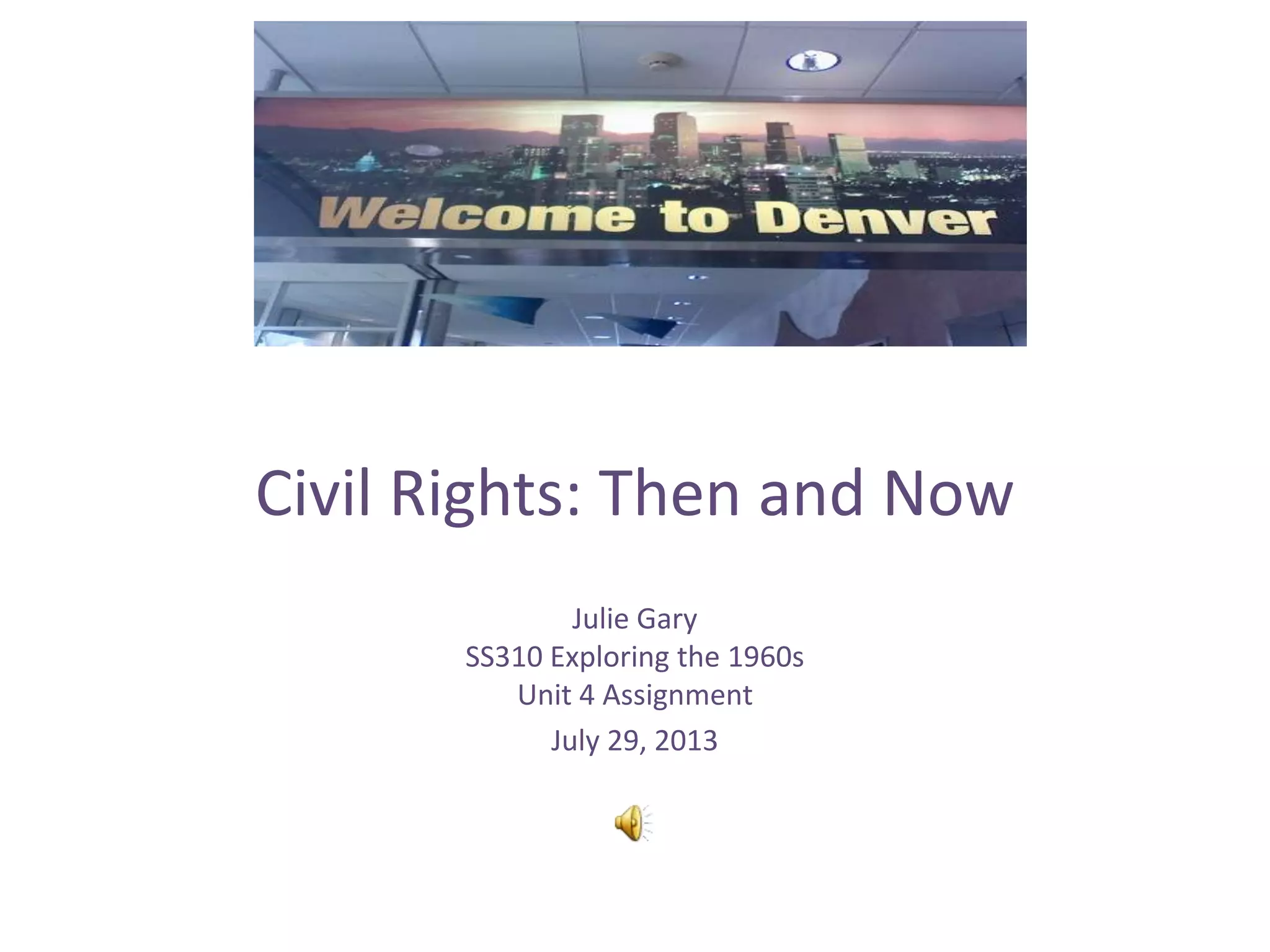
Civil Rights: Then and Now
Julie Gary
SS310 Exploring the 1960s
Unit 4 Assignment
July 29, 2013
In Denver, in the 1960’s, many services were
available for the elderly, different ethnic groups,
the disabled etc., but the services were often
segregated.
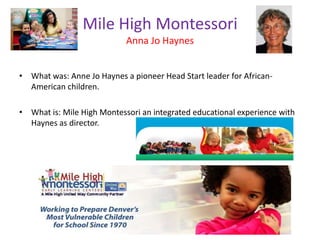
Mile High Montessori
Anna Jo Haynes
• What was: Anne Jo Haynes a pioneer Head Start leader for African-
American children.
• What is: Mile High Montessori an integrated educational experience with
Haynes as director.
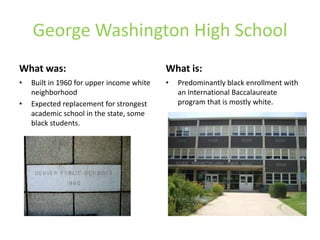
George Washington High School
What was:
• Built in 1960 for upper income white
neighborhood
• Expected replacement for strongest
academic school in the state, some
black students.
What is:
• Predominantly black enrollment with
an International Baccalaureate
program that is mostly white.
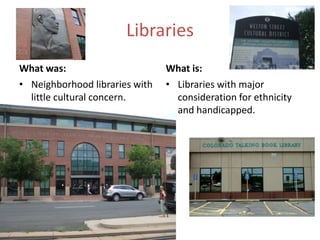
Libraries
What was:
• Neighborhood libraries with
little cultural concern.
What is:
• Libraries with major
consideration for ethnicity
and handicapped.
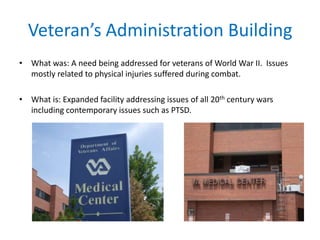
Veteran’s Administration Building
• What was: A need being addressed for veterans of World War II. Issues
mostly related to physical injuries suffered during combat.
• What is: Expanded facility addressing issues of all 20th century wars
including contemporary issues such as PTSD.
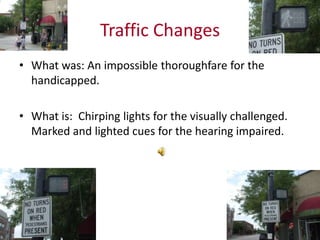
Traffic Changes
• What was: An impossible thoroughfare for the
handicapped.
• What is: Chirping lights for the visually challenged.
Marked and lighted cues for the hearing impaired.
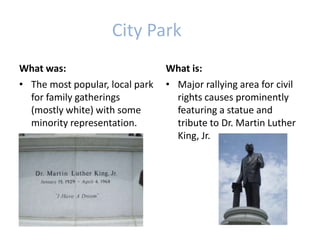
City Park
What was:
• The most popular, local park
for family gatherings
(mostly white) with some
minority representation.
What is:
• Major rallying area for civil
rights causes prominently
featuring a statue and
tribute to Dr. Martin Luther
King, Jr.
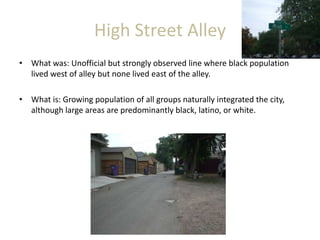
High Street Alley
• What was: Unofficial but strongly observed line where black population
lived west of alley but none lived east of the alley.
• What is: Growing population of all groups naturally integrated the city,
although large areas are predominantly black, latino, or white.
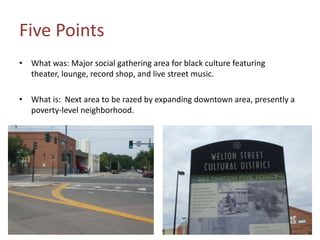
Five Points
• What was: Major social gathering area for black culture featuring
theater, lounge, record shop, and live street music.
• What is: Next area to be razed by expanding downtown area, presently a
poverty-level neighborhood.
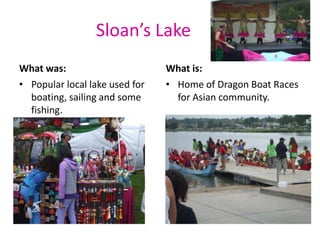
Sloan’s Lake
What was:
• Popular local lake used for
boating, sailing and some
fishing.
What is:
• Home of Dragon Boat Races
for Asian community.
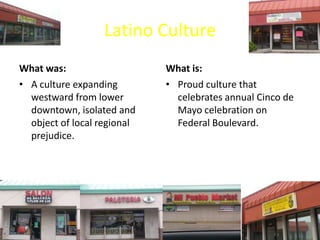
Latino Culture
What was:
• A culture expanding
westward from lower
downtown, isolated and
object of local regional
prejudice.
What is:
• Proud culture that
celebrates annual Cinco de
Mayo celebration on
Federal Boulevard.
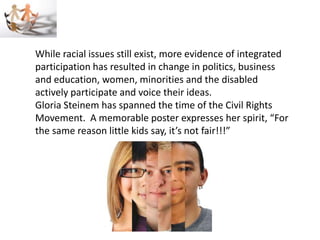
While racial issues still exist, more evidence of integrated
participation has resulted in change in politics, business
and education, women, minorities and the disabled
actively participate and voice their ideas.
Gloria Steinem has spanned the time of the Civil Rights
Movement. A memorable poster expresses her spirit, “For
the same reason little kids say, it’s not fair!!!”
References
• Mile High Montessori photos retrieved from
http://images.search.yahoo.com/search/images;_ylt=A0oG7h3sr_ZRRCwA
NEpXNyoA?p=mile+high+montestorri&fr=greentree_ff1&fr2=piv-web
• City of Denver
• Denver Public Schools
• Veteran’s Administration Building
• Original Photos (slides 3,4,5,6,7,8,9,11,&12) taken by Julie Gary on July 28,
2013
• Seeger, Pete. "We Shall Overcome." YouTube. YouTube, 24 Jan. 2008. Web.
29 July 2013.

Denver 60s 2

  • 1.
    Civil Rights: Thenand Now Julie Gary SS310 Exploring the 1960s Unit 4 Assignment July 29, 2013
  • 2.
    In Denver, inthe 1960’s, many services were available for the elderly, different ethnic groups, the disabled etc., but the services were often segregated.
  • 3.
    Mile High Montessori AnnaJo Haynes • What was: Anne Jo Haynes a pioneer Head Start leader for African- American children. • What is: Mile High Montessori an integrated educational experience with Haynes as director.
  • 4.
    George Washington HighSchool What was: • Built in 1960 for upper income white neighborhood • Expected replacement for strongest academic school in the state, some black students. What is: • Predominantly black enrollment with an International Baccalaureate program that is mostly white.
  • 5.
    Libraries What was: • Neighborhoodlibraries with little cultural concern. What is: • Libraries with major consideration for ethnicity and handicapped.
  • 6.
    Veteran’s Administration Building •What was: A need being addressed for veterans of World War II. Issues mostly related to physical injuries suffered during combat. • What is: Expanded facility addressing issues of all 20th century wars including contemporary issues such as PTSD.
  • 7.
    Traffic Changes • Whatwas: An impossible thoroughfare for the handicapped. • What is: Chirping lights for the visually challenged. Marked and lighted cues for the hearing impaired.
  • 8.
    City Park What was: •The most popular, local park for family gatherings (mostly white) with some minority representation. What is: • Major rallying area for civil rights causes prominently featuring a statue and tribute to Dr. Martin Luther King, Jr.
  • 9.
    High Street Alley •What was: Unofficial but strongly observed line where black population lived west of alley but none lived east of the alley. • What is: Growing population of all groups naturally integrated the city, although large areas are predominantly black, latino, or white.
  • 10.
    Five Points • Whatwas: Major social gathering area for black culture featuring theater, lounge, record shop, and live street music. • What is: Next area to be razed by expanding downtown area, presently a poverty-level neighborhood.
  • 11.
    Sloan’s Lake What was: •Popular local lake used for boating, sailing and some fishing. What is: • Home of Dragon Boat Races for Asian community.
  • 12.
    Latino Culture What was: •A culture expanding westward from lower downtown, isolated and object of local regional prejudice. What is: • Proud culture that celebrates annual Cinco de Mayo celebration on Federal Boulevard.
  • 13.
    While racial issuesstill exist, more evidence of integrated participation has resulted in change in politics, business and education, women, minorities and the disabled actively participate and voice their ideas. Gloria Steinem has spanned the time of the Civil Rights Movement. A memorable poster expresses her spirit, “For the same reason little kids say, it’s not fair!!!”
  • 14.
    References • Mile HighMontessori photos retrieved from http://images.search.yahoo.com/search/images;_ylt=A0oG7h3sr_ZRRCwA NEpXNyoA?p=mile+high+montestorri&fr=greentree_ff1&fr2=piv-web • City of Denver • Denver Public Schools • Veteran’s Administration Building • Original Photos (slides 3,4,5,6,7,8,9,11,&12) taken by Julie Gary on July 28, 2013 • Seeger, Pete. "We Shall Overcome." YouTube. YouTube, 24 Jan. 2008. Web. 29 July 2013.