Afro-Latinos in Black
Communities
By Antonia Johnson, Elijah Small, Michael Bell, Daniela Dally, Domonique Henderson
Problem and Solution
Problem
Afro-Latinos in some black populated neighborhoods struggle with discrimination due to the cultural
differences and language barriers between themselves and their community.
Solution
We propose that nationwide, communities with heavy populations of Black and Latin@ people host a week
long solidarity festival in which people of the community will participate in various cultural activities. Each day of the
week will be dedicated to a specific genre.
Solidarity Week Festival
Tuesday- Traditional Food and
Ethnic Cuisine
Wednesday- Art Convention
Thursday- Fashion Show / Pop up
Shops
Friday- Multi-Genre Concert - open
to the community
Saturday- Lawn Party
Justification: Language Barrier
● Struggle to communicate
○ Complex backgrounds
■ Raised speaking different
languages
■ Judged by their physical
appearance
● “People often assume I am black,
and then ask me why I know
Spanish” (Pitts)
● “They didn’t accept me because I
wasn’t a fluent Spanish speaker
and too brown” (Moreno)
● Solution: Music during the festival will expose
African Americans to the Spanish Language &
dialect.
Justification: Cultural Differences
● Respecting a person and their traditions becomes a conflict if there is no understanding of their culture.
● Where the feud comes from and why
● “There was a point in time where any type of Mexican could not come into our neighborhood (one of the
neighborhoods in Compton, California) because there were too many of them and they are dirty. If they
walked through here, they would always get into some type of altercation, especially physical; then they
would be chased out of our neighborhood.”
● From a Afro-Latin@ standpoint, “Blacks are lazy and have always been ghetto, that is what i was taught and
my family feels the same way. (Garcia)”
● If Black people were taught the culture of Afro-Latin@s= understanding
● If Afro-Latin@s were taught the culture of Black people= understanding
● if we understand one another and see how we are similar, there will be no respect
● Solution
Justification: Celebration
● You cannot force citizens to respect one another
● The purpose is to bring these two cultures together and
encourage them to bond
● In New York, this solution unites people of different
backgrounds
● The Puerto Rican day parade has been a main attraction since
1958
● It has become one of the city’s largest annual celebrations.
● With a high population of Puerto-Ricans, Afro-Dominicans, and
African Americans, the Puerto-Rican Day parade serves as an
essential event to bring these different communities together.
● Some citizens may believe parades, such as The Puerto-Rican
day parade, are solely focused on celebrating one ethnicity,
which is partially true, however, it is also about exposing the city
to a culture that is not widely recognized and inviting others to
fully understand it.
● These festivities encourage natives and other ethnic groups to
get along, encounter new people, and enjoy another culture. If
other states implement this solution, it will be a smoother
transition for the two ethnicities to come together.
Conclusion
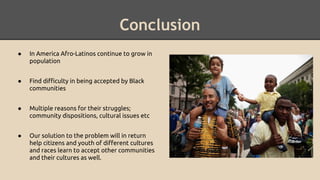
● In America Afro-Latinos continue to grow in
population
● Find difficulty in being accepted by Black
communities
● Multiple reasons for their struggles;
community dispositions, cultural issues etc
● Our solution to the problem will in return
help citizens and youth of different cultures
and races learn to accept other communities
and their cultures as well.
Work-Cited
Garcia, Yasmine. Telephone Interview. April 11, 2014.
Hamilton, Brad. "GANGS OF NEW YORK." Nypost. New York Post, 10 Oct. 2007. Web. 10 Apr. 2015.
"New York Celebrates National Puerto Rican Day Parade." Latino Fox News. Associated Press, 10 June 2012. Web. 13 Apr. 2015.
"New York City's Changing Latino Population." Latino Fox News. Latino Fox News, 10 May 2012. Web. 13 Apr. 2015.
Moreno, Carolina. "This Is What It Means To Be Afro-Latino." The Huffington Post. TheHuffingtonPost.com, n.d. Web. 12 Apr. 2015.
Reyes, Raula. "Afro-Latinos Seek Recognition, And Accurate Census Count." NBC News.
NBCNews.com, 15 Oct. 2014. Web. 11 Apr. 2015.
Zimmerman, Tracy. Telephone Interview. April 10, 2014.
"About Us - National Puerto Rican Day Parade." National Puerto Rican Day Parade. N.p., n.d.
Web. 13 Apr. 2015.
"Culture and Lifestyle." Puerto Rico. N.p., n.d. Web. 22 Apr. 2015.
"The Language Barrier in the Workplace | Shelflife Magazine." Shelflife Magazine. N.p., n.d. Web. 22 Apr. 2015.
"Bridging the Generational Gap." Bridging the Generational Gap. N.p., n.d. Web. 22 Apr. 2015.

Afro latin@ presentation

  • 1.
    Afro-Latinos in Black Communities ByAntonia Johnson, Elijah Small, Michael Bell, Daniela Dally, Domonique Henderson
  • 2.
    Problem and Solution Problem Afro-Latinosin some black populated neighborhoods struggle with discrimination due to the cultural differences and language barriers between themselves and their community. Solution We propose that nationwide, communities with heavy populations of Black and Latin@ people host a week long solidarity festival in which people of the community will participate in various cultural activities. Each day of the week will be dedicated to a specific genre.
  • 3.
    Solidarity Week Festival Tuesday-Traditional Food and Ethnic Cuisine Wednesday- Art Convention Thursday- Fashion Show / Pop up Shops Friday- Multi-Genre Concert - open to the community Saturday- Lawn Party
  • 4.
    Justification: Language Barrier ●Struggle to communicate ○ Complex backgrounds ■ Raised speaking different languages ■ Judged by their physical appearance ● “People often assume I am black, and then ask me why I know Spanish” (Pitts) ● “They didn’t accept me because I wasn’t a fluent Spanish speaker and too brown” (Moreno) ● Solution: Music during the festival will expose African Americans to the Spanish Language & dialect.
  • 5.
    Justification: Cultural Differences ●Respecting a person and their traditions becomes a conflict if there is no understanding of their culture. ● Where the feud comes from and why ● “There was a point in time where any type of Mexican could not come into our neighborhood (one of the neighborhoods in Compton, California) because there were too many of them and they are dirty. If they walked through here, they would always get into some type of altercation, especially physical; then they would be chased out of our neighborhood.” ● From a Afro-Latin@ standpoint, “Blacks are lazy and have always been ghetto, that is what i was taught and my family feels the same way. (Garcia)” ● If Black people were taught the culture of Afro-Latin@s= understanding ● If Afro-Latin@s were taught the culture of Black people= understanding ● if we understand one another and see how we are similar, there will be no respect ● Solution
  • 6.
    Justification: Celebration ● Youcannot force citizens to respect one another ● The purpose is to bring these two cultures together and encourage them to bond ● In New York, this solution unites people of different backgrounds ● The Puerto Rican day parade has been a main attraction since 1958 ● It has become one of the city’s largest annual celebrations. ● With a high population of Puerto-Ricans, Afro-Dominicans, and African Americans, the Puerto-Rican Day parade serves as an essential event to bring these different communities together. ● Some citizens may believe parades, such as The Puerto-Rican day parade, are solely focused on celebrating one ethnicity, which is partially true, however, it is also about exposing the city to a culture that is not widely recognized and inviting others to fully understand it. ● These festivities encourage natives and other ethnic groups to get along, encounter new people, and enjoy another culture. If other states implement this solution, it will be a smoother transition for the two ethnicities to come together.
  • 7.
    Conclusion ● In AmericaAfro-Latinos continue to grow in population ● Find difficulty in being accepted by Black communities ● Multiple reasons for their struggles; community dispositions, cultural issues etc ● Our solution to the problem will in return help citizens and youth of different cultures and races learn to accept other communities and their cultures as well.
  • 8.
    Work-Cited Garcia, Yasmine. TelephoneInterview. April 11, 2014. Hamilton, Brad. "GANGS OF NEW YORK." Nypost. New York Post, 10 Oct. 2007. Web. 10 Apr. 2015. "New York Celebrates National Puerto Rican Day Parade." Latino Fox News. Associated Press, 10 June 2012. Web. 13 Apr. 2015. "New York City's Changing Latino Population." Latino Fox News. Latino Fox News, 10 May 2012. Web. 13 Apr. 2015. Moreno, Carolina. "This Is What It Means To Be Afro-Latino." The Huffington Post. TheHuffingtonPost.com, n.d. Web. 12 Apr. 2015. Reyes, Raula. "Afro-Latinos Seek Recognition, And Accurate Census Count." NBC News. NBCNews.com, 15 Oct. 2014. Web. 11 Apr. 2015. Zimmerman, Tracy. Telephone Interview. April 10, 2014. "About Us - National Puerto Rican Day Parade." National Puerto Rican Day Parade. N.p., n.d. Web. 13 Apr. 2015. "Culture and Lifestyle." Puerto Rico. N.p., n.d. Web. 22 Apr. 2015. "The Language Barrier in the Workplace | Shelflife Magazine." Shelflife Magazine. N.p., n.d. Web. 22 Apr. 2015. "Bridging the Generational Gap." Bridging the Generational Gap. N.p., n.d. Web. 22 Apr. 2015.