Demystifying OTDR Event Analysis
TTI Technical Training Presentation
for CCTA July 15, 2014
2
Training Abstract
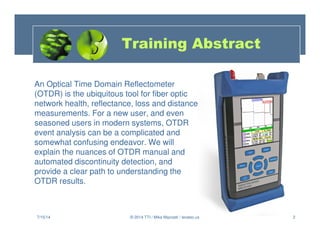
An Optical Time Domain Reflectometer
(OTDR) is the ubiquitous tool for fiber optic
network health, reflectance, loss and distance
measurements. For a new user, and even
seasoned users in modern systems, OTDR
event analysis can be a complicated and
somewhat confusing endeavor. We will
explain the nuances of OTDR manual and
automated discontinuity detection, and
provide a clear path to understanding the
OTDR results.
7/15/14 © 2014 TTI / Mike Mazzatti / teratec.us
7/15/14 © 2014 TTI / Mike Mazzatti / teratec.us 3
Training Objectives
• Introduction Into Optical Time Domain Reflectometry
• Review of Fiber Optic Fundamentals
• Understanding OTDRs
• Understanding FO Event Characteristics
• Understanding OTDR Results
• Applying Best Practices for Event Analysis
4
Training Sections
• Fiber Optic Introduction
• Fiber Optic Fundamentals
• OTDR Introduction
• OTDR Fundamentals
• Event Analysis Fundamentals
• Conclusions
7/15/14 © 2014 TTI / Mike Mazzatti / teratec.us
7/15/14 © 2014 TTI / Mike Mazzatti / teratec.us 5
Fiber Optics
Historical Perspective
• Colladon / Babinet 1840s - Principle of total internal reflection in water jets & bent glass rods.
• Hopkins / Kapany /Snitzer 1950s – Light propagation with cladded fibers for applications of
medicine, defense, even television.
• Charles Kao / Standard Telecommunications Lab Team 1960s – proposed a perfected SiO2 fiber
light pipe for low loss transmission capabilities.
• Keck / Maurer / Schultz at Corning 1970s – proved Kao’s vision through designing and drawing
preforms of chemical vapor deposition glass.
• Kao the 2009 co-winner of the Nobel prize in physics. [courtesy Royal Swedish Academy of
Sciences]
6
Fiber Optic Introduction
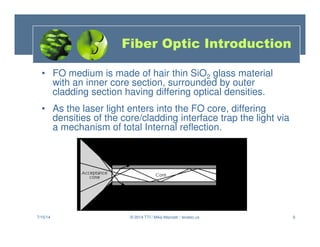
• FO medium is made of hair thin SiO2 glass material
with an inner core section, surrounded by outer
cladding section having differing optical densities.
• As the laser light enters into the FO core, differing
densities of the core/cladding interface trap the light via
a mechanism of total Internal reflection.
7/15/14 © 2014 TTI / Mike Mazzatti / teratec.us
7
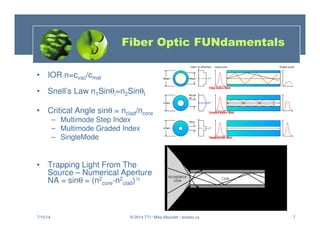
• IOR n=cvac/cmat
• Snell’s Law n1Sinθi=n2Sinθt
• Critical Angle sinθ = nclad/ncore
– Multimode Step Index
– Multimode Graded Index
– SingleMode
• Trapping Light From The
Source – Numerical Aperture
NA = sinθ = (n2
core-n2
clad)½
7/15/14 7
© 2014 TTI / Mike Mazzatti / teratec.us
Fiber Optic FUNdamentals
8
Fiber Optic FUNdamentals
• Losses - Attenuation
– dB or –dB
– Loss vs Wavelength (Loss vs Freq)
See Table
– Rayleigh Scattering Loss ≈ 1.7(0.85/λ)4
– Fresnel Reflections ρ = [(n-1)/(n+1)]2
– ORL Optical Return Loss
– Insertion Losses
– Connectorization Alignment
– Micro/macrobends & Absorption
7/15/14 8
© 2014 TTI / Mike Mazzatti / teratec.us
9
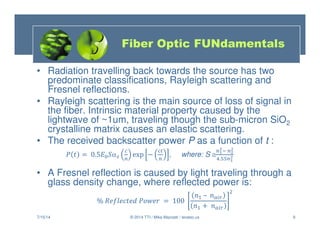
• Radiation travelling back towards the source has two
predominate classifications, Rayleigh scattering and
Fresnel reflections.
• Rayleigh scattering is the main source of loss of signal in
the fiber. Intrinsic material property caused by the
lightwave of ~1um, traveling though the sub-micron SiO2
crystalline matrix causes an elastic scattering.
• The received backscatter power P as a function of t :
  = 0.5 α exp −

, where: S ≅ 
 

. 

• A Fresnel reflection is caused by light traveling through a
glass density change, where reflected power is:
%   ! = 100
#$ – #'(
#$ + #'(
*
7/15/14 © 2014 TTI / Mike Mazzatti / teratec.us
Fiber Optic FUNdamentals
10
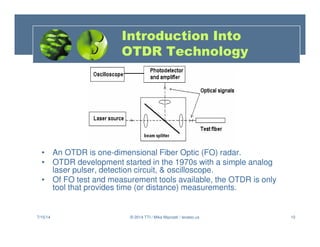
• An OTDR is one-dimensional Fiber Optic (FO) radar.
• OTDR development started in the 1970s with a simple analog
laser pulser, detection circuit,  oscilloscope.
• Of FO test and measurement tools available, the OTDR is only
tool that provides time (or distance) measurements.
7/15/14 © 2014 TTI / Mike Mazzatti / teratec.us
Introduction Into
OTDR Technology
7/15/14 © 2014 TTI / Mike Mazzatti / teratec.us 11
Introduction Into
OTDR Technology
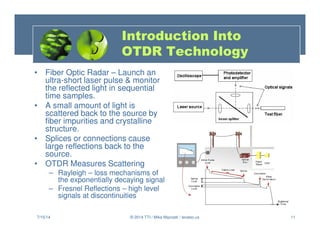
• Fiber Optic Radar – Launch an
ultra-short laser pulse  monitor
the reflected light in sequential
time samples.
• A small amount of light is
scattered back to the source by
fiber impurities and crystalline
structure.
• Splices or connections cause
large reflections back to the
source.
• OTDR Measures Scattering
– Rayleigh – loss mechanisms of
the exponentially decaying signal
– Fresnel Reflections – high level
signals at discontinuities
7/15/14 © 2014 TTI / Mike Mazzatti / teratec.us 12
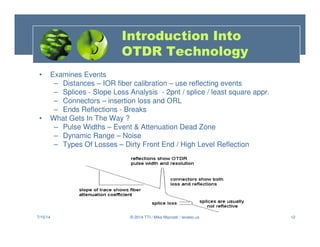
• Examines Events
– Distances – IOR fiber calibration – use reflecting events
– Splices - Slope Loss Analysis - 2pnt / splice / least square appr.
– Connectors – insertion loss and ORL
– Ends Reflections - Breaks
• What Gets In The Way ?
– Pulse Widths – Event  Attenuation Dead Zone
– Dynamic Range – Noise
– Types Of Losses – Dirty Front End / High Level Reflection
Introduction Into
OTDR Technology
13
OTDR Fundamentals
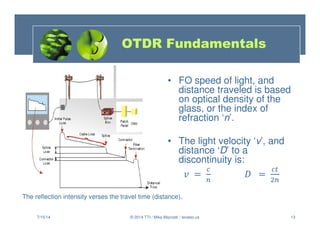
• FO speed of light, and
distance traveled is based
on optical density of the
glass, or the index of
refraction ‘n’.
• The light velocity ‘v’, and
distance ‘D’ to a
discontinuity is:
+ = , =

*
The reflection intensity verses the travel time (distance).
7/15/14 © 2014 TTI / Mike Mazzatti / teratec.us
14
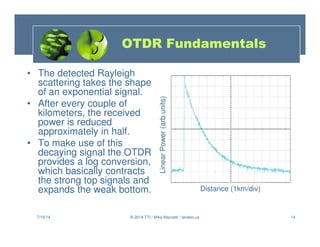
• The detected Rayleigh
scattering takes the shape
of an exponential signal.
• After every couple of
kilometers, the received
power is reduced
approximately in half.
• To make use of this
decaying signal the OTDR
provides a log conversion,
which basically contracts
the strong top signals and
expands the weak bottom. Distance (1km/div)
Linear
Power
(arb
units)
7/15/14 © 2014 TTI / Mike Mazzatti / teratec.us
OTDR Fundamentals
15
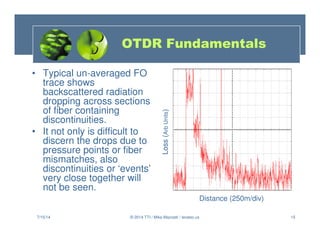
• Typical un-averaged FO
trace shows
backscattered radiation
dropping across sections
of fiber containing
discontinuities.
• It not only is difficult to
discern the drops due to
pressure points or fiber
mismatches, also
discontinuities or ‘events’
very close together will
not be seen.
Distance (250m/div)
Loss
(
Arb
Units
)
7/15/14 © 2014 TTI / Mike Mazzatti / teratec.us
OTDR Fundamentals
16
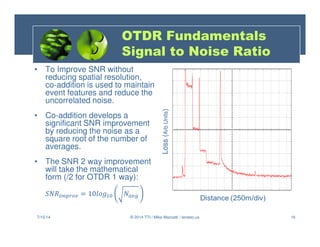
• To Improve SNR without
reducing spatial resolution,
co-addition is used to maintain
event features and reduce the
uncorrelated noise.
• Co-addition develops a
significant SNR improvement
by reducing the noise as a
square root of the number of
averages.
• The SNR 2 way improvement
will take the mathematical
form (/2 for OTDR 1 way):
-'./(01 = 102$ -13
Loss
(
Arb
Units
)
7/15/14 © 2014 TTI / Mike Mazzatti / teratec.us
OTDR Fundamentals
Signal to Noise Ratio
17
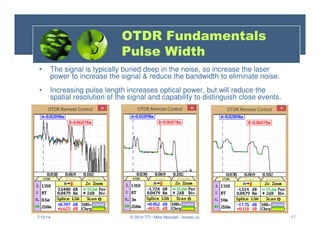
• The signal is typically buried deep in the noise, so increase the laser
power to increase the signal  reduce the bandwidth to eliminate noise.
• Increasing pulse length increases optical power, but will reduce the
spatial resolution of the signal and capability to distinguish close events.
7/15/14 © 2014 TTI / Mike Mazzatti / teratec.us
OTDR Fundamentals
Pulse Width
18
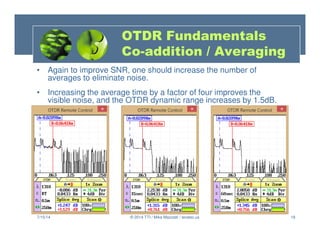
• Again to improve SNR, one should increase the number of
averages to eliminate noise.
• Increasing the average time by a factor of four improves the
visible noise, and the OTDR dynamic range increases by 1.5dB.
7/15/14 © 2014 TTI / Mike Mazzatti / teratec.us
OTDR Fundamentals
Co-addition / Averaging
19
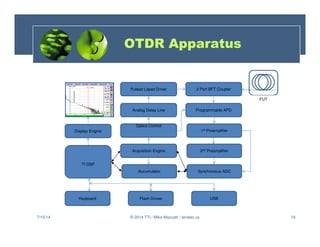
OTDR Apparatus
Pulsed Lased Driver
Analog Delay Line
1st Preamplifier
2nd Preamplifier
Synchronous ADC
Programmable APD
2 Port BFT Coupler
FUT
Acquisition Engine
Optics Control
Accumulator
TI DSP
Keyboard Flash Drives USB
Display Engine
7/15/14 © 2014 TTI / Mike Mazzatti / teratec.us
20
Event Analysis
Fundamentals
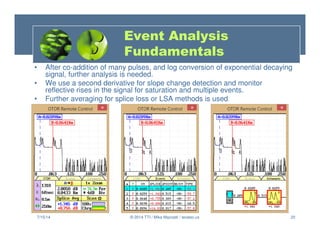
• After co-addition of many pulses, and log conversion of exponential decaying
signal, further analysis is needed.
• We use a second derivative for slope change detection and monitor
reflective rises in the signal for saturation and multiple events.
• Further averaging for splice loss or LSA methods is used.
7/15/14 © 2014 TTI / Mike Mazzatti / teratec.us
21
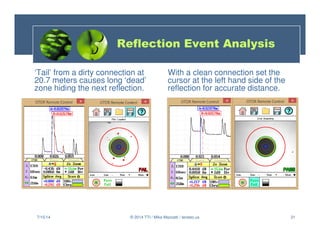
‘Tail’ from a dirty connection at
20.7 meters causes long ‘dead’
zone hiding the next reflection.
7/15/14 © 2014 TTI / Mike Mazzatti / teratec.us
Reflection Event Analysis
With a clean connection set the
cursor at the left hand side of the
reflection for accurate distance.
22
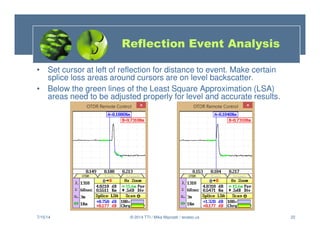
• Set cursor at left of reflection for distance to event. Make certain
splice loss areas around cursors are on level backscatter.
• Below the green lines of the Least Square Approximation (LSA)
areas need to be adjusted properly for level and accurate results.
7/15/14 © 2014 TTI / Mike Mazzatti / teratec.us
Reflection Event Analysis
23
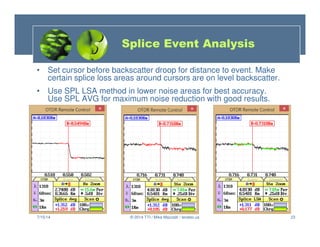
• Set cursor before backscatter droop for distance to event. Make
certain splice loss areas around cursors are on level backscatter.
• Use SPL LSA method in lower noise areas for best accuracy.
Use SPL AVG for maximum noise reduction with good results.
7/15/14 © 2014 TTI / Mike Mazzatti / teratec.us
Splice Event Analysis
24
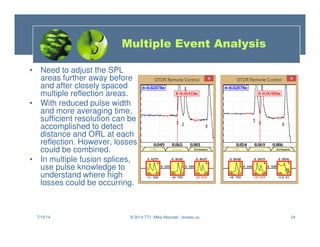
• Need to adjust the SPL
areas further away before
and after closely spaced
multiple reflection areas.
• With reduced pulse width
and more averaging time,
sufficient resolution can be
accomplished to detect
distance and ORL at each
reflection. However, losses
could be combined.
• In multiple fusion splices,
use pulse knowledge to
understand where high
losses could be occurring.
7/15/14 © 2014 TTI / Mike Mazzatti / teratec.us
Multiple Event Analysis
25
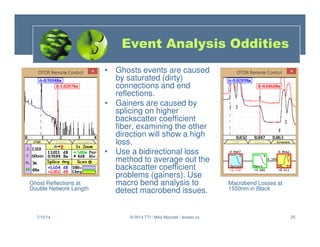
• Ghosts events are caused
by saturated (dirty)
connections and end
reflections.
• Gainers are caused by
splicing on higher
backscatter coefficient
fiber, examining the other
direction will show a high
loss.
• Use a bidirectional loss
method to average out the
backscatter coefficient
problems (gainers). Use
macro bend analysis to
detect macrobend issues.
7/15/14 © 2014 TTI / Mike Mazzatti / teratec.us
Event Analysis Oddities
Ghost Reflections at
Double Network Length
Macrobend Losses at
1550nm in Black
26
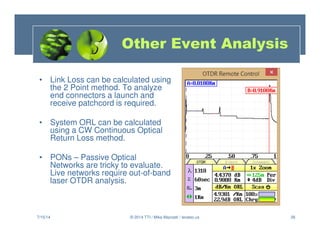
• Link Loss can be calculated using
the 2 Point method. To analyze
end connectors a launch and
receive patchcord is required.
• System ORL can be calculated
using a CW Continuous Optical
Return Loss method.
• PONs – Passive Optical
Networks are tricky to evaluate.
Live networks require out-of-band
laser OTDR analysis.
7/15/14 © 2014 TTI / Mike Mazzatti / teratec.us
Other Event Analysis
27
Automatic Event Analysis
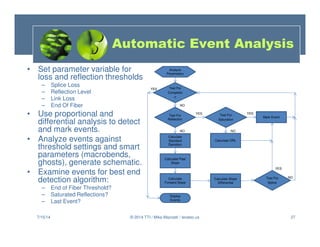
• Set parameter variable for
loss and reflection thresholds
– Splice Loss
– Reflection Level
– Link Loss
– End Of Fiber
• Use proportional and
differential analysis to detect
and mark events.
• Analyze events against
threshold settings and smart
parameters (macrobends,
ghosts), generate schematic.
• Examine events for best end
detection algorithm:
– End of Fiber Threshold?
– Saturated Reflections?
– Last Event?
Calculate Past
Slope
Calculate
Forward Slope
Calculate ORL
Calculate
Standard
Deviation
Calculate Slope
Differential
Test For
Reflection
Test For
Saturation
Test For
Splice
Display
Events
Test For
Completio
n
Mark Event
Analyze
Parameters
YES
YES
YES
YES
NO
NO
NO
NO
7/15/14 © 2014 TTI / Mike Mazzatti / teratec.us
28
Manual and Automatic
Advantages / Disadvantages
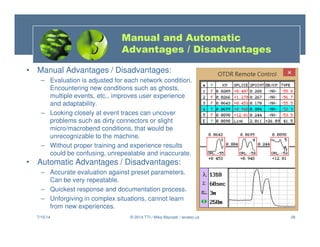
• Manual Advantages / Disadvantages:
– Evaluation is adjusted for each network condition.
Encountering new conditions such as ghosts,
multiple events, etc., improves user experience
and adaptability.
– Looking closely at event traces can uncover
problems such as dirty connectors or slight
micro/macrobend conditions, that would be
unrecognizable to the machine.
– Without proper training and experience results
could be confusing, unrepeatable and inaccurate.
• Automatic Advantages / Disadvantages:
– Accurate evaluation against preset parameters.
Can be very repeatable.
– Quickest response and documentation process.
– Unforgiving in complex situations, cannot learn
from new experiences.
7/15/14 © 2014 TTI / Mike Mazzatti / teratec.us
29
Summary
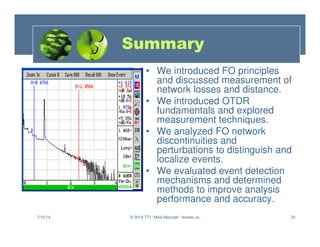
• We introduced FO principles
and discussed measurement of
network losses and distance.
• We introduced OTDR
fundamentals and explored
measurement techniques.
• We analyzed FO network
discontinuities and
perturbations to distinguish and
localize events.
• We evaluated event detection
mechanisms and determined
methods to improve analysis
performance and accuracy.
7/15/14 © 2014 TTI / Mike Mazzatti / teratec.us
30
Conclusion
Muchas Gracias! Merci! Dank U! Thank You!
Tenk Yuh!
To Learn More Visit:
Terahertz Technologies Inc.
teratec.us
1-888-US-OTDRS
315-736-3642
mmazzatti(at)teratec(dot)com
7/15/14 © 2014 TTI / Mike Mazzatti / teratec.us

Demystifying OTDR Event Analysis CCTA Presentation 070714.pdf

  • 1.
    Demystifying OTDR EventAnalysis TTI Technical Training Presentation for CCTA July 15, 2014
  • 2.
    2 Training Abstract An OpticalTime Domain Reflectometer (OTDR) is the ubiquitous tool for fiber optic network health, reflectance, loss and distance measurements. For a new user, and even seasoned users in modern systems, OTDR event analysis can be a complicated and somewhat confusing endeavor. We will explain the nuances of OTDR manual and automated discontinuity detection, and provide a clear path to understanding the OTDR results. 7/15/14 © 2014 TTI / Mike Mazzatti / teratec.us
  • 3.
    7/15/14 © 2014TTI / Mike Mazzatti / teratec.us 3 Training Objectives • Introduction Into Optical Time Domain Reflectometry • Review of Fiber Optic Fundamentals • Understanding OTDRs • Understanding FO Event Characteristics • Understanding OTDR Results • Applying Best Practices for Event Analysis
  • 4.
    4 Training Sections • FiberOptic Introduction • Fiber Optic Fundamentals • OTDR Introduction • OTDR Fundamentals • Event Analysis Fundamentals • Conclusions 7/15/14 © 2014 TTI / Mike Mazzatti / teratec.us
  • 5.
    7/15/14 © 2014TTI / Mike Mazzatti / teratec.us 5 Fiber Optics Historical Perspective • Colladon / Babinet 1840s - Principle of total internal reflection in water jets & bent glass rods. • Hopkins / Kapany /Snitzer 1950s – Light propagation with cladded fibers for applications of medicine, defense, even television. • Charles Kao / Standard Telecommunications Lab Team 1960s – proposed a perfected SiO2 fiber light pipe for low loss transmission capabilities. • Keck / Maurer / Schultz at Corning 1970s – proved Kao’s vision through designing and drawing preforms of chemical vapor deposition glass. • Kao the 2009 co-winner of the Nobel prize in physics. [courtesy Royal Swedish Academy of Sciences]
  • 6.
    6 Fiber Optic Introduction •FO medium is made of hair thin SiO2 glass material with an inner core section, surrounded by outer cladding section having differing optical densities. • As the laser light enters into the FO core, differing densities of the core/cladding interface trap the light via a mechanism of total Internal reflection. 7/15/14 © 2014 TTI / Mike Mazzatti / teratec.us
  • 7.
    7 • IOR n=cvac/cmat •Snell’s Law n1Sinθi=n2Sinθt • Critical Angle sinθ = nclad/ncore – Multimode Step Index – Multimode Graded Index – SingleMode • Trapping Light From The Source – Numerical Aperture NA = sinθ = (n2 core-n2 clad)½ 7/15/14 7 © 2014 TTI / Mike Mazzatti / teratec.us Fiber Optic FUNdamentals
  • 8.
    8 Fiber Optic FUNdamentals •Losses - Attenuation – dB or –dB – Loss vs Wavelength (Loss vs Freq) See Table – Rayleigh Scattering Loss ≈ 1.7(0.85/λ)4 – Fresnel Reflections ρ = [(n-1)/(n+1)]2 – ORL Optical Return Loss – Insertion Losses – Connectorization Alignment – Micro/macrobends & Absorption 7/15/14 8 © 2014 TTI / Mike Mazzatti / teratec.us
  • 9.
    9 • Radiation travellingback towards the source has two predominate classifications, Rayleigh scattering and Fresnel reflections. • Rayleigh scattering is the main source of loss of signal in the fiber. Intrinsic material property caused by the lightwave of ~1um, traveling though the sub-micron SiO2 crystalline matrix causes an elastic scattering. • The received backscatter power P as a function of t : = 0.5 α exp − , where: S ≅ . • A Fresnel reflection is caused by light traveling through a glass density change, where reflected power is: % ! = 100 #$ – #'( #$ + #'( * 7/15/14 © 2014 TTI / Mike Mazzatti / teratec.us Fiber Optic FUNdamentals
  • 10.
    10 • An OTDRis one-dimensional Fiber Optic (FO) radar. • OTDR development started in the 1970s with a simple analog laser pulser, detection circuit, oscilloscope. • Of FO test and measurement tools available, the OTDR is only tool that provides time (or distance) measurements. 7/15/14 © 2014 TTI / Mike Mazzatti / teratec.us Introduction Into OTDR Technology
  • 11.
    7/15/14 © 2014TTI / Mike Mazzatti / teratec.us 11 Introduction Into OTDR Technology • Fiber Optic Radar – Launch an ultra-short laser pulse monitor the reflected light in sequential time samples. • A small amount of light is scattered back to the source by fiber impurities and crystalline structure. • Splices or connections cause large reflections back to the source. • OTDR Measures Scattering – Rayleigh – loss mechanisms of the exponentially decaying signal – Fresnel Reflections – high level signals at discontinuities
  • 12.
    7/15/14 © 2014TTI / Mike Mazzatti / teratec.us 12 • Examines Events – Distances – IOR fiber calibration – use reflecting events – Splices - Slope Loss Analysis - 2pnt / splice / least square appr. – Connectors – insertion loss and ORL – Ends Reflections - Breaks • What Gets In The Way ? – Pulse Widths – Event Attenuation Dead Zone – Dynamic Range – Noise – Types Of Losses – Dirty Front End / High Level Reflection Introduction Into OTDR Technology
  • 13.
    13 OTDR Fundamentals • FOspeed of light, and distance traveled is based on optical density of the glass, or the index of refraction ‘n’. • The light velocity ‘v’, and distance ‘D’ to a discontinuity is: + = , = * The reflection intensity verses the travel time (distance). 7/15/14 © 2014 TTI / Mike Mazzatti / teratec.us
  • 14.
    14 • The detectedRayleigh scattering takes the shape of an exponential signal. • After every couple of kilometers, the received power is reduced approximately in half. • To make use of this decaying signal the OTDR provides a log conversion, which basically contracts the strong top signals and expands the weak bottom. Distance (1km/div) Linear Power (arb units) 7/15/14 © 2014 TTI / Mike Mazzatti / teratec.us OTDR Fundamentals
  • 15.
    15 • Typical un-averagedFO trace shows backscattered radiation dropping across sections of fiber containing discontinuities. • It not only is difficult to discern the drops due to pressure points or fiber mismatches, also discontinuities or ‘events’ very close together will not be seen. Distance (250m/div) Loss ( Arb Units ) 7/15/14 © 2014 TTI / Mike Mazzatti / teratec.us OTDR Fundamentals
  • 16.
    16 • To ImproveSNR without reducing spatial resolution, co-addition is used to maintain event features and reduce the uncorrelated noise. • Co-addition develops a significant SNR improvement by reducing the noise as a square root of the number of averages. • The SNR 2 way improvement will take the mathematical form (/2 for OTDR 1 way): -'./(01 = 102$ -13 Loss ( Arb Units ) 7/15/14 © 2014 TTI / Mike Mazzatti / teratec.us OTDR Fundamentals Signal to Noise Ratio
  • 17.
    17 • The signalis typically buried deep in the noise, so increase the laser power to increase the signal reduce the bandwidth to eliminate noise. • Increasing pulse length increases optical power, but will reduce the spatial resolution of the signal and capability to distinguish close events. 7/15/14 © 2014 TTI / Mike Mazzatti / teratec.us OTDR Fundamentals Pulse Width
  • 18.
    18 • Again toimprove SNR, one should increase the number of averages to eliminate noise. • Increasing the average time by a factor of four improves the visible noise, and the OTDR dynamic range increases by 1.5dB. 7/15/14 © 2014 TTI / Mike Mazzatti / teratec.us OTDR Fundamentals Co-addition / Averaging
  • 19.
    19 OTDR Apparatus Pulsed LasedDriver Analog Delay Line 1st Preamplifier 2nd Preamplifier Synchronous ADC Programmable APD 2 Port BFT Coupler FUT Acquisition Engine Optics Control Accumulator TI DSP Keyboard Flash Drives USB Display Engine 7/15/14 © 2014 TTI / Mike Mazzatti / teratec.us
  • 20.
    20 Event Analysis Fundamentals • Afterco-addition of many pulses, and log conversion of exponential decaying signal, further analysis is needed. • We use a second derivative for slope change detection and monitor reflective rises in the signal for saturation and multiple events. • Further averaging for splice loss or LSA methods is used. 7/15/14 © 2014 TTI / Mike Mazzatti / teratec.us
  • 21.
    21 ‘Tail’ from adirty connection at 20.7 meters causes long ‘dead’ zone hiding the next reflection. 7/15/14 © 2014 TTI / Mike Mazzatti / teratec.us Reflection Event Analysis With a clean connection set the cursor at the left hand side of the reflection for accurate distance.
  • 22.
    22 • Set cursorat left of reflection for distance to event. Make certain splice loss areas around cursors are on level backscatter. • Below the green lines of the Least Square Approximation (LSA) areas need to be adjusted properly for level and accurate results. 7/15/14 © 2014 TTI / Mike Mazzatti / teratec.us Reflection Event Analysis
  • 23.
    23 • Set cursorbefore backscatter droop for distance to event. Make certain splice loss areas around cursors are on level backscatter. • Use SPL LSA method in lower noise areas for best accuracy. Use SPL AVG for maximum noise reduction with good results. 7/15/14 © 2014 TTI / Mike Mazzatti / teratec.us Splice Event Analysis
  • 24.
    24 • Need toadjust the SPL areas further away before and after closely spaced multiple reflection areas. • With reduced pulse width and more averaging time, sufficient resolution can be accomplished to detect distance and ORL at each reflection. However, losses could be combined. • In multiple fusion splices, use pulse knowledge to understand where high losses could be occurring. 7/15/14 © 2014 TTI / Mike Mazzatti / teratec.us Multiple Event Analysis
  • 25.
    25 • Ghosts eventsare caused by saturated (dirty) connections and end reflections. • Gainers are caused by splicing on higher backscatter coefficient fiber, examining the other direction will show a high loss. • Use a bidirectional loss method to average out the backscatter coefficient problems (gainers). Use macro bend analysis to detect macrobend issues. 7/15/14 © 2014 TTI / Mike Mazzatti / teratec.us Event Analysis Oddities Ghost Reflections at Double Network Length Macrobend Losses at 1550nm in Black
  • 26.
    26 • Link Losscan be calculated using the 2 Point method. To analyze end connectors a launch and receive patchcord is required. • System ORL can be calculated using a CW Continuous Optical Return Loss method. • PONs – Passive Optical Networks are tricky to evaluate. Live networks require out-of-band laser OTDR analysis. 7/15/14 © 2014 TTI / Mike Mazzatti / teratec.us Other Event Analysis
  • 27.
    27 Automatic Event Analysis •Set parameter variable for loss and reflection thresholds – Splice Loss – Reflection Level – Link Loss – End Of Fiber • Use proportional and differential analysis to detect and mark events. • Analyze events against threshold settings and smart parameters (macrobends, ghosts), generate schematic. • Examine events for best end detection algorithm: – End of Fiber Threshold? – Saturated Reflections? – Last Event? Calculate Past Slope Calculate Forward Slope Calculate ORL Calculate Standard Deviation Calculate Slope Differential Test For Reflection Test For Saturation Test For Splice Display Events Test For Completio n Mark Event Analyze Parameters YES YES YES YES NO NO NO NO 7/15/14 © 2014 TTI / Mike Mazzatti / teratec.us
  • 28.
    28 Manual and Automatic Advantages/ Disadvantages • Manual Advantages / Disadvantages: – Evaluation is adjusted for each network condition. Encountering new conditions such as ghosts, multiple events, etc., improves user experience and adaptability. – Looking closely at event traces can uncover problems such as dirty connectors or slight micro/macrobend conditions, that would be unrecognizable to the machine. – Without proper training and experience results could be confusing, unrepeatable and inaccurate. • Automatic Advantages / Disadvantages: – Accurate evaluation against preset parameters. Can be very repeatable. – Quickest response and documentation process. – Unforgiving in complex situations, cannot learn from new experiences. 7/15/14 © 2014 TTI / Mike Mazzatti / teratec.us
  • 29.
    29 Summary • We introducedFO principles and discussed measurement of network losses and distance. • We introduced OTDR fundamentals and explored measurement techniques. • We analyzed FO network discontinuities and perturbations to distinguish and localize events. • We evaluated event detection mechanisms and determined methods to improve analysis performance and accuracy. 7/15/14 © 2014 TTI / Mike Mazzatti / teratec.us
  • 30.
    30 Conclusion Muchas Gracias! Merci!Dank U! Thank You! Tenk Yuh! To Learn More Visit: Terahertz Technologies Inc. teratec.us 1-888-US-OTDRS 315-736-3642 mmazzatti(at)teratec(dot)com 7/15/14 © 2014 TTI / Mike Mazzatti / teratec.us