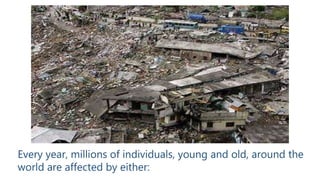
Every year, millions of individuals, young and old, around the
world are affected by either:
NATURAL DISASTERS
HUMAN-CAUSED DISASTERS
Common end results:
 Loss of lives
 livelihood
 properties
DISASTERS
Activity 1: GUESS THE PHENOMENA!
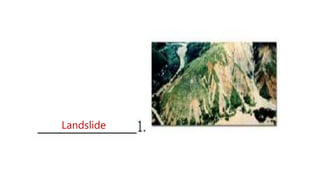
Landslide
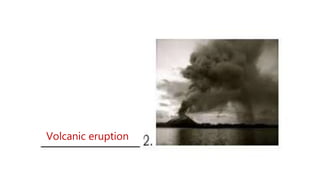
Volcanic eruption
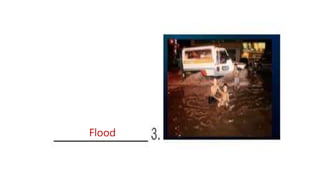
Flood
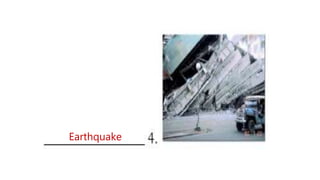
Earthquake
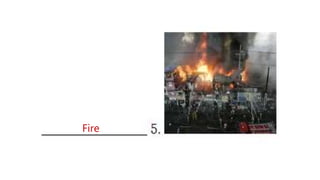
Fire
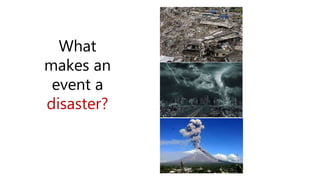
What
makes an
event a
disaster?
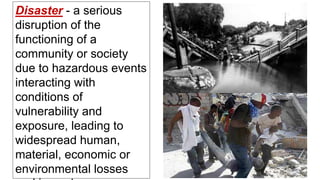
Disaster - a serious
disruption of the
functioning of a
community or society
due to hazardous events
interacting with
conditions of
vulnerability and
exposure, leading to
widespread human,
material, economic or
environmental losses
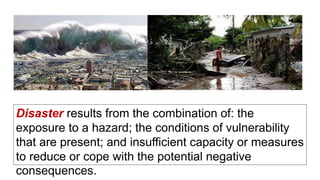
Disaster results from the combination of: the
exposure to a hazard; the conditions of vulnerability
that are present; and insufficient capacity or measures
to reduce or cope with the potential negative
consequences.
Consequences may include injuries, disease and other
negative effects on human physical, mental and social
well-being, together with damage to property, loss of
services and environmental degradation.
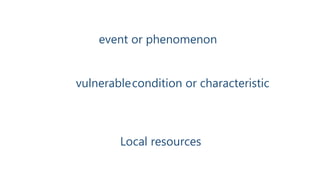
event or phenomenon
vulnerablecondition or characteristic
Local resources
Disaster affect communities in multiple ways. Their
impact on the health care infrastructure is also multi-
factorial. The disaster event can cause an
unexpected number of deaths. In addition, the large
numbers of wounded and sick often exceed the local
community’s health care delivery capacity.
Definitions of a disaster
“Disaster is a sudden calamitous event bringing
great damage, loss, or destruction”.
https://www.merriamwebster.com/dictionary/disaster
“Disaster is a major hazard event that causes
widespread disruption to a community or region
that the affected community is unable to deal with
adequately without outside help.”
https://graphylaunchpad.weebly.com/definition-of-
disaster.html
“A disaster is a sudden, calamitous event that seriously
disrupts the functioning of a community or society and
causes human, material, and economic orenvironmental
losses that exceed the community’s or society’s ability to
cope using its own resources.”
https://www.ifrc.org/en/whatwe-
do/disaster-management/about-disasters/what-is-
adisaster/#:~:text=A%20disaster%20is%20a%20sudden,disas
ters%20can%20have%20human%20origins.
“Disaster is an occurrence disrupting the normal
conditions of existence and causing a level of
suffering that exceeds the capacity of adjustment
of the affected community.”
https://apps.who.int/disasters/repo/7656.pdf
HOW AND
WHEN AN
EVENT
BECOMES A
DISASTER
An event, either human-made or natural,
becomes a disaster when it is sudden or
progressive, causing widespread human,
material or environmental
losses.
Our country, the Philippines, is frequently visited by
typhoons on the average of 20 every year. Thus, we
can consider typhoons as natural events. However, in
2009, Typhoon Ondoy turned into a disaster because
the amount of precipitation brought by its torrential
rains lasted for several days causing floods and flash
floods in Metro Manila. Thousands of houses were
submerged in flood water. Hundreds of shelters along
river banks and steros were washed out. Power and
water supplies were cut off for several weeks.
Hundreds of lives perished.
Wow Wowie, hosted by Willie Revillame, a popular
singer-commedian, became so popular. Thousands
of fans flock to ULTRA (a huge event venue during
that time) to watch the noon time variety show.
However, that event turned out to a disastrous
tragedy when there was a human-induced
disturbance among the watching crowd that caused
a stampede. Many spectators were hurt and some
even died which led to the dissolution of the said TV
program.
You are informed there has been a flood affecting
one of the municipalities in the Province of La
Union. According to the latest population census,
around 10,000 people who are mostly poor live in
this area. What are the characteristics that
indicate that this event can be defined as
disaster?
Activity 2: LET’S DO IT!
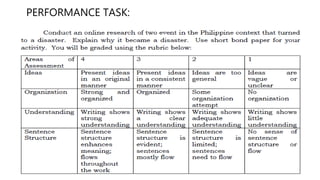
PERFORMANCE TASK:

Basic Concept of Disaster and Disaster Risk

  • 2.
    Every year, millionsof individuals, young and old, around the world are affected by either:
  • 3.
  • 4.
    Common end results: Loss of lives  livelihood  properties
  • 5.
  • 6.
    Activity 1: GUESSTHE PHENOMENA!
  • 7.
  • 8.
  • 9.
  • 10.
  • 11.
  • 12.
  • 13.
    Disaster - aserious disruption of the functioning of a community or society due to hazardous events interacting with conditions of vulnerability and exposure, leading to widespread human, material, economic or environmental losses
  • 14.
    Disaster results fromthe combination of: the exposure to a hazard; the conditions of vulnerability that are present; and insufficient capacity or measures to reduce or cope with the potential negative consequences.
  • 15.
    Consequences may includeinjuries, disease and other negative effects on human physical, mental and social well-being, together with damage to property, loss of services and environmental degradation.
  • 16.
    event or phenomenon vulnerableconditionor characteristic Local resources
  • 17.
    Disaster affect communitiesin multiple ways. Their impact on the health care infrastructure is also multi- factorial. The disaster event can cause an unexpected number of deaths. In addition, the large numbers of wounded and sick often exceed the local community’s health care delivery capacity.
  • 18.
    Definitions of adisaster “Disaster is a sudden calamitous event bringing great damage, loss, or destruction”. https://www.merriamwebster.com/dictionary/disaster
  • 19.
    “Disaster is amajor hazard event that causes widespread disruption to a community or region that the affected community is unable to deal with adequately without outside help.” https://graphylaunchpad.weebly.com/definition-of- disaster.html
  • 20.
    “A disaster isa sudden, calamitous event that seriously disrupts the functioning of a community or society and causes human, material, and economic orenvironmental losses that exceed the community’s or society’s ability to cope using its own resources.” https://www.ifrc.org/en/whatwe- do/disaster-management/about-disasters/what-is- adisaster/#:~:text=A%20disaster%20is%20a%20sudden,disas ters%20can%20have%20human%20origins.
  • 21.
    “Disaster is anoccurrence disrupting the normal conditions of existence and causing a level of suffering that exceeds the capacity of adjustment of the affected community.” https://apps.who.int/disasters/repo/7656.pdf
  • 22.
  • 23.
    An event, eitherhuman-made or natural, becomes a disaster when it is sudden or progressive, causing widespread human, material or environmental losses.
  • 24.
    Our country, thePhilippines, is frequently visited by typhoons on the average of 20 every year. Thus, we can consider typhoons as natural events. However, in 2009, Typhoon Ondoy turned into a disaster because the amount of precipitation brought by its torrential rains lasted for several days causing floods and flash floods in Metro Manila. Thousands of houses were submerged in flood water. Hundreds of shelters along river banks and steros were washed out. Power and water supplies were cut off for several weeks. Hundreds of lives perished.
  • 25.
    Wow Wowie, hostedby Willie Revillame, a popular singer-commedian, became so popular. Thousands of fans flock to ULTRA (a huge event venue during that time) to watch the noon time variety show. However, that event turned out to a disastrous tragedy when there was a human-induced disturbance among the watching crowd that caused a stampede. Many spectators were hurt and some even died which led to the dissolution of the said TV program.
  • 26.
    You are informedthere has been a flood affecting one of the municipalities in the Province of La Union. According to the latest population census, around 10,000 people who are mostly poor live in this area. What are the characteristics that indicate that this event can be defined as disaster? Activity 2: LET’S DO IT!
  • 27.

Editor's Notes

  • #13 The answer lies with how the population is eventually affected: both the direct effects on the people as well as the indirect effects or damage to infrastructure.
  • #14 According to: The United Nations International Strategy for Disaster Reduction (2015) Disasters are a type of hazardous event in which there is a significant disruption of the function of all or part of society. The impact of the disaster is often widespread and could last for a long period of time. The impact may test or exceed the capacity of a community or society to cope using its own resources, and therefore may requires assistance from external sources, which could include neighboring jurisdictions, or national or international levels.
  • #17 Although there are many definitions for disaster (Refer to Box 1), there are are common factors. First, there is an event or phenomenon that impacts a population or an environment. Second, a vulnerable condition or characteristic allows the event to have a more serious impact. For example, a typhoon will cause much greater damage to life and structures if it directly strikes an area with poorly constructed dwellings compared to striking a community of well-built homes with greater structural support. Third, local resources are often inadequate to cope with the problems created by the phenomenon or event.
  • #24 Lets take an example, typhoon Yolanda. Typhoon Yolanda is a natural phenomenon. However, it became a disaster for some factors: its strength (290 km/hr); the storm surge it brought was sudden and unexpected; and it is devastating to human, material, and environment. More than 7,000 people perished. The entire City of Tacloban was literally flattened to the ground.