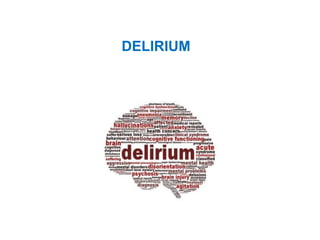
DELIRIUM
INTRODUCTION
Serious disturbance in mental abilities that
results in confused thinking and reduced
awareness of surrounding. It is also known as
acute confusional state.
DEFINITION
Delirium is a syndrome encompassing disturbance in
attention, consciousness and cognition. It may also
involve other neurological deficit such as psycho or
disturbances like hyper or hypoactive, or mixed, impaired
sleep wake cycle, emotional disturbances and perceptual
disturbance such as Hallucination & delusion.
RISK FACTORS
Delirium is one of the most common,
potentially preventable, adverse events for
hospitalized older people.
• Predisposing risk factors
Age > 70
Sex: men > women
Pre- existing dementia
Severe medical Illness
History of previous delirium
Visual and hearing impairment
RISK FACTORS
Depression
Abnormal sodium, potassium and glucose
Polypharmacy
Alcohol/Benzodiazepine use
• Precipitating risk factors
Use of Physical restraint
Use of indwelling
catheter
Adding three or more
medications
Multiple bed moves
pain
Surgery
Anaesthesia and
hypoxia
Malnutrition and
dehydration
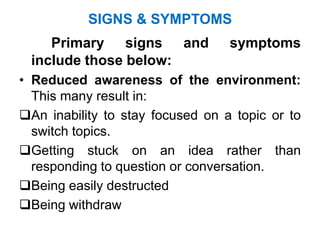
CAUSES
Triggered by serious medical
illness such as,
• Infection - pneumonia, UTI
• Medications. (such as B.P. medication)
• Drug withdrawal
• Alcohol withdrawal
• Electrolyte or other body chemical disturbances.
• Severe lack of sleep
• Poisons
• General anesthesia & surgery.
SIGNS & SYMPTOMS
Primary signs and symptoms
include those below:
• Reduced awareness of the environment:
This many result in:
An inability to stay focused on a topic or to
switch topics.
Getting stuck on an idea rather than
responding to question or conversation.
Being easily destructed
Being withdraw
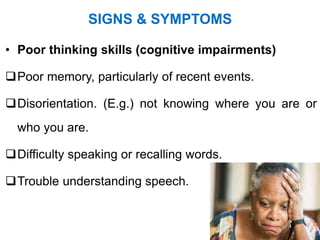
SIGNS & SYMPTOMS
• Poor thinking skills (cognitive impairments)
Poor memory, particularly of recent events.
Disorientation. (E.g.) not knowing where you are or
who you are.
Difficulty speaking or recalling words.
Trouble understanding speech.
SIGNS & SYMPTOMS
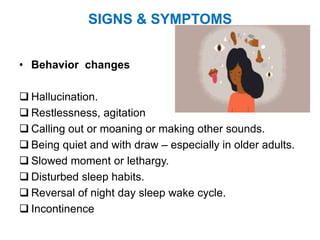
• Behavior changes
 Hallucination.
 Restlessness, agitation
 Calling out or moaning or making other sounds.
 Being quiet and with draw – especially in older adults.
 Slowed moment or lethargy.
 Disturbed sleep habits.
 Reversal of night day sleep wake cycle.
 Incontinence
SIGNS & SYMPTOMS
• Emotional Disturbances:
Anxiety, fear or paranoia.
Depression.
Irritability or anger.
A sense of feeling elated.
Apathy
Rapid or unpredictable mood shifts.
Personality changes.
DIAGNOSIS
Mental status Examination.
To assess orientation, attention and
thinking.
Physical and neurological Examination:
• Physical Examination: To check for signs of
health problems and underlying disease.
• Neurological Examination: Check for vision,
balance Co-ordination and reflexes.
Other test: Blood and urine to check for
electrolyte imbalance.
Brain Imaging.
TREATMENT
Treat the underlying causes or triggers. (Eg.)
• Stopping use of particular medication.
• Care for metabolic imbalance
• Treating Infection.
• Vitamins- Patient with alcoholism & malnutrition prone for
thiamine, B12 deficiency which can cause delirium.
Medication
• Antipsychotic-To treat agitation, hallucination and to
improve sensory problem.
• (Eg) Haloperidol, Risperidone, Olanzapine,
quetiapine
• Benzodiazepines

DELIRIUM.pptx

  • 1.
  • 2.
    INTRODUCTION Serious disturbance inmental abilities that results in confused thinking and reduced awareness of surrounding. It is also known as acute confusional state.
  • 3.
    DEFINITION Delirium is asyndrome encompassing disturbance in attention, consciousness and cognition. It may also involve other neurological deficit such as psycho or disturbances like hyper or hypoactive, or mixed, impaired sleep wake cycle, emotional disturbances and perceptual disturbance such as Hallucination & delusion.
  • 4.
    RISK FACTORS Delirium isone of the most common, potentially preventable, adverse events for hospitalized older people. • Predisposing risk factors Age > 70 Sex: men > women Pre- existing dementia Severe medical Illness History of previous delirium Visual and hearing impairment
  • 5.
    RISK FACTORS Depression Abnormal sodium,potassium and glucose Polypharmacy Alcohol/Benzodiazepine use • Precipitating risk factors Use of Physical restraint Use of indwelling catheter Adding three or more medications Multiple bed moves pain Surgery Anaesthesia and hypoxia Malnutrition and dehydration
  • 6.
    CAUSES Triggered by seriousmedical illness such as, • Infection - pneumonia, UTI • Medications. (such as B.P. medication) • Drug withdrawal • Alcohol withdrawal • Electrolyte or other body chemical disturbances. • Severe lack of sleep • Poisons • General anesthesia & surgery.
  • 7.
    SIGNS & SYMPTOMS Primarysigns and symptoms include those below: • Reduced awareness of the environment: This many result in: An inability to stay focused on a topic or to switch topics. Getting stuck on an idea rather than responding to question or conversation. Being easily destructed Being withdraw
  • 8.
    SIGNS & SYMPTOMS •Poor thinking skills (cognitive impairments) Poor memory, particularly of recent events. Disorientation. (E.g.) not knowing where you are or who you are. Difficulty speaking or recalling words. Trouble understanding speech.
  • 9.
    SIGNS & SYMPTOMS •Behavior changes  Hallucination.  Restlessness, agitation  Calling out or moaning or making other sounds.  Being quiet and with draw – especially in older adults.  Slowed moment or lethargy.  Disturbed sleep habits.  Reversal of night day sleep wake cycle.  Incontinence
  • 10.
    SIGNS & SYMPTOMS •Emotional Disturbances: Anxiety, fear or paranoia. Depression. Irritability or anger. A sense of feeling elated. Apathy Rapid or unpredictable mood shifts. Personality changes.
  • 11.
    DIAGNOSIS Mental status Examination. Toassess orientation, attention and thinking. Physical and neurological Examination: • Physical Examination: To check for signs of health problems and underlying disease. • Neurological Examination: Check for vision, balance Co-ordination and reflexes. Other test: Blood and urine to check for electrolyte imbalance. Brain Imaging.
  • 12.
    TREATMENT Treat the underlyingcauses or triggers. (Eg.) • Stopping use of particular medication. • Care for metabolic imbalance • Treating Infection. • Vitamins- Patient with alcoholism & malnutrition prone for thiamine, B12 deficiency which can cause delirium. Medication • Antipsychotic-To treat agitation, hallucination and to improve sensory problem. • (Eg) Haloperidol, Risperidone, Olanzapine, quetiapine • Benzodiazepines