What is Jurisprudence?
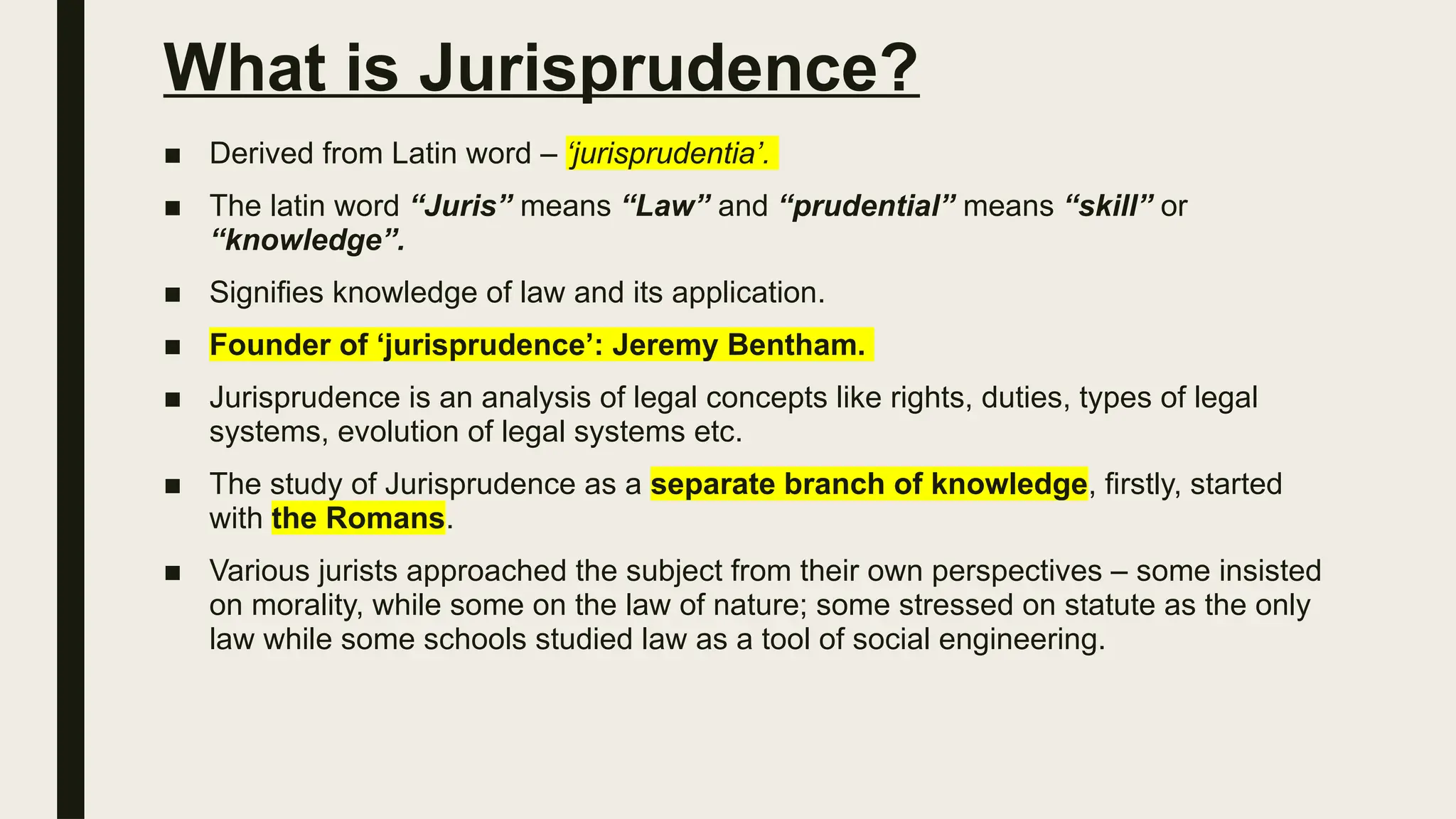
■ Derived from Latin word – ‘jurisprudentia’.
■ The latin word “Juris” means “Law” and “prudential” means “skill” or
“knowledge”.
■ Signifies knowledge of law and its application.
■ Founder of ‘jurisprudence’: Jeremy Bentham.
■ Jurisprudence is an analysis of legal concepts like rights, duties, types of legal
systems, evolution of legal systems etc.
■ The study of Jurisprudence as a separate branch of knowledge, firstly, started
with the Romans.
■ Various jurists approached the subject from their own perspectives – some insisted
on morality, while some on the law of nature; some stressed on statute as the only
law while some schools studied law as a tool of social engineering.
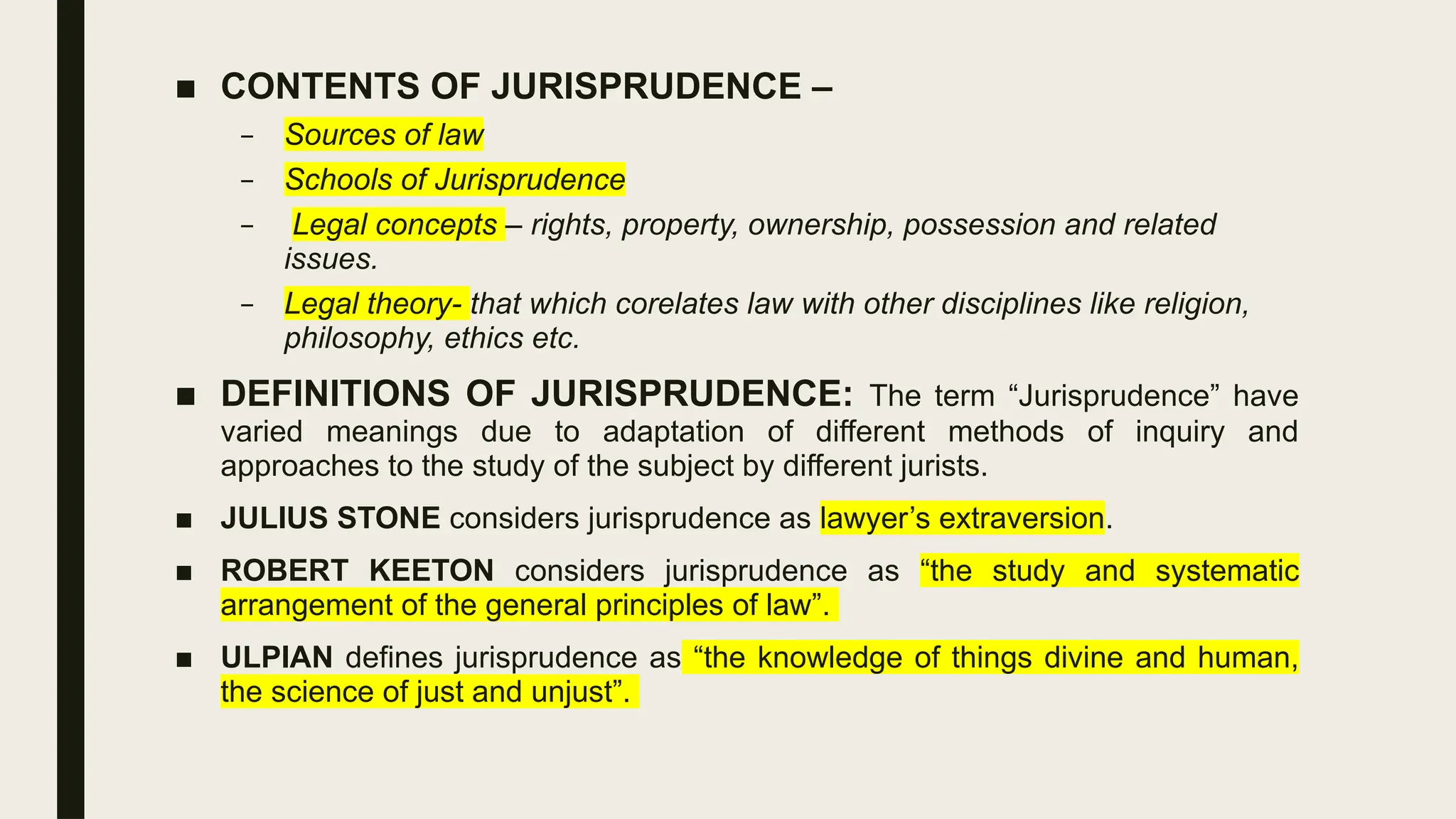
■ CONTENTS OF JURISPRUDENCE –
– Sources of law
– Schools of Jurisprudence
– Legal concepts – rights, property, ownership, possession and related
issues.
– Legal theory- that which corelates law with other disciplines like religion,
philosophy, ethics etc.
■ DEFINITIONS OF JURISPRUDENCE: The term “Jurisprudence” have
varied meanings due to adaptation of different methods of inquiry and
approaches to the study of the subject by different jurists.
■ JULIUS STONE considers jurisprudence as lawyer’s extraversion.
■ ROBERT KEETON considers jurisprudence as “the study and systematic
arrangement of the general principles of law”.
■ ULPIAN defines jurisprudence as “the knowledge of things divine and human,
the science of just and unjust”.
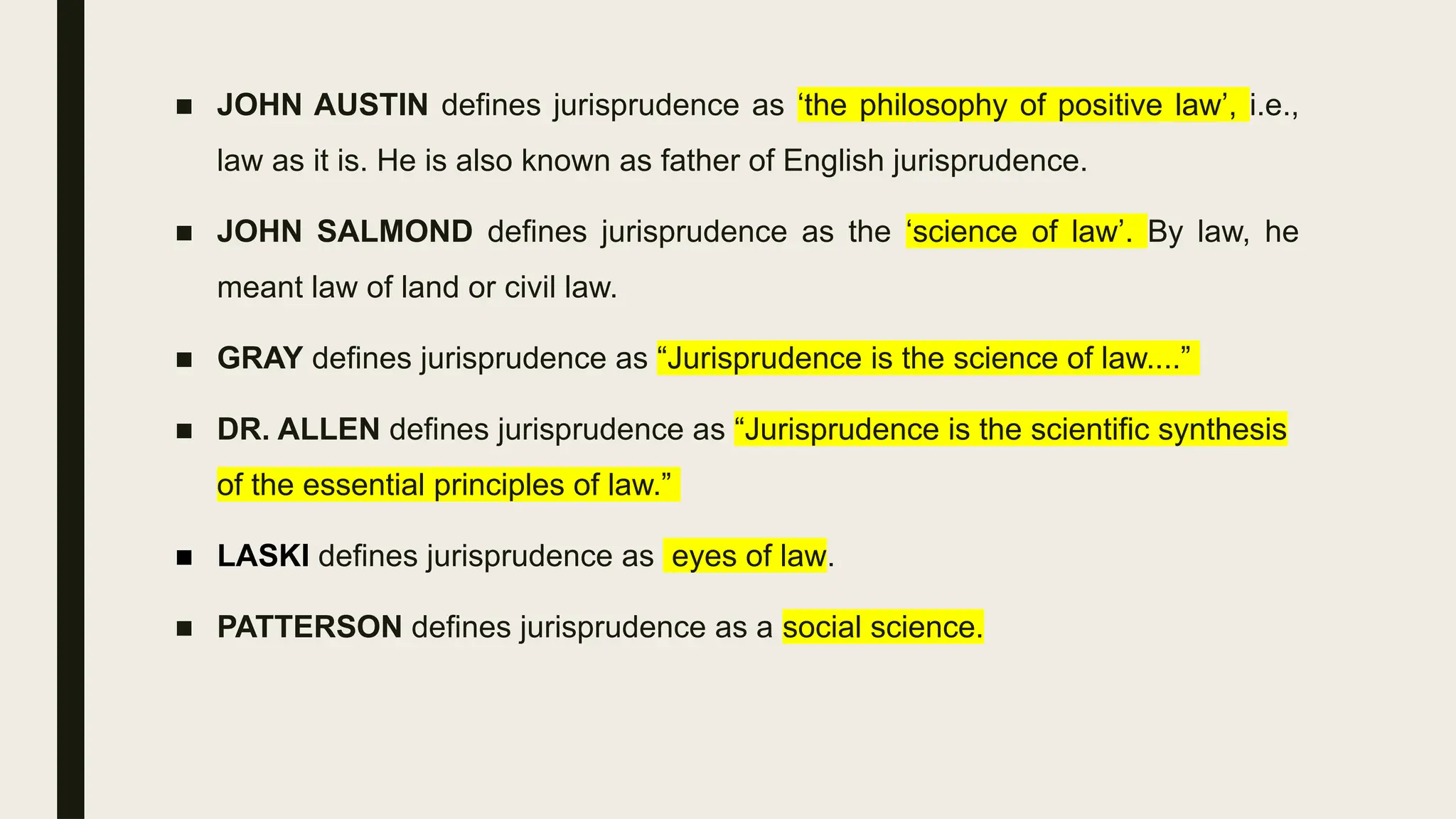
■ JOHN AUSTIN defines jurisprudence as ‘the philosophy of positive law’, i.e.,
law as it is. He is also known as father of English jurisprudence.
■ JOHN SALMOND defines jurisprudence as the ‘science of law’. By law, he
meant law of land or civil law.
■ GRAY defines jurisprudence as “Jurisprudence is the science of law....”
■ DR. ALLEN defines jurisprudence as “Jurisprudence is the scientific synthesis
of the essential principles of law.”
■ LASKI defines jurisprudence as eyes of law.
■ PATTERSON defines jurisprudence as a social science.
■ H.L.A. HART defines jurisprudence as the scientific study of Union of
rules (Primary and Secondary Rules.) Primary rules means rules
which imposes duty. Secondary Rules means rules which confers
powers whereby new duties may be created and defective duties may
be varied or repealed.
■ JUSTICE P.B. MUKHERJEE noted that jurisprudence is both an
intellectual and idealistic abstraction, as well as a study of human
behaviour in society. It encompasses political, social, economic and
cultural ideas and covers the study of individuals in relation to the
state and society.
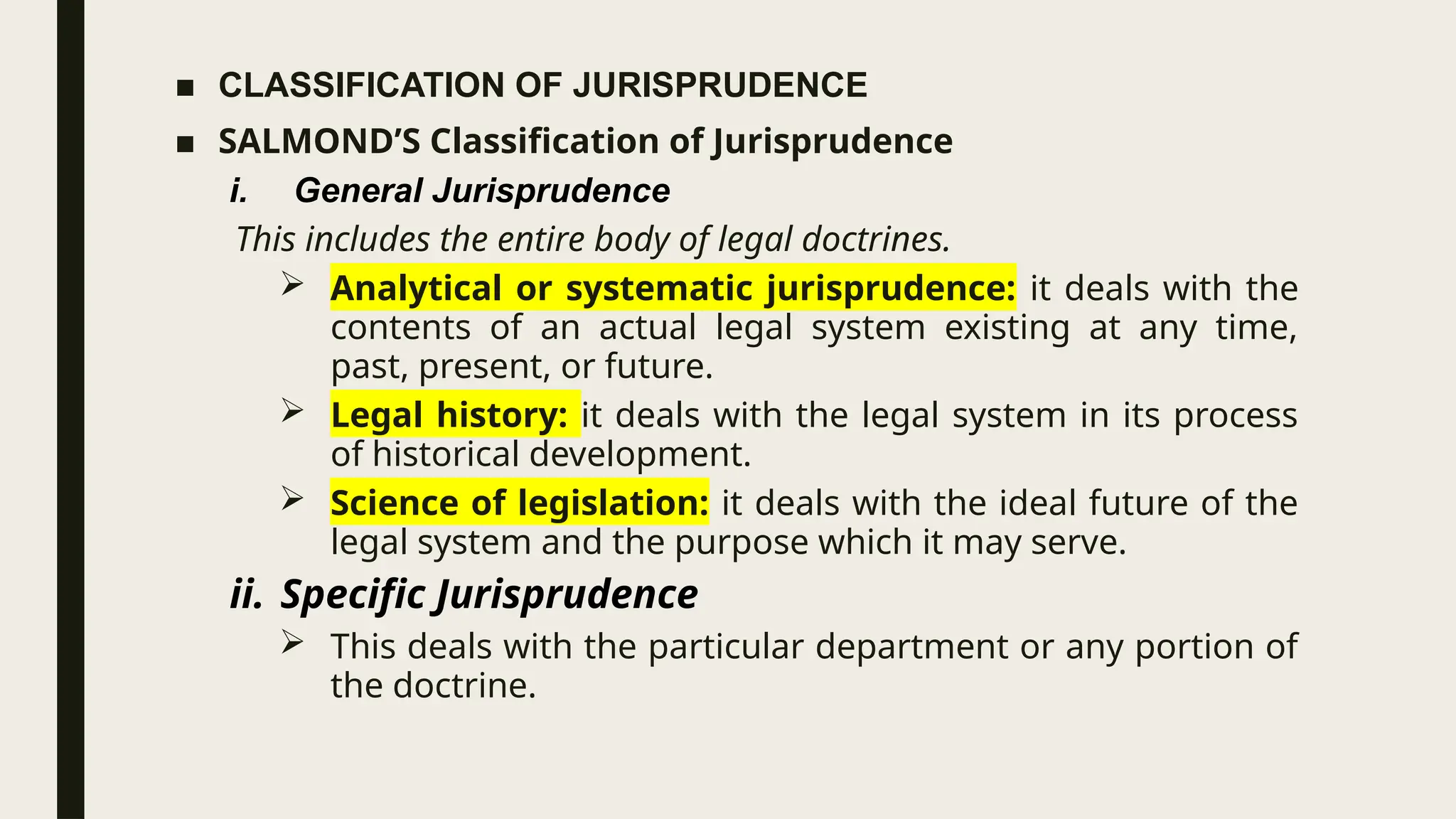
■ CLASSIFICATION OF JURISPRUDENCE
■ SALMOND’S Classification of Jurisprudence
i. General Jurisprudence
This includes the entire body of legal doctrines.
 Analytical or systematic jurisprudence: it deals with the
contents of an actual legal system existing at any time,
past, present, or future.
 Legal history: it deals with the legal system in its process
of historical development.
 Science of legislation: it deals with the ideal future of the
legal system and the purpose which it may serve.
ii. Specific Jurisprudence
 This deals with the particular department or any portion of
the doctrine.
■ AUSTIN’S Classification of Jurisprudence
i. General Jurisprudence
 It is the philosophy of positive law.
ii. Particular Jurisprudence
 It is the science of any such system of positive law that is
actually obtained in a specifically determined nation or is
specifically determined.
■ KINDS OF JURISPRUDENCE
■ BENTHAM : There are two types of jurisprudence:
i. Expository/ Expositorial (What the law is)
ii. Evaluative/Censorial (What the law ought to be)
■ AUSTIN : There are two types of jurisprudence:
i. General Jurisprudence
ii. Particular Jurisprudence.
■ SALMOND : There are two types of jurisprudence:
i. Generic Jurisprudence and
ii. Specific Jurisprudence
Scope and Nature of Jurisprudence
■ Jurisprudence is considered as the ‘eyes of law’.
■ It is the grammar of law.
■ A study of jurisprudence helps legislators by providing them precise and unambiguous
terminology.
■ Jurisprudence helps the judges and lawyers in ascertaining the true meaning of the law,
passed by the legislatures, by providing the rules of interpretation.
■ According to Dr MJ Sethna, the value of jurisprudence lies in examining the
consequences of law and its administration on social welfare and suggesting changes for
the betterment of the superstructure of laws.
■ The object and purpose of jurisprudence is to study the fundamental legal principles and
to know what law is and how a legal system is functioning in a particular country.
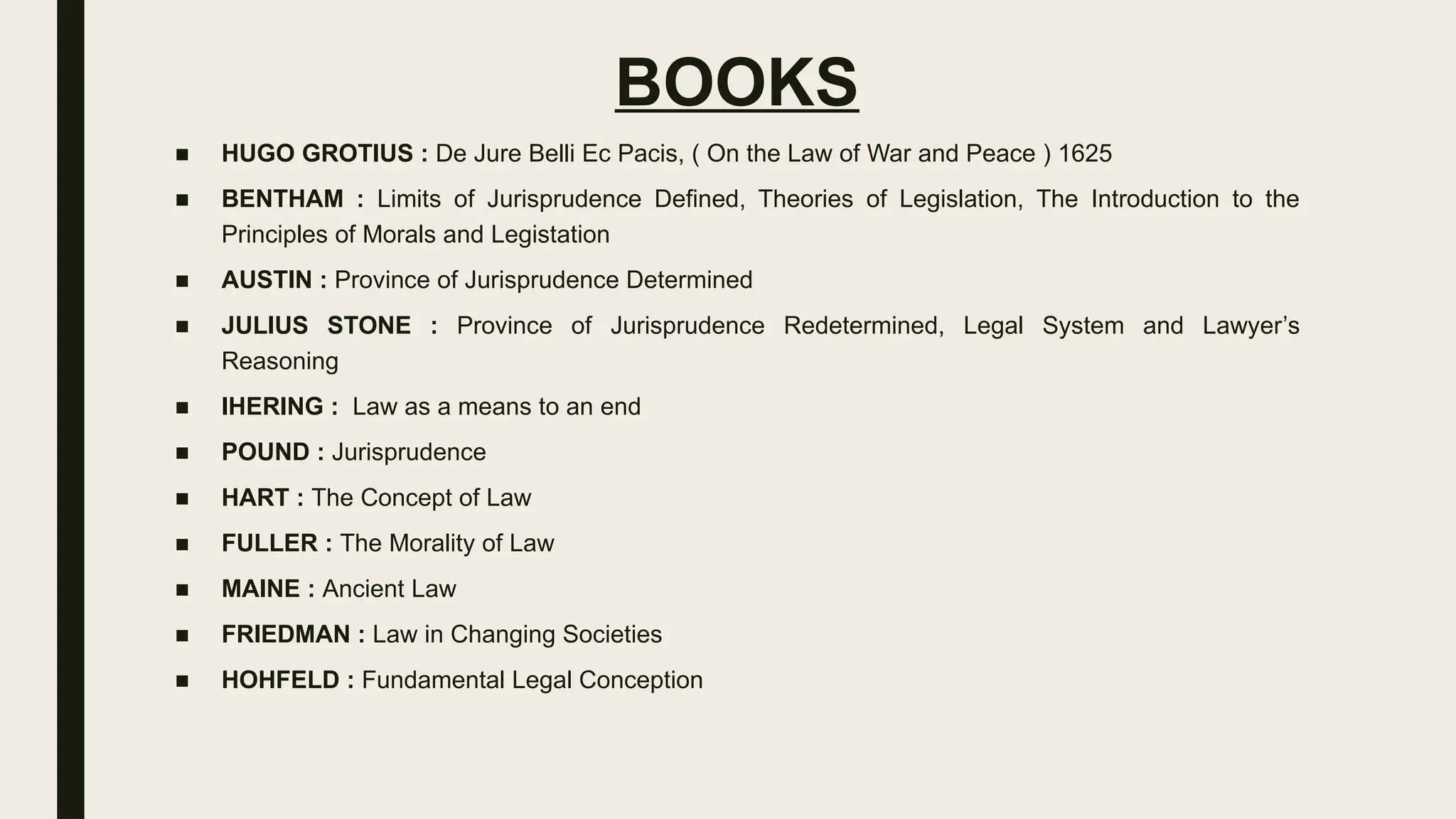
BOOKS
■ HUGO GROTIUS : De Jure Belli Ec Pacis, ( On the Law of War and Peace ) 1625
■ BENTHAM : Limits of Jurisprudence Defined, Theories of Legislation, The Introduction to the
Principles of Morals and Legistation
■ AUSTIN : Province of Jurisprudence Determined
■ JULIUS STONE : Province of Jurisprudence Redetermined, Legal System and Lawyer’s
Reasoning
■ IHERING : Law as a means to an end
■ POUND : Jurisprudence
■ HART : The Concept of Law
■ FULLER : The Morality of Law
■ MAINE : Ancient Law
■ FRIEDMAN : Law in Changing Societies
■ HOHFELD : Fundamental Legal Conception
BOOKS
■ Paton : A Text Book of Jurisprudence
■ Goodhart : “Essays in Jurisprudenceand Common Law”
■ Savigny : Das Recht Des Bestizes (The Law of Possession). System of modern Roman
Law
■ Buckland : Some reflections on Jurisprudence
THANK YOU!
JOIN US ON TELEGRAM

Ppt on jurisprudence for judiciary persp

  • 3.
    What is Jurisprudence? ■Derived from Latin word – ‘jurisprudentia’. ■ The latin word “Juris” means “Law” and “prudential” means “skill” or “knowledge”. ■ Signifies knowledge of law and its application. ■ Founder of ‘jurisprudence’: Jeremy Bentham. ■ Jurisprudence is an analysis of legal concepts like rights, duties, types of legal systems, evolution of legal systems etc. ■ The study of Jurisprudence as a separate branch of knowledge, firstly, started with the Romans. ■ Various jurists approached the subject from their own perspectives – some insisted on morality, while some on the law of nature; some stressed on statute as the only law while some schools studied law as a tool of social engineering.
  • 4.
    ■ CONTENTS OFJURISPRUDENCE – – Sources of law – Schools of Jurisprudence – Legal concepts – rights, property, ownership, possession and related issues. – Legal theory- that which corelates law with other disciplines like religion, philosophy, ethics etc. ■ DEFINITIONS OF JURISPRUDENCE: The term “Jurisprudence” have varied meanings due to adaptation of different methods of inquiry and approaches to the study of the subject by different jurists. ■ JULIUS STONE considers jurisprudence as lawyer’s extraversion. ■ ROBERT KEETON considers jurisprudence as “the study and systematic arrangement of the general principles of law”. ■ ULPIAN defines jurisprudence as “the knowledge of things divine and human, the science of just and unjust”.
  • 5.
    ■ JOHN AUSTINdefines jurisprudence as ‘the philosophy of positive law’, i.e., law as it is. He is also known as father of English jurisprudence. ■ JOHN SALMOND defines jurisprudence as the ‘science of law’. By law, he meant law of land or civil law. ■ GRAY defines jurisprudence as “Jurisprudence is the science of law....” ■ DR. ALLEN defines jurisprudence as “Jurisprudence is the scientific synthesis of the essential principles of law.” ■ LASKI defines jurisprudence as eyes of law. ■ PATTERSON defines jurisprudence as a social science.
  • 8.
    ■ H.L.A. HARTdefines jurisprudence as the scientific study of Union of rules (Primary and Secondary Rules.) Primary rules means rules which imposes duty. Secondary Rules means rules which confers powers whereby new duties may be created and defective duties may be varied or repealed. ■ JUSTICE P.B. MUKHERJEE noted that jurisprudence is both an intellectual and idealistic abstraction, as well as a study of human behaviour in society. It encompasses political, social, economic and cultural ideas and covers the study of individuals in relation to the state and society.
  • 9.
    ■ CLASSIFICATION OFJURISPRUDENCE ■ SALMOND’S Classification of Jurisprudence i. General Jurisprudence This includes the entire body of legal doctrines.  Analytical or systematic jurisprudence: it deals with the contents of an actual legal system existing at any time, past, present, or future.  Legal history: it deals with the legal system in its process of historical development.  Science of legislation: it deals with the ideal future of the legal system and the purpose which it may serve. ii. Specific Jurisprudence  This deals with the particular department or any portion of the doctrine.
  • 10.
    ■ AUSTIN’S Classificationof Jurisprudence i. General Jurisprudence  It is the philosophy of positive law. ii. Particular Jurisprudence  It is the science of any such system of positive law that is actually obtained in a specifically determined nation or is specifically determined.
  • 11.
    ■ KINDS OFJURISPRUDENCE ■ BENTHAM : There are two types of jurisprudence: i. Expository/ Expositorial (What the law is) ii. Evaluative/Censorial (What the law ought to be) ■ AUSTIN : There are two types of jurisprudence: i. General Jurisprudence ii. Particular Jurisprudence. ■ SALMOND : There are two types of jurisprudence: i. Generic Jurisprudence and ii. Specific Jurisprudence
  • 16.
    Scope and Natureof Jurisprudence ■ Jurisprudence is considered as the ‘eyes of law’. ■ It is the grammar of law. ■ A study of jurisprudence helps legislators by providing them precise and unambiguous terminology. ■ Jurisprudence helps the judges and lawyers in ascertaining the true meaning of the law, passed by the legislatures, by providing the rules of interpretation. ■ According to Dr MJ Sethna, the value of jurisprudence lies in examining the consequences of law and its administration on social welfare and suggesting changes for the betterment of the superstructure of laws. ■ The object and purpose of jurisprudence is to study the fundamental legal principles and to know what law is and how a legal system is functioning in a particular country.
  • 17.
    BOOKS ■ HUGO GROTIUS: De Jure Belli Ec Pacis, ( On the Law of War and Peace ) 1625 ■ BENTHAM : Limits of Jurisprudence Defined, Theories of Legislation, The Introduction to the Principles of Morals and Legistation ■ AUSTIN : Province of Jurisprudence Determined ■ JULIUS STONE : Province of Jurisprudence Redetermined, Legal System and Lawyer’s Reasoning ■ IHERING : Law as a means to an end ■ POUND : Jurisprudence ■ HART : The Concept of Law ■ FULLER : The Morality of Law ■ MAINE : Ancient Law ■ FRIEDMAN : Law in Changing Societies ■ HOHFELD : Fundamental Legal Conception
  • 19.
    BOOKS ■ Paton :A Text Book of Jurisprudence ■ Goodhart : “Essays in Jurisprudenceand Common Law” ■ Savigny : Das Recht Des Bestizes (The Law of Possession). System of modern Roman Law ■ Buckland : Some reflections on Jurisprudence
  • 20.
    THANK YOU! JOIN USON TELEGRAM