WHAT DEFINES STUDENT
SUCCESS: A MULTIPLE
CHOICE QUESTION
Tricia Seifert, Ph.D.
Diliana Peregrina-Kretz
Ontario Institute for Studies in Education
WHAT DEFINES STUDENT
SUCCESS: A MULTIPLE
CHOICE QUESTION
Tricia Seifert, Ph.D.
Diliana Peregrina-Kretz
Ontario Institute for Studies in Education
Before we begin
We are very excited to share this power point presentation with you
online!
This presentation was delivered on June 3, 2013 at the Canadian
Society for the Study of Higher Education (CSSHE) in Victoria, BC.
Please cite this presentation in the following format:
Seifert, T., & Peregrina-Kretz, D. (2013). What defines student
success: A multiple choice question [PowerPoint Slides].
Presentation for the annual meeting of the Society for the Study of
Higher Education, Victoria, BC. Retrieved from:
http://supportingstudentsuccess.wordpress.com/
If you have any questions about this presentation please contact the
Principal Investigator, Dr. Tricia Seifert at tricia.seifert@utoronto.ca
Supporting Student Success Study
To understand how stakeholder groups perceive their
institution's organization and approach to supporting
student success.
Methodology
• Constructivist methodology – participants play a role in
the data interpretation
• Interviews with senior administrators, faculty
collaborators & individual faculty
• Focus groups with faculty, SAS staff, students & student
leaders
Sample
80 Faculty
42 Senior Leaders
122 SASS
128 Students
N=372
▪Two publically-funded
education sectors:
Colleges (4) and
Universities (9)
Varied geographic
location, size, mandate
and programming
▪Eastern, Western and
Northern Ontario, GTA
▪Research intensive,
primarily undergraduate,
applied degrees, diploma,
certificate programs
▪Diverse communities
Data Analysis
1. Data was coded
2. Overarching domains developed
3. Take-away statements drafted
4. Synthesized institutional statements
and supported with evidence
5. Met with peer de-briefer
6. Drafted site visit report
7. Cross site comparison
What Defines Student
Success?
Is it:
a) Retention and graduation
b) Year-to-year persistence
c) Employment after graduation
d) Sense of belonging
e) Student engagement
f) Student satisfaction
g) Community Building
h) Taking risks
i) ….
j) ….
Theoretical Framework
Kuh and colleagues, 2006
Institutional
Conditions
Post College
Outcomes
Pre-College
Student
Behaviour
How is Student Success Defined?
Faculty
Senior
Administrators
Staff Students
1. Mastering
Academic
Content
2. Retention and
Graduation
3. Personal
Success
1. Retention and
Graduation
2. Holistic
Success
3. Academic
Success
1. Personal
Success
2. Holistic
Success
3. Engaging
Students
1. Personal
Success
2. Academic
Success
3. Sense of
Belonging
Top Definitions of Student Success
Academic Success
•Retention and Graduation
•G.P.A.
•Content Learning
•Finding Correct Program Fit
•Student Engagement
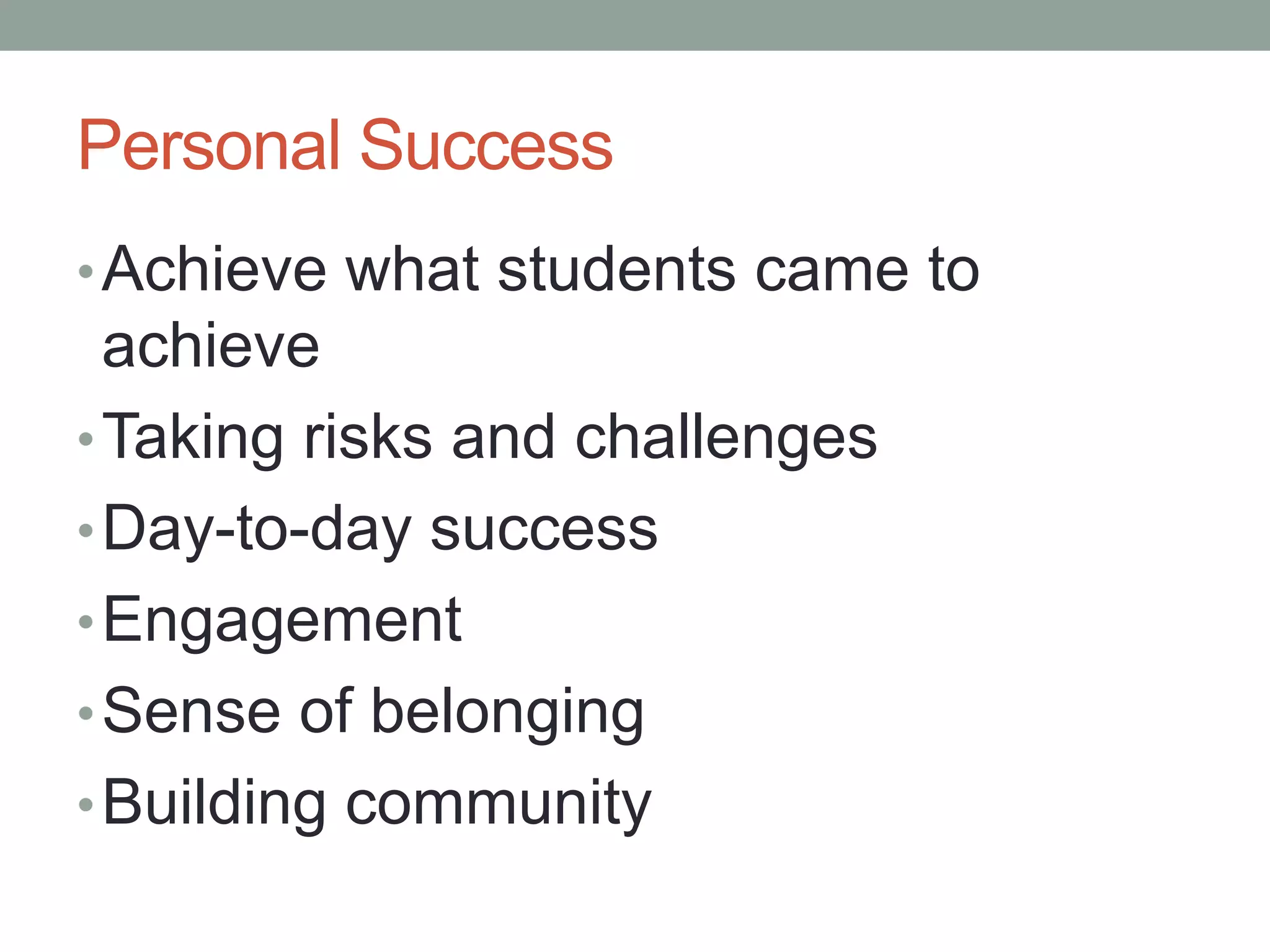
Personal Success
•Achieve what students came to
achieve
•Taking risks and challenges
•Day-to-day success
•Engagement
•Sense of belonging
•Building community
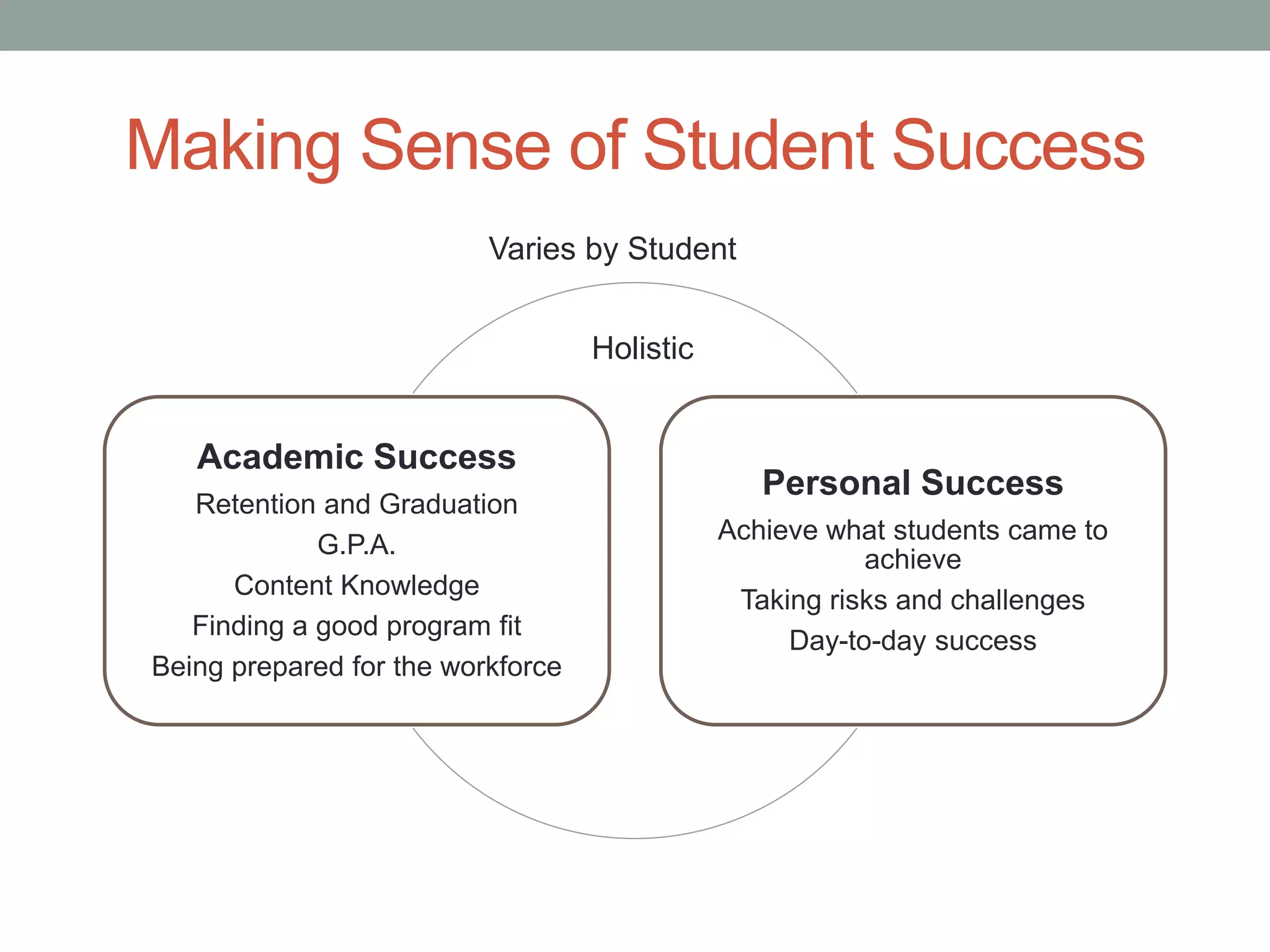
Making Sense of Student Success
Academic Success
Retention and Graduation
G.P.A.
Content Knowledge
Finding a good program fit
Being prepared for the workforce
Personal Success
Achieve what students came to
achieve
Taking risks and challenges
Day-to-day success
Holistic
Varies by Student
Faculty Perceptions
….the focus on decreasing the number of students
who aren't successful and don't continue
To me success is giving them the tools they
need to access the services, supports, the
delivery model of courses, how material is
taught that makes it so they can do well
Senior Administrators’ Perceptions
….it is a strategic direction for the college and a
board's ends policy, they actually define a metric that
we have to measure and [it is] the biggest
component [graduation rates].
Broadening their understanding of the world. A lot of
social issues are learned here. It is a time of
developmental growth.
Staff Perceptions
One thing that we hear from the top is student
success is graduation rate, and I don't necessarily
define it that way. And I don't even necessarily define
it as job ready because some use college as a
stepping-stone to get to university, and it works the
other way to…To me it needs to be kept flexible, and
should have a student focus to help them achieve
their goals in life …I would like to keep it general.
Students’ Perceptions
To me, its not just marks. I think you have more
success when you are involved and around other
students. So your extracurricular, your time
management skills are part of your success. I get
good grades, but I do a lot of extra things on campus.
I work with the student pub on campus, I work at the
convenience store. Student success is not just about
getting good marks, its about making yourself a well
rounded individual.
Summary
All of the Above
Faculty and Senior Administrators Definitions
Staff and Students Definitions
The influence of the institution's organizational structure in
defining student success
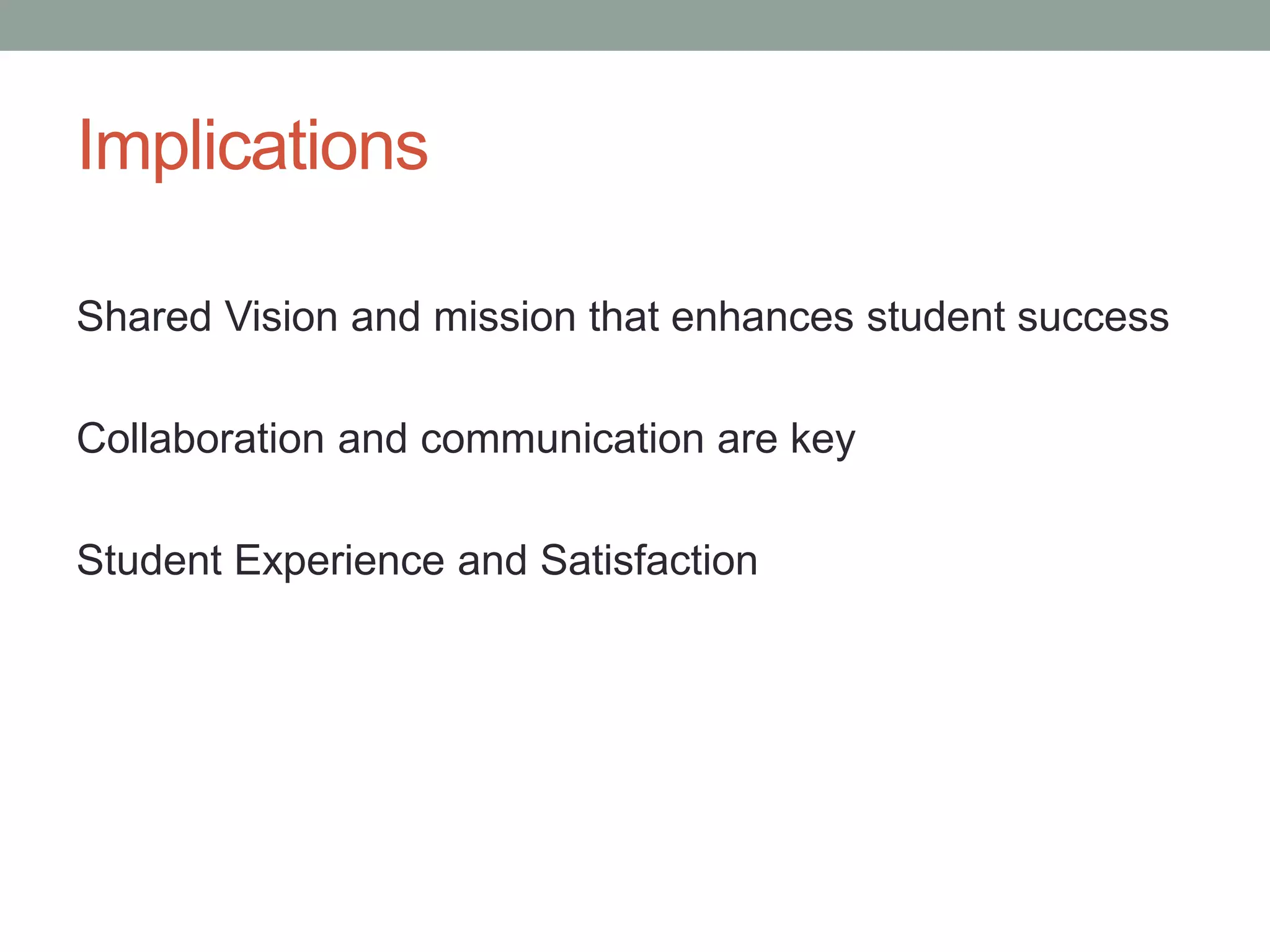
Implications
Shared Vision and mission that enhances student success
Collaboration and communication are key
Student Experience and Satisfaction
Follow our Research on:
Blog: http://supportingstudentsuccess.wordpress.com/
Twitter: @CdnStdntSuccess
Facebook: Supporting Student Success

Defining student success ppt

  • 1.
    WHAT DEFINES STUDENT SUCCESS:A MULTIPLE CHOICE QUESTION Tricia Seifert, Ph.D. Diliana Peregrina-Kretz Ontario Institute for Studies in Education
  • 2.
    WHAT DEFINES STUDENT SUCCESS:A MULTIPLE CHOICE QUESTION Tricia Seifert, Ph.D. Diliana Peregrina-Kretz Ontario Institute for Studies in Education
  • 3.
    Before we begin Weare very excited to share this power point presentation with you online! This presentation was delivered on June 3, 2013 at the Canadian Society for the Study of Higher Education (CSSHE) in Victoria, BC. Please cite this presentation in the following format: Seifert, T., & Peregrina-Kretz, D. (2013). What defines student success: A multiple choice question [PowerPoint Slides]. Presentation for the annual meeting of the Society for the Study of Higher Education, Victoria, BC. Retrieved from: http://supportingstudentsuccess.wordpress.com/ If you have any questions about this presentation please contact the Principal Investigator, Dr. Tricia Seifert at tricia.seifert@utoronto.ca
  • 4.
    Supporting Student SuccessStudy To understand how stakeholder groups perceive their institution's organization and approach to supporting student success.
  • 5.
    Methodology • Constructivist methodology– participants play a role in the data interpretation • Interviews with senior administrators, faculty collaborators & individual faculty • Focus groups with faculty, SAS staff, students & student leaders
  • 6.
    Sample 80 Faculty 42 SeniorLeaders 122 SASS 128 Students N=372 ▪Two publically-funded education sectors: Colleges (4) and Universities (9) Varied geographic location, size, mandate and programming ▪Eastern, Western and Northern Ontario, GTA ▪Research intensive, primarily undergraduate, applied degrees, diploma, certificate programs ▪Diverse communities
  • 7.
    Data Analysis 1. Datawas coded 2. Overarching domains developed 3. Take-away statements drafted 4. Synthesized institutional statements and supported with evidence 5. Met with peer de-briefer 6. Drafted site visit report 7. Cross site comparison
  • 8.
  • 9.
    Is it: a) Retentionand graduation b) Year-to-year persistence c) Employment after graduation d) Sense of belonging e) Student engagement f) Student satisfaction g) Community Building h) Taking risks i) …. j) ….
  • 10.
    Theoretical Framework Kuh andcolleagues, 2006 Institutional Conditions Post College Outcomes Pre-College Student Behaviour
  • 11.
    How is StudentSuccess Defined?
  • 12.
    Faculty Senior Administrators Staff Students 1. Mastering Academic Content 2.Retention and Graduation 3. Personal Success 1. Retention and Graduation 2. Holistic Success 3. Academic Success 1. Personal Success 2. Holistic Success 3. Engaging Students 1. Personal Success 2. Academic Success 3. Sense of Belonging Top Definitions of Student Success
  • 13.
    Academic Success •Retention andGraduation •G.P.A. •Content Learning •Finding Correct Program Fit •Student Engagement
  • 14.
    Personal Success •Achieve whatstudents came to achieve •Taking risks and challenges •Day-to-day success •Engagement •Sense of belonging •Building community
  • 15.
    Making Sense ofStudent Success Academic Success Retention and Graduation G.P.A. Content Knowledge Finding a good program fit Being prepared for the workforce Personal Success Achieve what students came to achieve Taking risks and challenges Day-to-day success Holistic Varies by Student
  • 16.
    Faculty Perceptions ….the focuson decreasing the number of students who aren't successful and don't continue To me success is giving them the tools they need to access the services, supports, the delivery model of courses, how material is taught that makes it so they can do well
  • 17.
    Senior Administrators’ Perceptions ….itis a strategic direction for the college and a board's ends policy, they actually define a metric that we have to measure and [it is] the biggest component [graduation rates]. Broadening their understanding of the world. A lot of social issues are learned here. It is a time of developmental growth.
  • 18.
    Staff Perceptions One thingthat we hear from the top is student success is graduation rate, and I don't necessarily define it that way. And I don't even necessarily define it as job ready because some use college as a stepping-stone to get to university, and it works the other way to…To me it needs to be kept flexible, and should have a student focus to help them achieve their goals in life …I would like to keep it general.
  • 19.
    Students’ Perceptions To me,its not just marks. I think you have more success when you are involved and around other students. So your extracurricular, your time management skills are part of your success. I get good grades, but I do a lot of extra things on campus. I work with the student pub on campus, I work at the convenience store. Student success is not just about getting good marks, its about making yourself a well rounded individual.
  • 20.
    Summary All of theAbove Faculty and Senior Administrators Definitions Staff and Students Definitions The influence of the institution's organizational structure in defining student success
  • 21.
    Implications Shared Vision andmission that enhances student success Collaboration and communication are key Student Experience and Satisfaction
  • 22.
    Follow our Researchon: Blog: http://supportingstudentsuccess.wordpress.com/ Twitter: @CdnStdntSuccess Facebook: Supporting Student Success

Editor's Notes

  • #2 Dr. Tricia Seifert is an Assistant Professor at the Ontario Institute for Studies in Education (OISE) at the University of Toronto. Diliana Peregrina-Kretz is a doctoral student in the Higher Education program at OISE/UT
  • #5 To learn more about the study, the research team, and the participating institutions please visit: http://supportingstudentsuccess.wordpress.com/overview/
  • #9 This project is part of the larger Supporting Student Success research study. We sought to comprehend how the stakeholders that we interviewed defined student success. Our aim is to contribute to the body of literature that examines and defines student success.
  • #11 This is the theoretical framework we explored for this paper. It exemplifies the various pathways and factors that can influence student success. Here is the link to the Kuh and colleagues’ piece: http://nces.ed.gov/npec/pdf/kuh_team_report.pdf
  • #12 These were the definitions (18 in total) that participants utilized to describe student success. These definitions were tallied and entered into wordle (http://www.wordle.net/) to create the imagery. Personal Success represents the most utilized definition.
  • #13 Given that there were 18 different definitions, we tallied up the top three for each of the four groups. You can see that faculty and senior administrators both chose retention and graduation as their number one definition of student success, and that staff and students ranked personal success as their first choice. As you go down each of the lists you will notice some interesting similarities and differences among the groups.
  • #14 Definitions of student success were put into two domains: Academic and personal success. These five codes fell under academic success.
  • #15 Codes for personal success.
  • #16 This is the framework that we composed based on the definitions and two domains that were developed. Overall, for participants, student success really varied by student. A holistic definition links both academic and personal success.
  • #21 Student success can be descried as all (and more) of the answers we posed in the first slide: Retention and graduation Year-to-year persistence Employment after graduation Sense of belonging Student engagement Student satisfaction Community Building Taking risks ......... While faculty and senior administrators primarily defined student success as retention and graduation, they understood that there was more to success than these two outcomes. While staff and students defined student success as personal, they also emphasized the importance of academic success and having a sense of belonging on campus. During our interviews and through analyzing institutional documents, we noticed that the organizational structure of the institution can influence the way that stakeholders interpret student success. Mission and Vision statements for example may define student success in academic terms and outcomes (e.g. retention/graduation/employability of graduates).
  • #23 To all of our participants and to those who have funded the second phase of the Supporting Student Success research project