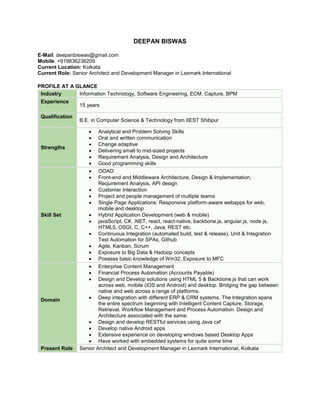
DEEPAN BISWAS
E-Mail: deepanbiswas@gmail.com
Mobile: +919836236209
Current Location: Kolkata
Current Role: Senior Architect and Development Manager in Lexmark International
PROFILE AT A GLANCE
Industry Information Technology, Software Engineering, ECM, Capture, BPM
Experience
15 years
Qualification
B.E. in Computer Science & Technology from IIEST Shibpur
Strengths
 Analytical and Problem Solving Skills
 Oral and written communication
 Change adaptive
 Delivering small to mid-sized projects
 Requirement Analysis, Design and Architecture
 Good programming skills
Skill Set
 OOAD
 Front-end and Middleware Architecture, Design & Implementation,
Requirement Analysis, API design
 Customer Interaction
 Project and people management of multiple teams
 Single Page Applications: Responsive platform-aware webapps for web,
mobile and desktop
 Hybrid Application Development (web & mobile)
 javaScript, C#, .NET, react, react-native, backbone.js, angular.js, node js,
HTML5, OSGI, C, C++, Java, REST etc.
 Continuous Integration (automated build, test & release), Unit & Integration
Test Automation for SPAs, Github
 Agile, Kanban, Scrum
 Exposure to Big Data & Hadoop concepts
 Possess basic knowledge of Win32, Exposure to MFC
Domain
 Enterprise Content Management
 Financial Process Automation (Accounts Payable)
 Design and Develop solutions using HTML 5 & Backbone.js that can work
across web, mobile (iOS and Android) and desktop. Bridging the gap between
native and web across a range of platforms.
 Deep integration with different ERP & CRM systems. The Integration spans
the entire spectrum beginning with Intelligent Content Capture, Storage,
Retrieval, Workflow Management and Process Automation. Design and
Architecture associated with the same.
 Design and develop RESTful services using Java cxf
 Develop native Android apps
 Extensive experience on developing windows based Desktop Apps
 Have worked with embedded systems for quite some time
Present Role Senior Architect and Development Manager in Lexmark International, Kolkata
EXPERIENCE SUMMARY
I have been working with Lexmark International India Private Limited for 10 years. Earlier, I worked with
Tata Consultancy Services for 5 years. I have the experience of successfully delivering quality software to
our customers in a variety of projects of different sizes and complexities on various platforms. Being one of
the first members of Lexmark Enterprise Software’s Kolkata chapter, I have the experience of building an
organization from ground up. Throughout my career, I have assumed various technical leadership roles –
that of a Module Lead, Team Lead, Domain Owner, Architect and Senior Architect. For the past 3 years, I
am also handling the responsibility of people management for the employees in my teams.
JOB OBJECTIVE
I see myself as a problem solver. My primary objective has been to provide the optimal solution to the
problem at hand that will delight our customers as well as serve the business interest of my organization.
For that, I aspire to assume leadership roles in the organization wherein I am empowered to influence
decisions and implement them in a way that would help my team, department and the organization grow.
PRESENT ROLE
In my current role as a Senior Architect and Development Manager, I provide technical direction to my
teams and manage the entire SDLC, besides coaching and managing the performance of my direct reports.
I interact with the customers and the product management team regularly to gather requirements, analyze
them, propose reusable solutions and decide the delivery timeline. I like to keep myself abreast with the
latest trends in hybrid app development (web & mobile), javascript frameworks, dev-ops, architectural
patterns etc.
I always encourage my teams to be self-managing. Also, my role as a senior architect needs me to provide
technical guidance for some of the more demanding requirements. Often times, I implement POCs for some
of the more complex technical needs. I encourage my teams to take calculated risks, question status quo
and adopt industry best practices for developing solutions in Agile with particular emphasis on automated
testing, continuous re-factoring and shorter release cycles. My teams thrive on adapting to changes be it in
terms of requirements, technology or otherwise.
My high performance teams are primarily responsible for providing solutions to manage unstructured
content of our customers. These solutions facilitate easy content-capture & content organization that
ultimately feeds the content to the customized workflow demanded by the business processes adopted by
our customers. To achieve the same, they have been working on the following: -
 Integration: Integrate Lexmark’s ECM product Perceptive Content with various ERPs like
Salesforce, SAP, Microsoft Dynamics AX, Kofax Total Agility (in-house BPM product).
 Financial Process Automation: Ease customer’s Accounts Payable workflow from end-to-end
right from Invoice capture, Invoice data extraction, Invoice processing and approval.
 Higher Education (Admission): Streamline Admission workflow beginning with capturing Student
and Application info and then managing the approval workflow.
 To achieve such deep integration with 3rd party ERPs, my teams use Lexmark’s Integration
Framework called Perceptive Connect Runtime which is a OSGI based middleware that facilitates
easy hand-shaking between variety of 3rd part systems.
 Until very recently and for over 2 years, I was managing teams who were developing re-usable
libraries to address different aspects of managing content. Some of the key libraries delivered are
Capture, Document, Workflow, Search, Viewer and Print. All these libraries are built using
Lexmark’s own Application Development Framework which ensures that the libraries are platform
independent, backend-agnostic, form-factor aware, HTML5 based, responsive client-side modules.
Besides managing project execution, I dedicate time towards building my teams. This requires, among
other things, having regular one-on-ones with my employees to understand their aspirations, identify
leaders, set expectations between each other, seek and provide feedback and most importantly help them
perform at an optimal level leading to their overall career growth. I am also closely involved with recruitment.
From time-to-time, I like to take up new initiatives like organizing online coding competition at Lexmark
Kolkata. I practice and promote knowledge sharing sessions with the aim of removing information silos. I
have tried to provide my employees with a platform to innovate and possibly apply them to their current
projects. The results have been quite satisfactory.
WORK EXPERIENCE
Date Organization Role
Since June 2006
Lexmark International India Pvt.
Ltd.
Senior Architect & Development
Manager
June 2001 – June
2006
TATA Consultancy Services I. T. Analyst
EDUCATIONAL QUALIFICATIONS
Degree and Date Institute
Major and
Specialization
%age
Year of
Passing
Bachelor of
Engineering
Bengal Engineering
College, Shibpore (Kolkata)
Computer Science and
Technology
72.4 2001
Higher Secondary
Education (10+2)
St. Xavier’s College,
Kolkata
Science 74.3 1997
Secondary Education
(class X)
St. Joseph’s School,
Bhagalpur
- 90.3 1995
PERSONAL DETAILS
Contact & Permanent Address
Flat S-306, Fortune City
155 Old Jessore Road, Ganganagar
Near Doltala Bus Stand, Madhyamgram
Kolkata - 700132
Date of Birth 8th December, 1978
KEY PROJECTS
1. Kofax Total Agility (KTA) Connector
Duration Since Jan 2016
Description
The connector aims to serve as the integration conduit between Perceptive
Content and products built on KTA platform. One such product is Invoice
Processing Agility (IPA).
Role Senior Architect & Development Manager
Major Contribution
Requirement analysis and solution architecting. Defining the connector’s
REST API and implementation strategy.
Technology &
Solution Environment
Perceptive Content, KTA, IPA, Perceptive Connect Runtime, OSGI, Java,
REST
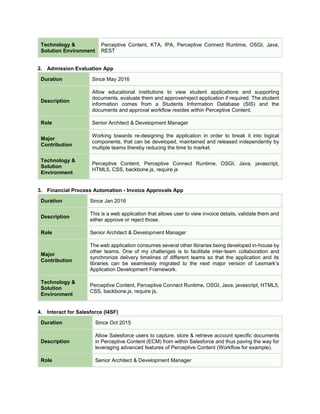
2. Admission Evaluation App
Duration Since May 2016
Description
Allow educational institutions to view student applications and supporting
documents, evaluate them and approve/reject application if required. The student
information comes from a Students Information Database (SIS) and the
documents and approval workflow resides within Perceptive Content.
Role Senior Architect & Development Manager
Major
Contribution
Working towards re-designing the application in order to break it into logical
components, that can be developed, maintained and released independently by
multiple teams thereby reducing the time to market.
Technology &
Solution
Environment
Perceptive Content, Perceptive Connect Runtime, OSGI, Java, javascript,
HTML5, CSS, backbone.js, require js
3. Financial Process Automation - Invoice Approvals App
Duration Since Jan 2016
Description
This is a web application that allows user to view invoice details, validate them and
either approve or reject those.
Role Senior Architect & Development Manager
Major
Contribution
The web application consumes several other libraries being developed in-house by
other teams. One of my challenges is to facilitate inter-team collaboration and
synchronize delivery timelines of different teams so that the application and its
libraries can be seamlessly migrated to the next major version of Lexmark’s
Application Development Framework.
Technology &
Solution
Environment
Perceptive Content, Perceptive Connect Runtime, OSGI, Java, javascript, HTML5,
CSS, backbone.js, require js,
4. Interact for Salesforce (I4SF)
Duration Since Oct 2015
Description
Allow Salesforce users to capture, store & retrieve account specific documents
in Perceptive Content (ECM) from within Salesforce and thus paving the way for
leveraging advanced features of Perceptive Content (Workflow for example).
Role Senior Architect & Development Manager
Major Contribution
Redesign the solution for a more contextual integration between Perceptive
Content and Salesforce. The re-designed solution is better equipped to handle
new enhancements.
Technology &
Solution
Environment
Salesforce, Perceptive Content, SSO (Shibboleth), javascript, HTML5, CSS,
backbone.js, require js,
5. Interact for Dynamics AX (IDAX)
Duration Since Oct 2015
Description
Allow Dynamics users to capture, store & retrieve account specific documents in
Perceptive Content (ECM) from within Dynamics AX and thus paving the way for
leveraging advanced features of Perceptive Content (Workflow for example). IDAX
also facilitates migrating Invoice data from Perceptive Content to Dynamics AX.
Role Senior Architect & Development Manager
Major
Contribution
 Move away from Microsoft specific protocols (WCF + NET TCP) to more
standard protocols (WCF+SOAP) for communicating with Dynamics AX.
 Set up a balanced team where knowledge and responsibility is evenly
distributed.
Technology &
Solution
Environment
Dynamics AX, Perceptive Content, Perceptive Connect Runtime, OSGI, Java,
javascript, HTML5, CSS, backbone.js, require js
6. Customized ECM solution for client in Healthcare Domain
Duration June 2014 to February 2016
Description
Provide a complete ECM solution to manage client’s unstructured content
beginning with capturing the content easily, indexing the content, associate
additional metadata with the captured content, viewing the content, version
controlling and add it to the customer’s workflow processes. Solution works on both
desktop as well as web.
Role Senior Architect & Development Manager
Contribution
Provide technical direction to the team. Create POCs for complex requirements.
Regular customer interaction for requirements gathering, requirements analysis,
managing delivery time lines etc. Create the overall architecture of the solution and
influence the design. Validate and accept user stories.
Technology &
Solution
Environment
javascript, HTML5, CSS, backbone.js, require js, C#, .NET, node js
7. Document Organizer
Duration
April 2014 to February 2016
Description
The idea was to come up with a web based solution for one of our customers that
would allow quick and easy document classification, viewing, printing and
downloading. Bulk of the work was done within extremely tight deadlines with no
compromise to quality.
Role Senior Architect & Development Manager
Contribution
Provide technical direction to the team. Regular interaction with product manager
for requirements collection and analysis, managing delivery time lines etc. Heavily
contributed to the UI design in order to provide the optimal user experience.
Validate and accept user stories.
Technology &
Solution
Environment
javascript, HTML5, CSS, backbone.js, require js
8. Perceptive Checklist Capture
Duration October 2014 to November 2015
Description
Perceptive Checklist Capture automates the gathering and tracking of related
content and data from mobile, tablet and web. It marks off a checklist as each
content type is captured into the designated folder, lets staff track a folder status
throughout the process, and provides notification when content is missing or
incomplete. It also delivers information directly to your core business system while
storing the content in Perceptive Content for speedy processing and retrieval.
Role Senior Architect & Development Manager
Contribution
Provide technical direction to the team. Regular interaction with product manager
for requirements collection and analysis, managing delivery time lines etc. Validate
and accept user stories.
Technology &
Solution
Environment
javascript, HTML5, CSS, backbone.js, require js, Java cxf RESTful services
9. Reusable Libraries - Platform Independent, Responsive, Form Factor Aware
Duration January 2013 to February 2016
Description
Create several client side reusable packages to handle different facets of content
management. Some of the major functionalities delivered successfully are Capture
module, Content module, Viewer module, Workflow, Search and Print. These
packages are being used by different solutions and consumed across web, native
desktop apps, native android and iOS apps.
Role Senior Architect & Development Manager
Contribution
I dedicate most of my effort towards managing these host of re-usable libraries. I
have to take key technical decisions during feature implementation, manage the
release cycle, analyze requirements and handle all communication from a variety
of stakeholders. Validate and accept user stories.
Technology &
Solution
Environment
javascript, HTML5, CSS, backbone.js, require js, Java cxf RESTful services
10. Android Client for Perceptive Content - Lexmark’s ECM Product
Duration July 2011 to April 2012
Description
Android client for Perceptive Content allows users to view organizational
workflows relevant to the user and perform actions on the workflow if needed. A
typical action could be a recruiter shortlisting a candidate for interview.
Role Architect
Contribution
I was leading the team that is responsible for incorporating e-Forms, a key feature
of Perceptive Content, in our android app. As an architect, I am technically
responsible for all things related to e-Forms like communication, implementation
and design.
Technology &
Solution
Environment
Android, Java, REST-ful web service using CXF , JavaScript, XML, CSS, Eclipse
11. Interact for SharePoint
Duration January 2011 to July 2011
Description
Interact for SharePoint is a client application for Lexmark’s ECM product called
Perceptive Content. This allows the user to access Perceptive Content
(documents, workflows etc.) from a SharePoint site.
Role Senior Developer
Contribution
I was primarily responsible for re-architecting the application by moving to a newer
and powerful set of technologies namely Silverlight and WCF. This allowed the
better integration with SharePoint and also the developers could harness the
power of .NET. UI design became better & easier using Silverlight.
Technology &
Solution
Environment
ASP .NET, Silverlight, WCF REST web service, SharePoint, JavaScript, Visual
Studio 2010
12. Printer Configuration Utilities
Duration June 2010 onwards to December 2010
Description
Printer Configuration Utilities, as the name implies, are a set of software
components that are responsible for configuring various functionalities of a
printing device. Key features include, wireless connectivity, fax & email.
Role Domain Owner
Contribution
I am responsible for creating the future roadmap of my domain, interfacing with
the requirements team for requirement analysis, influence the domain
architecture and design and provide technical assistance to the teams.
Technology &
Solution
Environment
Host – Printer communication & discovery protocol, C++, MFC, Win32 APIs,
Visual Studio 2005
13. Wireless Setup Utility (WSU), IP Setup Utility (IPSU)
Duration December 2008 to June 2010
Description
Wireless Setup Utility allows a user to easily establish wireless connectivity
between his/her Lexmark printer and the computer.
IP Setup Utility is used to assign static IP address to the printer. This is useful if
the printer is in a non-DHCP controlled network.
Role Team Member followed by Team Lead
Contribution
As a senior team member my main contribution was towards re-designing WSU.
Post re-design the rate of bug submission in WSU was drastically brought down.
As a team lead, I managed the schedule & delivery of converged WSU. Earlier
we had different versions of WSU for different firmware platforms (Laser & Inkjet).
The convergence initiative was taken to have a single WSU that works with both
Lasers and Inkjets.
Also, IPSU was made a much leaner component by proper distribution of
responsibilities.
As a Team Lead, I encouraged and empowered my team members to take
complete ownership of their assignments.
Technology &
Solution
Environment
Basic understanding of Wi-Fi Domain, Printer-Host communication & discovery
protocol, C++, MFC, WLAN APIs, Visual Studio 2005
14. Toner Reward Application
Duration May 2008 to November 2008
Description
Lexmark Rewards Program is an initiative wherein customers can get a free
Lexmark cartridge by returning a certain number of empty Lexmark cartridges.
The Toner Reward Application allows users to participate in the Rewards program
by registering their printers at the Lexmark Website.
Role Team Member
Contribution
I actively contributed to the design and implementation of business logic of Toner
rewards Application.
Technology &
Solution
Environment
Printer-Host communication & discovery protocol, C++, MFC, Win32, Java Applet,
Visual Studio 2005
15. Lexmark Imaging Studio
Duration June 2006 to May 2008
Description
Lexmark Imaging Studio is a feature-rich, .NET based application that serves as
the one stop utility for printing, scanning and editing your images and documents.
It provides a host of photo editing features such as red-eye correction, photo
slideshow, changing the image brightness & contrast to name a few.
Role
Team Member.
Lexmark Imaging Studio is an application with a big-footprint. Its two major
components are the UI and the business logic. I was part of the team that handled
the business logic.
Contribution
I created most of the design document for this large application. The design
document served as a means for understanding the elaborate design of the
application and was created well after the actual design phase.
I was also involved in adding new features to this utility. Handled complex bugs
reported during testing.
Technology &
Solution
Environment
C#, Understanding of .NET Framework, Design Patterns, Visual Studio 2005
16. Developing IPTV Stack (TCS)
Duration May 2006 to June 2006
Description
IPTV is a fast emerging technology in the area of television broadcasting. IPTV
technology encompasses all the aspects of transmitting TV and multimedia
content over bidirectional IP networks. DVB or Digital Video Broadcasting is a
consortium that aims at standardizing the protocols and interfaces required to
setup an IPTV network. In an IPTV network, typically there is a Service Provider
who transmits the content over IP which is then consumed by a Set Top Box
present at the consumer end. IPTV technology significantly enhances the TV
viewing experience by providing features such as Electronic Program Guide
(EPG) and Video On Demand (VOD).
The main purpose of the project is to develop a DVB compliant interface at the
client side. This interface will sit between the Set Top Box and the IPTV network.
Role Project Leader
Contribution
My main responsibility is to monitor and manage the project. In this capacity, I
have chalked out the proposal, schedule, effort estimate and budget for the
project. Other managerial responsibilities include assigning tasks to team
members including myself, monitoring the progress of the project and updating
the same to the senior management. Technically, I am involved in all the phases
of SDLC. Currently, the project is in the Requirements Gathering phase.
Technology &
Solution
Environment
Linux, C++, Java
17. Device Type Manager (TCS)
Duration Feb 2003 to Apr 2005 and Jan 2006 to Apr 2006
Description
The aim of the project was to develop a tool that would generate software
components called Device Type Managers or DTMs. DTMs are used to configure,
calibrate and monitor field devices meant for measuring levels in large industrial
tanks using RADAR technique. They communicate with the field device using
HART protocol. It sends commands (conforming to HART protocol) to the device
to transmit and receive various configuration and measurement parameters to
and from the device. The data obtained from device is analyzed using different
computations and displayed to the end user in a graphical and easy-to-
understand format
Role Module Leader
Contribution
Actively contributed the overall design and development of Device Type
Managers or DTMs. The module I was leading handled the following
functionalities: -
 Parsing the binary data received from device, implementing algorithms to
analyze the device data and displaying the same to the end user in the form of
charts and graphs in a meaningful way.
 Implementing useful functionalities to enhance user interaction such as
zooming and scrolling of graphs
Scope
Working in C# and .NET platform. Gained valuable experience and understanding
of the .NET architecture and COM - .NET interoperability. Gained understanding
of various modeling concepts such as meta-model and user model.
Technology &
Solution
Environment
C# and .NET Framework, COM - .NET interoperability, Windows, Visual Studio
2003, Dundas Winchart Control, Component Modeler (Adex)
18. Designing software models to simulate Body Control Electronics of an Automobile (TCS)
Duration May 2005 to Dec 2005
Description
A modern day vehicle needs to carry out several intelligent functionalities such as
Adaptive Cruise Control, Immobilizer and Anti-Theft Alarm. These functionalities
are shared among electronic components called Electronic Control Units or
ECUs. Several ECUs are installed inside a vehicle and are interconnected to
each other through a network called the Control Area Network (CAN). The main
aim of the project was to design and develop software models that will simulate
these functionalities. Models were developed using State Charts and Activity
Charts. The tool used for developing the models was Statemate. Simulating a
particular functionality of an automobile using Statemate models allowed a better
understanding of the requirements. This considerably minimized the chances of
errors while developing the actual hardware using ECUs.
Role Team Member and Function Lead
Contribution
Served as a function lead for two critical and complex functionalities of an
automobile namely, Immobilizer and Diagnosis. Developed models and test
benches to simulate and test these functions. Was also responsible for
developing, simulating and testing CAN communication model for a given vehicle.
Scope
Gained significant knowledge of automotive domain. Developing state charts and
activity charts with Statemate Modelling Tool helped to understand, appreciate
and tackle various design issues. Gained substantial knowledge of CAN protocol,
CAPL and CANoe.
Technology &
Solution
Environment
Gained knowledge of Automotive Domain, Statemate Modelling Tool , Windows
19. Behavioral Modelling Frameworks tool (TCS)
Duration Sep 2001 to Jan 2003
Description
The aim of the project was to develop a tool called Behavioral Modelling
Frameworks (BMF) that would try to formalize the ‘requirements capturing’ stage
of SDLC. This was achieved by capturing the requirements using mathematical
models rather than adopting the conventional way of documenting the
requirements in English language. In this manner, precise and unambiguous
requirements could be gathered from the client. Message Sequence Charts
(MSCs) and High Level MSCs (HMSCs) were the main constructs of this model.
MSCs are similar to sequence diagrams of UML. However, MSCs have strong
mathematical foundation and hence they can be formally analyzed. HMSCs, on
the other hand, are directed graphs where each node points to a MSC or another
HMSC.
Role Team Member
Contribution
Developed models using MSCs and HMSCs that tried to capture the
requirements described in a given problem statement. Implemented algorithms to
analyze the models and generate all possible use case scenarios and then
filtering out the practical and meaningful scenarios. Models were also analyzed to
find out the race and deadlock situations.
Technology &
Solution
Environment
Windows , Oracle 8i database, Visual Studio 6 (VC++), Component Modeler
(Adex)
ACADEMIC PROJECTS
Project Name Description Duration
Digital Image Processing
Implemented edge detection algorithms in C and
learnt various digital image processing techniques.
1 year
Network Sniffer
Developed code that would sniff the packets on the
network (TCP/IP) and find out malicious data. Coded
in C and 8086 Assembly Language.
2 months’
internship (CMC)
Compiler for a subset of
C language grammar
Gained practical insight on how to implement the
theories behind compiler construction. Used Lex and
Yacc
1 year (Laboratory
Assignment)
Assembler for Intel 8085
microprocessor
Learnt Assembly language & Assembler Design
theory. Coded in C
1 year (Laboratory
Assignment)

Deepan CV July 2016

  • 1.
    DEEPAN BISWAS E-Mail: deepanbiswas@gmail.com Mobile:+919836236209 Current Location: Kolkata Current Role: Senior Architect and Development Manager in Lexmark International PROFILE AT A GLANCE Industry Information Technology, Software Engineering, ECM, Capture, BPM Experience 15 years Qualification B.E. in Computer Science & Technology from IIEST Shibpur Strengths  Analytical and Problem Solving Skills  Oral and written communication  Change adaptive  Delivering small to mid-sized projects  Requirement Analysis, Design and Architecture  Good programming skills Skill Set  OOAD  Front-end and Middleware Architecture, Design & Implementation, Requirement Analysis, API design  Customer Interaction  Project and people management of multiple teams  Single Page Applications: Responsive platform-aware webapps for web, mobile and desktop  Hybrid Application Development (web & mobile)  javaScript, C#, .NET, react, react-native, backbone.js, angular.js, node js, HTML5, OSGI, C, C++, Java, REST etc.  Continuous Integration (automated build, test & release), Unit & Integration Test Automation for SPAs, Github  Agile, Kanban, Scrum  Exposure to Big Data & Hadoop concepts  Possess basic knowledge of Win32, Exposure to MFC Domain  Enterprise Content Management  Financial Process Automation (Accounts Payable)  Design and Develop solutions using HTML 5 & Backbone.js that can work across web, mobile (iOS and Android) and desktop. Bridging the gap between native and web across a range of platforms.  Deep integration with different ERP & CRM systems. The Integration spans the entire spectrum beginning with Intelligent Content Capture, Storage, Retrieval, Workflow Management and Process Automation. Design and Architecture associated with the same.  Design and develop RESTful services using Java cxf  Develop native Android apps  Extensive experience on developing windows based Desktop Apps  Have worked with embedded systems for quite some time Present Role Senior Architect and Development Manager in Lexmark International, Kolkata
  • 2.
    EXPERIENCE SUMMARY I havebeen working with Lexmark International India Private Limited for 10 years. Earlier, I worked with Tata Consultancy Services for 5 years. I have the experience of successfully delivering quality software to our customers in a variety of projects of different sizes and complexities on various platforms. Being one of the first members of Lexmark Enterprise Software’s Kolkata chapter, I have the experience of building an organization from ground up. Throughout my career, I have assumed various technical leadership roles – that of a Module Lead, Team Lead, Domain Owner, Architect and Senior Architect. For the past 3 years, I am also handling the responsibility of people management for the employees in my teams. JOB OBJECTIVE I see myself as a problem solver. My primary objective has been to provide the optimal solution to the problem at hand that will delight our customers as well as serve the business interest of my organization. For that, I aspire to assume leadership roles in the organization wherein I am empowered to influence decisions and implement them in a way that would help my team, department and the organization grow. PRESENT ROLE In my current role as a Senior Architect and Development Manager, I provide technical direction to my teams and manage the entire SDLC, besides coaching and managing the performance of my direct reports. I interact with the customers and the product management team regularly to gather requirements, analyze them, propose reusable solutions and decide the delivery timeline. I like to keep myself abreast with the latest trends in hybrid app development (web & mobile), javascript frameworks, dev-ops, architectural patterns etc. I always encourage my teams to be self-managing. Also, my role as a senior architect needs me to provide technical guidance for some of the more demanding requirements. Often times, I implement POCs for some of the more complex technical needs. I encourage my teams to take calculated risks, question status quo and adopt industry best practices for developing solutions in Agile with particular emphasis on automated testing, continuous re-factoring and shorter release cycles. My teams thrive on adapting to changes be it in terms of requirements, technology or otherwise. My high performance teams are primarily responsible for providing solutions to manage unstructured content of our customers. These solutions facilitate easy content-capture & content organization that ultimately feeds the content to the customized workflow demanded by the business processes adopted by our customers. To achieve the same, they have been working on the following: -  Integration: Integrate Lexmark’s ECM product Perceptive Content with various ERPs like Salesforce, SAP, Microsoft Dynamics AX, Kofax Total Agility (in-house BPM product).  Financial Process Automation: Ease customer’s Accounts Payable workflow from end-to-end right from Invoice capture, Invoice data extraction, Invoice processing and approval.  Higher Education (Admission): Streamline Admission workflow beginning with capturing Student and Application info and then managing the approval workflow.  To achieve such deep integration with 3rd party ERPs, my teams use Lexmark’s Integration Framework called Perceptive Connect Runtime which is a OSGI based middleware that facilitates easy hand-shaking between variety of 3rd part systems.  Until very recently and for over 2 years, I was managing teams who were developing re-usable libraries to address different aspects of managing content. Some of the key libraries delivered are Capture, Document, Workflow, Search, Viewer and Print. All these libraries are built using Lexmark’s own Application Development Framework which ensures that the libraries are platform independent, backend-agnostic, form-factor aware, HTML5 based, responsive client-side modules. Besides managing project execution, I dedicate time towards building my teams. This requires, among other things, having regular one-on-ones with my employees to understand their aspirations, identify leaders, set expectations between each other, seek and provide feedback and most importantly help them perform at an optimal level leading to their overall career growth. I am also closely involved with recruitment.
  • 3.
    From time-to-time, Ilike to take up new initiatives like organizing online coding competition at Lexmark Kolkata. I practice and promote knowledge sharing sessions with the aim of removing information silos. I have tried to provide my employees with a platform to innovate and possibly apply them to their current projects. The results have been quite satisfactory. WORK EXPERIENCE Date Organization Role Since June 2006 Lexmark International India Pvt. Ltd. Senior Architect & Development Manager June 2001 – June 2006 TATA Consultancy Services I. T. Analyst EDUCATIONAL QUALIFICATIONS Degree and Date Institute Major and Specialization %age Year of Passing Bachelor of Engineering Bengal Engineering College, Shibpore (Kolkata) Computer Science and Technology 72.4 2001 Higher Secondary Education (10+2) St. Xavier’s College, Kolkata Science 74.3 1997 Secondary Education (class X) St. Joseph’s School, Bhagalpur - 90.3 1995 PERSONAL DETAILS Contact & Permanent Address Flat S-306, Fortune City 155 Old Jessore Road, Ganganagar Near Doltala Bus Stand, Madhyamgram Kolkata - 700132 Date of Birth 8th December, 1978 KEY PROJECTS 1. Kofax Total Agility (KTA) Connector Duration Since Jan 2016 Description The connector aims to serve as the integration conduit between Perceptive Content and products built on KTA platform. One such product is Invoice Processing Agility (IPA). Role Senior Architect & Development Manager Major Contribution Requirement analysis and solution architecting. Defining the connector’s REST API and implementation strategy.
  • 4.
    Technology & Solution Environment PerceptiveContent, KTA, IPA, Perceptive Connect Runtime, OSGI, Java, REST 2. Admission Evaluation App Duration Since May 2016 Description Allow educational institutions to view student applications and supporting documents, evaluate them and approve/reject application if required. The student information comes from a Students Information Database (SIS) and the documents and approval workflow resides within Perceptive Content. Role Senior Architect & Development Manager Major Contribution Working towards re-designing the application in order to break it into logical components, that can be developed, maintained and released independently by multiple teams thereby reducing the time to market. Technology & Solution Environment Perceptive Content, Perceptive Connect Runtime, OSGI, Java, javascript, HTML5, CSS, backbone.js, require js 3. Financial Process Automation - Invoice Approvals App Duration Since Jan 2016 Description This is a web application that allows user to view invoice details, validate them and either approve or reject those. Role Senior Architect & Development Manager Major Contribution The web application consumes several other libraries being developed in-house by other teams. One of my challenges is to facilitate inter-team collaboration and synchronize delivery timelines of different teams so that the application and its libraries can be seamlessly migrated to the next major version of Lexmark’s Application Development Framework. Technology & Solution Environment Perceptive Content, Perceptive Connect Runtime, OSGI, Java, javascript, HTML5, CSS, backbone.js, require js, 4. Interact for Salesforce (I4SF) Duration Since Oct 2015 Description Allow Salesforce users to capture, store & retrieve account specific documents in Perceptive Content (ECM) from within Salesforce and thus paving the way for leveraging advanced features of Perceptive Content (Workflow for example). Role Senior Architect & Development Manager
  • 5.
    Major Contribution Redesign thesolution for a more contextual integration between Perceptive Content and Salesforce. The re-designed solution is better equipped to handle new enhancements. Technology & Solution Environment Salesforce, Perceptive Content, SSO (Shibboleth), javascript, HTML5, CSS, backbone.js, require js, 5. Interact for Dynamics AX (IDAX) Duration Since Oct 2015 Description Allow Dynamics users to capture, store & retrieve account specific documents in Perceptive Content (ECM) from within Dynamics AX and thus paving the way for leveraging advanced features of Perceptive Content (Workflow for example). IDAX also facilitates migrating Invoice data from Perceptive Content to Dynamics AX. Role Senior Architect & Development Manager Major Contribution  Move away from Microsoft specific protocols (WCF + NET TCP) to more standard protocols (WCF+SOAP) for communicating with Dynamics AX.  Set up a balanced team where knowledge and responsibility is evenly distributed. Technology & Solution Environment Dynamics AX, Perceptive Content, Perceptive Connect Runtime, OSGI, Java, javascript, HTML5, CSS, backbone.js, require js 6. Customized ECM solution for client in Healthcare Domain Duration June 2014 to February 2016 Description Provide a complete ECM solution to manage client’s unstructured content beginning with capturing the content easily, indexing the content, associate additional metadata with the captured content, viewing the content, version controlling and add it to the customer’s workflow processes. Solution works on both desktop as well as web. Role Senior Architect & Development Manager Contribution Provide technical direction to the team. Create POCs for complex requirements. Regular customer interaction for requirements gathering, requirements analysis, managing delivery time lines etc. Create the overall architecture of the solution and influence the design. Validate and accept user stories. Technology & Solution Environment javascript, HTML5, CSS, backbone.js, require js, C#, .NET, node js
  • 6.
    7. Document Organizer Duration April2014 to February 2016 Description The idea was to come up with a web based solution for one of our customers that would allow quick and easy document classification, viewing, printing and downloading. Bulk of the work was done within extremely tight deadlines with no compromise to quality. Role Senior Architect & Development Manager Contribution Provide technical direction to the team. Regular interaction with product manager for requirements collection and analysis, managing delivery time lines etc. Heavily contributed to the UI design in order to provide the optimal user experience. Validate and accept user stories. Technology & Solution Environment javascript, HTML5, CSS, backbone.js, require js 8. Perceptive Checklist Capture Duration October 2014 to November 2015 Description Perceptive Checklist Capture automates the gathering and tracking of related content and data from mobile, tablet and web. It marks off a checklist as each content type is captured into the designated folder, lets staff track a folder status throughout the process, and provides notification when content is missing or incomplete. It also delivers information directly to your core business system while storing the content in Perceptive Content for speedy processing and retrieval. Role Senior Architect & Development Manager Contribution Provide technical direction to the team. Regular interaction with product manager for requirements collection and analysis, managing delivery time lines etc. Validate and accept user stories. Technology & Solution Environment javascript, HTML5, CSS, backbone.js, require js, Java cxf RESTful services 9. Reusable Libraries - Platform Independent, Responsive, Form Factor Aware Duration January 2013 to February 2016 Description Create several client side reusable packages to handle different facets of content management. Some of the major functionalities delivered successfully are Capture module, Content module, Viewer module, Workflow, Search and Print. These packages are being used by different solutions and consumed across web, native desktop apps, native android and iOS apps. Role Senior Architect & Development Manager
  • 7.
    Contribution I dedicate mostof my effort towards managing these host of re-usable libraries. I have to take key technical decisions during feature implementation, manage the release cycle, analyze requirements and handle all communication from a variety of stakeholders. Validate and accept user stories. Technology & Solution Environment javascript, HTML5, CSS, backbone.js, require js, Java cxf RESTful services 10. Android Client for Perceptive Content - Lexmark’s ECM Product Duration July 2011 to April 2012 Description Android client for Perceptive Content allows users to view organizational workflows relevant to the user and perform actions on the workflow if needed. A typical action could be a recruiter shortlisting a candidate for interview. Role Architect Contribution I was leading the team that is responsible for incorporating e-Forms, a key feature of Perceptive Content, in our android app. As an architect, I am technically responsible for all things related to e-Forms like communication, implementation and design. Technology & Solution Environment Android, Java, REST-ful web service using CXF , JavaScript, XML, CSS, Eclipse 11. Interact for SharePoint Duration January 2011 to July 2011 Description Interact for SharePoint is a client application for Lexmark’s ECM product called Perceptive Content. This allows the user to access Perceptive Content (documents, workflows etc.) from a SharePoint site. Role Senior Developer Contribution I was primarily responsible for re-architecting the application by moving to a newer and powerful set of technologies namely Silverlight and WCF. This allowed the better integration with SharePoint and also the developers could harness the power of .NET. UI design became better & easier using Silverlight. Technology & Solution Environment ASP .NET, Silverlight, WCF REST web service, SharePoint, JavaScript, Visual Studio 2010 12. Printer Configuration Utilities Duration June 2010 onwards to December 2010 Description Printer Configuration Utilities, as the name implies, are a set of software components that are responsible for configuring various functionalities of a printing device. Key features include, wireless connectivity, fax & email. Role Domain Owner Contribution I am responsible for creating the future roadmap of my domain, interfacing with the requirements team for requirement analysis, influence the domain architecture and design and provide technical assistance to the teams. Technology & Solution Environment Host – Printer communication & discovery protocol, C++, MFC, Win32 APIs, Visual Studio 2005
  • 8.
    13. Wireless SetupUtility (WSU), IP Setup Utility (IPSU) Duration December 2008 to June 2010 Description Wireless Setup Utility allows a user to easily establish wireless connectivity between his/her Lexmark printer and the computer. IP Setup Utility is used to assign static IP address to the printer. This is useful if the printer is in a non-DHCP controlled network. Role Team Member followed by Team Lead Contribution As a senior team member my main contribution was towards re-designing WSU. Post re-design the rate of bug submission in WSU was drastically brought down. As a team lead, I managed the schedule & delivery of converged WSU. Earlier we had different versions of WSU for different firmware platforms (Laser & Inkjet). The convergence initiative was taken to have a single WSU that works with both Lasers and Inkjets. Also, IPSU was made a much leaner component by proper distribution of responsibilities. As a Team Lead, I encouraged and empowered my team members to take complete ownership of their assignments. Technology & Solution Environment Basic understanding of Wi-Fi Domain, Printer-Host communication & discovery protocol, C++, MFC, WLAN APIs, Visual Studio 2005 14. Toner Reward Application Duration May 2008 to November 2008 Description Lexmark Rewards Program is an initiative wherein customers can get a free Lexmark cartridge by returning a certain number of empty Lexmark cartridges. The Toner Reward Application allows users to participate in the Rewards program by registering their printers at the Lexmark Website. Role Team Member Contribution I actively contributed to the design and implementation of business logic of Toner rewards Application. Technology & Solution Environment Printer-Host communication & discovery protocol, C++, MFC, Win32, Java Applet, Visual Studio 2005 15. Lexmark Imaging Studio Duration June 2006 to May 2008 Description Lexmark Imaging Studio is a feature-rich, .NET based application that serves as the one stop utility for printing, scanning and editing your images and documents. It provides a host of photo editing features such as red-eye correction, photo slideshow, changing the image brightness & contrast to name a few. Role Team Member. Lexmark Imaging Studio is an application with a big-footprint. Its two major components are the UI and the business logic. I was part of the team that handled the business logic. Contribution I created most of the design document for this large application. The design document served as a means for understanding the elaborate design of the application and was created well after the actual design phase. I was also involved in adding new features to this utility. Handled complex bugs reported during testing.
  • 9.
    Technology & Solution Environment C#, Understandingof .NET Framework, Design Patterns, Visual Studio 2005 16. Developing IPTV Stack (TCS) Duration May 2006 to June 2006 Description IPTV is a fast emerging technology in the area of television broadcasting. IPTV technology encompasses all the aspects of transmitting TV and multimedia content over bidirectional IP networks. DVB or Digital Video Broadcasting is a consortium that aims at standardizing the protocols and interfaces required to setup an IPTV network. In an IPTV network, typically there is a Service Provider who transmits the content over IP which is then consumed by a Set Top Box present at the consumer end. IPTV technology significantly enhances the TV viewing experience by providing features such as Electronic Program Guide (EPG) and Video On Demand (VOD). The main purpose of the project is to develop a DVB compliant interface at the client side. This interface will sit between the Set Top Box and the IPTV network. Role Project Leader Contribution My main responsibility is to monitor and manage the project. In this capacity, I have chalked out the proposal, schedule, effort estimate and budget for the project. Other managerial responsibilities include assigning tasks to team members including myself, monitoring the progress of the project and updating the same to the senior management. Technically, I am involved in all the phases of SDLC. Currently, the project is in the Requirements Gathering phase. Technology & Solution Environment Linux, C++, Java 17. Device Type Manager (TCS) Duration Feb 2003 to Apr 2005 and Jan 2006 to Apr 2006 Description The aim of the project was to develop a tool that would generate software components called Device Type Managers or DTMs. DTMs are used to configure, calibrate and monitor field devices meant for measuring levels in large industrial tanks using RADAR technique. They communicate with the field device using HART protocol. It sends commands (conforming to HART protocol) to the device to transmit and receive various configuration and measurement parameters to and from the device. The data obtained from device is analyzed using different computations and displayed to the end user in a graphical and easy-to- understand format Role Module Leader Contribution Actively contributed the overall design and development of Device Type Managers or DTMs. The module I was leading handled the following functionalities: -  Parsing the binary data received from device, implementing algorithms to analyze the device data and displaying the same to the end user in the form of charts and graphs in a meaningful way.  Implementing useful functionalities to enhance user interaction such as zooming and scrolling of graphs Scope Working in C# and .NET platform. Gained valuable experience and understanding of the .NET architecture and COM - .NET interoperability. Gained understanding of various modeling concepts such as meta-model and user model.
  • 10.
    Technology & Solution Environment C# and.NET Framework, COM - .NET interoperability, Windows, Visual Studio 2003, Dundas Winchart Control, Component Modeler (Adex) 18. Designing software models to simulate Body Control Electronics of an Automobile (TCS) Duration May 2005 to Dec 2005 Description A modern day vehicle needs to carry out several intelligent functionalities such as Adaptive Cruise Control, Immobilizer and Anti-Theft Alarm. These functionalities are shared among electronic components called Electronic Control Units or ECUs. Several ECUs are installed inside a vehicle and are interconnected to each other through a network called the Control Area Network (CAN). The main aim of the project was to design and develop software models that will simulate these functionalities. Models were developed using State Charts and Activity Charts. The tool used for developing the models was Statemate. Simulating a particular functionality of an automobile using Statemate models allowed a better understanding of the requirements. This considerably minimized the chances of errors while developing the actual hardware using ECUs. Role Team Member and Function Lead Contribution Served as a function lead for two critical and complex functionalities of an automobile namely, Immobilizer and Diagnosis. Developed models and test benches to simulate and test these functions. Was also responsible for developing, simulating and testing CAN communication model for a given vehicle. Scope Gained significant knowledge of automotive domain. Developing state charts and activity charts with Statemate Modelling Tool helped to understand, appreciate and tackle various design issues. Gained substantial knowledge of CAN protocol, CAPL and CANoe. Technology & Solution Environment Gained knowledge of Automotive Domain, Statemate Modelling Tool , Windows 19. Behavioral Modelling Frameworks tool (TCS) Duration Sep 2001 to Jan 2003 Description The aim of the project was to develop a tool called Behavioral Modelling Frameworks (BMF) that would try to formalize the ‘requirements capturing’ stage of SDLC. This was achieved by capturing the requirements using mathematical models rather than adopting the conventional way of documenting the requirements in English language. In this manner, precise and unambiguous requirements could be gathered from the client. Message Sequence Charts (MSCs) and High Level MSCs (HMSCs) were the main constructs of this model. MSCs are similar to sequence diagrams of UML. However, MSCs have strong mathematical foundation and hence they can be formally analyzed. HMSCs, on the other hand, are directed graphs where each node points to a MSC or another HMSC. Role Team Member Contribution Developed models using MSCs and HMSCs that tried to capture the requirements described in a given problem statement. Implemented algorithms to analyze the models and generate all possible use case scenarios and then filtering out the practical and meaningful scenarios. Models were also analyzed to find out the race and deadlock situations.
  • 11.
    Technology & Solution Environment Windows ,Oracle 8i database, Visual Studio 6 (VC++), Component Modeler (Adex) ACADEMIC PROJECTS Project Name Description Duration Digital Image Processing Implemented edge detection algorithms in C and learnt various digital image processing techniques. 1 year Network Sniffer Developed code that would sniff the packets on the network (TCP/IP) and find out malicious data. Coded in C and 8086 Assembly Language. 2 months’ internship (CMC) Compiler for a subset of C language grammar Gained practical insight on how to implement the theories behind compiler construction. Used Lex and Yacc 1 year (Laboratory Assignment) Assembler for Intel 8085 microprocessor Learnt Assembly language & Assembler Design theory. Coded in C 1 year (Laboratory Assignment)