Presented by:
VAISHALI MISRA
CONTENTS
INTRODUCTION
SURFACE WEB
HISTORY
WORKING OF SEARCH ENGINES
APPLICATIONS
DARK WEB
TOR BROWSER
ADVANTAGES
DISADVANTAGES
CONCLUSION
INTRODUCTION
 The Web is the common name for the World Wide Web, a
subset of the Internet consisting of the pages that can be
accessed by a Web browser.
 Web is divided into two main parts
surface web
 Deep web
 Dark web is small part of deep web.
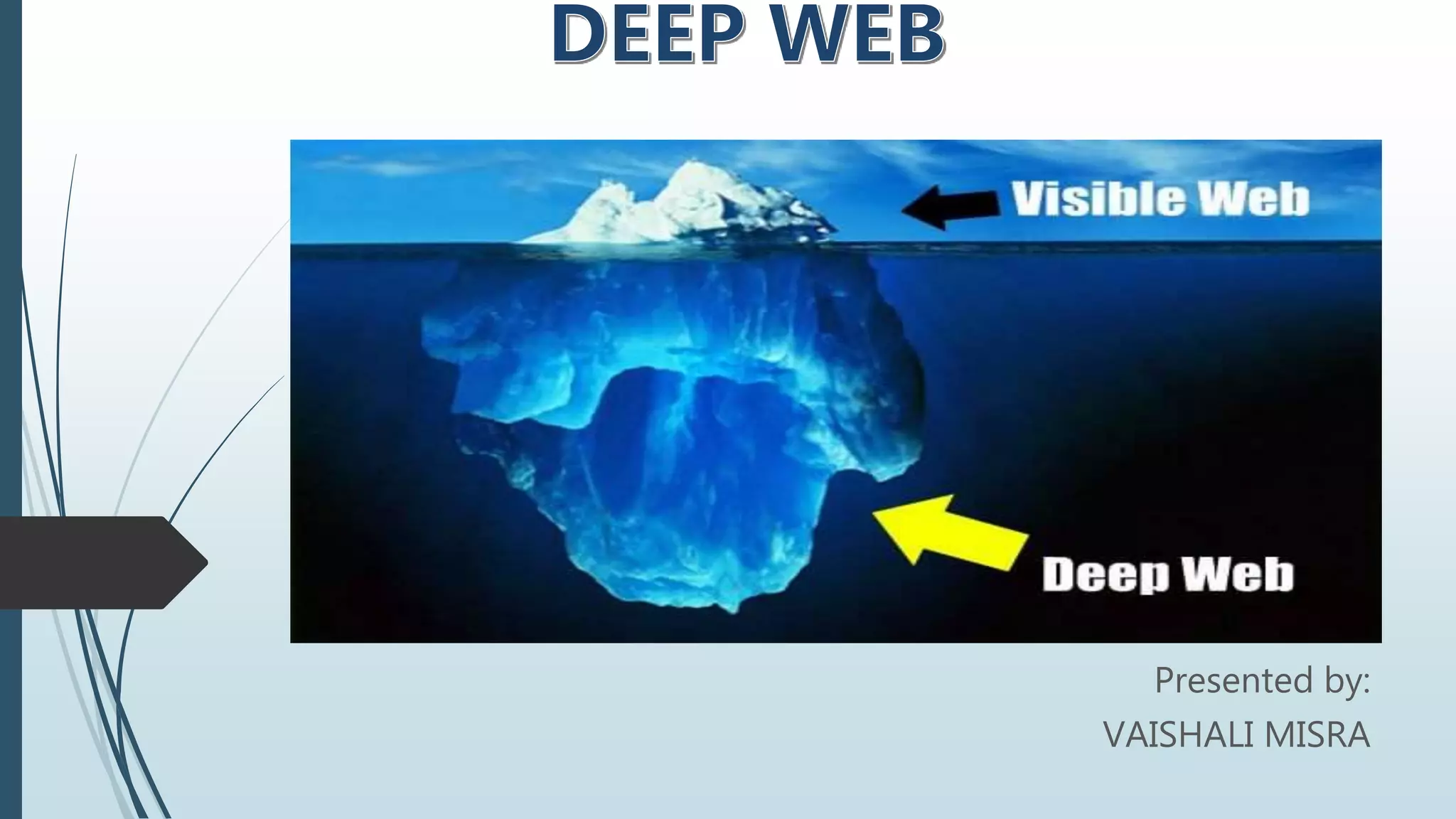
 Only 4% of web content is available via search engine
 Approximately 96% of the digital universe is on Deep web
sites protected by passwords.
SURFACE WEB
 The surface Web is that portion of the World Wide Web that
is readily available to the general public and searchable with
standard web search engines.
 It is also known as the Clearnet, the visible Web or indexable
Web.
 A traditional search engine sees only a small amount of the
information that's available
SURFACE WEB CHARACTERISTICS
Distributed data
High Volatility
Large volume
Unstructured data
Quality of data
Heterogeneous data
DEEP WEB
 The Deep Web is World Wide Web content that is not part of
the Surface Web, which is indexed by standard search
engines.
 It is also called the Deepnet, Invisible Web or Hidden Web.
 Largest growing category of new information on the Internet.
DEEP WEB CHARACTERISTICS
Dynamic webpages
Searchable databases
Private web
Limited access to web
HISTORY
 Jill Ellsworth used the term invisible Web in 1994 to refer to
websites that were not registered with any search engine.
 Mike Bergman cited a January 1996 article by Frank Garcia:
“It would be a site that's possibly reasonably designed, but they
didn't bother to register it with any of the search engines. So, no
one can find them! You're hidden. I call that the invisible Web”.
 The first use of the specific term Deep Web, now generally
accepted, occurred in the aforementioned 2001 Bergman
study.
WORKING OF SEARCH ENGINES
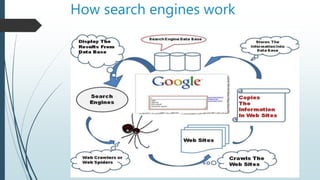
 Search engines construct a database of the Web by using
programs called spiders that begin with a list of known Web
pages.
 The spider gets a copy of each page and indexes it, storing
useful information that will let the page be quickly retrieved
again later.
 Eventually all reachable pages are indexed, unless the spider
runs out of time or disk space.
 The collection of reachable pages defines the Surface Web.
How search engines work
APPLICATIONS
 The internal sites of major companies, associations, and trade
organizations
 The school, college, and university intranet systems
 Access to online databases
 Password-protected websites with members-only access
 Timed access pages such as those found on online test-taking
sites
 An individual’s personal account for social media, email,
banking, and more
DARK WEB
 Dark Web is the Web content that exists on darknets.
 Darknets are overlay nets which use the public Internet but
require specific SW or authorization to access
Delivered over small peer-to-peer networks
As hidden services on top of Tor
 The Dark Web forms a small part of the Deep Web, the part of
the Web not indexed by search engines
TOR BROWSER
 Tor is software that installs into your browser and sets up the
specific connections you need to access dark Web sites.
 Critically it is free software for enabling online anonymity and
censorship resistance.
 Onion routing refers to the process of removing encryption
layers from Internet communications, similar to peeling back
the layers of an onion.
ADVANTAGES
 There is a wide range of people that benefit from the Deep
Web’s capability to allow anonymous use and communication.
Listed below are individuals or groups who have benefitted
from the Deep Web
Journalists and Whistleblowers
Political Protesters, and Anti-Censorship Advocacy Groups
Residents of Oppressive Political Regimes
DISADVANTAGES
 Deep Web search engines tend to be slower than standard
search engines.
 Searching the Deep Web also requires a more precise search
string.
 Deep Web searches should be reserved for serious,
painstaking research, not for simple questions and basic Web
surfing.
 Deep Web searches may also return sensitive personal
information from normally restricted databases.
 creating ethical dilemmas and leaving individuals susceptible
to fraud and identity theft.
CONCLUSION
 The Web is a major source of information for both criminal
and legal investigation activities.
 The Web content that is typically accessible through
conventional search engines is named the Surface Web and
represents only a small fraction of the whole Web.
 The Deep Web includes the largest bulk of the Web, a small
part of it (the Dark Web), being used specifically for carrying
out criminal activities.
THANK YOU!!!

Deep web and dark web

  • 1.
  • 2.
    CONTENTS INTRODUCTION SURFACE WEB HISTORY WORKING OFSEARCH ENGINES APPLICATIONS DARK WEB TOR BROWSER ADVANTAGES DISADVANTAGES CONCLUSION
  • 3.
    INTRODUCTION  The Webis the common name for the World Wide Web, a subset of the Internet consisting of the pages that can be accessed by a Web browser.  Web is divided into two main parts surface web  Deep web  Dark web is small part of deep web.  Only 4% of web content is available via search engine  Approximately 96% of the digital universe is on Deep web sites protected by passwords.
  • 4.
    SURFACE WEB  Thesurface Web is that portion of the World Wide Web that is readily available to the general public and searchable with standard web search engines.  It is also known as the Clearnet, the visible Web or indexable Web.  A traditional search engine sees only a small amount of the information that's available
  • 5.
    SURFACE WEB CHARACTERISTICS Distributeddata High Volatility Large volume Unstructured data Quality of data Heterogeneous data
  • 6.
    DEEP WEB  TheDeep Web is World Wide Web content that is not part of the Surface Web, which is indexed by standard search engines.  It is also called the Deepnet, Invisible Web or Hidden Web.  Largest growing category of new information on the Internet.
  • 7.
    DEEP WEB CHARACTERISTICS Dynamicwebpages Searchable databases Private web Limited access to web
  • 8.
    HISTORY  Jill Ellsworthused the term invisible Web in 1994 to refer to websites that were not registered with any search engine.  Mike Bergman cited a January 1996 article by Frank Garcia: “It would be a site that's possibly reasonably designed, but they didn't bother to register it with any of the search engines. So, no one can find them! You're hidden. I call that the invisible Web”.  The first use of the specific term Deep Web, now generally accepted, occurred in the aforementioned 2001 Bergman study.
  • 9.
    WORKING OF SEARCHENGINES  Search engines construct a database of the Web by using programs called spiders that begin with a list of known Web pages.  The spider gets a copy of each page and indexes it, storing useful information that will let the page be quickly retrieved again later.  Eventually all reachable pages are indexed, unless the spider runs out of time or disk space.  The collection of reachable pages defines the Surface Web.
  • 10.
  • 11.
    APPLICATIONS  The internalsites of major companies, associations, and trade organizations  The school, college, and university intranet systems  Access to online databases  Password-protected websites with members-only access  Timed access pages such as those found on online test-taking sites  An individual’s personal account for social media, email, banking, and more
  • 12.
    DARK WEB  DarkWeb is the Web content that exists on darknets.  Darknets are overlay nets which use the public Internet but require specific SW or authorization to access Delivered over small peer-to-peer networks As hidden services on top of Tor  The Dark Web forms a small part of the Deep Web, the part of the Web not indexed by search engines
  • 13.
    TOR BROWSER  Toris software that installs into your browser and sets up the specific connections you need to access dark Web sites.  Critically it is free software for enabling online anonymity and censorship resistance.  Onion routing refers to the process of removing encryption layers from Internet communications, similar to peeling back the layers of an onion.
  • 14.
    ADVANTAGES  There isa wide range of people that benefit from the Deep Web’s capability to allow anonymous use and communication. Listed below are individuals or groups who have benefitted from the Deep Web Journalists and Whistleblowers Political Protesters, and Anti-Censorship Advocacy Groups Residents of Oppressive Political Regimes
  • 15.
    DISADVANTAGES  Deep Websearch engines tend to be slower than standard search engines.  Searching the Deep Web also requires a more precise search string.  Deep Web searches should be reserved for serious, painstaking research, not for simple questions and basic Web surfing.  Deep Web searches may also return sensitive personal information from normally restricted databases.  creating ethical dilemmas and leaving individuals susceptible to fraud and identity theft.
  • 16.
    CONCLUSION  The Webis a major source of information for both criminal and legal investigation activities.  The Web content that is typically accessible through conventional search engines is named the Surface Web and represents only a small fraction of the whole Web.  The Deep Web includes the largest bulk of the Web, a small part of it (the Dark Web), being used specifically for carrying out criminal activities.
  • 17.