made by :
ISMAIL AIT BOUTALEB
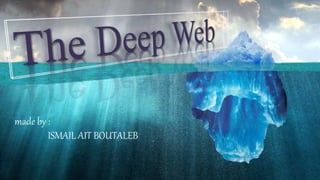
Deep Web - Introduction
 The Deep Web is World Wide Web content that is not part of the Surface Web,
which is indexed by standard search engines.
 It is also called the Deep net, Invisible Web or Hidden Web.
 Largest growing category of new information on the Internet.
 400-550X more public information than the Surface Web.
 Total quality 1000-2000X greater than the quality of the Surface Web.
History
 Jill Ellsworth used the term invisible Web in 1994 to refer to websites that were not
registered with any search engine.
 Mike Bergman cited a January 1996 article by Frank Garcia:
“It would be a site that's possibly reasonably designed, but they didn't bother to
register it with any of the search engines. So, no one can find them! You're hidden.
I call that the invisible Web”.
 Another early use of the term Invisible Web was by Bruce Mount and Matthew B. Koll
of Personal Library Software in 1996.
 The first use of the specific term Deep Web, now generally accepted, occurred in the
aforementioned 2001 Bergman study.
How search engines work
Contents
 Dynamic Content
 Unlinked content
 Private Web
 Contextual Web
 Limited access content
 Non-Scripted content
 Non-HTML/text content;
 Dynamic content
• Dynamic pages which are returned in response to a submitted query or accessed only
through a form
• especially if open-domain input elements (such as text fields) are used
• such fields are hard to navigate without domain knowledge
 Unlinked Content
• Pages which are not linked to by other pages
• Which may prevent web crawling programs from accessing the content
• This content is referred to as pages without backlinks (or in links).
 Private Web: sites that require registration and login (password-protected resources).
 Contextual Web: pages with content varying for different access contexts (e.g.,
ranges of client IP addresses or previous navigation sequence).
 Limited access content: sites that limit access to their pages in a technical way
(e.g., using the Robots Exclusion Standard, CAPTCHAs, or no-cache Pragma HTTP
headers which prohibit search engines from browsing them and creating cached copies.
 Scripted content
pages that are only accessible through links produced by JavaScript as well as content
dynamically downloaded from Web servers via Flash or Ajax solutions.
Non-HTML/text content
textual content encoded in multimedia (image or video) files or specific file formats not
handled by search engines.
Deep Potential
 The deep Web is an endless repository for a mind-reeling amount of information.
 It's powerful. It unleashes human nature in all its forms, both good and bad.
 There are engineering databases, financial information of all kinds, medical papers, pictures,
illustrations ... the list goes on, basically, forever.
 For example, construction engineers could potentially search research papers at multiple universities in
order to find the latest and greatest in bridge-building materials.
 Doctors could swiftly locate the latest research on a specific disease.
 The potential is unlimited. The technical challenges are daunting. That's the draw of the deep Web.
Money-related transactions
 You may wonder how any money-related transactions can happen when sellers
and buyers can't identify each other.
 That's where Bitcoin comes in.
 Bitcoin, it's basically an encrypted digital currency.
 Like regular cash, Bitcoin is good for transactions of all kinds, and notably, it
also allows for anonymity; no one can trace a purchase, illegal or otherwise.
 When paired properly with TOR, it's perhaps the closest thing to a foolproof
way to buy and sell on the web.
The Brighter Side of Darkness
 The deep Web is home to alternate search engines, e-mail services, file storage, file sharing, social media,
chat sites, news outlets and whistleblowing sites, as well as sites that provide a safer meeting ground for
political dissidents and anyone else who may find themselves on the fringes of society.
 In an age where NSA-type surveillance is omnipresent and privacy seems like a thing of the past, the dark
Web offers some relief to people who prize their anonymity.
 Bitcoin may not be entirely stable, but it offers privacy, which is something your credit card company most
certainly does not.
 For citizens living in countries with violent or oppressive leaders, the dark Web offers a more secure way to
communicate with like-minded individuals.
Conclusion
 The deep web will continue to perplex and fascinate everyone who uses the internet.
 It contains an enthralling amount of knowledge that could help us evolve technologically and as a species
when connected to other bits of information.
 And of course, its darker side will always be lurking, too, just as it always does in human nature.
 The deep web speaks to the fathomless, scattered potential of not only the internet, but the human race, too.
Thank You
For your
attention

DEEP WEB PRESENTATION.pptx

  • 1.
    made by : ISMAILAIT BOUTALEB
  • 2.
    Deep Web -Introduction  The Deep Web is World Wide Web content that is not part of the Surface Web, which is indexed by standard search engines.  It is also called the Deep net, Invisible Web or Hidden Web.  Largest growing category of new information on the Internet.  400-550X more public information than the Surface Web.  Total quality 1000-2000X greater than the quality of the Surface Web.
  • 4.
    History  Jill Ellsworthused the term invisible Web in 1994 to refer to websites that were not registered with any search engine.  Mike Bergman cited a January 1996 article by Frank Garcia: “It would be a site that's possibly reasonably designed, but they didn't bother to register it with any of the search engines. So, no one can find them! You're hidden. I call that the invisible Web”.  Another early use of the term Invisible Web was by Bruce Mount and Matthew B. Koll of Personal Library Software in 1996.  The first use of the specific term Deep Web, now generally accepted, occurred in the aforementioned 2001 Bergman study.
  • 5.
  • 7.
    Contents  Dynamic Content Unlinked content  Private Web  Contextual Web  Limited access content  Non-Scripted content  Non-HTML/text content;
  • 8.
     Dynamic content •Dynamic pages which are returned in response to a submitted query or accessed only through a form • especially if open-domain input elements (such as text fields) are used • such fields are hard to navigate without domain knowledge  Unlinked Content • Pages which are not linked to by other pages • Which may prevent web crawling programs from accessing the content • This content is referred to as pages without backlinks (or in links).
  • 9.
     Private Web:sites that require registration and login (password-protected resources).  Contextual Web: pages with content varying for different access contexts (e.g., ranges of client IP addresses or previous navigation sequence).  Limited access content: sites that limit access to their pages in a technical way (e.g., using the Robots Exclusion Standard, CAPTCHAs, or no-cache Pragma HTTP headers which prohibit search engines from browsing them and creating cached copies.
  • 10.
     Scripted content pagesthat are only accessible through links produced by JavaScript as well as content dynamically downloaded from Web servers via Flash or Ajax solutions. Non-HTML/text content textual content encoded in multimedia (image or video) files or specific file formats not handled by search engines.
  • 11.
    Deep Potential  Thedeep Web is an endless repository for a mind-reeling amount of information.  It's powerful. It unleashes human nature in all its forms, both good and bad.  There are engineering databases, financial information of all kinds, medical papers, pictures, illustrations ... the list goes on, basically, forever.  For example, construction engineers could potentially search research papers at multiple universities in order to find the latest and greatest in bridge-building materials.  Doctors could swiftly locate the latest research on a specific disease.  The potential is unlimited. The technical challenges are daunting. That's the draw of the deep Web.
  • 12.
    Money-related transactions  Youmay wonder how any money-related transactions can happen when sellers and buyers can't identify each other.  That's where Bitcoin comes in.  Bitcoin, it's basically an encrypted digital currency.  Like regular cash, Bitcoin is good for transactions of all kinds, and notably, it also allows for anonymity; no one can trace a purchase, illegal or otherwise.  When paired properly with TOR, it's perhaps the closest thing to a foolproof way to buy and sell on the web.
  • 13.
    The Brighter Sideof Darkness  The deep Web is home to alternate search engines, e-mail services, file storage, file sharing, social media, chat sites, news outlets and whistleblowing sites, as well as sites that provide a safer meeting ground for political dissidents and anyone else who may find themselves on the fringes of society.  In an age where NSA-type surveillance is omnipresent and privacy seems like a thing of the past, the dark Web offers some relief to people who prize their anonymity.  Bitcoin may not be entirely stable, but it offers privacy, which is something your credit card company most certainly does not.  For citizens living in countries with violent or oppressive leaders, the dark Web offers a more secure way to communicate with like-minded individuals.
  • 14.
    Conclusion  The deepweb will continue to perplex and fascinate everyone who uses the internet.  It contains an enthralling amount of knowledge that could help us evolve technologically and as a species when connected to other bits of information.  And of course, its darker side will always be lurking, too, just as it always does in human nature.  The deep web speaks to the fathomless, scattered potential of not only the internet, but the human race, too.
  • 15.