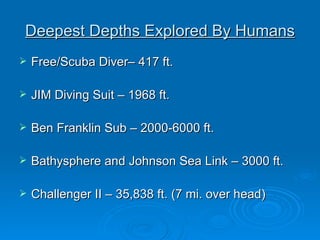
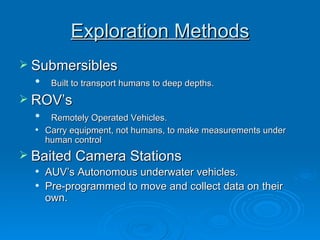
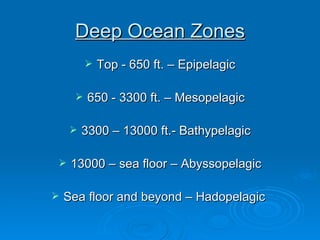
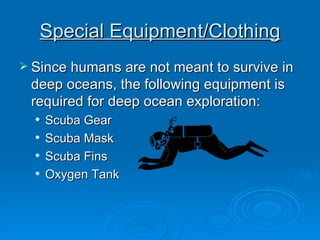
Deep oceans present challenges for human exploration due to extreme pressures and lack of light. The document discusses methods used to explore depths beyond recreational SCUBA diving limits, including manned submersibles that can transport people to over 35,000 feet deep. Unmanned technologies like remotely operated vehicles and autonomous underwater vehicles are also used to study deep zones and collect data without risking human lives. Special equipment is necessary to allow deep ocean exploration by humans, who are not naturally adapted to such extreme environments.



![Trabajo Guido 2008 2 [Modo De Compatibilidad]](https://cdn.slidesharecdn.com/ss_thumbnails/trabajo-guido-2008-2-modo-de-compatibilidad-1228754635400115-8-thumbnail.jpg?width=640&height=640&fit=bounds)


![971016 [網頁]現有停車裝置](https://cdn.slidesharecdn.com/ss_thumbnails/971016-1228731690742433-8-thumbnail.jpg?width=640&height=640&fit=bounds)


