Decoders
Name:B.Bhavani
Roll no:23h51a6272
Decoders:
Unlocking the
Hidden Meaning
Decoders are essential tools that convert coded information into a
format that can be understood by humans or machines. They play a
crucial role in a wide range of applications, from communication to data
analysis.
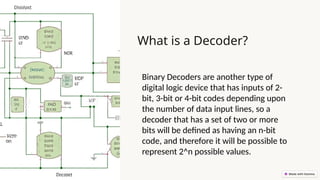
What is a Decoder?
.
Binary Decoders are another type of
digital logic device that has inputs of 2-
bit, 3-bit or 4-bit codes depending upon
the number of data input lines, so a
decoder that has a set of two or more
bits will be defined as having an n-bit
code, and therefore it will be possible to
represent 2^n possible values.
The Importance of Decoders
Communication
Decoders are essential for
transmitting and interpreting
information across various mediums,
from radio signals to digital data.
Data Analysis
They allow us to extract meaningful
insights from complex datasets,
enabling informed decision-making
and problem-solving.
Security
Decoders play a crucial role in
encryption and decryption, protecting
sensitive information and ensuring
secure communication.
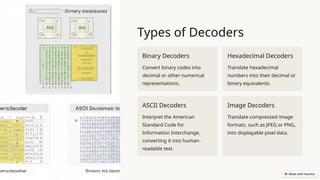
Types of Decoders
Binary Decoders
Convert binary codes into
decimal or other numerical
representations.
Hexadecimal Decoders
Translate hexadecimal
numbers into their decimal or
binary equivalents.
ASCII Decoders
Interpret the American
Standard Code for
Information Interchange,
converting it into human-
readable text.
Image Decoders
Translate compressed image
formats, such as JPEG or PNG,
into displayable pixel data.
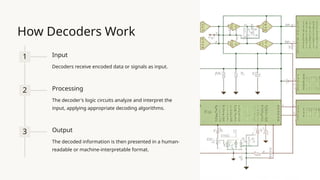
How Decoders Work
1 Input
Decoders receive encoded data or signals as input.
2 Processing
The decoder's logic circuits analyze and interpret the
input, applying appropriate decoding algorithms.
3 Output
The decoded information is then presented in a human-
readable or machine-interpretable format.
Applications of Decoders
Communication
Decoders enable the
transmission and
interpretation of
information across various
communication channels.
Data Analysis
They play a crucial role in
extracting meaningful
insights from complex
datasets.
Security
Decoders are essential for
encryption, decryption, and
protecting sensitive
information.
Automation
Decoders enable the control
and coordination of various
systems and devices.
Challenges in Decoder
Design
Speed
Decoders must process data quickly to maintain low latency
and high throughput.
Accuracy
Ensuring precise and error-free decoding is crucial for
reliable performance.
Complexity
Designing decoders that can handle diverse input formats
and protocols can be highly complex.
Emerging Trends in Decoder Technology
Quantum Decoders
Leveraging the principles of quantum
mechanics to achieve unprecedented
speed and accuracy in decoding.
AI-powered Decoders
Integrating machine learning and
artificial intelligence to enhance the
flexibility and adaptability of
decoders.
Multimodal Decoders
Decoders that can interpret and
translate across multiple data
formats, including text, audio, and
visual information.
Ethical Considerations in
Decoder Use
1 Privacy and Security
Ensuring the responsible
and ethical use of decoders
to protect individual privacy
and data security.
2 Transparency and
Accountability
Promoting transparency in
the design and deployment
of decoders, with clear
guidelines and oversight.
3 Equitable Access
Ensuring that the benefits
of decoder technology are
distributed fairly and
accessible to all.
4 Societal Impact
Considering the broader
implications of decoder use
and their impact on society,
culture, and the
environment.
Decoders-Unlocking-the-Hidden-Meaning.pptx

Decoders-Unlocking-the-Hidden-Meaning.pptx

  • 1.
  • 2.
    Decoders: Unlocking the Hidden Meaning Decodersare essential tools that convert coded information into a format that can be understood by humans or machines. They play a crucial role in a wide range of applications, from communication to data analysis.
  • 3.
    What is aDecoder? . Binary Decoders are another type of digital logic device that has inputs of 2- bit, 3-bit or 4-bit codes depending upon the number of data input lines, so a decoder that has a set of two or more bits will be defined as having an n-bit code, and therefore it will be possible to represent 2^n possible values.
  • 4.
    The Importance ofDecoders Communication Decoders are essential for transmitting and interpreting information across various mediums, from radio signals to digital data. Data Analysis They allow us to extract meaningful insights from complex datasets, enabling informed decision-making and problem-solving. Security Decoders play a crucial role in encryption and decryption, protecting sensitive information and ensuring secure communication.
  • 5.
    Types of Decoders BinaryDecoders Convert binary codes into decimal or other numerical representations. Hexadecimal Decoders Translate hexadecimal numbers into their decimal or binary equivalents. ASCII Decoders Interpret the American Standard Code for Information Interchange, converting it into human- readable text. Image Decoders Translate compressed image formats, such as JPEG or PNG, into displayable pixel data.
  • 6.
    How Decoders Work 1Input Decoders receive encoded data or signals as input. 2 Processing The decoder's logic circuits analyze and interpret the input, applying appropriate decoding algorithms. 3 Output The decoded information is then presented in a human- readable or machine-interpretable format.
  • 7.
    Applications of Decoders Communication Decodersenable the transmission and interpretation of information across various communication channels. Data Analysis They play a crucial role in extracting meaningful insights from complex datasets. Security Decoders are essential for encryption, decryption, and protecting sensitive information. Automation Decoders enable the control and coordination of various systems and devices.
  • 8.
    Challenges in Decoder Design Speed Decodersmust process data quickly to maintain low latency and high throughput. Accuracy Ensuring precise and error-free decoding is crucial for reliable performance. Complexity Designing decoders that can handle diverse input formats and protocols can be highly complex.
  • 9.
    Emerging Trends inDecoder Technology Quantum Decoders Leveraging the principles of quantum mechanics to achieve unprecedented speed and accuracy in decoding. AI-powered Decoders Integrating machine learning and artificial intelligence to enhance the flexibility and adaptability of decoders. Multimodal Decoders Decoders that can interpret and translate across multiple data formats, including text, audio, and visual information.
  • 10.
    Ethical Considerations in DecoderUse 1 Privacy and Security Ensuring the responsible and ethical use of decoders to protect individual privacy and data security. 2 Transparency and Accountability Promoting transparency in the design and deployment of decoders, with clear guidelines and oversight. 3 Equitable Access Ensuring that the benefits of decoder technology are distributed fairly and accessible to all. 4 Societal Impact Considering the broader implications of decoder use and their impact on society, culture, and the environment.