Creative Digital Media careers
in Film and TV
Yen Yau
Talent Development Manager
Into Film
yen.yau@intofilm.org
@yenyau
The Bigger Picture
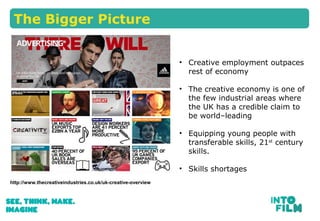
• Creative employment outpaces
rest of economy
• The creative economy is one of
the few industrial areas where
the UK has a credible claim to
be world–leading
• Equipping young people with
transferable skills, 21st
century
skills.
• Skills shortages
http://www.thecreativeindustries.co.uk/uk-creative-overview
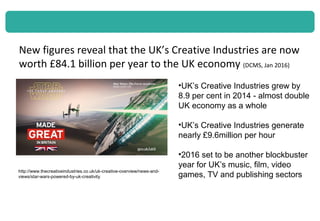
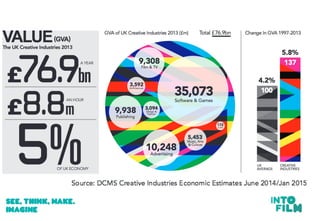
New figures reveal that the UK’s Creative Industries are now
worth £84.1 billion per year to the UK economy (DCMS, Jan 2016)
•UK’s Creative Industries grew by
8.9 per cent in 2014 - almost double
UK economy as a whole
•UK’s Creative Industries generate
nearly £9.6million per hour
•2016 set to be another blockbuster
year for UK’s music, film, video
games, TV and publishing sectors
http://www.thecreativeindustries.co.uk/uk-creative-overview/news-and-
views/star-wars-powered-by-uk-creativity
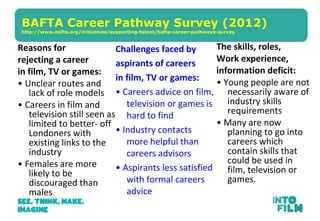
BAFTA Career Pathway Survey (2012)
http://www.bafta.org/initiatives/supporting-talent/bafta-career-pathways-survey
Challenges faced by
aspirants of careers
in film, TV or games:
• Careers advice on film,
television or games is
hard to find
• Industry contacts
more helpful than
careers advisors
• Aspirants less satisfied
with formal careers
advice
Reasons for
rejecting a career
in film, TV or games:
• Unclear routes and
lack of role models
• Careers in film and
television still seen as
limited to better- off
Londoners with
existing links to the
industry
• Females are more
likely to be
discouraged than
males
The skills, roles,
Work experience,
information deficit:
• Young people are not
necessarily aware of
industry skills
requirements
• Many are now
planning to go into
careers which
contain skills that
could be used in
film, television or
games.
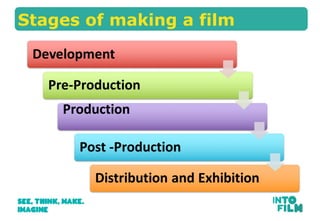
Stages of making a film
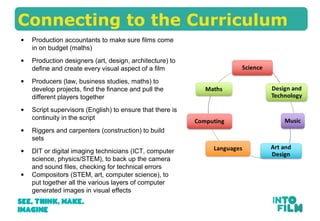
Connecting to the Curriculum
• Production accountants to make sure films come
in on budget (maths)
• Production designers (art, design, architecture) to
define and create every visual aspect of a film
• Producers (law, business studies, maths) to
develop projects, find the finance and pull the
different players together
• Script supervisors (English) to ensure that there is
continuity in the script
• Riggers and carpenters (construction) to build
sets
• DIT or digital imaging technicians (ICT, computer
science, physics/STEM), to back up the camera
and sound files, checking for technical errors
• Compositors (STEM, art, computer science), to
put together all the various layers of computer
generated images in visual effects
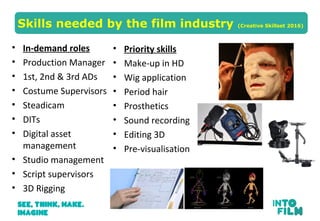
Skills needed by the film industry (Creative Skillset 2016)
• In-demand roles
• Production Manager
• 1st, 2nd & 3rd ADs
• Costume Supervisors
• Steadicam
• DITs
• Digital asset
management
• Studio management
• Script supervisors
• 3D Rigging
• Priority skills
• Make-up in HD
• Wig application
• Period hair
• Prosthetics
• Sound recording
• Editing 3D
• Pre-visualisation
Creative Industries Strategy 2014
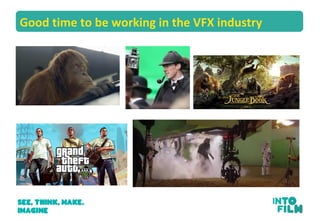
Good time to be working in the VFX industry
The Skills Shortage - VFX
UK National Shortage Occupation
List
Relates to jobs under Tier 2 of the
new five-tier system.
If the job is on the shortage
occupation list then an employer can
offer the job to an overseas person
without having first fulfilled the
Resident Labour Market Test by
advertising the vacancy in the UK.
The list is current at 14 November,
2011 but is subject to change at any
time.
.
Producers and directors in the
following roles within visual effects
and 2D / 3D computer animation
for film, television or video games:
2D supervisor, 3D supervisor,
computer graphics supervisor,
producer, production manager,
technical director, visual effects
supervisor.
Graphic Designers roles within
visual effects and 2D / 3D
computer animation for film,
television or video games:
compositing artist, matte painter,
modeller, rigger, stereo artist,
texture artist
http://www.iop.org/publications/iop/2015/page_65434.html
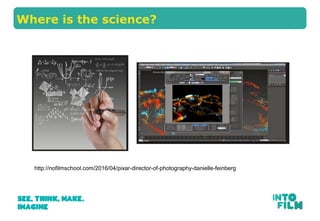
Where is the science?
http://nofilmschool.com/2016/04/pixar-director-of-photography-danielle-feinberg
VFX Film Resources
•The Core Skills of VFX
http://www.skillset.org/animation/qualifications/article_8377_1.asp
•Breakdown showreels
http://www.artofvfx.com/?p=6591
http://www.moving-picture.com/showreels/vfx-breakdowns/
•Individual Career Profiles and Case studies
http://www.dneg.com/career_profiles/
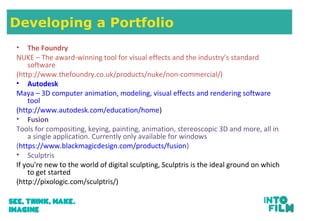
Developing a Portfolio
• The Foundry
NUKE – The award-winning tool for visual effects and the industry’s standard
software
(http://www.thefoundry.co.uk/products/nuke/non-commercial/)
• Autodesk
Maya – 3D computer animation, modeling, visual effects and rendering software
tool
(http://www.autodesk.com/education/home)
• Fusion
Tools for compositing, keying, painting, animation, stereoscopic 3D and more, all in
a single application. Currently only available for windows
(https://www.blackmagicdesign.com/products/fusion)
• Sculptris
If you're new to the world of digital sculpting, Sculptris is the ideal ground on which
to get started
(http://pixologic.com/sculptris/)
What we associate with feature films
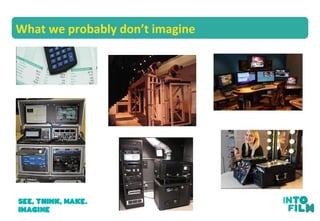
What we probably don’t imagine
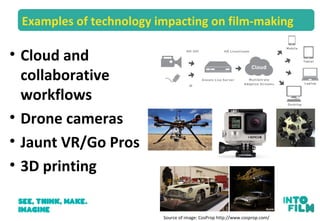
Examples of technology impacting on film-making
• Cloud and
collaborative
workflows
• Drone cameras
• Jaunt VR/Go Pros
• 3D printing
Source of image: CosProp http://www.cosprop.com/
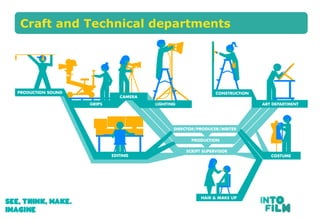
Craft and Technical departments
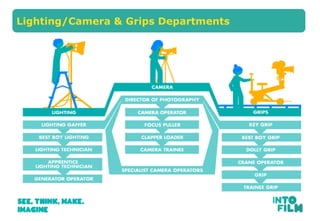
Costume & Hair/Make Up DepartmentsLighting/Camera & Grips Departments
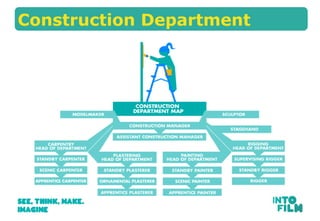
Construction Department
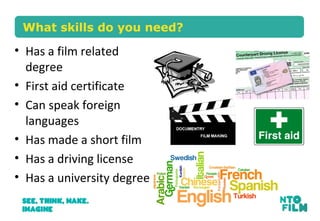
What skills do you need?
• Has a film related
degree
• First aid certificate
• Can speak foreign
languages
• Has made a short film
• Has a driving license
• Has a university degree
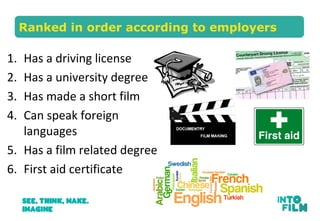
Ranked in order according to employers
1. Has a driving license
2. Has a university degree
3. Has made a short film
4. Can speak foreign
languages
5. Has a film related degree
6. First aid certificate
Useful Websites
• BAFTA Guru
• Double Negative
• Escape Studios
• Shooting People
• Screen International
• The CG Society
• Creative Skillset
• College of Production
• BBC Academy
• BFI Film Academy Network
(for 16-19 year olds)
• Film Distributors
Association
• Creative Choices /CCS
• UK Film Export
• Creative Access
Decisions at 18 conference 2016

Decisions at 18 conference 2016

  • 1.
    Creative Digital Mediacareers in Film and TV Yen Yau Talent Development Manager Into Film yen.yau@intofilm.org @yenyau
  • 2.
    The Bigger Picture •Creative employment outpaces rest of economy • The creative economy is one of the few industrial areas where the UK has a credible claim to be world–leading • Equipping young people with transferable skills, 21st century skills. • Skills shortages http://www.thecreativeindustries.co.uk/uk-creative-overview
  • 3.
    New figures revealthat the UK’s Creative Industries are now worth £84.1 billion per year to the UK economy (DCMS, Jan 2016) •UK’s Creative Industries grew by 8.9 per cent in 2014 - almost double UK economy as a whole •UK’s Creative Industries generate nearly £9.6million per hour •2016 set to be another blockbuster year for UK’s music, film, video games, TV and publishing sectors http://www.thecreativeindustries.co.uk/uk-creative-overview/news-and- views/star-wars-powered-by-uk-creativity
  • 5.
    BAFTA Career PathwaySurvey (2012) http://www.bafta.org/initiatives/supporting-talent/bafta-career-pathways-survey Challenges faced by aspirants of careers in film, TV or games: • Careers advice on film, television or games is hard to find • Industry contacts more helpful than careers advisors • Aspirants less satisfied with formal careers advice Reasons for rejecting a career in film, TV or games: • Unclear routes and lack of role models • Careers in film and television still seen as limited to better- off Londoners with existing links to the industry • Females are more likely to be discouraged than males The skills, roles, Work experience, information deficit: • Young people are not necessarily aware of industry skills requirements • Many are now planning to go into careers which contain skills that could be used in film, television or games.
  • 6.
  • 7.
    Connecting to theCurriculum • Production accountants to make sure films come in on budget (maths) • Production designers (art, design, architecture) to define and create every visual aspect of a film • Producers (law, business studies, maths) to develop projects, find the finance and pull the different players together • Script supervisors (English) to ensure that there is continuity in the script • Riggers and carpenters (construction) to build sets • DIT or digital imaging technicians (ICT, computer science, physics/STEM), to back up the camera and sound files, checking for technical errors • Compositors (STEM, art, computer science), to put together all the various layers of computer generated images in visual effects
  • 8.
    Skills needed bythe film industry (Creative Skillset 2016) • In-demand roles • Production Manager • 1st, 2nd & 3rd ADs • Costume Supervisors • Steadicam • DITs • Digital asset management • Studio management • Script supervisors • 3D Rigging • Priority skills • Make-up in HD • Wig application • Period hair • Prosthetics • Sound recording • Editing 3D • Pre-visualisation
  • 9.
  • 10.
    Good time tobe working in the VFX industry
  • 11.
    The Skills Shortage- VFX UK National Shortage Occupation List Relates to jobs under Tier 2 of the new five-tier system. If the job is on the shortage occupation list then an employer can offer the job to an overseas person without having first fulfilled the Resident Labour Market Test by advertising the vacancy in the UK. The list is current at 14 November, 2011 but is subject to change at any time. . Producers and directors in the following roles within visual effects and 2D / 3D computer animation for film, television or video games: 2D supervisor, 3D supervisor, computer graphics supervisor, producer, production manager, technical director, visual effects supervisor. Graphic Designers roles within visual effects and 2D / 3D computer animation for film, television or video games: compositing artist, matte painter, modeller, rigger, stereo artist, texture artist
  • 12.
  • 13.
    Where is thescience? http://nofilmschool.com/2016/04/pixar-director-of-photography-danielle-feinberg
  • 14.
    VFX Film Resources •TheCore Skills of VFX http://www.skillset.org/animation/qualifications/article_8377_1.asp •Breakdown showreels http://www.artofvfx.com/?p=6591 http://www.moving-picture.com/showreels/vfx-breakdowns/ •Individual Career Profiles and Case studies http://www.dneg.com/career_profiles/
  • 15.
    Developing a Portfolio •The Foundry NUKE – The award-winning tool for visual effects and the industry’s standard software (http://www.thefoundry.co.uk/products/nuke/non-commercial/) • Autodesk Maya – 3D computer animation, modeling, visual effects and rendering software tool (http://www.autodesk.com/education/home) • Fusion Tools for compositing, keying, painting, animation, stereoscopic 3D and more, all in a single application. Currently only available for windows (https://www.blackmagicdesign.com/products/fusion) • Sculptris If you're new to the world of digital sculpting, Sculptris is the ideal ground on which to get started (http://pixologic.com/sculptris/)
  • 16.
    What we associatewith feature films
  • 17.
    What we probablydon’t imagine
  • 18.
    Examples of technologyimpacting on film-making • Cloud and collaborative workflows • Drone cameras • Jaunt VR/Go Pros • 3D printing Source of image: CosProp http://www.cosprop.com/
  • 19.
  • 20.
    Costume & Hair/MakeUp DepartmentsLighting/Camera & Grips Departments
  • 21.
  • 22.
    What skills doyou need? • Has a film related degree • First aid certificate • Can speak foreign languages • Has made a short film • Has a driving license • Has a university degree
  • 23.
    Ranked in orderaccording to employers 1. Has a driving license 2. Has a university degree 3. Has made a short film 4. Can speak foreign languages 5. Has a film related degree 6. First aid certificate
  • 24.
    Useful Websites • BAFTAGuru • Double Negative • Escape Studios • Shooting People • Screen International • The CG Society • Creative Skillset • College of Production
  • 25.
    • BBC Academy •BFI Film Academy Network (for 16-19 year olds) • Film Distributors Association • Creative Choices /CCS • UK Film Export • Creative Access

Editor's Notes

  • #2 Introduction Who I am What I do – skills and talent development for new entrants for film; mentoring programmes, work placements, training, knowledge of documentary and visual effects for film – so wide ranging expertise PANEL My experience – mention having worked with Pinewood, BAFTA, BBC, EON Productions, Lime Pictures, BFI, UK FC, C4, Creative Skillset and so forth. Overview film industry – given it’s a large topic, touching surface and will be up to you to follow up. SIGNPOSTING Remember - Transferable skills – though talking of film also relevant for commercials, television, music videos, corporate films. Lots of different jobs in the Demonstrate you are committed and serious about working in your chosen career area of film or TV. In my job, I meet lots of young people whom I would describe as MEDIA WANNABES. By the end of this session, I hope that any of you who fall into this category will have converted this label to someone who genuinely wants a film/TV career. If you want to work in television, watch it. If you want to work in film, watch them. If you want to work in games, play them. Familiarise yourself with the issues in your chosen field and have an informed opinion. Don't be afraid to express an opinion even if it doesn't seem to be popular. Always remember the people who helped you and extend the same help to others when you are in a position to do so yourself. When you start moving up, don't surround yourself with 'yes' people. Never forget that you are always learning."
  • #3 Content of talk: Importance of supporting the development of creative and technical skills, preparing young people with transferable 21st century skills.  The UK is a world leader of film VFX (kicked of by the Harry Potter franchise), and to retain our leading edge in this sector, need to have students aware that careers dependent on strong STEM and computing science backgrounds are essential.   Working in this sector involves problem solving skills, a creative vision to develop stories and ideas that capture an international audiences imagination, the iterative process of making visual effects means that sometimes things do not work but that is a not to be seen as a failure because you learn something from that process.  We need to encourage more students to think about STEM subjects because many industries that we in the UK excel in depend on them. Not enough engineers undertaking R&D; UK 5th largest economy in the world yet we are 22nd in the world rankings for countries for registering patents (according to James Dyson in Observer last month) Companies like Dneg rely on individuals who can come up with technical innovation, to push at the cinematic boundaries.  Need to invest in indigenous talent – Dneg current workforce, 50% non UK. Exciting time to be working (or considering working in the creative industries/film) A  2012 study by Oxford Economics estimates that the core UK film industry is a substantial industry, directly generating 43,900 full time equivalent (FTE) jobs and contributing £1.6 billion to national GDP. In employment terms, the industry is larger than fund management and the pharmaceutical manufacturing sector. Furthermore, the overall trend is very positive with employment increasing since 1995, mirroring film production levels (particularly inward investment). Creative Industries Employment (2011 –2012) The Creative Industries accounted for 1.68 million jobs in 2012, 5.6 per cent of the total number of jobs in the UK.  Employment in the Creative Industries increased by 8.6 per cent between 2011 and 2012 ,a higher rate than for the UK Economy as a whole (0.7%) – DCMS 2014 report Martini media - 2006 speech, Mark Thompson urged the BBC to embrace "martini media" – making content available any time, any place, anywhere. Eg. Film not just viewed in cinemas but on several platforms – knowledge of how your creative vision can be viewed on large or small format; transmedia, new jobs (Head of Data, Head of User Experience – film turned into themepark rides), Tax credits, film studios (we have 10 in the UK) like Pinewood seeking expansion, Bottle Yard (Bristol), Scotland still seeking to build studio (recent productions (Prometheus, Skyfall, Under the Skin, Sunshine on Leith, World War Z, Outlander last year and more recently Macbeth) VFX – world reputation, kickstarted off the back of the HP franchise Remember - Transferable skills – though talking of film also relevant for commercials, television, music videos, corporate films. Lots of different jobs in the 21st century skills – not just about technology but also employers particularly in the creative industries want self starters, problem solvers, to have creative streak but also have technical know how (to be analytical). Fusion Skills the overlapping zones of Art/Creativity, STEM and Enterprise, which is the motor in our world of skills. Importance of creative industries to GDP 21st century skills – fit for, responsive, (Eric Schmidt) Convergence – digital skills, media literacy, to develop skills as creators and not just consumers of content – polymaths (not boffins vs luvvies) Lewis Carroll wrote one of the classic fairy tales, Alice in Wonderland, and was also a mathematics tutor at Oxford. the UK needed to bring art and science back together Priority as we as a country have moved away from traditional forms of work and enterprise. Transferable skills – though talking of film also relevant for commercials, television, music videos, corporate films health/medicine sector, Latest CS employment census Fusion Skills Skills Shortage: Our skills and talent base form the backbone of the UK's world class and growing creative media industries but we need to invest in on-going skills development; aging workforce
  • #5 Content of talk: Importance of supporting the development of creative and technical skills, preparing young people with transferable 21st century skills.  The UK is a world leader of film VFX (kicked of by the Harry Potter franchise), and to retain our leading edge in this sector, need to have students aware that careers dependent on strong STEM and computing science backgrounds are essential.   Working in this sector involves problem solving skills, a creative vision to develop stories and ideas that capture an international audiences imagination, the iterative process of making visual effects means that sometimes things do not work but that is a not to be seen as a failure because you learn something from that process.  We need to encourage more students to think about STEM subjects because many industries that we in the UK excel in depend on them. Not enough engineers undertaking R&D; UK 5th largest economy in the world yet we are 22nd in the world rankings for countries for registering patents (according to James Dyson in Observer last month) Companies like Dneg rely on individuals who can come up with technical innovation, to push at the cinematic boundaries.  Need to invest in indigenous talent – Dneg current workforce, 50% non UK. Exciting time to be working (or considering working in the creative industries/film) A  2012 study by Oxford Economics estimates that the core UK film industry is a substantial industry, directly generating 43,900 full time equivalent (FTE) jobs and contributing £1.6 billion to national GDP. In employment terms, the industry is larger than fund management and the pharmaceutical manufacturing sector. Furthermore, the overall trend is very positive with employment increasing since 1995, mirroring film production levels (particularly inward investment). Creative Industries Employment (2011 –2012) The Creative Industries accounted for 1.68 million jobs in 2012, 5.6 per cent of the total number of jobs in the UK.  Employment in the Creative Industries increased by 8.6 per cent between 2011 and 2012 ,a higher rate than for the UK Economy as a whole (0.7%) – DCMS 2014 report Martini media - 2006 speech, Mark Thompson urged the BBC to embrace "martini media" – making content available any time, any place, anywhere. Eg. Film not just viewed in cinemas but on several platforms – knowledge of how your creative vision can be viewed on large or small format; transmedia, new jobs (Head of Data, Head of User Experience – film turned into themepark rides), Tax credits, film studios (we have 10 in the UK) like Pinewood seeking expansion, Bottle Yard (Bristol), Scotland still seeking to build studio (recent productions (Prometheus, Skyfall, Under the Skin, Sunshine on Leith, World War Z, Outlander last year and more recently Macbeth) VFX – world reputation, kickstarted off the back of the HP franchise Remember - Transferable skills – though talking of film also relevant for commercials, television, music videos, corporate films. Lots of different jobs in the 21st century skills – not just about technology but also employers particularly in the creative industries want self starters, problem solvers, to have creative streak but also have technical know how (to be analytical). Fusion Skills the overlapping zones of Art/Creativity, STEM and Enterprise, which is the motor in our world of skills. Importance of creative industries to GDP 21st century skills – fit for, responsive, (Eric Schmidt) Convergence – digital skills, media literacy, to develop skills as creators and not just consumers of content – polymaths (not boffins vs luvvies) Lewis Carroll wrote one of the classic fairy tales, Alice in Wonderland, and was also a mathematics tutor at Oxford. the UK needed to bring art and science back together Priority as we as a country have moved away from traditional forms of work and enterprise. Transferable skills – though talking of film also relevant for commercials, television, music videos, corporate films health/medicine sector, Latest CS employment census Fusion Skills Skills Shortage: Our skills and talent base form the backbone of the UK's world class and growing creative media industries but we need to invest in on-going skills development; aging workforce
  • #6 Young people who are actively aspiring to a career in film, television or games appear to be particularly dissatisfied with formal careers advice; just 9% believe they received excellent careers advice, while over a third say it was extremely unhelpful or did not help them much at all to choose a career. For a quarter of this group, contact with people already working in their chosen industry was their most useful source of advice, compared to the general population, who found careers advisors at school, college or university most useful. Of those who are actively looking to go into these industries and received unsatisfying careers advice, one in six were actively discouraged from their chosen path. It compares to just one in ten respondents being discouraged from a career option overall. This suggests that careers advice for aspiring television, film or games professionals tends to be more discouraging than for other career paths. The research reveals a perception among young people and those who advise them, that these industries are harder to break into if you are from particular backgrounds or don't have family connections. It also suggests that women are more likely to be discouraged from these careers than men. The young people surveyed told us that clear advice and information about the best routes in is hard to find. The task of understanding the breadth of skills and the different roles available is an even bigger challenge than it should be – particularly when you consider the availability of resources such as BAFTA Guru, which provides an insight into the experiences of some of the most successful names in film, television and games. As well as our survey of young people, we asked almost 200 BAFTA members about their views on the careers advice they had received, and their experiences of starting out. It showed that there is no single route into the industries. Indeed, half of our members started their professional lives in a different industry so it is little wonder that we present a confusing picture.
  • #7 Or to look at getting in via subjects Stage 1: Researching the idea, finding money and team members to make your film Stage 2: Got the money and an idea – you’ve got the green light! Next, preparations Stage 3: The actual shooting of the film Stage 4: Post-production – what you do once you’ve shot the film Stage 5: Getting it seen in the cinema Point out, as some will know, US and UK have different systems Studio films/independently made films Films go through 5 common stages Say it is one of the most competitive and popular job markets to crack.   For teachers: Research and Development, including Writing, Pitching, Finding Finance Pre-Production: Production is definitely on and preparations are made Production or Shoot: Filming Post-Production or Post: Editing of sound, vision and visual effects Distribution and Exhibition, which may be the crucial part of the process -marketing the film; getting it shown and watched
  • #9 There is a wide range of specialist, high-end creative and technical skills employed in the film industry. The existing craft, technical and production skills long associated with the film industry remain in demand.  However, as the business model and technologies underlying the film industry become more complex, individuals will also need to develop a more sophisticated understanding of how the different sectors and functions of the industry inter-relate and of the impact of new technologies.
  • #10 Content of talk: Importance of supporting the development of creative and technical skills, preparing young people with transferable 21st century skills.  The UK is a world leader of film VFX (kicked of by the Harry Potter franchise), and to retain our leading edge in this sector, need to have students aware that careers dependent on strong STEM and computing science backgrounds are essential.   Working in this sector involves problem solving skills, a creative vision to develop stories and ideas that capture an international audiences imagination, the iterative process of making visual effects means that sometimes things do not work but that is a not to be seen as a failure because you learn something from that process.  We need to encourage more students to think about STEM subjects because many industries that we in the UK excel in depend on them. Not enough engineers undertaking R&D; UK 5th largest economy in the world yet we are 22nd in the world rankings for countries for registering patents (according to James Dyson in Observer last month) Companies like Dneg rely on individuals who can come up with technical innovation, to push at the cinematic boundaries.  Need to invest in indigenous talent – Dneg current workforce, 50% non UK. Exciting time to be working (or considering working in the creative industries/film) A  2012 study by Oxford Economics estimates that the core UK film industry is a substantial industry, directly generating 43,900 full time equivalent (FTE) jobs and contributing £1.6 billion to national GDP. In employment terms, the industry is larger than fund management and the pharmaceutical manufacturing sector. Furthermore, the overall trend is very positive with employment increasing since 1995, mirroring film production levels (particularly inward investment). Creative Industries Employment (2011 –2012) The Creative Industries accounted for 1.68 million jobs in 2012, 5.6 per cent of the total number of jobs in the UK.  Employment in the Creative Industries increased by 8.6 per cent between 2011 and 2012 ,a higher rate than for the UK Economy as a whole (0.7%) – DCMS 2014 report Martini media - 2006 speech, Mark Thompson urged the BBC to embrace "martini media" – making content available any time, any place, anywhere. Eg. Film not just viewed in cinemas but on several platforms – knowledge of how your creative vision can be viewed on large or small format; transmedia, new jobs (Head of Data, Head of User Experience – film turned into themepark rides), Tax credits, film studios (we have 10 in the UK) like Pinewood seeking expansion, Bottle Yard (Bristol), Scotland still seeking to build studio (recent productions (Prometheus, Skyfall, Under the Skin, Sunshine on Leith, World War Z, Outlander last year and more recently Macbeth) VFX – world reputation, kickstarted off the back of the HP franchise Remember - Transferable skills – though talking of film also relevant for commercials, television, music videos, corporate films. Lots of different jobs in the 21st century skills – not just about technology but also employers particularly in the creative industries want self starters, problem solvers, to have creative streak but also have technical know how (to be analytical). Fusion Skills the overlapping zones of Art/Creativity, STEM and Enterprise, which is the motor in our world of skills. Importance of creative industries to GDP 21st century skills – fit for, responsive, (Eric Schmidt) Convergence – digital skills, media literacy, to develop skills as creators and not just consumers of content – polymaths (not boffins vs luvvies) Lewis Carroll wrote one of the classic fairy tales, Alice in Wonderland, and was also a mathematics tutor at Oxford. the UK needed to bring art and science back together Priority as we as a country have moved away from traditional forms of work and enterprise. Transferable skills – though talking of film also relevant for commercials, television, music videos, corporate films health/medicine sector, Latest CS employment census Fusion Skills Skills Shortage: Our skills and talent base form the backbone of the UK's world class and growing creative media industries but we need to invest in on-going skills development; aging workforce
  • #11 Visual effects (commonly shortened to Visual FX or VFX) are the various processes by which imagery is created and/or manipulated outside the context of a live action shot. Visual effects involve the integration of live-action footage and generated imagery to create environments which look realistic, but would be dangerous, expensive, impractical, or simply impossible to capture on film. Visual effects using computer generated imagery has recently become accessible to the independent filmmaker with the introduction of affordable and user friendly animation and compositing software. Not to be confused with SFX – SFX are done ‘in camera,’ that is to say they actually, physically happen. If you drop a match in a can of petrol and record the resultant explosion, that’s SFX. If you build a prosthetic arm, then attach it to your actor then have it ripped off and blood spurt out, that’s SFX. So are gunshot wounds, firing blanks, stabbing people etc.VFX are done in post-production, through the power of a computer. If you create a computer model of a spaceship and fly it across the background of your scene, that’s VFX. If you greenscreen an actor to make it look like he’s falling from a plane, that’s VFX. Now, these days, VFX is often cheaper than SFX so often explosions, spurting blood and muzzle-flashes are done as VFX. OTHER CAREERS – pyrotechnics
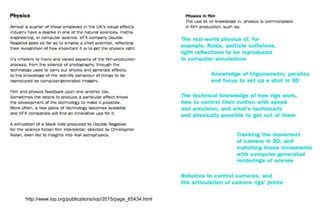
  • #12 Approx 25% of those employed in the UK’s visual effects industry have a degree in one of the natural sciences, maths, engineering, or computer science.
  • #14 Gravity – game changer Show breakdown showreel 400 people over 3 years Lighting the actors in previs Previs – actors have fairly accurate representation of what is happening and what to act against when in the lightbox which doesn’t have greenscreen Alfonso Cuaraon made the camera feel alive as if it was third character Immersed themselves in the reference materials – watched footage from NASA 2 years planning before shooting 80% CGI Script had been around Hollywood since 1995 but didn’t have the technology Motion Control rig – Bot and Dolly Then also Dneg maths and physics short film Divesifyication – Harry Potter theme parks (using VR Occulus headset) – geometry different from screening room Andy Nicholas film
  • #15 The handbook has been produced following a sustained dialogue between Creative Skillset, the industry and educators. It is a clear presentation of the VFX industry's voice on new entrant skills, setting out what skills the industry needs to remain world beating The Core Skills of VFX Handbook has one simple but ambitious aim: to improve the new entrant skills available for the UK's VFX industry The Core Skills of VFX is a comprehensive, modular guide to best practice in VFX education and training that draws on the knowledge and advice of more than 60 of the UK's top VFX professionals from many of the UKs leading companies. The handbook, which will be provided free to all universities and colleges across the UK, has been designed to give course tutors in-depth guidance on the skills that the next generation of VFX talent will need to keep our industry at the leading edge. The modular nature of the handbook will allow institutions to embed specific elements into their current courses, or use it in entirety to create brand new, industry-focused degree courses. It also contains a section for students, The VFX Core Skills Student Primer, with a guide to the core skills the industry needs - from technical elements to softer, often overlooked skills such as teamwork and meeting the client brief. Art of VFX – Capt America Milk – Dr Who, Sherlock MPC – Lone Ranger, WWZ, Percy Jackson, Dark Shadows NUKE Personal Learning Edition – do not worry about the watermark Maya 30 free trial Houdini – apprentice edition
  • #16 The handbook has been produced following a sustained dialogue between Creative Skillset, the industry and educators. It is a clear presentation of the VFX industry's voice on new entrant skills, setting out what skills the industry needs to remain world beating The Core Skills of VFX Handbook has one simple but ambitious aim: to improve the new entrant skills available for the UK's VFX industry The Core Skills of VFX is a comprehensive, modular guide to best practice in VFX education and training that draws on the knowledge and advice of more than 60 of the UK's top VFX professionals from many of the UKs leading companies. The handbook, which will be provided free to all universities and colleges across the UK, has been designed to give course tutors in-depth guidance on the skills that the next generation of VFX talent will need to keep our industry at the leading edge. The modular nature of the handbook will allow institutions to embed specific elements into their current courses, or use it in entirety to create brand new, industry-focused degree courses. It also contains a section for students, The VFX Core Skills Student Primer, with a guide to the core skills the industry needs - from technical elements to softer, often overlooked skills such as teamwork and meeting the client brief. Art of VFX – Capt America Milk – Dr Who, Sherlock MPC – Lone Ranger, WWZ, Percy Jackson, Dark Shadows NUKE Personal Learning Edition – do not worry about the watermark Maya 30 free trial Houdini – apprentice edition
  • #17 Content of talk: Importance of supporting the development of creative and technical skills, preparing young people with transferable 21st century skills.  The UK is a world leader of film VFX (kicked of by the Harry Potter franchise), and to retain our leading edge in this sector, need to have students aware that careers dependent on strong STEM and computing science backgrounds are essential.   Working in this sector involves problem solving skills, a creative vision to develop stories and ideas that capture an international audiences imagination, the iterative process of making visual effects means that sometimes things do not work but that is a not to be seen as a failure because you learn something from that process.  We need to encourage more students to think about STEM subjects because many industries that we in the UK excel in depend on them. Not enough engineers undertaking R&D; UK 5th largest economy in the world yet we are 22nd in the world rankings for countries for registering patents (according to James Dyson in Observer last month) Companies like Dneg rely on individuals who can come up with technical innovation, to push at the cinematic boundaries.  Need to invest in indigenous talent – Dneg current workforce, 50% non UK. Exciting time to be working (or considering working in the creative industries/film) A  2012 study by Oxford Economics estimates that the core UK film industry is a substantial industry, directly generating 43,900 full time equivalent (FTE) jobs and contributing £1.6 billion to national GDP. In employment terms, the industry is larger than fund management and the pharmaceutical manufacturing sector. Furthermore, the overall trend is very positive with employment increasing since 1995, mirroring film production levels (particularly inward investment). Creative Industries Employment (2011 –2012) The Creative Industries accounted for 1.68 million jobs in 2012, 5.6 per cent of the total number of jobs in the UK.  Employment in the Creative Industries increased by 8.6 per cent between 2011 and 2012 ,a higher rate than for the UK Economy as a whole (0.7%) – DCMS 2014 report Martini media - 2006 speech, Mark Thompson urged the BBC to embrace "martini media" – making content available any time, any place, anywhere. Eg. Film not just viewed in cinemas but on several platforms – knowledge of how your creative vision can be viewed on large or small format; transmedia, new jobs (Head of Data, Head of User Experience – film turned into themepark rides), Tax credits, film studios (we have 10 in the UK) like Pinewood seeking expansion, Bottle Yard (Bristol), Scotland still seeking to build studio (recent productions (Prometheus, Skyfall, Under the Skin, Sunshine on Leith, World War Z, Outlander last year and more recently Macbeth) VFX – world reputation, kickstarted off the back of the HP franchise Remember - Transferable skills – though talking of film also relevant for commercials, television, music videos, corporate films. Lots of different jobs in the 21st century skills – not just about technology but also employers particularly in the creative industries want self starters, problem solvers, to have creative streak but also have technical know how (to be analytical). Fusion Skills the overlapping zones of Art/Creativity, STEM and Enterprise, which is the motor in our world of skills. Importance of creative industries to GDP 21st century skills – fit for, responsive, (Eric Schmidt) Convergence – digital skills, media literacy, to develop skills as creators and not just consumers of content – polymaths (not boffins vs luvvies) Lewis Carroll wrote one of the classic fairy tales, Alice in Wonderland, and was also a mathematics tutor at Oxford. the UK needed to bring art and science back together Priority as we as a country have moved away from traditional forms of work and enterprise. Transferable skills – though talking of film also relevant for commercials, television, music videos, corporate films health/medicine sector, Latest CS employment census Fusion Skills Skills Shortage: Our skills and talent base form the backbone of the UK's world class and growing creative media industries but we need to invest in on-going skills development; aging workforce
  • #18 Content of talk: Importance of supporting the development of creative and technical skills, preparing young people with transferable 21st century skills.  The UK is a world leader of film VFX (kicked of by the Harry Potter franchise), and to retain our leading edge in this sector, need to have students aware that careers dependent on strong STEM and computing science backgrounds are essential.   Working in this sector involves problem solving skills, a creative vision to develop stories and ideas that capture an international audiences imagination, the iterative process of making visual effects means that sometimes things do not work but that is a not to be seen as a failure because you learn something from that process.  We need to encourage more students to think about STEM subjects because many industries that we in the UK excel in depend on them. Not enough engineers undertaking R&D; UK 5th largest economy in the world yet we are 22nd in the world rankings for countries for registering patents (according to James Dyson in Observer last month) Companies like Dneg rely on individuals who can come up with technical innovation, to push at the cinematic boundaries.  Need to invest in indigenous talent – Dneg current workforce, 50% non UK. Exciting time to be working (or considering working in the creative industries/film) A  2012 study by Oxford Economics estimates that the core UK film industry is a substantial industry, directly generating 43,900 full time equivalent (FTE) jobs and contributing £1.6 billion to national GDP. In employment terms, the industry is larger than fund management and the pharmaceutical manufacturing sector. Furthermore, the overall trend is very positive with employment increasing since 1995, mirroring film production levels (particularly inward investment). Creative Industries Employment (2011 –2012) The Creative Industries accounted for 1.68 million jobs in 2012, 5.6 per cent of the total number of jobs in the UK.  Employment in the Creative Industries increased by 8.6 per cent between 2011 and 2012 ,a higher rate than for the UK Economy as a whole (0.7%) – DCMS 2014 report Martini media - 2006 speech, Mark Thompson urged the BBC to embrace "martini media" – making content available any time, any place, anywhere. Eg. Film not just viewed in cinemas but on several platforms – knowledge of how your creative vision can be viewed on large or small format; transmedia, new jobs (Head of Data, Head of User Experience – film turned into themepark rides), Tax credits, film studios (we have 10 in the UK) like Pinewood seeking expansion, Bottle Yard (Bristol), Scotland still seeking to build studio (recent productions (Prometheus, Skyfall, Under the Skin, Sunshine on Leith, World War Z, Outlander last year and more recently Macbeth) VFX – world reputation, kickstarted off the back of the HP franchise Remember - Transferable skills – though talking of film also relevant for commercials, television, music videos, corporate films. Lots of different jobs in the 21st century skills – not just about technology but also employers particularly in the creative industries want self starters, problem solvers, to have creative streak but also have technical know how (to be analytical). Fusion Skills the overlapping zones of Art/Creativity, STEM and Enterprise, which is the motor in our world of skills. Importance of creative industries to GDP 21st century skills – fit for, responsive, (Eric Schmidt) Convergence – digital skills, media literacy, to develop skills as creators and not just consumers of content – polymaths (not boffins vs luvvies) Lewis Carroll wrote one of the classic fairy tales, Alice in Wonderland, and was also a mathematics tutor at Oxford. the UK needed to bring art and science back together Priority as we as a country have moved away from traditional forms of work and enterprise. Transferable skills – though talking of film also relevant for commercials, television, music videos, corporate films health/medicine sector, Latest CS employment census Fusion Skills Skills Shortage: Our skills and talent base form the backbone of the UK's world class and growing creative media industries but we need to invest in on-going skills development; aging workforce
  • #19 Content of talk: Importance of supporting the development of creative and technical skills, preparing young people with transferable 21st century skills.  The UK is a world leader of film VFX (kicked of by the Harry Potter franchise), and to retain our leading edge in this sector, need to have students aware that careers dependent on strong STEM and computing science backgrounds are essential.   Working in this sector involves problem solving skills, a creative vision to develop stories and ideas that capture an international audiences imagination, the iterative process of making visual effects means that sometimes things do not work but that is a not to be seen as a failure because you learn something from that process.  We need to encourage more students to think about STEM subjects because many industries that we in the UK excel in depend on them. Not enough engineers undertaking R&D; UK 5th largest economy in the world yet we are 22nd in the world rankings for countries for registering patents (according to James Dyson in Observer last month) Companies like Dneg rely on individuals who can come up with technical innovation, to push at the cinematic boundaries.  Need to invest in indigenous talent – Dneg current workforce, 50% non UK. Exciting time to be working (or considering working in the creative industries/film) A  2012 study by Oxford Economics estimates that the core UK film industry is a substantial industry, directly generating 43,900 full time equivalent (FTE) jobs and contributing £1.6 billion to national GDP. In employment terms, the industry is larger than fund management and the pharmaceutical manufacturing sector. Furthermore, the overall trend is very positive with employment increasing since 1995, mirroring film production levels (particularly inward investment). Creative Industries Employment (2011 –2012) The Creative Industries accounted for 1.68 million jobs in 2012, 5.6 per cent of the total number of jobs in the UK.  Employment in the Creative Industries increased by 8.6 per cent between 2011 and 2012 ,a higher rate than for the UK Economy as a whole (0.7%) – DCMS 2014 report Martini media - 2006 speech, Mark Thompson urged the BBC to embrace "martini media" – making content available any time, any place, anywhere. Eg. Film not just viewed in cinemas but on several platforms – knowledge of how your creative vision can be viewed on large or small format; transmedia, new jobs (Head of Data, Head of User Experience – film turned into themepark rides), Tax credits, film studios (we have 10 in the UK) like Pinewood seeking expansion, Bottle Yard (Bristol), Scotland still seeking to build studio (recent productions (Prometheus, Skyfall, Under the Skin, Sunshine on Leith, World War Z, Outlander last year and more recently Macbeth) VFX – world reputation, kickstarted off the back of the HP franchise Remember - Transferable skills – though talking of film also relevant for commercials, television, music videos, corporate films. Lots of different jobs in the 21st century skills – not just about technology but also employers particularly in the creative industries want self starters, problem solvers, to have creative streak but also have technical know how (to be analytical). Fusion Skills the overlapping zones of Art/Creativity, STEM and Enterprise, which is the motor in our world of skills. Importance of creative industries to GDP 21st century skills – fit for, responsive, (Eric Schmidt) Convergence – digital skills, media literacy, to develop skills as creators and not just consumers of content – polymaths (not boffins vs luvvies) Lewis Carroll wrote one of the classic fairy tales, Alice in Wonderland, and was also a mathematics tutor at Oxford. the UK needed to bring art and science back together Priority as we as a country have moved away from traditional forms of work and enterprise. Transferable skills – though talking of film also relevant for commercials, television, music videos, corporate films health/medicine sector, Latest CS employment census Fusion Skills Skills Shortage: Our skills and talent base form the backbone of the UK's world class and growing creative media industries but we need to invest in on-going skills development; aging workforce
  • #20 A key gap for the future is new and digital technology and particularly managing the change from traditional to digital media. In production digital camera skills and awareness are lacking For exhibition and distribution employers a key focus is exploiting opportunities such as online and digital sales, marketing and distribution and dealing with threats eg. file sharing. .
  • #23 The most important factors employers weigh up when recruiting school and college leavers are their attitudes to work (78%), their general aptitudes (57%) and literacy and numeracy (50%). These rank well ahead of academic results alone (37%) Having the right attitudes and aptitudes is by far the most important consideration when businesses are recruiting graduates – nearly nine in ten employers (88%) value these above other factors such as degree subject (67%) and degree class (48%) Being a problem solver, analytical; Fusion Skills The UK Commission for Employment and Skills (UKCES)[1] gives the simplest and most accessible definition of employability in terms of skills: 'the skills almost everyone needs to do almost any job'. This is a great definition as far as it goes, although employability is not just about skills, it’s also about capabilities or competencies: aptitude, attitude and behaviour. A survey carried out on behalf of the Institute of Directors (IoD) in October 2007 questioned 500 directors to gain their views on the skills and qualities they particularly valued in graduate employees. The top ten skills and qualities IoD members rated as being most important for recent graduates to possess noted. When asked to rate employability skills compared to the specific occupational, technical or academic knowledge and skills associated with their degree, 65% of graduate employers placed more importance on employability skills (Source: Institute of Directors skills briefing: December 2007). Identify what qualifies you for the role It isn't only paid experience that counts. Voluntary or community involvement, work placements, coursework, personal projects and extracurricular activities can all be highlighted to show your suitability. Think from the employer's perspective – decide on the most interesting factors, where you have used relevant skills, and then make these prominent on your CV. Make yourself irresistible to an employer – not just a list of traits – BACK UP WITH EXAMPLES One of the hardest things to do convincingly on a CV is to convey desirable personality traits. Just writing that you are enthusiastic or motivated without giving supporting details isn't enough. Instead, demonstrate through examples. Starting something from scratch and overcoming hurdles can show resourcefulness and determination Holding down a job to help family finances or pay your way through college can reveal humility and a strong work ethic: "Consistent work record: held variety of part-time roles since the age of 16 to contribute to educational costs." Learning about a role or sector through online communities, upskilling through tutorials or conducting your own projects all show enthusiasm – it could fit into the education, training or skills section of your CV. HUMAN BINGO
  • #24 The most important factors employers weigh up when recruiting school and college leavers are their attitudes to work (78%), their general aptitudes (57%) and literacy and numeracy (50%). These rank well ahead of academic results alone (37%) Having the right attitudes and aptitudes is by far the most important consideration when businesses are recruiting graduates – nearly nine in ten employers (88%) value these above other factors such as degree subject (67%) and degree class (48%) Being a problem solver, analytical; Fusion Skills The UK Commission for Employment and Skills (UKCES)[1] gives the simplest and most accessible definition of employability in terms of skills: 'the skills almost everyone needs to do almost any job'. This is a great definition as far as it goes, although employability is not just about skills, it’s also about capabilities or competencies: aptitude, attitude and behaviour. A survey carried out on behalf of the Institute of Directors (IoD) in October 2007 questioned 500 directors to gain their views on the skills and qualities they particularly valued in graduate employees. The top ten skills and qualities IoD members rated as being most important for recent graduates to possess noted. When asked to rate employability skills compared to the specific occupational, technical or academic knowledge and skills associated with their degree, 65% of graduate employers placed more importance on employability skills (Source: Institute of Directors skills briefing: December 2007). Identify what qualifies you for the role It isn't only paid experience that counts. Voluntary or community involvement, work placements, coursework, personal projects and extracurricular activities can all be highlighted to show your suitability. Think from the employer's perspective – decide on the most interesting factors, where you have used relevant skills, and then make these prominent on your CV. Make yourself irresistible to an employer – not just a list of traits – BACK UP WITH EXAMPLES One of the hardest things to do convincingly on a CV is to convey desirable personality traits. Just writing that you are enthusiastic or motivated without giving supporting details isn't enough. Instead, demonstrate through examples. Starting something from scratch and overcoming hurdles can show resourcefulness and determination Holding down a job to help family finances or pay your way through college can reveal humility and a strong work ethic: "Consistent work record: held variety of part-time roles since the age of 16 to contribute to educational costs." Learning about a role or sector through online communities, upskilling through tutorials or conducting your own projects all show enthusiasm – it could fit into the education, training or skills section of your CV. HUMAN BINGO
  • #25 The College of Production provides practical advice on all aspects of working in television, radio and online broadcast. This website is for everyone who wants to get into, get better and go further in their broadcast career.
  • #26 BBC Academy. We put training and development at the heart of the BBC and also work with the wider industry, equipping people with skills they need for a lifetime of employability in the ever-changing media landscape. Creative Choices: Our Creative Choices events give 13-16 year olds the chance to learn about working in music, theatre, design and cultural heritage. Our Production Days give aspiring backstage crew the chance to work at some of the country’s biggest music festivals. Our Technical Masterclasses provide bespoke training for young professionals with some of the leading practitioners within theatre and live events (is part of CCS) Creative Access Media cannot reflect society, if society is not reflected in the media Creative Access is looking for talented young people from Black, Asian and minority ethnic backgrounds to fill paid internship places at many of the UK’s top media organisations. Advertising - Film -  Journalism - Marketing -  Music - PR -  Publishing - Talent - Television - Theatre