TRADE
TABLE OF CONTENTS
CORPORATE FINANCE CORPORATE FINANCE BASICS
Decision Support System (DSS): What It Is and How Businesses Use Them
By TROY SEGAL Updated June 07, 2024
Reviewed by MARGARET JAMES
Fact checked by SUZANNE KVILHAUG
Decision Support System
Investopedia / Michela Buttignol
What Is a Decision Support System (DSS)?
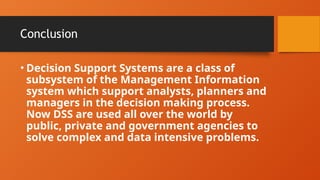
A decision support system (DSS) is a computerized program used to support determinations, judgments, and courses of action in an organization or a business. A DSS sifts through and analyzes massive amounts of data, compiling comprehensive information that can be used to solve problems and in decision-making.
Typical information used by a DSS includes target or projected revenue, sales figures or past ones from different time periods, and other inventory- or operations-related data.
KEY TAKEAWAYS
A decision support system (DSS) is a computerized system that gathers and analyzes data, synthesizing it to produce comprehensive information reports.
A decision support system differs from an ordinary operations application, whose function is just to collect data.
Decision support systems allow for more informed decision-making, timely problem-solving, and improved efficiency in dealing with issues or operations, planning, and even management.
Understanding a Decision Support System (DSS)
A decision support system gathers and analyzes data, synthesizing it to produce comprehensive information reports. In this way, as an informational application, a DSS differs from an ordinary operations application, whose function is just to collect data.
The DSS can either be completely computerized or powered by humans. In some cases, it may combine both. The ideal systems analyze information and actually make decisions for the user. At the very least, they allow human users to make more informed decisions at a quicker pace.
One of the first data-driven DSS was developed at American Airlines in the 1970s.1
Using a DSS
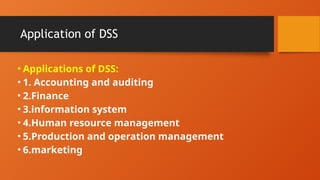
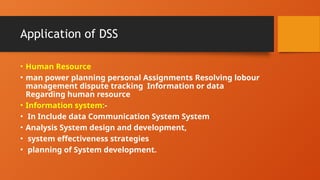
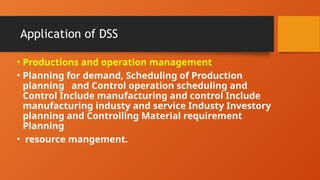
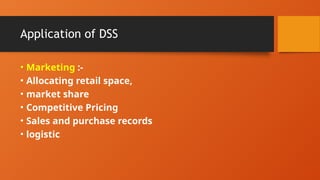
The DSS can be employed by operations management and other planning departments in an organization to compile information and data and synthesize it into actionable intelligence. In fact, these systems are primarily used by mid- to upper-level management.
For example, a DSS may be used to project a company's revenue over the upcoming six months based on new assumptions about product sales. Due to a large number of factors that surround projected revenue figures, this is not a straightforward calculation that can be done manually. However, a DSS can integrate all the multiple variables and generate an outcome and alternate outcomes, all based on the company's past product sales data and current variables.
A DSS can be tailored for any industry, profession, or domain including the medical field, government agencies, agricultural concerns, and corporate operations.
Characteristics of a DSS
The primary purpose of using a DSS is to present information to the customer in an easy-to-understand way. A DSS system is beneficial




![[2020] week09 a dss - ver01](https://cdn.slidesharecdn.com/ss_thumbnails/2020week09a-dss-ver01-201203074447-thumbnail.jpg?width=640&height=640&fit=bounds)


