Decidablity
Following are the decidable problems w.r.t.
CFG
1. Whether or not the given CFG generates
any word? Problem of emptiness of CFL.
2. Whether or not the given CFG generates
the finite language? Problem of finiteness.
3. Whether or not the given string w can be
generated by the given CFG? Problem of
membership.
Following are algorithms showing that the
answers to the above three questions are yes.
Algorithm 1 (Emptiness): If the given CFG
contains a production of the form S  ˄, then
obviously the corresponding CFL is empty.
If the CFG contains the production of the form
S  t, where t is a terminal or string of
terminal then t is a word of the corresponding
CFL and CFL is not empty.
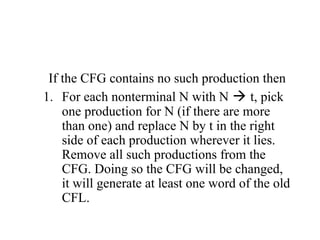
If the CFG contains no such production then
1. For each nonterminal N with N  t, pick
one production for N (if there are more
than one) and replace N by t in the right
side of each production wherever it lies.
Remove all such productions from the
CFG. Doing so the CFG will be changed,
it will generate at least one word of the old
CFL.
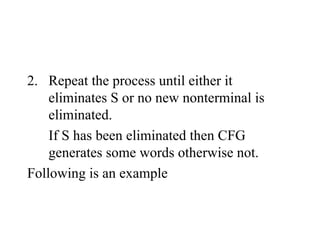
2. Repeat the process until either it
eliminates S or no new nonterminal is
eliminated.
If S has been eliminated then CFG
generates some words otherwise not.
Following is an example
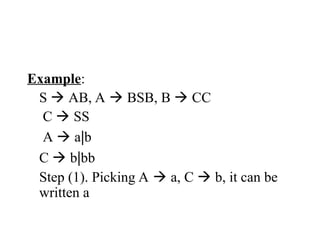
Example:
S  AB, A  BSB, B  CC
C  SS
A  a|b
C  b|bb
Step (1). Picking A  a, C  b, it can be
written a
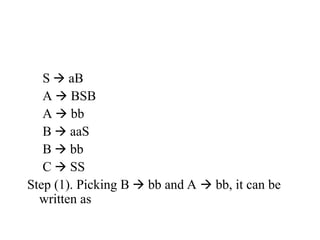
S  aB
A  BSB
A  bb
B  aaS
B  bb
C  SS
Step (1). Picking B  bb and A  bb, it can be
written as
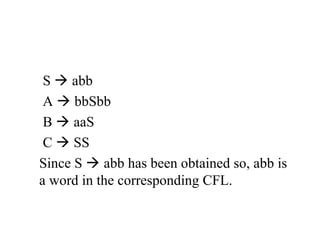
S  abb
A  bbSbb
B  aaS
C  SS
Since S  abb has been obtained so, abb is
a word in the corresponding CFL.
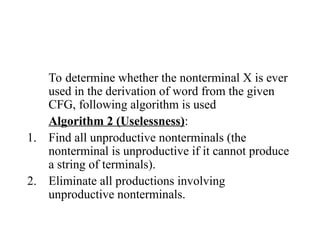
To determine whether the nonterminal X is ever
used in the derivation of word from the given
CFG, following algorithm is used
Algorithm 2 (Uselessness):
1. Find all unproductive nonterminals (the
nonterminal is unproductive if it cannot produce
a string of terminals).
2. Eliminate all productions involving
unproductive nonterminals.
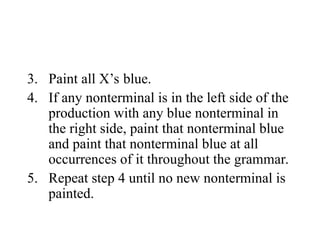
3. Paint all X’s blue.
4. If any nonterminal is in the left side of the
production with any blue nonterminal in
the right side, paint that nonterminal blue
and paint that nonterminal blue at all
occurrences of it throughout the grammar.
5. Repeat step 4 until no new nonterminal is
painted.
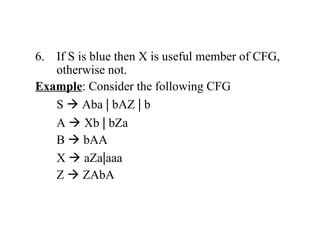
6. If S is blue then X is useful member of CFG,
otherwise not.
Example: Consider the following CFG
S  Aba | bAZ | b
A  Xb | bZa
B  bAA
X  aZa|aaa
Z  ZAbA
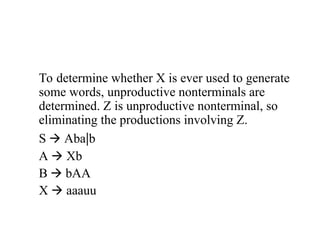
To determine whether X is ever used to generate
some words, unproductive nonterminals are
determined. Z is unproductive nonterminal, so
eliminating the productions involving Z.
S  Aba|b
A  Xb
B  bAA
X  aaauu
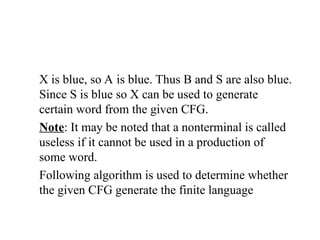
X is blue, so A is blue. Thus B and S are also blue.
Since S is blue so X can be used to generate
certain word from the given CFG.
Note: It may be noted that a nonterminal is called
useless if it cannot be used in a production of
some word.
Following algorithm is used to determine whether
the given CFG generate the finite language
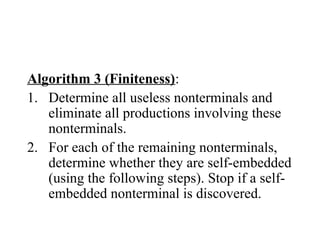
Algorithm 3 (Finiteness):
1. Determine all useless nonterminals and
eliminate all productions involving these
nonterminals.
2. For each of the remaining nonterminals,
determine whether they are self-embedded
(using the following steps). Stop if a self-
embedded nonterminal is discovered.
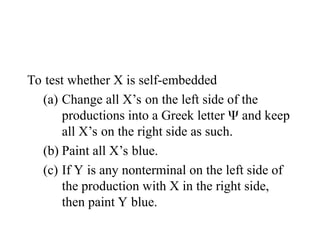
To test whether X is self-embedded
(a) Change all X’s on the left side of the
productions into a Greek letter  and keep
all X’s on the right side as such.
(b) Paint all X’s blue.
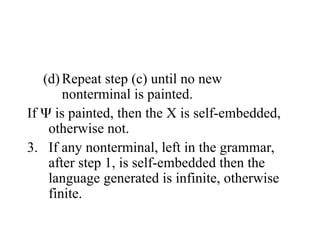
(c) If Y is any nonterminal on the left side of
the production with X in the right side,
then paint Y blue.
(d)Repeat step (c) until no new
nonterminal is painted.
If  is painted, then the X is self-embedded,
otherwise not.
3. If any nonterminal, left in the grammar,
after step 1, is self-embedded then the
language generated is infinite, otherwise
finite.
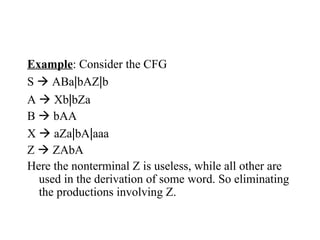
Example: Consider the CFG
S  ABa|bAZ|b
A  Xb|bZa
B  bAA
X  aZa|bA|aaa
Z  ZAbA
Here the nonterminal Z is useless, while all other are
used in the derivation of some word. So eliminating
the productions involving Z.
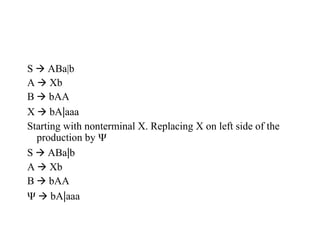
S  ABa|b
A  Xb
B  bAA
X  bA|aaa
Starting with nonterminal X. Replacing X on left side of the
production by 
S  ABa|b
A  Xb
B  bAA
  bA|aaa
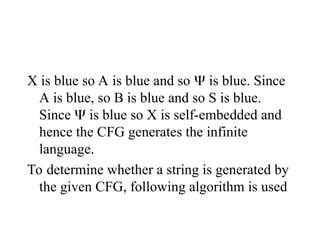
X is blue so A is blue and so  is blue. Since
A is blue, so B is blue and so S is blue.
Since  is blue so X is self-embedded and
hence the CFG generates the infinite
language.
To determine whether a string is generated by
the given CFG, following algorithm is used
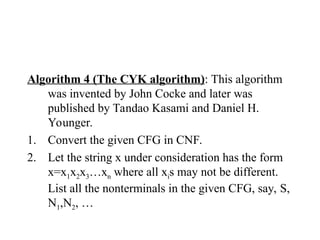
Algorithm 4 (The CYK algorithm): This algorithm
was invented by John Cocke and later was
published by Tandao Kasami and Daniel H.
Younger.
1. Convert the given CFG in CNF.
2. Let the string x under consideration has the form
x=x1x2x3…xn where all xis may not be different.
List all the nonterminals in the given CFG, say, S,
N1,N2, …
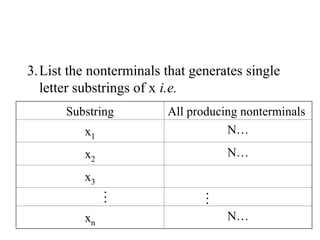
3.List the nonterminals that generates single
letter substrings of x i.e.
Substring All producing nonterminals
x1
N…
x2
N…
x3
xn
N…
…
…
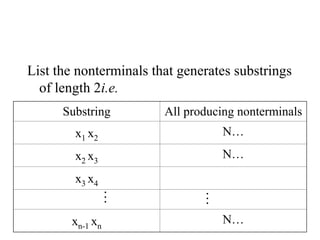
List the nonterminals that generates substrings
of length 2i.e.
Substring All producing nonterminals
x1 x2
N…
x2 x3
N…
x3 x4
xn-1 xn
N…
…
…
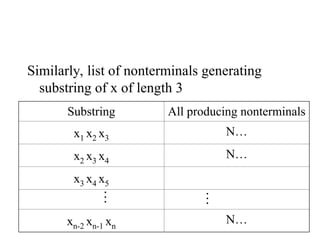
Similarly, list of nonterminals generating
substring of x of length 3
Substring All producing nonterminals
x1 x2 x3
N…
x2 x3 x4
N…
x3 x4 x5
xn-2 xn-1 xn
N…
…
…
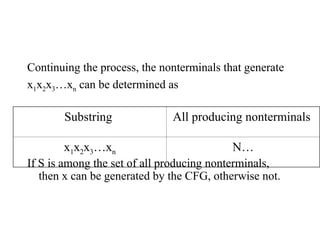
Continuing the process, the nonterminals that generate
x1x2x3…xn can be determined as
If S is among the set of all producing nonterminals,
then x can be generated by the CFG, otherwise not.
Substring All producing nonterminals
x1x2x3…xn N…
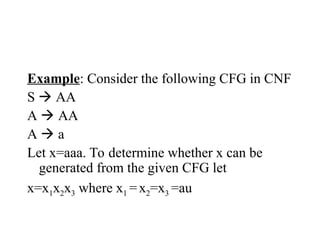
Example: Consider the following CFG in CNF
S  AA
A  AA
A  a
Let x=aaa. To determine whether x can be
generated from the given CFG let
x=x1x2x3 where x1 =x2=x3 =au
According to CYK algorithm, the list of
nonterminals producing single letter double
letter substrings of x and the string x itself,
can be determined as follows
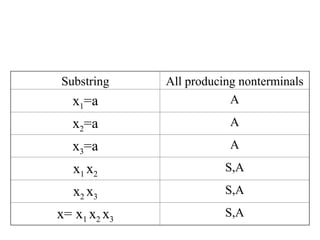
Substring All producing nonterminals
x1=a A
x2=a A
x3=a A
x1 x2
S,A
x2 x3
S,A
x= x1 x2 x3
S,A
Since S is in the list of producing
nonterminals, so aaa can be generated by
the given CFG.
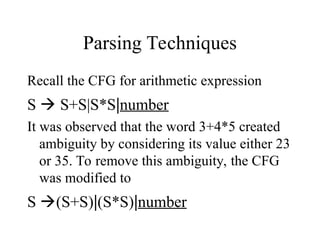
Parsing Techniques
Recall the CFG for arithmetic expression
S  S+S|S*S|number
It was observed that the word 3+4*5 created
ambiguity by considering its value either 23
or 35. To remove this ambiguity, the CFG
was modified to
S (S+S)|(S*S)|number
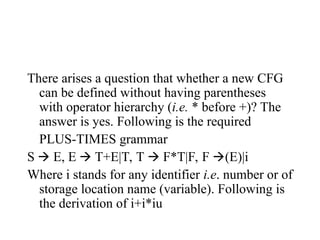
There arises a question that whether a new CFG
can be defined without having parentheses
with operator hierarchy (i.e. * before +)? The
answer is yes. Following is the required
PLUS-TIMES grammar
S  E, E  T+E|T, T  F*T|F, F (E)|i
Where i stands for any identifier i.e. number or of
storage location name (variable). Following is
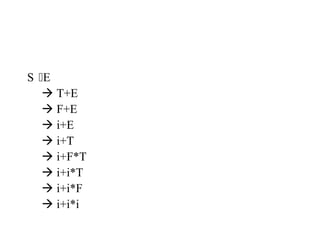
the derivation of i+i*iu
S E
 T+E
 F+E
 i+E
 i+T
 i+F*T
 i+i*T
 i+i*F
 i+i*i
Parsing of word
Definition: the process of finding the derivation
of word generated by particular grammar is
called parsing.
There are different parsing techniques, containing
the following three
1. Top down parsing.
2. Bottom up parsing.
3. Parsing technique for particular grammar of
arithmetic expression.
Top down parsing
Following is an example showing top down parsing
technique
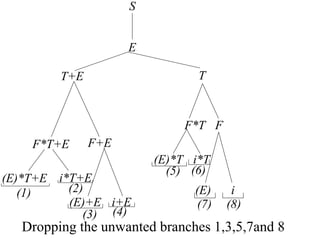
Example: Consider PLUS-TIMES grammar and a
word i+i*i.
As can be observed from the name of top down
parsing, the parsing starts from the nonterminal S
and the structure similar to that of total language
tree is developed. The branches of the tree are
extended till the required word is found as a
branch.
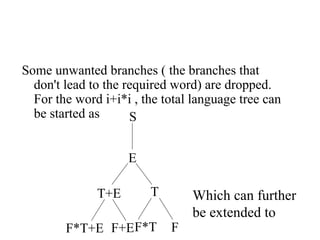
E
T+E T
F*T F
S
F*T+E F+E
Some unwanted branches ( the branches that
don't lead to the required word) are dropped.
For the word i+i*i , the total language tree can
be started as
Which can further
be extended to
E
T+E T
S
F*T F
F+E
F*T+E
(E)*T+E i*T+E
(E)+E i+E
(E)*T i*T
(E) i
(1) (2)
(3) (4)
(5) (6)
(7) (8)
Dropping the unwanted branches 1,3,5,7and 8
E
T+E T
S
F*T
F+E
F*T+E
i*T
i+E
i*T+E
(4)
(6)
(2)
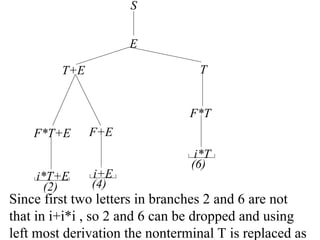
Since first two letters in branches 2 and 6 are not
that in i+i*i , so 2 and 6 can be dropped and using
left most derivation the nonterminal T is replaced as
i+E
i+T+E i+T
S
i+F+E
i+F*T+E
(12)
(9)
i+F
i+F*T
(10) (11)
E
T+E
F+E
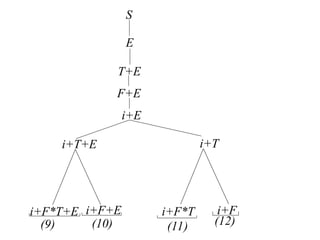
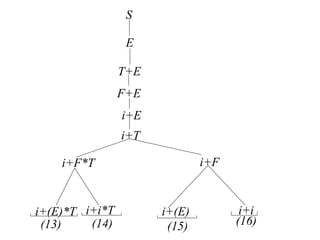
since (9) gives more than five letters and
(10) contains two + so (9) and (10) are
dropped and left most nonterminal F is
replaced as
i+E
i+F*T i+F
S
i+i*T
i+(E)*T
(16)
(13)
i+i
i+(E)
(14) (15)
E
T+E
F+E
i+T
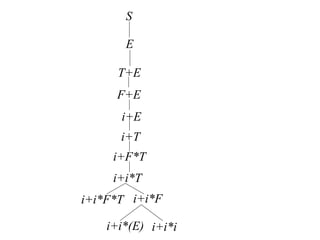
(13), (15) and (16) are again unwanted, so it
can be written as
i+E
S
E
T+E
F+E
i+T
i+F*T
i+i*T
i+i*F*T i+i*F
i+i*(E) i+i*i
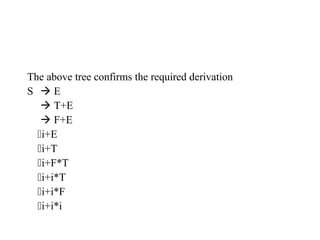
The above tree confirms the required derivation
S  E
 T+E
 F+E
i+E
i+T
i+F*T
i+i*T
i+i*F
i+i*i
Note
It can be noted that Bottom Up Parsing can
be determined similar to that of Top Down
Parsing with the change that in this case, the
process is started with the given string and
the tree is extended till S is obtained.
Summing Up
Decidability, whether a CFG generates certain
string (emptiness), examples, whether a
nonterminal is used in the derivation of
some word (uselessness), examples,
whether a CFL is finite (finiteness),
example, whether the given string is
generated by the given CFG (membership),
example, parsing techniques, top down
parsing, example
decidability context free grammar in automata

  • 1.
    Decidablity Following are thedecidable problems w.r.t. CFG 1. Whether or not the given CFG generates any word? Problem of emptiness of CFL. 2. Whether or not the given CFG generates the finite language? Problem of finiteness. 3. Whether or not the given string w can be generated by the given CFG? Problem of membership.
  • 2.
    Following are algorithmsshowing that the answers to the above three questions are yes. Algorithm 1 (Emptiness): If the given CFG contains a production of the form S  ˄, then obviously the corresponding CFL is empty. If the CFG contains the production of the form S  t, where t is a terminal or string of terminal then t is a word of the corresponding CFL and CFL is not empty.
  • 3.
    If the CFGcontains no such production then 1. For each nonterminal N with N  t, pick one production for N (if there are more than one) and replace N by t in the right side of each production wherever it lies. Remove all such productions from the CFG. Doing so the CFG will be changed, it will generate at least one word of the old CFL.
  • 4.
    2. Repeat theprocess until either it eliminates S or no new nonterminal is eliminated. If S has been eliminated then CFG generates some words otherwise not. Following is an example
  • 5.
    Example: S  AB,A  BSB, B  CC C  SS A  a|b C  b|bb Step (1). Picking A  a, C  b, it can be written a
  • 6.
    S  aB A BSB A  bb B  aaS B  bb C  SS Step (1). Picking B  bb and A  bb, it can be written as
  • 7.
    S  abb A bbSbb B  aaS C  SS Since S  abb has been obtained so, abb is a word in the corresponding CFL.
  • 8.
    To determine whetherthe nonterminal X is ever used in the derivation of word from the given CFG, following algorithm is used Algorithm 2 (Uselessness): 1. Find all unproductive nonterminals (the nonterminal is unproductive if it cannot produce a string of terminals). 2. Eliminate all productions involving unproductive nonterminals.
  • 9.
    3. Paint allX’s blue. 4. If any nonterminal is in the left side of the production with any blue nonterminal in the right side, paint that nonterminal blue and paint that nonterminal blue at all occurrences of it throughout the grammar. 5. Repeat step 4 until no new nonterminal is painted.
  • 10.
    6. If Sis blue then X is useful member of CFG, otherwise not. Example: Consider the following CFG S  Aba | bAZ | b A  Xb | bZa B  bAA X  aZa|aaa Z  ZAbA
  • 11.
    To determine whetherX is ever used to generate some words, unproductive nonterminals are determined. Z is unproductive nonterminal, so eliminating the productions involving Z. S  Aba|b A  Xb B  bAA X  aaauu
  • 12.
    X is blue,so A is blue. Thus B and S are also blue. Since S is blue so X can be used to generate certain word from the given CFG. Note: It may be noted that a nonterminal is called useless if it cannot be used in a production of some word. Following algorithm is used to determine whether the given CFG generate the finite language
  • 13.
    Algorithm 3 (Finiteness): 1.Determine all useless nonterminals and eliminate all productions involving these nonterminals. 2. For each of the remaining nonterminals, determine whether they are self-embedded (using the following steps). Stop if a self- embedded nonterminal is discovered.
  • 14.
    To test whetherX is self-embedded (a) Change all X’s on the left side of the productions into a Greek letter  and keep all X’s on the right side as such. (b) Paint all X’s blue. (c) If Y is any nonterminal on the left side of the production with X in the right side, then paint Y blue.
  • 15.
    (d)Repeat step (c)until no new nonterminal is painted. If  is painted, then the X is self-embedded, otherwise not. 3. If any nonterminal, left in the grammar, after step 1, is self-embedded then the language generated is infinite, otherwise finite.
  • 16.
    Example: Consider theCFG S  ABa|bAZ|b A  Xb|bZa B  bAA X  aZa|bA|aaa Z  ZAbA Here the nonterminal Z is useless, while all other are used in the derivation of some word. So eliminating the productions involving Z.
  • 17.
    S  ABa|b A Xb B  bAA X  bA|aaa Starting with nonterminal X. Replacing X on left side of the production by  S  ABa|b A  Xb B  bAA   bA|aaa
  • 18.
    X is blueso A is blue and so  is blue. Since A is blue, so B is blue and so S is blue. Since  is blue so X is self-embedded and hence the CFG generates the infinite language. To determine whether a string is generated by the given CFG, following algorithm is used
  • 19.
    Algorithm 4 (TheCYK algorithm): This algorithm was invented by John Cocke and later was published by Tandao Kasami and Daniel H. Younger. 1. Convert the given CFG in CNF. 2. Let the string x under consideration has the form x=x1x2x3…xn where all xis may not be different. List all the nonterminals in the given CFG, say, S, N1,N2, …
  • 20.
    3.List the nonterminalsthat generates single letter substrings of x i.e. Substring All producing nonterminals x1 N… x2 N… x3 xn N… … …
  • 21.
    List the nonterminalsthat generates substrings of length 2i.e. Substring All producing nonterminals x1 x2 N… x2 x3 N… x3 x4 xn-1 xn N… … …
  • 22.
    Similarly, list ofnonterminals generating substring of x of length 3 Substring All producing nonterminals x1 x2 x3 N… x2 x3 x4 N… x3 x4 x5 xn-2 xn-1 xn N… … …
  • 23.
    Continuing the process,the nonterminals that generate x1x2x3…xn can be determined as If S is among the set of all producing nonterminals, then x can be generated by the CFG, otherwise not. Substring All producing nonterminals x1x2x3…xn N…
  • 24.
    Example: Consider thefollowing CFG in CNF S  AA A  AA A  a Let x=aaa. To determine whether x can be generated from the given CFG let x=x1x2x3 where x1 =x2=x3 =au
  • 25.
    According to CYKalgorithm, the list of nonterminals producing single letter double letter substrings of x and the string x itself, can be determined as follows
  • 26.
    Substring All producingnonterminals x1=a A x2=a A x3=a A x1 x2 S,A x2 x3 S,A x= x1 x2 x3 S,A
  • 27.
    Since S isin the list of producing nonterminals, so aaa can be generated by the given CFG.
  • 28.
    Parsing Techniques Recall theCFG for arithmetic expression S  S+S|S*S|number It was observed that the word 3+4*5 created ambiguity by considering its value either 23 or 35. To remove this ambiguity, the CFG was modified to S (S+S)|(S*S)|number
  • 29.
    There arises aquestion that whether a new CFG can be defined without having parentheses with operator hierarchy (i.e. * before +)? The answer is yes. Following is the required PLUS-TIMES grammar S  E, E  T+E|T, T  F*T|F, F (E)|i Where i stands for any identifier i.e. number or of storage location name (variable). Following is the derivation of i+i*iu
  • 30.
    S E  T+E F+E  i+E  i+T  i+F*T  i+i*T  i+i*F  i+i*i
  • 31.
    Parsing of word Definition:the process of finding the derivation of word generated by particular grammar is called parsing. There are different parsing techniques, containing the following three 1. Top down parsing. 2. Bottom up parsing. 3. Parsing technique for particular grammar of arithmetic expression.
  • 32.
    Top down parsing Followingis an example showing top down parsing technique Example: Consider PLUS-TIMES grammar and a word i+i*i. As can be observed from the name of top down parsing, the parsing starts from the nonterminal S and the structure similar to that of total language tree is developed. The branches of the tree are extended till the required word is found as a branch.
  • 33.
    E T+E T F*T F S F*T+EF+E Some unwanted branches ( the branches that don't lead to the required word) are dropped. For the word i+i*i , the total language tree can be started as Which can further be extended to
  • 34.
    E T+E T S F*T F F+E F*T+E (E)*T+Ei*T+E (E)+E i+E (E)*T i*T (E) i (1) (2) (3) (4) (5) (6) (7) (8) Dropping the unwanted branches 1,3,5,7and 8
  • 35.
    E T+E T S F*T F+E F*T+E i*T i+E i*T+E (4) (6) (2) Since firsttwo letters in branches 2 and 6 are not that in i+i*i , so 2 and 6 can be dropped and using left most derivation the nonterminal T is replaced as
  • 36.
  • 37.
    since (9) givesmore than five letters and (10) contains two + so (9) and (10) are dropped and left most nonterminal F is replaced as
  • 38.
  • 39.
    (13), (15) and(16) are again unwanted, so it can be written as
  • 40.
  • 41.
    The above treeconfirms the required derivation S  E  T+E  F+E i+E i+T i+F*T i+i*T i+i*F i+i*i
  • 42.
    Note It can benoted that Bottom Up Parsing can be determined similar to that of Top Down Parsing with the change that in this case, the process is started with the given string and the tree is extended till S is obtained.
  • 43.
    Summing Up Decidability, whethera CFG generates certain string (emptiness), examples, whether a nonterminal is used in the derivation of some word (uselessness), examples, whether a CFL is finite (finiteness), example, whether the given string is generated by the given CFG (membership), example, parsing techniques, top down parsing, example