Dental
What is tooth decay?
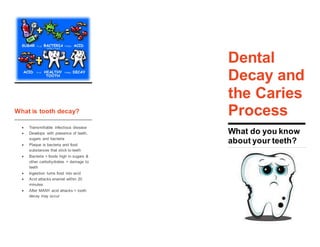
 Transmittable infectious disease
 Develops with presence of teeth,
sugars and bacteria
 Plaque is bacteria and food
substances that stick to teeth
 Bacteria + foods high in sugars &
other carbohydrates = damage to
teeth
 Ingestion turns food into acid
 Acid attacks enamel within 20
minutes
 After MANY acid attacks = tooth
decay may occur
Dental
Decay and
the Caries
Process
What do you know
about your teeth?
The Caries Balance
Pathological Factors = Caries
 Acid-producing bacteria
 Frequently eating/drinking of
fermentable carbohydrates
 Subnormal saliva flow and/or
function
Protective Factors = No Cares
 Saliva flow & components
 Fluoride, calcium, phosphate
 Antibacterials: chlorhexidine,
iodine, xylitol
The balance can be used to assess the
risk of developing caries in the future,
or why you have caries now. The
balance between demineralization &
remineralization isthe KEY to
progression or reversal of dental caries
at any time.
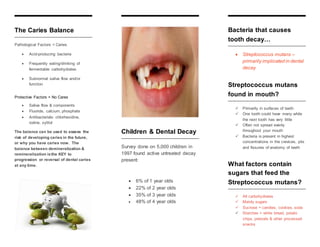
Children & Dental Decay
Survey done on 5,000 children in
1997 found active untreated decay
present:
 6% of 1 year olds
 22% of 2 year olds
 35% of 3 year olds
 48% of 4 year olds
Bacteria that causes
tooth decay…
 Streptococcus mutans –
primarily implicated in dental
decay
Streptococcus mutans
found in mouth?
 Primarily in surfaces of teeth
 One tooth could have many while
the next tooth has very little
 Often not spread evenly
throughout your mouth
 Bacteria is present in highest
concentrations in the crevices, pits
and fissures of anatomy of teeth
What factors contain
sugars that feed the
Streptococcus mutans?
 All carbohydrates
 Mainly sugars
 Sucrose = candies, cookies, soda
 Starches = white bread, potato
chips, pretzels & other processed
snacks

Decay Process

  • 1.
    Dental What is toothdecay?  Transmittable infectious disease  Develops with presence of teeth, sugars and bacteria  Plaque is bacteria and food substances that stick to teeth  Bacteria + foods high in sugars & other carbohydrates = damage to teeth  Ingestion turns food into acid  Acid attacks enamel within 20 minutes  After MANY acid attacks = tooth decay may occur Dental Decay and the Caries Process What do you know about your teeth?
  • 2.
    The Caries Balance PathologicalFactors = Caries  Acid-producing bacteria  Frequently eating/drinking of fermentable carbohydrates  Subnormal saliva flow and/or function Protective Factors = No Cares  Saliva flow & components  Fluoride, calcium, phosphate  Antibacterials: chlorhexidine, iodine, xylitol The balance can be used to assess the risk of developing caries in the future, or why you have caries now. The balance between demineralization & remineralization isthe KEY to progression or reversal of dental caries at any time. Children & Dental Decay Survey done on 5,000 children in 1997 found active untreated decay present:  6% of 1 year olds  22% of 2 year olds  35% of 3 year olds  48% of 4 year olds Bacteria that causes tooth decay…  Streptococcus mutans – primarily implicated in dental decay Streptococcus mutans found in mouth?  Primarily in surfaces of teeth  One tooth could have many while the next tooth has very little  Often not spread evenly throughout your mouth  Bacteria is present in highest concentrations in the crevices, pits and fissures of anatomy of teeth What factors contain sugars that feed the Streptococcus mutans?  All carbohydrates  Mainly sugars  Sucrose = candies, cookies, soda  Starches = white bread, potato chips, pretzels & other processed snacks