The Great Debate
The Roles…
• Opening Statement Presenter (1)
• Statement/Rebuttal Presenters (3)
• Closing Statement Presenter (1)
Opening Statement
• Gather your primary arguments into an opening statement
• Succinct
• No nonsense
• “This is true because of A, B, and C”
• Create original and creative arguments
• Give your team an ADVANTAGE
• Everyone has read the book…use close reading, archetypes, and
literary devices
• RESEARCH…use examples from other books, movies, history, etc.
as evidence for your claim, make it relevant to your audience
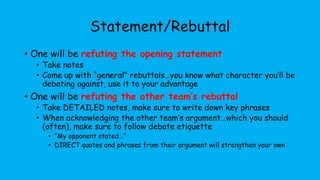
Statement/Rebuttal
• One will be refuting the opening statement
• Take notes
• Come up with “general” rebuttals…you know what character you’ll be
debating against, use it to your advantage
• One will be refuting the other team’s rebuttal
• Take DETAILED notes, make sure to write down key phrases
• When acknowledging the other team’s argument…which you should
(often), make sure to follow debate etiquette
• “My opponent stated…”
• DIRECT quotes and phrases from their argument will strengthen your own
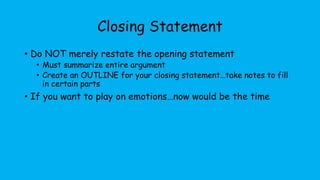
Closing Statement
• Do NOT merely restate the opening statement
• Must summarize entire argument
• Create an OUTLINE for your closing statement…take notes to fill
in certain parts
• If you want to play on emotions…now would be the time
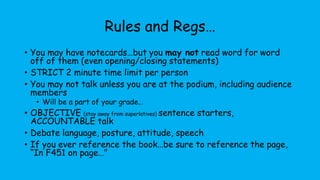
Rules and Regs…
• You may have notecards…but you may not read word for word
off of them (even opening/closing statements)
• STRICT 2 minute time limit per person
• You may not talk unless you are at the podium, including audience
members
• Will be a part of your grade…
• OBJECTIVE (stay away from superlatives) sentence starters,
ACCOUNTABLE talk
• Debate language, posture, attitude, speech
• If you ever reference the book…be sure to reference the page,
“In F451 on page…”
Agenda for today…meet in groups
• Assign roles/order
• Opening Statement
• Statement 1/Rebuttal 1
• Statement 2/Rebuttal 2
• Statement 3/Rebuttal 3
• Closing Statement
• Create Opening/Closing statements
• Incorporate research
• Create potential rebuttal situations
• REHEARSE, time your arguments

Debate.pptx

  • 1.
  • 2.
    The Roles… • OpeningStatement Presenter (1) • Statement/Rebuttal Presenters (3) • Closing Statement Presenter (1)
  • 3.
    Opening Statement • Gatheryour primary arguments into an opening statement • Succinct • No nonsense • “This is true because of A, B, and C” • Create original and creative arguments • Give your team an ADVANTAGE • Everyone has read the book…use close reading, archetypes, and literary devices • RESEARCH…use examples from other books, movies, history, etc. as evidence for your claim, make it relevant to your audience
  • 4.
    Statement/Rebuttal • One willbe refuting the opening statement • Take notes • Come up with “general” rebuttals…you know what character you’ll be debating against, use it to your advantage • One will be refuting the other team’s rebuttal • Take DETAILED notes, make sure to write down key phrases • When acknowledging the other team’s argument…which you should (often), make sure to follow debate etiquette • “My opponent stated…” • DIRECT quotes and phrases from their argument will strengthen your own
  • 5.
    Closing Statement • DoNOT merely restate the opening statement • Must summarize entire argument • Create an OUTLINE for your closing statement…take notes to fill in certain parts • If you want to play on emotions…now would be the time
  • 6.
    Rules and Regs… •You may have notecards…but you may not read word for word off of them (even opening/closing statements) • STRICT 2 minute time limit per person • You may not talk unless you are at the podium, including audience members • Will be a part of your grade… • OBJECTIVE (stay away from superlatives) sentence starters, ACCOUNTABLE talk • Debate language, posture, attitude, speech • If you ever reference the book…be sure to reference the page, “In F451 on page…”
  • 7.
    Agenda for today…meetin groups • Assign roles/order • Opening Statement • Statement 1/Rebuttal 1 • Statement 2/Rebuttal 2 • Statement 3/Rebuttal 3 • Closing Statement • Create Opening/Closing statements • Incorporate research • Create potential rebuttal situations • REHEARSE, time your arguments