








DEATH PENALTY
RAQUEL BAÑOLAS SUÁREZ
MILÁN SANTANA BAÑOLAS
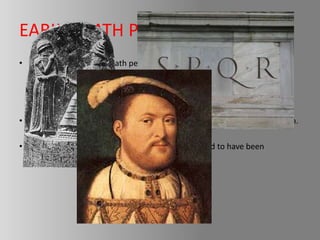
EARLY DEATH PENALTY LAWS:
• The first established death penalty law date in the Eighteenth Century
  B.C., and it used in other civilizations from the past, for example, in the
  Hittie code (Fourteenth Century B.C), the Draconian Code of Athens and
  the Roman Law of the Twelve Tablets.

• In Britain (Tenth Century A.D) hanging was the usual method of execution.

• During the reign of Henry VIII 72,000 are estimated to have been
  executed.
Death Penalty in America
                       and
           The Abolitionist Movement
• The first recorded execution was the execution of Captain George Kendall
  which was a spy for Spain.

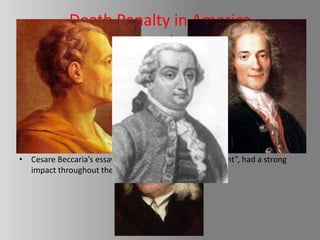
• The abolitionist movement started with the European Theorists
  Montesquieu, Voltaire and Bentham.

• Cesare Beccaria’s essay, “On the Crimes and Punishment”, had a strong
  impact throughout the world.
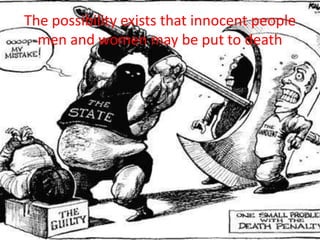
The possibility exists that innocent people
  men and women may be put to death
It sends the wrong message: “why kill
  people who kill people to show killing is
                  wrong?”


• Accountability: responsability
The endless appeals and required
   additional procedures clog the court
                  system


• Clog: block
• Attorney: lawyer
• Back up: delay
We as a society have to move away from
the “eye for an eye” revenge mentality if
        civilization is to advance
It is useless because it doesn’t bring
        the victim back to life.
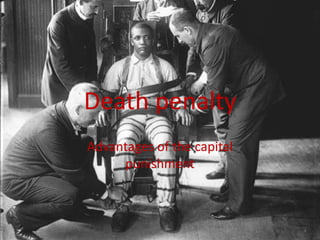
Death penalty
Advantages of the capital
     punishment
Death penalty gives closure to the
victim’s families who have suffered so
                 much
It creates another form of crime
            deterrent
DNA testing and other methods of modern crime scene
   science can now effectively eliminate almost all
    uncertainty as to a person’s guilt or innocence
Prisoner parole or escapes can give
  criminals another chance to kill
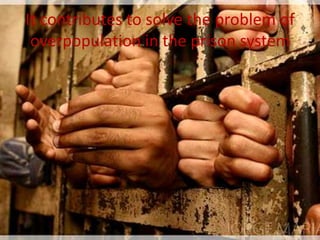
It contributes to solve the problem of
 overpopulation in the prison system

Death penalty

  • 1.
    DEATH PENALTY RAQUEL BAÑOLASSUÁREZ MILÁN SANTANA BAÑOLAS
  • 2.
    EARLY DEATH PENALTYLAWS: • The first established death penalty law date in the Eighteenth Century B.C., and it used in other civilizations from the past, for example, in the Hittie code (Fourteenth Century B.C), the Draconian Code of Athens and the Roman Law of the Twelve Tablets. • In Britain (Tenth Century A.D) hanging was the usual method of execution. • During the reign of Henry VIII 72,000 are estimated to have been executed.
  • 3.
    Death Penalty inAmerica and The Abolitionist Movement • The first recorded execution was the execution of Captain George Kendall which was a spy for Spain. • The abolitionist movement started with the European Theorists Montesquieu, Voltaire and Bentham. • Cesare Beccaria’s essay, “On the Crimes and Punishment”, had a strong impact throughout the world.
  • 5.
    The possibility existsthat innocent people men and women may be put to death
  • 6.
    It sends thewrong message: “why kill people who kill people to show killing is wrong?” • Accountability: responsability
  • 7.
    The endless appealsand required additional procedures clog the court system • Clog: block • Attorney: lawyer • Back up: delay
  • 8.
    We as asociety have to move away from the “eye for an eye” revenge mentality if civilization is to advance
  • 9.
    It is uselessbecause it doesn’t bring the victim back to life.
  • 10.
    Death penalty Advantages ofthe capital punishment
  • 12.
    Death penalty givesclosure to the victim’s families who have suffered so much
  • 13.
    It creates anotherform of crime deterrent
  • 14.
    DNA testing andother methods of modern crime scene science can now effectively eliminate almost all uncertainty as to a person’s guilt or innocence
  • 15.
    Prisoner parole orescapes can give criminals another chance to kill
  • 16.
    It contributes tosolve the problem of overpopulation in the prison system