











10 Steps to
Homeownership
A Guide for First-Time Homebuyers
1MAC1015-1914092820
Dean Wegner, Mortgage Originator
NMLS #220741
(602) 432-6388
15333 N Pima RD, Suite #210
Scottsdale, AZ 85260
State Lic AZ #0911804 | Corp State Lic AZ #BK-0904081
Corp NMLS #3113
Overview
Introduction
10 Steps to Homeownership
1. Loan Pre-Qualification
2. Home Search
3. Formal Loan Application and Product
Selection
4. Appraisal and Home Inspection
5. Processor’s and Underwriter’s Review
6. Final Loan Approval
7. Closing
8. Funding
9. Close of Escrow
10.Confirmation of Recording
About Academy Mortgage
Academy’s mission
is to be 1st CHOICE
in delivering the
dream of
sustainable
homeownership.
2
Introduction
• Buying a home can seem daunting, but if you plan ahead and
know all your mortgage options, it doesn’t have to be. Gaining a
thorough understanding of the homebuying process can help
ensure you have a smooth and positive experience.
• Working with the right team of real estate and mortgage
professionals makes all the difference. Academy commits to
working seamlessly with you and your real estate agent as a team
to get your loan closed in a timely and professional manner.
3
Introduction
Who Plays a Role in the Homebuying Process?
YOU!
REALTOR® or REAL ESTATE AGENT
 Listing agent: Hired by the seller. This agent places the property in the
Multiple Listing Service (MLS), a database of properties listed for sale.
 Buyer’s agent: Hired by the homebuyer.
MORTGAGE BANKER/DIRECT LENDER: Helps you start and finish the loan
process. Academy is a mortgage banker/direct lender.
For more information, see Academy’s flyer,
“Questions to Ask When Shopping for a Mortgage.”
4
Step 1: Loan Pre-Qualification
Pre-qualification helps you determine how much you can afford to spend on a
home, based on these 3 factors:
1. Your credit, including your credit score, credit report, and total debt history.
2. Your income, including your employment history and income.
3. Your assets, including money for down payment and closing costs.
Pre-qualification can help you:
• Determine how much house you qualify for.
• Increase your bargaining power when negotiating with a seller.
• Estimate your monthly payment and total investment.
• Identify which loan product will fulfill your needs.
For more information, see Academy’s “Improving Your Credit Score” flyer.
5Pre-qualification is not a commitment to lend, a condition of loan approval, or an application for credit. Pre-qualification will
result in a loan decision subject to conditions.
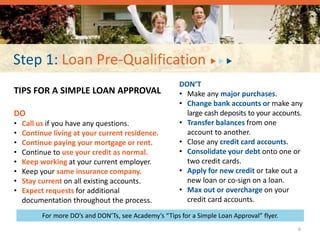
Step 1: Loan Pre-Qualification
TIPS FOR A SIMPLE LOAN APPROVAL
DO
• Call us if you have any questions.
• Continue living at your current residence.
• Continue paying your mortgage or rent.
• Continue to use your credit as normal.
• Keep working at your current employer.
• Keep your same insurance company.
• Stay current on all existing accounts.
• Expect requests for additional
documentation throughout the process.
DON’T
• Make any major purchases.
• Change bank accounts or make any
large cash deposits to your accounts.
• Transfer balances from one
account to another.
• Close any credit card accounts.
• Consolidate your debt onto one or
two credit cards.
• Apply for new credit or take out a
new loan or co-sign on a loan.
• Max out or overcharge on your
credit card accounts.
For more DO’s and DON’Ts, see Academy’s “Tips for a Simple Loan Approval” flyer.
6
Step 2: Home Search
YOUR REAL ESTATE AGENT:
• Helps you assess your needs and wants for purchasing your new home.
• Knows your preferences when selecting which homes to show you, and looks
up all properties in your selected area through the MLS.
• Negotiates for you. After selecting a home you want to buy, your agent
writes up an offer to present to the seller.
• Gets the right price. Your agent should know the market thoroughly to help
you get the best price on the home you want to buy.
• Helps you avoid pitfalls and resolve problems.
• Respects your opinions and decisions.
• Protects your rights.
7
Step 3: Formal Loan Application and Product Selection
Complete a loan application and
provide the following documentation:
• All paystubs for last 30 days.
• Copies of most recent W-2s and
most recent 2 years’ tax returns,
schedules, and other
documentation.
• Residence history for past 2 years.
• Outstanding loans and credit cards.
• Last 2 months’ bank statements.
• Information about your real estate
and personal property.
• Other requested documents,
depending on your circumstances:
self-employment, corporation
owner, VA eligibility, etc.
8
Step 3: Formal Loan Application and Product Selection
6 TYPES OF RESIDENTIAL MORTGAGES:
1. Conventional Mortgages (fixed-rate
and adjustable-rate): You have
money to put down.
2. FHA Home Loans: You have less
money to put down.
3. USDA Home Loans: Affordable,
government-backed loans in defined
rural areas.
4. VA Home Loans: Favorable terms
and interest rates for qualified
veterans and active-duty military.
5. Renovation Loans: To buy or
refinance a fixer-upper.
6. State Housing Agency Loans: For
low- and moderate-income.
9
Step 4: Home Inspection and Appraisal
INSPECTION APPRAISAL
Optional or required? Optional; buyer’s request. Required by Academy.
What is the purpose?
Evaluate the condition of
the home; repairs needed.
Determine the fair market
value of the home.
What is the average cost? $350-$550 $350-$500
How is it ordered? By buyer.
Randomly assigned by
Academy.
When is the report
delivered?
Usually within 24 hours
after inspection.
Usually within 5-7 business
days after inspection.
10
Step 5: Underwriter’s Review
UNDERWRITERS PRIMARILY CONSIDER THESE 3 FACTORS:
1. Your ability to repay the loan: Verify your employment; analyze your total
income. Your estimated monthly mortgage payment will be compared to
your monthly income and debt.
2. Your willingness to repay the loan: How you’ve paid previous loans, rent,
utility bills, etc.; how the property will be used; your credit report.
3. The collateral is the property that is pledged by a borrower to protect the
interests of Academy.
11
Step 6: Final Loan Approval
12
Step 7: Closing
• After your loan is approved, closing
documents are prepared and provided to a
title/escrow company. Federal law
mandates that you have at least three
business days from the time of receipt to
loan settlement to review your loan’s
Closing Disclosure, which details the
conditions, costs, and features of your loan.
• You will usually go to the title company’s
office to sign the prepared documents. This
signing is called the loan closing.
• Prior to the appointment, you will be
notified by the title company and/or your
Loan Officer of the amount of funds
required to close.
13
Step 7: Closing
WHAT DOES THE TITLE COMPANY DO?
• Conducts a title search and provides a title report.
• Requests a title insurance policy.
• Adjusts taxes between the seller and buyer.
• Provides prepared closing documents for the seller and buyer to sign.
• Records the security documents and other necessary documents.
• Distributes all signed documents to each party.
• Collects and disburses the loan proceeds.
14
Step 7: Closing
WHAT YOU WILL TO BRING TO CLOSING:
• One valid form of identification (driver’s
license, current passport, etc.) and one
additional form of photo identification
(membership card, school ID, etc.) so your
identity can be verified by the notary
public.
• A cashier’s check or wire to the settlement
agent for the funds required to close the
loan (see next slide).
• Any additional documentation needed by
Academy.
15
Step 7: Closing
COMMON CLOSING COSTS (some might not apply):
1. Title insurance fees, which cover both the buyer’s and seller’s title policies.
2. Miscellaneous title charges, for title search, recording and notary fees, etc.
3. Loan processing fee.
4. Appraisal fee.
5. Credit report fee.
6. Underwriting fee, for evaluating your entire loan application package.
7. Administrative fee, for processing your loan request.
8. Prepaid interest, depending on the day of the month your loan closes.
9. Private mortgage insurance (PMI), depending on the down payment and loan type.
10. Property taxes and homeowner’s insurance.
11. Loan origination fee, expressed as a percentage of the loan amount.
12. Loan discount (“points”), a charge to allow a lower interest rate than the current
market rate. 1 point = 1% of the loan amount.
16
Step 7: Closing
Speaking of costs . . .
THE COMPONENTS OF YOUR MONTHLY MORTGAGE PAYMENT:
• Principal. The beginning loan amount as stated on the loan note and the
subsequent balance after each loan payment is made.
• Interest. The charge for the use (loan) of the money.
• Taxes. The county assessor determines the property tax based on the value
of your home (might be paid monthly or annually).
• Homeowner’s insurance covers the loss of the home from specific hazards,
such as a fire.
• Other. Charges for PMI, an FHA MIP, a VA Funding Fee, or a USDA Guaranteed
Fee may be included in your monthly mortgage payment, depending on your
loan type, the amount of your down payment, and the unpaid loan balance.
17
Step 8: Funding by the Lender
If all requirements have been met,
Academy funds your loan by
sending a wire for the amount of
the loan to the settlement agent,
who disburses the funds.
18
Step 9: Close of Escrow
• When all of Academy’s conditions and those contained in the escrow
instructions have been satisfied, Academy will forward the loan funds to the
escrow trust account.
• The funds in the escrow are disbursed to the entitled parties and escrow is
“closed.”
• The settlement agent will arrange for the documents to be recorded.
19
Step 10: Confirmation of Recording
The title company
records the security
instrument and
warranty deed, and
the property is
officially transferred
from the seller to you!
20
You Move In . . . Congratulations!
21
But Academy’s service to you doesn’t stop . . . Your Academy Loan Officer will
be available to answer your questions during the life of your mortgage.
Given the ever-changing marketplace, it’s a good idea to have an annual
mortgage review.
Based on this analysis, we can decide together if it makes sense to refinance.
By taking a proactive approach with your Loan Officer, your mortgage will play
a positive role in your overall financial plan.
About Academy Mortgage
22
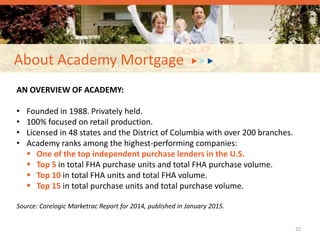
AN OVERVIEW OF ACADEMY:
• Founded in 1988. Privately held.
• 100% focused on retail production.
• Licensed in 48 states and the District of Columbia with over 200 branches.
• Academy ranks among the highest-performing companies:
 One of the top independent purchase lenders in the U.S.
 Top 5 in total FHA purchase units and total FHA purchase volume.
 Top 10 in total FHA units and total FHA volume.
 Top 15 in total purchase units and total purchase volume.
Source: Corelogic Marketrac Report for 2014, published in January 2015.
About Academy Mortgage
23
ACADEMY’S MISSION
To become 1st CHOICE in delivering the dream of sustainable
homeownership by inspiring hope and building prosperity in the lives
of our Employees, Builders, Realtors, and the communities we serve.
ACADEMY’S VISION
We look forward to helping you
on the road to homeownership!
24

Dean Wegner first time homebuyers presentation

  • 1.
    10 Steps to Homeownership AGuide for First-Time Homebuyers 1MAC1015-1914092820 Dean Wegner, Mortgage Originator NMLS #220741 (602) 432-6388 15333 N Pima RD, Suite #210 Scottsdale, AZ 85260 State Lic AZ #0911804 | Corp State Lic AZ #BK-0904081 Corp NMLS #3113
  • 2.
    Overview Introduction 10 Steps toHomeownership 1. Loan Pre-Qualification 2. Home Search 3. Formal Loan Application and Product Selection 4. Appraisal and Home Inspection 5. Processor’s and Underwriter’s Review 6. Final Loan Approval 7. Closing 8. Funding 9. Close of Escrow 10.Confirmation of Recording About Academy Mortgage Academy’s mission is to be 1st CHOICE in delivering the dream of sustainable homeownership. 2
  • 3.
    Introduction • Buying ahome can seem daunting, but if you plan ahead and know all your mortgage options, it doesn’t have to be. Gaining a thorough understanding of the homebuying process can help ensure you have a smooth and positive experience. • Working with the right team of real estate and mortgage professionals makes all the difference. Academy commits to working seamlessly with you and your real estate agent as a team to get your loan closed in a timely and professional manner. 3
  • 4.
    Introduction Who Plays aRole in the Homebuying Process? YOU! REALTOR® or REAL ESTATE AGENT  Listing agent: Hired by the seller. This agent places the property in the Multiple Listing Service (MLS), a database of properties listed for sale.  Buyer’s agent: Hired by the homebuyer. MORTGAGE BANKER/DIRECT LENDER: Helps you start and finish the loan process. Academy is a mortgage banker/direct lender. For more information, see Academy’s flyer, “Questions to Ask When Shopping for a Mortgage.” 4
  • 5.
    Step 1: LoanPre-Qualification Pre-qualification helps you determine how much you can afford to spend on a home, based on these 3 factors: 1. Your credit, including your credit score, credit report, and total debt history. 2. Your income, including your employment history and income. 3. Your assets, including money for down payment and closing costs. Pre-qualification can help you: • Determine how much house you qualify for. • Increase your bargaining power when negotiating with a seller. • Estimate your monthly payment and total investment. • Identify which loan product will fulfill your needs. For more information, see Academy’s “Improving Your Credit Score” flyer. 5Pre-qualification is not a commitment to lend, a condition of loan approval, or an application for credit. Pre-qualification will result in a loan decision subject to conditions.
  • 6.
    Step 1: LoanPre-Qualification TIPS FOR A SIMPLE LOAN APPROVAL DO • Call us if you have any questions. • Continue living at your current residence. • Continue paying your mortgage or rent. • Continue to use your credit as normal. • Keep working at your current employer. • Keep your same insurance company. • Stay current on all existing accounts. • Expect requests for additional documentation throughout the process. DON’T • Make any major purchases. • Change bank accounts or make any large cash deposits to your accounts. • Transfer balances from one account to another. • Close any credit card accounts. • Consolidate your debt onto one or two credit cards. • Apply for new credit or take out a new loan or co-sign on a loan. • Max out or overcharge on your credit card accounts. For more DO’s and DON’Ts, see Academy’s “Tips for a Simple Loan Approval” flyer. 6
  • 7.
    Step 2: HomeSearch YOUR REAL ESTATE AGENT: • Helps you assess your needs and wants for purchasing your new home. • Knows your preferences when selecting which homes to show you, and looks up all properties in your selected area through the MLS. • Negotiates for you. After selecting a home you want to buy, your agent writes up an offer to present to the seller. • Gets the right price. Your agent should know the market thoroughly to help you get the best price on the home you want to buy. • Helps you avoid pitfalls and resolve problems. • Respects your opinions and decisions. • Protects your rights. 7
  • 8.
    Step 3: FormalLoan Application and Product Selection Complete a loan application and provide the following documentation: • All paystubs for last 30 days. • Copies of most recent W-2s and most recent 2 years’ tax returns, schedules, and other documentation. • Residence history for past 2 years. • Outstanding loans and credit cards. • Last 2 months’ bank statements. • Information about your real estate and personal property. • Other requested documents, depending on your circumstances: self-employment, corporation owner, VA eligibility, etc. 8
  • 9.
    Step 3: FormalLoan Application and Product Selection 6 TYPES OF RESIDENTIAL MORTGAGES: 1. Conventional Mortgages (fixed-rate and adjustable-rate): You have money to put down. 2. FHA Home Loans: You have less money to put down. 3. USDA Home Loans: Affordable, government-backed loans in defined rural areas. 4. VA Home Loans: Favorable terms and interest rates for qualified veterans and active-duty military. 5. Renovation Loans: To buy or refinance a fixer-upper. 6. State Housing Agency Loans: For low- and moderate-income. 9
  • 10.
    Step 4: HomeInspection and Appraisal INSPECTION APPRAISAL Optional or required? Optional; buyer’s request. Required by Academy. What is the purpose? Evaluate the condition of the home; repairs needed. Determine the fair market value of the home. What is the average cost? $350-$550 $350-$500 How is it ordered? By buyer. Randomly assigned by Academy. When is the report delivered? Usually within 24 hours after inspection. Usually within 5-7 business days after inspection. 10
  • 11.
    Step 5: Underwriter’sReview UNDERWRITERS PRIMARILY CONSIDER THESE 3 FACTORS: 1. Your ability to repay the loan: Verify your employment; analyze your total income. Your estimated monthly mortgage payment will be compared to your monthly income and debt. 2. Your willingness to repay the loan: How you’ve paid previous loans, rent, utility bills, etc.; how the property will be used; your credit report. 3. The collateral is the property that is pledged by a borrower to protect the interests of Academy. 11
  • 12.
    Step 6: FinalLoan Approval 12
  • 13.
    Step 7: Closing •After your loan is approved, closing documents are prepared and provided to a title/escrow company. Federal law mandates that you have at least three business days from the time of receipt to loan settlement to review your loan’s Closing Disclosure, which details the conditions, costs, and features of your loan. • You will usually go to the title company’s office to sign the prepared documents. This signing is called the loan closing. • Prior to the appointment, you will be notified by the title company and/or your Loan Officer of the amount of funds required to close. 13
  • 14.
    Step 7: Closing WHATDOES THE TITLE COMPANY DO? • Conducts a title search and provides a title report. • Requests a title insurance policy. • Adjusts taxes between the seller and buyer. • Provides prepared closing documents for the seller and buyer to sign. • Records the security documents and other necessary documents. • Distributes all signed documents to each party. • Collects and disburses the loan proceeds. 14
  • 15.
    Step 7: Closing WHATYOU WILL TO BRING TO CLOSING: • One valid form of identification (driver’s license, current passport, etc.) and one additional form of photo identification (membership card, school ID, etc.) so your identity can be verified by the notary public. • A cashier’s check or wire to the settlement agent for the funds required to close the loan (see next slide). • Any additional documentation needed by Academy. 15
  • 16.
    Step 7: Closing COMMONCLOSING COSTS (some might not apply): 1. Title insurance fees, which cover both the buyer’s and seller’s title policies. 2. Miscellaneous title charges, for title search, recording and notary fees, etc. 3. Loan processing fee. 4. Appraisal fee. 5. Credit report fee. 6. Underwriting fee, for evaluating your entire loan application package. 7. Administrative fee, for processing your loan request. 8. Prepaid interest, depending on the day of the month your loan closes. 9. Private mortgage insurance (PMI), depending on the down payment and loan type. 10. Property taxes and homeowner’s insurance. 11. Loan origination fee, expressed as a percentage of the loan amount. 12. Loan discount (“points”), a charge to allow a lower interest rate than the current market rate. 1 point = 1% of the loan amount. 16
  • 17.
    Step 7: Closing Speakingof costs . . . THE COMPONENTS OF YOUR MONTHLY MORTGAGE PAYMENT: • Principal. The beginning loan amount as stated on the loan note and the subsequent balance after each loan payment is made. • Interest. The charge for the use (loan) of the money. • Taxes. The county assessor determines the property tax based on the value of your home (might be paid monthly or annually). • Homeowner’s insurance covers the loss of the home from specific hazards, such as a fire. • Other. Charges for PMI, an FHA MIP, a VA Funding Fee, or a USDA Guaranteed Fee may be included in your monthly mortgage payment, depending on your loan type, the amount of your down payment, and the unpaid loan balance. 17
  • 18.
    Step 8: Fundingby the Lender If all requirements have been met, Academy funds your loan by sending a wire for the amount of the loan to the settlement agent, who disburses the funds. 18
  • 19.
    Step 9: Closeof Escrow • When all of Academy’s conditions and those contained in the escrow instructions have been satisfied, Academy will forward the loan funds to the escrow trust account. • The funds in the escrow are disbursed to the entitled parties and escrow is “closed.” • The settlement agent will arrange for the documents to be recorded. 19
  • 20.
    Step 10: Confirmationof Recording The title company records the security instrument and warranty deed, and the property is officially transferred from the seller to you! 20
  • 21.
    You Move In. . . Congratulations! 21 But Academy’s service to you doesn’t stop . . . Your Academy Loan Officer will be available to answer your questions during the life of your mortgage. Given the ever-changing marketplace, it’s a good idea to have an annual mortgage review. Based on this analysis, we can decide together if it makes sense to refinance. By taking a proactive approach with your Loan Officer, your mortgage will play a positive role in your overall financial plan.
  • 22.
    About Academy Mortgage 22 ANOVERVIEW OF ACADEMY: • Founded in 1988. Privately held. • 100% focused on retail production. • Licensed in 48 states and the District of Columbia with over 200 branches. • Academy ranks among the highest-performing companies:  One of the top independent purchase lenders in the U.S.  Top 5 in total FHA purchase units and total FHA purchase volume.  Top 10 in total FHA units and total FHA volume.  Top 15 in total purchase units and total purchase volume. Source: Corelogic Marketrac Report for 2014, published in January 2015.
  • 23.
    About Academy Mortgage 23 ACADEMY’SMISSION To become 1st CHOICE in delivering the dream of sustainable homeownership by inspiring hope and building prosperity in the lives of our Employees, Builders, Realtors, and the communities we serve. ACADEMY’S VISION
  • 24.
    We look forwardto helping you on the road to homeownership! 24