• Deadlock canbe defined as the permanent blocking of a set of
processes that either compete for system resources or communicate
with each other. A set of processes is deadlocked when each process in
the set is blocked awaiting an event (typically the freeing up of some
requested resource) that can only be triggered by another blocked
process in the set. Deadlock is permanent because none of the events
is ever triggered.
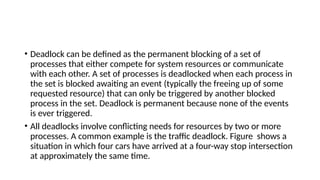
• All deadlocks involve conflicting needs for resources by two or more
processes. A common example is the traffic deadlock. Figure shows a
situation in which four cars have arrived at a four-way stop intersection
at approximately the same time.
3.
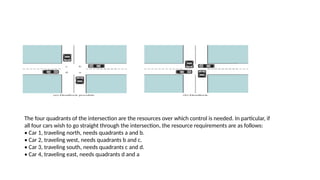
The four quadrantsof the intersection are the resources over which control is needed. In particular, if
all four cars wish to go straight through the intersection, the resource requirements are as follows:
• Car 1, traveling north, needs quadrants a and b.
• Car 2, traveling west, needs quadrants b and c.
• Car 3, traveling south, needs quadrants c and d.
• Car 4, traveling east, needs quadrants d and a
4.
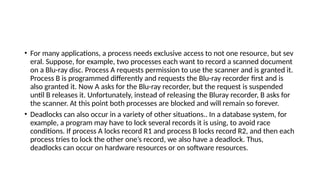
• For manyapplications, a process needs exclusive access to not one resource, but sev
eral. Suppose, for example, two processes each want to record a scanned document
on a Blu-ray disc. Process A requests permission to use the scanner and is granted it.
Process B is programmed differently and requests the Blu-ray recorder first and is
also granted it. Now A asks for the Blu-ray recorder, but the request is suspended
until B releases it. Unfortunately, instead of releasing the Bluray recorder, B asks for
the scanner. At this point both processes are blocked and will remain so forever.
• Deadlocks can also occur in a variety of other situations.. In a database system, for
example, a program may have to lock several records it is using, to avoid race
conditions. If process A locks record R1 and process B locks record R2, and then each
process tries to lock the other one’s record, we also have a deadlock. Thus,
deadlocks can occur on hardware resources or on software resources.
5.
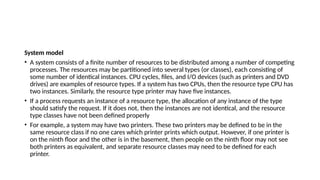
System model
• Asystem consists of a finite number of resources to be distributed among a number of competing
processes. The resources may be partitioned into several types (or classes), each consisting of
some number of identical instances. CPU cycles, files, and I/O devices (such as printers and DVD
drives) are examples of resource types. If a system has two CPUs, then the resource type CPU has
two instances. Similarly, the resource type printer may have five instances.
• If a process requests an instance of a resource type, the allocation of any instance of the type
should satisfy the request. If it does not, then the instances are not identical, and the resource
type classes have not been defined properly
• For example, a system may have two printers. These two printers may be defined to be in the
same resource class if no one cares which printer prints which output. However, if one printer is
on the ninth floor and the other is in the basement, then people on the ninth floor may not see
both printers as equivalent, and separate resource classes may need to be defined for each
printer.
6.
• A processmust request a resource before using it and must release the resource after using
it. A process may request as many resources as it requires to carry out its designated task.
Obviously, the number of resources requested may not exceed the total number of
resources available in the system. In other words, a process cannot request three printers if
the system has only two.
• Under the normal mode of operation, a process may utilize a resource in only the following
sequence:
1. Request. The process requests the resource. If the request cannot be granted immediately
(for example, if the resource is being used by another process), then the requesting process
must wait until it can acquire the resource.
2. Use. The process can operate on the resource (for example, if the resource is a printer, the
process can print on the printer).
3. Release. The process releases the resource.
7.
RESOURCES
• A majorclass of deadlocks involves resources to which some process has been granted exclusive access. These
resources include devices, data records, files, and so forth. To make the discussion of deadlocks as general as
possible, we will refer to the objects granted as resources. A resource can be a hardware device (e.g., a Blu-ray
drive) or a piece of information (e.g., a record in a database).
Preemptable resource
• A preemptable resource is one that can be taken away from the process owning it with no ill effects. Memory
is an example of a preemptable resource.
• Consider, for example, a system with 1 GB of user memory, one printer, and two 1-GB processes that each want
to print something. Process A requests and gets the printer, then starts to compute the values to print. Before it
has finished the computation, it exceeds its time quantum and is swapped out to disk.
• Process B now runs and tries, unsuccessfully as it turns out, to acquire the printer. Potenially, we now hav e a
deadlock situation, because A has the printer and B has the memory, and neither one can proceed without the
resource held by the other. Fortunately, it is possible to preempt (take away) the memory from B by swapping it
out and swapping A in. Now A can run, do its printing, and then release the printer. No deadlock occurs
8.
Nonpreemptable resource
• Anonpreemptable resource, in contrast, is one that cannot be taken
away from its current owner without potentially causing failure. If a
process has begun to burn a Blu-ray, suddenly taking the Blu-ray recorder
away from it and giving it to another process will result in a garbled Blu-
ray. Blu-ray recorders are not preemptable at an arbitrary moment
• In general, deadlocks involve nonpreemptable resources. Potential
deadlocks that involve preemptable resources can usually be resolved by
reallocating resources from one process to another. Thus, our treatment
will focus on nonpreemptable resources.
9.
Deadlock Characterization(deadlock modelling)
•In a deadlock, processes never finish executing, and system resources are tied up, preventing other jobs from
starting. Before we discuss the various methods for dealing with the deadlock problem, we look more closely at
features that characterize deadlocks.
Conditions for Resource Deadlocks
We emphasize that all four conditions must hold for a deadlock to occur.
1.Mutual exclusion. At least one resource must be held in a nonsharable mode; that is, only one process at a time can
use the resource. If another process requests that resource, the requesting process must be delayed until the resource
has been released.
2. Hold and wait. A process must be holding at least one resource and waiting to acquire additional resources that are
currently being held by other processes.
3. No preemption. Resources cannot be preempted; that is, a resource can be released only voluntarily by the process
holding it, after that process has completed its task.
4. Circular wait. A set {P0, P1, ..., Pn} of waiting processes must exist such that P0 is waiting for a resource held by P1,
P1 is waiting for a resource held by P2, ..., Pn−1 is waiting for a resource held by Pn, and Pn is waiting for a resource
held by P0
10.
• Resource-Allocation Graph
•Deadlocks can be described more precisely in terms of a directed graph called a
system resource-allocation graph. This graph consists of a set of vertices V and a
set of edges E
• The set of vertices V is partitioned into two different types of nodes: P = {P1, P2,
..., Pn}, the set consisting of all the active processes in the system, and R = {R1,
R2, ..., Rm}, the set consisting of all resource types in the system.
• A directed edge from process Pi to resource type Rj is denoted by Pi → Rj ; it
signifies that process Pi has requested an instance of resource type Rj and is
currently waiting for that resource.
• A directed edge from resource type Rj to process Pi is denoted by Rj → Pi ; it
signifies that an instance of resource type Rj has been allocated to process Pi .
• A directed edge Pi → Rj is called a request edge; a directed edge Rj → Pi is
called an assignment edge
11.
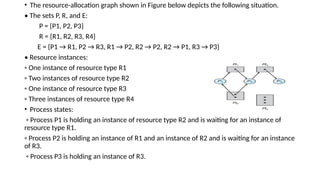
• The resource-allocationgraph shown in Figure below depicts the following situation.
• The sets P, R, and E:
P = {P1, P2, P3}
R = {R1, R2, R3, R4}
E = {P1 → R1, P2 → R3, R1 → P2, R2 → P2, R2 → P1, R3 → P3}
• Resource instances:
◦ One instance of resource type R1
◦ Two instances of resource type R2
◦ One instance of resource type R3
◦ Three instances of resource type R4
• Process states:
◦ Process P1 is holding an instance of resource type R2 and is waiting for an instance of
resource type R1.
◦ Process P2 is holding an instance of R1 and an instance of R2 and is waiting for an instance
of R3.
◦ Process P3 is holding an instance of R3.
12.
• Given thedefinition of a resource-allocation graph, it can be shown that, if the
graph contains no cycles, then no process in the system is deadlocked. If the
graph does contain a cycle, then a deadlock may exist. If each resource type has
several instances, then a cycle does not necessarily imply that a deadlock has
occurred
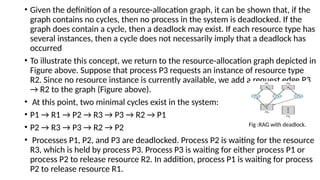
• To illustrate this concept, we return to the resource-allocation graph depicted in
Figure above. Suppose that process P3 requests an instance of resource type
R2. Since no resource instance is currently available, we add a request edge P3
→ R2 to the graph (Figure above).
• At this point, two minimal cycles exist in the system:
• P1 → R1 → P2 → R3 → P3 → R2 → P1
• P2 → R3 → P3 → R2 → P2
• Processes P1, P2, and P3 are deadlocked. Process P2 is waiting for the resource
R3, which is held by process P3. Process P3 is waiting for either process P1 or
process P2 to release resource R2. In addition, process P1 is waiting for process
P2 to release resource R1.
Fig :RAG with deadlock.
13.
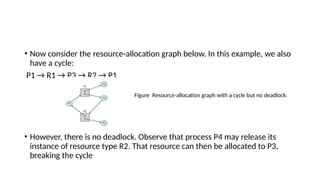
• Now considerthe resource-allocation graph below. In this example, we also
have a cycle:
P1 → R1 → P3 → R2 → P1
• However, there is no deadlock. Observe that process P4 may release its
instance of resource type R2. That resource can then be allocated to P3,
breaking the cycle
Figure Resource-allocation graph with a cycle but no deadlock.
14.
Methods for HandlingDeadlocks
Generally speaking, we can deal with the deadlock problem in one of three ways:
1. We can use a protocol to prevent or avoid deadlocks, ensuring that the system will never enter a deadlocked state.
2. We can allow the system to enter a deadlocked state, detect it, and recover.
3. We can ignore the problem altogether and pretend that deadlocks never occur in the system
• To ensure that deadlocks never occur, the system can use either a deadlock prevention or a deadlock-avoidance scheme.
Deadlock prevention provides a set of methods to ensure that at least one of the necessary conditions cannot hold. These
methods prevent deadlocks by constraining how requests for resources can be made. Deadlock avoidance requires that the
operating system be given additional information in advance concerning which resources a process will request and use during its
lifetime
• If a system does not employ either a deadlock-prevention or a deadlock avoidance algorithm, then a deadlock situation may
arise. In this environment, the system can provide an algorithm that examines the state of the system to determine whether a
deadlock has occurred and an algorithm to recover from the deadlock
• Expense is one important consideration. Ignoring the possibility of deadlocks is cheaper than the other approaches. Since in
many systems, deadlocks occur infrequently (say, once per year), the extra expense of the other methods may not seem
worthwhile.
• The third solution is the one used by most operating systems, including Linux and Windows. It is then up to the application
developer to write programs that handle deadlocks
15.
The ostrich algorithm
•The simplest approach is the ostrich algorithm: stick your head in the sand and pretend
there is no problem.
• People react to this strategy in different ways. Mathematicians find it unacceptable and say
that deadlocks must be prevented at all costs. Engineers ask how often the problem is
expected, how often the system crashes for other reasons, and how serious a deadlock is.
• If deadlocks occur on the average once every five years, but system crashes due to
hardware failures and operating system bugs occur once a week, most engineers would not
be willing to pay a large penalty in performance or convenience to eliminate deadlocks
• To make this contrast more specific, consider an operating system that blocks the caller
when an open system call on a physical device such as a Blu-ray driver or a printer cannot
be carried out because the device is busy. Typically it is up to the device driver to decide
what action to take under such circumstances. Blocking or returning an error code are two
obvious possibilities. If one process successfully opens the Blu-ray drive and another
successfully opens the printer and then each process tries to open the other one and
blocks trying, we have a deadlock.
16.
Deadlock Prevention
• fora deadlock to occur, we saw four necessary conditions must hold. By ensuring that at least one
of these conditions cannot hold, we can prevent the occurrence of a deadlock. We elaborate on
this approach by examining each of the four necessary conditions separately.
1. Mutual Exclusion
• Sharable resources do not require mutually exclusive access.
• For example read only files, If several processes attempt to open a read-only file at the same time, they can
be granted simultaneous access to the file.
• However, we cannot prevent deadlocks by denying the mutual-exclusion condition, because some resources
are intrinsically non-sharable.
• For example, a mutex lock cannot be simultaneously shared by several processes.
2. Hold and wait
• Whenever a process requests a resource, it does not hold any other resources.
• One protocol that we can use requires each process to request and be allocated all its resources before it
begins execution.
• An alternative protocol allows a process to request resources only when it has none. A process may request
some resources and use them. Before it can request any additional resources, it must release all the resources
that it is currently allocated.
Both these protocols have two main disadvantages.
• First, resource utilization may be low, since resources may be allocated but unused for a long period.
• Second, starvation is possible. A process that needs several popular resources may have to wait indefinitely,
because at least one of the resources that it needs is always allocated to some other process.
17.
3. No preemption
Toensure that this condition does not hold,
• Release any resource already being held if the process cannot get an additional resources
• Allow preemption - if a needed resouce is allocated by another process, which is also waiting
on same resource, steal it. Otherwise wait.
4.Circular wait
• To ensure this condition never holds we impose a total ordering of all resource types
and it require that each process requests resources in an increasing order of
enumeration.
• Let R = {R1, R2, ..., Rm} be the set of resource types. We assign each resource type a unique
integer number, which allows us to compare two resources and to determine whether one
precedes another in our ordering. We define a one-to-one function F: R → N, where N is the
set of natural numbers.
• To prevent deadlocks: Each process can request resources only in an increasing order of
enumeration. That is, a process can initially request any number of instances of a resource type
—say, Ri. After that, the process can request instances of resource type Rj if and only if F( R j ) >
F( Ri ).
• Alternatively, we can require that a process requesting an instance of resource type Rj must
have released any resources Ri such that F( Ri ) ≥ F( Rj ).
18.
• Deadlock avoidance
•In the discussion of deadlock detection, we tacitly assumed that when a process asks for resources, it asks for
them all at once. In most systems, however, resources are requested one at a time. The system must be able
to decide whether granting a resource is safe or not and make the allocation only when it is safe. Thus, the
question arises: Is there an algorithm that can always avoid deadlock by making the right choice all the time?
The answer is a qualified yes—we can avoid deadlocks, but only if certain information is available in advance.
In this section we examine ways to avoid deadlock by careful resource allocation.
1. Safe and unsafe state
• A state is safe if the system can allocate resources to each process (up to its maximum) in some order and still
avoid a deadlock.
• More formally, a system is in a safe state only if there exists a safe sequence. A sequence of processes is a
safe sequence for the current allocation state if, for each Pi , the resource requests that Pi can still make can
be satisfied by the currently available resources plus the resources held by all Pj , with j < i.
• In this situation, if the resources that Pi needs are not immediately available, then Pi can wait until all Pj have
finished. When they have finished, Pi can obtain all of its needed resources, complete its designated task,
return its allocated resources, and terminate. When Pi terminates, Pi+1 can obtain its needed resources, and
so on. If no such sequence exists, then the system state is said to be unsafe.
• A safe state is not a deadlocked state. Conversely, a deadlocked state is an unsafe state. Not all unsafe states
are deadlocks, however . An unsafe state may lead to a deadlock. As long as the state is safe, the operating
system can avoid unsafe (and deadlocked) states
19.
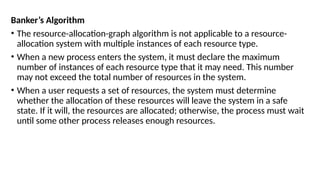
Banker’s Algorithm
• Theresource-allocation-graph algorithm is not applicable to a resource-
allocation system with multiple instances of each resource type.
• When a new process enters the system, it must declare the maximum
number of instances of each resource type that it may need. This number
may not exceed the total number of resources in the system.
• When a user requests a set of resources, the system must determine
whether the allocation of these resources will leave the system in a safe
state. If it will, the resources are allocated; otherwise, the process must wait
until some other process releases enough resources.
20.
• Several datastructures must be maintained to implement the banker’s algorithm.
• Available. A vector of length m indicates the number of available resources of
each type. If Available[j] equals k, then k instances of resource type Rj are
available.
• Max. An n × m matrix defines the maximum demand of each process. If Max[i][j]
equals k, then process Pi may request at most k instances of resource type Rj .
• Allocation. An n×m matrix defines the number of resources of each type
currently allocated to each process. If Allocation[i][j] equals k, then process Pi is
currently allocated k instances of resource type Rj .
• Need. An n × m matrix indicates the remaining resource need of each process. If
Need[i][j] equals k, then process Pi may need k more instances of resource type
Rj to complete its task. Note that Need[i][j] equals Max[i][j] − Allocation[i][j].
21.
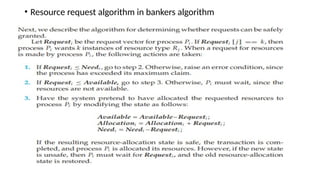
Safety Algorithm inbankers algo
• We can now present the algorithm for finding out whether or not a system is in a
safe state. This algorithm can be described as follows:
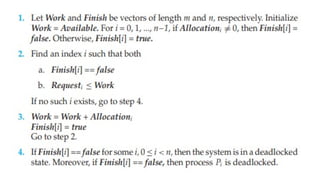
1. Let Work and Finish be vectors of length m and n, respectively. Initialize Work =
Available and Finish[i] = false for i = 0, 1, ..., n − 1.
2. Find an index i such that both
a. Finish[i] == false
b. Needi ≤ Work
If no such i exists, go to step 4.
3. Work = Work + Allocation(i)
Finish[i] = true
Go to step 2.
4. If Finish[i] == true for all i, then the system is in a safe state.
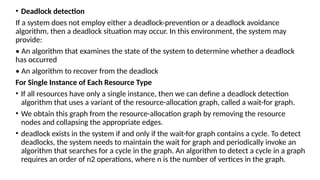
• Deadlock detection
Ifa system does not employ either a deadlock-prevention or a deadlock avoidance
algorithm, then a deadlock situation may occur. In this environment, the system may
provide:
• An algorithm that examines the state of the system to determine whether a deadlock
has occurred
• An algorithm to recover from the deadlock
For Single Instance of Each Resource Type
• If all resources have only a single instance, then we can define a deadlock detection
algorithm that uses a variant of the resource-allocation graph, called a wait-for graph.
• We obtain this graph from the resource-allocation graph by removing the resource
nodes and collapsing the appropriate edges.
• deadlock exists in the system if and only if the wait-for graph contains a cycle. To detect
deadlocks, the system needs to maintain the wait for graph and periodically invoke an
algorithm that searches for a cycle in the graph. An algorithm to detect a cycle in a graph
requires an order of n2 operations, where n is the number of vertices in the graph.
24.
Several Instances ofa Resource Type
• The wait-for graph scheme is not applicable to a resource-allocation system
with multiple instances of each resource type. We turn now to a deadlock-
detection algorithm that is applicable to such a system. The algorithm
employs several time-varying data structures that are similar to those used
in the banker’s algorithm
• Available. A vector of length m indicates the number of available resources
of each type.
• Allocation. An n × m matrix defines the number of resources of each type
currently allocated to each process.
• Request. An n × m matrix indicates the current request of each process. If
Request[i][j] equals k, then process Pi is requesting k more instances of
resource type Rj .
The algorithm for detection is given below
26.
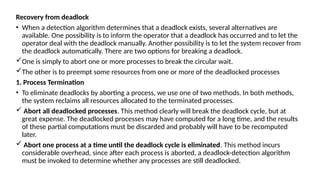
Recovery from deadlock
•When a detection algorithm determines that a deadlock exists, several alternatives are
available. One possibility is to inform the operator that a deadlock has occurred and to let the
operator deal with the deadlock manually. Another possibility is to let the system recover from
the deadlock automatically. There are two options for breaking a deadlock.
One is simply to abort one or more processes to break the circular wait.
The other is to preempt some resources from one or more of the deadlocked processes
1. Process Termination
• To eliminate deadlocks by aborting a process, we use one of two methods. In both methods,
the system reclaims all resources allocated to the terminated processes.
Abort all deadlocked processes. This method clearly will break the deadlock cycle, but at
great expense. The deadlocked processes may have computed for a long time, and the results
of these partial computations must be discarded and probably will have to be recomputed
later.
Abort one process at a time until the deadlock cycle is eliminated. This method incurs
considerable overhead, since after each process is aborted, a deadlock-detection algorithm
must be invoked to determine whether any processes are still deadlocked.
27.
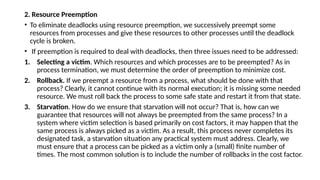
2. Resource Preemption
•To eliminate deadlocks using resource preemption, we successively preempt some
resources from processes and give these resources to other processes until the deadlock
cycle is broken.
• If preemption is required to deal with deadlocks, then three issues need to be addressed:
1. Selecting a victim. Which resources and which processes are to be preempted? As in
process termination, we must determine the order of preemption to minimize cost.
2. Rollback. If we preempt a resource from a process, what should be done with that
process? Clearly, it cannot continue with its normal execution; it is missing some needed
resource. We must roll back the process to some safe state and restart it from that state.
3. Starvation. How do we ensure that starvation will not occur? That is, how can we
guarantee that resources will not always be preempted from the same process? In a
system where victim selection is based primarily on cost factors, it may happen that the
same process is always picked as a victim. As a result, this process never completes its
designated task, a starvation situation any practical system must address. Clearly, we
must ensure that a process can be picked as a victim only a (small) finite number of
times. The most common solution is to include the number of rollbacks in the cost factor.
28.
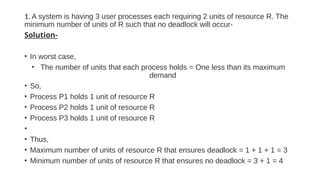
1. A systemis having 3 user processes each requiring 2 units of resource R. The
minimum number of units of R such that no deadlock will occur-
Solution-
• In worst case,
• The number of units that each process holds = One less than its maximum
demand
• So,
• Process P1 holds 1 unit of resource R
• Process P2 holds 1 unit of resource R
• Process P3 holds 1 unit of resource R
•
• Thus,
• Maximum number of units of resource R that ensures deadlock = 1 + 1 + 1 = 3
• Minimum number of units of resource R that ensures no deadlock = 3 + 1 = 4
29.
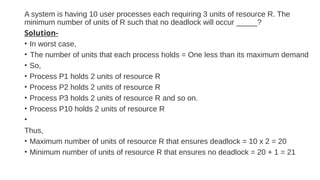
A system ishaving 10 user processes each requiring 3 units of resource R. The
minimum number of units of R such that no deadlock will occur _____?
Solution-
• In worst case,
• The number of units that each process holds = One less than its maximum demand
• So,
• Process P1 holds 2 units of resource R
• Process P2 holds 2 units of resource R
• Process P3 holds 2 units of resource R and so on.
• Process P10 holds 2 units of resource R
•
Thus,
• Maximum number of units of resource R that ensures deadlock = 10 x 2 = 20
• Minimum number of units of resource R that ensures no deadlock = 20 + 1 = 21
30.
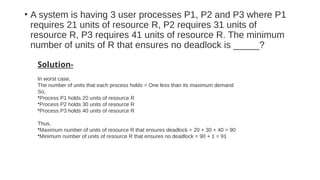
• A systemis having 3 user processes P1, P2 and P3 where P1
requires 21 units of resource R, P2 requires 31 units of
resource R, P3 requires 41 units of resource R. The minimum
number of units of R that ensures no deadlock is _____?
Solution-
In worst case,
The number of units that each process holds = One less than its maximum demand
So,
•Process P1 holds 20 units of resource R
•Process P2 holds 30 units of resource R
•Process P3 holds 40 units of resource R
Thus,
•Maximum number of units of resource R that ensures deadlock = 20 + 30 + 40 = 90
•Minimum number of units of resource R that ensures no deadlock = 90 + 1 = 91
31.
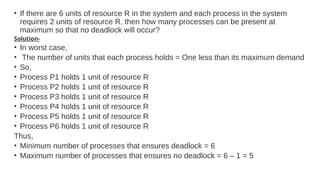
• If thereare 6 units of resource R in the system and each process in the system
requires 2 units of resource R, then how many processes can be present at
maximum so that no deadlock will occur?
Solution-
• In worst case,
• The number of units that each process holds = One less than its maximum demand
• So,
• Process P1 holds 1 unit of resource R
• Process P2 holds 1 unit of resource R
• Process P3 holds 1 unit of resource R
• Process P4 holds 1 unit of resource R
• Process P5 holds 1 unit of resource R
• Process P6 holds 1 unit of resource R
Thus,
• Minimum number of processes that ensures deadlock = 6
• Maximum number of processes that ensures no deadlock = 6 – 1 = 5
32.
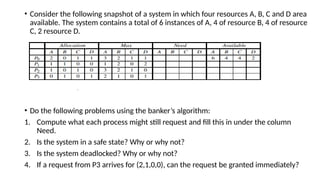
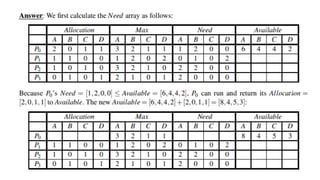
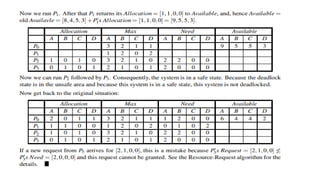
• Consider thefollowing snapshot of a system in which four resources A, B, C and D area
available. The system contains a total of 6 instances of A, 4 of resource B, 4 of resource
C, 2 resource D.
• Do the following problems using the banker’s algorithm:
1. Compute what each process might still request and fill this in under the column
Need.
2. Is the system in a safe state? Why or why not?
3. Is the system deadlocked? Why or why not?
4. If a request from P3 arrives for (2,1,0,0), can the request be granted immediately?

![• Several data structures must be maintained to implement the banker’s algorithm.
• Available. A vector of length m indicates the number of available resources of
each type. If Available[j] equals k, then k instances of resource type Rj are
available.
• Max. An n × m matrix defines the maximum demand of each process. If Max[i][j]
equals k, then process Pi may request at most k instances of resource type Rj .
• Allocation. An n×m matrix defines the number of resources of each type
currently allocated to each process. If Allocation[i][j] equals k, then process Pi is
currently allocated k instances of resource type Rj .
• Need. An n × m matrix indicates the remaining resource need of each process. If
Need[i][j] equals k, then process Pi may need k more instances of resource type
Rj to complete its task. Note that Need[i][j] equals Max[i][j] − Allocation[i][j].](https://image.slidesharecdn.com/deadlock-251105151902-b9f668ee/85/deadlock-pptx-operating-system-computer-engineering-20-320.jpg)
![Safety Algorithm in bankers algo
• We can now present the algorithm for finding out whether or not a system is in a
safe state. This algorithm can be described as follows:
1. Let Work and Finish be vectors of length m and n, respectively. Initialize Work =
Available and Finish[i] = false for i = 0, 1, ..., n − 1.
2. Find an index i such that both
a. Finish[i] == false
b. Needi ≤ Work
If no such i exists, go to step 4.
3. Work = Work + Allocation(i)
Finish[i] = true
Go to step 2.
4. If Finish[i] == true for all i, then the system is in a safe state.](https://image.slidesharecdn.com/deadlock-251105151902-b9f668ee/85/deadlock-pptx-operating-system-computer-engineering-21-320.jpg)
![Several Instances of a Resource Type
• The wait-for graph scheme is not applicable to a resource-allocation system
with multiple instances of each resource type. We turn now to a deadlock-
detection algorithm that is applicable to such a system. The algorithm
employs several time-varying data structures that are similar to those used
in the banker’s algorithm
• Available. A vector of length m indicates the number of available resources
of each type.
• Allocation. An n × m matrix defines the number of resources of each type
currently allocated to each process.
• Request. An n × m matrix indicates the current request of each process. If
Request[i][j] equals k, then process Pi is requesting k more instances of
resource type Rj .
The algorithm for detection is given below](https://image.slidesharecdn.com/deadlock-251105151902-b9f668ee/85/deadlock-pptx-operating-system-computer-engineering-24-320.jpg)


![3 (1) [Autosaved].ppt](https://cdn.slidesharecdn.com/ss_thumbnails/31autosaved-221227201419-17f998ab-thumbnail.jpg?width=640&height=640&fit=bounds)


