Knowledge Sharing Session
Md. Sadhan Sarker
Software Engineer
Journey to Domain Driven Design
2
Domain-Driven Design is an approach to the development of complex
software. It focus on domain itself and not the technical details.
Primarily on modeling the problem and trying to solve.
When huge, mission critical, n-tier solutions and too big for the human
mind.
3
Tactics and strategy must be combined to
succeed, and DDD addresses both tactical
and strategic design.
4
How Do We Get Started?
- Look at the big picture of the current business process.
- Breaking the domain into sub-domains.
- Focus on sub-domain with domain expert use ubiquitous language
- Creating a bonded context between sub-domain.
- Identity Domain Events based on Commands & Query.
- Shared kernel - any changes should be known and agreed between all
team in every bounded context.
- Focus the domain’s behaviors rather than domain’s state.
5
Big Ball of Mud
6
Context Map
Bounded

Context
Bounded

Context
Bounded

Context
7
?
Customer Order
Buggy Issues
Payment
E-Commerce Application
Context
Team Ubiquitous language &
Bounded Context
Ubiquitous
Language
8
Building Blocks of
A Model Driven Design
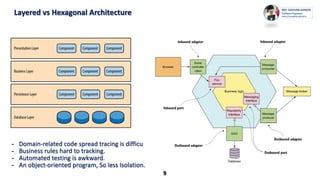
Layered vs Hexagonal Architecture
- Domain-related code spread tracing is difficult.
- Business rules hard to tracking.
- Automated testing is awkward.
- An object-oriented program, So less Isolation.
9
10
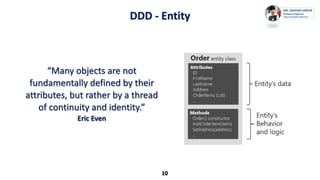
DDD - Entity
“Many objects are not
fundamentally defined by their
attributes, but rather by a thread
of continuity and identity.”
Eric Even
11
DDD - Value Object
As Eric Evans has noted,
"Many objects do not
have conceptual identity.
These objects describe
certain characteristics of
a thing."
12
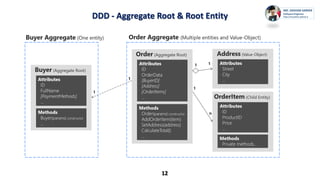
DDD - Aggregate Root & Root Entity
13
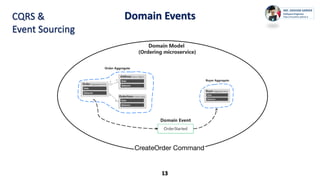
Domain Events
CreateOrder Command
CQRS &
Event Sourcing
14
Domain Events
CreateOrder Command
15
Layers in a Domain-Driven Microservice
16
Continuous Integration
Md. Sadhan Sarker
Software Engineer
Thanks! From
Coding is Fun, Enjoy It…!

DDD knowledge sharing