To study about Virtual Circuits
frame relay and ATM in modern
communication system
NAME - AMIT KUMAR BIHARI
REGD.NO.- 2201020180
GROUP-6
UNDER THE SUBMISSION OF:-
DR. MADHU SUDAN MAITI
CONTENTS
• VIRTUAL CIRCUITS
• CIRCUIT SWITCHING FUNDAMENTALS
• VIRTUAL CIRCUITS IN NETWORKING
• FRAME RELAY TECHNOLOGY
• FRAME RELAY APPLICATIONS
• ADVANTAGES OF FRAME RELAY
• ATM IN MODERN TECHNOLOGY
• ADVANTAGES OF ATM
• CONCLUSION
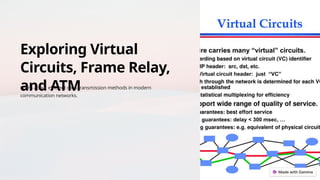
Exploring Virtual
Circuits, Frame Relay,
and ATM
Learn about efficient data transmission methods in modern
communication networks.
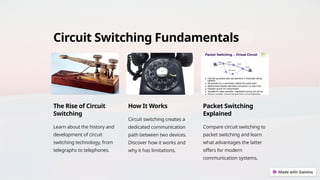
Circuit Switching Fundamentals
The Rise of Circuit
Switching
Learn about the history and
development of circuit
switching technology, from
telegraphs to telephones.
How It Works
Circuit switching creates a
dedicated communication
path between two devices.
Discover how it works and
why it has limitations.
Packet Switching
Explained
Compare circuit switching to
packet switching and learn
what advantages the latter
offers for modern
communication systems.
Virtual Circuits in Networking
Definition
What are virtual circuits and how do they
work? Discover how VC technology
creates a secure, dedicated path between
devices.
Purpose
Virtual circuits help optimize bandwidth
utilization and reduce network traffic,
providing a better overall user
experience.
Role
As an integral part of modern
communication systems, virtual circuits
play a crucial role in ensuring reliable
data transmission.
Types of Virtual Circuits
There are two types of virtual circuits:
Permanent Virtual Circuits (PVC) and
Switched Virtual Circuits (SVC). Learn the
differences between them.
Frame Relay Technology
1 What is Frame Relay?
Frame Relay is a high-speed WAN
technology designed for efficient
and reliable data transmission.
Discover the advantages it offers
over other WAN technologies.
2
Architecture and Operation
Frame Relay technology contains
three primary components: DTE,
DCE, and the Frame Relay switch.
Learn how these components work
together to transport data. 3 Frame Relay Networks
Frame Relay networks involve a
variety of devices, including
routers, switches, and FRADs.
Explore how each device
contributes to the overall network.
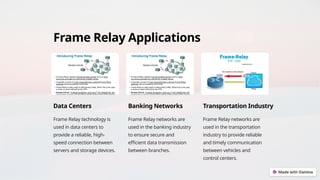
Frame Relay Applications
Data Centers
Frame Relay technology is
used in data centers to
provide a reliable, high-
speed connection between
servers and storage devices.
Banking Networks
Frame Relay networks are
used in the banking industry
to ensure secure and
efficient data transmission
between branches.
Transportation Industry
Frame Relay networks are
used in the transportation
industry to provide reliable
and timely communication
between vehicles and
control centers.
Advantages of Frame Relay
1 Scalability
Frame Relay technology is
highly scalable, making it
an ideal choice for large,
complex networks.
2 Cost-Effective
Frame Relay networks
require less hardware and
infrastructure than other
WAN technologies, leading
to cost savings.
3 Bandwidth Management
Frame Relay provides flexible bandwidth utilization, allowing
users to prioritize certain types of traffic.
ATM in Modern Networks
1 The Significance of ATM
ATM (Asynchronous Transfer Mode)
is a high-speed networking
technology that provides efficient,
reliable, and flexible data
transmission capabilities.
2
Use Cases in Various Scenarios
ATM is used in a variety of
industries, including healthcare,
finance, and media.
3 Role in Modern
Communication Systems
The use of ATM in modern
communication systems helps
improve network efficiency and
data transmission reliability.
Advantages of ATM
Quality of Service
ATM provides improved quality of service
compared to other network technologies.
Scalable
ATM networks can easily handle
increased traffic and additional users,
making it highly scalable.
Efficient Data Transmission
ATM facilitates efficient data transmission
and provides greater bandwidth
utilization.
Flexible Connection Types
ATM allows for a variety of connection
types, including point-to-point, point-to-
multipoint, and multipoint-to-multipoint.
Comparing Frame Relay and ATM
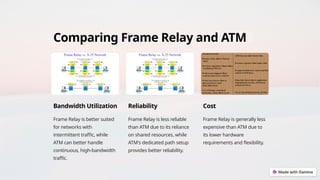
Bandwidth Utilization
Frame Relay is better suited
for networks with
intermittent traffic, while
ATM can better handle
continuous, high-bandwidth
traffic.
Reliability
Frame Relay is less reliable
than ATM due to its reliance
on shared resources, while
ATM's dedicated path setup
provides better reliability.
Cost
Frame Relay is generally less
expensive than ATM due to
its lower hardware
requirements and flexibility.
Future Trends in Communication Systems
1 5G Technology
5G technology is set to revolutionize
modern communication systems by
providing higher data transfer speeds
and lower latency.
2 Internet of Things
The IoT is rapidly changing the
landscape of modern communication,
connecting a variety of devices to the
internet for smarter and more efficient
communication.
3 Software-Defined Networking
SDN allows for greater network
automation and flexibility, making it
easier to configure and manage
modern networks.
4 Artificial Intelligence
AI may play a key role in modern
communication systems, providing
advanced automation and intelligent
decision-making capabilities.
Conclusion and Implications
Key Takeaways
Virtual circuits, Frame
Relay, and ATM
technologies play a
crucial role in modern
communication
networks, providing
efficient and reliable
data transmission
capabilities.
Importance
As communication
needs continue to grow,
these technologies will
become increasingly
important in ensuring
reliable and secure data
transmission.
Implications
The future of
communication systems
will likely depend on the
continued development
and integration of these
technologies, as well as
emerging trends like 5G
and the IoT.

DCCN_EXL_AKB(22vsbbsbbsbsbsbsbsbbbsbs01020180).pptx

  • 1.
    To study aboutVirtual Circuits frame relay and ATM in modern communication system NAME - AMIT KUMAR BIHARI REGD.NO.- 2201020180 GROUP-6 UNDER THE SUBMISSION OF:- DR. MADHU SUDAN MAITI
  • 2.
    CONTENTS • VIRTUAL CIRCUITS •CIRCUIT SWITCHING FUNDAMENTALS • VIRTUAL CIRCUITS IN NETWORKING • FRAME RELAY TECHNOLOGY • FRAME RELAY APPLICATIONS • ADVANTAGES OF FRAME RELAY • ATM IN MODERN TECHNOLOGY • ADVANTAGES OF ATM • CONCLUSION
  • 3.
    Exploring Virtual Circuits, FrameRelay, and ATM Learn about efficient data transmission methods in modern communication networks.
  • 4.
    Circuit Switching Fundamentals TheRise of Circuit Switching Learn about the history and development of circuit switching technology, from telegraphs to telephones. How It Works Circuit switching creates a dedicated communication path between two devices. Discover how it works and why it has limitations. Packet Switching Explained Compare circuit switching to packet switching and learn what advantages the latter offers for modern communication systems.
  • 5.
    Virtual Circuits inNetworking Definition What are virtual circuits and how do they work? Discover how VC technology creates a secure, dedicated path between devices. Purpose Virtual circuits help optimize bandwidth utilization and reduce network traffic, providing a better overall user experience. Role As an integral part of modern communication systems, virtual circuits play a crucial role in ensuring reliable data transmission. Types of Virtual Circuits There are two types of virtual circuits: Permanent Virtual Circuits (PVC) and Switched Virtual Circuits (SVC). Learn the differences between them.
  • 6.
    Frame Relay Technology 1What is Frame Relay? Frame Relay is a high-speed WAN technology designed for efficient and reliable data transmission. Discover the advantages it offers over other WAN technologies. 2 Architecture and Operation Frame Relay technology contains three primary components: DTE, DCE, and the Frame Relay switch. Learn how these components work together to transport data. 3 Frame Relay Networks Frame Relay networks involve a variety of devices, including routers, switches, and FRADs. Explore how each device contributes to the overall network.
  • 7.
    Frame Relay Applications DataCenters Frame Relay technology is used in data centers to provide a reliable, high- speed connection between servers and storage devices. Banking Networks Frame Relay networks are used in the banking industry to ensure secure and efficient data transmission between branches. Transportation Industry Frame Relay networks are used in the transportation industry to provide reliable and timely communication between vehicles and control centers.
  • 8.
    Advantages of FrameRelay 1 Scalability Frame Relay technology is highly scalable, making it an ideal choice for large, complex networks. 2 Cost-Effective Frame Relay networks require less hardware and infrastructure than other WAN technologies, leading to cost savings. 3 Bandwidth Management Frame Relay provides flexible bandwidth utilization, allowing users to prioritize certain types of traffic.
  • 9.
    ATM in ModernNetworks 1 The Significance of ATM ATM (Asynchronous Transfer Mode) is a high-speed networking technology that provides efficient, reliable, and flexible data transmission capabilities. 2 Use Cases in Various Scenarios ATM is used in a variety of industries, including healthcare, finance, and media. 3 Role in Modern Communication Systems The use of ATM in modern communication systems helps improve network efficiency and data transmission reliability.
  • 10.
    Advantages of ATM Qualityof Service ATM provides improved quality of service compared to other network technologies. Scalable ATM networks can easily handle increased traffic and additional users, making it highly scalable. Efficient Data Transmission ATM facilitates efficient data transmission and provides greater bandwidth utilization. Flexible Connection Types ATM allows for a variety of connection types, including point-to-point, point-to- multipoint, and multipoint-to-multipoint.
  • 11.
    Comparing Frame Relayand ATM Bandwidth Utilization Frame Relay is better suited for networks with intermittent traffic, while ATM can better handle continuous, high-bandwidth traffic. Reliability Frame Relay is less reliable than ATM due to its reliance on shared resources, while ATM's dedicated path setup provides better reliability. Cost Frame Relay is generally less expensive than ATM due to its lower hardware requirements and flexibility.
  • 12.
    Future Trends inCommunication Systems 1 5G Technology 5G technology is set to revolutionize modern communication systems by providing higher data transfer speeds and lower latency. 2 Internet of Things The IoT is rapidly changing the landscape of modern communication, connecting a variety of devices to the internet for smarter and more efficient communication. 3 Software-Defined Networking SDN allows for greater network automation and flexibility, making it easier to configure and manage modern networks. 4 Artificial Intelligence AI may play a key role in modern communication systems, providing advanced automation and intelligent decision-making capabilities.
  • 13.
    Conclusion and Implications KeyTakeaways Virtual circuits, Frame Relay, and ATM technologies play a crucial role in modern communication networks, providing efficient and reliable data transmission capabilities. Importance As communication needs continue to grow, these technologies will become increasingly important in ensuring reliable and secure data transmission. Implications The future of communication systems will likely depend on the continued development and integration of these technologies, as well as emerging trends like 5G and the IoT.