Winter 2008/2009 Volume 10, Number 8
CHAIRMAN’S CORNER
OUR GOAL: As a nonprofit, volunteer organization to spread the good word of Job Order Contracting through education, networking
and awareness building efforts nationally, promoting Job Order Contracting as a cost effective and responsive solution for publicly
funded facilities and infrastructures for renovation, repair, remodeling and construction projects.
Center for
Job Order Contracting
Excellence
1425 K Street, NW, Suite 350
Washington, DC 20005
Phone: (202) 587-5721
Fax: (202) 587-5601
info@JOCexcellence.org
Editors:
	 Lissa Adams
Contributors:
	 Charlie Bowers
	 David Carrithers
	 Bob Gair
	 Vince Duobinis
	 Tom Julian
CJE Committees:
	 • Legislation:
Mike Ladino
	 • Education:
Bob Gair
	 • Membership and Industry Chair:	
David Carrithers
	 • Past Industry Chair  Election:	
Ron Ecker
	 • Industry Chair Elect:
Bob Gair
	 • Treasurer:
Clint Owings
	 • Secretary:
Carol Greb
	 • Members at Large:
Rick Farrag, Greg Smith
By David Carrithers
Job Order Contracting – Now
More Than Ever!
Some days it feels like a rollercoaster.
Even a crystal ball would do little good
because things change so fast. With the
power of the internet, we can get the
changing pulse of the economy – from
around the world and in our backyards –
within seconds of something happening;
all adding to the sense of what next? I’m
like everyone else: seeing, reading and
hearing all the economic news and think-
ing, “What can I do to help?”
While so many things are out of our hands as individuals, there are a few
things that are very clear to me as 2008 Industry Chairman of CJE. Of
these I am 100% sure:
• More Renovation Needs, Less New Larger Capital Construction:
Job Order Contracting is needed to help publicly-funded entities
continue to operate and execute work. While many schools districts,
cities and other public agencies are feeling the budget impacts, the
facts are simple. Most capital projects – new construction projects –
are taking the biggest hit. Because of this fact the existing facilities
are under more stress to perform, and in many cases take on increased
demands. Renovations, repair and remodeling demands are growing. At
the December 2008 COAA conference in Tampa, I heard loud and clear
from the facilities’ owners, “We have more renovation and remodeling
demands and less people to get the job done”. They are looking at Job
Order Contracting as a solution.
• Job Order Contracting Is Less Risky: What we are seeing is publicly-
funded facilities and infrastructure organizations wanting to their needs
continued on next page
David Carrithers, Outgoing
Industry Chairman
CJE Newsletter WINTER 2008/2009
22
and support with programs and companies where
there is less risk in delivery and execution. What a job
order contracting program offers is more control for
them on project parameters like budget, deadlines and
quality levels. We are seeing more interest in job order
contracting and other solutions that are performance-
based, because owners and managers of facilities
cannot take chances with unknown outcomes – they
want predictable outcomes.
• Facility Owner Resource Challenges Continues To
Grow: Cities, universities and other public entities
need more control of budgets. They need more help in
getting the work done with either shrinking staff or less
budgets. Job order contracting allows for 100% control
of budgets – 100% control of outcomes. No surprises,
in a time when surprises can be career ­ending. Job
order contracting is a way for a director of facilities
maintenance or construction, or an owner, to get more
done with fewer resources. A job order contracting
program gets more dollars to the project work; not to
procurement (and re-procurement) costs; not to change
order costs; not to legal costs. One ­procurement, single
source accountability via a professional job order con-
tracting provider, means positive outcomes.
• Project Backlog Is Not Going Away  Frazzled
In-house Teams Need Help: Job order contract-
ing programs allow states, municipalities, housing
authorities and other public entities to focus their
existing staff and in-house teams on what they do best.
Job order contracting does not compete with these
resources. Instead it allows for the same team to get
more done. Job order contracting allows for the exist-
ing teams to focus on mission-critical projects while
the job order contracting partner helps offset the staff
shortfalls to continue moving backlog forward.
• Stimulus Packages Will Need A Mechanism To
Deliver Through: In the upcoming months, the feder-
al and state stimulus dollars will need ways to become
localized and be turned into action in the ­markets.
Job order contracting programs will be one way to
quickly get dollars to work in states, public schools,
universities, bases and other publicly-funded facili-
ties. Nothing works faster than a job order contracting
program on getting local businesses working. A JOC
program also allows for more of the dollars to go to the
project work – meaning more dollars to local subcon-
tractors, minority and small business subcontractors
and regional JOC contractors.
• Clearer, More Frequent Communications Needed:
Job order contracting allows for a completely new
level of communication on construction focused on
renovation and repair projects. There needs to be no
misunderstandings, no delays, no re-do work. Instead,
through jointly-developed detailed scopes, detailed
line item estimates, and lots of idea sharing, cost-
savings­, innovative processes and approaches, facili-
ties managers, construction managers and owners,
with their job order contracting provider will make
sure that the efforts underway are productive, cost
effective and bring immediate value.
• Don’t Be Distracted, Don’t Lose Focus On Service:
At the core of job order contracting is service. It is the
focus on delivering and performing at higher levels for
the users of job order contracting. Relationships with
the owners, with the job order contracting contractors,
with the consultants and with the subcontractors, is key
to a successful job order contract program. To reduce
service levels or to begin to look at ways of cutting
the levels of quality and delivery performance are not
wise. Job order contracting is all about relationships
based on service. We need to reach out to our clients,
contracting partners, subcontractors and consultants,
and ask how else we can be of service.
Everyone is feeling some level of stress, both now and
over the next year, and as an industry and as members,
CJE Newsletter WINTER 2008/2009
33
we need to see how we can support all those we touch
in their times of need. We need to stay focused on job
order contracting and not stray too far afield opportu-
nities nor try to be all things to all people. Job order
contracting has to have a core focus of service and is
not the silver bullet solution to all construction needs.
• Do Look For Growth Based On Relationships: We
all market; we all sell in our industry. Please take
the time to talk with your business leaders and with
the other members of CJE to share ideas and ways to
grow. We need everyone to come up with ideas and
work on growing the use of, acceptance of, and the
spirit around job order contracting for publicly-funded
facilities and buildings – both in federal environments
and state, municipal and other agencies. Everyone is
going to be tasked with thinking about how to grow
the right relationships at the right time. We need to
maximize existing relationships, remind old ones of
the value provided by job order contracting, and find
those new opportunities that fit the job order contract-
ing niche.
• Continued Support Of CJE: In 2009, I am personally
excited at the opportunities before us, as an organiza-
tion and as an industry. In 2009, I will continue to
support any and all efforts to grow CJE and the aware-
ness, understanding and use of job order contracting.
I look forward to supporting the new 2009 Industry
Chairman, Bob Gair, and the whole CJE team. My
key focus will be helping the regional chapters become
real, and offering new ways of communicating and
building awareness of job order contracting and CJE.
A professionally developed, launched and managed
job order contracting program is a responsive, flexible,
cost effective tool in the toolbox. Not having a program
available is not allowing those organizations the fullest
range of services and solutions they will need – having
a job order contract available makes sense.
We all need to realize that the world around us is
going to continue to change and that much of it will
be beyond our ability to control. At the same time if
we stay focused, continue to do an outstanding job on
service and execution of job order contracting programs
and offer a different kind of construction approach, we
will ALL grow stronger – both as an industry and also
in our relationships to the clients we serve (past, pres-
ent and future.) Together we will go through the days
and months ahead, we will become stronger and we will
continue to build a positive future for CJE and job order
contracting.
As Past Indus-
try Chairman, I
really see 2009
as an exciting
opportunity. I
look forward to
continuing to
support CJE and
the industry. I
know Bob Gair
will build upon
what we started
in 2008 and grow forward. This is our time to shine,
to set the vision for the industry for the next 15 to 20
years. Right here, right now, we are setting the ground
work for the viable, growing and changing job order
contracting market. This is our time to make a differ-
ence. Step forward and make a difference, be the job
order ­contracting leader your organization, your facility
or your company needs.E.
Best in Spirit!
David Carrithers
2008 Industry Chairman
Contact: David Carrithers, dcarrithers@cce-inc.com
2008 Targeted
Strategic Goals Were:
A.	2 to 3 Regional Chapters Established –
Under Way
B.	50% Membership Increase – Added New
Members, But Fell Short of Goal
C.	3 Conferences where JOC Is On The
Agenda – Achieved
D.	2 Articles Placed Mentioning CJE and
JOC – Achieved
CJE Newsletter WINTER 2008/2009
4
	 • Elections come up in December/January for
Industry Chair
	 • Committee leadership and membership will be
reviewed and adjusted as we move into the New Year
	 • The essence of creating active regional chapters
will be emphasized
	 • Solidifying a member development plan
	 • Continuing to create superb Newsletters
	 • Finalize educational opportunities and conference
presentations
	 • Enhance communications and accessibility
	 • Look for sponsorships
All agreed to continue the mission, vision and values of
CJE and support the organization and members through
action and personal commitment.
The success of CJE and our Industry as a whole is depen-
dent upon active participation of Owners, Consultants,
and Builders. We encourage you to stay involved and
look for ways to enhance our environment. If you are
a  member in CJE please participate in our meetings,
conferences, and committees. And for those who are yet
to become members…you can make the difference!
Contact: Ron Ecker, Ron.Ecker@parsons.com
On August 20th,
a quarterly CJE
business and plan-
ning meeting took
place at our office in
Washington, DC. This
was the third official
“in person” meeting
for the new CJE orga-
nization and was in
keeping with the goal
of bringing the organization to where the members are
living and working. (Our first “in person” meeting was
in Austin, Texas in March, and our second in Jackson
Hole, Wyoming in June and the December session will
be in Tampa, Florida).
What was really exciting about this meeting is that we
could appreciate that all the hard work on reorganiz-
ing was behind us and we are tracking on our strategic
­planning goals and actions. Plus the organization is
thriving with a solid membership and steady progress
on the “normal” items of business.
The real important thing is to keep the focus on what we
need to accomplish for 2009:
August Business and Strategic Planning Meeting
By Ron Ecker	
CJE Offices in Washington, DC
REGIONAL CHAPTER UPDATES
A target goal for CJE is to launch regional chapter
committees in Texas, the Southwest and in the Mid-
Atlantic regions. The first step in these chapters is to
hold an exploratory session to identify an owner in the
region that will help spearhead the development team.
CJE Southwest Chapter News
Charlie Bowers, Past Industry Chairman, from Parsons
continues to work on getting a local regional chapter
established in early 2009. At the Feb. 12th business
meeting, a SW Region session will take place.
CJE Mid-Atlantic Chapter News
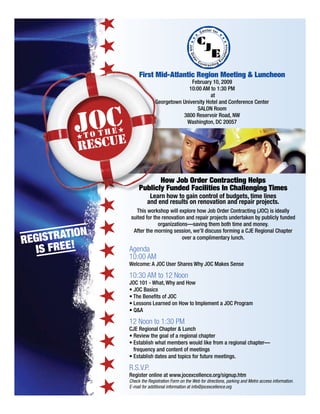
The first meeting is scheduled to be held on February
10, 2009 at the Georgetown University Hotel and
Conference Center, 3800 Reservoir Road, NW in
Washington, DC 20057. This will be both a JOC train-
ing opportunity combined with a regional chapter first
meeting. The JOC 101 session will start at 10:30 AM
and go until noon. During lunch, there will be a session
on the start up of the regional CJE Mid-Atlantic chap-
ter. The target goal for attendees is around 40 people,
both those new to JOC and also experienced users –
both Federal and Non Federal organizations.
To register please go to:
http://www.jocexcellence.org/signup.htm
CJE Texas Chapter News
Carol Greb held a CJE Texas Region planning
meeting on December 9, 2008 in Houston. More news
to follow in early 2009
First Mid-Atlantic Region Meeting  Luncheon
February 10, 2009
10:00 AM to 1:30 PM
at
Georgetown University Hotel and Conference Center
SALON Room
3800 Reservoir Road, NW
Washington, DC 20057
How Job Order Contracting Helps
Publicly Funded Facilities In Challenging Times
Learn how to gain control of budgets, time lines
and end results on renovation and repair projects.
This workshop will explore how Job Order Contracting (JOC) is ideally
suited for the renovation and repair projects undertaken by publicly funded
organizations—saving them both time and money.
After the morning session, we’ll discuss forming a CJE Regional Chapter
over a complimentary lunch.
Agenda
10:00 AM
Welcome: A JOC User Shares Why JOC Makes Sense
10:30 AM to 12 Noon
JOC 101 - What, Why and How
12 Noon to 1:30 PM
frequency and content of meetings
R.S.V.P.
Register online at www.jocexcellence.org/signup.htm
Check the Registration Form on the Web for directions, parking and Metro access information.
E-mail for additional information at info@jocexcellence.org
JOCT O T H E
RESCUE
REGISTRATION
IS FREE!
CJE Newsletter WINTER 2008/2009
6
of sustainable green efforts is the need for collabora-
tion between building owners, managers, construction
providers, designers, etc. If these groups are unable
to freely ­communicate, exchange ideas, change think-
ing and modify solutions as they work towards an end
result, green efforts will be slow and marginalized.
Job order contracting is a method that allows for
­sustainable thinking, to look at all the shades of green,
from a comprehensive program to simple steps in the
right direction. A job order contracting program allows
for an organization to decide what level of effort they
want to apply – whether on a single project or across all
projects impacting the whole program.
An example and a real “hot button” with members of
the green world, especially institutional owners and the
Department of Defense is the management of decon-
struction waste and the ability to incorporate recycled
materials into the construction process. Job order con-
tracting allows for a focused or a general approach to
this solution.
Why Job Order Contracting Is Well Suited
for Green Initiatives
Job order contracting is particularly well suited for sus-
tainable building. JOC is a contracting method focused
on construction services based on a contractor’s per-
formance and ability to deliver results. This type of
procurement creates a partnership relationship between
an owner and contractor because potential barriers like
profitability, schedule, scope and services are agreed
to before construction begins. This includes a scope or
Job Order Contracting Programs Allow Green,
Sustainable Renovations To Take Root
By Charlie Bowers  Vince Duobinis
The very nature of how a job order contracting program
operates allows for green, sustainable efforts to come to
life and reality at publicly-funded facilities, campuses
and organizations.
“There is always one moment in childhood when
the door opens and lets the green future in.”
– Graham Greene
Although publicly-funded facilities have focused on
LEED certifications and sustainable practices for new
construction projects, there exists a further reaching
need. With the current number of existing and aging
publicly-funded buildings and other infrastructures,
it is time to focus on improving what we have today.
Recently the USGBC has developed LEED guidelines
for existing buildings, which has opened the doors for
green strategies for repair, renovation and rehabilitation
construction.
Through a job order contracting program focused on
renovating, renewing and revitalizing existing facilities,
we are extending the usable, serviceable life of build-
ings, bringing considerable benefits to the facility owner
and the environment.
Keys To Crafting A Green And Sustainable
Renovation Construction Strategy
1. Design and implement a sustainable green renovation,
remodeling and construction policy through clear
specifications and communications to contractors and
staff. Decide how green you want to be and what this
means to your supporting construction efforts through
both your internal and external resources.
2. Have in place a contracting method that allows
­collaboration, conversations and two-way thinking
around green renovation efforts.
3. Establish goals and metrics to determine your
­success.
The contracting method and form are crucial to the
successful ability to develop and implement a green
renovation sustainability plan for a university, K-12
district, municipality or federal agency. At the core
CJE Newsletter WINTER 2008/2009
7
focus of support around green initiatives.
Developing this kind of partnership is essential in any
successful construction venture, but is ­particularly
important when an owner is trying to incorporate
­sustainability goals into their project.
For example, upwards of 80 different categories and
unique requirements need to be met in order for a proj-
ect to achieve LEED Certification in schools. With such
diverse areas as job site management, water efficiency,
energy and atmospheric controls, materials, resources,
indoor environmental quality, innovation and design
process included within 80 different ­categories needing
to be met to achieve some level of LEED ­certification,
only true collaboration between an owner, designer and
contractor can produce the kind of careful coordina-
tion, documentation, procurement and construction
­demanded for such specific requirements.
Critics of green
buildings claim
they are more
expensive to build
because of numer-
ous standards
involved, expen-
sive construc-
tion materials and
m e t h o d o l o g i e s
required. Job order
contracting tends to focus on bringing the best value for
the construction dollars, as opposed to typical design-
bid-build projects, because it requires a lower overhead
cost of construction procurement and delivery, helps
reduce and eliminate the change order philosophy, and
thus, reduces legal fees. Another key element is the abil-
ity to jointly scope projects, within a team environment,
allowing the best thinking to come together before work
is begun.
The scope is also developed to the budget, mean-
ing there are no surprises at project completion. With
JOC in particular, standard pricing and specification,
­utilizing a published unit price book (UPB), results in
efficient and effective estimating, design and fixed price
construction.
With JOC, the contractor becomes an extension of the
owner’s team and the goals of the owner become those
of the JOC contractor. A JOC program’s processes
allow the owner/client to craft and direct at what level
green and sustainable planning, development and exe­
cution should and can be applied to any project – from
simple energy savings approaches (motion sensors on/
off switches) to complete buildings.
What Is Sustainability?
In its broadest sense, sustainability is a characteristic of
a process or state that can be maintained at a certain level
indefinitely. In recent years, it has often been associated
with the environment and the discussion of how long
ecological systems can be expected to be ­productive. In
the building industry, sustainability is most often used
when referring to sustainable design, which is the prac-
tice of designing physical objects and the built environ-
ment to comply with the principles of economic, social
and ecological sustainability. It is often referred to as
“green design” or “green building.”
The five major components of sustainability are:
	 • energy efficiency
	 • water conservation
	 • indoor air and environmental quality
	 • quality, materials and construction
	 • site sustainability
We would also include:
	 • A contracting and work execution method that
allows for improved collaboration, communications
and rapid changes.
	 • A cultural attitude shift towards green and
­sustainability impacting social, economic and
­environmental concerns (the triple bottom line).
The aim of sustainable design is to produce places,
products and services in a way that reduces use
of non‑renewable resources, minimizes environmental
impact, and relates people with the natural environment.
Principles of Sustainable Design
While the practical application varies among disci-
plines, some common principles as described by the
Green Building Council are as follows:
	 • Low-impact materials – Choosing nontoxic, sus­
tainably-produced or recycled materials which
require little energy to process.
	 • Energy efficiency – Using manufacturing processes
and products which require less energy.
CJE Newsletter WINTER 2008/2009
8
assists in a seamless and consistent delivery of design
and engineering, so does job order contracting to the
improvement (or enhancement) of the built envir­onment,
allowing the teams to apply LEED and ­sustainability
standards (including self defined ones) to renovation,
remodeling and repair.
A Job Order Contracting Program
Allows For:
	 3 Green Sustainable Efforts On Renovation 
Repair Work
	 3 Contracting Methodology Allows For Green
Thinking  Dialogue
	 3 Cooperative, Collaborative Development
of Solutions
	 3 Fast Response Using Best Practices In
Sustainability
	 3 Innovative Green Solutions, Ideas and Sharing
	 3 Control On Budgets and Outcomes Of Green
Projects
	 3 Driven By Client Desired Level Of Green Focus
	 3 Jointly Developed Detailed Green Project Scopes
	 3 Ability To Work With Green Experienced
Subcontractors
	 3 Ability To Use Green Building Materials
	 3 Green Thinking On Small, Medium and Larger
Projects
	 3 Can Focus On Recyclable and Reusable Materials
	 3 Can Include Energy Efficiency and Improvement
Efforts – from simple to more complicated
A JOC Program Allows For Green
Subcontractors
When implementing green
renovation strategies at any
publicly-funded facility, it is
important to tap into green
knowledgeable and experi-
enced subcontractors. The
ability to install a green roof,
or to trade out poor perform-
ing lighting and replace it
with high efficiency, requires past performance and
	 • Quality and durability – Longer-lasting and
better-functioning products will have to be replaced
less frequently, reducing the impacts of producing
replacements.
	 • Design for reuse and recycling – Products, ­processes,
and systems should be designed for performance in
a commercial “afterlife”.
	 • Design Impact Measures – Measurements for total
earth footprint and life cycle assessment for any
resource use are increasingly required and available.
Many are complex, but some give quick and accu-
rate whole earth estimates of impacts.
	 • Sustainable Design Standards – These, along with
project design guides are increasingly being made
available and are originated by a wide array of
­private and industry organizations.
	 • Biomimicry – Redesigning industrial systems on
biological lines … enabling the constant reuse of
materials in continuous closed cycles.
	 • Service substitution – Shifting the mode of con­
sumption from personal ownership of products
to provision of services which provide similar
­functions, e.g., from a private automobile to a car
sharing service.
	 • Renewability – Using materials that come from
nearby  (local or bioregional), sustainably managed
renewable sources that can be composted (or fed to
livestock) when their usefulness has been exhausted.
	 • Healthy Buildings – Sustainable building design
aims to create buildings that are not harmful to their
occupants or to the larger environment. An impor-
tant emphasis is on indoor environmental quality,
especially indoor air quality.
Job Order Contracting Allows For Cost
Effective Green Solutions
Job order contracting allows for a holistic approach of
expediting sustainability into an ongoing construction
program. Basically, think of it as a tool or value-added
process to meet guidelines and goals – rather than a
tactical use.
Nothing gets “lost in translation” when working as a
unified job order contracting team. Professional JOC
programs allow for the integration of sustainable short
term objectives to meet the long-term regeneration
goals. As an integrated project delivery unifies and
CJE Newsletter WINTER 2008/2009
9
City/ Municipality
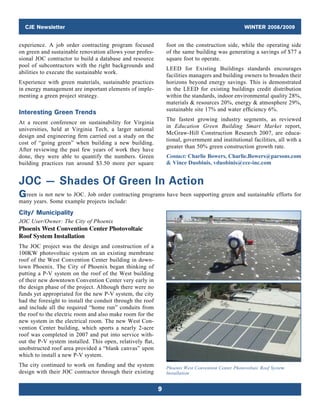
JOC User/Owner: The City of Phoenix
Phoenix West Convention Center Photovoltaic
Roof System Installation
The JOC project was the design and construction of a
100KW photovoltaic system on an existing membrane
roof of the West Convention Center building in down-
town Phoenix. The City of Phoenix began thinking of
putting a P-V system on the roof of the West building
of their new downtown Convention Center very early in
the design phase of the project. Although there were no
funds yet appropriated for the new P-V system, the city
had the foresight to install the conduit through the roof
and include all the required “home run” conduits from
the roof to the electric room and also make room for the
new system in the electrical room. The new West Con-
vention Center building, which sports a nearly 2-acre
roof was completed in 2007 and put into service with-
out the P-V system installed. This open, relatively flat,
unobstructed roof area provided a “blank canvas” upon
which to install a new P-V system.
The city continued to work on funding and the system
design with their JOC contractor through their existing
Phoenix West Convention Center Photovoltaic Roof System
Installation
JOC — Shades Of Green In Action
Green is not new to JOC. Job order contracting programs have been supporting green and sustainable efforts for
many years. Some example projects include:
experience. A job order contracting program focused
on green and sustainable renovation allows your profes-
sional JOC contractor to build a database and resource
pool of subcontractors with the right backgrounds and
abilities to execute the sustainable work.
Experience with green materials, sustainable practices
in energy management are important elements of imple-
menting a green project strategy.
Interesting Green Trends
At a recent conference on sustainability for Virginia
universities, held at Virginia Tech, a larger national
design and engineering firm carried out a study on the
cost of “going green” when building a new building.
After reviewing the past few years of work they have
done, they were able to quantify the numbers. Green
building practices run around $3.50 more per square
foot on the construction side, while the operating side
of the same building was generating a savings of $77 a
square foot to operate.
LEED for Existing Buildings standards encourages
facilities managers and building owners to broaden their
horizons beyond energy savings. This is demonstrated
in the LEED for existing buildings credit distribution
within the standards, indoor environmental quality 28%,
materials  resources 20%, energy  atmosphere 29%,
sustainable site 17% and water efficiency 6%.
The fastest growing industry segments, as reviewed
in Education Green Building Smart Market report,
McGraw-Hill Construction Research 2007, are educa-
tional, government and institutional facilities, all with a
greater than 50% green construction growth rate.
Contact: Charlie Bowers, Charlie.Bowers@parsons.com
 Vince Duobinis, vduobinis@cce-inc.com
CJE Newsletter WINTER 2008/2009
10
JOC contract. The entire design-build process took
approximately 6 months to complete, including the
detailed design, city permitting, an eight week delivery
time on the P-V materials, and the installation and system
start-up. During this time, the city and the JOC contractor
worked on constructability issues, cost concerns and
­system compatibility with the existing roofing.
Submitted by CJE Member Organization: Parsons
City/ Municipality
JOC User/Owner: City of Chicago Department of
General Services (DGS)
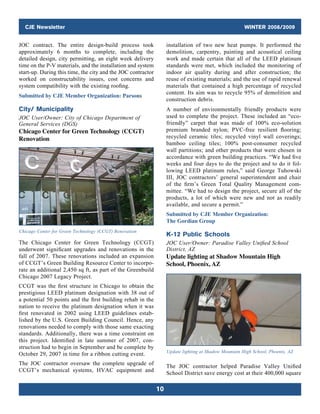
Chicago Center for Green Technology (CCGT)
Renovation
Chicago Center for Green Technology (CCGT) Renovation
The Chicago Center for Green Technology (CCGT)
underwent significant upgrades and renovations in the
fall of 2007. These renovations included an expansion
of CCGT’s Green Building Resource Center to incorpo-
rate an additional 2,450 sq ft, as part of the Greenbuild
Chicago 2007 Legacy Project.
CCGT was the first structure in Chicago to obtain the
prestigious LEED platinum designation with 38 out of
a potential 50 points and the first building rehab in the
nation to receive the platinum designation when it was
first renovated in 2002 using LEED guidelines estab-
lished by the U.S. Green Building Council. Hence, any
renovations needed to comply with those same exacting
standards. Additionally, there was a time constraint on
this project. Identified in late summer of 2007, con-
struction had to begin in September and be complete by
October 29, 2007 in time for a ribbon cutting event.
The JOC contractor oversaw the complete upgrade of
CCGT’s mechanical systems, HVAC equipment and
installation of two new heat pumps. It performed the
demolition, carpentry, painting and acoustical ceiling
work and made certain that all of the LEED platinum
standards were met, which included the monitoring of
indoor air quality during and after construction; the
reuse of existing materials; and the use of rapid renewal
materials that contained a high percentage of recycled
content. Its aim was to recycle 95% of demolition and
construction debris.
A number of environmentally friendly products were
used to complete the project. These included an “eco-
friendly” carpet that was made of 100% eco-solution
premium branded nylon; PVC-free resilient flooring;
recycled ceramic tiles; recycled vinyl wall coverings;
bamboo ceiling tiles; 100% post-consumer recycled
wall partitions; and other products that were chosen in
accordance with green building practices. “We had five
weeks and four days to do the project and to do it fol-
lowing LEED platinum rules,” said George Tuhowski
III, JOC contractors’ general superintendent and chair
of the firm’s Green Total Quality Management com-
mittee. “We had to design the project, secure all of the
products, a lot of which were new and not as readily
available, and secure a permit.”
Submitted by CJE Member Organization:
The Gordian Group
K-12 Public Schools
JOC User/Owner: Paradise Valley Unified School
District, AZ
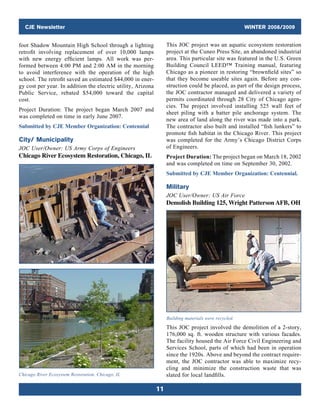
Update lighting at Shadow Mountain High
School, Phoenix, AZ
Update lighting at Shadow Mountain High School, Phoenix, AZ
The JOC contractor helped Paradise Valley Unified
School District save energy cost at their 400,000 square
CJE Newsletter WINTER 2008/2009
11
foot Shadow Mountain High School through a lighting
retrofit involving replacement of over 10,000 lamps
with new energy efficient lamps. All work was per-
formed between 4:00 PM and 2:00 AM in the morning
to avoid interference with the operation of the high
school. The retrofit saved an estimated $44,000 in ener-
gy cost per year. In addition the electric utility, Arizona
Public Service, rebated $54,000 toward the capital
cost.
Project Duration: The project began March 2007 and
was completed on time in early June 2007.
Submitted by CJE Member Organization: Centennial
City/ Municipality
JOC User/Owner: US Army Corps of Engineers
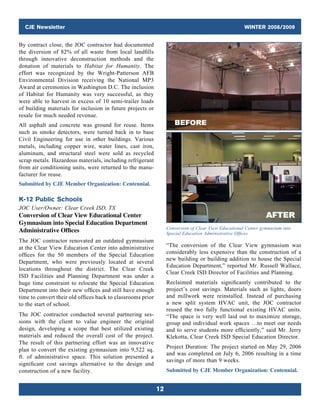
Chicago River Ecosystem Restoration, Chicago, IL
This JOC project was an aquatic ecosystem restoration
project at the Cuneo Press Site, an abandoned industrial
area. This particular site was featured in the U.S. Green
Building Council LEED™ Training manual, featuring
Chicago as a pioneer in restoring “brownfield sites” so
that they become useable sites again. Before any con-
struction could be placed, as part of the design process,
the JOC contractor managed and delivered a variety of
permits coordinated through 28 City of Chicago agen-
cies. The project involved installing 525 wall feet of
sheet piling with a batter pile anchorage system. The
new area of land along the river was made into a park.
The contractor also built and installed “fish lunkers” to
promote fish habitat in the Chicago River. This project
was completed for the Army’s Chicago District Corps
of Engineers.
Project Duration: The project began on March 18, 2002
and was completed on time on September 30, 2002.
Submitted by CJE Member Organization: Centennial.
Military
JOC User/Owner: US Air Force
Demolish Building 125, Wright Patterson AFB, OH
Building materials were recycled.
This JOC project involved the demolition of a 2-story,
176,000 sq. ft. wooden structure with various facades.
The facility housed the Air Force Civil Engineering and
Services School, parts of which had been in ­operation
since the 1920s. Above and beyond the contract require-
ment, the JOC contractor was able to maximize recy-
cling and minimize the construction waste that was
slated for local landfills.
CJE Newsletter WINTER 2008/2009
12
By contract close, the JOC contractor had documented
the diversion of 82% of all waste from local landfills
through innovative deconstruction methods and the
donation of materials to Habitat for Humanity. The
effort was recognized by the Wright-Patterson AFB
Environmental Division receiving the National MP3
Award at ceremonies in Washington D.C. The inclusion
of Habitat for Humanity was very successful, as they
were able to harvest in excess of 10 semi-trailer loads
of building materials for inclusion in future projects or
resale for much needed revenue.
All asphalt and concrete was ground for reuse. Items
such as smoke detectors, were turned back in to base
Civil Engineering for use in other buildings. Various
metals, including copper wire, water lines, cast iron,
aluminum, and structural steel were sold as recycled
scrap metals. Hazardous materials, including refrigerant
from air conditioning units, were returned to the manu-
facturer for reuse.
Submitted by CJE Member Organization: Centennial.
K-12 Public Schools
JOC User/Owner: Clear Creek ISD, TX
Conversion of Clear View Educational Center
Gymnasium into Special Education Department
Administrative Offices
The JOC contractor renovated an outdated gymnasium
at the Clear View Education Center into administrative
offices for the 50 members of the Special Education
Department, who were previously located at several
locations throughout the district. The Clear Creek
ISD Facilities and Planning Department was under a
huge time constraint to relocate the Special Education
Department into their new offices and still have enough
time to convert their old offices back to classrooms prior
to the start of school.
The JOC contractor conducted several partnering ses-
sions with the client to value engineer the original
design, developing a scope that best utilized existing
materials and reduced the overall cost of the project.
The result of this partnering effort was an innovative
plan to convert the existing gymnasium into 9,522 sq.
ft. of administrative space. This solution presented a
significant cost savings alternative to the design and
construction of a new facility.
Conversion of Clear View Educational Center gymnasium into
Special Education Administrative Offices
“The conversion of the Clear View gymnasium was
considerably less expensive than the construction of a
new building or building addition to house the Special
Education Department,” reported Mr. Russell Wallace,
Clear Creek ISD Director of Facilities and Planning.
Reclaimed materials significantly contributed to the
project’s cost savings. Materials such as lights, doors
and millwork were reinstalled. Instead of purchasing
a new split system HVAC unit, the JOC contractor
reused the two fully functional existing HVAC units.
“The space is very well laid out to maximize storage,
group and individual work spaces …to meet our needs
and to serve students more efficiently,” said Mr. Jerry
Klekotta, Clear Creek ISD Special Education Director.
Project Duration: The project started on May 29, 2006
and was completed on July 6, 2006 resulting in a time
savings of more than 9 weeks.
Submitted by CJE Member Organization: Centennial.
CJE Newsletter WINTER 2008/2009
13
City/Municipality
JOC User/Owner: City of Chandler’s Parks
Department, AZ
Snedigar Sportsplex Reclaimed Water Project,
Chandler, AZ
City of Chandler’s Parks for Municipalities, AZ
With water conservation being a high priority for muni­ci­
palities in Arizona, the JOC contractor was tasked with
designing and constructing an irrigation system that
would provide water to The Snedigar Sports Complex, a
70-acre sports center overseen by the City of Chandler’s
Parks Department. The JOC contractor worked with the
City’s Parks Department to develop a system in which
wastewater would be reclaimed and used to irrigate the
grounds. The JOC contractor installed an automated
pump that is controlled via a remote monitoring system.
Project Duration: The project was started on June 23,
2003 and completed on January 12, 2004.
Submitted by CJE Member Organization: Centennial.
Military
JOC User/Owner: Fort Lewis, WA
Waste Management Program at Fort Lewis
World War II era buildings being “deconstructed” in order to
increase the recovery of useable materials
The JOC contractor has developed a comprehensive
Waste Management Program for their Job Order Contract
program at Fort Lewis (the base is at the forefront of
sustainability in the U.S. Army.) Fort Lewis was the
first Army installation to have an internationally certi-
fied environmental management system in place, and
the first Army installation to be accepted into the EPA’s
National Environmental Performance Track Program.
The JOC contractors’ goal for the program is to divert
from the waste stream at least 60 percent by volume
of all construction waste. Prior to commencing work
on projects, the JOC contractor works with the client’s
Public Works Inspector to develop aTask Order Waste
Management Plan Worksheet which identifies recyclable
and recoverable material. The plan identifies construc-
tion waste that will be disposed of on the installation
or at an off site disposal facility. As work proceeds on
the task order, construction debris is removed from the
work site to a central location and sorted into the various
components of wood, metal, glass, concrete aggregate,
soil, and miscellaneous debris. Certain components of
wood and metal may be reused on the project.
Upon completion, the JOC contractor provides the
­client  with a report which documents the quantity of
waste diverted from the landfill, including the volume of
recovered materials reused or sent to recycling centers.
Submitted by CJE Member Organization: Centennial.
CJE Newsletter WINTER 2008/2009
14
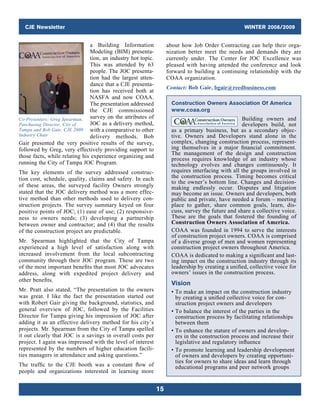
Bob Gair, 2009 Industry Chair, working the CJE booth
2008 COAA Conference—Tampa, FL
Job Order Contracting: Topic Of Conversation and Great Interest
By Robert Gair
The Construction Owners Association of America
(COAA) is a professionally run nonprofit organiza-
tion that was founded in 1994 to serve the interests of
construction project owners within public and private
institutions. CJE had a booth at the conference, manned
by David Carrithers, current Industry Chairman and Bob
Gair, 2009 Industry Chairman.
“COAA brings together a diverse group of owners who
employ means to design and build facilities. COAA
meetings are a great opportunity to learn a lot in a short
time. I appreciate the willingness of owners who have
solved similar problems to candidly share ideas,” said
Ford Stryker, Penn State University.
The Tampa Conference held on December 2–4, attend-
ed by the Center for JOC Excellence, had a good
mix of ­representatives from Universities/Schools,
A/E Firms, City/County Governments, Contractors,
Medical Institutions, Software Companies and Federal
Government Agencies. Over 300 people attended with
University/Schools having the largest share of ­attendees,
making up 40% of all attendees. This fit well with the
best target audience for JOC and CJE related services
in the current economic environment. Although the
Conference had a Florida/Georgia/Mid-Atlantic States
flavor, thirty-three percent (33%) of the attendees came
from other parts of the country, including the Northeast,
Southwest and Western States.
The Vendor attendance was small with only twenty (20)
booths, yet from CJE’s perspective this is a plus as we
readily received face time with a large number of attend-
ees. Like NASFA, this type of conference provides the
highest amount of exposure for CJE with our targeted
audiences. Based on this launch event and the success
in the interest in Job Order Contracting CJE plans to
further grow its association with COAA in 2009.
Trapas Pratt, CJE’s newest member, attended the con-
ference. “The CJE booth looked great,” he said. “It was
definitely one of the better set up’s out of the bunch. I
am sure it didn’t hurt that you were using little green
gator’s with the CJE logo in Florida, but I chose to think
it was the booth message as well. I was happy to see the
level of interest in JOC, being that our company has just
recently decided to look into this delivery method. “
Kelvin King, a long term CJE member who also attended
and exhibited at the conference stated, “Representatives
from universities in Iowa, Georgia, Virginia and Penn­
sylvania, mentioned that they were close to implement-
ing a JOC program. Other attendees, like those from
Texas and Florida as an example, commented that they
were already using JOC and found it key to their ability
to manage their construction projects focused on reno-
vation and repair. There was a buzz at the meeting on
JOC as a tool to help people get done what they need
to in 2009.”
COAA holds two conferences a year; in 2009 they will
be held in Indianapolis, IN, May 13–15 and in Austin,
TX, November 18–20. Austin certainly would be a
­natural location for CJE with the development of the
Texas Regional Chapter. This would be a great way to
support the Chapter, hold a National Quarterly meet-
ing and provide the Region with exposure to the CJE
National Organization.
The facilities at the Tampa Marriott Waterside were
first rate; the meeting rooms, vendor display area and
the hotel in general. COAA representatives were ever
­present, very service oriented and readily available to
ensure that our needs were met.
We were surprised, when discussing JOC with the
attendees, how little was known about this delivery
method. We felt that our presentation could have been
JOC 101; ironically we were asked by a COAA commit-
tee member to attend a future conference to present at
the introductory level.
The presentation given by Greg Spearman, Purchasing
Director, City of Tampa and Bob Gair, CJE Industry
Chair-Elect was attended by thirty-one (31) people. We
felt this was a good turnout as we were competing with
CJE Newsletter WINTER 2008/2009
15
a Building Information
Modeling (BIM) presenta-
tion, an industry hot topic.
This was attended by 63
people. The JOC presenta-
tion had the largest atten-
dance that a CJE presenta-
tion has received both at
NASFA and now COAA.
The presentation addressed
the CJE commissioned
survey on the attributes of
JOC as a delivery ­method,
with a comparative to other
delivery methods. Bob
Gair presented the very positive results of the ­survey,
followed by Greg, very effectively providing support to
those facts, while relating his experience organizing and
running the City of Tampa JOC Program.
The key elements of the survey addressed construc-
tion cost, schedule, quality, claims and safety. In each
of these areas, the surveyed facility Owners strongly
stated that the JOC delivery method was a more effec-
tive method than other methods used to delivery con-
struction projects. The survey summary keyed on four
­positive points of JOC; (1) ease of use; (2) responsive-
ness to owners needs; (3) developing a partnership
between owner and contractor; and (4) that the results
of the construction project are predictable.
Mr. Spearman highlighted that the City of Tampa
­experienced a high level of satisfaction along with
increased involvement from the local subcontracting
community through their JOC program. These are two
of the most important benefits that most JOC advocates
address, along with expedited project delivery and
other benefits.
Mr. Pratt also stated, “The presentation to the owners
was great. I like the fact the presentation started out
with Robert Gair giving the background, statistics, and
general overview of JOC, followed by the Facilities
Director for Tampa giving his impression of JOC after
adding it as an effective delivery method for his city’s
projects. Mr. Spearman from the City of Tampa spelled
it out clearly that JOC is a savings in overall costs per
project. I again was impressed with the level of interest
represented by the numbers of higher education facili-
ties managers in attendance and asking questions.”
The traffic to the CJE booth was a constant flow of
people and organizations interested in learning more
about how Job Order Contracting can help their orga-
nization better meet the needs and demands they are
currently under. The Center for JOC Excellence was
pleased with having attended the conference and look
forward to building a continuing relationship with the
COAA organization.
Contact: Bob Gair, bgair@reedbusiness.com
Construction Owners Association Of America
www.coaa.org
Building owners and
developers build, not
as a primary business, but as a secondary objec-
tive. Owners and Developers stand alone in the
complex, changing construction process, represent-
ing themselves in a major financial commitment.
The management of the design and construction
process requires knowledge of an industry whose
technology evolves and changes continuously. It
requires interfacing with all the groups involved in
the construction process. Timing becomes critical
to the owner’s bottom line. Changes and decision-
making endlessly occur. Disputes and litigation
may become an issue. Owners and developers, both
public and private, have needed a forum – meeting
place to gather, share common goals, learn, dis-
cuss, survey the future and share a collective voice.
These are the goals that fostered the founding of
Construction Owners Association of America.
COAA was founded in 1994 to serve the interests
of construction project owners. COAA is comprised
of a diverse group of men and women representing
construction project owners throughout America.
COAA is dedicated to making a significant and last-
ing impact on the construction industry through its
leadership by creating a unified, collective voice for
owners’ issues in the construction process.
Vision
• To make an impact on the construction industry
by creating a unified collective voice for con-
struction project owners and developers
• To balance the interest of the parties in the
­
construction process by facilitating relationships
between them
• To enhance the stature of owners and develop-
ers in the construction process and increase their
­legislative and regulatory influence
• To promote learning and leadership development
of owners and developers by creating opportuni-
ties for owners to share ideas and learn through
educational programs and peer network groups
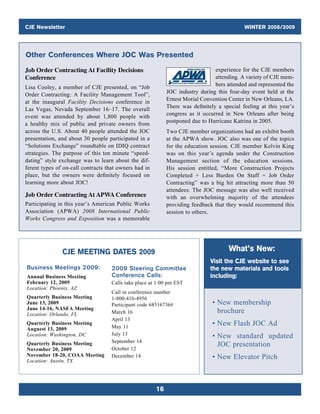
Co-Presenters: Greg Spearman,
Purchasing Director, City of
Tampa and Bob Gair, CJE 2009
Industry Chair
CJE Newsletter WINTER 2008/2009
16
Other Conferences Where JOC Was Presented
Job Order Contracting At Facility Decisions
Conference
Lisa Cooley, a member of CJE presented, on “Job
Order Contracting: A Facility Management Tool”,
at the inaugural Facility Decisions conference in
Las Vegas, Nevada September 16–17. The overall
event was attended by about 1,800 people with
a healthy mix of public and private owners from
across the U.S. About 40 people attended the JOC
presentation, and about 30 people participated in a
“Solutions Exchange” roundtable on IDIQ contract
strategies. The purpose of this ten minute “speed-
dating” style exchange was to learn about the dif-
ferent types of on-call contracts that owners had in
place, but the owners were definitely focused on
learning more about JOC!
Job Order Contracting At APWA Conference
Participating in this year’s American Public Works
Association (APWA) 2008 International Public
Works Congress and Exposition was a memorable
experience for the CJE members
attending. A variety of CJE mem-
bers attended and represented the
JOC industry during this four-day event held at the
Ernest Morial Convention Center in New Orleans, LA.
There was definitely a special feeling at this year’s
congress as it occurred in New Orleans after being
postponed due to Hurricane Katrina in 2005.
Two CJE member organizations had an exhibit booth
at the APWA show. JOC also was one of the topics
for the education session. CJE member Kelvin King
was on this year’s agenda under the Construction
Management section of the education sessions.
His session entitled, “More Construction Projects
Completed + Less Burden On Staff = Job Order
Contracting” was a big hit attracting more than 50
attendees. The JOC message was also well received
with an overwhelming majority of the attendees
providing feedback that they would recommend this
session to others.
CJE MEETING DATES 2009
Business Meetings 2009:
Annual Business Meeting
February 12, 2009
Location: Phoenix, AZ
Quarterly Business Meeting
June 13, 2009
June 14-16, NASFA Meeting
Location: Orlando, FL
Quarterly Business Meeting
Auguest 13, 2009
Location: Washington, DC
Quarterly Business Meeting
November 20, 2009
November 18-20, COAA Meeting
Location: Austin, TX
2009 Steering Committee
Conference Calls:
Calls take place at 1:00 pm EST
Call in conference number
1-800-416-4956
Participant code 68516736#
March 16
April 13
May 11
July 13
September 14
October 12
December 14
• New membership
­brochure
• New Flash JOC Ad
• New standard updated
JOC presentation
• New Elevator Pitch
What’s New:
Visit the CJE website to see
the new materials and tools
including:
CJE Newsletter WINTER 2008/2009
17
Founded in 1928 as a
small roofing materials
manufacturer, Tremco has
grown into The Tremco Group, an RPM International
Incorporated affiliate company employing over 1,900
people in ­dozens of locations around the world. The
Tremco Group consists of operating divisions special-
izing not only in the manufacture and sale of roof-
ing materials and services, but construction sealants,
glazing and gaskets, waterproofing systems, concrete
admixtures and sealers, grouts and mortars, fire stop-
ping systems, and a host of custom designed products,
programs and services dedicated to the worldwide con-
struction, maintenance and repair industries.
Roofififing  Building Maintenance
Tremco’s Roofing and Building Maintenance Division
specializes in custom roofing and weatherproofing
solutions for facility managers, engineers and business
owners. Designed to maximize roofing assets, Tremco
provides a complete line of asbestos free roofing and
weatherproofing systems and products. With one of the
largest networks of highly trained, company-employed
field advisors, the Roofing and Building Maintenance
Division is committed to establishing long term rela-
tionships with our customers. In addition, to the service
division, Weatherproofing Technologies Inc. offers a
number of investigative, maintenance and information-
based services to assist in asset management and main-
tenance of roofing systems. The Roofing Division also
includes Republic Powdered Metals, the founding
company of RPM International Inc.
Job Order Contracting
Tremco and its service division, Weatherproofing
Technologies Incorporated (WTI), entered the job order
contracting environment in Texas in late 2007 via a suc-
cessful award of a competitively bid solicitation from
The Cooperative Purchasing Network (TCPN), through
parking garages, building envelope management, gener-
al contracting and a host of other services listed below.
Sealant/Weatherproofing
Tremco’s Sealant/Weatherproofing Division was created
from the marriage of Tremco’s Construction Division
with Mameco International, Paramount Technical
MEMBER PROFILE
By Gary Johnson
Products and Tremco Barrier Solutions, a market leader
in below-grade waterproofing products and services.
This powerful combination affords Tremco with a
leader­ship position in the sealants, waterproofing, glaz-
ing and fire stopping markets throughout the world. For
generations, Tremco has successfully provided products
and services to architects, engineers, contractors and
building owners worldwide. When it comes to protect-
ing and weatherproofing the entire building envelope,
Tremco Sealants/Weatherproofing is uniquely posi-
tioned to provide single source products, services and
solutions.
The Euclid Chemical Company
Tremco’s Euclid Chemical Company Division is an
industry leader in the concrete and masonry industries
and is divided into two product and service platforms,
construction products and concrete admixtures. With
world headquarters in Cleveland, OH, Euclid is aggres-
sively pursuing sales and manufacturing opportunities
throughout the U.S., Canada, Mexico and South America.
Additionally, it is expanding it’s international presence
with marketing partnerships in Asia-Pacific and the
Middle East. Euclid’s specialty products include: floor
hardeners, curing and sealing compounds, grouts and
mortars, concrete and masonry repair systems, concrete
admixtures, architectural and engineering services and
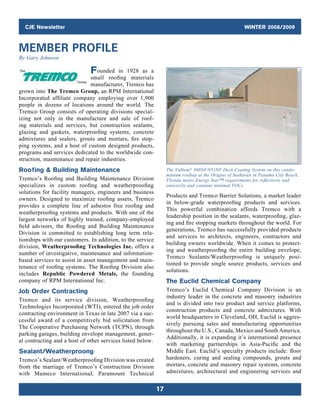
The Vulkem®
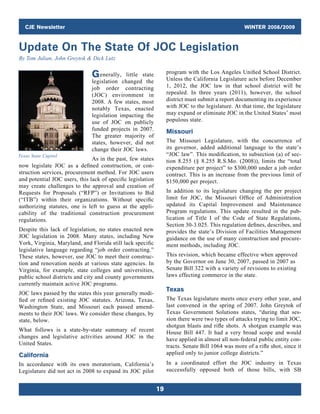
360NF/951NF Deck Coating System on this condo-
minium rooftop at the Origins of Seahaven in Panama City Beach,
Florida meets Energy Star™ requirements for reflectivity and
­emissivity and contains minimal VOCs.
CJE Newsletter WINTER 2008/2009
18
Tndustry Liaison Committee within
NASFA supports the joint work of
numerous liaisons with other groups,
including AGC, ACEC, USGBC.
During this year’s June conference
in Jackson Hole, the idea of creating
a liaison between NASFA and CJE
was born, and received strong sup-
port from the CJE contingent there.
After endorsement from the NASFA Industry Liaison
committee, a survey of NASFA members who were
using JOC and interested in participating, and approval
from the full CJE Board, we hosted a preparatory liaison
call on Dec. 11th to better understand the needs of the
NASFA participants.
What emerged from the NASFA members was that in spite
of the many educational sessions on JOC, the states still
have a strong need for educational programming on JOC.
It turns out that many states are using JOC-like contracts
but are not necessarily calling them JOC, so the group
thought that starting with basic definitions and the difference
between JOC and other on-call contracts might be good.
The states were also interested in learning from other states
that are using JOC, so a survey or poll to discover more
about different states’ programs could be a good kickoff
project, with the results forming a roundtable discussion at
the annual conference, or other educational program.
The next call is February 9th at 3PM EST 319-279-1000
participant code 435123#.
Contact: Lisa Cooley at lcooley@cce-inc.com
Broaden CJE Reach Through NASFA Liaison
By Lisa Cooley
extensive technical and customer support. Originally
started as a family business, Euclid became part of
the RPM family of companies in 1984 and part of the
Tremco Group in 1999.
HVAC Repair and Maintenance
Using a network of approved contractors to perform
HVAC and mechanical installation, maintenance, repair
and replacement work, conduct installation of ­boilers,
split systems, fans, pumps and other devices related
to heating, ventilation and cooling of air and water,
preventive maintenance and repair programs cover all
types of HVAC equipment as well as related electrical
and plumbing systems.
Parking Garage Repair and Maintenance
Through proper discovery and programming, we extend
the life of parking garage structures and reduce dete-
rioration of steel reinforced concrete. Repairs include
slab replacement, all repairs, sealing and waterproofing.
Tremco also offers maintenance programs that pre-
serve concrete structures and reduce the cost of future
repairs.
Façade Repair and Maintenance
WTI offers complete facade restoration including brick-
work, masonry walls, tiles, glass metalwork, con-
crete, and structural supports. Services include facade
repair work as well as exterior cleaning, caulking and
­weatherproofing.
Other Services
Additional project management services offered include
below-grade waterproofing, concrete and asphalt park-
ing lot restoration, fencing, security and fire systems,
life safety: fire barrier management, plumbing, elect­
rical, landscaping, as well as interior and exterior
­renovation and restoration.
Facility Management General Contracting
General contracting through WTI offers single source
responsibility and total coordination for all of the facility
management services that Tremco offers. Single source
responsibility means that at the end of the day, there is
“one throat to choke”. To our customers, this translates to
a reduction in the hassle factor. Services include an on-site
superintendent who manages daily work-in-progress, and
keeps customers informed throughout the entire job. This
exclusive interaction minimizes project concerns while
ensuring effective communication and job satisfaction.
Tremco has executed projects ranging in size from $2,500
to over $7 million via the TCPN contract. Tremco has
been privileged to serve numerous school districts, uni-
versities, cities, counties and states utilizing this process.
Projects have included mechanical, electrical plumbing,
paving, façade, interior remodel, historical renovation,
interior and exterior painting and landscaping.
Contact: Gary Johnson, 713-594-5036
jgjohnson@tremcoinc.com
CJE Newsletter WINTER 2008/2009
19
Generally, little state
legislation changed the
job order contracting
(JOC) environment in
2008. A few states, most
notably Texas, enacted
legislation impacting the
use of JOC on publicly
funded projects in 2007.
The greater majority of
states, however, did not
change their JOC laws.
As in the past, few states
now legislate JOC as a defined construction, or con-
struction services, procurement method. For JOC users
and potential JOC users, this lack of ­specific ­legislation
may create challenges to the approval and creation of
Requests for Proposals (“RFP”) or Invitations to Bid
(“ITB”) within their organizations. Without ­specific
authorizing statutes, one is left to guess at the appli-
cability of the traditional construction procurement
regulations.
Despite this lack of legislation, no states enacted new
JOC legislation in 2008. Many states, including New
York, Virginia, Maryland, and Florida still lack specific
legislative language regarding “job order contracting.”
These states, however, use JOC to meet their construc-
tion and renovation needs at various state agencies. In
Virginia, for example, state colleges and universities,
public school districts and city and county governments
currently maintain active JOC programs.
JOC laws passed by the states this year generally modi-
fied or refined existing JOC statutes. Arizona, Texas,
Washington State, and Missouri each passed amend-
ments to their JOC laws. We consider these changes, by
state, below.
What follows is a state-by-state summary of recent
changes and legislative activities around JOC in the
United States.
California
In accordance with its own moratorium, California’s
Legislature did not act in 2008 to expand its JOC pilot
program with the Los Angeles Unified School District.
Unless the California Legislature acts before December
1, 2012, the JOC law in that school district will be
repealed. In three years (2011), however, the school
district must submit a report documenting its experience
with JOC to the legislature. At that time, the legislature
may expand or eliminate JOC in the United States’ most
populous state.
Missouri
The Missouri Legislature, with the concurrence of
its governor, added additional language to the state’s
“JOC law”. This modification, to subsection (a) of sec-
tion 8.255 (§ 8.255 R.S.Mo. (2008)), limits the “total
expenditure per project” to $300,000 under a job order
contract. This is an increase from the previous limit of
$150,000 per project.
In addition to its legislature changing the per project
limit for JOC, the Missouri Office of Administration
updated its Capital Improvement and Maintenance
Program regulations. This update resulted in the pub-
lication of Title I of the Code of State Regulations,
Section 30-3.025. This regulation defines, describes, and
provides the state’s Division of Facilities Management
guidance on the use of many construction and procure-
ment methods, including JOC.
This revision, which became effective when approved
by the Governor on June 30, 2007, passed in 2007 as
Senate Bill 322 with a variety of revisions to existing
laws effecting commerce in the state.
Texas
The Texas legislature meets once every other year, and
last convened in the spring of 2007. John Greytok of
Texas Government Solutions states, “during that ses-
sion there were two types of attacks trying to limit JOC,
shotgun blasts and rifle shots. A shotgun example was
House Bill 447. It had a very broad scope and would
have applied in almost all non-federal public entity con-
tracts. Senate Bill 1064 was more of a rifle shot, since it
applied only to junior college districts.”
In a coordinated effort the JOC industry in Texas
­successfully opposed both of those bills, with SB
Texas State Capitol
Update On The State Of JOC Legislation
By Tom Julian, John Greytok  Dick Lutz
CJE Newsletter WINTER 2008/2009
20
1064 dying before the House floor and HB 447 being
vetoed  by  the Governor. Just prior to this session
the Texas JOC industry worked with an investiga-
tion ­committee on the use of JOC in the state, and the
report findings were positive and favorable on job order
­contracting.
These bills are being pushed specifically by architects
and engineers who view JOC as a threat to their “pro-
fessional integrity,” meaning that they believe JOC will
reduce their authority, diminish their role, and cut their
income. John also added, “We have to assume that the
new Texas session (starting January 13, 2009) will bring
several more efforts to limit JOC, sponsored by similar
groups for similar reasons.”
Last session one item did slip past us. A last min-
ute amendment to HB 1886 inserted to harmful JOC
­
language to a bill applicable to municipal construction
projects. John concluded, “That just motivates all of us
in Texas to be even stronger and more vigilant this time
around. Like football, the legislative process is a game
of inches and the team that stops playing is likely to get
pushed off the field.”
Washington State
The Capital Projects Advisory Review Board (CPARB)
has been in operation for the past three years. This com-
mittee, appointed by the governor, is composed of 23
stakeholders in capital construction projects throughout
the state.
As stated in the legislation, “The 2005 Legislature
created the Capital Projects Advisory Review Board
(CPARB) under ESHB 1830 (RCW 39.10) to review
alternative public works contracting procedures and
provide guidance to state policymakers on ways to
­further enhance the quality, efficiency and accounta­
bility of public works contracting methods.”
Thus far, CPARB has concentrated its efforts on General
Contractor/Construction Manager, Design Build, and
JOC. With over 450 hours of formal meeting time in
the past forty months, approximately 9% of that time
has been devoted to JOC. The main reason for this lack
of time devoted to JOC has been a limited knowledge
about what JOC is and how it works by the members of
CPARB. Additionally, the state spends much more of
its capital construction budget on GC/CM, with a much
smaller amount spent on D-B and JOC.
As Dick Lutz, a legislative educational consultant stated
“While for JOC, during the past 12 months, approxi-
mately eleven million dollars of JOC work orders have
been completed statewide by four JOC contractors.
However, without a few people knowledgeable in JOC
meeting regularly with CPARB, JOC would receive
little or no attention. This limited attention has caused
JOC to remain stagnant while the desire of those direct-
ly involved in JOC have tried to expand not only the use
of JOC by public facility owners but also the expansion
of the dollar limitations put on JOC by the legislation
authorizing JOC.”
Recently, the expansion of JOC is not an option because
some of the CPARB members will not support change
without definitive data about the implementation of
JOC in the state. It was hoped that the data collected by
a recent survey conducted by CPARB would result in
substantive information that would document the suc-
cess of JOC.
However, the survey document was not well conceived
and the resulting information provide nothing that
would suggest a expansion of JOC was warranted. Some
of the major roadblocks identified by a few CAPRB
members included:
• JOC contractors are not using a large variety of
­subcontractors to perform work
• There is limited documentation of payment of pre-
vailing wage and verification of proper classification
of subcontractor employees
• There is not enough documented opportunity for
certified women and minority owned subcontractor
participation
• There is confusion over small works roster construc-
tion projects as compared to JOC work orders
• JOC contractors are performing more than 10% of the
work which should be performed by subcontractors
During the last CPARB meeting, a JOC presentation
was made in an effort to lay a foundation for mutual
understanding of what JOC is and how it works within
the parameters of RCW 39.10. Dick stated, “During
the discussion a major issue arose about Bonding and
Insurance which is provided by the JOC contractors.
It was suggested that, due to the quick turnaround of
JOC work orders, a subcontractor has no recourse, if in
fact it was determined that prevailing wages were not
CJE Newsletter WINTER 2008/2009
21
paid, or the proper classification for wages paid was not
­properly identified. It was suggested that other procure-
ment methods allow for filing of complaints for incor-
rect wages paid and can be adjudicated while retainage
is being held.” But, with JOC, the project closeout
foreshortens the retainage period. In spite of the lengthy
debate there was no resolution other than JOC is a light-
ning rod issue for prevailing wage issue that impacts all
of public works construction. It does not seem as though
a solution is eminent.
The future of JOC is secure at the present level with
little chance of expansion for 2009. However, a new
data collection process will be developed and an effort
will be made to expand JOC for the 2010 legislative
session.
Massachusetts
Starting in 2008 the Office of Facilities Maintenance,
part of the Division of Capital Asset Management, has
started a review of how a JOC program could be set up
and allowed within the state. In the past there was an
understanding that JOC was not allowed in the state,
but with new reviews and interpolation underway, there
might be movement in 2009 towards allowing JOC to
be utilized. As more is known it will be shared with
the organization.
The key to a solid state legislative front is the ability of
all the members of CJE to keep their ears to the legisla-
tive front and make sure any changes are shared with the
wider group of members and CJE leaders to help make
the organization smarter and also allow us to respond
and help.
Contacts: Thomas Julian, tjulian@cce-inc.com
John Greytok, jg@texlobbyist.com
Dick Lutz, dicklutz@comcast.net
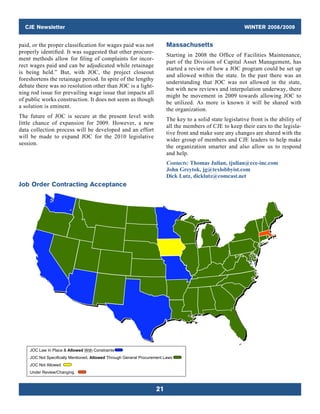
Job Order Contracting Acceptance
OC Law In Place  Allowed With Constraints
OC Not Specifically Mentioned, Allowed Through General Procurement Laws
OC Not Allowed
nder Review/Changing
Job Order Contracting Acceptance
JOC Law In Place  Allowed With Constraints
JOC Not Specifically Mentioned, Allowed Through General Procurement Laws
JOC Not Allowed
Under Review/Changing
Job Order Contracting Acceptance
CJE Newsletter WINTER 2008/2009
22
who still fear the “unknown” of collaboration. Or even
worse, collaboration that is one-sided (all for them, little
for anyone else).
An important directional change is needed and it needs
to start in the schools, the associations, and the jour-
nals of business. It’s OK not to do everything yourself.
It’s OK to look for partners, and others to “jointly”
develop and grow a business, a product, or a technology.
Collaboration begins not with engineers, or research
people, or IT people. It begins with the business manag-
ers of a company and their willingness to look outside
their fortress and ask, “If we work with others, can we
become better, can we become different, can we become
stronger?”
Many U.S. businesses have spent a great deal of dollars
and time to create a culture that looks at anyone not on
the payroll as a threat or a leak; someone that is not to
be trusted. Collaboration requires defined and tested
trust, and a willingness to start with the idea that the
other person might just bring something of value! Have
confidence in your thinking and strategy – very few can
duplicate or reproduce your true value.
The Maginot Line companies of today build walls that
in the end will be as useless as the physical one built at
the beginning of the last century. It almost ties to the
human psyche of, “If I collaborate, maybe others will
not think I’m important, that I’m not worth the salary
I’m paid.” Human nature within a business setting might
be driven to not collaborate. It might be more about the
individual’s introspection on what they are worth alone,
Where Is Your Sustainable Competitive
Advantage?
The enemy is everywhere. Trust no one. If you want
something done right, then do it yourself. If we didn’t
build it, then it must be second rate. Pretty basic
thoughts. Ones that go back to being a 10 year old, look-
ing at the world as if no one else could ever understand
you, your ideas and your feelings.
Then as we grow up and move on we take these feelings
with us. We join companies that have years of structure
around keeping the knowledge in-house, under cover
and wrapped up with non-competes, exclusives and
non-disclosures.
The realization has come to pass that “collaborate or
die” should be tattooed on a manager’s forehead. Why
foreheads? So that everyone can SEE that it is OK to
work with others not in the company. Not only do com-
panies have a hard time with collaboration with other
businesses, but also other departments within the same
company!
For too long there was a Cold War mentality about
­management, business and the competition. Even suppli-
ers were looked at as possible leaks of thinking. With the
development path (or more like explosion) of new tech-
nologies, new players and new business models, the old
way of thinking about business is like the WWI French
Maginot Line (a 100 mile underground fortress built by
the French after WWI to prepare for possible future inva-
sion from Germany again). Well, lo-and-behold, a really
neat new weapon/technology – the airplane – made the
concept obsolete before WW2 even started.
The old line thinking of trenching, stonewalling, and
“must be made here” is worthless in a world where any
manager can go out and find tons of information on
any possible topic; where any employee can e-mail the
CEO of their company; where everything is being built
for ease of communications and sharing (i.e. files, data,
documents, thoughts and even emotions). Old world
controls and thinking starts to fall short.
Change on collaboration needs to start with the people,
the managers, and the business drivers within an orga-
nization. Time and time again, I come across people
Collaborate Or Die
By David Carrithers
CJE Newsletter WINTER 2008/2009
23
or in “control” vs. a collaborative effort (many parts
making a stronger whole).
Now this doesn’t mean you shouldn’t use sound judg-
ment. You still need to make sure that your mission to
collaborate is filled with exploration and due diligence,
with reviews and written understandings. It does mean
to begin with the thought of collaboration with another
business, maybe even some one who today is seen as a
competitor. Even another department or just one other
individual besides yourself is a good place to start.
Corporate isolationism creates the problem of being
unprepared or unrealistic of what the market will drop
on a company or industry. This isolationism of thought,
this inability to grow beyond a corporation’s brand and
knowledge, leads to big problems. All answers come
from within and most of the time the answers are just
a mirror image of nods and agreements. Many are just
confirmations that the leader was right. And in the end,
progress is either not found or it’s forced.
The future of industry will be focused on how to pull
together groups of individuals and companies and get
them working together to advance a mission, a strat-
egy or a cause. The pressures we are all facing require
bigger thinking – beyond common thinking – and only
through improved inward and outward collaboration
will we be able to bridge to new opportunities and long-
term sustainable business success.
Collaboration can speed up new ideas and offerings,
and reduce development costs and stress on an organi-
zation. It can lead to new ideas never thought of before
when a business looks outward. So maybe the French
government at the start of the last century would have
been wiser to spend the $100 million (in 1920 dollars)
to find ways to bring the two countries together and
work together, than to separate them (both physically
and culturally).
One point of clarification. Don’t get confused.
Collaboration is not consensus management. Consensus
management is the destroyer of advancement. Consensus
management is the creator of all things mediocre and
“plain vanilla.” Consensus management is what happens
when there is a lack of direction, passion and shows no
element of leadership. While on the other hand, col-
laboration is the honest sharing and mingling of the
strengths of two, three or more businesses, people and/
or products to create something new, and sometimes
something bold. Collaboration requires a direction and
demands true leadership. Collaboration strengthens,
while consensus management weakens.
Collaboration Ideas:
• Look through your industry association directory and
see who is on the list. Send them a letter introducing
yourself and your products/services. Give the letter a
tone of “not sure where this will end up, but I wanted
to touch base and…”
• Are there services or features that you know would add
value to your products or your company, but you can’t
afford the development costs? Find the top 5 players
that already have a focused business on these, add on
value opportunities, and see if they want to become a
supplier partner, or team up and do a joint marketing
and development effort.
• Have you ever even met the competition? Might be
worth talking with them at tradeshows or conferences
and maybe even meeting on their turf. Sometimes
you will find that you have more in common than
you think. There might be opportunities to carry out
industry wide development or research efforts helping
both companies. Sometimes, there might be opportuni-
ties to build combination products (this has been done
successfully in the agricultural chemical industry for
years), where two competing products are combined to
create a new third product that both can sell.
• The client can sometimes be the best place to look
for ideas on collaboration. Clients love to be turned
to as mentors or as industry experts. Ask them how
can we make the products better; or the service better.
Ask who does it best in their minds, etc. Based on this
information, build a target list of possible collabora-
tors and extend the hand of interest first.
• Attend conferences that might be vertical in nature and/
or specific to an industry, and walk the floor. Listen to
the speakers. Form some new ideas or bring some with
you. Have a simple leave behind on your business/
product. Then go at it; speak with as many people as
possible and listen to as many ideas as there are booths
to look at. Don’t go with the goal to sell anything –
just to meet, talk and grow your understanding of the
businesses and people in the industry.
Contact: David Carrithers, dcarriters@cce-inc.com
Take The Struggle
Out of Construction!
Whether you are a facility construction manager, owner, a municipal department,
a construction company, an industry consultant or professor you can benefit
from learning about and improving your knowledge on Job Order Contracting.
Publicly funded facilities have unique demands that a professionally developed and managed Job
Order Contracting program can serve. Federal Government, State and Local Governments, Public
Schools, Universities, Transportation and many other facility and infrastructure environments are
benefiting from Job Order Contracting programs all across the United States.
To learn more about Job Order Contracting through networking, sharing best practices and training
become a member of the Center For Job Order Contracting Excellence today.
You’re not alone in your quest to meet your organizations’ facilities goals and demands.
w w w. j o c e x c e l l e n c e . o r g
LEARN, SHARE  SUCCEED
CC-156

Job Order Contracting – Now More Than Ever!

  • 1.
    Winter 2008/2009 Volume10, Number 8 CHAIRMAN’S CORNER OUR GOAL: As a nonprofit, volunteer organization to spread the good word of Job Order Contracting through education, networking and awareness building efforts nationally, promoting Job Order Contracting as a cost effective and responsive solution for publicly funded facilities and infrastructures for renovation, repair, remodeling and construction projects. Center for Job Order Contracting Excellence 1425 K Street, NW, Suite 350 Washington, DC 20005 Phone: (202) 587-5721 Fax: (202) 587-5601 info@JOCexcellence.org Editors: Lissa Adams Contributors: Charlie Bowers David Carrithers Bob Gair Vince Duobinis Tom Julian CJE Committees: • Legislation: Mike Ladino • Education: Bob Gair • Membership and Industry Chair: David Carrithers • Past Industry Chair Election: Ron Ecker • Industry Chair Elect: Bob Gair • Treasurer: Clint Owings • Secretary: Carol Greb • Members at Large: Rick Farrag, Greg Smith By David Carrithers Job Order Contracting – Now More Than Ever! Some days it feels like a rollercoaster. Even a crystal ball would do little good because things change so fast. With the power of the internet, we can get the changing pulse of the economy – from around the world and in our backyards – within seconds of something happening; all adding to the sense of what next? I’m like everyone else: seeing, reading and hearing all the economic news and think- ing, “What can I do to help?” While so many things are out of our hands as individuals, there are a few things that are very clear to me as 2008 Industry Chairman of CJE. Of these I am 100% sure: • More Renovation Needs, Less New Larger Capital Construction: Job Order Contracting is needed to help publicly-funded entities continue to operate and execute work. While many schools districts, cities and other public agencies are feeling the budget impacts, the facts are simple. Most capital projects – new construction projects – are taking the biggest hit. Because of this fact the existing facilities are under more stress to perform, and in many cases take on increased demands. Renovations, repair and remodeling demands are growing. At the December 2008 COAA conference in Tampa, I heard loud and clear from the facilities’ owners, “We have more renovation and remodeling demands and less people to get the job done”. They are looking at Job Order Contracting as a solution. • Job Order Contracting Is Less Risky: What we are seeing is publicly- funded facilities and infrastructure organizations wanting to their needs continued on next page David Carrithers, Outgoing Industry Chairman
  • 2.
    CJE Newsletter WINTER2008/2009 22 and support with programs and companies where there is less risk in delivery and execution. What a job order contracting program offers is more control for them on project parameters like budget, deadlines and quality levels. We are seeing more interest in job order contracting and other solutions that are performance- based, because owners and managers of facilities cannot take chances with unknown outcomes – they want predictable outcomes. • Facility Owner Resource Challenges Continues To Grow: Cities, universities and other public entities need more control of budgets. They need more help in getting the work done with either shrinking staff or less budgets. Job order contracting allows for 100% control of budgets – 100% control of outcomes. No surprises, in a time when surprises can be career ­ending. Job order contracting is a way for a director of facilities maintenance or construction, or an owner, to get more done with fewer resources. A job order contracting program gets more dollars to the project work; not to procurement (and re-procurement) costs; not to change order costs; not to legal costs. One ­procurement, single source accountability via a professional job order con- tracting provider, means positive outcomes. • Project Backlog Is Not Going Away Frazzled In-house Teams Need Help: Job order contract- ing programs allow states, municipalities, housing authorities and other public entities to focus their existing staff and in-house teams on what they do best. Job order contracting does not compete with these resources. Instead it allows for the same team to get more done. Job order contracting allows for the exist- ing teams to focus on mission-critical projects while the job order contracting partner helps offset the staff shortfalls to continue moving backlog forward. • Stimulus Packages Will Need A Mechanism To Deliver Through: In the upcoming months, the feder- al and state stimulus dollars will need ways to become localized and be turned into action in the ­markets. Job order contracting programs will be one way to quickly get dollars to work in states, public schools, universities, bases and other publicly-funded facili- ties. Nothing works faster than a job order contracting program on getting local businesses working. A JOC program also allows for more of the dollars to go to the project work – meaning more dollars to local subcon- tractors, minority and small business subcontractors and regional JOC contractors. • Clearer, More Frequent Communications Needed: Job order contracting allows for a completely new level of communication on construction focused on renovation and repair projects. There needs to be no misunderstandings, no delays, no re-do work. Instead, through jointly-developed detailed scopes, detailed line item estimates, and lots of idea sharing, cost- savings­, innovative processes and approaches, facili- ties managers, construction managers and owners, with their job order contracting provider will make sure that the efforts underway are productive, cost effective and bring immediate value. • Don’t Be Distracted, Don’t Lose Focus On Service: At the core of job order contracting is service. It is the focus on delivering and performing at higher levels for the users of job order contracting. Relationships with the owners, with the job order contracting contractors, with the consultants and with the subcontractors, is key to a successful job order contract program. To reduce service levels or to begin to look at ways of cutting the levels of quality and delivery performance are not wise. Job order contracting is all about relationships based on service. We need to reach out to our clients, contracting partners, subcontractors and consultants, and ask how else we can be of service. Everyone is feeling some level of stress, both now and over the next year, and as an industry and as members,
  • 3.
    CJE Newsletter WINTER2008/2009 33 we need to see how we can support all those we touch in their times of need. We need to stay focused on job order contracting and not stray too far afield opportu- nities nor try to be all things to all people. Job order contracting has to have a core focus of service and is not the silver bullet solution to all construction needs. • Do Look For Growth Based On Relationships: We all market; we all sell in our industry. Please take the time to talk with your business leaders and with the other members of CJE to share ideas and ways to grow. We need everyone to come up with ideas and work on growing the use of, acceptance of, and the spirit around job order contracting for publicly-funded facilities and buildings – both in federal environments and state, municipal and other agencies. Everyone is going to be tasked with thinking about how to grow the right relationships at the right time. We need to maximize existing relationships, remind old ones of the value provided by job order contracting, and find those new opportunities that fit the job order contract- ing niche. • Continued Support Of CJE: In 2009, I am personally excited at the opportunities before us, as an organiza- tion and as an industry. In 2009, I will continue to support any and all efforts to grow CJE and the aware- ness, understanding and use of job order contracting. I look forward to supporting the new 2009 Industry Chairman, Bob Gair, and the whole CJE team. My key focus will be helping the regional chapters become real, and offering new ways of communicating and building awareness of job order contracting and CJE. A professionally developed, launched and managed job order contracting program is a responsive, flexible, cost effective tool in the toolbox. Not having a program available is not allowing those organizations the fullest range of services and solutions they will need – having a job order contract available makes sense. We all need to realize that the world around us is going to continue to change and that much of it will be beyond our ability to control. At the same time if we stay focused, continue to do an outstanding job on service and execution of job order contracting programs and offer a different kind of construction approach, we will ALL grow stronger – both as an industry and also in our relationships to the clients we serve (past, pres- ent and future.) Together we will go through the days and months ahead, we will become stronger and we will continue to build a positive future for CJE and job order contracting. As Past Indus- try Chairman, I really see 2009 as an exciting opportunity. I look forward to continuing to support CJE and the industry. I know Bob Gair will build upon what we started in 2008 and grow forward. This is our time to shine, to set the vision for the industry for the next 15 to 20 years. Right here, right now, we are setting the ground work for the viable, growing and changing job order contracting market. This is our time to make a differ- ence. Step forward and make a difference, be the job order ­contracting leader your organization, your facility or your company needs.E. Best in Spirit! David Carrithers 2008 Industry Chairman Contact: David Carrithers, dcarrithers@cce-inc.com 2008 Targeted Strategic Goals Were: A. 2 to 3 Regional Chapters Established – Under Way B. 50% Membership Increase – Added New Members, But Fell Short of Goal C. 3 Conferences where JOC Is On The Agenda – Achieved D. 2 Articles Placed Mentioning CJE and JOC – Achieved
  • 4.
    CJE Newsletter WINTER2008/2009 4 • Elections come up in December/January for Industry Chair • Committee leadership and membership will be reviewed and adjusted as we move into the New Year • The essence of creating active regional chapters will be emphasized • Solidifying a member development plan • Continuing to create superb Newsletters • Finalize educational opportunities and conference presentations • Enhance communications and accessibility • Look for sponsorships All agreed to continue the mission, vision and values of CJE and support the organization and members through action and personal commitment. The success of CJE and our Industry as a whole is depen- dent upon active participation of Owners, Consultants, and Builders. We encourage you to stay involved and look for ways to enhance our environment. If you are a  member in CJE please participate in our meetings, conferences, and committees. And for those who are yet to become members…you can make the difference! Contact: Ron Ecker, Ron.Ecker@parsons.com On August 20th, a quarterly CJE business and plan- ning meeting took place at our office in Washington, DC. This was the third official “in person” meeting for the new CJE orga- nization and was in keeping with the goal of bringing the organization to where the members are living and working. (Our first “in person” meeting was in Austin, Texas in March, and our second in Jackson Hole, Wyoming in June and the December session will be in Tampa, Florida). What was really exciting about this meeting is that we could appreciate that all the hard work on reorganiz- ing was behind us and we are tracking on our strategic ­planning goals and actions. Plus the organization is thriving with a solid membership and steady progress on the “normal” items of business. The real important thing is to keep the focus on what we need to accomplish for 2009: August Business and Strategic Planning Meeting By Ron Ecker CJE Offices in Washington, DC REGIONAL CHAPTER UPDATES A target goal for CJE is to launch regional chapter committees in Texas, the Southwest and in the Mid- Atlantic regions. The first step in these chapters is to hold an exploratory session to identify an owner in the region that will help spearhead the development team. CJE Southwest Chapter News Charlie Bowers, Past Industry Chairman, from Parsons continues to work on getting a local regional chapter established in early 2009. At the Feb. 12th business meeting, a SW Region session will take place. CJE Mid-Atlantic Chapter News The first meeting is scheduled to be held on February 10, 2009 at the Georgetown University Hotel and Conference Center, 3800 Reservoir Road, NW in Washington, DC 20057. This will be both a JOC train- ing opportunity combined with a regional chapter first meeting. The JOC 101 session will start at 10:30 AM and go until noon. During lunch, there will be a session on the start up of the regional CJE Mid-Atlantic chap- ter. The target goal for attendees is around 40 people, both those new to JOC and also experienced users – both Federal and Non Federal organizations. To register please go to: http://www.jocexcellence.org/signup.htm CJE Texas Chapter News Carol Greb held a CJE Texas Region planning meeting on December 9, 2008 in Houston. More news to follow in early 2009
  • 5.
    First Mid-Atlantic RegionMeeting Luncheon February 10, 2009 10:00 AM to 1:30 PM at Georgetown University Hotel and Conference Center SALON Room 3800 Reservoir Road, NW Washington, DC 20057 How Job Order Contracting Helps Publicly Funded Facilities In Challenging Times Learn how to gain control of budgets, time lines and end results on renovation and repair projects. This workshop will explore how Job Order Contracting (JOC) is ideally suited for the renovation and repair projects undertaken by publicly funded organizations—saving them both time and money. After the morning session, we’ll discuss forming a CJE Regional Chapter over a complimentary lunch. Agenda 10:00 AM Welcome: A JOC User Shares Why JOC Makes Sense 10:30 AM to 12 Noon JOC 101 - What, Why and How 12 Noon to 1:30 PM frequency and content of meetings R.S.V.P. Register online at www.jocexcellence.org/signup.htm Check the Registration Form on the Web for directions, parking and Metro access information. E-mail for additional information at info@jocexcellence.org JOCT O T H E RESCUE REGISTRATION IS FREE!
  • 6.
    CJE Newsletter WINTER2008/2009 6 of sustainable green efforts is the need for collabora- tion between building owners, managers, construction providers, designers, etc. If these groups are unable to freely ­communicate, exchange ideas, change think- ing and modify solutions as they work towards an end result, green efforts will be slow and marginalized. Job order contracting is a method that allows for ­sustainable thinking, to look at all the shades of green, from a comprehensive program to simple steps in the right direction. A job order contracting program allows for an organization to decide what level of effort they want to apply – whether on a single project or across all projects impacting the whole program. An example and a real “hot button” with members of the green world, especially institutional owners and the Department of Defense is the management of decon- struction waste and the ability to incorporate recycled materials into the construction process. Job order con- tracting allows for a focused or a general approach to this solution. Why Job Order Contracting Is Well Suited for Green Initiatives Job order contracting is particularly well suited for sus- tainable building. JOC is a contracting method focused on construction services based on a contractor’s per- formance and ability to deliver results. This type of procurement creates a partnership relationship between an owner and contractor because potential barriers like profitability, schedule, scope and services are agreed to before construction begins. This includes a scope or Job Order Contracting Programs Allow Green, Sustainable Renovations To Take Root By Charlie Bowers Vince Duobinis The very nature of how a job order contracting program operates allows for green, sustainable efforts to come to life and reality at publicly-funded facilities, campuses and organizations. “There is always one moment in childhood when the door opens and lets the green future in.” – Graham Greene Although publicly-funded facilities have focused on LEED certifications and sustainable practices for new construction projects, there exists a further reaching need. With the current number of existing and aging publicly-funded buildings and other infrastructures, it is time to focus on improving what we have today. Recently the USGBC has developed LEED guidelines for existing buildings, which has opened the doors for green strategies for repair, renovation and rehabilitation construction. Through a job order contracting program focused on renovating, renewing and revitalizing existing facilities, we are extending the usable, serviceable life of build- ings, bringing considerable benefits to the facility owner and the environment. Keys To Crafting A Green And Sustainable Renovation Construction Strategy 1. Design and implement a sustainable green renovation, remodeling and construction policy through clear specifications and communications to contractors and staff. Decide how green you want to be and what this means to your supporting construction efforts through both your internal and external resources. 2. Have in place a contracting method that allows ­collaboration, conversations and two-way thinking around green renovation efforts. 3. Establish goals and metrics to determine your ­success. The contracting method and form are crucial to the successful ability to develop and implement a green renovation sustainability plan for a university, K-12 district, municipality or federal agency. At the core
  • 7.
    CJE Newsletter WINTER2008/2009 7 focus of support around green initiatives. Developing this kind of partnership is essential in any successful construction venture, but is ­particularly important when an owner is trying to incorporate ­sustainability goals into their project. For example, upwards of 80 different categories and unique requirements need to be met in order for a proj- ect to achieve LEED Certification in schools. With such diverse areas as job site management, water efficiency, energy and atmospheric controls, materials, resources, indoor environmental quality, innovation and design process included within 80 different ­categories needing to be met to achieve some level of LEED ­certification, only true collaboration between an owner, designer and contractor can produce the kind of careful coordina- tion, documentation, procurement and construction ­demanded for such specific requirements. Critics of green buildings claim they are more expensive to build because of numer- ous standards involved, expen- sive construc- tion materials and m e t h o d o l o g i e s required. Job order contracting tends to focus on bringing the best value for the construction dollars, as opposed to typical design- bid-build projects, because it requires a lower overhead cost of construction procurement and delivery, helps reduce and eliminate the change order philosophy, and thus, reduces legal fees. Another key element is the abil- ity to jointly scope projects, within a team environment, allowing the best thinking to come together before work is begun. The scope is also developed to the budget, mean- ing there are no surprises at project completion. With JOC in particular, standard pricing and specification, ­utilizing a published unit price book (UPB), results in efficient and effective estimating, design and fixed price construction. With JOC, the contractor becomes an extension of the owner’s team and the goals of the owner become those of the JOC contractor. A JOC program’s processes allow the owner/client to craft and direct at what level green and sustainable planning, development and exe­ cution should and can be applied to any project – from simple energy savings approaches (motion sensors on/ off switches) to complete buildings. What Is Sustainability? In its broadest sense, sustainability is a characteristic of a process or state that can be maintained at a certain level indefinitely. In recent years, it has often been associated with the environment and the discussion of how long ecological systems can be expected to be ­productive. In the building industry, sustainability is most often used when referring to sustainable design, which is the prac- tice of designing physical objects and the built environ- ment to comply with the principles of economic, social and ecological sustainability. It is often referred to as “green design” or “green building.” The five major components of sustainability are: • energy efficiency • water conservation • indoor air and environmental quality • quality, materials and construction • site sustainability We would also include: • A contracting and work execution method that allows for improved collaboration, communications and rapid changes. • A cultural attitude shift towards green and ­sustainability impacting social, economic and ­environmental concerns (the triple bottom line). The aim of sustainable design is to produce places, products and services in a way that reduces use of non‑renewable resources, minimizes environmental impact, and relates people with the natural environment. Principles of Sustainable Design While the practical application varies among disci- plines, some common principles as described by the Green Building Council are as follows: • Low-impact materials – Choosing nontoxic, sus­ tainably-produced or recycled materials which require little energy to process. • Energy efficiency – Using manufacturing processes and products which require less energy.
  • 8.
    CJE Newsletter WINTER2008/2009 8 assists in a seamless and consistent delivery of design and engineering, so does job order contracting to the improvement (or enhancement) of the built envir­onment, allowing the teams to apply LEED and ­sustainability standards (including self defined ones) to renovation, remodeling and repair. A Job Order Contracting Program Allows For: 3 Green Sustainable Efforts On Renovation Repair Work 3 Contracting Methodology Allows For Green Thinking Dialogue 3 Cooperative, Collaborative Development of Solutions 3 Fast Response Using Best Practices In Sustainability 3 Innovative Green Solutions, Ideas and Sharing 3 Control On Budgets and Outcomes Of Green Projects 3 Driven By Client Desired Level Of Green Focus 3 Jointly Developed Detailed Green Project Scopes 3 Ability To Work With Green Experienced Subcontractors 3 Ability To Use Green Building Materials 3 Green Thinking On Small, Medium and Larger Projects 3 Can Focus On Recyclable and Reusable Materials 3 Can Include Energy Efficiency and Improvement Efforts – from simple to more complicated A JOC Program Allows For Green Subcontractors When implementing green renovation strategies at any publicly-funded facility, it is important to tap into green knowledgeable and experi- enced subcontractors. The ability to install a green roof, or to trade out poor perform- ing lighting and replace it with high efficiency, requires past performance and • Quality and durability – Longer-lasting and better-functioning products will have to be replaced less frequently, reducing the impacts of producing replacements. • Design for reuse and recycling – Products, ­processes, and systems should be designed for performance in a commercial “afterlife”. • Design Impact Measures – Measurements for total earth footprint and life cycle assessment for any resource use are increasingly required and available. Many are complex, but some give quick and accu- rate whole earth estimates of impacts. • Sustainable Design Standards – These, along with project design guides are increasingly being made available and are originated by a wide array of ­private and industry organizations. • Biomimicry – Redesigning industrial systems on biological lines … enabling the constant reuse of materials in continuous closed cycles. • Service substitution – Shifting the mode of con­ sumption from personal ownership of products to provision of services which provide similar ­functions, e.g., from a private automobile to a car sharing service. • Renewability – Using materials that come from nearby  (local or bioregional), sustainably managed renewable sources that can be composted (or fed to livestock) when their usefulness has been exhausted. • Healthy Buildings – Sustainable building design aims to create buildings that are not harmful to their occupants or to the larger environment. An impor- tant emphasis is on indoor environmental quality, especially indoor air quality. Job Order Contracting Allows For Cost Effective Green Solutions Job order contracting allows for a holistic approach of expediting sustainability into an ongoing construction program. Basically, think of it as a tool or value-added process to meet guidelines and goals – rather than a tactical use. Nothing gets “lost in translation” when working as a unified job order contracting team. Professional JOC programs allow for the integration of sustainable short term objectives to meet the long-term regeneration goals. As an integrated project delivery unifies and
  • 9.
    CJE Newsletter WINTER2008/2009 9 City/ Municipality JOC User/Owner: The City of Phoenix Phoenix West Convention Center Photovoltaic Roof System Installation The JOC project was the design and construction of a 100KW photovoltaic system on an existing membrane roof of the West Convention Center building in down- town Phoenix. The City of Phoenix began thinking of putting a P-V system on the roof of the West building of their new downtown Convention Center very early in the design phase of the project. Although there were no funds yet appropriated for the new P-V system, the city had the foresight to install the conduit through the roof and include all the required “home run” conduits from the roof to the electric room and also make room for the new system in the electrical room. The new West Con- vention Center building, which sports a nearly 2-acre roof was completed in 2007 and put into service with- out the P-V system installed. This open, relatively flat, unobstructed roof area provided a “blank canvas” upon which to install a new P-V system. The city continued to work on funding and the system design with their JOC contractor through their existing Phoenix West Convention Center Photovoltaic Roof System Installation JOC — Shades Of Green In Action Green is not new to JOC. Job order contracting programs have been supporting green and sustainable efforts for many years. Some example projects include: experience. A job order contracting program focused on green and sustainable renovation allows your profes- sional JOC contractor to build a database and resource pool of subcontractors with the right backgrounds and abilities to execute the sustainable work. Experience with green materials, sustainable practices in energy management are important elements of imple- menting a green project strategy. Interesting Green Trends At a recent conference on sustainability for Virginia universities, held at Virginia Tech, a larger national design and engineering firm carried out a study on the cost of “going green” when building a new building. After reviewing the past few years of work they have done, they were able to quantify the numbers. Green building practices run around $3.50 more per square foot on the construction side, while the operating side of the same building was generating a savings of $77 a square foot to operate. LEED for Existing Buildings standards encourages facilities managers and building owners to broaden their horizons beyond energy savings. This is demonstrated in the LEED for existing buildings credit distribution within the standards, indoor environmental quality 28%, materials resources 20%, energy atmosphere 29%, sustainable site 17% and water efficiency 6%. The fastest growing industry segments, as reviewed in Education Green Building Smart Market report, McGraw-Hill Construction Research 2007, are educa- tional, government and institutional facilities, all with a greater than 50% green construction growth rate. Contact: Charlie Bowers, Charlie.Bowers@parsons.com Vince Duobinis, vduobinis@cce-inc.com
  • 10.
    CJE Newsletter WINTER2008/2009 10 JOC contract. The entire design-build process took approximately 6 months to complete, including the detailed design, city permitting, an eight week delivery time on the P-V materials, and the installation and system start-up. During this time, the city and the JOC contractor worked on constructability issues, cost concerns and ­system compatibility with the existing roofing. Submitted by CJE Member Organization: Parsons City/ Municipality JOC User/Owner: City of Chicago Department of General Services (DGS) Chicago Center for Green Technology (CCGT) Renovation Chicago Center for Green Technology (CCGT) Renovation The Chicago Center for Green Technology (CCGT) underwent significant upgrades and renovations in the fall of 2007. These renovations included an expansion of CCGT’s Green Building Resource Center to incorpo- rate an additional 2,450 sq ft, as part of the Greenbuild Chicago 2007 Legacy Project. CCGT was the first structure in Chicago to obtain the prestigious LEED platinum designation with 38 out of a potential 50 points and the first building rehab in the nation to receive the platinum designation when it was first renovated in 2002 using LEED guidelines estab- lished by the U.S. Green Building Council. Hence, any renovations needed to comply with those same exacting standards. Additionally, there was a time constraint on this project. Identified in late summer of 2007, con- struction had to begin in September and be complete by October 29, 2007 in time for a ribbon cutting event. The JOC contractor oversaw the complete upgrade of CCGT’s mechanical systems, HVAC equipment and installation of two new heat pumps. It performed the demolition, carpentry, painting and acoustical ceiling work and made certain that all of the LEED platinum standards were met, which included the monitoring of indoor air quality during and after construction; the reuse of existing materials; and the use of rapid renewal materials that contained a high percentage of recycled content. Its aim was to recycle 95% of demolition and construction debris. A number of environmentally friendly products were used to complete the project. These included an “eco- friendly” carpet that was made of 100% eco-solution premium branded nylon; PVC-free resilient flooring; recycled ceramic tiles; recycled vinyl wall coverings; bamboo ceiling tiles; 100% post-consumer recycled wall partitions; and other products that were chosen in accordance with green building practices. “We had five weeks and four days to do the project and to do it fol- lowing LEED platinum rules,” said George Tuhowski III, JOC contractors’ general superintendent and chair of the firm’s Green Total Quality Management com- mittee. “We had to design the project, secure all of the products, a lot of which were new and not as readily available, and secure a permit.” Submitted by CJE Member Organization: The Gordian Group K-12 Public Schools JOC User/Owner: Paradise Valley Unified School District, AZ Update lighting at Shadow Mountain High School, Phoenix, AZ Update lighting at Shadow Mountain High School, Phoenix, AZ The JOC contractor helped Paradise Valley Unified School District save energy cost at their 400,000 square
  • 11.
    CJE Newsletter WINTER2008/2009 11 foot Shadow Mountain High School through a lighting retrofit involving replacement of over 10,000 lamps with new energy efficient lamps. All work was per- formed between 4:00 PM and 2:00 AM in the morning to avoid interference with the operation of the high school. The retrofit saved an estimated $44,000 in ener- gy cost per year. In addition the electric utility, Arizona Public Service, rebated $54,000 toward the capital cost. Project Duration: The project began March 2007 and was completed on time in early June 2007. Submitted by CJE Member Organization: Centennial City/ Municipality JOC User/Owner: US Army Corps of Engineers Chicago River Ecosystem Restoration, Chicago, IL Chicago River Ecosystem Restoration, Chicago, IL This JOC project was an aquatic ecosystem restoration project at the Cuneo Press Site, an abandoned industrial area. This particular site was featured in the U.S. Green Building Council LEED™ Training manual, featuring Chicago as a pioneer in restoring “brownfield sites” so that they become useable sites again. Before any con- struction could be placed, as part of the design process, the JOC contractor managed and delivered a variety of permits coordinated through 28 City of Chicago agen- cies. The project involved installing 525 wall feet of sheet piling with a batter pile anchorage system. The new area of land along the river was made into a park. The contractor also built and installed “fish lunkers” to promote fish habitat in the Chicago River. This project was completed for the Army’s Chicago District Corps of Engineers. Project Duration: The project began on March 18, 2002 and was completed on time on September 30, 2002. Submitted by CJE Member Organization: Centennial. Military JOC User/Owner: US Air Force Demolish Building 125, Wright Patterson AFB, OH Building materials were recycled. This JOC project involved the demolition of a 2-story, 176,000 sq. ft. wooden structure with various facades. The facility housed the Air Force Civil Engineering and Services School, parts of which had been in ­operation since the 1920s. Above and beyond the contract require- ment, the JOC contractor was able to maximize recy- cling and minimize the construction waste that was slated for local landfills.
  • 12.
    CJE Newsletter WINTER2008/2009 12 By contract close, the JOC contractor had documented the diversion of 82% of all waste from local landfills through innovative deconstruction methods and the donation of materials to Habitat for Humanity. The effort was recognized by the Wright-Patterson AFB Environmental Division receiving the National MP3 Award at ceremonies in Washington D.C. The inclusion of Habitat for Humanity was very successful, as they were able to harvest in excess of 10 semi-trailer loads of building materials for inclusion in future projects or resale for much needed revenue. All asphalt and concrete was ground for reuse. Items such as smoke detectors, were turned back in to base Civil Engineering for use in other buildings. Various metals, including copper wire, water lines, cast iron, aluminum, and structural steel were sold as recycled scrap metals. Hazardous materials, including refrigerant from air conditioning units, were returned to the manu- facturer for reuse. Submitted by CJE Member Organization: Centennial. K-12 Public Schools JOC User/Owner: Clear Creek ISD, TX Conversion of Clear View Educational Center Gymnasium into Special Education Department Administrative Offices The JOC contractor renovated an outdated gymnasium at the Clear View Education Center into administrative offices for the 50 members of the Special Education Department, who were previously located at several locations throughout the district. The Clear Creek ISD Facilities and Planning Department was under a huge time constraint to relocate the Special Education Department into their new offices and still have enough time to convert their old offices back to classrooms prior to the start of school. The JOC contractor conducted several partnering ses- sions with the client to value engineer the original design, developing a scope that best utilized existing materials and reduced the overall cost of the project. The result of this partnering effort was an innovative plan to convert the existing gymnasium into 9,522 sq. ft. of administrative space. This solution presented a significant cost savings alternative to the design and construction of a new facility. Conversion of Clear View Educational Center gymnasium into Special Education Administrative Offices “The conversion of the Clear View gymnasium was considerably less expensive than the construction of a new building or building addition to house the Special Education Department,” reported Mr. Russell Wallace, Clear Creek ISD Director of Facilities and Planning. Reclaimed materials significantly contributed to the project’s cost savings. Materials such as lights, doors and millwork were reinstalled. Instead of purchasing a new split system HVAC unit, the JOC contractor reused the two fully functional existing HVAC units. “The space is very well laid out to maximize storage, group and individual work spaces …to meet our needs and to serve students more efficiently,” said Mr. Jerry Klekotta, Clear Creek ISD Special Education Director. Project Duration: The project started on May 29, 2006 and was completed on July 6, 2006 resulting in a time savings of more than 9 weeks. Submitted by CJE Member Organization: Centennial.
  • 13.
    CJE Newsletter WINTER2008/2009 13 City/Municipality JOC User/Owner: City of Chandler’s Parks Department, AZ Snedigar Sportsplex Reclaimed Water Project, Chandler, AZ City of Chandler’s Parks for Municipalities, AZ With water conservation being a high priority for muni­ci­ palities in Arizona, the JOC contractor was tasked with designing and constructing an irrigation system that would provide water to The Snedigar Sports Complex, a 70-acre sports center overseen by the City of Chandler’s Parks Department. The JOC contractor worked with the City’s Parks Department to develop a system in which wastewater would be reclaimed and used to irrigate the grounds. The JOC contractor installed an automated pump that is controlled via a remote monitoring system. Project Duration: The project was started on June 23, 2003 and completed on January 12, 2004. Submitted by CJE Member Organization: Centennial. Military JOC User/Owner: Fort Lewis, WA Waste Management Program at Fort Lewis World War II era buildings being “deconstructed” in order to increase the recovery of useable materials The JOC contractor has developed a comprehensive Waste Management Program for their Job Order Contract program at Fort Lewis (the base is at the forefront of sustainability in the U.S. Army.) Fort Lewis was the first Army installation to have an internationally certi- fied environmental management system in place, and the first Army installation to be accepted into the EPA’s National Environmental Performance Track Program. The JOC contractors’ goal for the program is to divert from the waste stream at least 60 percent by volume of all construction waste. Prior to commencing work on projects, the JOC contractor works with the client’s Public Works Inspector to develop aTask Order Waste Management Plan Worksheet which identifies recyclable and recoverable material. The plan identifies construc- tion waste that will be disposed of on the installation or at an off site disposal facility. As work proceeds on the task order, construction debris is removed from the work site to a central location and sorted into the various components of wood, metal, glass, concrete aggregate, soil, and miscellaneous debris. Certain components of wood and metal may be reused on the project. Upon completion, the JOC contractor provides the ­client  with a report which documents the quantity of waste diverted from the landfill, including the volume of recovered materials reused or sent to recycling centers. Submitted by CJE Member Organization: Centennial.
  • 14.
    CJE Newsletter WINTER2008/2009 14 Bob Gair, 2009 Industry Chair, working the CJE booth 2008 COAA Conference—Tampa, FL Job Order Contracting: Topic Of Conversation and Great Interest By Robert Gair The Construction Owners Association of America (COAA) is a professionally run nonprofit organiza- tion that was founded in 1994 to serve the interests of construction project owners within public and private institutions. CJE had a booth at the conference, manned by David Carrithers, current Industry Chairman and Bob Gair, 2009 Industry Chairman. “COAA brings together a diverse group of owners who employ means to design and build facilities. COAA meetings are a great opportunity to learn a lot in a short time. I appreciate the willingness of owners who have solved similar problems to candidly share ideas,” said Ford Stryker, Penn State University. The Tampa Conference held on December 2–4, attend- ed by the Center for JOC Excellence, had a good mix of ­representatives from Universities/Schools, A/E Firms, City/County Governments, Contractors, Medical Institutions, Software Companies and Federal Government Agencies. Over 300 people attended with University/Schools having the largest share of ­attendees, making up 40% of all attendees. This fit well with the best target audience for JOC and CJE related services in the current economic environment. Although the Conference had a Florida/Georgia/Mid-Atlantic States flavor, thirty-three percent (33%) of the attendees came from other parts of the country, including the Northeast, Southwest and Western States. The Vendor attendance was small with only twenty (20) booths, yet from CJE’s perspective this is a plus as we readily received face time with a large number of attend- ees. Like NASFA, this type of conference provides the highest amount of exposure for CJE with our targeted audiences. Based on this launch event and the success in the interest in Job Order Contracting CJE plans to further grow its association with COAA in 2009. Trapas Pratt, CJE’s newest member, attended the con- ference. “The CJE booth looked great,” he said. “It was definitely one of the better set up’s out of the bunch. I am sure it didn’t hurt that you were using little green gator’s with the CJE logo in Florida, but I chose to think it was the booth message as well. I was happy to see the level of interest in JOC, being that our company has just recently decided to look into this delivery method. “ Kelvin King, a long term CJE member who also attended and exhibited at the conference stated, “Representatives from universities in Iowa, Georgia, Virginia and Penn­ sylvania, mentioned that they were close to implement- ing a JOC program. Other attendees, like those from Texas and Florida as an example, commented that they were already using JOC and found it key to their ability to manage their construction projects focused on reno- vation and repair. There was a buzz at the meeting on JOC as a tool to help people get done what they need to in 2009.” COAA holds two conferences a year; in 2009 they will be held in Indianapolis, IN, May 13–15 and in Austin, TX, November 18–20. Austin certainly would be a ­natural location for CJE with the development of the Texas Regional Chapter. This would be a great way to support the Chapter, hold a National Quarterly meet- ing and provide the Region with exposure to the CJE National Organization. The facilities at the Tampa Marriott Waterside were first rate; the meeting rooms, vendor display area and the hotel in general. COAA representatives were ever ­present, very service oriented and readily available to ensure that our needs were met. We were surprised, when discussing JOC with the attendees, how little was known about this delivery method. We felt that our presentation could have been JOC 101; ironically we were asked by a COAA commit- tee member to attend a future conference to present at the introductory level. The presentation given by Greg Spearman, Purchasing Director, City of Tampa and Bob Gair, CJE Industry Chair-Elect was attended by thirty-one (31) people. We felt this was a good turnout as we were competing with
  • 15.
    CJE Newsletter WINTER2008/2009 15 a Building Information Modeling (BIM) presenta- tion, an industry hot topic. This was attended by 63 people. The JOC presenta- tion had the largest atten- dance that a CJE presenta- tion has received both at NASFA and now COAA. The presentation addressed the CJE commissioned survey on the attributes of JOC as a delivery ­method, with a comparative to other delivery methods. Bob Gair presented the very positive results of the ­survey, followed by Greg, very effectively providing support to those facts, while relating his experience organizing and running the City of Tampa JOC Program. The key elements of the survey addressed construc- tion cost, schedule, quality, claims and safety. In each of these areas, the surveyed facility Owners strongly stated that the JOC delivery method was a more effec- tive method than other methods used to delivery con- struction projects. The survey summary keyed on four ­positive points of JOC; (1) ease of use; (2) responsive- ness to owners needs; (3) developing a partnership between owner and contractor; and (4) that the results of the construction project are predictable. Mr. Spearman highlighted that the City of Tampa ­experienced a high level of satisfaction along with increased involvement from the local subcontracting community through their JOC program. These are two of the most important benefits that most JOC advocates address, along with expedited project delivery and other benefits. Mr. Pratt also stated, “The presentation to the owners was great. I like the fact the presentation started out with Robert Gair giving the background, statistics, and general overview of JOC, followed by the Facilities Director for Tampa giving his impression of JOC after adding it as an effective delivery method for his city’s projects. Mr. Spearman from the City of Tampa spelled it out clearly that JOC is a savings in overall costs per project. I again was impressed with the level of interest represented by the numbers of higher education facili- ties managers in attendance and asking questions.” The traffic to the CJE booth was a constant flow of people and organizations interested in learning more about how Job Order Contracting can help their orga- nization better meet the needs and demands they are currently under. The Center for JOC Excellence was pleased with having attended the conference and look forward to building a continuing relationship with the COAA organization. Contact: Bob Gair, bgair@reedbusiness.com Construction Owners Association Of America www.coaa.org Building owners and developers build, not as a primary business, but as a secondary objec- tive. Owners and Developers stand alone in the complex, changing construction process, represent- ing themselves in a major financial commitment. The management of the design and construction process requires knowledge of an industry whose technology evolves and changes continuously. It requires interfacing with all the groups involved in the construction process. Timing becomes critical to the owner’s bottom line. Changes and decision- making endlessly occur. Disputes and litigation may become an issue. Owners and developers, both public and private, have needed a forum – meeting place to gather, share common goals, learn, dis- cuss, survey the future and share a collective voice. These are the goals that fostered the founding of Construction Owners Association of America. COAA was founded in 1994 to serve the interests of construction project owners. COAA is comprised of a diverse group of men and women representing construction project owners throughout America. COAA is dedicated to making a significant and last- ing impact on the construction industry through its leadership by creating a unified, collective voice for owners’ issues in the construction process. Vision • To make an impact on the construction industry by creating a unified collective voice for con- struction project owners and developers • To balance the interest of the parties in the ­ construction process by facilitating relationships between them • To enhance the stature of owners and develop- ers in the construction process and increase their ­legislative and regulatory influence • To promote learning and leadership development of owners and developers by creating opportuni- ties for owners to share ideas and learn through educational programs and peer network groups Co-Presenters: Greg Spearman, Purchasing Director, City of Tampa and Bob Gair, CJE 2009 Industry Chair
  • 16.
    CJE Newsletter WINTER2008/2009 16 Other Conferences Where JOC Was Presented Job Order Contracting At Facility Decisions Conference Lisa Cooley, a member of CJE presented, on “Job Order Contracting: A Facility Management Tool”, at the inaugural Facility Decisions conference in Las Vegas, Nevada September 16–17. The overall event was attended by about 1,800 people with a healthy mix of public and private owners from across the U.S. About 40 people attended the JOC presentation, and about 30 people participated in a “Solutions Exchange” roundtable on IDIQ contract strategies. The purpose of this ten minute “speed- dating” style exchange was to learn about the dif- ferent types of on-call contracts that owners had in place, but the owners were definitely focused on learning more about JOC! Job Order Contracting At APWA Conference Participating in this year’s American Public Works Association (APWA) 2008 International Public Works Congress and Exposition was a memorable experience for the CJE members attending. A variety of CJE mem- bers attended and represented the JOC industry during this four-day event held at the Ernest Morial Convention Center in New Orleans, LA. There was definitely a special feeling at this year’s congress as it occurred in New Orleans after being postponed due to Hurricane Katrina in 2005. Two CJE member organizations had an exhibit booth at the APWA show. JOC also was one of the topics for the education session. CJE member Kelvin King was on this year’s agenda under the Construction Management section of the education sessions. His session entitled, “More Construction Projects Completed + Less Burden On Staff = Job Order Contracting” was a big hit attracting more than 50 attendees. The JOC message was also well received with an overwhelming majority of the attendees providing feedback that they would recommend this session to others. CJE MEETING DATES 2009 Business Meetings 2009: Annual Business Meeting February 12, 2009 Location: Phoenix, AZ Quarterly Business Meeting June 13, 2009 June 14-16, NASFA Meeting Location: Orlando, FL Quarterly Business Meeting Auguest 13, 2009 Location: Washington, DC Quarterly Business Meeting November 20, 2009 November 18-20, COAA Meeting Location: Austin, TX 2009 Steering Committee Conference Calls: Calls take place at 1:00 pm EST Call in conference number 1-800-416-4956 Participant code 68516736# March 16 April 13 May 11 July 13 September 14 October 12 December 14 • New membership ­brochure • New Flash JOC Ad • New standard updated JOC presentation • New Elevator Pitch What’s New: Visit the CJE website to see the new materials and tools including:
  • 17.
    CJE Newsletter WINTER2008/2009 17 Founded in 1928 as a small roofing materials manufacturer, Tremco has grown into The Tremco Group, an RPM International Incorporated affiliate company employing over 1,900 people in ­dozens of locations around the world. The Tremco Group consists of operating divisions special- izing not only in the manufacture and sale of roof- ing materials and services, but construction sealants, glazing and gaskets, waterproofing systems, concrete admixtures and sealers, grouts and mortars, fire stop- ping systems, and a host of custom designed products, programs and services dedicated to the worldwide con- struction, maintenance and repair industries. Roofififing Building Maintenance Tremco’s Roofing and Building Maintenance Division specializes in custom roofing and weatherproofing solutions for facility managers, engineers and business owners. Designed to maximize roofing assets, Tremco provides a complete line of asbestos free roofing and weatherproofing systems and products. With one of the largest networks of highly trained, company-employed field advisors, the Roofing and Building Maintenance Division is committed to establishing long term rela- tionships with our customers. In addition, to the service division, Weatherproofing Technologies Inc. offers a number of investigative, maintenance and information- based services to assist in asset management and main- tenance of roofing systems. The Roofing Division also includes Republic Powdered Metals, the founding company of RPM International Inc. Job Order Contracting Tremco and its service division, Weatherproofing Technologies Incorporated (WTI), entered the job order contracting environment in Texas in late 2007 via a suc- cessful award of a competitively bid solicitation from The Cooperative Purchasing Network (TCPN), through parking garages, building envelope management, gener- al contracting and a host of other services listed below. Sealant/Weatherproofing Tremco’s Sealant/Weatherproofing Division was created from the marriage of Tremco’s Construction Division with Mameco International, Paramount Technical MEMBER PROFILE By Gary Johnson Products and Tremco Barrier Solutions, a market leader in below-grade waterproofing products and services. This powerful combination affords Tremco with a leader­ship position in the sealants, waterproofing, glaz- ing and fire stopping markets throughout the world. For generations, Tremco has successfully provided products and services to architects, engineers, contractors and building owners worldwide. When it comes to protect- ing and weatherproofing the entire building envelope, Tremco Sealants/Weatherproofing is uniquely posi- tioned to provide single source products, services and solutions. The Euclid Chemical Company Tremco’s Euclid Chemical Company Division is an industry leader in the concrete and masonry industries and is divided into two product and service platforms, construction products and concrete admixtures. With world headquarters in Cleveland, OH, Euclid is aggres- sively pursuing sales and manufacturing opportunities throughout the U.S., Canada, Mexico and South America. Additionally, it is expanding it’s international presence with marketing partnerships in Asia-Pacific and the Middle East. Euclid’s specialty products include: floor hardeners, curing and sealing compounds, grouts and mortars, concrete and masonry repair systems, concrete admixtures, architectural and engineering services and The Vulkem® 360NF/951NF Deck Coating System on this condo- minium rooftop at the Origins of Seahaven in Panama City Beach, Florida meets Energy Star™ requirements for reflectivity and ­emissivity and contains minimal VOCs.
  • 18.
    CJE Newsletter WINTER2008/2009 18 Tndustry Liaison Committee within NASFA supports the joint work of numerous liaisons with other groups, including AGC, ACEC, USGBC. During this year’s June conference in Jackson Hole, the idea of creating a liaison between NASFA and CJE was born, and received strong sup- port from the CJE contingent there. After endorsement from the NASFA Industry Liaison committee, a survey of NASFA members who were using JOC and interested in participating, and approval from the full CJE Board, we hosted a preparatory liaison call on Dec. 11th to better understand the needs of the NASFA participants. What emerged from the NASFA members was that in spite of the many educational sessions on JOC, the states still have a strong need for educational programming on JOC. It turns out that many states are using JOC-like contracts but are not necessarily calling them JOC, so the group thought that starting with basic definitions and the difference between JOC and other on-call contracts might be good. The states were also interested in learning from other states that are using JOC, so a survey or poll to discover more about different states’ programs could be a good kickoff project, with the results forming a roundtable discussion at the annual conference, or other educational program. The next call is February 9th at 3PM EST 319-279-1000 participant code 435123#. Contact: Lisa Cooley at lcooley@cce-inc.com Broaden CJE Reach Through NASFA Liaison By Lisa Cooley extensive technical and customer support. Originally started as a family business, Euclid became part of the RPM family of companies in 1984 and part of the Tremco Group in 1999. HVAC Repair and Maintenance Using a network of approved contractors to perform HVAC and mechanical installation, maintenance, repair and replacement work, conduct installation of ­boilers, split systems, fans, pumps and other devices related to heating, ventilation and cooling of air and water, preventive maintenance and repair programs cover all types of HVAC equipment as well as related electrical and plumbing systems. Parking Garage Repair and Maintenance Through proper discovery and programming, we extend the life of parking garage structures and reduce dete- rioration of steel reinforced concrete. Repairs include slab replacement, all repairs, sealing and waterproofing. Tremco also offers maintenance programs that pre- serve concrete structures and reduce the cost of future repairs. Façade Repair and Maintenance WTI offers complete facade restoration including brick- work, masonry walls, tiles, glass metalwork, con- crete, and structural supports. Services include facade repair work as well as exterior cleaning, caulking and ­weatherproofing. Other Services Additional project management services offered include below-grade waterproofing, concrete and asphalt park- ing lot restoration, fencing, security and fire systems, life safety: fire barrier management, plumbing, elect­ rical, landscaping, as well as interior and exterior ­renovation and restoration. Facility Management General Contracting General contracting through WTI offers single source responsibility and total coordination for all of the facility management services that Tremco offers. Single source responsibility means that at the end of the day, there is “one throat to choke”. To our customers, this translates to a reduction in the hassle factor. Services include an on-site superintendent who manages daily work-in-progress, and keeps customers informed throughout the entire job. This exclusive interaction minimizes project concerns while ensuring effective communication and job satisfaction. Tremco has executed projects ranging in size from $2,500 to over $7 million via the TCPN contract. Tremco has been privileged to serve numerous school districts, uni- versities, cities, counties and states utilizing this process. Projects have included mechanical, electrical plumbing, paving, façade, interior remodel, historical renovation, interior and exterior painting and landscaping. Contact: Gary Johnson, 713-594-5036 jgjohnson@tremcoinc.com
  • 19.
    CJE Newsletter WINTER2008/2009 19 Generally, little state legislation changed the job order contracting (JOC) environment in 2008. A few states, most notably Texas, enacted legislation impacting the use of JOC on publicly funded projects in 2007. The greater majority of states, however, did not change their JOC laws. As in the past, few states now legislate JOC as a defined construction, or con- struction services, procurement method. For JOC users and potential JOC users, this lack of ­specific ­legislation may create challenges to the approval and creation of Requests for Proposals (“RFP”) or Invitations to Bid (“ITB”) within their organizations. Without ­specific authorizing statutes, one is left to guess at the appli- cability of the traditional construction procurement regulations. Despite this lack of legislation, no states enacted new JOC legislation in 2008. Many states, including New York, Virginia, Maryland, and Florida still lack specific legislative language regarding “job order contracting.” These states, however, use JOC to meet their construc- tion and renovation needs at various state agencies. In Virginia, for example, state colleges and universities, public school districts and city and county governments currently maintain active JOC programs. JOC laws passed by the states this year generally modi- fied or refined existing JOC statutes. Arizona, Texas, Washington State, and Missouri each passed amend- ments to their JOC laws. We consider these changes, by state, below. What follows is a state-by-state summary of recent changes and legislative activities around JOC in the United States. California In accordance with its own moratorium, California’s Legislature did not act in 2008 to expand its JOC pilot program with the Los Angeles Unified School District. Unless the California Legislature acts before December 1, 2012, the JOC law in that school district will be repealed. In three years (2011), however, the school district must submit a report documenting its experience with JOC to the legislature. At that time, the legislature may expand or eliminate JOC in the United States’ most populous state. Missouri The Missouri Legislature, with the concurrence of its governor, added additional language to the state’s “JOC law”. This modification, to subsection (a) of sec- tion 8.255 (§ 8.255 R.S.Mo. (2008)), limits the “total expenditure per project” to $300,000 under a job order contract. This is an increase from the previous limit of $150,000 per project. In addition to its legislature changing the per project limit for JOC, the Missouri Office of Administration updated its Capital Improvement and Maintenance Program regulations. This update resulted in the pub- lication of Title I of the Code of State Regulations, Section 30-3.025. This regulation defines, describes, and provides the state’s Division of Facilities Management guidance on the use of many construction and procure- ment methods, including JOC. This revision, which became effective when approved by the Governor on June 30, 2007, passed in 2007 as Senate Bill 322 with a variety of revisions to existing laws effecting commerce in the state. Texas The Texas legislature meets once every other year, and last convened in the spring of 2007. John Greytok of Texas Government Solutions states, “during that ses- sion there were two types of attacks trying to limit JOC, shotgun blasts and rifle shots. A shotgun example was House Bill 447. It had a very broad scope and would have applied in almost all non-federal public entity con- tracts. Senate Bill 1064 was more of a rifle shot, since it applied only to junior college districts.” In a coordinated effort the JOC industry in Texas ­successfully opposed both of those bills, with SB Texas State Capitol Update On The State Of JOC Legislation By Tom Julian, John Greytok Dick Lutz
  • 20.
    CJE Newsletter WINTER2008/2009 20 1064 dying before the House floor and HB 447 being vetoed  by  the Governor. Just prior to this session the Texas JOC industry worked with an investiga- tion ­committee on the use of JOC in the state, and the report findings were positive and favorable on job order ­contracting. These bills are being pushed specifically by architects and engineers who view JOC as a threat to their “pro- fessional integrity,” meaning that they believe JOC will reduce their authority, diminish their role, and cut their income. John also added, “We have to assume that the new Texas session (starting January 13, 2009) will bring several more efforts to limit JOC, sponsored by similar groups for similar reasons.” Last session one item did slip past us. A last min- ute amendment to HB 1886 inserted to harmful JOC ­ language to a bill applicable to municipal construction projects. John concluded, “That just motivates all of us in Texas to be even stronger and more vigilant this time around. Like football, the legislative process is a game of inches and the team that stops playing is likely to get pushed off the field.” Washington State The Capital Projects Advisory Review Board (CPARB) has been in operation for the past three years. This com- mittee, appointed by the governor, is composed of 23 stakeholders in capital construction projects throughout the state. As stated in the legislation, “The 2005 Legislature created the Capital Projects Advisory Review Board (CPARB) under ESHB 1830 (RCW 39.10) to review alternative public works contracting procedures and provide guidance to state policymakers on ways to ­further enhance the quality, efficiency and accounta­ bility of public works contracting methods.” Thus far, CPARB has concentrated its efforts on General Contractor/Construction Manager, Design Build, and JOC. With over 450 hours of formal meeting time in the past forty months, approximately 9% of that time has been devoted to JOC. The main reason for this lack of time devoted to JOC has been a limited knowledge about what JOC is and how it works by the members of CPARB. Additionally, the state spends much more of its capital construction budget on GC/CM, with a much smaller amount spent on D-B and JOC. As Dick Lutz, a legislative educational consultant stated “While for JOC, during the past 12 months, approxi- mately eleven million dollars of JOC work orders have been completed statewide by four JOC contractors. However, without a few people knowledgeable in JOC meeting regularly with CPARB, JOC would receive little or no attention. This limited attention has caused JOC to remain stagnant while the desire of those direct- ly involved in JOC have tried to expand not only the use of JOC by public facility owners but also the expansion of the dollar limitations put on JOC by the legislation authorizing JOC.” Recently, the expansion of JOC is not an option because some of the CPARB members will not support change without definitive data about the implementation of JOC in the state. It was hoped that the data collected by a recent survey conducted by CPARB would result in substantive information that would document the suc- cess of JOC. However, the survey document was not well conceived and the resulting information provide nothing that would suggest a expansion of JOC was warranted. Some of the major roadblocks identified by a few CAPRB members included: • JOC contractors are not using a large variety of ­subcontractors to perform work • There is limited documentation of payment of pre- vailing wage and verification of proper classification of subcontractor employees • There is not enough documented opportunity for certified women and minority owned subcontractor participation • There is confusion over small works roster construc- tion projects as compared to JOC work orders • JOC contractors are performing more than 10% of the work which should be performed by subcontractors During the last CPARB meeting, a JOC presentation was made in an effort to lay a foundation for mutual understanding of what JOC is and how it works within the parameters of RCW 39.10. Dick stated, “During the discussion a major issue arose about Bonding and Insurance which is provided by the JOC contractors. It was suggested that, due to the quick turnaround of JOC work orders, a subcontractor has no recourse, if in fact it was determined that prevailing wages were not
  • 21.
    CJE Newsletter WINTER2008/2009 21 paid, or the proper classification for wages paid was not ­properly identified. It was suggested that other procure- ment methods allow for filing of complaints for incor- rect wages paid and can be adjudicated while retainage is being held.” But, with JOC, the project closeout foreshortens the retainage period. In spite of the lengthy debate there was no resolution other than JOC is a light- ning rod issue for prevailing wage issue that impacts all of public works construction. It does not seem as though a solution is eminent. The future of JOC is secure at the present level with little chance of expansion for 2009. However, a new data collection process will be developed and an effort will be made to expand JOC for the 2010 legislative session. Massachusetts Starting in 2008 the Office of Facilities Maintenance, part of the Division of Capital Asset Management, has started a review of how a JOC program could be set up and allowed within the state. In the past there was an understanding that JOC was not allowed in the state, but with new reviews and interpolation underway, there might be movement in 2009 towards allowing JOC to be utilized. As more is known it will be shared with the organization. The key to a solid state legislative front is the ability of all the members of CJE to keep their ears to the legisla- tive front and make sure any changes are shared with the wider group of members and CJE leaders to help make the organization smarter and also allow us to respond and help. Contacts: Thomas Julian, tjulian@cce-inc.com John Greytok, jg@texlobbyist.com Dick Lutz, dicklutz@comcast.net Job Order Contracting Acceptance OC Law In Place Allowed With Constraints OC Not Specifically Mentioned, Allowed Through General Procurement Laws OC Not Allowed nder Review/Changing Job Order Contracting Acceptance JOC Law In Place Allowed With Constraints JOC Not Specifically Mentioned, Allowed Through General Procurement Laws JOC Not Allowed Under Review/Changing Job Order Contracting Acceptance
  • 22.
    CJE Newsletter WINTER2008/2009 22 who still fear the “unknown” of collaboration. Or even worse, collaboration that is one-sided (all for them, little for anyone else). An important directional change is needed and it needs to start in the schools, the associations, and the jour- nals of business. It’s OK not to do everything yourself. It’s OK to look for partners, and others to “jointly” develop and grow a business, a product, or a technology. Collaboration begins not with engineers, or research people, or IT people. It begins with the business manag- ers of a company and their willingness to look outside their fortress and ask, “If we work with others, can we become better, can we become different, can we become stronger?” Many U.S. businesses have spent a great deal of dollars and time to create a culture that looks at anyone not on the payroll as a threat or a leak; someone that is not to be trusted. Collaboration requires defined and tested trust, and a willingness to start with the idea that the other person might just bring something of value! Have confidence in your thinking and strategy – very few can duplicate or reproduce your true value. The Maginot Line companies of today build walls that in the end will be as useless as the physical one built at the beginning of the last century. It almost ties to the human psyche of, “If I collaborate, maybe others will not think I’m important, that I’m not worth the salary I’m paid.” Human nature within a business setting might be driven to not collaborate. It might be more about the individual’s introspection on what they are worth alone, Where Is Your Sustainable Competitive Advantage? The enemy is everywhere. Trust no one. If you want something done right, then do it yourself. If we didn’t build it, then it must be second rate. Pretty basic thoughts. Ones that go back to being a 10 year old, look- ing at the world as if no one else could ever understand you, your ideas and your feelings. Then as we grow up and move on we take these feelings with us. We join companies that have years of structure around keeping the knowledge in-house, under cover and wrapped up with non-competes, exclusives and non-disclosures. The realization has come to pass that “collaborate or die” should be tattooed on a manager’s forehead. Why foreheads? So that everyone can SEE that it is OK to work with others not in the company. Not only do com- panies have a hard time with collaboration with other businesses, but also other departments within the same company! For too long there was a Cold War mentality about ­management, business and the competition. Even suppli- ers were looked at as possible leaks of thinking. With the development path (or more like explosion) of new tech- nologies, new players and new business models, the old way of thinking about business is like the WWI French Maginot Line (a 100 mile underground fortress built by the French after WWI to prepare for possible future inva- sion from Germany again). Well, lo-and-behold, a really neat new weapon/technology – the airplane – made the concept obsolete before WW2 even started. The old line thinking of trenching, stonewalling, and “must be made here” is worthless in a world where any manager can go out and find tons of information on any possible topic; where any employee can e-mail the CEO of their company; where everything is being built for ease of communications and sharing (i.e. files, data, documents, thoughts and even emotions). Old world controls and thinking starts to fall short. Change on collaboration needs to start with the people, the managers, and the business drivers within an orga- nization. Time and time again, I come across people Collaborate Or Die By David Carrithers
  • 23.
    CJE Newsletter WINTER2008/2009 23 or in “control” vs. a collaborative effort (many parts making a stronger whole). Now this doesn’t mean you shouldn’t use sound judg- ment. You still need to make sure that your mission to collaborate is filled with exploration and due diligence, with reviews and written understandings. It does mean to begin with the thought of collaboration with another business, maybe even some one who today is seen as a competitor. Even another department or just one other individual besides yourself is a good place to start. Corporate isolationism creates the problem of being unprepared or unrealistic of what the market will drop on a company or industry. This isolationism of thought, this inability to grow beyond a corporation’s brand and knowledge, leads to big problems. All answers come from within and most of the time the answers are just a mirror image of nods and agreements. Many are just confirmations that the leader was right. And in the end, progress is either not found or it’s forced. The future of industry will be focused on how to pull together groups of individuals and companies and get them working together to advance a mission, a strat- egy or a cause. The pressures we are all facing require bigger thinking – beyond common thinking – and only through improved inward and outward collaboration will we be able to bridge to new opportunities and long- term sustainable business success. Collaboration can speed up new ideas and offerings, and reduce development costs and stress on an organi- zation. It can lead to new ideas never thought of before when a business looks outward. So maybe the French government at the start of the last century would have been wiser to spend the $100 million (in 1920 dollars) to find ways to bring the two countries together and work together, than to separate them (both physically and culturally). One point of clarification. Don’t get confused. Collaboration is not consensus management. Consensus management is the destroyer of advancement. Consensus management is the creator of all things mediocre and “plain vanilla.” Consensus management is what happens when there is a lack of direction, passion and shows no element of leadership. While on the other hand, col- laboration is the honest sharing and mingling of the strengths of two, three or more businesses, people and/ or products to create something new, and sometimes something bold. Collaboration requires a direction and demands true leadership. Collaboration strengthens, while consensus management weakens. Collaboration Ideas: • Look through your industry association directory and see who is on the list. Send them a letter introducing yourself and your products/services. Give the letter a tone of “not sure where this will end up, but I wanted to touch base and…” • Are there services or features that you know would add value to your products or your company, but you can’t afford the development costs? Find the top 5 players that already have a focused business on these, add on value opportunities, and see if they want to become a supplier partner, or team up and do a joint marketing and development effort. • Have you ever even met the competition? Might be worth talking with them at tradeshows or conferences and maybe even meeting on their turf. Sometimes you will find that you have more in common than you think. There might be opportunities to carry out industry wide development or research efforts helping both companies. Sometimes, there might be opportuni- ties to build combination products (this has been done successfully in the agricultural chemical industry for years), where two competing products are combined to create a new third product that both can sell. • The client can sometimes be the best place to look for ideas on collaboration. Clients love to be turned to as mentors or as industry experts. Ask them how can we make the products better; or the service better. Ask who does it best in their minds, etc. Based on this information, build a target list of possible collabora- tors and extend the hand of interest first. • Attend conferences that might be vertical in nature and/ or specific to an industry, and walk the floor. Listen to the speakers. Form some new ideas or bring some with you. Have a simple leave behind on your business/ product. Then go at it; speak with as many people as possible and listen to as many ideas as there are booths to look at. Don’t go with the goal to sell anything – just to meet, talk and grow your understanding of the businesses and people in the industry. Contact: David Carrithers, dcarriters@cce-inc.com
  • 24.
    Take The Struggle Outof Construction! Whether you are a facility construction manager, owner, a municipal department, a construction company, an industry consultant or professor you can benefit from learning about and improving your knowledge on Job Order Contracting. Publicly funded facilities have unique demands that a professionally developed and managed Job Order Contracting program can serve. Federal Government, State and Local Governments, Public Schools, Universities, Transportation and many other facility and infrastructure environments are benefiting from Job Order Contracting programs all across the United States. To learn more about Job Order Contracting through networking, sharing best practices and training become a member of the Center For Job Order Contracting Excellence today. You’re not alone in your quest to meet your organizations’ facilities goals and demands. w w w. j o c e x c e l l e n c e . o r g LEARN, SHARE SUCCEED CC-156