Day 1 Social Media Simulation Game

Editor's Notes

  • #2 This content is licensed under creative commonsTime: 10:45-12:00Goal: To introduce planning questions that a nonprofit organization needs to ask before getting started with a social media plan and examples of how other nonprofits have approach this taskObjectives Target Audience Integration Culture Change Capacity Tools and Tactics Measurement Experiment Exercises:Share Pair: Understanding the online social behavior of our audiences by examining our own.Human graph. Get people to line in the room from very ready to implement to not at all ready to implement. Facilitate discussion on reflection questions. Why do you feel ready? Why not? What do you need to be more ready once you leave today?Remember:-If you’re using flickr photos, be sure they are CC licensed and include attribution. Flickr user name is okay, include URL to user’s profile page in the notes section-Feel Free to include an “instructor” slide that has your photo, your URL, etc.-You can format the rest of the slides however you want, you don’t need to put the logo in each one or use the orange text! Just use good taste.
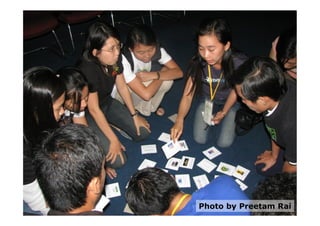
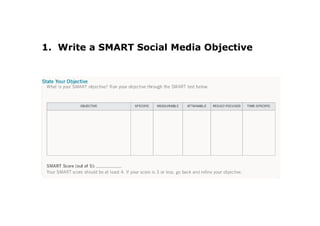
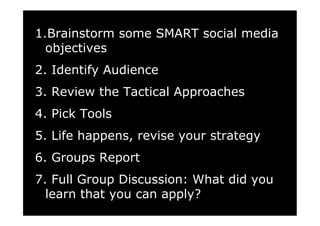
  • #3 To go through a strategy brainstorming session that maps out objective, audience, and tactical approaches for a fictional organization
  • #5 You are free:to Share — to copy, distribute, display, and perform the work to Remix — to make derivative works Under the following conditions:Attribution. You must attribute the work in the manner specified by the author or licensor (but not in any way that suggests that they endorse you or your use of the work). What does \"Attribute this work\" mean? The page you came from contained embedded licensing metadata, including how the creator wishes to be attributed for re-use. You can use the HTML here to cite the work. Doing so will also include metadata on your page so that others can find the original work as well.
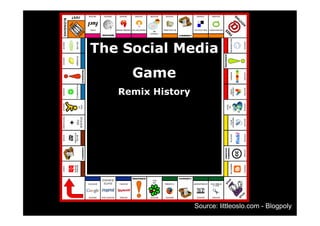
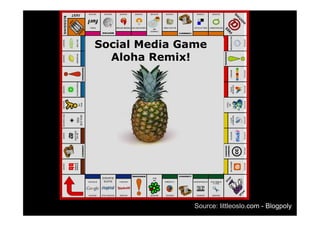
  • #6 http://littleoslo.com/img/feature/09/blogpoly.png
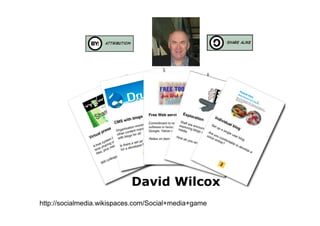
  • #7 http://socialmedia.wikispaces.com/Social+media+game
  • #8 http://socialmedia.wikispaces.com/Social+media+game
  • #12 http://littleoslo.com/img/feature/09/blogpoly.png
  • #14 You are a campaign team for a local tourist office and you want to get visitors to Hawaii to enjoy your local restaurants, hotels, and attractions. .You would like to use social media to educate tourists who have select Hawaii as a destination to come off the beaten path. You also want to build relationships with people who have visited so they will return or tell others.
  • #15 http://littleoslo.com/img/feature/09/blogpoly.png
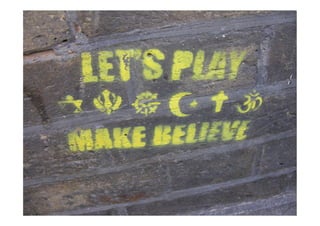
  • #16 http://www.flickr.com/photos/vgm8383/2176897085/
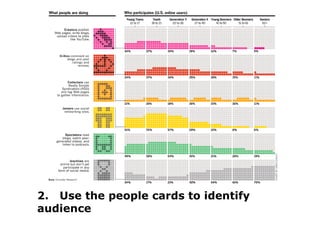
  • #20 And so are the technograpics …This is a chart from Forrester research – where they look at what people do on the social web – across different age categories .As you can see the tools we’re going to look at today appeal to different age categoriesAnd, it may surprise you but the demographics of social networking sites or these use profiles is aging – and not all kids are using all tools … What's interesting is why they don't use social networks.
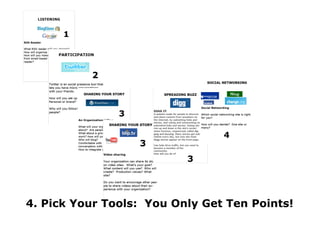
  • #21 Listening:Knowing what is being said online about your organization and the field you work in. You can listen with google alerts, technorati, twitter, and RSS readers. Key skill is pattern analysis. Link listening and analysis to decisions or actions. About 5 hours a week once you learn how to use the tools and make listening a daily habit.