Big Data 101
What It Means for Business

David Ray
Corporate Internet
Corporate Communications Dept
Big Data
“Big Data is like teenage sex;
everyone talks about it, nobody
really knows how to do it, everyone
thinks everyone one else is doing it, so
everyone claims they are doing it.”
-Dan Ariely, Duke University
Director of the Center for Advanced Hindsight

Big Data 101: What It Means for Business | December 4, 2013

2
Big Data
“‘Big Data’ is just more data than we’re
used to.”
– Jim Sterne, WAA & eMetrics Founder

Big Data 101: What It Means for Business | December 4, 2013

3
What is “Big Data”?
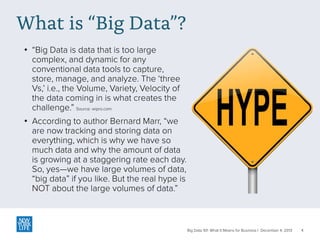
• “Big Data is data that is too large
complex, and dynamic for any
conventional data tools to capture,
store, manage, and analyze. The ‘three
Vs,’ i.e., the Volume, Variety, Velocity of
the data coming in is what creates the
challenge.” Source: wipro.com
• According to author Bernard Marr, “we
are now tracking and storing data on
everything, which is why we have so
much data and why the amount of data
is growing at a staggering rate each day.
So, yes—we have large volumes of data,
“big data” if you like. But the real hype is
NOT about the large volumes of data.”

Big Data 101: What It Means for Business | December 4, 2013

4
What is “Big Data”?
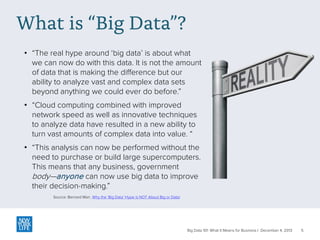
• “The real hype around ‘big data’ is about what
we can now do with this data. It is not the amount
of data that is making the difference but our
ability to analyze vast and complex data sets
beyond anything we could ever do before.”
• “Cloud computing combined with improved
network speed as well as innovative techniques
to analyze data have resulted in a new ability to
turn vast amounts of complex data into value. “
• “This analysis can now be performed without the
need to purchase or build large supercomputers.
This means that any business, government
body—anyone can now use big data to improve
their decision-making.”
Source: Bernard Marr, Why the ‘Big Data’ Hype is NOT About Big or Data!

Big Data 101: What It Means for Business | December 4, 2013

5
What is “Big Data”?
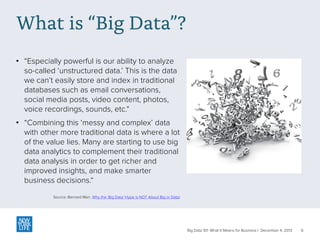
• “Especially powerful is our ability to analyze
so-called ‘unstructured data.’ This is the data
we can’t easily store and index in traditional
databases such as email conversations,
social media posts, video content, photos,
voice recordings, sounds, etc.“
• “Combining this ‘messy and complex’ data
with other more traditional data is where a lot
of the value lies. Many are starting to use big
data analytics to complement their traditional
data analysis in order to get richer and
improved insights, and make smarter
business decisions.“
Source: Bernard Marr, Why the ‘Big Data’ Hype is NOT About Big or Data!

Big Data 101: What It Means for Business | December 4, 2013

6
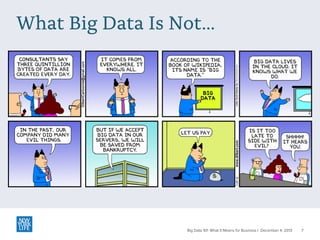
What Big Data Is Not…

Big Data 101: What It Means for Business | December 4, 2013

7
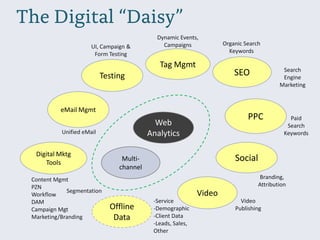
The Digital “Daisy”
UI, Campaign &
Form Testing

Testing

Dynamic Events,
Campaigns

Tag Mgmt

Digital Mktg
Tools
Content Mgmt
PZN
Segmentation
Workflow
DAM
Campaign Mgt
Marketing/Branding

PPC

Web
Analytics

Paid
Search
Keywords

Social

Multichannel

Offline
Data

Search
Engine
Marketing

SEO

eMail Mgmt
Unified eMail

Organic Search
Keywords

-Service
-Demographic
-Client Data
-Leads, Sales,
Other

Video

Branding,
Attribution
Video
Publishing
8
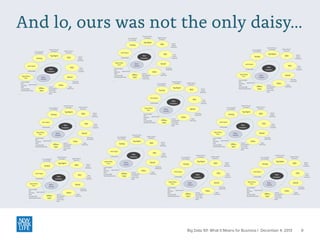
And lo, ours was not the only daisy…

Big Data 101: What It Means for Business | December 4, 2013

9
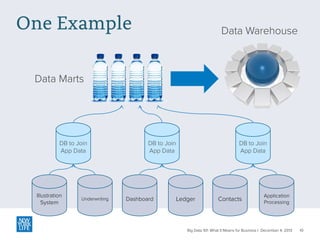
One Example

Data Warehouse

Data Marts

DB to Join
App Data

Illustration
System

Underwriting

DB to Join
App Data

Dashboard

DB to Join
App Data

Ledger

Contacts

Application
Processing

Big Data 101: What It Means for Business | December 4, 2013

10
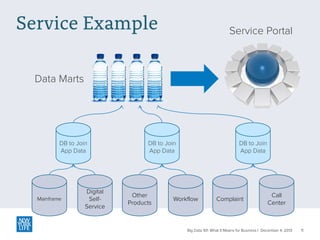
Service Example

Service Portal

Data Marts

DB to Join
App Data

Mainframe

Digital
SelfService

DB to Join
App Data

Other
Products

DB to Join
App Data

Workflow

Complaint

Call
Center

Big Data 101: What It Means for Business | December 4, 2013

11
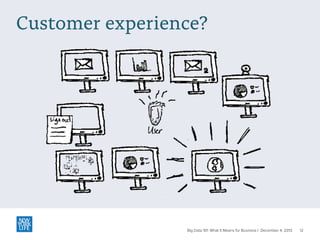
Customer experience?

Big Data 101: What It Means for Business | December 4, 2013

12
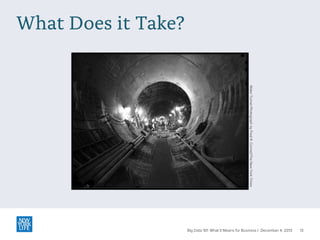
What Does it Take?

Water Tunnel Photograph by Fred R. Conrad/The New York Times

Big Data 101: What It Means for Business | December 4, 2013

13
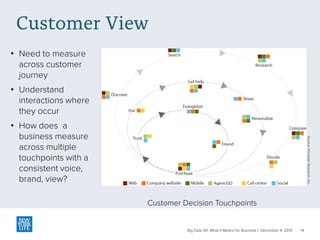
Customer View
• Need to measure
across customer
journey
• Understand
interactions where
they occur
Source: Forrester Research, Inc.

• How does a
business measure
across multiple
touchpoints with a
consistent voice,
brand, view?
Customer Decision Touchpoints

Big Data 101: What It Means for Business | December 4, 2013

14
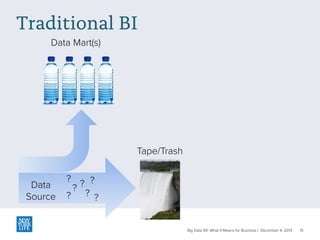
Traditional BI
Data Mart(s)

Tape/Trash
Data
Source

? ? ?
?
? ? ?

Big Data 101: What It Means for Business | December 4, 2013

15
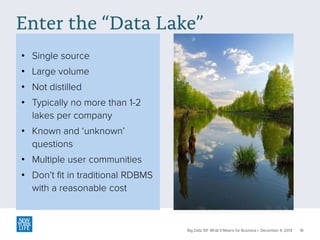
Enter the “Data Lake”
• Single source
• Large volume
• Not distilled
• Typically no more than 1-2
lakes per company
• Known and ‘unknown’
questions
• Multiple user communities
• Don’t fit in traditional RDBMS
with a reasonable cost

Big Data 101: What It Means for Business | December 4, 2013

16
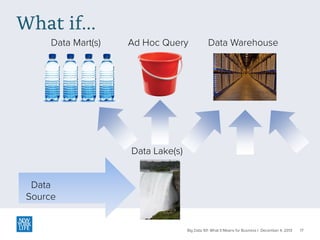
What if...
Data Mart(s)

Ad Hoc Query

Data Warehouse

Data Lake(s)
Data
Source

Big Data 101: What It Means for Business | December 4, 2013

17
What’s Our Big Data Worth?
• According to statistics from IDC: Unstructured data
comprises more than 90% of the information in today's
enterprises, much of it stored away in documents, email,
notes and Web content.
• What’s the potential value of mining this untapped data?
• If 90% is unstructured, at best we’re making business
decisions based on 10% of our data.
• What if businesses could increase that to 20-, 30-, 50%?
• What are the risks/competitive disadvantages if we don’t?

Big Data 101: What It Means for Business | December 4, 2013

18
The Future Opportunity
• The present and future opportunity for “big data” may not be
to process enormous amounts of data (though many use
cases exist), but rather to tie together previously un-tied
and/or isolated systems.
• Use cases abound, from customer experience management
to service to product development to marketing.
• Imagine a service rep having a single service application
with a cross-channel view of the customer, or a consolidated
Agent book of business; picture a centralized marketing
area that’s aware of every customer correspondence, email,
touchpoint, interaction, plus a Web site and/or Call Center
that responds accordingly.
Big Data 101: What It Means for Business | December 4, 2013

19
Who Uses Big Data?
“While there are plenty of specialized
uses for big data analytics—such as a
fraud-detection model for a credit card
company handling tens of millions of
cards and transactions—one of the
broadest applications has been in
marketing. Marketers have been quick
to see the promise of modeling the
activities of their customers across
multiple channels (in-store, online, call
center, CRM, mobile, social media) to
understand implicit preferences and
build predictive models.”
Source: Information Week

Big Data 101: What It Means for Business | December 4, 2013

20
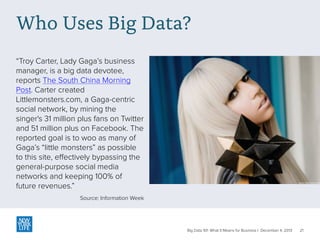
Who Uses Big Data?
“Troy Carter, Lady Gaga’s business
manager, is a big data devotee,
reports The South China Morning
Post. Carter created
Littlemonsters.com, a Gaga-centric
social network, by mining the
singer's 31 million plus fans on Twitter
and 51 million plus on Facebook. The
reported goal is to woo as many of
Gaga’s “little monsters” as possible
to this site, effectively bypassing the
general-purpose social media
networks and keeping 100% of
future revenues.”
Source: Information Week

Big Data 101: What It Means for Business | December 4, 2013

21
Who Uses Big Data?
“Facebook and Yahoo run their own giant,
in-house “clusters”—collections of powerful
servers—for crunching data. The necessity
of these clusters is one of the hallmarks of
big data. After all, data isn’t all that “big” if
you could chew through it on your PC at
home. The necessity of breaking problems
into many small parts, and processing each
on a large array of computers, characterizes
classic big data problems like Google’s
need to compute the rank of every single
web page on the planet.”
Source: Christopher Mims, Quartz

Big Data 101: What It Means for Business | December 4, 2013

22
Who Uses Big Data?
Apparently, even the Central Intelligence
Agency is searching for data scientists. “All of
CIA’s directorates—the National Clandestine
Service and the Directorates of Intelligence,
Support and Science and Technology—are
looking for curious, creative individuals
interested in serving their country through the
field of data science,” reads the job posting
on CIA.gov.
https://www.cia.gov/news-information/featured-story-archive/2012-featured-story-archive/big-data-at-the-cia.html

Big Data 101: What It Means for Business | December 4, 2013

23
Who Uses Big Data?
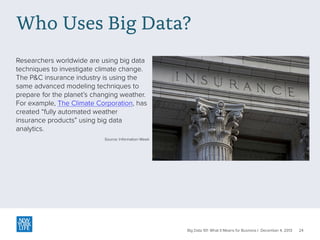
Researchers worldwide are using big data
techniques to investigate climate change.
The P&C insurance industry is using the
same advanced modeling techniques to
prepare for the planet’s changing weather.
For example, The Climate Corporation, has
created “fully automated weather
insurance products” using big data
analytics.
Source: Information Week

Big Data 101: What It Means for Business | December 4, 2013

24
Who Uses Big Data?
“For years now, big data
has helped 1-800-Flowers
ship flowers to loved
ones. The company uses
data analytics for both
customer intelligence and
to optimize its own
marketing choices.”
Source: Information Week

Big Data 101: What It Means for Business | December 4, 2013

25
Who Uses Big Data?
“So big data and its associated analytics
have found a home in virtually every
industry. Which begs the question: If Lady
Gaga uses it, why aren’t you?”
Source: Information Week

Big Data 101: What It Means for Business | December 4, 2013

26

Big Data 101, What It Means for Business - BDI 12/4/13 The Future of Financial Services Communications: Case Studies and Roundtables

  • 1.
    Big Data 101 WhatIt Means for Business David Ray Corporate Internet Corporate Communications Dept
  • 2.
    Big Data “Big Datais like teenage sex; everyone talks about it, nobody really knows how to do it, everyone thinks everyone one else is doing it, so everyone claims they are doing it.” -Dan Ariely, Duke University Director of the Center for Advanced Hindsight Big Data 101: What It Means for Business | December 4, 2013 2
  • 3.
    Big Data “‘Big Data’is just more data than we’re used to.” – Jim Sterne, WAA & eMetrics Founder Big Data 101: What It Means for Business | December 4, 2013 3
  • 4.
    What is “BigData”? • “Big Data is data that is too large complex, and dynamic for any conventional data tools to capture, store, manage, and analyze. The ‘three Vs,’ i.e., the Volume, Variety, Velocity of the data coming in is what creates the challenge.” Source: wipro.com • According to author Bernard Marr, “we are now tracking and storing data on everything, which is why we have so much data and why the amount of data is growing at a staggering rate each day. So, yes—we have large volumes of data, “big data” if you like. But the real hype is NOT about the large volumes of data.” Big Data 101: What It Means for Business | December 4, 2013 4
  • 5.
    What is “BigData”? • “The real hype around ‘big data’ is about what we can now do with this data. It is not the amount of data that is making the difference but our ability to analyze vast and complex data sets beyond anything we could ever do before.” • “Cloud computing combined with improved network speed as well as innovative techniques to analyze data have resulted in a new ability to turn vast amounts of complex data into value. “ • “This analysis can now be performed without the need to purchase or build large supercomputers. This means that any business, government body—anyone can now use big data to improve their decision-making.” Source: Bernard Marr, Why the ‘Big Data’ Hype is NOT About Big or Data! Big Data 101: What It Means for Business | December 4, 2013 5
  • 6.
    What is “BigData”? • “Especially powerful is our ability to analyze so-called ‘unstructured data.’ This is the data we can’t easily store and index in traditional databases such as email conversations, social media posts, video content, photos, voice recordings, sounds, etc.“ • “Combining this ‘messy and complex’ data with other more traditional data is where a lot of the value lies. Many are starting to use big data analytics to complement their traditional data analysis in order to get richer and improved insights, and make smarter business decisions.“ Source: Bernard Marr, Why the ‘Big Data’ Hype is NOT About Big or Data! Big Data 101: What It Means for Business | December 4, 2013 6
  • 7.
    What Big DataIs Not… Big Data 101: What It Means for Business | December 4, 2013 7
  • 8.
    The Digital “Daisy” UI,Campaign & Form Testing Testing Dynamic Events, Campaigns Tag Mgmt Digital Mktg Tools Content Mgmt PZN Segmentation Workflow DAM Campaign Mgt Marketing/Branding PPC Web Analytics Paid Search Keywords Social Multichannel Offline Data Search Engine Marketing SEO eMail Mgmt Unified eMail Organic Search Keywords -Service -Demographic -Client Data -Leads, Sales, Other Video Branding, Attribution Video Publishing 8
  • 9.
    And lo, ourswas not the only daisy… Big Data 101: What It Means for Business | December 4, 2013 9
  • 10.
    One Example Data Warehouse DataMarts DB to Join App Data Illustration System Underwriting DB to Join App Data Dashboard DB to Join App Data Ledger Contacts Application Processing Big Data 101: What It Means for Business | December 4, 2013 10
  • 11.
    Service Example Service Portal DataMarts DB to Join App Data Mainframe Digital SelfService DB to Join App Data Other Products DB to Join App Data Workflow Complaint Call Center Big Data 101: What It Means for Business | December 4, 2013 11
  • 12.
    Customer experience? Big Data101: What It Means for Business | December 4, 2013 12
  • 13.
    What Does itTake? Water Tunnel Photograph by Fred R. Conrad/The New York Times Big Data 101: What It Means for Business | December 4, 2013 13
  • 14.
    Customer View • Needto measure across customer journey • Understand interactions where they occur Source: Forrester Research, Inc. • How does a business measure across multiple touchpoints with a consistent voice, brand, view? Customer Decision Touchpoints Big Data 101: What It Means for Business | December 4, 2013 14
  • 15.
    Traditional BI Data Mart(s) Tape/Trash Data Source ?? ? ? ? ? ? Big Data 101: What It Means for Business | December 4, 2013 15
  • 16.
    Enter the “DataLake” • Single source • Large volume • Not distilled • Typically no more than 1-2 lakes per company • Known and ‘unknown’ questions • Multiple user communities • Don’t fit in traditional RDBMS with a reasonable cost Big Data 101: What It Means for Business | December 4, 2013 16
  • 17.
    What if... Data Mart(s) AdHoc Query Data Warehouse Data Lake(s) Data Source Big Data 101: What It Means for Business | December 4, 2013 17
  • 18.
    What’s Our BigData Worth? • According to statistics from IDC: Unstructured data comprises more than 90% of the information in today's enterprises, much of it stored away in documents, email, notes and Web content. • What’s the potential value of mining this untapped data? • If 90% is unstructured, at best we’re making business decisions based on 10% of our data. • What if businesses could increase that to 20-, 30-, 50%? • What are the risks/competitive disadvantages if we don’t? Big Data 101: What It Means for Business | December 4, 2013 18
  • 19.
    The Future Opportunity •The present and future opportunity for “big data” may not be to process enormous amounts of data (though many use cases exist), but rather to tie together previously un-tied and/or isolated systems. • Use cases abound, from customer experience management to service to product development to marketing. • Imagine a service rep having a single service application with a cross-channel view of the customer, or a consolidated Agent book of business; picture a centralized marketing area that’s aware of every customer correspondence, email, touchpoint, interaction, plus a Web site and/or Call Center that responds accordingly. Big Data 101: What It Means for Business | December 4, 2013 19
  • 20.
    Who Uses BigData? “While there are plenty of specialized uses for big data analytics—such as a fraud-detection model for a credit card company handling tens of millions of cards and transactions—one of the broadest applications has been in marketing. Marketers have been quick to see the promise of modeling the activities of their customers across multiple channels (in-store, online, call center, CRM, mobile, social media) to understand implicit preferences and build predictive models.” Source: Information Week Big Data 101: What It Means for Business | December 4, 2013 20
  • 21.
    Who Uses BigData? “Troy Carter, Lady Gaga’s business manager, is a big data devotee, reports The South China Morning Post. Carter created Littlemonsters.com, a Gaga-centric social network, by mining the singer's 31 million plus fans on Twitter and 51 million plus on Facebook. The reported goal is to woo as many of Gaga’s “little monsters” as possible to this site, effectively bypassing the general-purpose social media networks and keeping 100% of future revenues.” Source: Information Week Big Data 101: What It Means for Business | December 4, 2013 21
  • 22.
    Who Uses BigData? “Facebook and Yahoo run their own giant, in-house “clusters”—collections of powerful servers—for crunching data. The necessity of these clusters is one of the hallmarks of big data. After all, data isn’t all that “big” if you could chew through it on your PC at home. The necessity of breaking problems into many small parts, and processing each on a large array of computers, characterizes classic big data problems like Google’s need to compute the rank of every single web page on the planet.” Source: Christopher Mims, Quartz Big Data 101: What It Means for Business | December 4, 2013 22
  • 23.
    Who Uses BigData? Apparently, even the Central Intelligence Agency is searching for data scientists. “All of CIA’s directorates—the National Clandestine Service and the Directorates of Intelligence, Support and Science and Technology—are looking for curious, creative individuals interested in serving their country through the field of data science,” reads the job posting on CIA.gov. https://www.cia.gov/news-information/featured-story-archive/2012-featured-story-archive/big-data-at-the-cia.html Big Data 101: What It Means for Business | December 4, 2013 23
  • 24.
    Who Uses BigData? Researchers worldwide are using big data techniques to investigate climate change. The P&C insurance industry is using the same advanced modeling techniques to prepare for the planet’s changing weather. For example, The Climate Corporation, has created “fully automated weather insurance products” using big data analytics. Source: Information Week Big Data 101: What It Means for Business | December 4, 2013 24
  • 25.
    Who Uses BigData? “For years now, big data has helped 1-800-Flowers ship flowers to loved ones. The company uses data analytics for both customer intelligence and to optimize its own marketing choices.” Source: Information Week Big Data 101: What It Means for Business | December 4, 2013 25
  • 26.
    Who Uses BigData? “So big data and its associated analytics have found a home in virtually every industry. Which begs the question: If Lady Gaga uses it, why aren’t you?” Source: Information Week Big Data 101: What It Means for Business | December 4, 2013 26