DATASERVICES
PROCESSING (BIG) DATA THE
MICROSERVICE WAY
Dr. Josef Adersberger ( @adersberger), QAware GmbH
http://www.datasciencecentral.com
ENTERPRISE
http://www.cardinalfang.net/misc/companies_list.html
?
PROCESSING
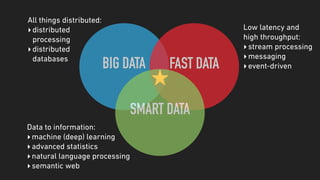
BIG DATA FAST DATA
SMART DATA
All things distributed:
‣distributed 

processing
‣distributed 

databases
Data to information:
‣machine (deep) learning
‣advanced statistics
‣natural language processing
‣semantic web
Low latency and 

high throughput:
‣stream processing
‣messaging
‣event-driven
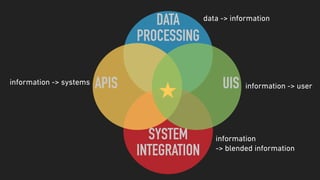
DATA

PROCESSING
SYSTEM

INTEGRATION
APIS UIS
data -> information
information -> userinformation -> systems
information 

-> blended information
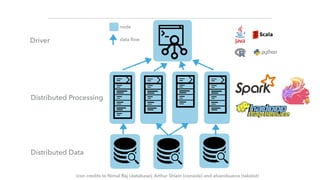
SOLUTIONS
The {big,SMART,FAST} data 

Swiss Army Knifes
( )
node
Distributed Data
Distributed Processing
Driver data flow
icon credits to Nimal Raj (database), Arthur Shlain (console) and alvarobueno (takslist)
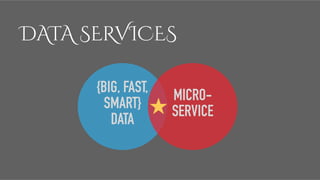
DATA SERVICES
{BIG, FAST,
SMART}
DATA
MICRO-

SERVICE
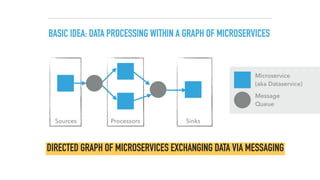
BASIC IDEA: DATA PROCESSING WITHIN A GRAPH OF MICROSERVICES
Microservice

(aka Dataservice)
Message 

Queue
Sources Processors Sinks
DIRECTED GRAPH OF MICROSERVICES EXCHANGING DATA VIA MESSAGING
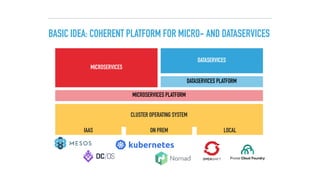
BASIC IDEA: COHERENT PLATFORM FOR MICRO- AND DATASERVICES
CLUSTER OPERATING SYSTEM
IAAS ON PREM LOCAL
MICROSERVICES
DATASERVICES
MICROSERVICES PLATFORM
DATASERVICES PLATFORM
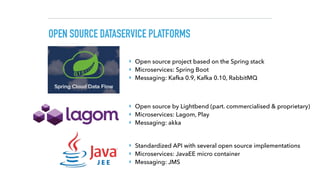
OPEN SOURCE DATASERVICE PLATFORMS
‣ Open source project based on the Spring stack
‣ Microservices: Spring Boot
‣ Messaging: Kafka 0.9, Kafka 0.10, RabbitMQ
‣ Standardized API with several open source implementations
‣ Microservices: JavaEE micro container
‣ Messaging: JMS
‣ Open source by Lightbend (part. commercialised & proprietary)
‣ Microservices: Lagom, Play
‣ Messaging: akka
ARCHITECT’S VIEW
- ON SPRING CLOUD DATA FLOW
DATASERVICES
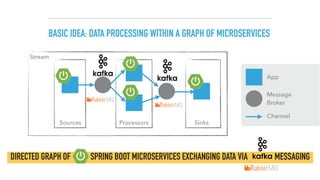
BASIC IDEA: DATA PROCESSING WITHIN A GRAPH OF MICROSERVICES
Sources Processors Sinks
DIRECTED GRAPH OF SPRING BOOT MICROSERVICES EXCHANGING DATA VIA MESSAGING
Stream
App
Message 

Broker
Channel
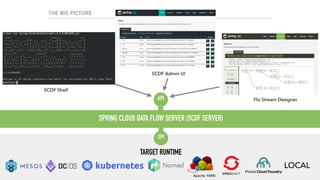
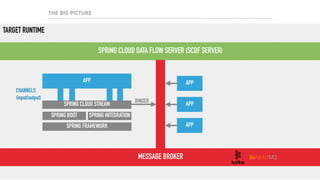
THE BIG PICTURE
SPRING CLOUD DATA FLOW SERVER (SCDF SERVER)
TARGET RUNTIME
SPI
API
LOCAL
SCDF Shell
SCDF Admin UI
Flo Stream Designer
THE BIG PICTURE
SPRING CLOUD DATA FLOW SERVER (SCDF SERVER)
TARGET RUNTIME
MESSAGE BROKER
APP
SPRING BOOT
SPRING FRAMEWORK
SPRING CLOUD STREAM
SPRING INTEGRATION
BINDER
APP
APP
APP
CHANNELS

(input/output)
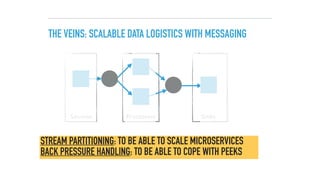
THE VEINS: SCALABLE DATA LOGISTICS WITH MESSAGING
Sources Processors Sinks
STREAM PARTITIONING: TO BE ABLE TO SCALE MICROSERVICES
BACK PRESSURE HANDLING: TO BE ABLE TO COPE WITH PEEKS
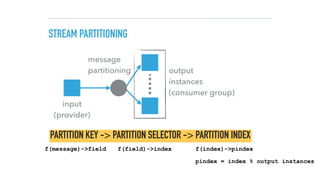
STREAM PARTITIONING
output 

instances

(consumer group)
PARTITION KEY -> PARTITION SELECTOR -> PARTITION INDEX
input

(provider)
f(message)->field f(field)->index f(index)->pindex
pindex = index % output instances
message 

partitioning
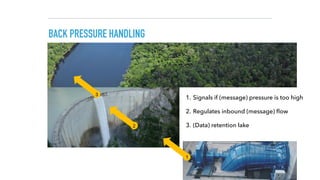
BACK PRESSURE HANDLING
1
3
2
1. Signals if (message) pressure is too high
2. Regulates inbound (message) flow
3. (Data) retention lake
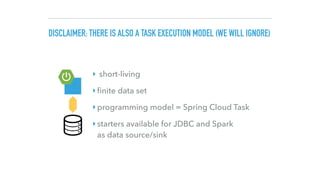
DISCLAIMER: THERE IS ALSO A TASK EXECUTION MODEL (WE WILL IGNORE)
‣ short-living
‣finite data set
‣programming model = Spring Cloud Task
‣starters available for JDBC and Spark 

as data source/sink
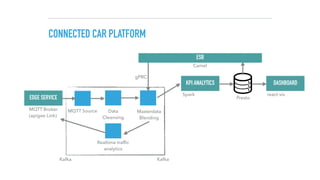
CONNECTED CAR PLATFORM
EDGE SERVICE
MQTT Broker

(apigee Link)
MQTT Source Data 

Cleansing
Realtime traffic

analytics
KPI ANALYTICS
Spark
DASHBOARD
react-vis
Presto
Masterdata

Blending
Camel
KafkaKafka
ESB
gPRC
DEVELOPERS’S VIEW
-ON SPRING CLOUD DATA FLOW
DATASERVICES
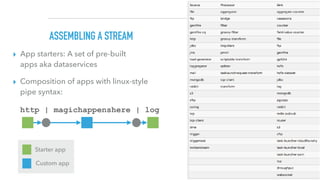
ASSEMBLING A STREAM
▸ App starters: A set of pre-built

apps aka dataservices
▸ Composition of apps with linux-style 

pipe syntax:
http | magichappenshere | log
Starter app
Custom app
https://www.pinterest.de/pin/272116002461148164
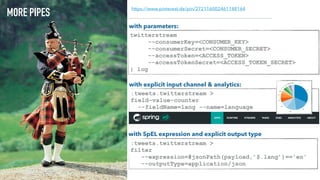
MORE PIPES
twitterstream 

--consumerKey=<CONSUMER_KEY> 

--consumerSecret=<CONSUMER_SECRET> 

--accessToken=<ACCESS_TOKEN> 

--accessTokenSecret=<ACCESS_TOKEN_SECRET> 

| log
:tweets.twitterstream > 

field-value-counter 

--fieldName=lang --name=language
:tweets.twitterstream > 

filter 

--expression=#jsonPath(payload,’$.lang’)=='en'
--outputType=application/json
with parameters:
with explicit input channel & analytics:
with SpEL expression and explicit output type
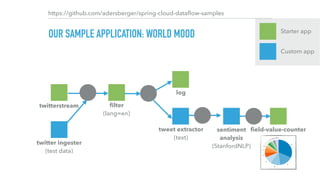
OUR SAMPLE APPLICATION: WORLD MOOD
https://github.com/adersberger/spring-cloud-dataflow-samples
twitterstream
Starter app
Custom app
filter

(lang=en)
log
twitter ingester

(test data)
tweet extractor

(text)
sentiment

analysis

(StanfordNLP)
field-value-counter
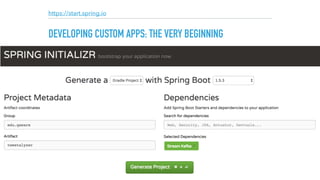
DEVELOPING CUSTOM APPS: THE VERY BEGINNING
https://start.spring.io
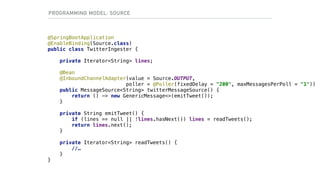
@SpringBootApplication
@EnableBinding(Source.class)
public class TwitterIngester {
private Iterator<String> lines;
@Bean
@InboundChannelAdapter(value = Source.OUTPUT,
poller = @Poller(fixedDelay = "200", maxMessagesPerPoll = "1"))
public MessageSource<String> twitterMessageSource() {
return () -> new GenericMessage<>(emitTweet());
}
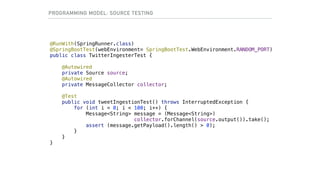
private String emitTweet() {
if (lines == null || !lines.hasNext()) lines = readTweets();
return lines.next();
}
private Iterator<String> readTweets() {
//…
}
}
PROGRAMMING MODEL: SOURCE
@RunWith(SpringRunner.class)
@SpringBootTest(webEnvironment= SpringBootTest.WebEnvironment.RANDOM_PORT)
public class TwitterIngesterTest {
@Autowired
private Source source;
@Autowired
private MessageCollector collector;
@Test
public void tweetIngestionTest() throws InterruptedException {
for (int i = 0; i < 100; i++) {
Message<String> message = (Message<String>) 

collector.forChannel(source.output()).take();
assert (message.getPayload().length() > 0);
}
}
}
PROGRAMMING MODEL: SOURCE TESTING
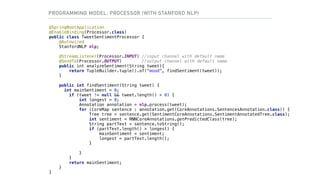
PROGRAMMING MODEL: PROCESSOR (WITH STANFORD NLP)
@SpringBootApplication
@EnableBinding(Processor.class)
public class TweetSentimentProcessor {
@Autowired
StanfordNLP nlp;
@StreamListener(Processor.INPUT) //input channel with default name
@SendTo(Processor.OUTPUT) //output channel with default name
public int analyzeSentiment(String tweet){
return TupleBuilder.tuple().of("mood", findSentiment(tweet));
}
public int findSentiment(String tweet) {
int mainSentiment = 0;
if (tweet != null && tweet.length() > 0) {
int longest = 0;
Annotation annotation = nlp.process(tweet);
for (CoreMap sentence : annotation.get(CoreAnnotations.SentencesAnnotation.class)) {
Tree tree = sentence.get(SentimentCoreAnnotations.SentimentAnnotatedTree.class);
int sentiment = RNNCoreAnnotations.getPredictedClass(tree);
String partText = sentence.toString();
if (partText.length() > longest) {
mainSentiment = sentiment;
longest = partText.length();
}
}
}
return mainSentiment;
}
}
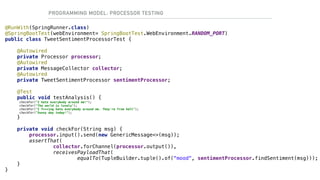
PROGRAMMING MODEL: PROCESSOR TESTING
@RunWith(SpringRunner.class)
@SpringBootTest(webEnvironment= SpringBootTest.WebEnvironment.RANDOM_PORT)
public class TweetSentimentProcessorTest {
@Autowired
private Processor processor;
@Autowired
private MessageCollector collector;
@Autowired
private TweetSentimentProcessor sentimentProcessor;
@Test
public void testAnalysis() {
checkFor("I hate everybody around me!");
checkFor("The world is lovely");
checkFor("I f***ing hate everybody around me. They're from hell");
checkFor("Sunny day today!");
}
private void checkFor(String msg) {
processor.input().send(new GenericMessage<>(msg));
assertThat(
collector.forChannel(processor.output()),
receivesPayloadThat(
equalTo(TupleBuilder.tuple().of("mood", sentimentProcessor.findSentiment(msg)));
}
}
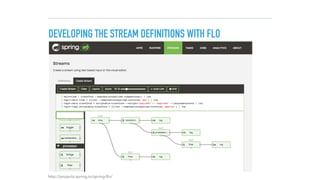
DEVELOPING THE STREAM DEFINITIONS WITH FLO
http://projects.spring.io/spring-flo/
RUNNING IT LOCAL
RUNNING THE DATASERVICES
$ redis-server &

$ zookeeper-server-start.sh . /config/zookeeper.properties &

$ kafka-server-start.sh ./config/server.properties &

$ java -jar spring-cloud-dataflow-server-local-1.2.0.RELEASE.jar &

$ java -jar ../spring-cloud-dataflow-shell-1.2.0.RELEASE.jar
dataflow:> app import —uri [1]


dataflow:> app register --name tweetsentimentalyzer --type processor --uri file:///libs/
worldmoodindex-0.0.2-SNAPSHOT.jar


dataflow:> stream create tweets-ingestion --definition "twitterstream --consumerKey=A --
consumerSecret=B --accessToken=C --accessTokenSecret=D | filter —
expression=#jsonPath(payload,’$.lang')=='en' | log" —deploy


dataflow:> stream create tweets-analyzer --definition “:tweets-ingestion.filter >
tweetsentimentalyzer | field-value-counter --fieldName=mood —name=Mood"


dataflow:> stream deploy tweets-analyzer —properties
“deployer.tweetsentimentalyzer.memory=1024m,deployer.tweetsentimentalyzer.count=8,

app.transform.producer.partitionKeyExpression=payload.id"
[1] http://repo.spring.io/libs-release/org/springframework/cloud/stream/app/spring-cloud-stream-app-descriptor/Bacon.RELEASE/
spring-cloud-stream-app-descriptor-Bacon.RELEASE.kafka-10-apps-maven-repo-url.properties
RUNNING IT IN THE CLOUD
RUNNING THE DATASERVICES
$ git clone https://github.com/spring-cloud/spring-cloud-dataflow-server-kubernetes

$ kubectl create -f src/etc/kubernetes/kafka-zk-controller.yml

$ kubectl create -f src/etc/kubernetes/kafka-zk-service.yml

$ kubectl create -f src/etc/kubernetes/kafka-controller.yml

$ kubectl create -f src/etc/kubernetes/mysql-controller.yml

$ kubectl create -f src/etc/kubernetes/mysql-service.yml

$ kubectl create -f src/etc/kubernetes/kafka-service.yml

$ kubectl create -f src/etc/kubernetes/redis-controller.yml

$ kubectl create -f src/etc/kubernetes/redis-service.yml

$ kubectl create -f src/etc/kubernetes/scdf-config-kafka.yml

$ kubectl create -f src/etc/kubernetes/scdf-secrets.yml

$ kubectl create -f src/etc/kubernetes/scdf-service.yml

$ kubectl create -f src/etc/kubernetes/scdf-controller.yml

$ kubectl get svc #lookup external ip “scdf” <IP>
$ java -jar ../spring-cloud-dataflow-shell-1.2.0.RELEASE.jar
dataflow:> dataflow config server --uri http://<IP>:9393

dataflow:> app import —uri [2]

dataflow:> app register --type processor --name tweetsentimentalyzer --uri docker:qaware/
tweetsentimentalyzer-processor:latest
dataflow:> …
[2] http://repo.spring.io/libs-release/org/springframework/cloud/stream/app/spring-cloud-stream-app-descriptor/Bacon.RELEASE/spring-
cloud-stream-app-descriptor-Bacon.RELEASE.stream-apps-kafka-09-docker
LESSONS LEARNED
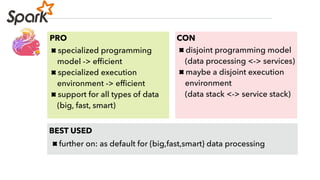
PRO CON
specialized programming

model -> efficient
specialized execution 

environment -> efficient
support for all types of data

(big, fast, smart)
disjoint programming model 

(data processing <-> services)
maybe a disjoint execution

environment

(data stack <-> service stack)
BEST USED
further on: as default for {big,fast,smart} data processing
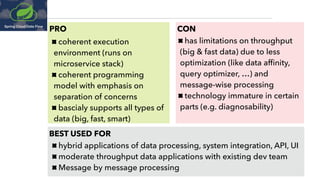
PRO CON
coherent execution
environment (runs on
microservice stack)
coherent programming
model with emphasis on
separation of concerns
bascialy supports all types of
data (big, fast, smart)
has limitations on throughput

(big & fast data) due to less
optimization (like data affinity,
query optimizer, …) and
message-wise processing
technology immature in certain

parts (e.g. diagnosability)
BEST USED FOR
hybrid applications of data processing, system integration, API, UI
moderate throughput data applications with existing dev team
Message by message processing
TWITTER.COM/QAWARE - SLIDESHARE.NET/QAWARE
Thank you!
Questions?
josef.adersberger@qaware.de
@adersberger
https://github.com/adersberger/spring-cloud-dataflow-samples
BONUS SLIDES
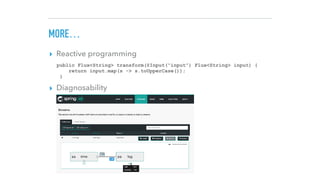
MORE…
▸ Reactive programming
▸ Diagnosability
public Flux<String> transform(@Input(“input”) Flux<String> input) {
return input.map(s -> s.toUpperCase());
}
@EnableBinding(Sink::class)
@EnableConfigurationProperties(PostgresSinkProperties::class)
class PostgresSink {
@Autowired
lateinit var props: PostgresSinkProperties
@StreamListener(Sink.INPUT)
fun processTweet(message: String) {
Database.connect(props.url, user = props.user, password = props.password,
driver = "org.postgresql.Driver")
transaction {
SchemaUtils.create(Messages)
Messages.insert {
it[Messages.message] = message
}
}
}
}
object Messages : Table() {
val id = integer("id").autoIncrement().primaryKey()
val message = text("message")
}
PROGRAMMING MODEL: SINK (WITH KOTLIN)
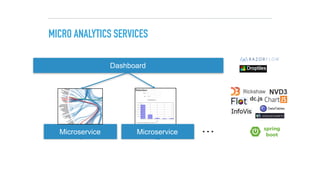
MICRO ANALYTICS SERVICES
Microservice
Dashboard
Microservice …
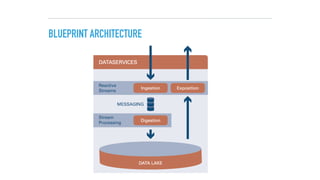
BLUEPRINT ARCHITECTURE
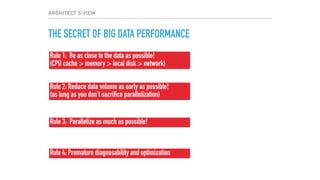
ARCHITECT’S VIEW
THE SECRET OF BIG DATA PERFORMANCE
Rule 1: Be as close to the data as possible!

(CPU cache > memory > local disk > network)
Rule 2: Reduce data volume as early as possible! 

(as long as you don’t sacrifice parallelization)
Rule 3: Parallelize as much as possible!
Rule 4: Premature diagnosability and optimization
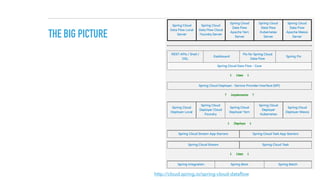
THE BIG PICTURE
http://cloud.spring.io/spring-cloud-dataflow
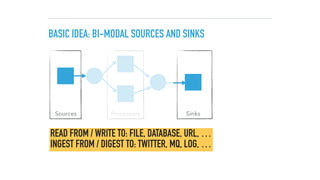
BASIC IDEA: BI-MODAL SOURCES AND SINKS
Sources Processors Sinks
READ FROM / WRITE TO: FILE, DATABASE, URL, …
INGEST FROM / DIGEST TO: TWITTER, MQ, LOG, …

Dataservices: Processing (Big) Data the Microservice Way

  • 1.
    DATASERVICES PROCESSING (BIG) DATATHE MICROSERVICE WAY Dr. Josef Adersberger ( @adersberger), QAware GmbH
  • 2.
  • 3.
    BIG DATA FASTDATA SMART DATA All things distributed: ‣distributed 
 processing ‣distributed 
 databases Data to information: ‣machine (deep) learning ‣advanced statistics ‣natural language processing ‣semantic web Low latency and 
 high throughput: ‣stream processing ‣messaging ‣event-driven
  • 4.
    DATA
 PROCESSING SYSTEM
 INTEGRATION APIS UIS data ->information information -> userinformation -> systems information 
 -> blended information
  • 5.
  • 6.
    The {big,SMART,FAST} data
 Swiss Army Knifes ( )
  • 7.
    node Distributed Data Distributed Processing Driverdata flow icon credits to Nimal Raj (database), Arthur Shlain (console) and alvarobueno (takslist)
  • 8.
  • 9.
    BASIC IDEA: DATAPROCESSING WITHIN A GRAPH OF MICROSERVICES Microservice
 (aka Dataservice) Message 
 Queue Sources Processors Sinks DIRECTED GRAPH OF MICROSERVICES EXCHANGING DATA VIA MESSAGING
  • 10.
    BASIC IDEA: COHERENTPLATFORM FOR MICRO- AND DATASERVICES CLUSTER OPERATING SYSTEM IAAS ON PREM LOCAL MICROSERVICES DATASERVICES MICROSERVICES PLATFORM DATASERVICES PLATFORM
  • 11.
    OPEN SOURCE DATASERVICEPLATFORMS ‣ Open source project based on the Spring stack ‣ Microservices: Spring Boot ‣ Messaging: Kafka 0.9, Kafka 0.10, RabbitMQ ‣ Standardized API with several open source implementations ‣ Microservices: JavaEE micro container ‣ Messaging: JMS ‣ Open source by Lightbend (part. commercialised & proprietary) ‣ Microservices: Lagom, Play ‣ Messaging: akka
  • 12.
    ARCHITECT’S VIEW - ONSPRING CLOUD DATA FLOW DATASERVICES
  • 13.
    BASIC IDEA: DATAPROCESSING WITHIN A GRAPH OF MICROSERVICES Sources Processors Sinks DIRECTED GRAPH OF SPRING BOOT MICROSERVICES EXCHANGING DATA VIA MESSAGING Stream App Message 
 Broker Channel
  • 14.
    THE BIG PICTURE SPRINGCLOUD DATA FLOW SERVER (SCDF SERVER) TARGET RUNTIME SPI API LOCAL SCDF Shell SCDF Admin UI Flo Stream Designer
  • 15.
    THE BIG PICTURE SPRINGCLOUD DATA FLOW SERVER (SCDF SERVER) TARGET RUNTIME MESSAGE BROKER APP SPRING BOOT SPRING FRAMEWORK SPRING CLOUD STREAM SPRING INTEGRATION BINDER APP APP APP CHANNELS
 (input/output)
  • 16.
    THE VEINS: SCALABLEDATA LOGISTICS WITH MESSAGING Sources Processors Sinks STREAM PARTITIONING: TO BE ABLE TO SCALE MICROSERVICES BACK PRESSURE HANDLING: TO BE ABLE TO COPE WITH PEEKS
  • 17.
    STREAM PARTITIONING output 
 instances
 (consumergroup) PARTITION KEY -> PARTITION SELECTOR -> PARTITION INDEX input
 (provider) f(message)->field f(field)->index f(index)->pindex pindex = index % output instances message 
 partitioning
  • 18.
    BACK PRESSURE HANDLING 1 3 2 1.Signals if (message) pressure is too high 2. Regulates inbound (message) flow 3. (Data) retention lake
  • 19.
    DISCLAIMER: THERE ISALSO A TASK EXECUTION MODEL (WE WILL IGNORE) ‣ short-living ‣finite data set ‣programming model = Spring Cloud Task ‣starters available for JDBC and Spark 
 as data source/sink
  • 20.
    CONNECTED CAR PLATFORM EDGESERVICE MQTT Broker
 (apigee Link) MQTT Source Data 
 Cleansing Realtime traffic
 analytics KPI ANALYTICS Spark DASHBOARD react-vis Presto Masterdata
 Blending Camel KafkaKafka ESB gPRC
  • 21.
    DEVELOPERS’S VIEW -ON SPRINGCLOUD DATA FLOW DATASERVICES
  • 22.
    ASSEMBLING A STREAM ▸App starters: A set of pre-built
 apps aka dataservices ▸ Composition of apps with linux-style 
 pipe syntax: http | magichappenshere | log Starter app Custom app
  • 23.
    https://www.pinterest.de/pin/272116002461148164 MORE PIPES twitterstream 
 --consumerKey=<CONSUMER_KEY>
 --consumerSecret=<CONSUMER_SECRET> 
 --accessToken=<ACCESS_TOKEN> 
 --accessTokenSecret=<ACCESS_TOKEN_SECRET> 
 | log :tweets.twitterstream > 
 field-value-counter 
 --fieldName=lang --name=language :tweets.twitterstream > 
 filter 
 --expression=#jsonPath(payload,’$.lang’)=='en' --outputType=application/json with parameters: with explicit input channel & analytics: with SpEL expression and explicit output type
  • 24.
    OUR SAMPLE APPLICATION:WORLD MOOD https://github.com/adersberger/spring-cloud-dataflow-samples twitterstream Starter app Custom app filter
 (lang=en) log twitter ingester
 (test data) tweet extractor
 (text) sentiment
 analysis
 (StanfordNLP) field-value-counter
  • 25.
    DEVELOPING CUSTOM APPS:THE VERY BEGINNING https://start.spring.io
  • 26.
    @SpringBootApplication @EnableBinding(Source.class) public class TwitterIngester{ private Iterator<String> lines; @Bean @InboundChannelAdapter(value = Source.OUTPUT, poller = @Poller(fixedDelay = "200", maxMessagesPerPoll = "1")) public MessageSource<String> twitterMessageSource() { return () -> new GenericMessage<>(emitTweet()); } private String emitTweet() { if (lines == null || !lines.hasNext()) lines = readTweets(); return lines.next(); } private Iterator<String> readTweets() { //… } } PROGRAMMING MODEL: SOURCE
  • 27.
    @RunWith(SpringRunner.class) @SpringBootTest(webEnvironment= SpringBootTest.WebEnvironment.RANDOM_PORT) public classTwitterIngesterTest { @Autowired private Source source; @Autowired private MessageCollector collector; @Test public void tweetIngestionTest() throws InterruptedException { for (int i = 0; i < 100; i++) { Message<String> message = (Message<String>) 
 collector.forChannel(source.output()).take(); assert (message.getPayload().length() > 0); } } } PROGRAMMING MODEL: SOURCE TESTING
  • 28.
    PROGRAMMING MODEL: PROCESSOR(WITH STANFORD NLP) @SpringBootApplication @EnableBinding(Processor.class) public class TweetSentimentProcessor { @Autowired StanfordNLP nlp; @StreamListener(Processor.INPUT) //input channel with default name @SendTo(Processor.OUTPUT) //output channel with default name public int analyzeSentiment(String tweet){ return TupleBuilder.tuple().of("mood", findSentiment(tweet)); } public int findSentiment(String tweet) { int mainSentiment = 0; if (tweet != null && tweet.length() > 0) { int longest = 0; Annotation annotation = nlp.process(tweet); for (CoreMap sentence : annotation.get(CoreAnnotations.SentencesAnnotation.class)) { Tree tree = sentence.get(SentimentCoreAnnotations.SentimentAnnotatedTree.class); int sentiment = RNNCoreAnnotations.getPredictedClass(tree); String partText = sentence.toString(); if (partText.length() > longest) { mainSentiment = sentiment; longest = partText.length(); } } } return mainSentiment; } }
  • 29.
    PROGRAMMING MODEL: PROCESSORTESTING @RunWith(SpringRunner.class) @SpringBootTest(webEnvironment= SpringBootTest.WebEnvironment.RANDOM_PORT) public class TweetSentimentProcessorTest { @Autowired private Processor processor; @Autowired private MessageCollector collector; @Autowired private TweetSentimentProcessor sentimentProcessor; @Test public void testAnalysis() { checkFor("I hate everybody around me!"); checkFor("The world is lovely"); checkFor("I f***ing hate everybody around me. They're from hell"); checkFor("Sunny day today!"); } private void checkFor(String msg) { processor.input().send(new GenericMessage<>(msg)); assertThat( collector.forChannel(processor.output()), receivesPayloadThat( equalTo(TupleBuilder.tuple().of("mood", sentimentProcessor.findSentiment(msg))); } }
  • 30.
    DEVELOPING THE STREAMDEFINITIONS WITH FLO http://projects.spring.io/spring-flo/
  • 31.
    RUNNING IT LOCAL RUNNINGTHE DATASERVICES $ redis-server &
 $ zookeeper-server-start.sh . /config/zookeeper.properties &
 $ kafka-server-start.sh ./config/server.properties &
 $ java -jar spring-cloud-dataflow-server-local-1.2.0.RELEASE.jar &
 $ java -jar ../spring-cloud-dataflow-shell-1.2.0.RELEASE.jar dataflow:> app import —uri [1]
 
 dataflow:> app register --name tweetsentimentalyzer --type processor --uri file:///libs/ worldmoodindex-0.0.2-SNAPSHOT.jar
 
 dataflow:> stream create tweets-ingestion --definition "twitterstream --consumerKey=A -- consumerSecret=B --accessToken=C --accessTokenSecret=D | filter — expression=#jsonPath(payload,’$.lang')=='en' | log" —deploy
 
 dataflow:> stream create tweets-analyzer --definition “:tweets-ingestion.filter > tweetsentimentalyzer | field-value-counter --fieldName=mood —name=Mood" 
 dataflow:> stream deploy tweets-analyzer —properties “deployer.tweetsentimentalyzer.memory=1024m,deployer.tweetsentimentalyzer.count=8,
 app.transform.producer.partitionKeyExpression=payload.id" [1] http://repo.spring.io/libs-release/org/springframework/cloud/stream/app/spring-cloud-stream-app-descriptor/Bacon.RELEASE/ spring-cloud-stream-app-descriptor-Bacon.RELEASE.kafka-10-apps-maven-repo-url.properties
  • 33.
    RUNNING IT INTHE CLOUD RUNNING THE DATASERVICES $ git clone https://github.com/spring-cloud/spring-cloud-dataflow-server-kubernetes
 $ kubectl create -f src/etc/kubernetes/kafka-zk-controller.yml
 $ kubectl create -f src/etc/kubernetes/kafka-zk-service.yml
 $ kubectl create -f src/etc/kubernetes/kafka-controller.yml
 $ kubectl create -f src/etc/kubernetes/mysql-controller.yml
 $ kubectl create -f src/etc/kubernetes/mysql-service.yml
 $ kubectl create -f src/etc/kubernetes/kafka-service.yml
 $ kubectl create -f src/etc/kubernetes/redis-controller.yml
 $ kubectl create -f src/etc/kubernetes/redis-service.yml
 $ kubectl create -f src/etc/kubernetes/scdf-config-kafka.yml
 $ kubectl create -f src/etc/kubernetes/scdf-secrets.yml
 $ kubectl create -f src/etc/kubernetes/scdf-service.yml
 $ kubectl create -f src/etc/kubernetes/scdf-controller.yml
 $ kubectl get svc #lookup external ip “scdf” <IP> $ java -jar ../spring-cloud-dataflow-shell-1.2.0.RELEASE.jar dataflow:> dataflow config server --uri http://<IP>:9393
 dataflow:> app import —uri [2]
 dataflow:> app register --type processor --name tweetsentimentalyzer --uri docker:qaware/ tweetsentimentalyzer-processor:latest dataflow:> … [2] http://repo.spring.io/libs-release/org/springframework/cloud/stream/app/spring-cloud-stream-app-descriptor/Bacon.RELEASE/spring- cloud-stream-app-descriptor-Bacon.RELEASE.stream-apps-kafka-09-docker
  • 34.
  • 35.
    PRO CON specialized programming
 model-> efficient specialized execution 
 environment -> efficient support for all types of data
 (big, fast, smart) disjoint programming model 
 (data processing <-> services) maybe a disjoint execution
 environment
 (data stack <-> service stack) BEST USED further on: as default for {big,fast,smart} data processing
  • 36.
    PRO CON coherent execution environment(runs on microservice stack) coherent programming model with emphasis on separation of concerns bascialy supports all types of data (big, fast, smart) has limitations on throughput
 (big & fast data) due to less optimization (like data affinity, query optimizer, …) and message-wise processing technology immature in certain
 parts (e.g. diagnosability) BEST USED FOR hybrid applications of data processing, system integration, API, UI moderate throughput data applications with existing dev team Message by message processing
  • 37.
    TWITTER.COM/QAWARE - SLIDESHARE.NET/QAWARE Thankyou! Questions? josef.adersberger@qaware.de @adersberger https://github.com/adersberger/spring-cloud-dataflow-samples
  • 38.
  • 39.
    MORE… ▸ Reactive programming ▸Diagnosability public Flux<String> transform(@Input(“input”) Flux<String> input) { return input.map(s -> s.toUpperCase()); }
  • 40.
    @EnableBinding(Sink::class) @EnableConfigurationProperties(PostgresSinkProperties::class) class PostgresSink { @Autowired lateinitvar props: PostgresSinkProperties @StreamListener(Sink.INPUT) fun processTweet(message: String) { Database.connect(props.url, user = props.user, password = props.password, driver = "org.postgresql.Driver") transaction { SchemaUtils.create(Messages) Messages.insert { it[Messages.message] = message } } } } object Messages : Table() { val id = integer("id").autoIncrement().primaryKey() val message = text("message") } PROGRAMMING MODEL: SINK (WITH KOTLIN)
  • 41.
  • 42.
  • 43.
    ARCHITECT’S VIEW THE SECRETOF BIG DATA PERFORMANCE Rule 1: Be as close to the data as possible!
 (CPU cache > memory > local disk > network) Rule 2: Reduce data volume as early as possible! 
 (as long as you don’t sacrifice parallelization) Rule 3: Parallelize as much as possible! Rule 4: Premature diagnosability and optimization
  • 44.
  • 45.
    BASIC IDEA: BI-MODALSOURCES AND SINKS Sources Processors Sinks READ FROM / WRITE TO: FILE, DATABASE, URL, … INGEST FROM / DIGEST TO: TWITTER, MQ, LOG, …