Reactive Design Patterns
Dr. Roland Kuhn
@rolandkuhn — Akka Tech Lead
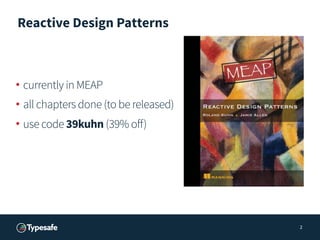
Reactive Design Patterns
• currently in MEAP
• all chapters done (to be released)
• use code 39kuhn (39% off)
2
Reactive?
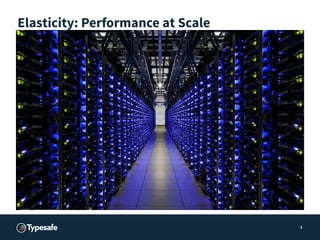
Elasticity: Performance at Scale
4
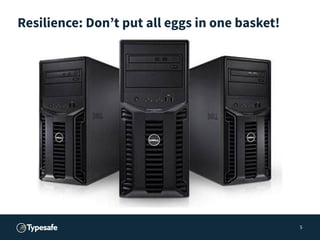
Resilience: Don’t put all eggs in one basket!
5
Result: Responsiveness
• elastic components that scale with their load
• responses in the presence of partial failures
6
Result: Decoupling
• containment of
• failures
• implementation details
• responsibility
• shared-nothing architecture, clear boundaries
• Microservices: Single Responsibility Principle
7
Result: Maintainability
• decoupled responsibility—decoupled teams
• develop pieces at their own pace
• continuous delivery
8
Implementation: Message-Driven
• focus on communication between components
• model message flows and protocols
• common transports: async HTTP, *MQ, Actors
9
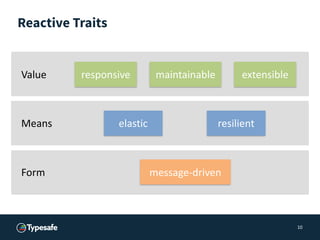
Reactive Traits
10
elastic resilient
responsive maintainable extensible
message:driven
Value
Means
Form
Architecture Patterns
Simple Component Pattern
12
«A component shall do only one thing,
but do it in full.»
Simple Component Pattern
• SingleResponsibilityPrinciple formulated by
DeMarco in «Structured analysis and system
specification» (Yourdon, New York, 1979)
• “maximize cohesion and minimize coupling”
• “a class should have only one reason to change”

(UncleBobMartin’sformulationforOOD)
13
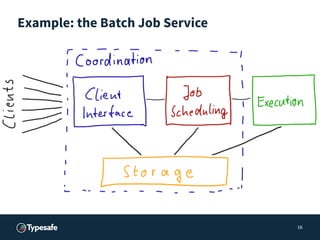
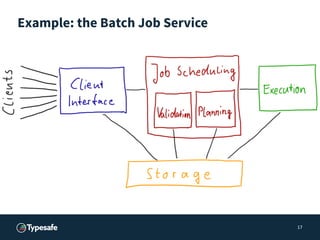
Example: the Batch Job Service
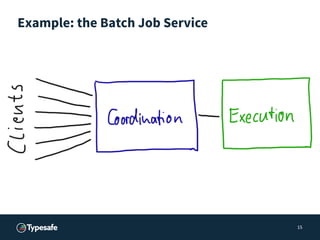
• users submit jobs
• planning and validation rules
• execution on elastic compute cluster
• users query job status and results
14
Example: the Batch Job Service
15
Example: the Batch Job Service
16
Example: the Batch Job Service
17
Let-It-Crash Pattern
18
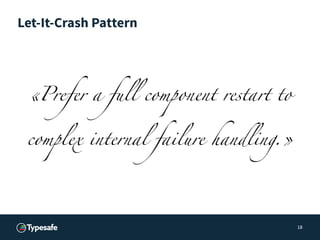
«Prefer a full component restart to
complex internal failure handling.»
Let-It-Crash Pattern
• Candea & Fox: “Crash-Only Software”

(USENIX HotOS IX, 2003)
• transient and rare failures are hard to detect and fix
• write component such that full restart is always o.k.
• simplified failure model leads to more reliability
19
Let-It-Crash Pattern
• Erlang philosophy from day one
• popularized by Netflix Chaos Monkey
• make sure that system is resilient by arbitrarily performing
recovery restarts
• exercise failure recovery code paths for real
• failure will happen, fault-avoidance is doomed
20
Implementation Patterns
Circuit Breaker Pattern
22
«Protect services by breaking the
connection during failure periods.»
Circuit Breaker Pattern
• well-known, inspired by electrical engineering
• first published by M. Nygard in «Release It!»
• protects both ways:
• allows client to avoid long failure timeouts
• gives service some breathing room to recover
23
Circuit Breaker Example
24
private object StorageFailed extends RuntimeException
private def sendToStorage(job: Job): Future[StorageStatus] = {
// make an asynchronous request to the storage subsystem
val f: Future[StorageStatus] = ???
// map storage failures to Future failures to alert the breaker
f.map {
case StorageStatus.Failed => throw StorageFailed
case other => other
}
}
private val breaker = CircuitBreaker(
system.scheduler, // used for scheduling timeouts
5, // number of failures in a row when it trips
300.millis, // timeout for each service call
30.seconds) // time before trying to close after tripping
def persist(job: Job): Future[StorageStatus] =
breaker
.withCircuitBreaker(sendToStorage(job))
.recover {
case StorageFailed => StorageStatus.Failed
case _: TimeoutException => StorageStatus.Unknown
case _: CircuitBreakerOpenException => StorageStatus.Failed
}
Saga Pattern
25
«Divide long-lived distributed
transactions into quick local ones with
compensating actions for recovery.»
Saga Pattern: Background
• Microservice Architecture means distribution of
knowledge, no more central database instance
• Pat Helland:
• “Life Beyond Distributed Transactions”, CIDR 2007
• “Memories, Guesses, and Apologies”, MSDN blog 2007
• What about transactions that affect multiple
microservices?
26
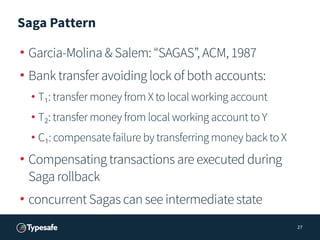
Saga Pattern
• Garcia-Molina & Salem: “SAGAS”, ACM, 1987
• Bank transfer avoiding lock of both accounts:
• T₁: transfer money from X to local working account
• T₂: transfer money from local working account to Y
• C₁: compensate failure by transferring money back to X
• Compensating transactions are executed during
Saga rollback
• concurrent Sagas can see intermediate state
27
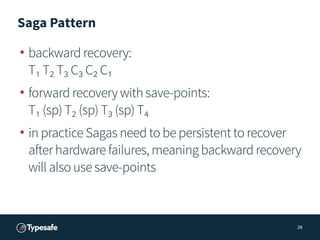
Saga Pattern
• backward recovery:

T₁ T₂ T₃ C₃ C₂ C₁
• forward recovery with save-points:

T₁ (sp) T₂ (sp) T₃ (sp) T₄
• in practice Sagas need to be persistent to recover
after hardware failures, meaning backward recovery
will also use save-points
28
Example: Bank Transfer
29
trait Account {
def withdraw(amount: BigDecimal, id: Long): Future[Unit]
def deposit(amount: BigDecimal, id: Long): Future[Unit]
}
case class Transfer(amount: BigDecimal, x: Account, y: Account)
sealed trait Event
case class TransferStarted(amount: BigDecimal, x: Account, y: Account) extends Event
case object MoneyWithdrawn extends Event
case object MoneyDeposited extends Event
case object RolledBack extends Event
Example: Bank Transfer
30
class TransferSaga(id: Long) extends PersistentActor {
import context.dispatcher
override val persistenceId: String = s"transaction-$id"
override def receiveCommand: PartialFunction[Any, Unit] = {
case Transfer(amount, x, y) =>
persist(TransferStarted(amount, x, y))(withdrawMoney)
}
def withdrawMoney(t: TransferStarted): Unit = {
t.x.withdraw(t.amount, id).map(_ => MoneyWithdrawn).pipeTo(self)
context.become(awaitMoneyWithdrawn(t.amount, t.x, t.y))
}
def awaitMoneyWithdrawn(amount: BigDecimal, x: Account, y: Account): Receive = {
case m @ MoneyWithdrawn => persist(m)(_ => depositMoney(amount, x, y))
}
...
}
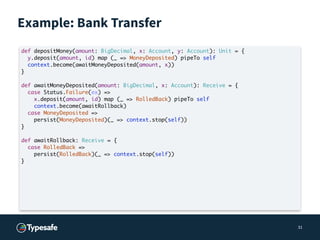
Example: Bank Transfer
31
def depositMoney(amount: BigDecimal, x: Account, y: Account): Unit = {
y.deposit(amount, id) map (_ => MoneyDeposited) pipeTo self
context.become(awaitMoneyDeposited(amount, x))
}
def awaitMoneyDeposited(amount: BigDecimal, x: Account): Receive = {
case Status.Failure(ex) =>
x.deposit(amount, id) map (_ => RolledBack) pipeTo self
context.become(awaitRollback)
case MoneyDeposited =>
persist(MoneyDeposited)(_ => context.stop(self))
}
def awaitRollback: Receive = {
case RolledBack =>
persist(RolledBack)(_ => context.stop(self))
}
Example: Bank Transfer
32
override def receiveRecover: PartialFunction[Any, Unit] = {
var start: TransferStarted = null
var last: Event = null
{
case t: TransferStarted => { start = t; last = t }
case e: Event => last = e
case RecoveryCompleted =>
last match {
case null => // wait for initialization
case t: TransferStarted => withdrawMoney(t)
case MoneyWithdrawn => depositMoney(start.amount, start.x, start.y)
case MoneyDeposited => context.stop(self)
case RolledBack => context.stop(self)
}
}
}
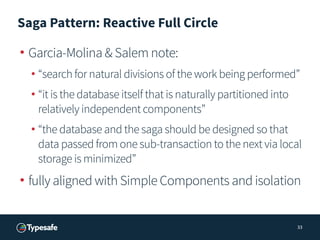
Saga Pattern: Reactive Full Circle
• Garcia-Molina & Salem note:
• “search for natural divisions of the work being performed”
• “it is the database itself that is naturally partitioned into
relatively independent components”
• “the database and the saga should be designed so that
data passed from one sub-transaction to the next via local
storage is minimized”
• fully aligned with Simple Components and isolation
33
Conclusion
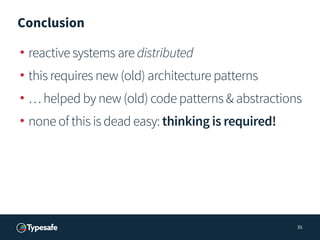
Conclusion
• reactive systems are distributed
• this requires new (old) architecture patterns
• … helped by new (old) code patterns & abstractions
• none of this is dead easy: thinking is required!
35
©Typesafe 2015 – All Rights Reserved

Reactive Design Patterns

  • 1.
    Reactive Design Patterns Dr.Roland Kuhn @rolandkuhn — Akka Tech Lead
  • 2.
    Reactive Design Patterns •currently in MEAP • all chapters done (to be released) • use code 39kuhn (39% off) 2
  • 3.
  • 4.
  • 5.
    Resilience: Don’t putall eggs in one basket! 5
  • 6.
    Result: Responsiveness • elasticcomponents that scale with their load • responses in the presence of partial failures 6
  • 7.
    Result: Decoupling • containmentof • failures • implementation details • responsibility • shared-nothing architecture, clear boundaries • Microservices: Single Responsibility Principle 7
  • 8.
    Result: Maintainability • decoupledresponsibility—decoupled teams • develop pieces at their own pace • continuous delivery 8
  • 9.
    Implementation: Message-Driven • focuson communication between components • model message flows and protocols • common transports: async HTTP, *MQ, Actors 9
  • 10.
    Reactive Traits 10 elastic resilient responsivemaintainable extensible message:driven Value Means Form
  • 11.
  • 12.
    Simple Component Pattern 12 «Acomponent shall do only one thing, but do it in full.»
  • 13.
    Simple Component Pattern •SingleResponsibilityPrinciple formulated by DeMarco in «Structured analysis and system specification» (Yourdon, New York, 1979) • “maximize cohesion and minimize coupling” • “a class should have only one reason to change”
 (UncleBobMartin’sformulationforOOD) 13
  • 14.
    Example: the BatchJob Service • users submit jobs • planning and validation rules • execution on elastic compute cluster • users query job status and results 14
  • 15.
    Example: the BatchJob Service 15
  • 16.
    Example: the BatchJob Service 16
  • 17.
    Example: the BatchJob Service 17
  • 18.
    Let-It-Crash Pattern 18 «Prefer afull component restart to complex internal failure handling.»
  • 19.
    Let-It-Crash Pattern • Candea& Fox: “Crash-Only Software”
 (USENIX HotOS IX, 2003) • transient and rare failures are hard to detect and fix • write component such that full restart is always o.k. • simplified failure model leads to more reliability 19
  • 20.
    Let-It-Crash Pattern • Erlangphilosophy from day one • popularized by Netflix Chaos Monkey • make sure that system is resilient by arbitrarily performing recovery restarts • exercise failure recovery code paths for real • failure will happen, fault-avoidance is doomed 20
  • 21.
  • 22.
    Circuit Breaker Pattern 22 «Protectservices by breaking the connection during failure periods.»
  • 23.
    Circuit Breaker Pattern •well-known, inspired by electrical engineering • first published by M. Nygard in «Release It!» • protects both ways: • allows client to avoid long failure timeouts • gives service some breathing room to recover 23
  • 24.
    Circuit Breaker Example 24 privateobject StorageFailed extends RuntimeException private def sendToStorage(job: Job): Future[StorageStatus] = { // make an asynchronous request to the storage subsystem val f: Future[StorageStatus] = ??? // map storage failures to Future failures to alert the breaker f.map { case StorageStatus.Failed => throw StorageFailed case other => other } } private val breaker = CircuitBreaker( system.scheduler, // used for scheduling timeouts 5, // number of failures in a row when it trips 300.millis, // timeout for each service call 30.seconds) // time before trying to close after tripping def persist(job: Job): Future[StorageStatus] = breaker .withCircuitBreaker(sendToStorage(job)) .recover { case StorageFailed => StorageStatus.Failed case _: TimeoutException => StorageStatus.Unknown case _: CircuitBreakerOpenException => StorageStatus.Failed }
  • 25.
    Saga Pattern 25 «Divide long-liveddistributed transactions into quick local ones with compensating actions for recovery.»
  • 26.
    Saga Pattern: Background •Microservice Architecture means distribution of knowledge, no more central database instance • Pat Helland: • “Life Beyond Distributed Transactions”, CIDR 2007 • “Memories, Guesses, and Apologies”, MSDN blog 2007 • What about transactions that affect multiple microservices? 26
  • 27.
    Saga Pattern • Garcia-Molina& Salem: “SAGAS”, ACM, 1987 • Bank transfer avoiding lock of both accounts: • T₁: transfer money from X to local working account • T₂: transfer money from local working account to Y • C₁: compensate failure by transferring money back to X • Compensating transactions are executed during Saga rollback • concurrent Sagas can see intermediate state 27
  • 28.
    Saga Pattern • backwardrecovery:
 T₁ T₂ T₃ C₃ C₂ C₁ • forward recovery with save-points:
 T₁ (sp) T₂ (sp) T₃ (sp) T₄ • in practice Sagas need to be persistent to recover after hardware failures, meaning backward recovery will also use save-points 28
  • 29.
    Example: Bank Transfer 29 traitAccount { def withdraw(amount: BigDecimal, id: Long): Future[Unit] def deposit(amount: BigDecimal, id: Long): Future[Unit] } case class Transfer(amount: BigDecimal, x: Account, y: Account) sealed trait Event case class TransferStarted(amount: BigDecimal, x: Account, y: Account) extends Event case object MoneyWithdrawn extends Event case object MoneyDeposited extends Event case object RolledBack extends Event
  • 30.
    Example: Bank Transfer 30 classTransferSaga(id: Long) extends PersistentActor { import context.dispatcher override val persistenceId: String = s"transaction-$id" override def receiveCommand: PartialFunction[Any, Unit] = { case Transfer(amount, x, y) => persist(TransferStarted(amount, x, y))(withdrawMoney) } def withdrawMoney(t: TransferStarted): Unit = { t.x.withdraw(t.amount, id).map(_ => MoneyWithdrawn).pipeTo(self) context.become(awaitMoneyWithdrawn(t.amount, t.x, t.y)) } def awaitMoneyWithdrawn(amount: BigDecimal, x: Account, y: Account): Receive = { case m @ MoneyWithdrawn => persist(m)(_ => depositMoney(amount, x, y)) } ... }
  • 31.
    Example: Bank Transfer 31 defdepositMoney(amount: BigDecimal, x: Account, y: Account): Unit = { y.deposit(amount, id) map (_ => MoneyDeposited) pipeTo self context.become(awaitMoneyDeposited(amount, x)) } def awaitMoneyDeposited(amount: BigDecimal, x: Account): Receive = { case Status.Failure(ex) => x.deposit(amount, id) map (_ => RolledBack) pipeTo self context.become(awaitRollback) case MoneyDeposited => persist(MoneyDeposited)(_ => context.stop(self)) } def awaitRollback: Receive = { case RolledBack => persist(RolledBack)(_ => context.stop(self)) }
  • 32.
    Example: Bank Transfer 32 overridedef receiveRecover: PartialFunction[Any, Unit] = { var start: TransferStarted = null var last: Event = null { case t: TransferStarted => { start = t; last = t } case e: Event => last = e case RecoveryCompleted => last match { case null => // wait for initialization case t: TransferStarted => withdrawMoney(t) case MoneyWithdrawn => depositMoney(start.amount, start.x, start.y) case MoneyDeposited => context.stop(self) case RolledBack => context.stop(self) } } }
  • 33.
    Saga Pattern: ReactiveFull Circle • Garcia-Molina & Salem note: • “search for natural divisions of the work being performed” • “it is the database itself that is naturally partitioned into relatively independent components” • “the database and the saga should be designed so that data passed from one sub-transaction to the next via local storage is minimized” • fully aligned with Simple Components and isolation 33
  • 34.
  • 35.
    Conclusion • reactive systemsare distributed • this requires new (old) architecture patterns • … helped by new (old) code patterns & abstractions • none of this is dead easy: thinking is required! 35
  • 36.
    ©Typesafe 2015 –All Rights Reserved