Product Structure*Overview
May 2010
No part of this document may be reproduced. Datamine may have patent applications, trademarks, copyrights or other
intellectual property rights in this document. This document does not give you any license to these patents, trademarks,
copyrights, or other intellectual property. Datamine is a registered trademark. ‘use.your.data’ is a registered trademark
Competition Analysis System
CAS v3.0 Product Structure pg. 2 http://www.datamine.gr
1 CAS - Introduction
Datamine’s Competition Analysis System (CAS) is a sophisticated, highly engineered data
processing and visualization platform providing outstanding analytical capabilities to telecom
decision makers, such as:
- the design of customer retention strategies and pricing policies
- the development of innovative products
- the assessment of tariff performance, internally or against competition
- the compilation of business cases to support candidate products
In all of above cases, CAS provides robust answers through single click sequences.
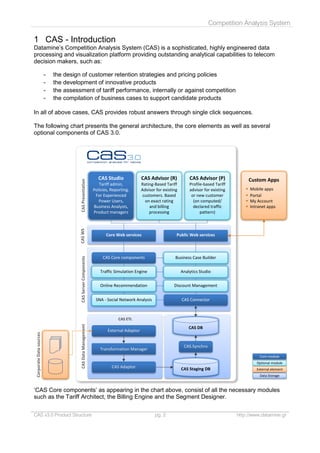
The following chart presents the general architecture, the core elements as well as several
optional components of CAS 3.0.
‘CAS Core components’ as appearing in the chart above, consist of all the necessary modules
such as the Tariff Architect, the Billing Engine and the Segment Designer.
CAS DB
CAS Staging DB
CAS.Synchro
CAS ETL
External Adaptor
CAS Adaptor
Transformation Manager
CAS Core components
Traffic Simulation Engine
Business Case Builder
Analytics Studio
Online Recommendation Discount Management
CASServerComponents
CAS Connector
CASDataManagement
Core Web services Public Web services
CASPresentation
CAS Studio
Tariff admin,
Policies, Reporting.
For Experienced
Power Users,
Business Analysts,
Product managers
CAS Advisor (R)
Rating-Based Tariff
Advisor for existing
customers. Based
on exact rating
and billing
processing
CAS Advisor (P)
Profile-based Tariff
advisor for existing
or new customer
(on computed/
declared traffic
pattern)
CASWS
CorporateDatasources
Custom Apps
 Mobile apps
 Portal
 My Account
 Intranet apps
SNA - Social Network Analysis
Optional module
Core module
Data Storage
External element
Competition Analysis System
CAS v3.0 Product Structure pg. 3 http://www.datamine.gr
2 CAS Product Structure
The following table presents all the distinct components/ service packages of CAS.
ID Component
#01 Infrastructure + CAS Studio
This is the core platform consisting of all server components + CAS Studio. Includes all tools for
tariff creation and administration, customer base analysis, segment & policy definition, analysis
and management, basic reporting and analytics.
This is an autonomous, minimal edition of CAS, a prerequisite for all other CAS components. For
experienced power users, business analysts, product managers.
#02 CAS Advisor (R)
Intranet application for POS/ Agents, dealing with owned (existing) customers. This component
serves agents with a tariff negotiation framework for existing customers according to active
corporate policies. This is an optional component.
#03 CAS Advisor (P)
Intranet application for POS/ Agents, dealing with candidate (competitor) customers based on
traffic patterns. This is an optional component.
#04 Analytics Studio
This is an optional component offering sophisticated, interactive, OLAP-based analytics against
tariff performance and customer data.
A powerful cube exposes numerous customer, billing and tariff related metrics to the business
users, through drag-n-drop operations and instant response. Additional features such as Drill
Down, Drill Through and integration with MS-Excel ensure an outstanding customer analysis
experience.
#05 Business Case Builder
This advanced module enables business users to define complex comparison scenarios and
business cases. For instance, a wizard like process enables the definition of a complete scenario
through a set of simple steps:
- Customer Analysis Groups: Business users may define complex set of customers
(including balanced random samples against existing segmentation schemes), save,
share and administer groups for repeating analysis or reference/ baseline
- Perform Customer Group Profiling through standardized analysis templates.
- Define assumptions to be used for analysis and impact estimation (such as transition
rates towards certain tariffs, churn rates or expected traffic impact)
- Define the Output to be generated: define level of detail (top x tariffs per customer, all
commercially available tariffs per customer, policy outcome per customer etc)
- Analyze the results (or export customer-level comparison results for further external
processing)
Competition Analysis System
CAS v3.0 Product Structure pg. 4 http://www.datamine.gr
- Schedule Execution of certain analysis packs as repeating tasks and get notified when
completed
The main usage scenarios are:
- Policy Evaluation Studies: This type of analysis involves the evaluation of a certain
policy A generating tariff proposals to customers of certain type (for instance consumers,
of top tenure, high traffic to competitors) against a new, alternative policy B. In this case,
under certain business assumptions, the system generates detailed comparison report
with impact figures/ estimates in several levels, thus providing a straightforward,
quantitative comparison of strategies A & B.
- Tariff Evaluation Studies: The business user analyzes the performance of a candidate,
hypothetical or under release tariff: defines the tariff in CAS, designs the profile of
customers expected to be interested, makes reasonable assumptions on transition rates
from existing tariff to the new offering and generates a detailed impact analysis report, to
be used as a baseline for setting the performance expectations for the candidate tariff.
- User-defined Bill Cycle Executions: the business user defines the target set of
customers (or selects one of the existing, named customer groups), selects the tariffs to
participate in the analysis, determines time frame and any additional output configuration
and submits the Custom Billing request. The system triggers the billing engine for this
specific request, and produces a local file with the detailed results (billing output or policy
output per MSISDN) for further analysis or data feeding (for instance analysis in an
external data mining package, or feed towards the campaign management system in
use).
#06 Traffic Simulation Engine
Specialized tools enabling sensitivity analysis, tariff configuration impact estimators as well as
CDR simulation tools (generation of user-defined sets of CDRs following customizable traffic
patterns).
#07 SNA – Social Network Analysis
Advanced traffic modeling enabling the identification of clusters of ‘connected’ customers
(cliques), the role of each customer within its clique (‘opinion leader’ etc) along with a set of SNA
related metrics.
The output of this component is directly available to CAS components, thus boosting customer
analysis & handling capabilities (for instance use Segment Designer for SNA-related customer
filtering and segment/policy definition). This is an optional component.
#08 Online Recommendation engine (web)
Advanced component enabling integration with corporate portal, under ‘myaccount’ section.
#09 Discount Management system
Advanced module enabling the definition, management and performance analysis of
personalized discount models.
Competition Analysis System
CAS v3.0 Product Structure pg. 5 http://www.datamine.gr
3 Subscription services
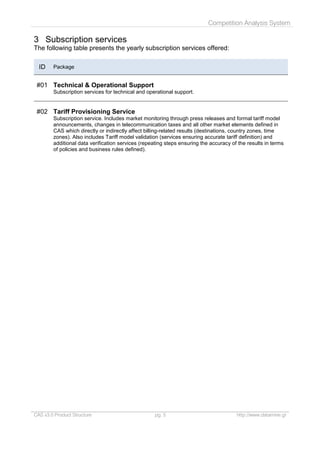
The following table presents the yearly subscription services offered:
ID Package
#01 Technical & Operational Support
Subscription services for technical and operational support.
#02 Tariff Provisioning Service
Subscription service. Includes market monitoring through press releases and formal tariff model
announcements, changes in telecommunication taxes and all other market elements defined in
CAS which directly or indirectly affect billing-related results (destinations, country zones, time
zones). Also includes Tariff model validation (services ensuring accurate tariff definition) and
additional data verification services (repeating steps ensuring the accuracy of the results in terms
of policies and business rules defined).
Competition Analysis System
CAS v3.0 Product Structure pg. 6 http://www.datamine.gr
Contact information
George Krasadakis
Head of engineering & product
development
datamine ltd
Decision support systems
22 Ethnikis Antistasis avenue
15232 Halandri
Athens, Greece
Tel: 0030 210 6899960
Fax: 0030 210 6899968
www.datamine.gr
info@datamine.gr
No part of this document may be reproduced. Datamine may have patent applications, trademarks, copyrights or other
intellectual property rights in this document. This document does not give you any license to these patents, trademarks,
copyrights, or other intellectual property. Datamine is a registered trademark. ‘use.your.data’ is a registered trademark.

Datamine - CAS: Competition Analysis, for Telcos

  • 1.
    Product Structure*Overview May 2010 Nopart of this document may be reproduced. Datamine may have patent applications, trademarks, copyrights or other intellectual property rights in this document. This document does not give you any license to these patents, trademarks, copyrights, or other intellectual property. Datamine is a registered trademark. ‘use.your.data’ is a registered trademark
  • 2.
    Competition Analysis System CASv3.0 Product Structure pg. 2 http://www.datamine.gr 1 CAS - Introduction Datamine’s Competition Analysis System (CAS) is a sophisticated, highly engineered data processing and visualization platform providing outstanding analytical capabilities to telecom decision makers, such as: - the design of customer retention strategies and pricing policies - the development of innovative products - the assessment of tariff performance, internally or against competition - the compilation of business cases to support candidate products In all of above cases, CAS provides robust answers through single click sequences. The following chart presents the general architecture, the core elements as well as several optional components of CAS 3.0. ‘CAS Core components’ as appearing in the chart above, consist of all the necessary modules such as the Tariff Architect, the Billing Engine and the Segment Designer. CAS DB CAS Staging DB CAS.Synchro CAS ETL External Adaptor CAS Adaptor Transformation Manager CAS Core components Traffic Simulation Engine Business Case Builder Analytics Studio Online Recommendation Discount Management CASServerComponents CAS Connector CASDataManagement Core Web services Public Web services CASPresentation CAS Studio Tariff admin, Policies, Reporting. For Experienced Power Users, Business Analysts, Product managers CAS Advisor (R) Rating-Based Tariff Advisor for existing customers. Based on exact rating and billing processing CAS Advisor (P) Profile-based Tariff advisor for existing or new customer (on computed/ declared traffic pattern) CASWS CorporateDatasources Custom Apps  Mobile apps  Portal  My Account  Intranet apps SNA - Social Network Analysis Optional module Core module Data Storage External element
  • 3.
    Competition Analysis System CASv3.0 Product Structure pg. 3 http://www.datamine.gr 2 CAS Product Structure The following table presents all the distinct components/ service packages of CAS. ID Component #01 Infrastructure + CAS Studio This is the core platform consisting of all server components + CAS Studio. Includes all tools for tariff creation and administration, customer base analysis, segment & policy definition, analysis and management, basic reporting and analytics. This is an autonomous, minimal edition of CAS, a prerequisite for all other CAS components. For experienced power users, business analysts, product managers. #02 CAS Advisor (R) Intranet application for POS/ Agents, dealing with owned (existing) customers. This component serves agents with a tariff negotiation framework for existing customers according to active corporate policies. This is an optional component. #03 CAS Advisor (P) Intranet application for POS/ Agents, dealing with candidate (competitor) customers based on traffic patterns. This is an optional component. #04 Analytics Studio This is an optional component offering sophisticated, interactive, OLAP-based analytics against tariff performance and customer data. A powerful cube exposes numerous customer, billing and tariff related metrics to the business users, through drag-n-drop operations and instant response. Additional features such as Drill Down, Drill Through and integration with MS-Excel ensure an outstanding customer analysis experience. #05 Business Case Builder This advanced module enables business users to define complex comparison scenarios and business cases. For instance, a wizard like process enables the definition of a complete scenario through a set of simple steps: - Customer Analysis Groups: Business users may define complex set of customers (including balanced random samples against existing segmentation schemes), save, share and administer groups for repeating analysis or reference/ baseline - Perform Customer Group Profiling through standardized analysis templates. - Define assumptions to be used for analysis and impact estimation (such as transition rates towards certain tariffs, churn rates or expected traffic impact) - Define the Output to be generated: define level of detail (top x tariffs per customer, all commercially available tariffs per customer, policy outcome per customer etc) - Analyze the results (or export customer-level comparison results for further external processing)
  • 4.
    Competition Analysis System CASv3.0 Product Structure pg. 4 http://www.datamine.gr - Schedule Execution of certain analysis packs as repeating tasks and get notified when completed The main usage scenarios are: - Policy Evaluation Studies: This type of analysis involves the evaluation of a certain policy A generating tariff proposals to customers of certain type (for instance consumers, of top tenure, high traffic to competitors) against a new, alternative policy B. In this case, under certain business assumptions, the system generates detailed comparison report with impact figures/ estimates in several levels, thus providing a straightforward, quantitative comparison of strategies A & B. - Tariff Evaluation Studies: The business user analyzes the performance of a candidate, hypothetical or under release tariff: defines the tariff in CAS, designs the profile of customers expected to be interested, makes reasonable assumptions on transition rates from existing tariff to the new offering and generates a detailed impact analysis report, to be used as a baseline for setting the performance expectations for the candidate tariff. - User-defined Bill Cycle Executions: the business user defines the target set of customers (or selects one of the existing, named customer groups), selects the tariffs to participate in the analysis, determines time frame and any additional output configuration and submits the Custom Billing request. The system triggers the billing engine for this specific request, and produces a local file with the detailed results (billing output or policy output per MSISDN) for further analysis or data feeding (for instance analysis in an external data mining package, or feed towards the campaign management system in use). #06 Traffic Simulation Engine Specialized tools enabling sensitivity analysis, tariff configuration impact estimators as well as CDR simulation tools (generation of user-defined sets of CDRs following customizable traffic patterns). #07 SNA – Social Network Analysis Advanced traffic modeling enabling the identification of clusters of ‘connected’ customers (cliques), the role of each customer within its clique (‘opinion leader’ etc) along with a set of SNA related metrics. The output of this component is directly available to CAS components, thus boosting customer analysis & handling capabilities (for instance use Segment Designer for SNA-related customer filtering and segment/policy definition). This is an optional component. #08 Online Recommendation engine (web) Advanced component enabling integration with corporate portal, under ‘myaccount’ section. #09 Discount Management system Advanced module enabling the definition, management and performance analysis of personalized discount models.
  • 5.
    Competition Analysis System CASv3.0 Product Structure pg. 5 http://www.datamine.gr 3 Subscription services The following table presents the yearly subscription services offered: ID Package #01 Technical & Operational Support Subscription services for technical and operational support. #02 Tariff Provisioning Service Subscription service. Includes market monitoring through press releases and formal tariff model announcements, changes in telecommunication taxes and all other market elements defined in CAS which directly or indirectly affect billing-related results (destinations, country zones, time zones). Also includes Tariff model validation (services ensuring accurate tariff definition) and additional data verification services (repeating steps ensuring the accuracy of the results in terms of policies and business rules defined).
  • 6.
    Competition Analysis System CASv3.0 Product Structure pg. 6 http://www.datamine.gr Contact information George Krasadakis Head of engineering & product development datamine ltd Decision support systems 22 Ethnikis Antistasis avenue 15232 Halandri Athens, Greece Tel: 0030 210 6899960 Fax: 0030 210 6899968 www.datamine.gr info@datamine.gr No part of this document may be reproduced. Datamine may have patent applications, trademarks, copyrights or other intellectual property rights in this document. This document does not give you any license to these patents, trademarks, copyrights, or other intellectual property. Datamine is a registered trademark. ‘use.your.data’ is a registered trademark.