Data Management
Strategy 2019-2022
Data Management Strategy is the
process of creating a plan to handle
the data created, stored, managed and
processed by an organization.
1. Executive Summary������������������������������������������������������������������������������������������������������������������������������������������� 03
2. Data Management Strategy Overview������������������������������������������������������������������������������������������������������������� 04
3. Data Governance Structure ����������������������������������������������������������������������������������������������������������������������������� 05
4. Data Management and IT Governance����������������������������������������������������������������������������������������������������������� 07
5. Data Governance Framework��������������������������������������������������������������������������������������������������������������������������� 08
6. Data Management Strategy����������������������������������������������������������������������������������������������������������������������������� 09
7. Exective Road Map ������������������������������������������������������������������������������������������������������������������������������������������� 10
8. Contact Us��������������������������������������������������������������������������������������������������������������������������������������������������������� 11
TABLE OF CONTENTS
Information  Technology Services
Executive Summary
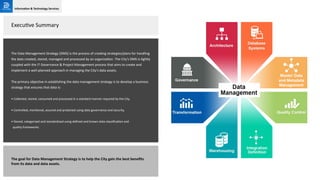
The Data Management Strategy (DMS) is the process of creating strategies/plans for handling
the data created, stored, managed and processed by an organization. The City’s DMS is tightly
coupled with the IT Governance  Project Management process that aims to create and
implement a well-planned approach in managing the City’s data assets.
The primary objective in establishing the data management strategy is to develop a business
strategy that ensures that data is:
• Collected, stored, consumed and processed in a standard manner required by the City.
• Controlled, monitored, assured and protected using data governance and security.
• Stored, categorized and standardized using defined and known data classification and
quality frameworks
The goal for Data Management Strategy is to help the City gain the best benefits
from its data and data assets.
Information  Technology Services
Organizations make decisions about how they engage with, operate on and leverage their data - at an enterprise or project level.
Organizations that form a holistic point of view in adopting an enterprise-grade data strategy are well positioned to optimize their
technology investments and lower their costs. Such a strategy treats data as an asset from which valuable insights can be derived.
These insights can be used to gain a competitive advantage by being integrated into business operations.
The City of Dallas aims for a smooth transition to becoming data driven — aligning operational decisions to the systematic (and
automatic as much as possible) interpretation of data needs a plan for advancing its digital transformation journey and treating
data as an asset. The COD data management strategy (DMS) is the first step toward enabling such a plan and increasing the City’s
Analytics IQ.
A DMS ensures that all data initiatives follow a common method and structure that is repeatable. This uniformity enables efficient
communication throughout the enterprise for rationalizing and defining all solution designs that leverage data in some manner.
Creating a data strategy is both achievable and valuable. It’s also an essential component of the City’s digital transformation journey.
Common drivers for an effective DMS:
• Unification of Department and IT perspectives. A
common data strategy ensures that the department and
IT organizations are positioned as joint leaders of the
company’s direction by understanding each other’s needs,
capabilities and priorities.
• Enterprise-wide alignment of vision and guidance on
leveraging data as an asset. Such alignment, captured
in a data strategy, ensures that different groups in the
enterprise view data-related capabilities with consistency,
which reduces redundancy and confusion.
• Definition of key metrics and success criteria across
the enterprise. The data strategy defines “success” and
“quality,” thus reinforcing consistency for how initiatives
are measured, evaluated `and tracked across all levels of
interacting organizations.
Data Management Strategy Overview
Information  Technology Services
E
S
C
A
L
A
T
I
O
N
I
M
P
L
E
M
E
N
T
A
T
I
O
N
Execu�ve
Leadership
Data Governance Board
Execu�ve Directors
Data Stewards Workshops*
People working with data on a daily basis
Policy Advisory Commi�ees
Internal  External Stakeholders
External Advisory Commi�ees
Agency Cons�tuants  Data End Users
Changes to
a Collec�on
Process
Data
Standards
Research
and
Analy�cs
Access
Policies
From the execution side, an established Data governance touches every part of the data
management process down to the individual technologies, databases and data models. The
governance process also affects the processes people use to create and retain data and how these
rules are replicated within applications to help make smarter decisions faster.
The effective part about a data governance is that the City never has to start from scratch and
there are typically pockets of data governance underway, and new efforts can tap into those to find
leaders, supporters and advocates.
Figure DGS 1 is the high-level layout of the data governance committee structure. Escalation
flows up the pyramid with the executive leadership having decision-making authority, and
implementation flows down the pyramid with the data stewards being the subject matter experts
and best suited to implement processes and changes to data.
This structure allows the City to clearly identify decision-making authority at all levels.
FIGURE DGS 1
Data Governance Structure
Information  Technology Services
Why do Data Management?
Data Management helps with a tighter information control that builds opportunities and reduces risks
of data breaches, privacy violation, distributing bad data.
• Information quality - Having enterprise wide data standards, definitions and coordinated effort will
improve data quality.
• Ability to integrate - Well-defined data management processes allow an organization to be
proactive and integrate with organizational changes or developments at a reduced cost and with
limited burden.
• Performance management and business intelligence - Defining clear ownership of data,
controlling data quality and implementing data management will reduce the costs and complexity of
performance management and business intelligence.
• Establish new rules and processes - Creating and implementing standard, formalized rules and
processes is key to ensuring data are trusted, secure and ultimately fit for business usage.
• Align or modify the existing rules and processes - Assessing existing rules and processes to ensure
they are accomplishing the purpose intended and modifying them if needed.
• Richer data environment and regulatory compliance - Overall, data governance leads to a richer
data environment and ensures regulatory compliance
DATA
INFORM
“What happened?”
1.
EXPLORE
“Why did it happen?”
INFORMATION
2.
PREDICTIVE
“What will happen next?”
KNOWLEDGE
3.
PRESCRIPTIVE
“What’s the best we can do?”
WISDOM
(Scenario Planning)
4.
Information  Technology Services
DATA MANAGEMENT
PROJECT
MANAGEMENT
Strategic
Alignment
Value
Delivery
Risk
Management
Performance
Management
Resource
Management
IT
GOVERNANCE
Data Management complements Project Management. Both exist under the overarching structure of IT governance.
• Project Management focuses on defining a portfolio of investments, setting performance objectives, and evaluating and managing
risk for IT projects.
• Data Management focuses on creating a structure enabling an organization to align data efforts to business objectives, to support
regulatory compliance and to manage risks associated with data.
Data Management and IT Governance
• IT governance is the overarching structure that focuses on IT infrastructure, including managing resources and risks, to ensure IT
efforts and solutions align with the City’s mission and business goals.
To borrow an analogy commonly used by the data management community: IT governance focuses on the pipelines in the
organization’s IT infrastructure, data and project management focus on the water that flows through those pipelines.
Information  Technology Services
Data Governance Framework
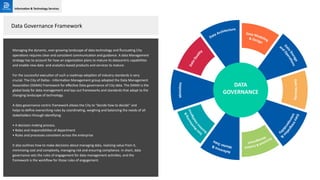
Managing the dynamic, ever-growing landscape of data technology and fluctuating City
operations requires clear and consistent communication and guidance. A data Management
strategy has to account for how an organization plans to mature its datacentric capabilities
and enable new data- and analytics-based products and services to mature.
For the successful execution of such a roadmap adoption of industry standards is very
crucial. The City of Dallas - Information Management group adopted the Data Management
Association (DAMA) Framework for effective Data governance of City data. The DAMA is the
global body for data management and lays out frameworks and standards that adopt to the
changing landscape of technology.
A data governance centric framework allows the City to “decide how to decide” and
helps to define overarching rules by coordinating, weighing and balancing the needs of all
stakeholders through identifying:
• A decision-making process.
• Roles and responsibilities of department
• Rules and processes consistent across the enterprise
It also outlines how to make decisions about managing data, realizing value from it,
minimizing cost and complexity, managing risk and ensuring compliance. In short, data
governance sets the rules of engagement for data management activities, and the
framework is the workflow for those rules of engagement.
D
a
t
a
Q
u
a
l
i
t
y
D
o
c
u
m
e
n
t

C
o
n
t
e
n
t
D
a
t
a
S
e
c
u
r
i
t
y
Data Modeling
 Design
D
a
t
a
S
t
o
r
a
g
e
M
e
t
a
d
a
t
a
Data Architecture
DATA
GOVERNANCE
an
d
O
p
e
r
a
�
o
n
s
D
a
t
a
I
n
t
e
g
r
a
�
o
n

I
n
t
e
r
o
p
e
r
a
b
i
l
i
t
y
M
a
n
a
g
e
m
e
n
t
R
e
f
e
r
e
n
c
e
 M
a
s
t
e
r
D
a
t
a
D
a
t
a
W
a
r
e
h
o
u
s
i
n
g

B
u
s
i
n
e
s
s
I
n
t
e
l
l
i
g
e
n
c
e
Information  Technology Services
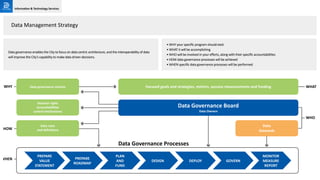
Data governance enables the City to focus on data centric architecture, and the interoperability of data
will improve the City’s capability to make data driven decisions.
• WHY your specific program should exist
• WHAT it will be accomplishing
• WHO will be involved in your efforts, along with their specific accountabilities
• HOW data governance processes will be achieved
• WHEN specific data governance processes will be performed
Data Management Strategy
Data governance mission Focused goals and strategies, metrics, success measurements and funding
Data
Stewards
Data Governance Board
Data Owners
Data Governance Processes
WHY
WHEN
HOW
WHAT
WHO
Decision rights
accountabili�es
control mechanisms
Data rules
and defini�ons
PREPARE
VALUE
STATEMENT
PREPARE
ROADMAP
PLAN
AND
FUND
DEPLOY GOVERN
MONITOR
MEASURE
REPORT
DESIGN
Information  Technology Services
Executive Road Map
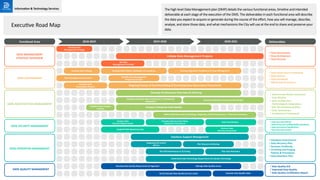
The high level Data Management plan (DMP) details the various functional areas, timeline and intended
deliverable at each stage of the execution of the DMS. The deliverables in each functional area will describe
the data you expect to acquire or generate during the course of the effort, how you will manage, describe,
analyze, and store those data, and what mechanisms the City will use at the end to share and preserve your
data.
2018-2019 2019-2020 2020-2021
Func�onal Area
DATA MANAGEMENT
STRATEGY OVERVIEW
DATA GOVERNANCE
Deliverables
Develop Data
Management Strategy
Ini�ate Data Management Projects
Set Data
Management Priori�es
✓ Data Governance
✓ Data Architecture
✓ Data Services
Develop Data Strategy
Data Management Discussion Iden�fy Data Management
Projects  Services
Develop Data Policies, Standards,  Procedures Develop Regulatory Compliance  Issue Management
Establish Data
Governance Process
Ongoing Process of Communica�ng  Promo�ng Data Governance Framework
Develop Architectural Overview  Planning
Database Support Management
Analyze Enterprise Data Needs
Develop Enterprise Data Architecture / Architectural
Framework
Define  Maintain Data Technology, Integra�on, DW-BI Architecture + Enterprise Taxonomy
Establish Data Analysis
Process
Develop  Maintain Enterprise Data Model
✓ Data Governance Framework
✓ Data Policies
✓ Data Standards
✓ DM Project  Services
✓ Government Needs Document
✓ Data Models
✓ Data Architecture
(Technology  Integra�on)
✓ DW /BI Architecture/Plan
✓ Data Taxonomies
✓ Architectural Framework
✓ Database Environment
✓ Data Recovery Plan
✓ Business Con�nuity
✓ Archiving and Purging
Policies  Procedures
✓ Data Reten�on Plan
✓ Data Quality SLA
✓ Improved Data Quality
✓ Data Quality Cer�fica�on Report
✓ Data Security Policies
✓ Data Privacy  Confiden�ality Standards
✓ Data Document Classifica�on
✓ Data Security Control
DATA ARCHITECTURE MANAGMENT
DATA SECURITY MANAGMENT
DATA OPERATION MANAGMENT
DATA QUALITY MANAGMENT
Analyze Data
Security Requirements
Establish Role-Based Security
Implement  Control
DB Env
Plan DB Performance SL  Tuning
Understand Data Technology Requirement  Evaluate Technology
Plan Data Reten�on
Plan Recovery  Backup
Develop Data Security Policy,
Standard  Procedures
Data Classifica�on
Perform Data
Security Assessment
Develop Data Quality Requirement  Approach Manage Data Quality Issues
Set  Evaluate Data Quality Service Levels Evaluate Data Quality Tools
Information  Technology Services
CONTACT US
References:
The following websites were useful in drafting the details related to the development of the City of
Dallas – Data Management Strategy.
DAMA Book of Knowledge:
https://dama.org/sites/default/files/download/DAMA-DMBOK2-Framework-V2-20140317-FINAL.pdf
City of Dallas - Technology+ Strategic Plan:
https://dallascityhall.com/departments/ciservices/DCH%20Documents/City-of-Dallas-
Technology+StrategicPlan.pdf
City of Dallas – Enterprise Architecture:
https://dallascityhall.com/departments/ciservices/Pages/enterprise-architecture.aspx
City of Dallas Data Hub:
https://dallascityhall.com/Pages/Dallas-Datahub.aspx
If you have questions or comments regarding this document, please
contact us: ITStrategy@dallascityhall.com
Information  Technology Services

data-management-strategy data-management-strategy

  • 1.
  • 2.
    Data Management Strategyis the process of creating a plan to handle the data created, stored, managed and processed by an organization. 1. Executive Summary������������������������������������������������������������������������������������������������������������������������������������������� 03 2. Data Management Strategy Overview������������������������������������������������������������������������������������������������������������� 04 3. Data Governance Structure ����������������������������������������������������������������������������������������������������������������������������� 05 4. Data Management and IT Governance����������������������������������������������������������������������������������������������������������� 07 5. Data Governance Framework��������������������������������������������������������������������������������������������������������������������������� 08 6. Data Management Strategy����������������������������������������������������������������������������������������������������������������������������� 09 7. Exective Road Map ������������������������������������������������������������������������������������������������������������������������������������������� 10 8. Contact Us��������������������������������������������������������������������������������������������������������������������������������������������������������� 11 TABLE OF CONTENTS Information Technology Services
  • 3.
    Executive Summary The DataManagement Strategy (DMS) is the process of creating strategies/plans for handling the data created, stored, managed and processed by an organization. The City’s DMS is tightly coupled with the IT Governance Project Management process that aims to create and implement a well-planned approach in managing the City’s data assets. The primary objective in establishing the data management strategy is to develop a business strategy that ensures that data is: • Collected, stored, consumed and processed in a standard manner required by the City. • Controlled, monitored, assured and protected using data governance and security. • Stored, categorized and standardized using defined and known data classification and quality frameworks The goal for Data Management Strategy is to help the City gain the best benefits from its data and data assets. Information Technology Services
  • 4.
    Organizations make decisionsabout how they engage with, operate on and leverage their data - at an enterprise or project level. Organizations that form a holistic point of view in adopting an enterprise-grade data strategy are well positioned to optimize their technology investments and lower their costs. Such a strategy treats data as an asset from which valuable insights can be derived. These insights can be used to gain a competitive advantage by being integrated into business operations. The City of Dallas aims for a smooth transition to becoming data driven — aligning operational decisions to the systematic (and automatic as much as possible) interpretation of data needs a plan for advancing its digital transformation journey and treating data as an asset. The COD data management strategy (DMS) is the first step toward enabling such a plan and increasing the City’s Analytics IQ. A DMS ensures that all data initiatives follow a common method and structure that is repeatable. This uniformity enables efficient communication throughout the enterprise for rationalizing and defining all solution designs that leverage data in some manner. Creating a data strategy is both achievable and valuable. It’s also an essential component of the City’s digital transformation journey. Common drivers for an effective DMS: • Unification of Department and IT perspectives. A common data strategy ensures that the department and IT organizations are positioned as joint leaders of the company’s direction by understanding each other’s needs, capabilities and priorities. • Enterprise-wide alignment of vision and guidance on leveraging data as an asset. Such alignment, captured in a data strategy, ensures that different groups in the enterprise view data-related capabilities with consistency, which reduces redundancy and confusion. • Definition of key metrics and success criteria across the enterprise. The data strategy defines “success” and “quality,” thus reinforcing consistency for how initiatives are measured, evaluated `and tracked across all levels of interacting organizations. Data Management Strategy Overview Information Technology Services
  • 5.
    E S C A L A T I O N I M P L E M E N T A T I O N Execu�ve Leadership Data Governance Board Execu�veDirectors Data Stewards Workshops* People working with data on a daily basis Policy Advisory Commi�ees Internal External Stakeholders External Advisory Commi�ees Agency Cons�tuants Data End Users Changes to a Collec�on Process Data Standards Research and Analy�cs Access Policies From the execution side, an established Data governance touches every part of the data management process down to the individual technologies, databases and data models. The governance process also affects the processes people use to create and retain data and how these rules are replicated within applications to help make smarter decisions faster. The effective part about a data governance is that the City never has to start from scratch and there are typically pockets of data governance underway, and new efforts can tap into those to find leaders, supporters and advocates. Figure DGS 1 is the high-level layout of the data governance committee structure. Escalation flows up the pyramid with the executive leadership having decision-making authority, and implementation flows down the pyramid with the data stewards being the subject matter experts and best suited to implement processes and changes to data. This structure allows the City to clearly identify decision-making authority at all levels. FIGURE DGS 1 Data Governance Structure Information Technology Services
  • 6.
    Why do DataManagement? Data Management helps with a tighter information control that builds opportunities and reduces risks of data breaches, privacy violation, distributing bad data. • Information quality - Having enterprise wide data standards, definitions and coordinated effort will improve data quality. • Ability to integrate - Well-defined data management processes allow an organization to be proactive and integrate with organizational changes or developments at a reduced cost and with limited burden. • Performance management and business intelligence - Defining clear ownership of data, controlling data quality and implementing data management will reduce the costs and complexity of performance management and business intelligence. • Establish new rules and processes - Creating and implementing standard, formalized rules and processes is key to ensuring data are trusted, secure and ultimately fit for business usage. • Align or modify the existing rules and processes - Assessing existing rules and processes to ensure they are accomplishing the purpose intended and modifying them if needed. • Richer data environment and regulatory compliance - Overall, data governance leads to a richer data environment and ensures regulatory compliance DATA INFORM “What happened?” 1. EXPLORE “Why did it happen?” INFORMATION 2. PREDICTIVE “What will happen next?” KNOWLEDGE 3. PRESCRIPTIVE “What’s the best we can do?” WISDOM (Scenario Planning) 4. Information Technology Services
  • 7.
    DATA MANAGEMENT PROJECT MANAGEMENT Strategic Alignment Value Delivery Risk Management Performance Management Resource Management IT GOVERNANCE Data Managementcomplements Project Management. Both exist under the overarching structure of IT governance. • Project Management focuses on defining a portfolio of investments, setting performance objectives, and evaluating and managing risk for IT projects. • Data Management focuses on creating a structure enabling an organization to align data efforts to business objectives, to support regulatory compliance and to manage risks associated with data. Data Management and IT Governance • IT governance is the overarching structure that focuses on IT infrastructure, including managing resources and risks, to ensure IT efforts and solutions align with the City’s mission and business goals. To borrow an analogy commonly used by the data management community: IT governance focuses on the pipelines in the organization’s IT infrastructure, data and project management focus on the water that flows through those pipelines. Information Technology Services
  • 8.
    Data Governance Framework Managingthe dynamic, ever-growing landscape of data technology and fluctuating City operations requires clear and consistent communication and guidance. A data Management strategy has to account for how an organization plans to mature its datacentric capabilities and enable new data- and analytics-based products and services to mature. For the successful execution of such a roadmap adoption of industry standards is very crucial. The City of Dallas - Information Management group adopted the Data Management Association (DAMA) Framework for effective Data governance of City data. The DAMA is the global body for data management and lays out frameworks and standards that adopt to the changing landscape of technology. A data governance centric framework allows the City to “decide how to decide” and helps to define overarching rules by coordinating, weighing and balancing the needs of all stakeholders through identifying: • A decision-making process. • Roles and responsibilities of department • Rules and processes consistent across the enterprise It also outlines how to make decisions about managing data, realizing value from it, minimizing cost and complexity, managing risk and ensuring compliance. In short, data governance sets the rules of engagement for data management activities, and the framework is the workflow for those rules of engagement. D a t a Q u a l i t y D o c u m e n t C o n t e n t D a t a S e c u r i t y Data Modeling Design D a t a S t o r a g e M e t a d a t a Data Architecture DATA GOVERNANCE an d O p e r a � o n s D a t a I n t e g r a � o n I n t e r o p e r a b i l i t y M a n a g e m e n t R e f e r e n c e M a s t e r D a t a D a t a W a r e h o u s i n g B u s i n e s s I n t e l l i g e n c e Information Technology Services
  • 9.
    Data governance enablesthe City to focus on data centric architecture, and the interoperability of data will improve the City’s capability to make data driven decisions. • WHY your specific program should exist • WHAT it will be accomplishing • WHO will be involved in your efforts, along with their specific accountabilities • HOW data governance processes will be achieved • WHEN specific data governance processes will be performed Data Management Strategy Data governance mission Focused goals and strategies, metrics, success measurements and funding Data Stewards Data Governance Board Data Owners Data Governance Processes WHY WHEN HOW WHAT WHO Decision rights accountabili�es control mechanisms Data rules and defini�ons PREPARE VALUE STATEMENT PREPARE ROADMAP PLAN AND FUND DEPLOY GOVERN MONITOR MEASURE REPORT DESIGN Information Technology Services
  • 10.
    Executive Road Map Thehigh level Data Management plan (DMP) details the various functional areas, timeline and intended deliverable at each stage of the execution of the DMS. The deliverables in each functional area will describe the data you expect to acquire or generate during the course of the effort, how you will manage, describe, analyze, and store those data, and what mechanisms the City will use at the end to share and preserve your data. 2018-2019 2019-2020 2020-2021 Func�onal Area DATA MANAGEMENT STRATEGY OVERVIEW DATA GOVERNANCE Deliverables Develop Data Management Strategy Ini�ate Data Management Projects Set Data Management Priori�es ✓ Data Governance ✓ Data Architecture ✓ Data Services Develop Data Strategy Data Management Discussion Iden�fy Data Management Projects Services Develop Data Policies, Standards, Procedures Develop Regulatory Compliance Issue Management Establish Data Governance Process Ongoing Process of Communica�ng Promo�ng Data Governance Framework Develop Architectural Overview Planning Database Support Management Analyze Enterprise Data Needs Develop Enterprise Data Architecture / Architectural Framework Define Maintain Data Technology, Integra�on, DW-BI Architecture + Enterprise Taxonomy Establish Data Analysis Process Develop Maintain Enterprise Data Model ✓ Data Governance Framework ✓ Data Policies ✓ Data Standards ✓ DM Project Services ✓ Government Needs Document ✓ Data Models ✓ Data Architecture (Technology Integra�on) ✓ DW /BI Architecture/Plan ✓ Data Taxonomies ✓ Architectural Framework ✓ Database Environment ✓ Data Recovery Plan ✓ Business Con�nuity ✓ Archiving and Purging Policies Procedures ✓ Data Reten�on Plan ✓ Data Quality SLA ✓ Improved Data Quality ✓ Data Quality Cer�fica�on Report ✓ Data Security Policies ✓ Data Privacy Confiden�ality Standards ✓ Data Document Classifica�on ✓ Data Security Control DATA ARCHITECTURE MANAGMENT DATA SECURITY MANAGMENT DATA OPERATION MANAGMENT DATA QUALITY MANAGMENT Analyze Data Security Requirements Establish Role-Based Security Implement Control DB Env Plan DB Performance SL Tuning Understand Data Technology Requirement Evaluate Technology Plan Data Reten�on Plan Recovery Backup Develop Data Security Policy, Standard Procedures Data Classifica�on Perform Data Security Assessment Develop Data Quality Requirement Approach Manage Data Quality Issues Set Evaluate Data Quality Service Levels Evaluate Data Quality Tools Information Technology Services
  • 11.
    CONTACT US References: The followingwebsites were useful in drafting the details related to the development of the City of Dallas – Data Management Strategy. DAMA Book of Knowledge: https://dama.org/sites/default/files/download/DAMA-DMBOK2-Framework-V2-20140317-FINAL.pdf City of Dallas - Technology+ Strategic Plan: https://dallascityhall.com/departments/ciservices/DCH%20Documents/City-of-Dallas- Technology+StrategicPlan.pdf City of Dallas – Enterprise Architecture: https://dallascityhall.com/departments/ciservices/Pages/enterprise-architecture.aspx City of Dallas Data Hub: https://dallascityhall.com/Pages/Dallas-Datahub.aspx If you have questions or comments regarding this document, please contact us: ITStrategy@dallascityhall.com Information Technology Services