Data Encoding and Transmission
1
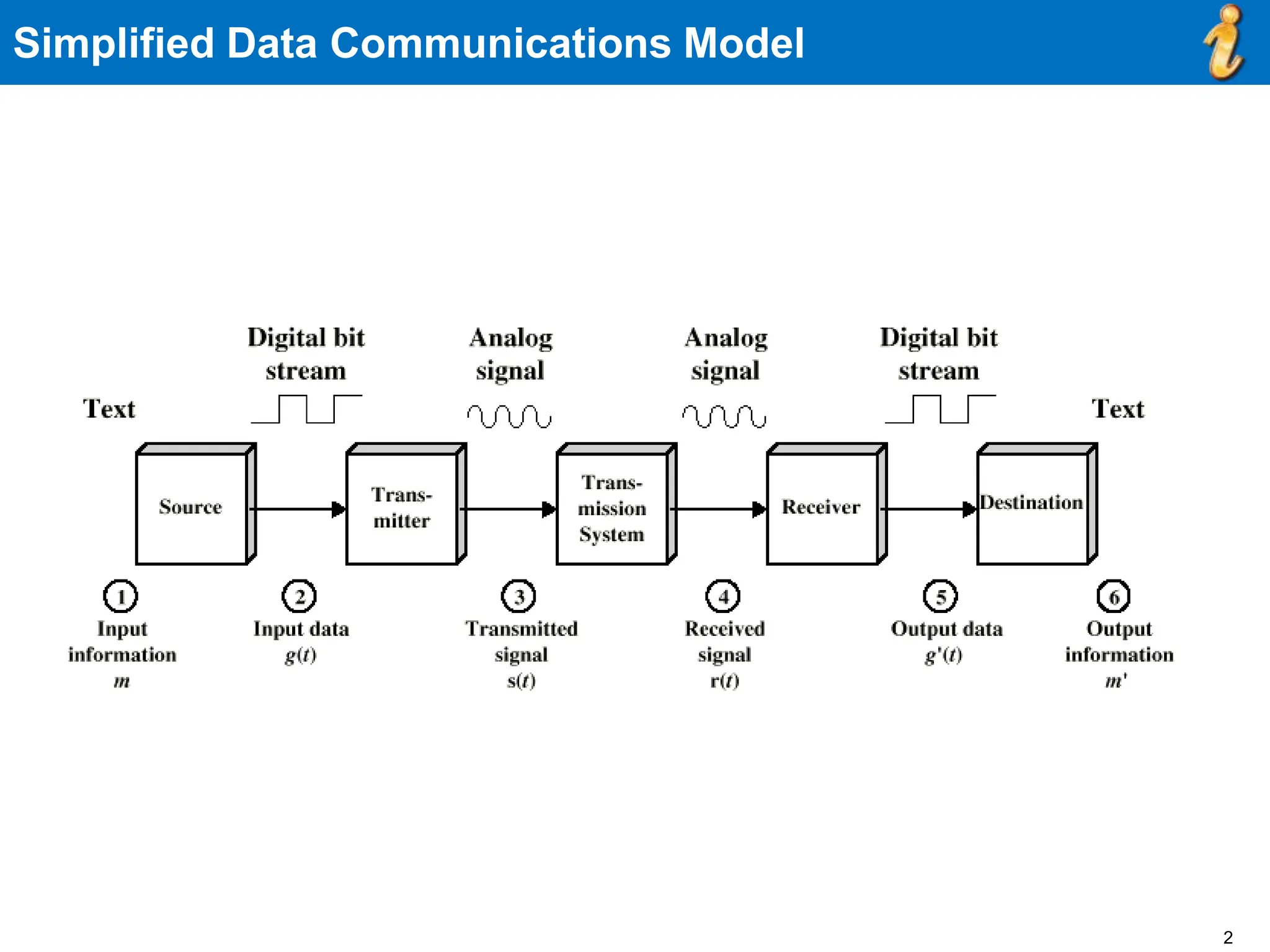
Simplified Data Communications Model
2
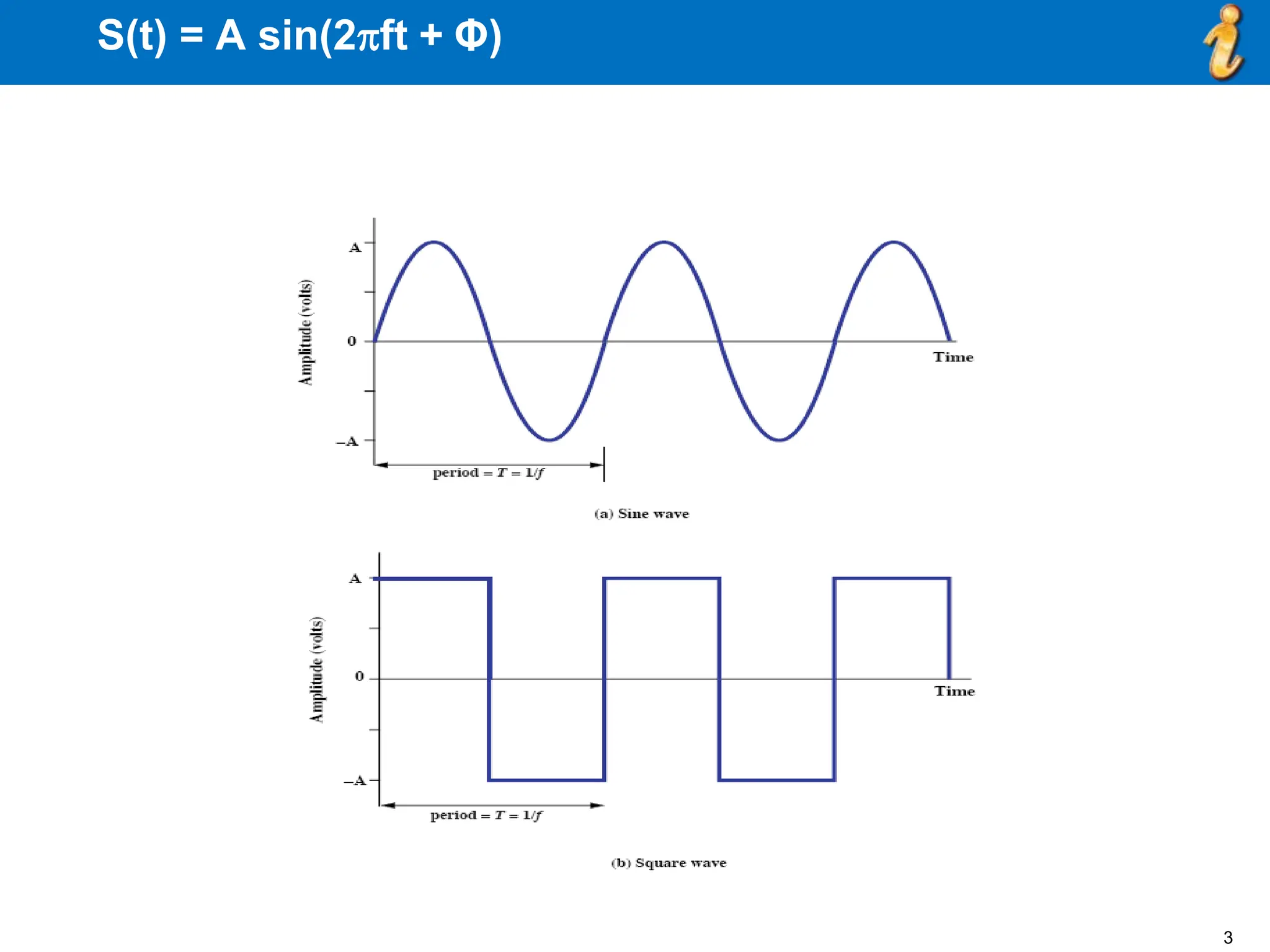
S(t) = A sin(2ft + Φ)
3
Terminology
 Transmitter
 Receiver
 Medium
 Guided medium
 E.g., twisted pair, optical fiber
 Unguided medium
 E.g., air, water, vacuum
4
Terminology
 Direct link
 No intermediate devices
 Point-to-point
 Direct link
 Only 2 devices share link
 Multi-point
 More than two devices share the link
5
Terminology
 Simplex
 One direction
 e.g., television
 Half duplex
 Either direction, but only one way at a time
 e.g. police radio
 Full duplex
 Both directions at the same time
 e.g., telephone
6
Analog and Digital Data Transmission
 Data
 Entities that convey meaning
 Signals
 Electric or electromagnetic representations of
data
 Transmission
 Communication of data by propagation and
processing of signals
7
Data
 Analog
 Continuous values within some interval
 e.g., sound, video
 Digital
 Discrete values
 e.g., text, integers
8
Signals
 Means by which data are propagated
 Analog
 Continuously variable
 Various media
 e.g., wire, fiber optic, space
 Speech bandwidth 100Hz to 7kHz
 Telephone bandwidth 300Hz to 3400Hz
 Video bandwidth 4MHz
 Digital
 Use two DC components
9
Data and Signals
 Usually use digital signals for digital data and
analog signals for analog data
 Can use analog signal to carry digital data
 Modem
 Can use digital signal to carry analog data
 Compact Disc audio
10
Analog Transmission
 Analog signal transmitted without regard to
content
 May be analog or digital data
 Attenuated over distance
 Use amplifiers to boost signal
 Also amplifies noise
11
Digital Transmission
 Concerned with content
 Integrity endangered by noise, attenuation etc.
 Repeaters used
 Repeater receives signal
 Extracts bit pattern
 Retransmits
 Attenuation is overcome
 Noise is not amplified
12
Advantages/Disadvantages of Digital
 Cheaper
 Less susceptible to noise
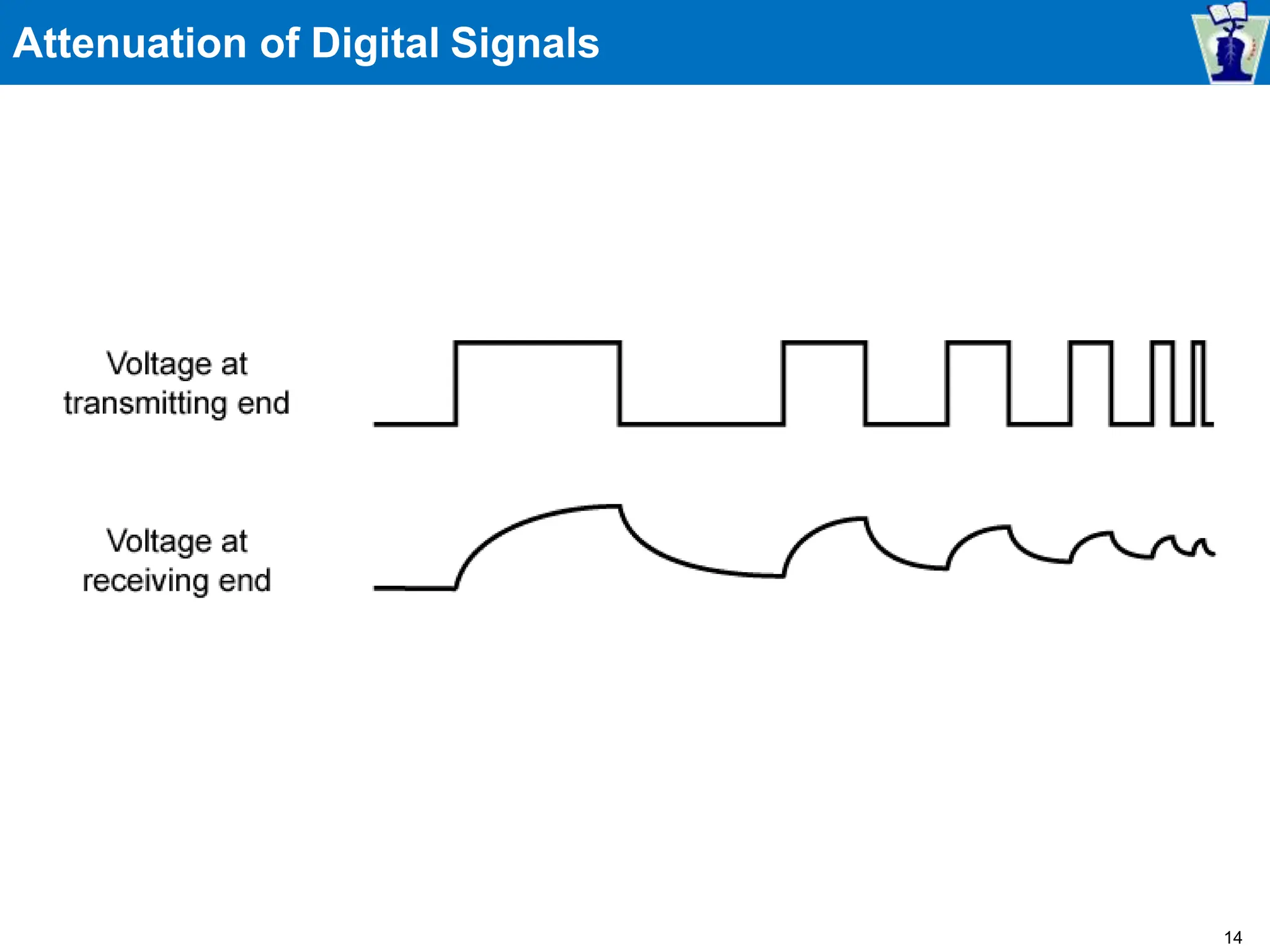
 Greater attenuation
 Pulses become rounded and smaller
 Leads to loss of information
13
Attenuation of Digital Signals
14
Interpreting Signals
 Need to know
 Timing of bits - when they start and end
 Signal levels
 Factors affecting successful interpreting of
signals
 Signal to noise ratio
 Data rate
 Bandwidth
15
Encoding
Schemes
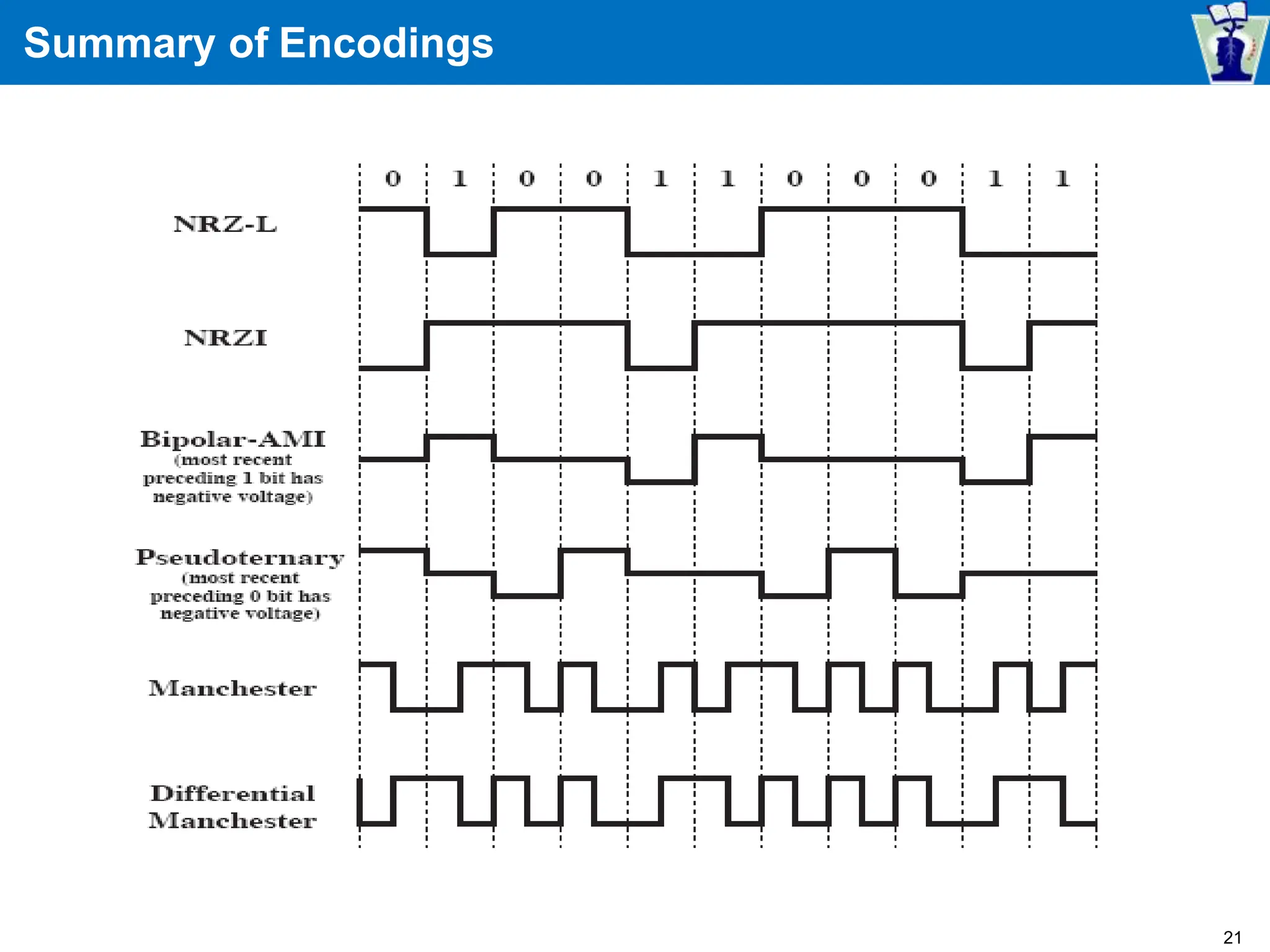
 Non-return to Zero-Level (NRZ-L)
 Non-return to Zero Inverted (NRZI)
 Bipolar –AMI
 Pseudoternary
 Manchester
 Differential Manchester
16
Non-Return to Zero-Level (NRZ-L)
 Two different voltages for 0 and 1 bits
 Voltage constant during bit interval
 No transition (i.e. no return to zero voltage)
 e.g., Absence of voltage for zero, constant
positive voltage for one
 More often, negative voltage for one value
and positive for the other
 This is NRZ-L
25
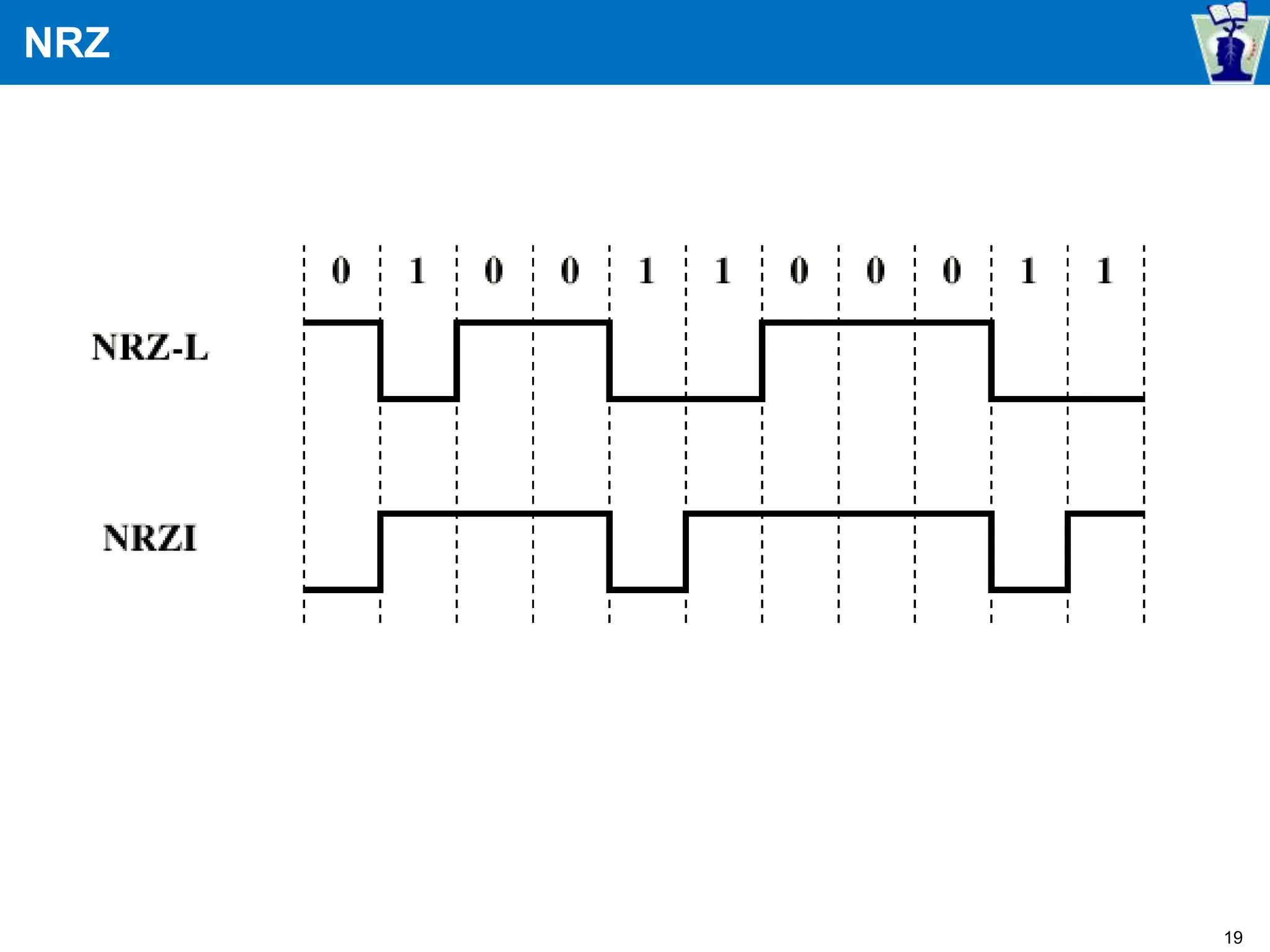
Non-Return to Zero Inverted
 Nonreturn to zero inverted on ones
 Constant voltage pulse for duration of bit
 Data encoded as presence or absence of signal
transition at beginning of bit time
 Transition (low to high or high to low) denotes a
binary 1
 No transition denotes binary 0
 An example of differential encoding
18
NRZ
19
Differential Encoding
 Data represented by changes rather than
levels
 More reliable detection of transition rather
than level
 In complex transmission layouts it is easy to
lose sense of polarity
20
Summary of Encodings
21
NRZs Pros and Cons
 Pros
 Easy to engineer
 Make good use of bandwidth
 Cons
 DC component
 Lack of synchronization capability
 Used for magnetic recording
 Not often used for signal transmission
22
Biphase
 Manchester
 Transition in middle of each bit period
 Transition serves as clock and data
 Low to high represents one
 High to low represents zero
 Used by IEEE 802.3
 Differential Manchester
 Mid-bit transition is clocking only
 Transition at start of a bit period represents zero
 No transition at start of a bit period representsone
 Note: this is a differential encoding scheme
 Used by IEEE 802.5
23
Biphase Pros and Cons
 Con
 At least one transition per bit time and possibly two
 Maximum modulation rate is twice NRZ
 Requires more bandwidth
 Pros
 Synchronization on mid bit transition (self clocking)
 No dc component
 Error detection
 Absence of expected transition
24
Asynchronous/Synchronous Transmission
 Timing problems require a mechanism
to synchronize the transmitter and
receiver
 Two solutions
 Asynchronous
 Synchronous
25
Asynchronous
 Data transmitted one character at a
time
 5 to 8 bits
 Timing only needs maintaining within
each character
 Resync with each character
26
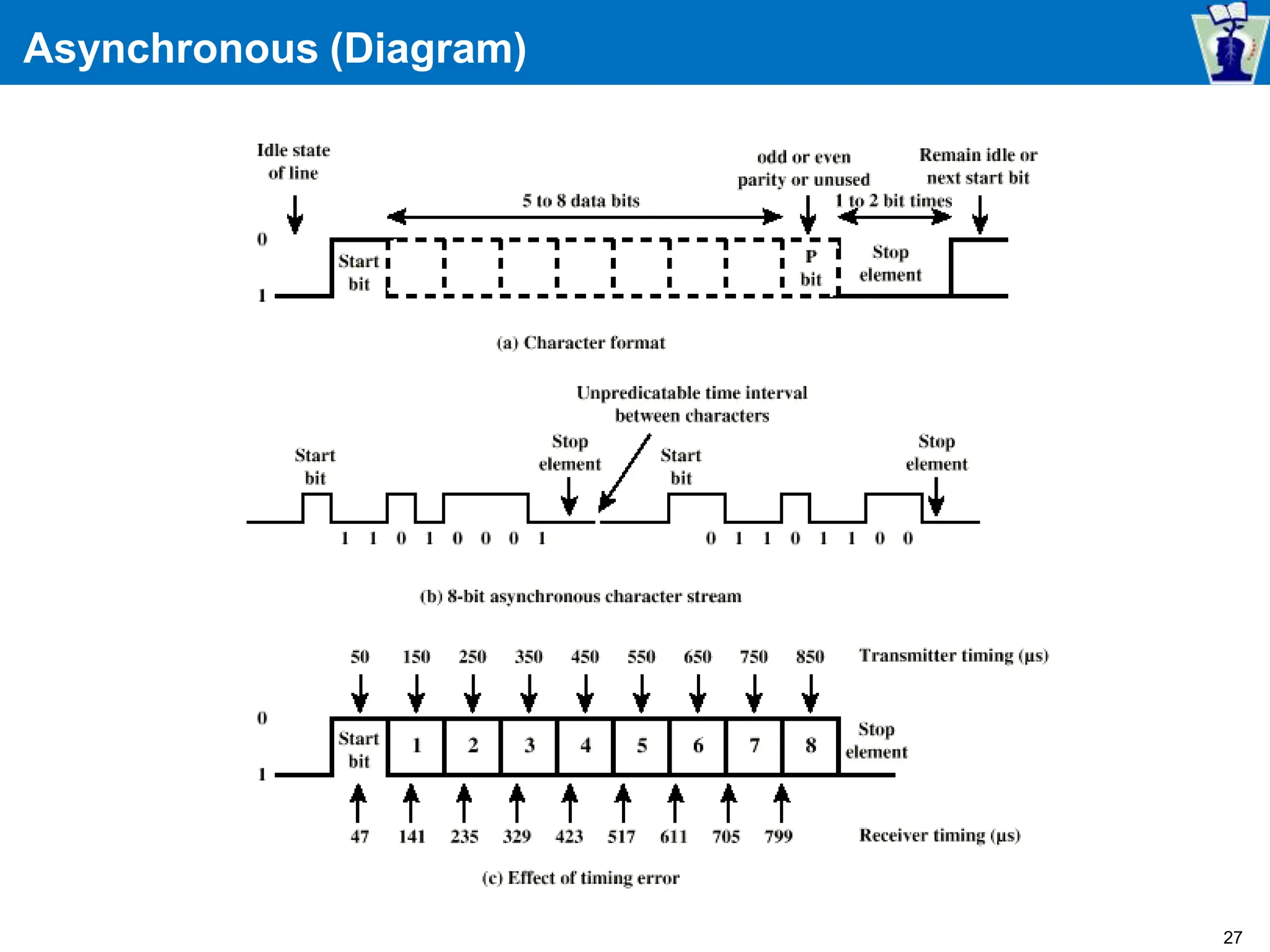
Asynchronous (Diagram)
27
Asynchronous - Behavior
 In a steady stream, interval between characters is uniform
(length of stop element)
 In idle state, receiver looks for transition 1 to 0
 Then samples next seven intervals (char length)
 Then looks for next 1 to 0 for next char
 Simple
 Cheap
 Overhead of 2 or 3 bits per char (~20%)
 Good for data with large gaps (keyboard)
28
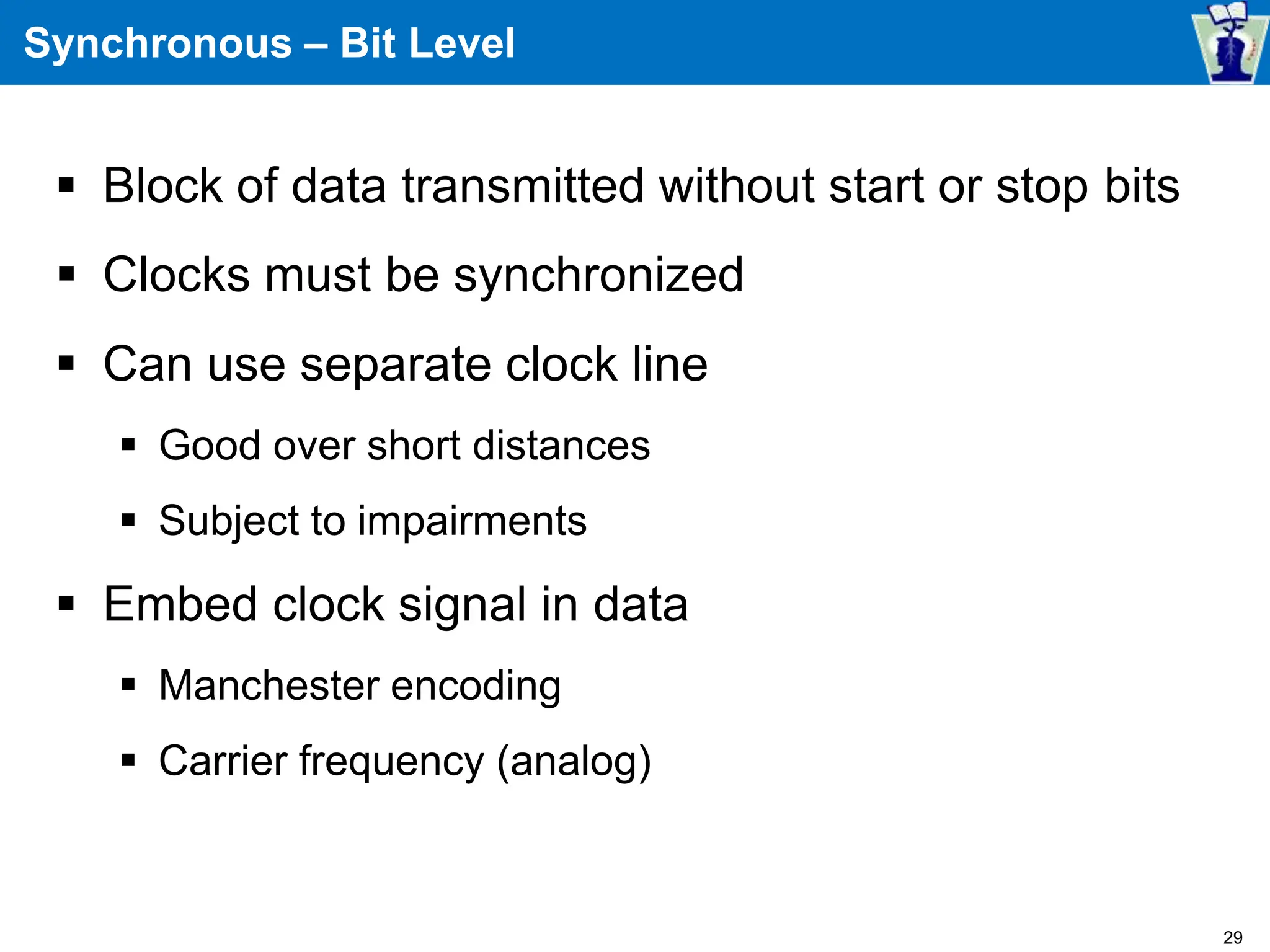
Synchronous – Bit Level
 Block of data transmitted without start or stop bits
 Clocks must be synchronized
 Can use separate clock line
 Good over short distances
 Subject to impairments
 Embed clock signal in data
 Manchester encoding
 Carrier frequency (analog)
29
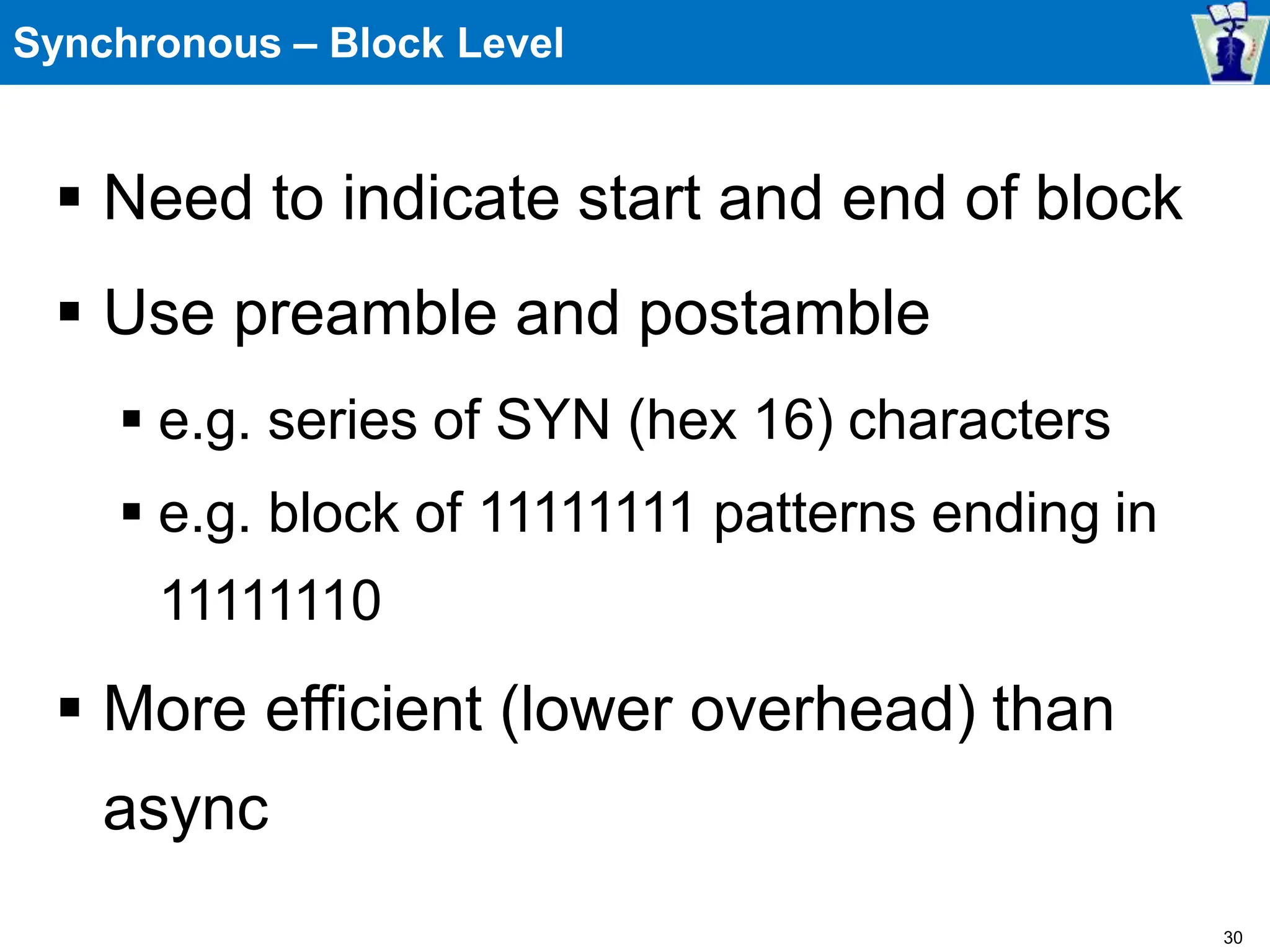
Synchronous – Block Level
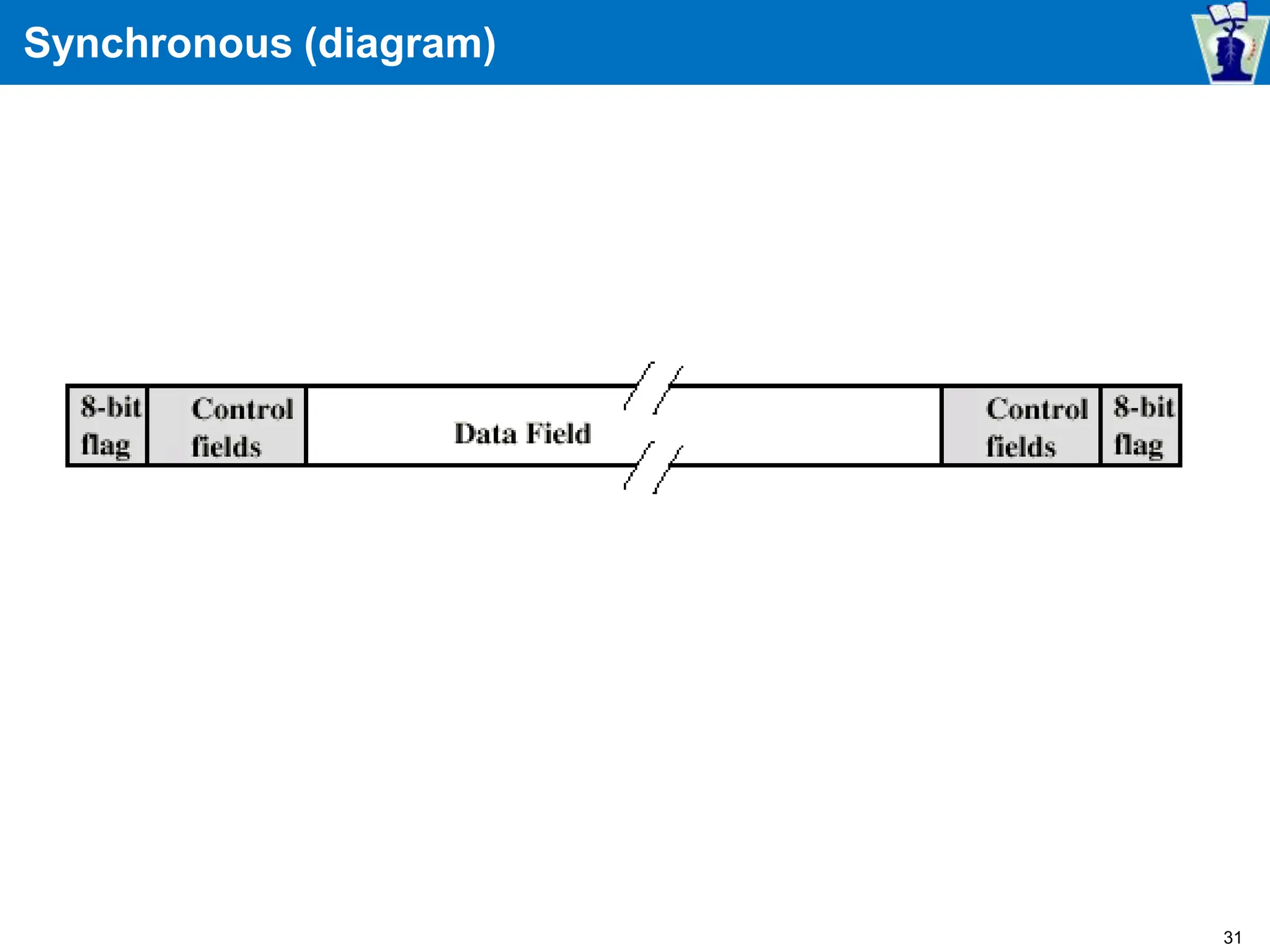
 Need to indicate start and end of block
 Use preamble and postamble
 e.g. series of SYN (hex 16) characters
 e.g. block of 11111111 patterns ending in
11111110
 More efficient (lower overhead) than
async
30
Synchronous (diagram)
31

DataEncodingAndTransmission Computer Networks.ppt.pptx

  • 1.
    Data Encoding andTransmission 1
  • 2.
  • 3.
    S(t) = Asin(2ft + Φ) 3
  • 4.
    Terminology  Transmitter  Receiver Medium  Guided medium  E.g., twisted pair, optical fiber  Unguided medium  E.g., air, water, vacuum 4
  • 5.
    Terminology  Direct link No intermediate devices  Point-to-point  Direct link  Only 2 devices share link  Multi-point  More than two devices share the link 5
  • 6.
    Terminology  Simplex  Onedirection  e.g., television  Half duplex  Either direction, but only one way at a time  e.g. police radio  Full duplex  Both directions at the same time  e.g., telephone 6
  • 7.
    Analog and DigitalData Transmission  Data  Entities that convey meaning  Signals  Electric or electromagnetic representations of data  Transmission  Communication of data by propagation and processing of signals 7
  • 8.
    Data  Analog  Continuousvalues within some interval  e.g., sound, video  Digital  Discrete values  e.g., text, integers 8
  • 9.
    Signals  Means bywhich data are propagated  Analog  Continuously variable  Various media  e.g., wire, fiber optic, space  Speech bandwidth 100Hz to 7kHz  Telephone bandwidth 300Hz to 3400Hz  Video bandwidth 4MHz  Digital  Use two DC components 9
  • 10.
    Data and Signals Usually use digital signals for digital data and analog signals for analog data  Can use analog signal to carry digital data  Modem  Can use digital signal to carry analog data  Compact Disc audio 10
  • 11.
    Analog Transmission  Analogsignal transmitted without regard to content  May be analog or digital data  Attenuated over distance  Use amplifiers to boost signal  Also amplifies noise 11
  • 12.
    Digital Transmission  Concernedwith content  Integrity endangered by noise, attenuation etc.  Repeaters used  Repeater receives signal  Extracts bit pattern  Retransmits  Attenuation is overcome  Noise is not amplified 12
  • 13.
    Advantages/Disadvantages of Digital Cheaper  Less susceptible to noise  Greater attenuation  Pulses become rounded and smaller  Leads to loss of information 13
  • 14.
  • 15.
    Interpreting Signals  Needto know  Timing of bits - when they start and end  Signal levels  Factors affecting successful interpreting of signals  Signal to noise ratio  Data rate  Bandwidth 15
  • 16.
    Encoding Schemes  Non-return toZero-Level (NRZ-L)  Non-return to Zero Inverted (NRZI)  Bipolar –AMI  Pseudoternary  Manchester  Differential Manchester 16
  • 17.
    Non-Return to Zero-Level(NRZ-L)  Two different voltages for 0 and 1 bits  Voltage constant during bit interval  No transition (i.e. no return to zero voltage)  e.g., Absence of voltage for zero, constant positive voltage for one  More often, negative voltage for one value and positive for the other  This is NRZ-L 25
  • 18.
    Non-Return to ZeroInverted  Nonreturn to zero inverted on ones  Constant voltage pulse for duration of bit  Data encoded as presence or absence of signal transition at beginning of bit time  Transition (low to high or high to low) denotes a binary 1  No transition denotes binary 0  An example of differential encoding 18
  • 19.
  • 20.
    Differential Encoding  Datarepresented by changes rather than levels  More reliable detection of transition rather than level  In complex transmission layouts it is easy to lose sense of polarity 20
  • 21.
  • 22.
    NRZs Pros andCons  Pros  Easy to engineer  Make good use of bandwidth  Cons  DC component  Lack of synchronization capability  Used for magnetic recording  Not often used for signal transmission 22
  • 23.
    Biphase  Manchester  Transitionin middle of each bit period  Transition serves as clock and data  Low to high represents one  High to low represents zero  Used by IEEE 802.3  Differential Manchester  Mid-bit transition is clocking only  Transition at start of a bit period represents zero  No transition at start of a bit period representsone  Note: this is a differential encoding scheme  Used by IEEE 802.5 23
  • 24.
    Biphase Pros andCons  Con  At least one transition per bit time and possibly two  Maximum modulation rate is twice NRZ  Requires more bandwidth  Pros  Synchronization on mid bit transition (self clocking)  No dc component  Error detection  Absence of expected transition 24
  • 25.
    Asynchronous/Synchronous Transmission  Timingproblems require a mechanism to synchronize the transmitter and receiver  Two solutions  Asynchronous  Synchronous 25
  • 26.
    Asynchronous  Data transmittedone character at a time  5 to 8 bits  Timing only needs maintaining within each character  Resync with each character 26
  • 27.
  • 28.
    Asynchronous - Behavior In a steady stream, interval between characters is uniform (length of stop element)  In idle state, receiver looks for transition 1 to 0  Then samples next seven intervals (char length)  Then looks for next 1 to 0 for next char  Simple  Cheap  Overhead of 2 or 3 bits per char (~20%)  Good for data with large gaps (keyboard) 28
  • 29.
    Synchronous – BitLevel  Block of data transmitted without start or stop bits  Clocks must be synchronized  Can use separate clock line  Good over short distances  Subject to impairments  Embed clock signal in data  Manchester encoding  Carrier frequency (analog) 29
  • 30.
    Synchronous – BlockLevel  Need to indicate start and end of block  Use preamble and postamble  e.g. series of SYN (hex 16) characters  e.g. block of 11111111 patterns ending in 11111110  More efficient (lower overhead) than async 30
  • 31.