Databases Introduction To Databases General database Concepts Application Areas of databases
Databases Database are the systems that  contain different objects used together to facilitate fast and efficient access to data.
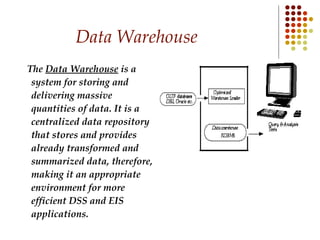
Data Warehouse The  Data Warehouse  is a system for storing and delivering massive quantities of data. It is a centralized data repository that stores and provides already transformed and summarized data, therefore, making it an appropriate environment for more efficient DSS and EIS applications.
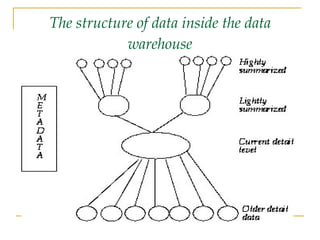
The structure of data inside the data warehouse
Metadata  is data about data. The information that describes the model and definition of the source data elements. Data Dictionary  is a data about data and database structures i.e. Metadata. Data mining  refers to the extraction of hidden predictive information patterns from large database
An  Objec t  is and identifiable entity with some characteristics and behaviors. A  Class  represents a group of objects that share common properties and relationships  ABSTRACTION refers to the act of representing essential features without including the background details and explainations.
Encapsulation  :- the wrapping up of data and functions (that operate on the data ) into a single (called class)  The  Object Modeling  refers to building models and performing activities to deploy a good object oriented system.
The  Object Modeling  refers to building models and performing activities to deploy a good object oriented system.  UML  stands for  Unified Modeling Language  which is an open and industry standard visual modeling language for object-oriented systems.
The Client Server Computing  represents a model requests are made at one end i.e. The client end and the services are provided at another end i.e. The server end. The Client  is defined as a requester of services and a server is defined as the provider of the services
The Client Server Computing  represents a model requests are made at one end i.e. The client end and the services are provided at another end i.e. The server end. CLIENT SERVER COMPUTING
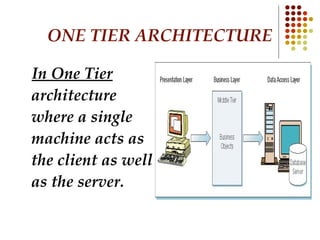
ONE TIER ARCHITECTURE In One Tier  architecture where a single machine acts as the client as well as the server.
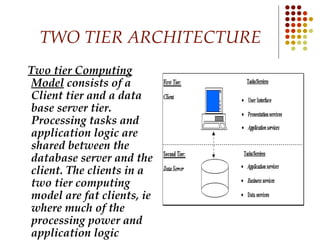
TWO TIER ARCHITECTURE Two tier Computing Model  consists of a Client tier and a data base server tier. Processing tasks and application logic are shared between the database server and the client. The clients in a two tier computing model are fat clients, ie where much of the processing power and application logic inside .
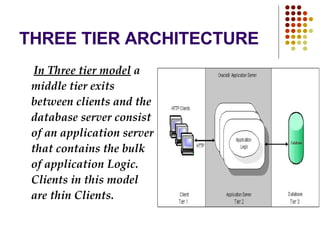
THREE TIER ARCHITECTURE In Three tier model  a middle tier exits between clients and the database server consist of an application server that contains the bulk of application Logic. Clients in this model are thin Clients.

Databases

  • 1.
    Databases Introduction ToDatabases General database Concepts Application Areas of databases
  • 2.
    Databases Database arethe systems that contain different objects used together to facilitate fast and efficient access to data.
  • 3.
    Data Warehouse The Data Warehouse is a system for storing and delivering massive quantities of data. It is a centralized data repository that stores and provides already transformed and summarized data, therefore, making it an appropriate environment for more efficient DSS and EIS applications.
  • 4.
    The structure ofdata inside the data warehouse
  • 5.
    Metadata isdata about data. The information that describes the model and definition of the source data elements. Data Dictionary is a data about data and database structures i.e. Metadata. Data mining refers to the extraction of hidden predictive information patterns from large database
  • 6.
    An Object is and identifiable entity with some characteristics and behaviors. A Class represents a group of objects that share common properties and relationships ABSTRACTION refers to the act of representing essential features without including the background details and explainations.
  • 7.
    Encapsulation :-the wrapping up of data and functions (that operate on the data ) into a single (called class) The Object Modeling refers to building models and performing activities to deploy a good object oriented system.
  • 8.
    The ObjectModeling refers to building models and performing activities to deploy a good object oriented system. UML stands for Unified Modeling Language which is an open and industry standard visual modeling language for object-oriented systems.
  • 9.
    The Client ServerComputing represents a model requests are made at one end i.e. The client end and the services are provided at another end i.e. The server end. The Client is defined as a requester of services and a server is defined as the provider of the services
  • 10.
    The Client ServerComputing represents a model requests are made at one end i.e. The client end and the services are provided at another end i.e. The server end. CLIENT SERVER COMPUTING
  • 11.
    ONE TIER ARCHITECTUREIn One Tier architecture where a single machine acts as the client as well as the server.
  • 12.
    TWO TIER ARCHITECTURETwo tier Computing Model consists of a Client tier and a data base server tier. Processing tasks and application logic are shared between the database server and the client. The clients in a two tier computing model are fat clients, ie where much of the processing power and application logic inside .
  • 13.
    THREE TIER ARCHITECTUREIn Three tier model a middle tier exits between clients and the database server consist of an application server that contains the bulk of application Logic. Clients in this model are thin Clients.