Database Design Application Development and
Administration 3rd Edition Mannino Test Bank

install download
https://testbankfan.com/product/database-design-application-
development-and-administration-3rd-edition-mannino-test-bank/
Download more testbank from https://testbankfan.com
We believe these products will be a great fit for you. Click
the link to download now, or visit testbankfan.com
to discover even more!
Database Design Application Development and
Administration 3rd Edition Mannino Solutions Manual
https://testbankfan.com/product/database-design-application-
development-and-administration-3rd-edition-mannino-solutions-
manual/
Oracle 10g Database Administrator Implementation and
Administration 2nd Edition Powell Test Bank
https://testbankfan.com/product/oracle-10g-database-
administrator-implementation-and-administration-2nd-edition-
powell-test-bank/
Leadership Theory Application and Skill Development 6th
Edition Lussier Test Bank
https://testbankfan.com/product/leadership-theory-application-
and-skill-development-6th-edition-lussier-test-bank/
Leadership Theory Application and Skill Development 5th
Edition Lussier Test Bank
https://testbankfan.com/product/leadership-theory-application-
and-skill-development-5th-edition-lussier-test-bank/
Medical Instrumentation Application and Design 4th
Edition Webster Solutions Manual
https://testbankfan.com/product/medical-instrumentation-
application-and-design-4th-edition-webster-solutions-manual/
Database Systems Design Implementation and Management
12th Edition Coronel Test Bank
https://testbankfan.com/product/database-systems-design-
implementation-and-management-12th-edition-coronel-test-bank/
Database Processing Fundamentals Design and
Implementation 13th Edition Kroenke Test Bank
https://testbankfan.com/product/database-processing-fundamentals-
design-and-implementation-13th-edition-kroenke-test-bank/
Database Processing Fundamentals Design and
Implementation 15th Edition Kroenke Test Bank
https://testbankfan.com/product/database-processing-fundamentals-
design-and-implementation-15th-edition-kroenke-test-bank/
Database Processing Fundamentals Design and
Implementation 14th Edition Kroenke Test Bank
https://testbankfan.com/product/database-processing-fundamentals-
design-and-implementation-14th-edition-kroenke-test-bank/
Chapter 11 Stored Procedures and Triggers
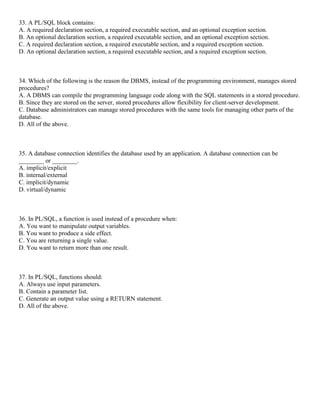
1. A database programming language allows a program to combine procedural statements with non-procedural
database access.
True False
2. Due to the growth of online database processing and commercial Web commerce, batch processing is no
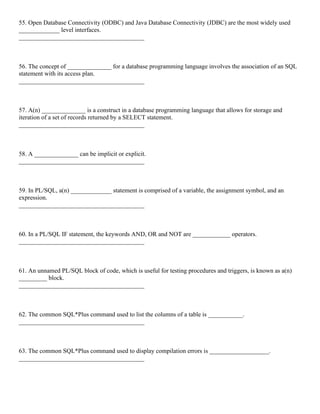
longer an important method to process database work.
True False
3. Transitive closure, an important operation for queries involving self-referencing relationships, is supported by
most SQL implementations.
True False
4. Portability across host languages is one advantage of using the statement level interface language style.
True False
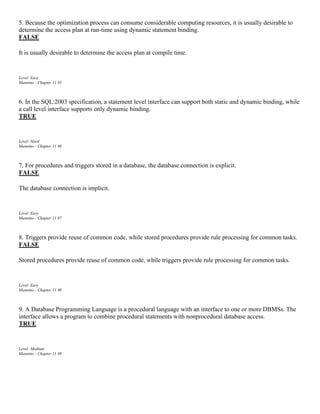
5. Because the optimization process can consume considerable computing resources, it is usually desirable to
determine the access plan at run-time using dynamic statement binding.
True False
6. In the SQL:2003 specification, a statement level interface can support both static and dynamic binding, while
a call level interface supports only dynamic binding.
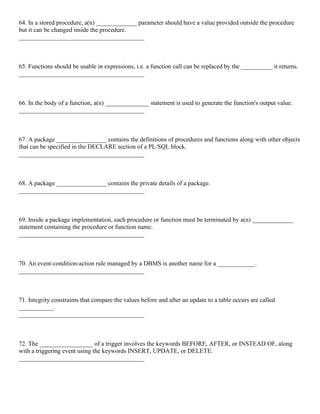
True False
7. For procedures and triggers stored in a database, the database connection is explicit.
True False
8. Triggers provide reuse of common code, while stored procedures provide rule processing for common tasks.
True False
9. A Database Programming Language is a procedural language with an interface to one or more DBMSs. The
interface allows a program to combine procedural statements with nonprocedural database access.
True False
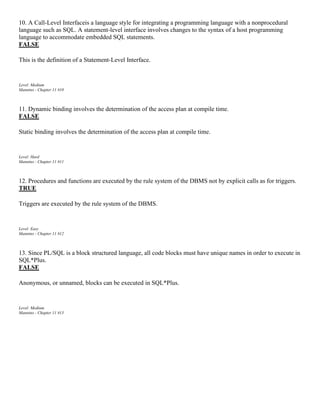
10. A Call-Level Interfaceis a language style for integrating a programming language with a nonprocedural
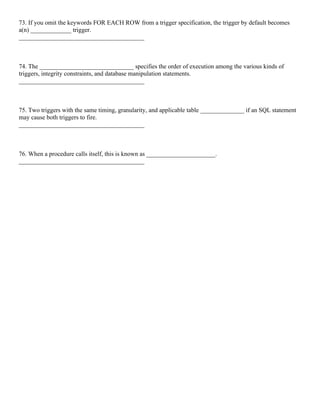
language such as SQL. A statement-level interface involves changes to the syntax of a host programming
language to accommodate embedded SQL statements.
True False
11. Dynamic binding involves the determination of the access plan at compile time.
True False
12. Procedures and functions are executed by the rule system of the DBMS not by explicit calls as for triggers.
True False
13. Since PL/SQL is a block structured language, all code blocks must have unique names in order to execute in
SQL*Plus.
True False
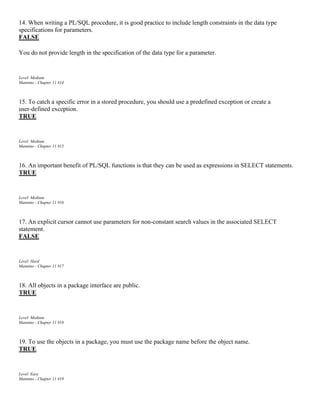
14. When writing a PL/SQL procedure, it is good practice to include length constraints in the data type
specifications for parameters.
True False
15. To catch a specific error in a stored procedure, you should use a predefined exception or create a
user-defined exception.
True False
16. An important benefit of PL/SQL functions is that they can be used as expressions in SELECT statements.
True False
17. An explicit cursor cannot use parameters for non-constant search values in the associated SELECT
statement.
True False
18. All objects in a package interface are public.
True False
19. To use the objects in a package, you must use the package name before the object name.
True False
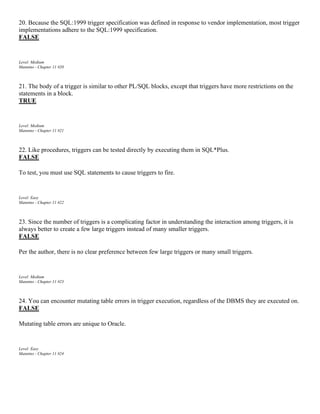
20. Because the SQL:1999 trigger specification was defined in response to vendor implementation, most trigger
implementations adhere to the SQL:1999 specification.
True False
21. The body of a trigger is similar to other PL/SQL blocks, except that triggers have more restrictions on the
statements in a block.
True False
22. Like procedures, triggers can be tested directly by executing them in SQL*Plus.
True False
23. Since the number of triggers is a complicating factor in understanding the interaction among triggers, it is
always better to create a few large triggers instead of many smaller triggers.
True False
24. You can encounter mutating table errors in trigger execution, regardless of the DBMS they are executed on.
True False
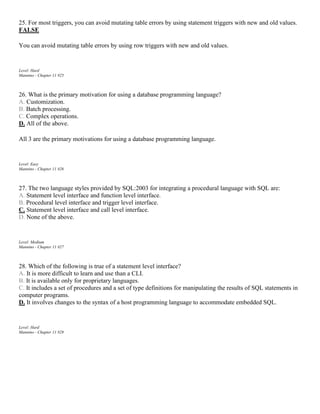
25. For most triggers, you can avoid mutating table errors by using statement triggers with new and old values.
True False
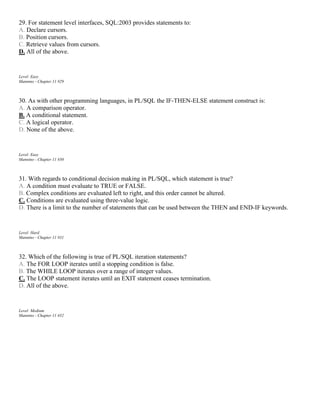
26. What is the primary motivation for using a database programming language?
A. Customization.
B. Batch processing.
C. Complex operations.
D. All of the above.
27. The two language styles provided by SQL:2003 for integrating a procedural language with SQL are:
A. Statement level interface and function level interface.
B. Procedural level interface and trigger level interface.
C. Statement level interface and call level interface.
D. None of the above.
28. Which of the following is true of a statement level interface?
A. It is more difficult to learn and use than a CLI.
B. It is available only for proprietary languages.
C. It includes a set of procedures and a set of type definitions for manipulating the results of SQL statements in
computer programs.
D. It involves changes to the syntax of a host programming language to accommodate embedded SQL.
29. For statement level interfaces, SQL:2003 provides statements to:
A. Declare cursors.
B. Position cursors.
C. Retrieve values from cursors.
D. All of the above.
30. As with other programming languages, in PL/SQL the IF-THEN-ELSE statement construct is:
A. A comparison operator.
B. A conditional statement.
C. A logical operator.
D. None of the above.
31. With regards to conditional decision making in PL/SQL, which statement is true?
A. A condition must evaluate to TRUE or FALSE.
B. Complex conditions are evaluated left to right, and this order cannot be altered.
C. Conditions are evaluated using three-value logic.
D. There is a limit to the number of statements that can be used between the THEN and END-IF keywords.
32. Which of the following is true of PL/SQL iteration statements?
A. The FOR LOOP iterates until a stopping condition is false.
B. The WHILE LOOP iterates over a range of integer values.
C. The LOOP statement iterates until an EXIT statement ceases termination.
D. All of the above.
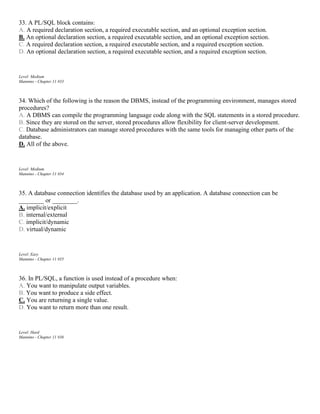
33. A PL/SQL block contains:
A. A required declaration section, a required executable section, and an optional exception section.
B. An optional declaration section, a required executable section, and an optional exception section.
C. A required declaration section, a required executable section, and a required exception section.
D. An optional declaration section, a required executable section, and a required exception section.
34. Which of the following is the reason the DBMS, instead of the programming environment, manages stored
procedures?
A. A DBMS can compile the programming language code along with the SQL statements in a stored procedure.
B. Since they are stored on the server, stored procedures allow flexibility for client-server development.
C. Database administrators can manage stored procedures with the same tools for managing other parts of the
database.
D. All of the above.
35. A database connection identifies the database used by an application. A database connection can be
________ or ________.
A. implicit/explicit
B. internal/external
C. implicit/dynamic
D. virtual/dynamic
36. In PL/SQL, a function is used instead of a procedure when:
A. You want to manipulate output variables.
B. You want to produce a side effect.
C. You are returning a single value.
D. You want to return more than one result.
37. In PL/SQL, functions should:
A. Always use input parameters.
B. Contain a parameter list.
C. Generate an output value using a RETURN statement.
D. All of the above.
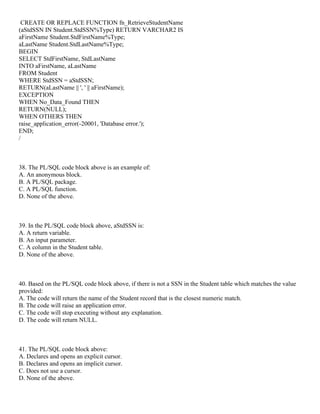
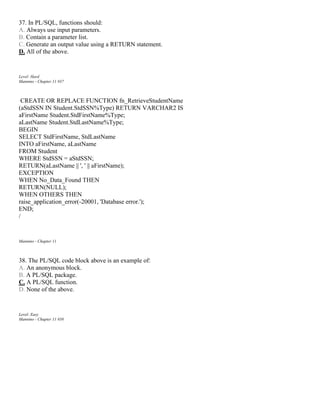
CREATE OR REPLACE FUNCTION fn_RetrieveStudentName
(aStdSSN IN Student.StdSSN%Type) RETURN VARCHAR2 IS
aFirstName Student.StdFirstName%Type;
aLastName Student.StdLastName%Type;
BEGIN
SELECT StdFirstName, StdLastName
INTO aFirstName, aLastName
FROM Student
WHERE StdSSN = aStdSSN;
RETURN(aLastName || ', ' || aFirstName);
EXCEPTION
WHEN No_Data_Found THEN
RETURN(NULL);
WHEN OTHERS THEN
raise_application_error(-20001, 'Database error.');
END;
/
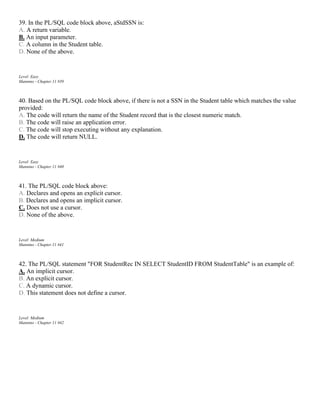
38. The PL/SQL code block above is an example of:
A. An anonymous block.
B. A PL/SQL package.
C. A PL/SQL function.
D. None of the above.
39. In the PL/SQL code block above, aStdSSN is:
A. A return variable.
B. An input parameter.
C. A column in the Student table.
D. None of the above.
40. Based on the PL/SQL code block above, if there is not a SSN in the Student table which matches the value
provided:
A. The code will return the name of the Student record that is the closest numeric match.
B. The code will raise an application error.
C. The code will stop executing without any explanation.
D. The code will return NULL.
41. The PL/SQL code block above:
A. Declares and opens an explicit cursor.
B. Declares and opens an implicit cursor.
C. Does not use a cursor.
D. None of the above.
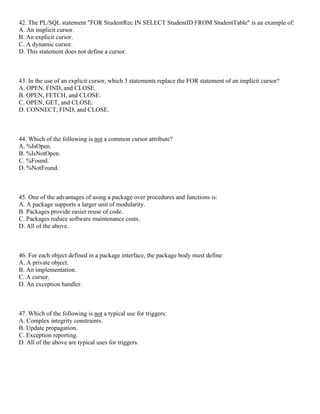
42. The PL/SQL statement "FOR StudentRec IN SELECT StudentID FROM StudentTable" is an example of:
A. An implicit cursor.
B. An explicit cursor.
C. A dynamic cursor.
D. This statement does not define a cursor.
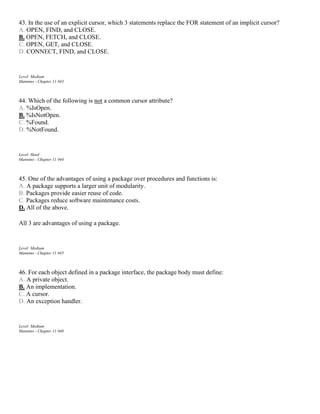
43. In the use of an explicit cursor, which 3 statements replace the FOR statement of an implicit cursor?
A. OPEN, FIND, and CLOSE.
B. OPEN, FETCH, and CLOSE.
C. OPEN, GET, and CLOSE.
D. CONNECT, FIND, and CLOSE.
44. Which of the following is not a common cursor attribute?
A. %IsOpen.
B. %IsNotOpen.
C. %Found.
D. %NotFound.
45. One of the advantages of using a package over procedures and functions is:
A. A package supports a larger unit of modularity.
B. Packages provide easier reuse of code.
C. Packages reduce software maintenance costs.
D. All of the above.
46. For each object defined in a package interface, the package body must define:
A. A private object.
B. An implementation.
C. A cursor.
D. An exception handler.
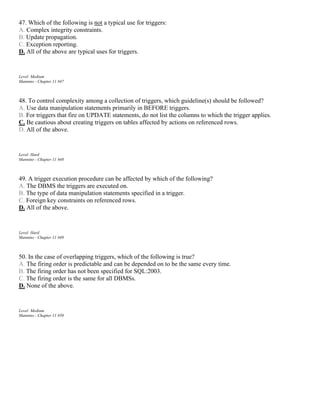
47. Which of the following is not a typical use for triggers:
A. Complex integrity constraints.
B. Update propagation.
C. Exception reporting.
D. All of the above are typical uses for triggers.
48. To control complexity among a collection of triggers, which guideline(s) should be followed?
A. Use data manipulation statements primarily in BEFORE triggers.
B. For triggers that fire on UPDATE statements, do not list the columns to which the trigger applies.
C. Be cautious about creating triggers on tables affected by actions on referenced rows.
D. All of the above.
49. A trigger execution procedure can be affected by which of the following?
A. The DBMS the triggers are executed on.
B. The type of data manipulation statements specified in a trigger.
C. Foreign key constraints on referenced rows.
D. All of the above.
50. In the case of overlapping triggers, which of the following is true?
A. The firing order is predictable and can be depended on to be the same every time.
B. The firing order has not been specified for SQL:2003.
C. The firing order is the same for all DBMSs.
D. None of the above.
51. Mutating table errors:
A. Can occur when one table is cloned from another.
B. Can occur in trigger actions with SQL statements on the target table or related tables affected by DELETE
CASCADE actions.
C. Never occur in Oracle databases.
D. None of the above.
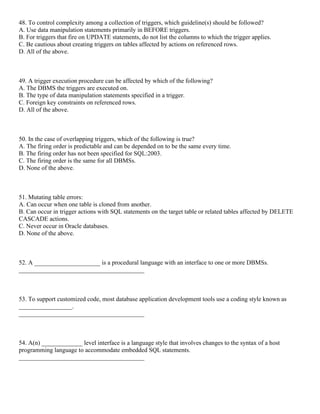
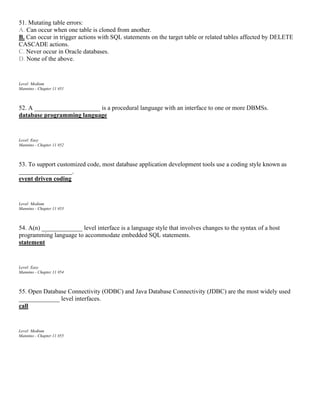
52. A _____________________ is a procedural language with an interface to one or more DBMSs.
________________________________________
53. To support customized code, most database application development tools use a coding style known as
_________________.
________________________________________
54. A(n) _____________ level interface is a language style that involves changes to the syntax of a host
programming language to accommodate embedded SQL statements.
________________________________________
55. Open Database Connectivity (ODBC) and Java Database Connectivity (JDBC) are the most widely used
_____________ level interfaces.
________________________________________
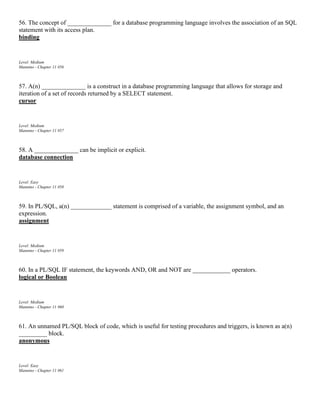
56. The concept of ______________ for a database programming language involves the association of an SQL
statement with its access plan.
________________________________________
57. A(n) ______________ is a construct in a database programming language that allows for storage and
iteration of a set of records returned by a SELECT statement.
________________________________________
58. A ______________ can be implicit or explicit.
________________________________________
59. In PL/SQL, a(n) _____________ statement is comprised of a variable, the assignment symbol, and an
expression.
________________________________________
60. In a PL/SQL IF statement, the keywords AND, OR and NOT are ____________ operators.
________________________________________
61. An unnamed PL/SQL block of code, which is useful for testing procedures and triggers, is known as a(n)
_________ block.
________________________________________
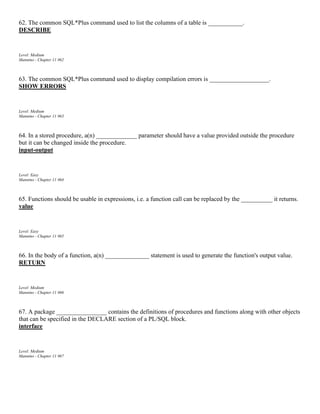
62. The common SQL*Plus command used to list the columns of a table is ___________.
________________________________________
63. The common SQL*Plus command used to display compilation errors is ___________________.
________________________________________
64. In a stored procedure, a(n) _____________ parameter should have a value provided outside the procedure
but it can be changed inside the procedure.
________________________________________
65. Functions should be usable in expressions, i.e. a function call can be replaced by the __________ it returns.
________________________________________
66. In the body of a function, a(n) ______________ statement is used to generate the function's output value.
________________________________________
67. A package ________________ contains the definitions of procedures and functions along with other objects
that can be specified in the DECLARE section of a PL/SQL block.
________________________________________
68. A package ________________ contains the private details of a package.
________________________________________
69. Inside a package implementation, each procedure or function must be terminated by a(n) _____________
statement containing the procedure or function name.
________________________________________
70. An event-condition-action rule managed by a DBMS is another name for a ____________.
________________________________________
71. Integrity constraints that compare the values before and after an update to a table occurs are called
___________.
________________________________________
72. The _________________ of a trigger involves the keywords BEFORE, AFTER, or INSTEAD OF, along
with a triggering event using the keywords INSERT, UPDATE, or DELETE.
________________________________________
73. If you omit the keywords FOR EACH ROW from a trigger specification, the trigger by default becomes
a(n) _____________ trigger.
________________________________________
74. The ______________________________ specifies the order of execution among the various kinds of
triggers, integrity constraints, and database manipulation statements.
________________________________________
75. Two triggers with the same timing, granularity, and applicable table ______________ if an SQL statement
may cause both triggers to fire.
________________________________________
76. When a procedure calls itself, this is known as ______________________.
________________________________________
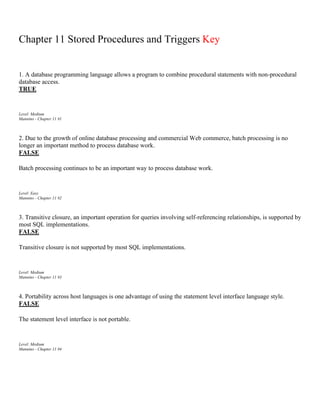
Chapter 11 Stored Procedures and Triggers Key
1. A database programming language allows a program to combine procedural statements with non-procedural
database access.
TRUE
Level: Medium
Mannino - Chapter 11 #1
2. Due to the growth of online database processing and commercial Web commerce, batch processing is no
longer an important method to process database work.
FALSE
Batch processing continues to be an important way to process database work.
Level: Easy
Mannino - Chapter 11 #2
3. Transitive closure, an important operation for queries involving self-referencing relationships, is supported by
most SQL implementations.
FALSE
Transitive closure is not supported by most SQL implementations.
Level: Medium
Mannino - Chapter 11 #3
4. Portability across host languages is one advantage of using the statement level interface language style.
FALSE
The statement level interface is not portable.
Level: Medium
Mannino - Chapter 11 #4
5. Because the optimization process can consume considerable computing resources, it is usually desirable to
determine the access plan at run-time using dynamic statement binding.
FALSE
It is usually desirable to determine the access plan at compile time.
Level: Easy
Mannino - Chapter 11 #5
6. In the SQL:2003 specification, a statement level interface can support both static and dynamic binding, while
a call level interface supports only dynamic binding.
TRUE
Level: Hard
Mannino - Chapter 11 #6
7. For procedures and triggers stored in a database, the database connection is explicit.
FALSE
The database connection is implicit.
Level: Easy
Mannino - Chapter 11 #7
8. Triggers provide reuse of common code, while stored procedures provide rule processing for common tasks.
FALSE
Stored procedures provide reuse of common code, while triggers provide rule processing for common tasks.
Level: Easy
Mannino - Chapter 11 #8
9. A Database Programming Language is a procedural language with an interface to one or more DBMSs. The
interface allows a program to combine procedural statements with nonprocedural database access.
TRUE
Level: Medium
Mannino - Chapter 11 #9
10. A Call-Level Interfaceis a language style for integrating a programming language with a nonprocedural
language such as SQL. A statement-level interface involves changes to the syntax of a host programming
language to accommodate embedded SQL statements.
FALSE
This is the definition of a Statement-Level Interface.
Level: Medium
Mannino - Chapter 11 #10
11. Dynamic binding involves the determination of the access plan at compile time.
FALSE
Static binding involves the determination of the access plan at compile time.
Level: Hard
Mannino - Chapter 11 #11
12. Procedures and functions are executed by the rule system of the DBMS not by explicit calls as for triggers.
TRUE
Triggers are executed by the rule system of the DBMS.
Level: Easy
Mannino - Chapter 11 #12
13. Since PL/SQL is a block structured language, all code blocks must have unique names in order to execute in
SQL*Plus.
FALSE
Anonymous, or unnamed, blocks can be executed in SQL*Plus.
Level: Medium
Mannino - Chapter 11 #13
14. When writing a PL/SQL procedure, it is good practice to include length constraints in the data type
specifications for parameters.
FALSE
You do not provide length in the specification of the data type for a parameter.
Level: Medium
Mannino - Chapter 11 #14
15. To catch a specific error in a stored procedure, you should use a predefined exception or create a
user-defined exception.
TRUE
Level: Medium
Mannino - Chapter 11 #15
16. An important benefit of PL/SQL functions is that they can be used as expressions in SELECT statements.
TRUE
Level: Medium
Mannino - Chapter 11 #16
17. An explicit cursor cannot use parameters for non-constant search values in the associated SELECT
statement.
FALSE
Level: Hard
Mannino - Chapter 11 #17
18. All objects in a package interface are public.
TRUE
Level: Medium
Mannino - Chapter 11 #18
19. To use the objects in a package, you must use the package name before the object name.
TRUE
Level: Easy
Mannino - Chapter 11 #19
20. Because the SQL:1999 trigger specification was defined in response to vendor implementation, most trigger
implementations adhere to the SQL:1999 specification.
FALSE
Level: Medium
Mannino - Chapter 11 #20
21. The body of a trigger is similar to other PL/SQL blocks, except that triggers have more restrictions on the
statements in a block.
TRUE
Level: Medium
Mannino - Chapter 11 #21
22. Like procedures, triggers can be tested directly by executing them in SQL*Plus.
FALSE
To test, you must use SQL statements to cause triggers to fire.
Level: Easy
Mannino - Chapter 11 #22
23. Since the number of triggers is a complicating factor in understanding the interaction among triggers, it is
always better to create a few large triggers instead of many smaller triggers.
FALSE
Per the author, there is no clear preference between few large triggers or many small triggers.
Level: Medium
Mannino - Chapter 11 #23
24. You can encounter mutating table errors in trigger execution, regardless of the DBMS they are executed on.
FALSE
Mutating table errors are unique to Oracle.
Level: Easy
Mannino - Chapter 11 #24
25. For most triggers, you can avoid mutating table errors by using statement triggers with new and old values.
FALSE
You can avoid mutating table errors by using row triggers with new and old values.
Level: Hard
Mannino - Chapter 11 #25
26. What is the primary motivation for using a database programming language?
A. Customization.
B. Batch processing.
C. Complex operations.
D. All of the above.
All 3 are the primary motivations for using a database programming language.
Level: Easy
Mannino - Chapter 11 #26
27. The two language styles provided by SQL:2003 for integrating a procedural language with SQL are:
A. Statement level interface and function level interface.
B. Procedural level interface and trigger level interface.
C. Statement level interface and call level interface.
D. None of the above.
Level: Medium
Mannino - Chapter 11 #27
28. Which of the following is true of a statement level interface?
A. It is more difficult to learn and use than a CLI.
B. It is available only for proprietary languages.
C. It includes a set of procedures and a set of type definitions for manipulating the results of SQL statements in
computer programs.
D. It involves changes to the syntax of a host programming language to accommodate embedded SQL.
Level: Hard
Mannino - Chapter 11 #28
29. For statement level interfaces, SQL:2003 provides statements to:
A. Declare cursors.
B. Position cursors.
C. Retrieve values from cursors.
D. All of the above.
Level: Easy
Mannino - Chapter 11 #29
30. As with other programming languages, in PL/SQL the IF-THEN-ELSE statement construct is:
A. A comparison operator.
B. A conditional statement.
C. A logical operator.
D. None of the above.
Level: Easy
Mannino - Chapter 11 #30
31. With regards to conditional decision making in PL/SQL, which statement is true?
A. A condition must evaluate to TRUE or FALSE.
B. Complex conditions are evaluated left to right, and this order cannot be altered.
C. Conditions are evaluated using three-value logic.
D. There is a limit to the number of statements that can be used between the THEN and END-IF keywords.
Level: Hard
Mannino - Chapter 11 #31
32. Which of the following is true of PL/SQL iteration statements?
A. The FOR LOOP iterates until a stopping condition is false.
B. The WHILE LOOP iterates over a range of integer values.
C. The LOOP statement iterates until an EXIT statement ceases termination.
D. All of the above.
Level: Medium
Mannino - Chapter 11 #32
33. A PL/SQL block contains:
A. A required declaration section, a required executable section, and an optional exception section.
B. An optional declaration section, a required executable section, and an optional exception section.
C. A required declaration section, a required executable section, and a required exception section.
D. An optional declaration section, a required executable section, and a required exception section.
Level: Medium
Mannino - Chapter 11 #33
34. Which of the following is the reason the DBMS, instead of the programming environment, manages stored
procedures?
A. A DBMS can compile the programming language code along with the SQL statements in a stored procedure.
B. Since they are stored on the server, stored procedures allow flexibility for client-server development.
C. Database administrators can manage stored procedures with the same tools for managing other parts of the
database.
D. All of the above.
Level: Medium
Mannino - Chapter 11 #34
35. A database connection identifies the database used by an application. A database connection can be
________ or ________.
A. implicit/explicit
B. internal/external
C. implicit/dynamic
D. virtual/dynamic
Level: Easy
Mannino - Chapter 11 #35
36. In PL/SQL, a function is used instead of a procedure when:
A. You want to manipulate output variables.
B. You want to produce a side effect.
C. You are returning a single value.
D. You want to return more than one result.
Level: Hard
Mannino - Chapter 11 #36
37. In PL/SQL, functions should:
A. Always use input parameters.
B. Contain a parameter list.
C. Generate an output value using a RETURN statement.
D. All of the above.
Level: Hard
Mannino - Chapter 11 #37
CREATE OR REPLACE FUNCTION fn_RetrieveStudentName
(aStdSSN IN Student.StdSSN%Type) RETURN VARCHAR2 IS
aFirstName Student.StdFirstName%Type;
aLastName Student.StdLastName%Type;
BEGIN
SELECT StdFirstName, StdLastName
INTO aFirstName, aLastName
FROM Student
WHERE StdSSN = aStdSSN;
RETURN(aLastName || ', ' || aFirstName);
EXCEPTION
WHEN No_Data_Found THEN
RETURN(NULL);
WHEN OTHERS THEN
raise_application_error(-20001, 'Database error.');
END;
/
Mannino - Chapter 11
38. The PL/SQL code block above is an example of:
A. An anonymous block.
B. A PL/SQL package.
C. A PL/SQL function.
D. None of the above.
Level: Easy
Mannino - Chapter 11 #38
39. In the PL/SQL code block above, aStdSSN is:
A. A return variable.
B. An input parameter.
C. A column in the Student table.
D. None of the above.
Level: Easy
Mannino - Chapter 11 #39
40. Based on the PL/SQL code block above, if there is not a SSN in the Student table which matches the value
provided:
A. The code will return the name of the Student record that is the closest numeric match.
B. The code will raise an application error.
C. The code will stop executing without any explanation.
D. The code will return NULL.
Level: Easy
Mannino - Chapter 11 #40
41. The PL/SQL code block above:
A. Declares and opens an explicit cursor.
B. Declares and opens an implicit cursor.
C. Does not use a cursor.
D. None of the above.
Level: Medium
Mannino - Chapter 11 #41
42. The PL/SQL statement "FOR StudentRec IN SELECT StudentID FROM StudentTable" is an example of:
A. An implicit cursor.
B. An explicit cursor.
C. A dynamic cursor.
D. This statement does not define a cursor.
Level: Medium
Mannino - Chapter 11 #42
43. In the use of an explicit cursor, which 3 statements replace the FOR statement of an implicit cursor?
A. OPEN, FIND, and CLOSE.
B. OPEN, FETCH, and CLOSE.
C. OPEN, GET, and CLOSE.
D. CONNECT, FIND, and CLOSE.
Level: Medium
Mannino - Chapter 11 #43
44. Which of the following is not a common cursor attribute?
A. %IsOpen.
B. %IsNotOpen.
C. %Found.
D. %NotFound.
Level: Hard
Mannino - Chapter 11 #44
45. One of the advantages of using a package over procedures and functions is:
A. A package supports a larger unit of modularity.
B. Packages provide easier reuse of code.
C. Packages reduce software maintenance costs.
D. All of the above.
All 3 are advantages of using a package.
Level: Medium
Mannino - Chapter 11 #45
46. For each object defined in a package interface, the package body must define:
A. A private object.
B. An implementation.
C. A cursor.
D. An exception handler.
Level: Medium
Mannino - Chapter 11 #46
47. Which of the following is not a typical use for triggers:
A. Complex integrity constraints.
B. Update propagation.
C. Exception reporting.
D. All of the above are typical uses for triggers.
Level: Medium
Mannino - Chapter 11 #47
48. To control complexity among a collection of triggers, which guideline(s) should be followed?
A. Use data manipulation statements primarily in BEFORE triggers.
B. For triggers that fire on UPDATE statements, do not list the columns to which the trigger applies.
C. Be cautious about creating triggers on tables affected by actions on referenced rows.
D. All of the above.
Level: Hard
Mannino - Chapter 11 #48
49. A trigger execution procedure can be affected by which of the following?
A. The DBMS the triggers are executed on.
B. The type of data manipulation statements specified in a trigger.
C. Foreign key constraints on referenced rows.
D. All of the above.
Level: Hard
Mannino - Chapter 11 #49
50. In the case of overlapping triggers, which of the following is true?
A. The firing order is predictable and can be depended on to be the same every time.
B. The firing order has not been specified for SQL:2003.
C. The firing order is the same for all DBMSs.
D. None of the above.
Level: Medium
Mannino - Chapter 11 #50
51. Mutating table errors:
A. Can occur when one table is cloned from another.
B. Can occur in trigger actions with SQL statements on the target table or related tables affected by DELETE
CASCADE actions.
C. Never occur in Oracle databases.
D. None of the above.
Level: Medium
Mannino - Chapter 11 #51
52. A _____________________ is a procedural language with an interface to one or more DBMSs.
database programming language
Level: Easy
Mannino - Chapter 11 #52
53. To support customized code, most database application development tools use a coding style known as
_________________.
event driven coding
Level: Medium
Mannino - Chapter 11 #53
54. A(n) _____________ level interface is a language style that involves changes to the syntax of a host
programming language to accommodate embedded SQL statements.
statement
Level: Easy
Mannino - Chapter 11 #54
55. Open Database Connectivity (ODBC) and Java Database Connectivity (JDBC) are the most widely used
_____________ level interfaces.
call
Level: Medium
Mannino - Chapter 11 #55
56. The concept of ______________ for a database programming language involves the association of an SQL
statement with its access plan.
binding
Level: Medium
Mannino - Chapter 11 #56
57. A(n) ______________ is a construct in a database programming language that allows for storage and
iteration of a set of records returned by a SELECT statement.
cursor
Level: Medium
Mannino - Chapter 11 #57
58. A ______________ can be implicit or explicit.
database connection
Level: Easy
Mannino - Chapter 11 #58
59. In PL/SQL, a(n) _____________ statement is comprised of a variable, the assignment symbol, and an
expression.
assignment
Level: Medium
Mannino - Chapter 11 #59
60. In a PL/SQL IF statement, the keywords AND, OR and NOT are ____________ operators.
logical or Boolean
Level: Medium
Mannino - Chapter 11 #60
61. An unnamed PL/SQL block of code, which is useful for testing procedures and triggers, is known as a(n)
_________ block.
anonymous
Level: Easy
Mannino - Chapter 11 #61
62. The common SQL*Plus command used to list the columns of a table is ___________.
DESCRIBE
Level: Medium
Mannino - Chapter 11 #62
63. The common SQL*Plus command used to display compilation errors is ___________________.
SHOW ERRORS
Level: Medium
Mannino - Chapter 11 #63
64. In a stored procedure, a(n) _____________ parameter should have a value provided outside the procedure
but it can be changed inside the procedure.
input-output
Level: Easy
Mannino - Chapter 11 #64
65. Functions should be usable in expressions, i.e. a function call can be replaced by the __________ it returns.
value
Level: Easy
Mannino - Chapter 11 #65
66. In the body of a function, a(n) ______________ statement is used to generate the function's output value.
RETURN
Level: Medium
Mannino - Chapter 11 #66
67. A package ________________ contains the definitions of procedures and functions along with other objects
that can be specified in the DECLARE section of a PL/SQL block.
interface
Level: Medium
Mannino - Chapter 11 #67
68. A package ________________ contains the private details of a package.
implementation or body
Level: Medium
Mannino - Chapter 11 #68
69. Inside a package implementation, each procedure or function must be terminated by a(n) _____________
statement containing the procedure or function name.
END
Level: Medium
Mannino - Chapter 11 #69
70. An event-condition-action rule managed by a DBMS is another name for a ____________.
trigger
Level: Medium
Mannino - Chapter 11 #70
71. Integrity constraints that compare the values before and after an update to a table occurs are called
___________.
transition constraints
Level: Medium
Mannino - Chapter 11 #71
72. The _________________ of a trigger involves the keywords BEFORE, AFTER, or INSTEAD OF, along
with a triggering event using the keywords INSERT, UPDATE, or DELETE.
timing specification
Level: Hard
Mannino - Chapter 11 #72
73. If you omit the keywords FOR EACH ROW from a trigger specification, the trigger by default becomes
a(n) _____________ trigger.
statement
Level: Medium
Mannino - Chapter 11 #73
74. The ______________________________ specifies the order of execution among the various kinds of
triggers, integrity constraints, and database manipulation statements.
trigger execution procedure
Level: Medium
Mannino - Chapter 11 #74
75. Two triggers with the same timing, granularity, and applicable table ______________ if an SQL statement
may cause both triggers to fire.
overlap
Level: Easy
Mannino - Chapter 11 #75
76. When a procedure calls itself, this is known as ______________________.
recursive execution
Level: Hard
Mannino - Chapter 11 #76
Chapter 11 Stored Procedures and Triggers Summary
Category # of Questions
Level: Easy 22
Level: Hard 13
Level: Medium 41
Mannino - Chapter 11 77
Exploring the Variety of Random
Documents with Different Content
deeds related. Such has ever been considered the real end of
biographical literature.
In this respect, the Life of O'Connell, by Sister Mary Francis Clare, is
much superior to Mr. Luby's, as it is in every other essential quality,
though in itself far inferior to what might have been expected from
so popular a writer, particularly when dealing with so great and
congenial a theme. In her book of eight hundred pages, the good
religious has shown a vast amount of industry, a genuine
appreciation of the character, labors, and conduct of the Liberator,
and considerable literary skill in presenting them to the public in the
most attractive and readable form. The correspondence between
O'Connell and the venerable Archbishop of Tuam, now for the first
time published, constitutes a most valuable, perhaps the most
valuable, feature in the work, and, as a glimpse at the inner life of
the busy lawyer and untiring agitator, will be read with particular
gratification by the admirers of his extraordinary abilities in this
country. Here, we regret to say, our praise of Miss Cusack's book
must end. As a biography of one of the most remarkable public men
of this century or of any country, it is not a decided success, and, as
coming from the pen of an experienced, facile, and patriotic writer, it
will, we do not doubt, disappoint the majority of her admirers at
home and abroad. With the exception of the letters to Abp. McHale,
alluded to above, and some original notes and appendices supplied
by friends, the facts, incidents, and anecdotes recounted of the Irish
leader are mainly taken from such books as those of O'Neill Daunt,
Fegan, Sheil, and his own son, John O'Connell, all of which may be
found in an anonymous compilation published five or six years ago.
[76]
We do not find fault so much with the fact that it is so largely a
compilation, as with the crude manner in which the extracts from
those works are collated and presented to the public. We can even
point to several instances where they are inserted bodily in the text,
as original, without quotation-marks, foot-notes, or any other sign of
reference. This may or may not be the fault of the printer, but the
examples are so numerous as to incline us to the latter opinion. We
have often admired the industry of Miss Cusack in bringing out so
many good books in such rapid succession; as well as her zeal in
endeavoring to aid, by the products of her genius, a most
meritorious charity; but we hold it to be against the laws both of fair
play and literary courtesy to neglect to accord to the labors of others
a proper share of acknowledgment.
We do not want to be unreasonable. Had the gifted authoress
allowed herself more time, and related the dramatic story of
O'Connell's life entirely in her own words, we would have been
satisfied. We do not expect that a lady secluded from the world,
necessarily devoting the greater part of her time to the duties of her
calling, and consequently practically unacquainted with the outside
political world, its storms, passions, and intrigues, can treat us to
anything like a full or elaborate disquisition on the circumstances,
dangers, and difficulties which surrounded and impeded the career
of such a man as the emancipator of the Catholics of Great Britain
and Ireland. Only a person who has devoted much time to the
examination of the history of Ireland and England, for the past
hundred years, at least; who himself has been a participant in, or an
interested spectator of, the unceasing conflict which during that
period was naturally waged between the Irish nationalists and their
opponents, can attempt to do so. This war was carried on in every
relation of life; at the bar, on the bench; in the pulpit, press, and
forum; in the workshop, the club, and the halls of St. Stephen; and
the central figure, the invincible leader of the aggressive and at
length victorious national party, was O'Connell—the man who for
near half a century dared all opposition and defied all hostile power
in the championship of the cause of his persecuted countrymen and
co-religionists.
However men may differ as to the wisdom, policy, or honesty of
O'Connell, none will deny that he was a man of stupendous intellect
and indomitable perseverance. In everything he was gigantic. In
physique, mental attainments, courage, virtues, and even in his
errors, he was decidedly great. There was nothing small or dwarfed
about him; and as, a popular leader while living, he seemed to hold
in his hand the control of the masses of his countrymen; so, when
dead, the very mention of his name is enough to awaken the
gratitude and evoke the admiration of millions of the present
generation, whose advent into the world succeeded his demise. Not
only in Ireland was he trusted, beloved, and revered, but on the
continent of Europe and in this country his name was associated
with the cause of civil and religious liberty, and his every movement
watched with interest by all classes. And when at length, worn down
by his excessive labors in behalf of faith and liberty, he yielded up
his soul to his Creator, his piety and patriotism became the subjects
of unqualified encomiums from the noblest and most distinguished
orators in both hemispheres. Surely so great an embodiment of zeal
and genius, well directed, deserves a fitting chronicler.
Born of a house never remarkable before nor since his time for
attachment to creed or country; educated far from the influences of
his native land, we find him returning to it just as he had completed
his majority, an accomplished scholar and a barrister, with nothing to
depend upon but his own labors for support, yet full of ambition and
eager for distinction. Had he followed the traditions of his family, he
would have settled down quietly to the practice of his profession,
and in course of time, doubtless, would have become wealthy and a
useful assistant to the hostile power that controlled the destinies of
his nation, as too many of his professional brothers had already
done. But the young lawyer, to the dismay of many of his relations,
soon showed that he was made of sterner stuff. He could not "bend
the pregnant hinges of the knee, that thrift might follow fawning."
He had arrived home in time to witness the horrors of '98; he had
seen his fellow-Catholics, even then four-fifths of the population of
Ireland, bowed down to the very dust, sneered at, reprobated, and,
on their own soil, denied every social, commercial, and political right
to which as freemen they were entitled; and, with a courage that
never deserted him, and a capacity for labor that was truly
remarkable, he ranged himself on the side of the proscribed, and
took up the gauntlet cast down to the oppressed by the powerful
and unscrupulous faction which then, as now, represented British
supremacy in Ireland.
His first appearance in public, being then but twenty-three years old,
was in 1799, when the question of a legislative union between
Ireland and England convulsed the former and deeply moved the
public mind of the latter country. At a meeting in Dublin, he
denounced the measure in terms so bold, clear, and forcible that
those who listened to him had little difficulty in foreseeing his future
eminence and usefulness to the national cause. The scheme of Pitt
and Castlereagh was, however, carried out, the Irish parliament was
destroyed, and the Catholics saw themselves at the beginning of the
century not only without a domestic legislature, but shut out from all
representation, not only in the united Lords and Commons, but even
in the most insignificant corporation and local boards.
Where, then, could the ardent young patriot, gifted, enthusiastic,
and impatient of the restrictions placed upon himself and his fellow-
countrymen, find an audience and an outlet for the fiery eloquence
that heaved and burned in his soul? Clearly in popular gatherings
and in the courts of law. But the people at that time were so timid,
nay, so degraded, that they dared not assemble in any force to
protest against the tyranny that had for so many generations
enslaved them; or, if a few hundreds did assemble together, the
sight of a magistrate, or the presence of some truculent follower of
the castle, like the infamous Maj. Sirr, was sufficient to disperse
them, while the few Catholic noblemen and gentry yet left were as
timid as so many hares. The Irish Catholics of that epoch, so long
trodden under foot, and deprived absolutely of political power and
landed interests, were not like the Catholics of to-day, who, in all
thankfulness be it said, are triumphantly bearing aloft the banner of
the church when so much of Europe is trailing it in the mire of
infidelity and communism. Then Wolfe Tone, once their secretary, in
his Memoirs, and Wyse, in his History of the Catholic Association,
likened them to the servile Jews, and described them as deficient in
manliness and self-respect. They crawled at the feet of a hostile
government, says the latter, fawned on their Protestant neighbors,
and felt honored by being even noticed by persons of that creed,
even though in every respect their inferiors. Such people had very
little business in the civil courts to give, and what little they had they
gave to those who loathed their creed and despised themselves.
O'Connell soon saw that nothing could be effected in the way of
popular demonstrations with such unpromising materials. He
therefore adopted another and a wiser course. The courts became
his fulcrum, and his eloquence the lever, by which he sought to raise
the spirit of the nation. Term after term, year after year, his potent
voice was heard ringing through the halls of justice by an astonished
bar and delighted and electrified audiences, in the defence of the
victims of landlord tyranny or official persecution. His arguments to
the bench, and his harangues to the jury, were always full of fire,
audacity, and logic, and were seldom, even in the face of
unmitigated prejudice, unsuccessful. Pathos and humor, wit and
vituperation, strong appeals to the patriotism of his hearers, and
stern denunciations of the rashness and folly of some of his
compatriots, were with him invariably mingled with sound common
sense and unerring legal acumen. So great, indeed, was his success
as a pleader in criminal cases, so unlimited his resources in difficult
motions, and so general his triumphs over ignorance and bigotry,
that, before most of his fellow-practitioners had earned their first
fees, he found himself in the enjoyment of a lucrative practice, and,
what to him was an object of much greater importance, the
spokesman of the degraded majority, and the oracle of his people.
His forensic efforts were not confined to judges and juries
exclusively. He lost no opportunity of throwing into his legal
arguments and speeches some remarks for the benefit of the
masses who always throng Irish courts—remarks which never failed
to elicit the wildest delight and the most hearty applause.
In this indirect way he was gradually infusing into his countrymen
that spirit of manhood which so powerfully moved himself. As an
evidence of this, we may quote an extract, though a long one, from
his speech in defence of Magee, editor of the Evening Post, then the
most influential advocate of Catholic rights in Ireland. In 1813,
Magee was prosecuted for a libel on the Duke of Richmond, the
retiring lord-lieutenant; and as the crown officers in their speeches,
and, as it appeared, by previous arrangement, endeavored to give to
the trial—having first selected a jury to suit themselves—a political
significance, Magee's counsel willingly joined issue with them on
their own terms. The array of legal ability on both sides was
proportionate to the gravity of the question involved. For the
government appeared the Attorney-General, Saurin, the Solicitor-
General, Bushe, and Sergeants Moore, Ball, and McMahon; for the
defence, O'Connell, assisted by Messrs. Wallace, Hamilton, Findley,
and Philips. Saurin, in his opening, alluding to the Catholic Board, of
which the defendant's newspaper was the organ, made use of these
words: "If the libel only related to him [Richmond], it would have
gone by unprosecuted by me. But the imputation is made against
the administration of justice by the government of Ireland, and it
forms only a part of a system of calumny with which an association
of factious and revolutionary men are in the habit of vilifying every
constitutional authority in the land." The opportunity thus afforded
O'Connell was instantly and dexterously seized by him to reply with
more than his usual boldness and wealth of invective. In the course
of his long address to the jury, he said:
"My lord, upon the Catholic subject I commence with one
assertion of the Attorney-General, which I trust I
misunderstood. He talked, as I collected him, of the
Catholics having imbibed principles of a seditious,
treasonable, and revolutionary nature! He seemed to me
most distinctly to charge us with treason! There is no
relying on his words for his meaning—I know there is not.
On a former occasion, I took down a repetition of this
charge full seventeen times on my brief; and yet
afterwards it turned out that he never intended to make
any such charge; that he forgot he had ever used those
words, and he disclaimed the idea they naturally convey.
It is clear, therefore, that upon this subject he knows not
what he says; and that these phrases are the mere
flowers of his rhetoric, but quite innocent of any meaning!
"Upon this account I pass him by, I go beyond him, and I
content myself with proclaiming those charges, whosoever
may make them, to be false and base calumnies! It is
impossible to refute such charges in the language of
dignity or temper. But if any man dares to charge the
Catholic body, or the Catholic Board, or any individuals of
that Board, with sedition or treason, I do here, I shall
always in this court, in the city, in the field, brand him as
an infamous and profligate liar!
"Pardon the phrase, but there is no other suitable to the
occasion. But he is a profligate liar who so asserts,
because he must know that the whole tenor of our
conduct confutes the assertion. What is it we seek?"
"Chief-Justice.—What, Mr. O'Connell, can this have to do
with the question which the jury are to try?"
"Mr. O'Connell.—You heard the Attorney-General traduce
and calumniate us; you heard him with patience and with
temper—listen now to our vindication!
"I ask, What is it we seek? What is it we incessantly, and,
if you please, clamorously, petition for? Why, to be
allowed to partake of the advantages of the constitution.
We are earnestly anxious to share the benefits of the
constitution. We look to the participation in the
constitution as our greatest political blessing. If we
desired to destroy it, would we seek to share it? If we
wished to overturn it, would we exert ourselves through
calumny, and in peril, to obtain a portion of its blessings?
Strange, inconsistent voice of calumny! You charge us
with intemperance in our exertions for a participation in
the constitution, and you charge us at the same time,
almost in the same sentence, with a design to overturn
the constitution. The dupes of your hypocrisy may believe
you; but, base calumniators, you do not, you cannot
believe yourselves!
"The Attorney-General—'this wisest and best of men,' as
his colleague, the Solicitor-General, called him in his
presence,—the Attorney-General next boasted of his
triumph over Pope and Popery; 'I put down the Catholic
Committee; I will put down, at my good time, the Catholic
Board.' This boast is partly historical, partly prophecy. He
was wrong in his history—he is quite mistaken in his
prophecy. He did not put down the Catholic Committee;
we gave up that name the moment that this sapient
Attorney-General's polemico-legal controversy dwindled
into a mere dispute about words. He told us that, in the
English language, 'pretence' means 'purpose.' Had it been
French and not English, we might have been inclined to
respect his judgment; but in point of English, we venture
to differ with him. We told him, 'Purpose,' good Mr.
Attorney-General, is just the reverse of 'pretence.' The
quarrel grew warm and animated. We appealed to
common sense, to the grammar, and to the dictionary;
common sense, grammar, and the dictionary decided in
our favor. He brought his appeal to this court, your
lordship, and your brethren unanimously decided that in
point of law—mark, mark, gentlemen of the jury, the
sublime wisdom of the law—the court decided that, in
point of law, 'pretence' does mean 'purpose'!
"Fully contented with this very reasonable and most
satisfactory decision, there still remained a matter of fact
between us. The Attorney-General charged us with being
representatives; we denied all representation. He had two
witnesses to prove the fact for him; they swore to it one
way at one trial, and directly the other way at the next. An
honorable, intelligent, and enlightened jury disbelieved
those witnesses at the first trial; matters were better
managed at the second trial—the jury were better
arranged. I speak delicately, gentlemen: the jury were
better arranged, as the witnesses were better informed;
and, accordingly, there was one verdict for us on the
representative question, and one verdict against us....
"Let me pledge myself to you that he imposes on you
when he threatens to crush the Catholic Board. Illegal
violence may do it, force may effectuate it; but your hopes
and his will be defeated if he attempts it by any course of
law. I am, if not a lawyer, at least a barrister. On this
subject I ought to know something, and I do not hesitate
to contradict the Attorney-General on this point, and to
proclaim to you and to the country that the Catholic Board
is a perfectly legal assembly; that it not only does not
violate the law, but that it is entitled to the protection of
the law; and in the very proudest tone of firmness, I hurl
defiance at the Attorney-General!
"I defy him to allege a law or a statute, or even a
proclamation, that is violated by the Catholic Board. No,
gentlemen, no; his religious prejudices—if the absence of
every charity can be called anything religious,—his
religious prejudices really obscure his reason, his bigoted
intolerance has totally darkened his understanding, and he
mistakes the plainest facts, and misquotes the clearest
law, in the ardor and vehemence of his rancor. I disclaim
his moderation, I scorn his forbearance. I tell him he
knows not the law, if he thinks as he says; and if he thinks
so, I tell him to his beard that he is not honest in not
having sooner prosecuted us, and I challenge him to that
prosecution."[77]
Those were brave words, such as the ears of the English officials
were unused to hear, but which found a responsive echo in the
hearts of millions of the oppressed Catholics, degraded and
enthralled as they were at that time. On the first day of its
publication, ten thousand copies of the entire address were sold, and
in a short time it was to be found in nearly every house and place of
public resort in the country. It was also translated into French and
Spanish, and eagerly read and commented upon on the continent.
In fact, this trial may be considered the true initial point of the great
Catholic movement which culminated in emancipation sixteen years
afterwards.
To a man of less indomitable will and less transcendent legal
abilities, a course such as O'Connell had adopted would have been
utterly ruinous. Then, as now, but to a far greater extent, the Irish
judges were the mere creatures of the castle, and their least frown
or sneer was considered sufficient to blast the prospects of any
young aspirant for professional honors, even if he were only
suspected of patriotic leanings. But in the future Emancipator they
met their equal, not only in point of legal knowledge, but their
superior in moral courage and in that mental force which, like a
torrent, swept everything before it. The following anecdotes, told of
O'Connell while in active practice, illustrate his method of dealing
with the government jurists:
"Happening to be one day present in the courts in Dublin,
where a discussion arose on a motion for a new trial, a
young attorney was called upon by the opposing counsel
either to admit a statement as evidence, or hand in some
document he could legally detain. O'Connell stood up, and
told the attorney to make no admission.
"'Have you a brief in this case, Mr. O'Connell?' asked Baron
McCleland, with very peculiar emphasis.
"'I have not, my lord; but I shall have one when the case
goes down to the assizes.'
"'When I was at the bar, it was not my habit to anticipate
briefs.'
"'When you were at the bar, I never chose you for a
model; and now that you are on the bench, I shall not
submit to your dictation.'
"Leaving the judge to digest this retort, he walked out of
the court, accompanied by the young attorney.
"At a case tried at the Cork assizes, a point arose touching
the legality of certain evidence, which O'Connell argued
was clearly admissible. He sustained his own view very
fully, reasoning with that force and clearness, and quoting
precedent with that facility, for which he was
distinguished. But it was to no purpose. The court ruled
against him, and the witnesses were shut out. The trial
was of extraordinary length, and at the close of the day
the proceedings were not ended. On the following
morning, when the case was about to be resumed, the
judge addressed O'Connell:
"'I have reconsidered my decision of yesterday,' said his
lordship, 'and my present opinion is that the evidence
tendered by you should not have been rejected. You can,
therefore, reproduce the evidence now.'
"Instead of obsequiously thanking him for his
condescension, as another would have done, O'Connell's
impatience broke out:
"'Had your lordship known as much law yesterday as you
do to-day,' said he bitterly, 'you would have spared me a
vast amount of time and trouble, and my client a
considerable amount of injury. Crier, call up the
witnesses.'"[78]
The career of the great criminal lawyer—for his civil business was
comparatively small—lasted for more than a generation, and his
success was uniform and uninterrupted, while his fees in the
aggregate, for that time, were enormous. "A single fact," says the
author just quoted, "will demonstrate the confidence which the Irish
public placed at this period in the professional abilities of O'Connell.
In the autumnal assizes of 1813, twenty-six cases were tried in the
Limerick Record Court. In every one of these O'Connell held a brief.
He was likewise retained in every criminal case tried in the same city.
His professional career was equally triumphant and extraordinary in
the autumn assizes of Ennis; while in Cork and his native province,
Kerry, it was that year, if possible, exceeded. At this golden period of
his life, his prosperity, flowing from his brilliant abilities, and his
popularity, springing from his country's gratitude, rendered his
position at the bar in the highest degree enviable."
But it was not as a jurist or an advocate that O'Connell was destined
to hand down his name to posterity covered with imperishable glory.
He only used his great professional success to further two ends. Like
a true patriot, and, à fortiori, unlike the politicians of to-day, he
desired first to establish his own independence before attempting to
obtain that of his countrymen, knowing well that poverty, associated
with ambition, is too often the means of leading men, otherwise
honest, into the commission of acts not always honorable or
meritorious. Then, also, as we have before intimated, he desired,
under the protection of the court, to instil into the hearts and souls
of the dejected Catholics a spirit of manliness and courage by his
burning appeals to courts and juries—words which, if uttered out of
court, would have entailed on him endless prosecutions and
proscription.
Strictly speaking, O'Connell cannot be considered as the leader of
the Irish Catholics till 1820, when Henry Grattan died. That brilliant
orator and inflexible patriot, though a Protestant, always enjoyed the
confidence and esteem of the persecuted masses; and whether in or
out of Parliament, in College Green or St. Stephen's, his conduct was
ever such as to command their respect and affection. O'Connell, on
the contrary, up to that date, was unable to control for any length of
time the feeble movements which, during the previous decade, had
been made by the Catholic body to obtain some redress of their
grievances. His audacious denunciation of the government, and his
contempt for the advocates of half measures, frightened away such
lukewarm Catholics as Lords Fingal, Trimleston, and French; while
his superior foresight, skill, and perhaps arrogance, frequently led
him into disputes with the less clear-headed and more violent of his
other associates. A portion of the national press, also, looked coldly
upon the burly lawyer, fearing his ambition; while many of the clergy
and bishops hesitated to yield implicit confidence to a man who was
once a freemason, and a good deal of whose leisure time, it was
said, was spent amid the convives of the capital. The "Catholic
Committee," which was mainly his creation, was established in 1808,
and easily suppressed by the government, after a useless existence
of less than three years. Its successor, the "Catholic Board," was
equally powerless, and even more given to internal dissensions; and
after its demise, in 1814, nine years elapsed, during which the
Catholics, divided, dispirited, and despairing, made no effort
whatever for their rights, unless the forwarding of an odd petition to
the English Parliament might be called so.
In fact, the generation that had witnessed the horrors of '98 and the
wholesale perfidy of the men who planned and passed the act of
union, were not fit to carry on a manly, determined agitation: fear
had been driven into their very marrow, and the badge of slavery
was worn with a calmness that closely resembled contentment. It
required a new generation to conduct such a movement with
success, and a leader to point the way to victory.
Time at last brought both. The first sign of returning life in the
people was evinced upon the occasion of a relief bill having been
introduced into the House of Commons in 1821, and passed by that
body by nineteen majority. Though of course defeated by the Lords,
its partial success, and the unexpected support it received from
some of the more distinguished members, had a salutary effect on
the public mind in Ireland, and aroused hopes that had long lain
dormant in the bosom of the Catholic party. Meetings began to be
held in different parts of the provinces, and at length a Catholic
Association was formed in Dublin, April 28, 1823. Its founder was
O'Connell, then in his prime, physically and mentally; his reputation
as an orator and a statesman beyond question; his impetuosity
mollified, if not subdued; and his judgment matured by long
experience of actual life. At first the association numbered but a few
individuals; so few, indeed, that after it had been a year in
existence, it was difficult to get the necessary quorum of members
to attend its stated meetings; but a combination of circumstances
almost providential, and certainly unexpected, occurred, which gave
the movement an irresistible impulse. The hierarchy of Ireland
unanimously endorsed the movement; the clergy not only approved
of it, but were active in extending the organization; the poet Moore
dropped the lyre, and took up the pen controversial; the illustrious
"J. K. L." thundered through the press; while the halls of Parliament
rang with the eloquence of Brougham, Mackintosh, and Sir F.
Burdett. The rent or revenue to conduct and disseminate a
knowledge of the principles of the association flowed in with
unparalleled generosity, sometimes as much as ten thousand dollars
being received weekly by the treasurer. O'Connell was the head and
front, the vivifying principle, organizer, and counsellor of this grand
uprising of an enslaved people; and his efforts were as untiring as
his advice was judicious and well timed.
At length the government, the supporters of Protestant ascendency,
became alarmed, and at the session of 1825 of the British
Parliament a bill was introduced to suppress the association. That
body immediately delegated O'Connell and R. L. Sheil to attend the
bar of the House, and offer their testimony as to the perfect legality
of the organization. They attended, but were not heard, though
admitted to seats in the body of the chamber. Still, they were ably
represented by Brougham and other influential members. Speaking
of the two delegates, the Edinburgh Review of that day well said:
"No men in circumstances so difficult and delicate ever behaved with
greater temper and moderation, or more recommended themselves
to all parties by their fairness and the conciliatory manner of their
proceedings. Of necessity ignorant of the men with whom they were
called upon to act, they could not avoid falling into some errors....
The sanguine temper which made them give ear to the hope [of
emancipation] so unaccountably held out by some persons, is to be
reckoned the chief of these mistakes; for it led to far too much
carelessness about the blow to be levelled at the association....
When the bill was prepared for putting down the association, a
debate ensued, not, perhaps, paralleled in parliamentary history for
its importance and the sustained excellence which marked the whole
compass of its duration. Four whole nights did this memorable
contest last, if contest it might be called, where all the strength lay,
except that of numbers, on one side. The effect produced by this
debate out of doors and within the Parliament itself was truly
important. The whole range of Irish policy was discussed, all the
grievances of Ireland were openly canvassed, the conduct of the
government freely arraigned, and such a death-blow given to the cry
of 'No Popery!' and the other delusions of the High-Church party that
intolerance lost more ground that night than it had ever hoped to
regain by the alarm which the association enabled it to excite. The
conduct of that body was most triumphantly defended, and it
appeared plainly that the peace of Ireland had been restored by its
exertions and maintained by its influence."
Nevertheless, the act passed and the association was dissolved, but
only to reappear in another form. The cause of emancipation had
gained many and powerful friends, not the least of whom was the
editor of the quarterly just quoted. A new Catholic Association was
formed the same year, and the work of arousing the supine masses
went bravely on. Meetings were held simultaneously in the various
centres of population, at one or more of which O'Connell was
generally present; for he seemed ubiquitous. The patriotic
newspapers teemed with speeches, communications, and extracts,
all directed to the same purpose. The country was in a state of
tremendous fermentation, to a degree that it was thought impossible
it could go further, till the Emancipator himself, by a masterly stroke
of policy, which could only have been the inspiration of genius,
resolved to get himself elected to Parliament, and "carry the war into
Africa." Ireland was now thoroughly aroused and organized; so he
resolved, if he could not convince or persuade England to do her
justice, at least to shock the latter into something like equity, or
expose her to the world as an oppressor and a hypocrite. He had
seen what beneficial effects had followed the debate on the
"Algerine Bill," and he was determined not to rest till all Europe, all
Christendom, should become familiar with the wrongs of the
Catholics. In 1828, a vacancy occurred in the representation of
Clare. O'Connell presented himself as a candidate, was against all
odds elected, and immediately proceeded to London.
Events, however, hurried on so fast that he had not time to present
himself to the Commons before the great measure for which he had
so long struggled, and for which millions had prayed for years, had
passed. On the 22d of January, 1828, the Duke of Wellington was
appointed First Lord of the Treasury. Towards the end of that year,
the Catholic Association was voluntarily dissolved, in conformity to a
preconcerted plan between the Irish Catholics and the British
Ministry, having first passed unanimously the following resolution:
"That, as the last act of this body, we do declare that we
are indebted to Daniel O'Connell, beyond all other men,
for its original creation and sustainment, and that he is
entitled, for the achievement of its freedom, to the
everlasting gratitude of Ireland."
On the 13th of April, 1829, the Emancipation Act received the royal
signature, the bill having passed the House by an overwhelming
vote, and the Lords by one hundred and four majority.
Many persons fondly thought that this law had laid the fell spirit of
Protestant bigotry for ever; but it was not so. The snake was only
scotched, not killed. It required another blow to render it completely
innoxious. O'Connell, who had been elected before the bill passed,
claimed a right to a seat in the Commons, even though a Catholic,
and in support of that claim presented himself early in the session.
The scene that ensued is thus described by an eye-witness:
"It is impossible to convey a perfect idea of the silent, the
almost breathless attention with which O'Connell was
watched and perused, when, in compliance with the
request of the speaker, he advanced to the table. So large
a number of peers had never been previously seen in that
House. Two members of the aristocracy accompanied
O'Connell, and, as a matter of form, introduced him to the
House. Their names were Ebrington and Dungannon. As
he passed the bar of the House, every eye was fixed on
him. The first oath tendered to O'Connell was that of the
supremacy, which he was seen, by the silent and watching
multitude, to wave away and refuse. They heard him say:
'I apply to take my seat under the new act. I am ready to
take the oath directed to be taken by Roman Catholic
members. I do not feel that I am bound to take these
oaths.' As he uttered these last words, he passed his hand
over the oaths which he objected to, and which were
affixed to pasteboards. 'You will be good enough,' added
O'Connell, 'to inform the speaker that I do not think I am
bound to take these oaths.' The chief clerk gathered up
the pieces of pasteboard, and hurried up with them to the
speaker, where he was seen pointing out to that
functionary the oaths which O'Connell refused to take.
The speaker then rose and said that, unless the new
member took the old oaths, he must withdraw. The
speaker alluded to those blasphemous oaths whose
injustice was so flagrant that they had been just repealed.
O'Connell, it is said, requested that the oath of
qualification, stating that he possessed six hundred a year,
should be administered to him; but this was likewise
refused. During all this time, the speaker's manner and
expression of countenance towards O'Connell, on whom
he fixed his regards, were extremely courteous, but the
declaration that he must withdraw firm and authoritative.
O'Connell looked round, as if expecting support; but this
failing, he bowed, and stood facing the speaker in perfect
silence. At this moment, Brougham was seen to rise; but
before he could address the house, the speaker exclaimed
'Order!' and again intimated to O'Connell that he must
withdraw. The latter bowed respectfully, and, without
uttering a single syllable, withdrew. After his departure,
Brougham, who was still on his legs, addressed the house
in a subdued tone, and, after some discussion, the debate
was postponed.
"May 18, 1829, was a memorable day in the history of
O'Connell's eventful life. Peel, rising in the House of
Commons on that day, moved that O'Connell should be
heard at the bar—a motion which was carried.
Accordingly, he advanced to the bar, attended by Pierce
Mahony—the whole house regarding him with the most
intense interest. He addressed the house in a long and
elaborate speech, in which he clearly demonstrated his
right. His courteous manner and temperate address
conciliated, in some degree, the good opinion of the
members. He exhibited that flexibility of mind, that power
of accommodating himself to his auditory, which formed
his most remarkable attribute. When he concluded, the
question was taken up by the lawyers, who endeavored to
explain the meaning of the new act to the very men who
had passed it. As the aristocracy had previously
determined that O'Connell should not sit, the members of
the lower house, who always do their bidding, rejected
O'Connell's claim.
"Retiring with Pierce Mahony by his side, O'Connell
endeavored to recover the seat which he had occupied
previously to his appearance at the table. But to his
surprise, he found two gentlemen in possession of it. They
were Frenchmen, but spoke English like natives. One of
these men afterwards reigned in France as Louis Philippe.
The other was his son, the Duke of Orleans.
"The following day, O'Connell appeared for the third time
at the bar of the House. He was told by the speaker that
unless he took the oath of supremacy, the House would
not permit him to take his seat.
"'Are you willing to take the oath of supremacy?' asked the
speaker.
"'Allow me to look at it,' replied O'Connell.
"The oath was handed to O'Connell, and he looked at it in
silence for a few seconds; then raising his head, he said:
'In this oath I see one assertion as to a matter of fact,
which I know to be untrue. I see a second assertion as to
a matter of opinion, which I believe to be untrue. I
therefore refuse to take this oath.' A writ was immediately
issued for a new election."
He was again triumphantly elected for Clare, and from thenceforth
till his death occupied a seat in the House, representing at various
times different constituencies. Of his conduct as member of
Parliament, however his contemporaries might have differed in
opinion, either through partiality or prejudice, posterity will do him
the justice of according to him a wonderful versatility of talent, a
conscientious desire to forward the interests of his country, an
unswerving courage and dignity in meeting the taunts and sneers of
Tory and Whig alike against his compatriots—a process of reasoning
then much in vogue among English politicians. From Peel, Russell,
Disraeli, and Sipthorpe downwards, no man, among the seven
hundred or so that are supposed to represent the commons of Great
Britain and Ireland, ever dared to raise their crest against Catholics
or Irishmen, but, swifter than the flight of a falcon on a heron, the
Liberator pounced upon him, and, metaphorically, tore him to pieces.
In the debates on the Reform Bill, the Poor Law Act, and the tithe
question, he was generally found on the side of popular rights and
free government; and if, as has been charged, he sometimes leaned
towards the Whigs, it was because he accepted their measures as
the lesser evils.
FOOTNOTES:
[76] A Life and Times of Daniel O'Connell, with Sketches of his Contemporaries,
etc. 2 vols. Dublin: John Mullany. 1867.
[77] Life and Speeches of Daniel O'Connell, M.P. New York: J. A. McGee. 1872.
[78] Life and Times of Daniel O'Connell. (Anonymous.) Dublin. 1867.
THE PRIEST.
"And the people were waiting for Zachary."—S. Luke i. 21.
As morning breaks, or evening shadows steal,
Duties and thoughts throng round the marble stair,
Waiting for Him who burneth incense there,
Till He shall send to bless them as they kneel.
Greater than Aaron is the mighty Priest
Who in that radiant shrine for ever dwells;
Brighter the stones that stud His glowing vest,
And ravishing the music of His bells
That tinkle as He moves. The golden air
Is filled with notes of joy that dance and run
Through every court, and make the temple one.
—The lamps are lit; 'tis past the hour of prayer,
And through the windows is their lustre thrown—
Deep in the holy place the Priest doth watch alone.
—Faber.
GRAPES AND THORNS.
BY THE AUTHOR OF "THE HOUSE OF YORKE."
CHAPTER VI.
MARRIAGE BELLS.
That green and sequestered domain which Mr. Schöninger had
looked at across the water-lilies and peopled with his fancies, which,
indeed, he had visited, and was perfectly familiar with, was not so
far out of the world as it appeared. It was in a great triangle made
by three railroads, and there was a station-house a mile back from
the pond by which the tenants of the cottage held easy
communication with the two cities near. Still, the place was not very
accessible from without; for this mile of country road had been
made by simply driving over pasture and field, and through alder-
woods, till a track was visible, and then continuing to drive in the
same track. After coming through the alder-swamp, the road
became two yellow-brown lines across the greensward, and ended in
a grove that completely hid the barn built in it. Between these two
yellow-brown lines, at regular distances, were yellow-brown spots,
showing where the horse had stepped. Dobbin appeared to always
step precisely in his own tracks.
It was seldom that any one drove over this road except old Mr. Grey,
whose horse and wagon were, after their kind, quite as old as
himself. Mrs. Macon, zealously collecting useful articles for the new
convent, had driven there in her light phaeton, and spent two hours
rummaging the attics with Mrs. Grey, and talking over the relics they
found; that is, Mrs. Grey explained, and her visitor listened. She had
gone away with bundles piled up to her chin.
One afternoon late in August, Mr. Grey harnessed Dobbin to the
wagon—"tackled" Dobbin, he would have said—and started for the
railroad station. He had almost reached the alders, which seemed to
bar the way, when he drew the reins and listened. If it had been
Mrs. Grey, instead of her husband, she would have driven straight
on, for she was perfectly deaf.
These alders leaned over, and, in summer, completely hid the road,
and whatever went through there had to breast a tide of leaves. It
had never occurred to Mr. Grey to cut the twigs away, nor,
apparently, had it occurred to Dobbin to fret against them. They
jogged on uncomplainingly, never in a hurry, and lived and let live.
Mr. Grey's philosophy was that every person in the world is
appointed to do just so much, and that, as soon as his work is
accomplished, he dies. He preferred to do his part in a leisurely
manner, and live the longer.
The sound he listened to was a faint noise of wheels and hoofs, in,
or beyond, the alders. For two carriages to meet in that place would
be a predicament more perplexing than that of the two unwise men
and the two wise goats on the narrow bridge we have all read of;
because here neither could turn back, nor walk over the other, and if
one should be killed, still that would not clear the track. So the driver
waited, his mouth slightly open, to hear the better, and the lash of
his old-fashioned whip hanging motionless over his shoulder. The old
white horse dropped his nose, and went to sleep, and the creaking
and rattling wagon looked as if it had made its final stand, and
meant to go to pieces where it was.
There was just sound enough to show how still it was. Some wild
creature under a rude cage on the lawn snarled lowly to itself, there
was the swift rustle of a bird's wings through the air, and the roll of
a train of cars lessened to a bee's hum by distance. The pond was
glassy, the rails shone hot beyond it; farther still the sultry woods
heaved their billows of light and shade; and, farthest of all, over a
little scooped-out valley, a single mountain stood on the horizon.
There was, indeed, a carriage among the alders, but by no means
such an equipage as that which awaited it. It was like a fairy coach
in comparison, with a glitter of varnish and metal, and snowy-white
lining that shone like satin, and beautiful horses that pranced from
side to side as they felt the soft, brushing leaves and twigs against
their dainty coats, and pushing into their very eyes. The mice on the
box wore glossy hats, and appeared to be very much disgusted with
this trap into which they had fallen. To the birds overhead the whole
must have looked like something swimming in a sea of green leaves.
The fairies in the coach were not fully visible from any point, but a
clear voice rose presently from the submerged cushions. "There's a
sufficient road underneath, John," it said. "Drive where you see the
alder-tops lowest. There are no roots, if you keep the way. It is only
overleaning branches."
In a few minutes they emerged, and drew up beside the wagon. Its
occupant did not make the slightest reply to the bright salutation of
the two ladies. It was not his custom to salute any one. He merely
waited to see what would be said.
"O Mr. Grey!" says Annette, "if I had a pair of strong shears, I would
cut a peep-hole, at least, through that jungle. Did you get my
letter?"
He nodded, with a short "Yes," looking with calm scrutiny at the two
young women.
"Well?" continued Miss Ferrier.
"Elizabeth is out on the pond," he said; "but the old woman will blow
the horn for her. She'll show you the flowers; and you can have 'em
all. I can put them aboard of any train you settle on."
There was a moment of silence; for Mr. Grey had condensed the
whole business into a few words, and there was really no more to
say. Annette had written him to save all his flowers for her wedding,
and this was his answer.
"Are you going away?" she asked, rather needlessly.
"I'm going to meet the next up-train," he answered, and began to
tug at his reins, and chirrup at Dobbin.
They left him making great efforts to get under way again, and
drove noiselessly on.
"What a peculiarly condensed sort of man he is in his speech!"
remarked Miss Pembroke.
"Condensed!" exclaimed the other. "His talk reminds me of some one
whose head and limbs have been cut off. It takes me by surprise,
and leaves me astonished. I always feel as if something ought to be
done."
So one carriage creaked into the alders, and the other sparkled up to
the house door.
This door stood open, and within it sat an old woman, her hands
folded in her lap, her eyes looking out over the water. She had a
placid face, and looked refined. A sweet, faint smile greeted her
visitors, and her voice was sweet, and was very low, as the voices of
some deaf persons are.
"Elizabeth has gone out on the water," she said. "I will call her."
"Don't rise!" exclaimed Annette quickly, preventing her. "I'll get the
horn for you. I know where everything is here."
The old lady understood the action, though she had not heard the
words, and sank back into her seat again.
"She feels for everybody's pain," she said gratefully, speaking to
herself.
Annette tripped lightly across the sunny, silent room, and took down
from a nail beside the chimney a large ox-horn suspended there.
With simple politeness, the old lady obeyed her visitor's wish, and
did not rise even when the horn was placed in her hand. She merely
leaned forward, and, placing it to her lips, blew a loud and
prolonged blast that sounded far over water and forest.
"That will bring her," she said, and gave back the rustic instrument
for Annette to return to its place.
The two then strolled down to the water-side to wait for the lady of
the lake. They seated themselves on a mossy rock close to the
water, under the shade of the only tree left there. It was an old pine-
tree, of which the main part was decayed, but one strong branch
made a shade over them, and held firmly all its dark-green fasces in
token of a sovereignty it would not abdicate while life remained.
Beside the rock, in the warm sunshine, stood a group of Japan lilies.
"I don't like them," Annette said. "They are beautiful in their way,
but they look cruel and detestable. They seem to me like a large
pink and white woman who poisons people."
"My dear," said Miss Pembroke, as she bent her head over the
flowers, "it would be well if you could contrive to shut the battery of
those nerves of yours once in a while."
"It might be well if I could be changed into one like you," Annette
responded; but immediately corrected herself. "No! And I do not
believe that the most unfortunate and discontented person in the
world would be willing to change his individuality with another. It is
only his circumstances he would change, and be still himself, but at
his best. Perhaps that is what will keep us contented in heaven,
though we may see others far above us: each will be himself in
perfection, with all the good in possession that he is capable of
holding, and will see that he cannot be different without being some
one else."
"Perhaps," said Honora dreamily.
It may be that she felt unconsciously a little of that superiority which
the calm assume over the troubled, though the calm may be of the
pool, and the trouble of the ocean, or both a mere question of
temperament. She leaned over the lily, and examined the red clots
on its petals; how they rose higher, and strained upward toward the
centre, till by their passionate stress they drew up the milky flower
substance into a stem to support them; as though they would reach
the slender filaments that towered aloft over their heads. Two or
three tiniest red spiders were picnicking on the fragrant white
ground among these stems, and did not seem to even suspect the
presence of a large black spider, with extravagantly long legs, which
walked directly over the flower and them in two or three sextuple
strides.
"The petal they stand on must seem to them a soft and snowy-white
moss," drawled Miss Pembroke, half asleep with the heat and the
silence. "I should think the perfume of it would be too strong for
their little noses."
"Perhaps the particles of fragrance are too large for their little noses.
Or, perhaps, they have no noses," responded Miss Ferrier, gravely.
A faint, responsive murmur of assent from the other.
Annette tossed twigs into the water, and watched the dimples they
made, and which way they floated. "That is a wild fox up under that
cage," she said. "It is cruel to keep it there. I shall free it when we
go back."
"Perhaps Mr. Grey is going to stuff its skin, and may not like to lose
it," Honora answered, having finished her examination of the lily. "I
have heard that he is quite a naturalist, and has specimens of every
animal, and insect, and plant about."
Annette tossed a pebble this time with energy. "I hate naturalists,"
she remarked. "I always fancy that they have bugs in their pockets."
"Bugs in their pockets! That would be uncomfortable," was the
placid comment.
"For the bugs, yes!" said Annette; then, after a moment, added,
"Whenever it is a question of tormenting what Lord Erskine called
the 'mute creation,' I am always for the plaintiff. Who is to be
profited by knowing about bugs and beetles? It is a contemptible
science, and, I repeat, a cruel one. I never can like a woman or a
man whom I have once seen sticking pins through beetles, and
butterflies, and bats; and I would as lief have a human skull for an
ornament in a room as a stuffed skin of anything. I shall set that fox
free this instant. I observed it as I came past, and it looked like a
person going crazy. Its eyes were like fire and there was froth round
its teeth."
Miss Pembroke looked up in alarm, for Annette had risen. "Do be
careful!" she said. "His bite would kill you. Don't you remember that
Duke of Richmond who was bitten by a fox, in Canada, and died of
hydrophobia a day to two afterwards? He was playing with it, and it
snapped at his hand."
"I'm not going to play with it, but to free it," said Annette, and
walked rapidly across the green. "I've found one fault in Honora,"
she muttered. "She is sweet and good to a certain length, but her
sympathies are circumscribed."
The cage of strong withes was securely fastened to the ground with
wooden pins, and the door was tied with a slender chain. The fox
was furthermore secured by a rope which held one of his legs. He
faced about and glared at his liberator, while, from the outside, she
cut the rope with her pocket-knife. His eyes were like balls of fire,
but he did not snap at her. He did not trust her, but he had perhaps
a doubt that she meant him well.
The leg free, Annette slipped the knob of the chain, and opened the
door.
"In honor of the Creator of men and beasts, and S. Francis of Assisi,
go free now and for ever," she said.
The creature stood motionless one instant, then, with the rush and
speed of an arrow, it shot through the opening, flew across the
green, and leaped into the water, that hissed as though a red-hot
coal had been dropped into it. Annette ran, laughing and full of
excitement, back to the rock, and watched the swimmer. Only his
nose and long tail showing, he made fiercely for the shore, his whole
being concentrated in the one longing for freedom.
"If he should run into a cage on the other side, I believe his heart
would burst with the disappointment," Annette said, standing up to
watch him. "Bravo! There he is, my dear brother, the fox."
He leaped up the farther shore and over the track, and rushed
headlong into the broad, free woods.
"Won't he have a story to tell!" said Annette, seating herself; "that
is, if he ever stops running. You may depend on it, Honora, I shall be
a great heroine among the foxes; and as years go by, and the story
is passed down from generation to generation, I shall undergo a
change in the picture. My hair will grow to be golden, with stars in it,
and my eyes will be radiant, and they will put wings on me, and I
shall be an angel. That's the way the myths and marvels were made.
But how they will get over my sawing off the rope with a dull pen-
knife is more than I can tell."
"The spirit will be true, dear, if not the letter," Honora answered,
smiling. "What signifies a little inaccuracy in the material part? That
will be turned to dust before the story reaches the winged period."
Miss Ferrier had something on her mind which she shrank a little
from speaking of, but presently mentioned in that careless manner
we assume when we care more than we like to own:
"I've been wondering lately whether it would be silly in me to have
my genealogy looked up. It seems a little top-heavy to have one's
family tree all leaves and no roots, though mine is not so in reality.
My father and mother were both very poor and ignorant when I was
born; but my great-grandfather was a French gentleman. He became
poor in some way, and had no idea how to do anything for himself. I
dare say he was very weak, but he was immensely genteel. He and
his sons lived in a tumble-down old stone house somewhere near
Quebec, and ate oatmeal porridge out of painted china bowls, with
heavy spoons that had a crest on them. There they moaned away
their existence in a state of resigned surprise at their circumstances,
and of expectation that the riches that had taken to themselves
wings would fly back again. There was one desperate one in the
family, and he was my grandfather. He grew tired of shabby gentility,
and set out to work. The others cast him off; and I suppose he
wasn't very energetic, or very lucky, for he went down. He married a
wife from the working class, and they had no end of children, who
all died sooner or later, except my father. My grandfather died, too—
was glad to get himself out of sight of the sun; and my poor father—
God be merciful to him!—stumbled on through life in the same
dazed way. All he inherited was the dull astonishment of that old
Frenchman who could never be made to realize that riches would
not some day come back as they had gone. Of course"—Annette
shrugged her shoulders, and laughed slightly—"it would be
necessary to drop some of the later details. That is the way people
do. Build a bridge over the chasm into the shining part. Miss
Pembroke, what do you think of my unearthing my great-
grandfather, and setting him up in my parlors for people to admire?
Wouldn't it be more interesting than a stuffed fox? I am of his
ancestry"—her laughter died out in a flash of pride. "If they had any
fire worthy their blood, I have it. Some spark was held in abeyance,
and I have caught it. I would like to go back and search out my
kindred. Well! do you think me vulgar?"
Honora looked at her earnestly. "No, Annette; but you are
condescending too much. You are coming nearer to vulgarity than I
ever knew you to before. Lineage is something, is much, and those
who can look back on a noble and stainless ancestry are fortunate, if
they are worthy of it. I do not wonder that they are pleased to
remember their forefathers. But character is more, and does not
need ancestry. It is sufficient to itself. What, after all, is the real
advantage of belonging to a high family? It is that one is supposed
to inherit from it high qualities. If one has the qualities without the
family, it is far higher. It is the kind of character that founds great
families—that natural, newly-given loftiness. I should be sorry if you
allowed yourself to take a step in this matter, Annette."
"You can easily say all that," Annette replied, half pleased and half
bitter. "You have a past that you can look to with pride."
"With pride!" echoed the other. "I do not understand you. If you
mean Mrs. Carpenter, I certainly like to think of her; but her qualities

Database Design Application Development and Administration 3rd Edition Mannino Test Bank

  • 1.
    Database Design ApplicationDevelopment and Administration 3rd Edition Mannino Test Bank install download https://testbankfan.com/product/database-design-application- development-and-administration-3rd-edition-mannino-test-bank/ Download more testbank from https://testbankfan.com

  • 2.
    We believe theseproducts will be a great fit for you. Click the link to download now, or visit testbankfan.com to discover even more! Database Design Application Development and Administration 3rd Edition Mannino Solutions Manual https://testbankfan.com/product/database-design-application- development-and-administration-3rd-edition-mannino-solutions- manual/ Oracle 10g Database Administrator Implementation and Administration 2nd Edition Powell Test Bank https://testbankfan.com/product/oracle-10g-database- administrator-implementation-and-administration-2nd-edition- powell-test-bank/ Leadership Theory Application and Skill Development 6th Edition Lussier Test Bank https://testbankfan.com/product/leadership-theory-application- and-skill-development-6th-edition-lussier-test-bank/ Leadership Theory Application and Skill Development 5th Edition Lussier Test Bank https://testbankfan.com/product/leadership-theory-application- and-skill-development-5th-edition-lussier-test-bank/

  • 3.
    Medical Instrumentation Applicationand Design 4th Edition Webster Solutions Manual https://testbankfan.com/product/medical-instrumentation- application-and-design-4th-edition-webster-solutions-manual/ Database Systems Design Implementation and Management 12th Edition Coronel Test Bank https://testbankfan.com/product/database-systems-design- implementation-and-management-12th-edition-coronel-test-bank/ Database Processing Fundamentals Design and Implementation 13th Edition Kroenke Test Bank https://testbankfan.com/product/database-processing-fundamentals- design-and-implementation-13th-edition-kroenke-test-bank/ Database Processing Fundamentals Design and Implementation 15th Edition Kroenke Test Bank https://testbankfan.com/product/database-processing-fundamentals- design-and-implementation-15th-edition-kroenke-test-bank/ Database Processing Fundamentals Design and Implementation 14th Edition Kroenke Test Bank https://testbankfan.com/product/database-processing-fundamentals- design-and-implementation-14th-edition-kroenke-test-bank/

  • 4.
    Chapter 11 StoredProcedures and Triggers 1. A database programming language allows a program to combine procedural statements with non-procedural database access. True False 2. Due to the growth of online database processing and commercial Web commerce, batch processing is no longer an important method to process database work. True False 3. Transitive closure, an important operation for queries involving self-referencing relationships, is supported by most SQL implementations. True False 4. Portability across host languages is one advantage of using the statement level interface language style. True False 5. Because the optimization process can consume considerable computing resources, it is usually desirable to determine the access plan at run-time using dynamic statement binding. True False 6. In the SQL:2003 specification, a statement level interface can support both static and dynamic binding, while a call level interface supports only dynamic binding. True False 7. For procedures and triggers stored in a database, the database connection is explicit. True False 8. Triggers provide reuse of common code, while stored procedures provide rule processing for common tasks. True False
  • 5.
    9. A DatabaseProgramming Language is a procedural language with an interface to one or more DBMSs. The interface allows a program to combine procedural statements with nonprocedural database access. True False 10. A Call-Level Interfaceis a language style for integrating a programming language with a nonprocedural language such as SQL. A statement-level interface involves changes to the syntax of a host programming language to accommodate embedded SQL statements. True False 11. Dynamic binding involves the determination of the access plan at compile time. True False 12. Procedures and functions are executed by the rule system of the DBMS not by explicit calls as for triggers. True False 13. Since PL/SQL is a block structured language, all code blocks must have unique names in order to execute in SQL*Plus. True False 14. When writing a PL/SQL procedure, it is good practice to include length constraints in the data type specifications for parameters. True False 15. To catch a specific error in a stored procedure, you should use a predefined exception or create a user-defined exception. True False 16. An important benefit of PL/SQL functions is that they can be used as expressions in SELECT statements. True False 17. An explicit cursor cannot use parameters for non-constant search values in the associated SELECT statement. True False
  • 6.
    18. All objectsin a package interface are public. True False 19. To use the objects in a package, you must use the package name before the object name. True False 20. Because the SQL:1999 trigger specification was defined in response to vendor implementation, most trigger implementations adhere to the SQL:1999 specification. True False 21. The body of a trigger is similar to other PL/SQL blocks, except that triggers have more restrictions on the statements in a block. True False 22. Like procedures, triggers can be tested directly by executing them in SQL*Plus. True False 23. Since the number of triggers is a complicating factor in understanding the interaction among triggers, it is always better to create a few large triggers instead of many smaller triggers. True False 24. You can encounter mutating table errors in trigger execution, regardless of the DBMS they are executed on. True False 25. For most triggers, you can avoid mutating table errors by using statement triggers with new and old values. True False 26. What is the primary motivation for using a database programming language? A. Customization. B. Batch processing. C. Complex operations. D. All of the above.
  • 7.
    27. The twolanguage styles provided by SQL:2003 for integrating a procedural language with SQL are: A. Statement level interface and function level interface. B. Procedural level interface and trigger level interface. C. Statement level interface and call level interface. D. None of the above. 28. Which of the following is true of a statement level interface? A. It is more difficult to learn and use than a CLI. B. It is available only for proprietary languages. C. It includes a set of procedures and a set of type definitions for manipulating the results of SQL statements in computer programs. D. It involves changes to the syntax of a host programming language to accommodate embedded SQL. 29. For statement level interfaces, SQL:2003 provides statements to: A. Declare cursors. B. Position cursors. C. Retrieve values from cursors. D. All of the above. 30. As with other programming languages, in PL/SQL the IF-THEN-ELSE statement construct is: A. A comparison operator. B. A conditional statement. C. A logical operator. D. None of the above. 31. With regards to conditional decision making in PL/SQL, which statement is true? A. A condition must evaluate to TRUE or FALSE. B. Complex conditions are evaluated left to right, and this order cannot be altered. C. Conditions are evaluated using three-value logic. D. There is a limit to the number of statements that can be used between the THEN and END-IF keywords. 32. Which of the following is true of PL/SQL iteration statements? A. The FOR LOOP iterates until a stopping condition is false. B. The WHILE LOOP iterates over a range of integer values. C. The LOOP statement iterates until an EXIT statement ceases termination. D. All of the above.
  • 8.
    33. A PL/SQLblock contains: A. A required declaration section, a required executable section, and an optional exception section. B. An optional declaration section, a required executable section, and an optional exception section. C. A required declaration section, a required executable section, and a required exception section. D. An optional declaration section, a required executable section, and a required exception section. 34. Which of the following is the reason the DBMS, instead of the programming environment, manages stored procedures? A. A DBMS can compile the programming language code along with the SQL statements in a stored procedure. B. Since they are stored on the server, stored procedures allow flexibility for client-server development. C. Database administrators can manage stored procedures with the same tools for managing other parts of the database. D. All of the above. 35. A database connection identifies the database used by an application. A database connection can be ________ or ________. A. implicit/explicit B. internal/external C. implicit/dynamic D. virtual/dynamic 36. In PL/SQL, a function is used instead of a procedure when: A. You want to manipulate output variables. B. You want to produce a side effect. C. You are returning a single value. D. You want to return more than one result. 37. In PL/SQL, functions should: A. Always use input parameters. B. Contain a parameter list. C. Generate an output value using a RETURN statement. D. All of the above.
  • 9.
    CREATE OR REPLACEFUNCTION fn_RetrieveStudentName (aStdSSN IN Student.StdSSN%Type) RETURN VARCHAR2 IS aFirstName Student.StdFirstName%Type; aLastName Student.StdLastName%Type; BEGIN SELECT StdFirstName, StdLastName INTO aFirstName, aLastName FROM Student WHERE StdSSN = aStdSSN; RETURN(aLastName || ', ' || aFirstName); EXCEPTION WHEN No_Data_Found THEN RETURN(NULL); WHEN OTHERS THEN raise_application_error(-20001, 'Database error.'); END; / 38. The PL/SQL code block above is an example of: A. An anonymous block. B. A PL/SQL package. C. A PL/SQL function. D. None of the above. 39. In the PL/SQL code block above, aStdSSN is: A. A return variable. B. An input parameter. C. A column in the Student table. D. None of the above. 40. Based on the PL/SQL code block above, if there is not a SSN in the Student table which matches the value provided: A. The code will return the name of the Student record that is the closest numeric match. B. The code will raise an application error. C. The code will stop executing without any explanation. D. The code will return NULL. 41. The PL/SQL code block above: A. Declares and opens an explicit cursor. B. Declares and opens an implicit cursor. C. Does not use a cursor. D. None of the above.
  • 10.
    42. The PL/SQLstatement "FOR StudentRec IN SELECT StudentID FROM StudentTable" is an example of: A. An implicit cursor. B. An explicit cursor. C. A dynamic cursor. D. This statement does not define a cursor. 43. In the use of an explicit cursor, which 3 statements replace the FOR statement of an implicit cursor? A. OPEN, FIND, and CLOSE. B. OPEN, FETCH, and CLOSE. C. OPEN, GET, and CLOSE. D. CONNECT, FIND, and CLOSE. 44. Which of the following is not a common cursor attribute? A. %IsOpen. B. %IsNotOpen. C. %Found. D. %NotFound. 45. One of the advantages of using a package over procedures and functions is: A. A package supports a larger unit of modularity. B. Packages provide easier reuse of code. C. Packages reduce software maintenance costs. D. All of the above. 46. For each object defined in a package interface, the package body must define: A. A private object. B. An implementation. C. A cursor. D. An exception handler. 47. Which of the following is not a typical use for triggers: A. Complex integrity constraints. B. Update propagation. C. Exception reporting. D. All of the above are typical uses for triggers.
  • 11.
    48. To controlcomplexity among a collection of triggers, which guideline(s) should be followed? A. Use data manipulation statements primarily in BEFORE triggers. B. For triggers that fire on UPDATE statements, do not list the columns to which the trigger applies. C. Be cautious about creating triggers on tables affected by actions on referenced rows. D. All of the above. 49. A trigger execution procedure can be affected by which of the following? A. The DBMS the triggers are executed on. B. The type of data manipulation statements specified in a trigger. C. Foreign key constraints on referenced rows. D. All of the above. 50. In the case of overlapping triggers, which of the following is true? A. The firing order is predictable and can be depended on to be the same every time. B. The firing order has not been specified for SQL:2003. C. The firing order is the same for all DBMSs. D. None of the above. 51. Mutating table errors: A. Can occur when one table is cloned from another. B. Can occur in trigger actions with SQL statements on the target table or related tables affected by DELETE CASCADE actions. C. Never occur in Oracle databases. D. None of the above. 52. A _____________________ is a procedural language with an interface to one or more DBMSs. ________________________________________ 53. To support customized code, most database application development tools use a coding style known as _________________. ________________________________________ 54. A(n) _____________ level interface is a language style that involves changes to the syntax of a host programming language to accommodate embedded SQL statements. ________________________________________
  • 12.
    55. Open DatabaseConnectivity (ODBC) and Java Database Connectivity (JDBC) are the most widely used _____________ level interfaces. ________________________________________ 56. The concept of ______________ for a database programming language involves the association of an SQL statement with its access plan. ________________________________________ 57. A(n) ______________ is a construct in a database programming language that allows for storage and iteration of a set of records returned by a SELECT statement. ________________________________________ 58. A ______________ can be implicit or explicit. ________________________________________ 59. In PL/SQL, a(n) _____________ statement is comprised of a variable, the assignment symbol, and an expression. ________________________________________ 60. In a PL/SQL IF statement, the keywords AND, OR and NOT are ____________ operators. ________________________________________ 61. An unnamed PL/SQL block of code, which is useful for testing procedures and triggers, is known as a(n) _________ block. ________________________________________ 62. The common SQL*Plus command used to list the columns of a table is ___________. ________________________________________ 63. The common SQL*Plus command used to display compilation errors is ___________________. ________________________________________
  • 13.
    64. In astored procedure, a(n) _____________ parameter should have a value provided outside the procedure but it can be changed inside the procedure. ________________________________________ 65. Functions should be usable in expressions, i.e. a function call can be replaced by the __________ it returns. ________________________________________ 66. In the body of a function, a(n) ______________ statement is used to generate the function's output value. ________________________________________ 67. A package ________________ contains the definitions of procedures and functions along with other objects that can be specified in the DECLARE section of a PL/SQL block. ________________________________________ 68. A package ________________ contains the private details of a package. ________________________________________ 69. Inside a package implementation, each procedure or function must be terminated by a(n) _____________ statement containing the procedure or function name. ________________________________________ 70. An event-condition-action rule managed by a DBMS is another name for a ____________. ________________________________________ 71. Integrity constraints that compare the values before and after an update to a table occurs are called ___________. ________________________________________ 72. The _________________ of a trigger involves the keywords BEFORE, AFTER, or INSTEAD OF, along with a triggering event using the keywords INSERT, UPDATE, or DELETE. ________________________________________
  • 14.
    73. If youomit the keywords FOR EACH ROW from a trigger specification, the trigger by default becomes a(n) _____________ trigger. ________________________________________ 74. The ______________________________ specifies the order of execution among the various kinds of triggers, integrity constraints, and database manipulation statements. ________________________________________ 75. Two triggers with the same timing, granularity, and applicable table ______________ if an SQL statement may cause both triggers to fire. ________________________________________ 76. When a procedure calls itself, this is known as ______________________. ________________________________________
  • 15.
    Chapter 11 StoredProcedures and Triggers Key 1. A database programming language allows a program to combine procedural statements with non-procedural database access. TRUE Level: Medium Mannino - Chapter 11 #1 2. Due to the growth of online database processing and commercial Web commerce, batch processing is no longer an important method to process database work. FALSE Batch processing continues to be an important way to process database work. Level: Easy Mannino - Chapter 11 #2 3. Transitive closure, an important operation for queries involving self-referencing relationships, is supported by most SQL implementations. FALSE Transitive closure is not supported by most SQL implementations. Level: Medium Mannino - Chapter 11 #3 4. Portability across host languages is one advantage of using the statement level interface language style. FALSE The statement level interface is not portable. Level: Medium Mannino - Chapter 11 #4
  • 16.
    5. Because theoptimization process can consume considerable computing resources, it is usually desirable to determine the access plan at run-time using dynamic statement binding. FALSE It is usually desirable to determine the access plan at compile time. Level: Easy Mannino - Chapter 11 #5 6. In the SQL:2003 specification, a statement level interface can support both static and dynamic binding, while a call level interface supports only dynamic binding. TRUE Level: Hard Mannino - Chapter 11 #6 7. For procedures and triggers stored in a database, the database connection is explicit. FALSE The database connection is implicit. Level: Easy Mannino - Chapter 11 #7 8. Triggers provide reuse of common code, while stored procedures provide rule processing for common tasks. FALSE Stored procedures provide reuse of common code, while triggers provide rule processing for common tasks. Level: Easy Mannino - Chapter 11 #8 9. A Database Programming Language is a procedural language with an interface to one or more DBMSs. The interface allows a program to combine procedural statements with nonprocedural database access. TRUE Level: Medium Mannino - Chapter 11 #9
  • 17.
    10. A Call-LevelInterfaceis a language style for integrating a programming language with a nonprocedural language such as SQL. A statement-level interface involves changes to the syntax of a host programming language to accommodate embedded SQL statements. FALSE This is the definition of a Statement-Level Interface. Level: Medium Mannino - Chapter 11 #10 11. Dynamic binding involves the determination of the access plan at compile time. FALSE Static binding involves the determination of the access plan at compile time. Level: Hard Mannino - Chapter 11 #11 12. Procedures and functions are executed by the rule system of the DBMS not by explicit calls as for triggers. TRUE Triggers are executed by the rule system of the DBMS. Level: Easy Mannino - Chapter 11 #12 13. Since PL/SQL is a block structured language, all code blocks must have unique names in order to execute in SQL*Plus. FALSE Anonymous, or unnamed, blocks can be executed in SQL*Plus. Level: Medium Mannino - Chapter 11 #13
  • 18.
    14. When writinga PL/SQL procedure, it is good practice to include length constraints in the data type specifications for parameters. FALSE You do not provide length in the specification of the data type for a parameter. Level: Medium Mannino - Chapter 11 #14 15. To catch a specific error in a stored procedure, you should use a predefined exception or create a user-defined exception. TRUE Level: Medium Mannino - Chapter 11 #15 16. An important benefit of PL/SQL functions is that they can be used as expressions in SELECT statements. TRUE Level: Medium Mannino - Chapter 11 #16 17. An explicit cursor cannot use parameters for non-constant search values in the associated SELECT statement. FALSE Level: Hard Mannino - Chapter 11 #17 18. All objects in a package interface are public. TRUE Level: Medium Mannino - Chapter 11 #18 19. To use the objects in a package, you must use the package name before the object name. TRUE Level: Easy Mannino - Chapter 11 #19
  • 19.
    20. Because theSQL:1999 trigger specification was defined in response to vendor implementation, most trigger implementations adhere to the SQL:1999 specification. FALSE Level: Medium Mannino - Chapter 11 #20 21. The body of a trigger is similar to other PL/SQL blocks, except that triggers have more restrictions on the statements in a block. TRUE Level: Medium Mannino - Chapter 11 #21 22. Like procedures, triggers can be tested directly by executing them in SQL*Plus. FALSE To test, you must use SQL statements to cause triggers to fire. Level: Easy Mannino - Chapter 11 #22 23. Since the number of triggers is a complicating factor in understanding the interaction among triggers, it is always better to create a few large triggers instead of many smaller triggers. FALSE Per the author, there is no clear preference between few large triggers or many small triggers. Level: Medium Mannino - Chapter 11 #23 24. You can encounter mutating table errors in trigger execution, regardless of the DBMS they are executed on. FALSE Mutating table errors are unique to Oracle. Level: Easy Mannino - Chapter 11 #24
  • 20.
    25. For mosttriggers, you can avoid mutating table errors by using statement triggers with new and old values. FALSE You can avoid mutating table errors by using row triggers with new and old values. Level: Hard Mannino - Chapter 11 #25 26. What is the primary motivation for using a database programming language? A. Customization. B. Batch processing. C. Complex operations. D. All of the above. All 3 are the primary motivations for using a database programming language. Level: Easy Mannino - Chapter 11 #26 27. The two language styles provided by SQL:2003 for integrating a procedural language with SQL are: A. Statement level interface and function level interface. B. Procedural level interface and trigger level interface. C. Statement level interface and call level interface. D. None of the above. Level: Medium Mannino - Chapter 11 #27 28. Which of the following is true of a statement level interface? A. It is more difficult to learn and use than a CLI. B. It is available only for proprietary languages. C. It includes a set of procedures and a set of type definitions for manipulating the results of SQL statements in computer programs. D. It involves changes to the syntax of a host programming language to accommodate embedded SQL. Level: Hard Mannino - Chapter 11 #28
  • 21.
    29. For statementlevel interfaces, SQL:2003 provides statements to: A. Declare cursors. B. Position cursors. C. Retrieve values from cursors. D. All of the above. Level: Easy Mannino - Chapter 11 #29 30. As with other programming languages, in PL/SQL the IF-THEN-ELSE statement construct is: A. A comparison operator. B. A conditional statement. C. A logical operator. D. None of the above. Level: Easy Mannino - Chapter 11 #30 31. With regards to conditional decision making in PL/SQL, which statement is true? A. A condition must evaluate to TRUE or FALSE. B. Complex conditions are evaluated left to right, and this order cannot be altered. C. Conditions are evaluated using three-value logic. D. There is a limit to the number of statements that can be used between the THEN and END-IF keywords. Level: Hard Mannino - Chapter 11 #31 32. Which of the following is true of PL/SQL iteration statements? A. The FOR LOOP iterates until a stopping condition is false. B. The WHILE LOOP iterates over a range of integer values. C. The LOOP statement iterates until an EXIT statement ceases termination. D. All of the above. Level: Medium Mannino - Chapter 11 #32
  • 22.
    33. A PL/SQLblock contains: A. A required declaration section, a required executable section, and an optional exception section. B. An optional declaration section, a required executable section, and an optional exception section. C. A required declaration section, a required executable section, and a required exception section. D. An optional declaration section, a required executable section, and a required exception section. Level: Medium Mannino - Chapter 11 #33 34. Which of the following is the reason the DBMS, instead of the programming environment, manages stored procedures? A. A DBMS can compile the programming language code along with the SQL statements in a stored procedure. B. Since they are stored on the server, stored procedures allow flexibility for client-server development. C. Database administrators can manage stored procedures with the same tools for managing other parts of the database. D. All of the above. Level: Medium Mannino - Chapter 11 #34 35. A database connection identifies the database used by an application. A database connection can be ________ or ________. A. implicit/explicit B. internal/external C. implicit/dynamic D. virtual/dynamic Level: Easy Mannino - Chapter 11 #35 36. In PL/SQL, a function is used instead of a procedure when: A. You want to manipulate output variables. B. You want to produce a side effect. C. You are returning a single value. D. You want to return more than one result. Level: Hard Mannino - Chapter 11 #36
  • 23.
    37. In PL/SQL,functions should: A. Always use input parameters. B. Contain a parameter list. C. Generate an output value using a RETURN statement. D. All of the above. Level: Hard Mannino - Chapter 11 #37 CREATE OR REPLACE FUNCTION fn_RetrieveStudentName (aStdSSN IN Student.StdSSN%Type) RETURN VARCHAR2 IS aFirstName Student.StdFirstName%Type; aLastName Student.StdLastName%Type; BEGIN SELECT StdFirstName, StdLastName INTO aFirstName, aLastName FROM Student WHERE StdSSN = aStdSSN; RETURN(aLastName || ', ' || aFirstName); EXCEPTION WHEN No_Data_Found THEN RETURN(NULL); WHEN OTHERS THEN raise_application_error(-20001, 'Database error.'); END; / Mannino - Chapter 11 38. The PL/SQL code block above is an example of: A. An anonymous block. B. A PL/SQL package. C. A PL/SQL function. D. None of the above. Level: Easy Mannino - Chapter 11 #38
  • 24.
    39. In thePL/SQL code block above, aStdSSN is: A. A return variable. B. An input parameter. C. A column in the Student table. D. None of the above. Level: Easy Mannino - Chapter 11 #39 40. Based on the PL/SQL code block above, if there is not a SSN in the Student table which matches the value provided: A. The code will return the name of the Student record that is the closest numeric match. B. The code will raise an application error. C. The code will stop executing without any explanation. D. The code will return NULL. Level: Easy Mannino - Chapter 11 #40 41. The PL/SQL code block above: A. Declares and opens an explicit cursor. B. Declares and opens an implicit cursor. C. Does not use a cursor. D. None of the above. Level: Medium Mannino - Chapter 11 #41 42. The PL/SQL statement "FOR StudentRec IN SELECT StudentID FROM StudentTable" is an example of: A. An implicit cursor. B. An explicit cursor. C. A dynamic cursor. D. This statement does not define a cursor. Level: Medium Mannino - Chapter 11 #42
  • 25.
    43. In theuse of an explicit cursor, which 3 statements replace the FOR statement of an implicit cursor? A. OPEN, FIND, and CLOSE. B. OPEN, FETCH, and CLOSE. C. OPEN, GET, and CLOSE. D. CONNECT, FIND, and CLOSE. Level: Medium Mannino - Chapter 11 #43 44. Which of the following is not a common cursor attribute? A. %IsOpen. B. %IsNotOpen. C. %Found. D. %NotFound. Level: Hard Mannino - Chapter 11 #44 45. One of the advantages of using a package over procedures and functions is: A. A package supports a larger unit of modularity. B. Packages provide easier reuse of code. C. Packages reduce software maintenance costs. D. All of the above. All 3 are advantages of using a package. Level: Medium Mannino - Chapter 11 #45 46. For each object defined in a package interface, the package body must define: A. A private object. B. An implementation. C. A cursor. D. An exception handler. Level: Medium Mannino - Chapter 11 #46
  • 26.
    47. Which ofthe following is not a typical use for triggers: A. Complex integrity constraints. B. Update propagation. C. Exception reporting. D. All of the above are typical uses for triggers. Level: Medium Mannino - Chapter 11 #47 48. To control complexity among a collection of triggers, which guideline(s) should be followed? A. Use data manipulation statements primarily in BEFORE triggers. B. For triggers that fire on UPDATE statements, do not list the columns to which the trigger applies. C. Be cautious about creating triggers on tables affected by actions on referenced rows. D. All of the above. Level: Hard Mannino - Chapter 11 #48 49. A trigger execution procedure can be affected by which of the following? A. The DBMS the triggers are executed on. B. The type of data manipulation statements specified in a trigger. C. Foreign key constraints on referenced rows. D. All of the above. Level: Hard Mannino - Chapter 11 #49 50. In the case of overlapping triggers, which of the following is true? A. The firing order is predictable and can be depended on to be the same every time. B. The firing order has not been specified for SQL:2003. C. The firing order is the same for all DBMSs. D. None of the above. Level: Medium Mannino - Chapter 11 #50
  • 27.
    51. Mutating tableerrors: A. Can occur when one table is cloned from another. B. Can occur in trigger actions with SQL statements on the target table or related tables affected by DELETE CASCADE actions. C. Never occur in Oracle databases. D. None of the above. Level: Medium Mannino - Chapter 11 #51 52. A _____________________ is a procedural language with an interface to one or more DBMSs. database programming language Level: Easy Mannino - Chapter 11 #52 53. To support customized code, most database application development tools use a coding style known as _________________. event driven coding Level: Medium Mannino - Chapter 11 #53 54. A(n) _____________ level interface is a language style that involves changes to the syntax of a host programming language to accommodate embedded SQL statements. statement Level: Easy Mannino - Chapter 11 #54 55. Open Database Connectivity (ODBC) and Java Database Connectivity (JDBC) are the most widely used _____________ level interfaces. call Level: Medium Mannino - Chapter 11 #55
  • 28.
    56. The conceptof ______________ for a database programming language involves the association of an SQL statement with its access plan. binding Level: Medium Mannino - Chapter 11 #56 57. A(n) ______________ is a construct in a database programming language that allows for storage and iteration of a set of records returned by a SELECT statement. cursor Level: Medium Mannino - Chapter 11 #57 58. A ______________ can be implicit or explicit. database connection Level: Easy Mannino - Chapter 11 #58 59. In PL/SQL, a(n) _____________ statement is comprised of a variable, the assignment symbol, and an expression. assignment Level: Medium Mannino - Chapter 11 #59 60. In a PL/SQL IF statement, the keywords AND, OR and NOT are ____________ operators. logical or Boolean Level: Medium Mannino - Chapter 11 #60 61. An unnamed PL/SQL block of code, which is useful for testing procedures and triggers, is known as a(n) _________ block. anonymous Level: Easy Mannino - Chapter 11 #61
  • 29.
    62. The commonSQL*Plus command used to list the columns of a table is ___________. DESCRIBE Level: Medium Mannino - Chapter 11 #62 63. The common SQL*Plus command used to display compilation errors is ___________________. SHOW ERRORS Level: Medium Mannino - Chapter 11 #63 64. In a stored procedure, a(n) _____________ parameter should have a value provided outside the procedure but it can be changed inside the procedure. input-output Level: Easy Mannino - Chapter 11 #64 65. Functions should be usable in expressions, i.e. a function call can be replaced by the __________ it returns. value Level: Easy Mannino - Chapter 11 #65 66. In the body of a function, a(n) ______________ statement is used to generate the function's output value. RETURN Level: Medium Mannino - Chapter 11 #66 67. A package ________________ contains the definitions of procedures and functions along with other objects that can be specified in the DECLARE section of a PL/SQL block. interface Level: Medium Mannino - Chapter 11 #67
  • 30.
    68. A package________________ contains the private details of a package. implementation or body Level: Medium Mannino - Chapter 11 #68 69. Inside a package implementation, each procedure or function must be terminated by a(n) _____________ statement containing the procedure or function name. END Level: Medium Mannino - Chapter 11 #69 70. An event-condition-action rule managed by a DBMS is another name for a ____________. trigger Level: Medium Mannino - Chapter 11 #70 71. Integrity constraints that compare the values before and after an update to a table occurs are called ___________. transition constraints Level: Medium Mannino - Chapter 11 #71 72. The _________________ of a trigger involves the keywords BEFORE, AFTER, or INSTEAD OF, along with a triggering event using the keywords INSERT, UPDATE, or DELETE. timing specification Level: Hard Mannino - Chapter 11 #72 73. If you omit the keywords FOR EACH ROW from a trigger specification, the trigger by default becomes a(n) _____________ trigger. statement Level: Medium Mannino - Chapter 11 #73
  • 31.
    74. The ______________________________specifies the order of execution among the various kinds of triggers, integrity constraints, and database manipulation statements. trigger execution procedure Level: Medium Mannino - Chapter 11 #74 75. Two triggers with the same timing, granularity, and applicable table ______________ if an SQL statement may cause both triggers to fire. overlap Level: Easy Mannino - Chapter 11 #75 76. When a procedure calls itself, this is known as ______________________. recursive execution Level: Hard Mannino - Chapter 11 #76
  • 32.
    Chapter 11 StoredProcedures and Triggers Summary Category # of Questions Level: Easy 22 Level: Hard 13 Level: Medium 41 Mannino - Chapter 11 77
  • 33.
    Exploring the Varietyof Random Documents with Different Content
  • 34.
    deeds related. Suchhas ever been considered the real end of biographical literature. In this respect, the Life of O'Connell, by Sister Mary Francis Clare, is much superior to Mr. Luby's, as it is in every other essential quality, though in itself far inferior to what might have been expected from so popular a writer, particularly when dealing with so great and congenial a theme. In her book of eight hundred pages, the good religious has shown a vast amount of industry, a genuine appreciation of the character, labors, and conduct of the Liberator, and considerable literary skill in presenting them to the public in the most attractive and readable form. The correspondence between O'Connell and the venerable Archbishop of Tuam, now for the first time published, constitutes a most valuable, perhaps the most valuable, feature in the work, and, as a glimpse at the inner life of the busy lawyer and untiring agitator, will be read with particular gratification by the admirers of his extraordinary abilities in this country. Here, we regret to say, our praise of Miss Cusack's book must end. As a biography of one of the most remarkable public men of this century or of any country, it is not a decided success, and, as coming from the pen of an experienced, facile, and patriotic writer, it will, we do not doubt, disappoint the majority of her admirers at home and abroad. With the exception of the letters to Abp. McHale, alluded to above, and some original notes and appendices supplied by friends, the facts, incidents, and anecdotes recounted of the Irish leader are mainly taken from such books as those of O'Neill Daunt, Fegan, Sheil, and his own son, John O'Connell, all of which may be found in an anonymous compilation published five or six years ago. [76] We do not find fault so much with the fact that it is so largely a compilation, as with the crude manner in which the extracts from those works are collated and presented to the public. We can even point to several instances where they are inserted bodily in the text, as original, without quotation-marks, foot-notes, or any other sign of reference. This may or may not be the fault of the printer, but the
  • 35.
    examples are sonumerous as to incline us to the latter opinion. We have often admired the industry of Miss Cusack in bringing out so many good books in such rapid succession; as well as her zeal in endeavoring to aid, by the products of her genius, a most meritorious charity; but we hold it to be against the laws both of fair play and literary courtesy to neglect to accord to the labors of others a proper share of acknowledgment. We do not want to be unreasonable. Had the gifted authoress allowed herself more time, and related the dramatic story of O'Connell's life entirely in her own words, we would have been satisfied. We do not expect that a lady secluded from the world, necessarily devoting the greater part of her time to the duties of her calling, and consequently practically unacquainted with the outside political world, its storms, passions, and intrigues, can treat us to anything like a full or elaborate disquisition on the circumstances, dangers, and difficulties which surrounded and impeded the career of such a man as the emancipator of the Catholics of Great Britain and Ireland. Only a person who has devoted much time to the examination of the history of Ireland and England, for the past hundred years, at least; who himself has been a participant in, or an interested spectator of, the unceasing conflict which during that period was naturally waged between the Irish nationalists and their opponents, can attempt to do so. This war was carried on in every relation of life; at the bar, on the bench; in the pulpit, press, and forum; in the workshop, the club, and the halls of St. Stephen; and the central figure, the invincible leader of the aggressive and at length victorious national party, was O'Connell—the man who for near half a century dared all opposition and defied all hostile power in the championship of the cause of his persecuted countrymen and co-religionists. However men may differ as to the wisdom, policy, or honesty of O'Connell, none will deny that he was a man of stupendous intellect and indomitable perseverance. In everything he was gigantic. In physique, mental attainments, courage, virtues, and even in his errors, he was decidedly great. There was nothing small or dwarfed
  • 36.
    about him; andas, a popular leader while living, he seemed to hold in his hand the control of the masses of his countrymen; so, when dead, the very mention of his name is enough to awaken the gratitude and evoke the admiration of millions of the present generation, whose advent into the world succeeded his demise. Not only in Ireland was he trusted, beloved, and revered, but on the continent of Europe and in this country his name was associated with the cause of civil and religious liberty, and his every movement watched with interest by all classes. And when at length, worn down by his excessive labors in behalf of faith and liberty, he yielded up his soul to his Creator, his piety and patriotism became the subjects of unqualified encomiums from the noblest and most distinguished orators in both hemispheres. Surely so great an embodiment of zeal and genius, well directed, deserves a fitting chronicler. Born of a house never remarkable before nor since his time for attachment to creed or country; educated far from the influences of his native land, we find him returning to it just as he had completed his majority, an accomplished scholar and a barrister, with nothing to depend upon but his own labors for support, yet full of ambition and eager for distinction. Had he followed the traditions of his family, he would have settled down quietly to the practice of his profession, and in course of time, doubtless, would have become wealthy and a useful assistant to the hostile power that controlled the destinies of his nation, as too many of his professional brothers had already done. But the young lawyer, to the dismay of many of his relations, soon showed that he was made of sterner stuff. He could not "bend the pregnant hinges of the knee, that thrift might follow fawning." He had arrived home in time to witness the horrors of '98; he had seen his fellow-Catholics, even then four-fifths of the population of Ireland, bowed down to the very dust, sneered at, reprobated, and, on their own soil, denied every social, commercial, and political right to which as freemen they were entitled; and, with a courage that never deserted him, and a capacity for labor that was truly remarkable, he ranged himself on the side of the proscribed, and took up the gauntlet cast down to the oppressed by the powerful
  • 37.
    and unscrupulous factionwhich then, as now, represented British supremacy in Ireland. His first appearance in public, being then but twenty-three years old, was in 1799, when the question of a legislative union between Ireland and England convulsed the former and deeply moved the public mind of the latter country. At a meeting in Dublin, he denounced the measure in terms so bold, clear, and forcible that those who listened to him had little difficulty in foreseeing his future eminence and usefulness to the national cause. The scheme of Pitt and Castlereagh was, however, carried out, the Irish parliament was destroyed, and the Catholics saw themselves at the beginning of the century not only without a domestic legislature, but shut out from all representation, not only in the united Lords and Commons, but even in the most insignificant corporation and local boards. Where, then, could the ardent young patriot, gifted, enthusiastic, and impatient of the restrictions placed upon himself and his fellow- countrymen, find an audience and an outlet for the fiery eloquence that heaved and burned in his soul? Clearly in popular gatherings and in the courts of law. But the people at that time were so timid, nay, so degraded, that they dared not assemble in any force to protest against the tyranny that had for so many generations enslaved them; or, if a few hundreds did assemble together, the sight of a magistrate, or the presence of some truculent follower of the castle, like the infamous Maj. Sirr, was sufficient to disperse them, while the few Catholic noblemen and gentry yet left were as timid as so many hares. The Irish Catholics of that epoch, so long trodden under foot, and deprived absolutely of political power and landed interests, were not like the Catholics of to-day, who, in all thankfulness be it said, are triumphantly bearing aloft the banner of the church when so much of Europe is trailing it in the mire of infidelity and communism. Then Wolfe Tone, once their secretary, in his Memoirs, and Wyse, in his History of the Catholic Association, likened them to the servile Jews, and described them as deficient in manliness and self-respect. They crawled at the feet of a hostile government, says the latter, fawned on their Protestant neighbors,
  • 38.
    and felt honoredby being even noticed by persons of that creed, even though in every respect their inferiors. Such people had very little business in the civil courts to give, and what little they had they gave to those who loathed their creed and despised themselves. O'Connell soon saw that nothing could be effected in the way of popular demonstrations with such unpromising materials. He therefore adopted another and a wiser course. The courts became his fulcrum, and his eloquence the lever, by which he sought to raise the spirit of the nation. Term after term, year after year, his potent voice was heard ringing through the halls of justice by an astonished bar and delighted and electrified audiences, in the defence of the victims of landlord tyranny or official persecution. His arguments to the bench, and his harangues to the jury, were always full of fire, audacity, and logic, and were seldom, even in the face of unmitigated prejudice, unsuccessful. Pathos and humor, wit and vituperation, strong appeals to the patriotism of his hearers, and stern denunciations of the rashness and folly of some of his compatriots, were with him invariably mingled with sound common sense and unerring legal acumen. So great, indeed, was his success as a pleader in criminal cases, so unlimited his resources in difficult motions, and so general his triumphs over ignorance and bigotry, that, before most of his fellow-practitioners had earned their first fees, he found himself in the enjoyment of a lucrative practice, and, what to him was an object of much greater importance, the spokesman of the degraded majority, and the oracle of his people. His forensic efforts were not confined to judges and juries exclusively. He lost no opportunity of throwing into his legal arguments and speeches some remarks for the benefit of the masses who always throng Irish courts—remarks which never failed to elicit the wildest delight and the most hearty applause. In this indirect way he was gradually infusing into his countrymen that spirit of manhood which so powerfully moved himself. As an evidence of this, we may quote an extract, though a long one, from his speech in defence of Magee, editor of the Evening Post, then the most influential advocate of Catholic rights in Ireland. In 1813,
  • 39.
    Magee was prosecutedfor a libel on the Duke of Richmond, the retiring lord-lieutenant; and as the crown officers in their speeches, and, as it appeared, by previous arrangement, endeavored to give to the trial—having first selected a jury to suit themselves—a political significance, Magee's counsel willingly joined issue with them on their own terms. The array of legal ability on both sides was proportionate to the gravity of the question involved. For the government appeared the Attorney-General, Saurin, the Solicitor- General, Bushe, and Sergeants Moore, Ball, and McMahon; for the defence, O'Connell, assisted by Messrs. Wallace, Hamilton, Findley, and Philips. Saurin, in his opening, alluding to the Catholic Board, of which the defendant's newspaper was the organ, made use of these words: "If the libel only related to him [Richmond], it would have gone by unprosecuted by me. But the imputation is made against the administration of justice by the government of Ireland, and it forms only a part of a system of calumny with which an association of factious and revolutionary men are in the habit of vilifying every constitutional authority in the land." The opportunity thus afforded O'Connell was instantly and dexterously seized by him to reply with more than his usual boldness and wealth of invective. In the course of his long address to the jury, he said: "My lord, upon the Catholic subject I commence with one assertion of the Attorney-General, which I trust I misunderstood. He talked, as I collected him, of the Catholics having imbibed principles of a seditious, treasonable, and revolutionary nature! He seemed to me most distinctly to charge us with treason! There is no relying on his words for his meaning—I know there is not. On a former occasion, I took down a repetition of this charge full seventeen times on my brief; and yet afterwards it turned out that he never intended to make any such charge; that he forgot he had ever used those words, and he disclaimed the idea they naturally convey. It is clear, therefore, that upon this subject he knows not
  • 40.
    what he says;and that these phrases are the mere flowers of his rhetoric, but quite innocent of any meaning! "Upon this account I pass him by, I go beyond him, and I content myself with proclaiming those charges, whosoever may make them, to be false and base calumnies! It is impossible to refute such charges in the language of dignity or temper. But if any man dares to charge the Catholic body, or the Catholic Board, or any individuals of that Board, with sedition or treason, I do here, I shall always in this court, in the city, in the field, brand him as an infamous and profligate liar! "Pardon the phrase, but there is no other suitable to the occasion. But he is a profligate liar who so asserts, because he must know that the whole tenor of our conduct confutes the assertion. What is it we seek?" "Chief-Justice.—What, Mr. O'Connell, can this have to do with the question which the jury are to try?" "Mr. O'Connell.—You heard the Attorney-General traduce and calumniate us; you heard him with patience and with temper—listen now to our vindication! "I ask, What is it we seek? What is it we incessantly, and, if you please, clamorously, petition for? Why, to be allowed to partake of the advantages of the constitution. We are earnestly anxious to share the benefits of the constitution. We look to the participation in the constitution as our greatest political blessing. If we desired to destroy it, would we seek to share it? If we wished to overturn it, would we exert ourselves through calumny, and in peril, to obtain a portion of its blessings? Strange, inconsistent voice of calumny! You charge us with intemperance in our exertions for a participation in the constitution, and you charge us at the same time, almost in the same sentence, with a design to overturn
  • 41.
    the constitution. Thedupes of your hypocrisy may believe you; but, base calumniators, you do not, you cannot believe yourselves! "The Attorney-General—'this wisest and best of men,' as his colleague, the Solicitor-General, called him in his presence,—the Attorney-General next boasted of his triumph over Pope and Popery; 'I put down the Catholic Committee; I will put down, at my good time, the Catholic Board.' This boast is partly historical, partly prophecy. He was wrong in his history—he is quite mistaken in his prophecy. He did not put down the Catholic Committee; we gave up that name the moment that this sapient Attorney-General's polemico-legal controversy dwindled into a mere dispute about words. He told us that, in the English language, 'pretence' means 'purpose.' Had it been French and not English, we might have been inclined to respect his judgment; but in point of English, we venture to differ with him. We told him, 'Purpose,' good Mr. Attorney-General, is just the reverse of 'pretence.' The quarrel grew warm and animated. We appealed to common sense, to the grammar, and to the dictionary; common sense, grammar, and the dictionary decided in our favor. He brought his appeal to this court, your lordship, and your brethren unanimously decided that in point of law—mark, mark, gentlemen of the jury, the sublime wisdom of the law—the court decided that, in point of law, 'pretence' does mean 'purpose'! "Fully contented with this very reasonable and most satisfactory decision, there still remained a matter of fact between us. The Attorney-General charged us with being representatives; we denied all representation. He had two witnesses to prove the fact for him; they swore to it one way at one trial, and directly the other way at the next. An honorable, intelligent, and enlightened jury disbelieved those witnesses at the first trial; matters were better
  • 42.
    managed at thesecond trial—the jury were better arranged. I speak delicately, gentlemen: the jury were better arranged, as the witnesses were better informed; and, accordingly, there was one verdict for us on the representative question, and one verdict against us.... "Let me pledge myself to you that he imposes on you when he threatens to crush the Catholic Board. Illegal violence may do it, force may effectuate it; but your hopes and his will be defeated if he attempts it by any course of law. I am, if not a lawyer, at least a barrister. On this subject I ought to know something, and I do not hesitate to contradict the Attorney-General on this point, and to proclaim to you and to the country that the Catholic Board is a perfectly legal assembly; that it not only does not violate the law, but that it is entitled to the protection of the law; and in the very proudest tone of firmness, I hurl defiance at the Attorney-General! "I defy him to allege a law or a statute, or even a proclamation, that is violated by the Catholic Board. No, gentlemen, no; his religious prejudices—if the absence of every charity can be called anything religious,—his religious prejudices really obscure his reason, his bigoted intolerance has totally darkened his understanding, and he mistakes the plainest facts, and misquotes the clearest law, in the ardor and vehemence of his rancor. I disclaim his moderation, I scorn his forbearance. I tell him he knows not the law, if he thinks as he says; and if he thinks so, I tell him to his beard that he is not honest in not having sooner prosecuted us, and I challenge him to that prosecution."[77] Those were brave words, such as the ears of the English officials were unused to hear, but which found a responsive echo in the hearts of millions of the oppressed Catholics, degraded and enthralled as they were at that time. On the first day of its
  • 43.
    publication, ten thousandcopies of the entire address were sold, and in a short time it was to be found in nearly every house and place of public resort in the country. It was also translated into French and Spanish, and eagerly read and commented upon on the continent. In fact, this trial may be considered the true initial point of the great Catholic movement which culminated in emancipation sixteen years afterwards. To a man of less indomitable will and less transcendent legal abilities, a course such as O'Connell had adopted would have been utterly ruinous. Then, as now, but to a far greater extent, the Irish judges were the mere creatures of the castle, and their least frown or sneer was considered sufficient to blast the prospects of any young aspirant for professional honors, even if he were only suspected of patriotic leanings. But in the future Emancipator they met their equal, not only in point of legal knowledge, but their superior in moral courage and in that mental force which, like a torrent, swept everything before it. The following anecdotes, told of O'Connell while in active practice, illustrate his method of dealing with the government jurists: "Happening to be one day present in the courts in Dublin, where a discussion arose on a motion for a new trial, a young attorney was called upon by the opposing counsel either to admit a statement as evidence, or hand in some document he could legally detain. O'Connell stood up, and told the attorney to make no admission. "'Have you a brief in this case, Mr. O'Connell?' asked Baron McCleland, with very peculiar emphasis. "'I have not, my lord; but I shall have one when the case goes down to the assizes.' "'When I was at the bar, it was not my habit to anticipate briefs.' "'When you were at the bar, I never chose you for a model; and now that you are on the bench, I shall not
  • 44.
    submit to yourdictation.' "Leaving the judge to digest this retort, he walked out of the court, accompanied by the young attorney. "At a case tried at the Cork assizes, a point arose touching the legality of certain evidence, which O'Connell argued was clearly admissible. He sustained his own view very fully, reasoning with that force and clearness, and quoting precedent with that facility, for which he was distinguished. But it was to no purpose. The court ruled against him, and the witnesses were shut out. The trial was of extraordinary length, and at the close of the day the proceedings were not ended. On the following morning, when the case was about to be resumed, the judge addressed O'Connell: "'I have reconsidered my decision of yesterday,' said his lordship, 'and my present opinion is that the evidence tendered by you should not have been rejected. You can, therefore, reproduce the evidence now.' "Instead of obsequiously thanking him for his condescension, as another would have done, O'Connell's impatience broke out: "'Had your lordship known as much law yesterday as you do to-day,' said he bitterly, 'you would have spared me a vast amount of time and trouble, and my client a considerable amount of injury. Crier, call up the witnesses.'"[78] The career of the great criminal lawyer—for his civil business was comparatively small—lasted for more than a generation, and his success was uniform and uninterrupted, while his fees in the aggregate, for that time, were enormous. "A single fact," says the author just quoted, "will demonstrate the confidence which the Irish public placed at this period in the professional abilities of O'Connell. In the autumnal assizes of 1813, twenty-six cases were tried in the
  • 45.
    Limerick Record Court.In every one of these O'Connell held a brief. He was likewise retained in every criminal case tried in the same city. His professional career was equally triumphant and extraordinary in the autumn assizes of Ennis; while in Cork and his native province, Kerry, it was that year, if possible, exceeded. At this golden period of his life, his prosperity, flowing from his brilliant abilities, and his popularity, springing from his country's gratitude, rendered his position at the bar in the highest degree enviable." But it was not as a jurist or an advocate that O'Connell was destined to hand down his name to posterity covered with imperishable glory. He only used his great professional success to further two ends. Like a true patriot, and, à fortiori, unlike the politicians of to-day, he desired first to establish his own independence before attempting to obtain that of his countrymen, knowing well that poverty, associated with ambition, is too often the means of leading men, otherwise honest, into the commission of acts not always honorable or meritorious. Then, also, as we have before intimated, he desired, under the protection of the court, to instil into the hearts and souls of the dejected Catholics a spirit of manliness and courage by his burning appeals to courts and juries—words which, if uttered out of court, would have entailed on him endless prosecutions and proscription. Strictly speaking, O'Connell cannot be considered as the leader of the Irish Catholics till 1820, when Henry Grattan died. That brilliant orator and inflexible patriot, though a Protestant, always enjoyed the confidence and esteem of the persecuted masses; and whether in or out of Parliament, in College Green or St. Stephen's, his conduct was ever such as to command their respect and affection. O'Connell, on the contrary, up to that date, was unable to control for any length of time the feeble movements which, during the previous decade, had been made by the Catholic body to obtain some redress of their grievances. His audacious denunciation of the government, and his contempt for the advocates of half measures, frightened away such lukewarm Catholics as Lords Fingal, Trimleston, and French; while his superior foresight, skill, and perhaps arrogance, frequently led
  • 46.
    him into disputeswith the less clear-headed and more violent of his other associates. A portion of the national press, also, looked coldly upon the burly lawyer, fearing his ambition; while many of the clergy and bishops hesitated to yield implicit confidence to a man who was once a freemason, and a good deal of whose leisure time, it was said, was spent amid the convives of the capital. The "Catholic Committee," which was mainly his creation, was established in 1808, and easily suppressed by the government, after a useless existence of less than three years. Its successor, the "Catholic Board," was equally powerless, and even more given to internal dissensions; and after its demise, in 1814, nine years elapsed, during which the Catholics, divided, dispirited, and despairing, made no effort whatever for their rights, unless the forwarding of an odd petition to the English Parliament might be called so. In fact, the generation that had witnessed the horrors of '98 and the wholesale perfidy of the men who planned and passed the act of union, were not fit to carry on a manly, determined agitation: fear had been driven into their very marrow, and the badge of slavery was worn with a calmness that closely resembled contentment. It required a new generation to conduct such a movement with success, and a leader to point the way to victory. Time at last brought both. The first sign of returning life in the people was evinced upon the occasion of a relief bill having been introduced into the House of Commons in 1821, and passed by that body by nineteen majority. Though of course defeated by the Lords, its partial success, and the unexpected support it received from some of the more distinguished members, had a salutary effect on the public mind in Ireland, and aroused hopes that had long lain dormant in the bosom of the Catholic party. Meetings began to be held in different parts of the provinces, and at length a Catholic Association was formed in Dublin, April 28, 1823. Its founder was O'Connell, then in his prime, physically and mentally; his reputation as an orator and a statesman beyond question; his impetuosity mollified, if not subdued; and his judgment matured by long experience of actual life. At first the association numbered but a few
  • 47.
    individuals; so few,indeed, that after it had been a year in existence, it was difficult to get the necessary quorum of members to attend its stated meetings; but a combination of circumstances almost providential, and certainly unexpected, occurred, which gave the movement an irresistible impulse. The hierarchy of Ireland unanimously endorsed the movement; the clergy not only approved of it, but were active in extending the organization; the poet Moore dropped the lyre, and took up the pen controversial; the illustrious "J. K. L." thundered through the press; while the halls of Parliament rang with the eloquence of Brougham, Mackintosh, and Sir F. Burdett. The rent or revenue to conduct and disseminate a knowledge of the principles of the association flowed in with unparalleled generosity, sometimes as much as ten thousand dollars being received weekly by the treasurer. O'Connell was the head and front, the vivifying principle, organizer, and counsellor of this grand uprising of an enslaved people; and his efforts were as untiring as his advice was judicious and well timed. At length the government, the supporters of Protestant ascendency, became alarmed, and at the session of 1825 of the British Parliament a bill was introduced to suppress the association. That body immediately delegated O'Connell and R. L. Sheil to attend the bar of the House, and offer their testimony as to the perfect legality of the organization. They attended, but were not heard, though admitted to seats in the body of the chamber. Still, they were ably represented by Brougham and other influential members. Speaking of the two delegates, the Edinburgh Review of that day well said: "No men in circumstances so difficult and delicate ever behaved with greater temper and moderation, or more recommended themselves to all parties by their fairness and the conciliatory manner of their proceedings. Of necessity ignorant of the men with whom they were called upon to act, they could not avoid falling into some errors.... The sanguine temper which made them give ear to the hope [of emancipation] so unaccountably held out by some persons, is to be reckoned the chief of these mistakes; for it led to far too much carelessness about the blow to be levelled at the association....
  • 48.
    When the billwas prepared for putting down the association, a debate ensued, not, perhaps, paralleled in parliamentary history for its importance and the sustained excellence which marked the whole compass of its duration. Four whole nights did this memorable contest last, if contest it might be called, where all the strength lay, except that of numbers, on one side. The effect produced by this debate out of doors and within the Parliament itself was truly important. The whole range of Irish policy was discussed, all the grievances of Ireland were openly canvassed, the conduct of the government freely arraigned, and such a death-blow given to the cry of 'No Popery!' and the other delusions of the High-Church party that intolerance lost more ground that night than it had ever hoped to regain by the alarm which the association enabled it to excite. The conduct of that body was most triumphantly defended, and it appeared plainly that the peace of Ireland had been restored by its exertions and maintained by its influence." Nevertheless, the act passed and the association was dissolved, but only to reappear in another form. The cause of emancipation had gained many and powerful friends, not the least of whom was the editor of the quarterly just quoted. A new Catholic Association was formed the same year, and the work of arousing the supine masses went bravely on. Meetings were held simultaneously in the various centres of population, at one or more of which O'Connell was generally present; for he seemed ubiquitous. The patriotic newspapers teemed with speeches, communications, and extracts, all directed to the same purpose. The country was in a state of tremendous fermentation, to a degree that it was thought impossible it could go further, till the Emancipator himself, by a masterly stroke of policy, which could only have been the inspiration of genius, resolved to get himself elected to Parliament, and "carry the war into Africa." Ireland was now thoroughly aroused and organized; so he resolved, if he could not convince or persuade England to do her justice, at least to shock the latter into something like equity, or expose her to the world as an oppressor and a hypocrite. He had seen what beneficial effects had followed the debate on the
  • 49.
    "Algerine Bill," andhe was determined not to rest till all Europe, all Christendom, should become familiar with the wrongs of the Catholics. In 1828, a vacancy occurred in the representation of Clare. O'Connell presented himself as a candidate, was against all odds elected, and immediately proceeded to London. Events, however, hurried on so fast that he had not time to present himself to the Commons before the great measure for which he had so long struggled, and for which millions had prayed for years, had passed. On the 22d of January, 1828, the Duke of Wellington was appointed First Lord of the Treasury. Towards the end of that year, the Catholic Association was voluntarily dissolved, in conformity to a preconcerted plan between the Irish Catholics and the British Ministry, having first passed unanimously the following resolution: "That, as the last act of this body, we do declare that we are indebted to Daniel O'Connell, beyond all other men, for its original creation and sustainment, and that he is entitled, for the achievement of its freedom, to the everlasting gratitude of Ireland." On the 13th of April, 1829, the Emancipation Act received the royal signature, the bill having passed the House by an overwhelming vote, and the Lords by one hundred and four majority. Many persons fondly thought that this law had laid the fell spirit of Protestant bigotry for ever; but it was not so. The snake was only scotched, not killed. It required another blow to render it completely innoxious. O'Connell, who had been elected before the bill passed, claimed a right to a seat in the Commons, even though a Catholic, and in support of that claim presented himself early in the session. The scene that ensued is thus described by an eye-witness: "It is impossible to convey a perfect idea of the silent, the almost breathless attention with which O'Connell was watched and perused, when, in compliance with the request of the speaker, he advanced to the table. So large a number of peers had never been previously seen in that
  • 50.
    House. Two membersof the aristocracy accompanied O'Connell, and, as a matter of form, introduced him to the House. Their names were Ebrington and Dungannon. As he passed the bar of the House, every eye was fixed on him. The first oath tendered to O'Connell was that of the supremacy, which he was seen, by the silent and watching multitude, to wave away and refuse. They heard him say: 'I apply to take my seat under the new act. I am ready to take the oath directed to be taken by Roman Catholic members. I do not feel that I am bound to take these oaths.' As he uttered these last words, he passed his hand over the oaths which he objected to, and which were affixed to pasteboards. 'You will be good enough,' added O'Connell, 'to inform the speaker that I do not think I am bound to take these oaths.' The chief clerk gathered up the pieces of pasteboard, and hurried up with them to the speaker, where he was seen pointing out to that functionary the oaths which O'Connell refused to take. The speaker then rose and said that, unless the new member took the old oaths, he must withdraw. The speaker alluded to those blasphemous oaths whose injustice was so flagrant that they had been just repealed. O'Connell, it is said, requested that the oath of qualification, stating that he possessed six hundred a year, should be administered to him; but this was likewise refused. During all this time, the speaker's manner and expression of countenance towards O'Connell, on whom he fixed his regards, were extremely courteous, but the declaration that he must withdraw firm and authoritative. O'Connell looked round, as if expecting support; but this failing, he bowed, and stood facing the speaker in perfect silence. At this moment, Brougham was seen to rise; but before he could address the house, the speaker exclaimed 'Order!' and again intimated to O'Connell that he must withdraw. The latter bowed respectfully, and, without uttering a single syllable, withdrew. After his departure,
  • 51.
    Brougham, who wasstill on his legs, addressed the house in a subdued tone, and, after some discussion, the debate was postponed. "May 18, 1829, was a memorable day in the history of O'Connell's eventful life. Peel, rising in the House of Commons on that day, moved that O'Connell should be heard at the bar—a motion which was carried. Accordingly, he advanced to the bar, attended by Pierce Mahony—the whole house regarding him with the most intense interest. He addressed the house in a long and elaborate speech, in which he clearly demonstrated his right. His courteous manner and temperate address conciliated, in some degree, the good opinion of the members. He exhibited that flexibility of mind, that power of accommodating himself to his auditory, which formed his most remarkable attribute. When he concluded, the question was taken up by the lawyers, who endeavored to explain the meaning of the new act to the very men who had passed it. As the aristocracy had previously determined that O'Connell should not sit, the members of the lower house, who always do their bidding, rejected O'Connell's claim. "Retiring with Pierce Mahony by his side, O'Connell endeavored to recover the seat which he had occupied previously to his appearance at the table. But to his surprise, he found two gentlemen in possession of it. They were Frenchmen, but spoke English like natives. One of these men afterwards reigned in France as Louis Philippe. The other was his son, the Duke of Orleans. "The following day, O'Connell appeared for the third time at the bar of the House. He was told by the speaker that unless he took the oath of supremacy, the House would not permit him to take his seat.
  • 52.
    "'Are you willingto take the oath of supremacy?' asked the speaker. "'Allow me to look at it,' replied O'Connell. "The oath was handed to O'Connell, and he looked at it in silence for a few seconds; then raising his head, he said: 'In this oath I see one assertion as to a matter of fact, which I know to be untrue. I see a second assertion as to a matter of opinion, which I believe to be untrue. I therefore refuse to take this oath.' A writ was immediately issued for a new election." He was again triumphantly elected for Clare, and from thenceforth till his death occupied a seat in the House, representing at various times different constituencies. Of his conduct as member of Parliament, however his contemporaries might have differed in opinion, either through partiality or prejudice, posterity will do him the justice of according to him a wonderful versatility of talent, a conscientious desire to forward the interests of his country, an unswerving courage and dignity in meeting the taunts and sneers of Tory and Whig alike against his compatriots—a process of reasoning then much in vogue among English politicians. From Peel, Russell, Disraeli, and Sipthorpe downwards, no man, among the seven hundred or so that are supposed to represent the commons of Great Britain and Ireland, ever dared to raise their crest against Catholics or Irishmen, but, swifter than the flight of a falcon on a heron, the Liberator pounced upon him, and, metaphorically, tore him to pieces. In the debates on the Reform Bill, the Poor Law Act, and the tithe question, he was generally found on the side of popular rights and free government; and if, as has been charged, he sometimes leaned towards the Whigs, it was because he accepted their measures as the lesser evils. FOOTNOTES:
  • 53.
    [76] A Lifeand Times of Daniel O'Connell, with Sketches of his Contemporaries, etc. 2 vols. Dublin: John Mullany. 1867. [77] Life and Speeches of Daniel O'Connell, M.P. New York: J. A. McGee. 1872. [78] Life and Times of Daniel O'Connell. (Anonymous.) Dublin. 1867.
  • 54.
    THE PRIEST. "And thepeople were waiting for Zachary."—S. Luke i. 21. As morning breaks, or evening shadows steal, Duties and thoughts throng round the marble stair, Waiting for Him who burneth incense there, Till He shall send to bless them as they kneel. Greater than Aaron is the mighty Priest Who in that radiant shrine for ever dwells; Brighter the stones that stud His glowing vest, And ravishing the music of His bells That tinkle as He moves. The golden air Is filled with notes of joy that dance and run Through every court, and make the temple one. —The lamps are lit; 'tis past the hour of prayer, And through the windows is their lustre thrown— Deep in the holy place the Priest doth watch alone. —Faber.
  • 55.
    GRAPES AND THORNS. BYTHE AUTHOR OF "THE HOUSE OF YORKE." CHAPTER VI. MARRIAGE BELLS. That green and sequestered domain which Mr. Schöninger had looked at across the water-lilies and peopled with his fancies, which, indeed, he had visited, and was perfectly familiar with, was not so far out of the world as it appeared. It was in a great triangle made by three railroads, and there was a station-house a mile back from the pond by which the tenants of the cottage held easy communication with the two cities near. Still, the place was not very accessible from without; for this mile of country road had been made by simply driving over pasture and field, and through alder- woods, till a track was visible, and then continuing to drive in the same track. After coming through the alder-swamp, the road became two yellow-brown lines across the greensward, and ended in a grove that completely hid the barn built in it. Between these two yellow-brown lines, at regular distances, were yellow-brown spots, showing where the horse had stepped. Dobbin appeared to always step precisely in his own tracks. It was seldom that any one drove over this road except old Mr. Grey, whose horse and wagon were, after their kind, quite as old as himself. Mrs. Macon, zealously collecting useful articles for the new convent, had driven there in her light phaeton, and spent two hours rummaging the attics with Mrs. Grey, and talking over the relics they found; that is, Mrs. Grey explained, and her visitor listened. She had gone away with bundles piled up to her chin.
  • 56.
    One afternoon latein August, Mr. Grey harnessed Dobbin to the wagon—"tackled" Dobbin, he would have said—and started for the railroad station. He had almost reached the alders, which seemed to bar the way, when he drew the reins and listened. If it had been Mrs. Grey, instead of her husband, she would have driven straight on, for she was perfectly deaf. These alders leaned over, and, in summer, completely hid the road, and whatever went through there had to breast a tide of leaves. It had never occurred to Mr. Grey to cut the twigs away, nor, apparently, had it occurred to Dobbin to fret against them. They jogged on uncomplainingly, never in a hurry, and lived and let live. Mr. Grey's philosophy was that every person in the world is appointed to do just so much, and that, as soon as his work is accomplished, he dies. He preferred to do his part in a leisurely manner, and live the longer. The sound he listened to was a faint noise of wheels and hoofs, in, or beyond, the alders. For two carriages to meet in that place would be a predicament more perplexing than that of the two unwise men and the two wise goats on the narrow bridge we have all read of; because here neither could turn back, nor walk over the other, and if one should be killed, still that would not clear the track. So the driver waited, his mouth slightly open, to hear the better, and the lash of his old-fashioned whip hanging motionless over his shoulder. The old white horse dropped his nose, and went to sleep, and the creaking and rattling wagon looked as if it had made its final stand, and meant to go to pieces where it was. There was just sound enough to show how still it was. Some wild creature under a rude cage on the lawn snarled lowly to itself, there was the swift rustle of a bird's wings through the air, and the roll of a train of cars lessened to a bee's hum by distance. The pond was glassy, the rails shone hot beyond it; farther still the sultry woods heaved their billows of light and shade; and, farthest of all, over a little scooped-out valley, a single mountain stood on the horizon.
  • 57.
    There was, indeed,a carriage among the alders, but by no means such an equipage as that which awaited it. It was like a fairy coach in comparison, with a glitter of varnish and metal, and snowy-white lining that shone like satin, and beautiful horses that pranced from side to side as they felt the soft, brushing leaves and twigs against their dainty coats, and pushing into their very eyes. The mice on the box wore glossy hats, and appeared to be very much disgusted with this trap into which they had fallen. To the birds overhead the whole must have looked like something swimming in a sea of green leaves. The fairies in the coach were not fully visible from any point, but a clear voice rose presently from the submerged cushions. "There's a sufficient road underneath, John," it said. "Drive where you see the alder-tops lowest. There are no roots, if you keep the way. It is only overleaning branches." In a few minutes they emerged, and drew up beside the wagon. Its occupant did not make the slightest reply to the bright salutation of the two ladies. It was not his custom to salute any one. He merely waited to see what would be said. "O Mr. Grey!" says Annette, "if I had a pair of strong shears, I would cut a peep-hole, at least, through that jungle. Did you get my letter?" He nodded, with a short "Yes," looking with calm scrutiny at the two young women. "Well?" continued Miss Ferrier. "Elizabeth is out on the pond," he said; "but the old woman will blow the horn for her. She'll show you the flowers; and you can have 'em all. I can put them aboard of any train you settle on." There was a moment of silence; for Mr. Grey had condensed the whole business into a few words, and there was really no more to say. Annette had written him to save all his flowers for her wedding, and this was his answer. "Are you going away?" she asked, rather needlessly.
  • 58.
    "I'm going tomeet the next up-train," he answered, and began to tug at his reins, and chirrup at Dobbin. They left him making great efforts to get under way again, and drove noiselessly on. "What a peculiarly condensed sort of man he is in his speech!" remarked Miss Pembroke. "Condensed!" exclaimed the other. "His talk reminds me of some one whose head and limbs have been cut off. It takes me by surprise, and leaves me astonished. I always feel as if something ought to be done." So one carriage creaked into the alders, and the other sparkled up to the house door. This door stood open, and within it sat an old woman, her hands folded in her lap, her eyes looking out over the water. She had a placid face, and looked refined. A sweet, faint smile greeted her visitors, and her voice was sweet, and was very low, as the voices of some deaf persons are. "Elizabeth has gone out on the water," she said. "I will call her." "Don't rise!" exclaimed Annette quickly, preventing her. "I'll get the horn for you. I know where everything is here." The old lady understood the action, though she had not heard the words, and sank back into her seat again. "She feels for everybody's pain," she said gratefully, speaking to herself. Annette tripped lightly across the sunny, silent room, and took down from a nail beside the chimney a large ox-horn suspended there. With simple politeness, the old lady obeyed her visitor's wish, and did not rise even when the horn was placed in her hand. She merely leaned forward, and, placing it to her lips, blew a loud and prolonged blast that sounded far over water and forest.
  • 59.
    "That will bringher," she said, and gave back the rustic instrument for Annette to return to its place. The two then strolled down to the water-side to wait for the lady of the lake. They seated themselves on a mossy rock close to the water, under the shade of the only tree left there. It was an old pine- tree, of which the main part was decayed, but one strong branch made a shade over them, and held firmly all its dark-green fasces in token of a sovereignty it would not abdicate while life remained. Beside the rock, in the warm sunshine, stood a group of Japan lilies. "I don't like them," Annette said. "They are beautiful in their way, but they look cruel and detestable. They seem to me like a large pink and white woman who poisons people." "My dear," said Miss Pembroke, as she bent her head over the flowers, "it would be well if you could contrive to shut the battery of those nerves of yours once in a while." "It might be well if I could be changed into one like you," Annette responded; but immediately corrected herself. "No! And I do not believe that the most unfortunate and discontented person in the world would be willing to change his individuality with another. It is only his circumstances he would change, and be still himself, but at his best. Perhaps that is what will keep us contented in heaven, though we may see others far above us: each will be himself in perfection, with all the good in possession that he is capable of holding, and will see that he cannot be different without being some one else." "Perhaps," said Honora dreamily. It may be that she felt unconsciously a little of that superiority which the calm assume over the troubled, though the calm may be of the pool, and the trouble of the ocean, or both a mere question of temperament. She leaned over the lily, and examined the red clots on its petals; how they rose higher, and strained upward toward the centre, till by their passionate stress they drew up the milky flower substance into a stem to support them; as though they would reach
  • 60.
    the slender filamentsthat towered aloft over their heads. Two or three tiniest red spiders were picnicking on the fragrant white ground among these stems, and did not seem to even suspect the presence of a large black spider, with extravagantly long legs, which walked directly over the flower and them in two or three sextuple strides. "The petal they stand on must seem to them a soft and snowy-white moss," drawled Miss Pembroke, half asleep with the heat and the silence. "I should think the perfume of it would be too strong for their little noses." "Perhaps the particles of fragrance are too large for their little noses. Or, perhaps, they have no noses," responded Miss Ferrier, gravely. A faint, responsive murmur of assent from the other. Annette tossed twigs into the water, and watched the dimples they made, and which way they floated. "That is a wild fox up under that cage," she said. "It is cruel to keep it there. I shall free it when we go back." "Perhaps Mr. Grey is going to stuff its skin, and may not like to lose it," Honora answered, having finished her examination of the lily. "I have heard that he is quite a naturalist, and has specimens of every animal, and insect, and plant about." Annette tossed a pebble this time with energy. "I hate naturalists," she remarked. "I always fancy that they have bugs in their pockets." "Bugs in their pockets! That would be uncomfortable," was the placid comment. "For the bugs, yes!" said Annette; then, after a moment, added, "Whenever it is a question of tormenting what Lord Erskine called the 'mute creation,' I am always for the plaintiff. Who is to be profited by knowing about bugs and beetles? It is a contemptible science, and, I repeat, a cruel one. I never can like a woman or a man whom I have once seen sticking pins through beetles, and butterflies, and bats; and I would as lief have a human skull for an
  • 61.
    ornament in aroom as a stuffed skin of anything. I shall set that fox free this instant. I observed it as I came past, and it looked like a person going crazy. Its eyes were like fire and there was froth round its teeth." Miss Pembroke looked up in alarm, for Annette had risen. "Do be careful!" she said. "His bite would kill you. Don't you remember that Duke of Richmond who was bitten by a fox, in Canada, and died of hydrophobia a day to two afterwards? He was playing with it, and it snapped at his hand." "I'm not going to play with it, but to free it," said Annette, and walked rapidly across the green. "I've found one fault in Honora," she muttered. "She is sweet and good to a certain length, but her sympathies are circumscribed." The cage of strong withes was securely fastened to the ground with wooden pins, and the door was tied with a slender chain. The fox was furthermore secured by a rope which held one of his legs. He faced about and glared at his liberator, while, from the outside, she cut the rope with her pocket-knife. His eyes were like balls of fire, but he did not snap at her. He did not trust her, but he had perhaps a doubt that she meant him well. The leg free, Annette slipped the knob of the chain, and opened the door. "In honor of the Creator of men and beasts, and S. Francis of Assisi, go free now and for ever," she said. The creature stood motionless one instant, then, with the rush and speed of an arrow, it shot through the opening, flew across the green, and leaped into the water, that hissed as though a red-hot coal had been dropped into it. Annette ran, laughing and full of excitement, back to the rock, and watched the swimmer. Only his nose and long tail showing, he made fiercely for the shore, his whole being concentrated in the one longing for freedom. "If he should run into a cage on the other side, I believe his heart would burst with the disappointment," Annette said, standing up to
  • 62.
    watch him. "Bravo!There he is, my dear brother, the fox." He leaped up the farther shore and over the track, and rushed headlong into the broad, free woods. "Won't he have a story to tell!" said Annette, seating herself; "that is, if he ever stops running. You may depend on it, Honora, I shall be a great heroine among the foxes; and as years go by, and the story is passed down from generation to generation, I shall undergo a change in the picture. My hair will grow to be golden, with stars in it, and my eyes will be radiant, and they will put wings on me, and I shall be an angel. That's the way the myths and marvels were made. But how they will get over my sawing off the rope with a dull pen- knife is more than I can tell." "The spirit will be true, dear, if not the letter," Honora answered, smiling. "What signifies a little inaccuracy in the material part? That will be turned to dust before the story reaches the winged period." Miss Ferrier had something on her mind which she shrank a little from speaking of, but presently mentioned in that careless manner we assume when we care more than we like to own: "I've been wondering lately whether it would be silly in me to have my genealogy looked up. It seems a little top-heavy to have one's family tree all leaves and no roots, though mine is not so in reality. My father and mother were both very poor and ignorant when I was born; but my great-grandfather was a French gentleman. He became poor in some way, and had no idea how to do anything for himself. I dare say he was very weak, but he was immensely genteel. He and his sons lived in a tumble-down old stone house somewhere near Quebec, and ate oatmeal porridge out of painted china bowls, with heavy spoons that had a crest on them. There they moaned away their existence in a state of resigned surprise at their circumstances, and of expectation that the riches that had taken to themselves wings would fly back again. There was one desperate one in the family, and he was my grandfather. He grew tired of shabby gentility, and set out to work. The others cast him off; and I suppose he
  • 63.
    wasn't very energetic,or very lucky, for he went down. He married a wife from the working class, and they had no end of children, who all died sooner or later, except my father. My grandfather died, too— was glad to get himself out of sight of the sun; and my poor father— God be merciful to him!—stumbled on through life in the same dazed way. All he inherited was the dull astonishment of that old Frenchman who could never be made to realize that riches would not some day come back as they had gone. Of course"—Annette shrugged her shoulders, and laughed slightly—"it would be necessary to drop some of the later details. That is the way people do. Build a bridge over the chasm into the shining part. Miss Pembroke, what do you think of my unearthing my great- grandfather, and setting him up in my parlors for people to admire? Wouldn't it be more interesting than a stuffed fox? I am of his ancestry"—her laughter died out in a flash of pride. "If they had any fire worthy their blood, I have it. Some spark was held in abeyance, and I have caught it. I would like to go back and search out my kindred. Well! do you think me vulgar?" Honora looked at her earnestly. "No, Annette; but you are condescending too much. You are coming nearer to vulgarity than I ever knew you to before. Lineage is something, is much, and those who can look back on a noble and stainless ancestry are fortunate, if they are worthy of it. I do not wonder that they are pleased to remember their forefathers. But character is more, and does not need ancestry. It is sufficient to itself. What, after all, is the real advantage of belonging to a high family? It is that one is supposed to inherit from it high qualities. If one has the qualities without the family, it is far higher. It is the kind of character that founds great families—that natural, newly-given loftiness. I should be sorry if you allowed yourself to take a step in this matter, Annette." "You can easily say all that," Annette replied, half pleased and half bitter. "You have a past that you can look to with pride." "With pride!" echoed the other. "I do not understand you. If you mean Mrs. Carpenter, I certainly like to think of her; but her qualities