2
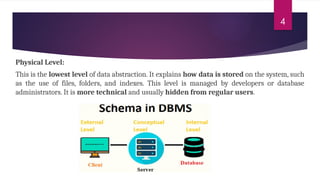
There are threeStages of Data Abstraction
for Data Independence:
To achieve Data Independence, we organize
data into levels of abstraction:
1. External Level – How users view the data
2. Conceptual Level – The logical structure of
the data
3. Internal Level – How data is physically
stored
Data Abstraction refers to the process of hiding irrelevant details from the user
DATA ABSTRACTION
3.
3
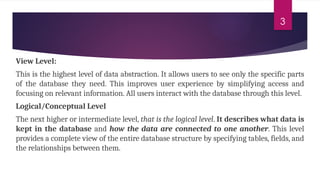
View Level:
This isthe highest level of data abstraction. It allows users to see only the specific parts
of the database they need. This improves user experience by simplifying access and
focusing on relevant information. All users interact with the database through this level.
Logical/Conceptual Level
The next higher or intermediate level, that is the logical level. It describes what data is
kept in the database and how the data are connected to one another. This level
provides a complete view of the entire database structure by specifying tables, fields, and
the relationships between them.
4.
4
Physical Level:
This isthe lowest level of data abstraction. It explains how data is stored on the system, such
as the use of files, folders, and indexes. This level is managed by developers or database
administrators. It is more technical and usually hidden from regular users.
5.
5
Advantages of DataAbstraction
It simplifies things for the users.
While retrieving data abstractions in DBMS improves system efficiency.
Users' usability is increased.
Increases the application's security by hiding implementation details
from users.
Increases code duplication and reuse.
6.
6
What is DataIndependence?
Data Independence means you can change the structure of the database at one level without affecting
the next level. It allows the data to be separate from the applications that use it, making the system
easier to manage and update.
Mapping is the process of translating data and requests between the different levels (tiers) of a database
system.
There are three types:
• External Mapping – Connects user views to the conceptual level
• Conceptual/Internal Mapping – Connects the logical design to physical storage
• Internal Mapping – Handles data at the physical level
Mapping & Data Independence
7.
7
External/Conceptual Mapping orLogical Data Independence
The ability to update the logical schema without changing the external schema or application software is
referred to as this feature. Any changes to the data's conceptual representation would have no effect on the
user's perception of the data.
Examples of changes under Physical Data Independence
Due to Physical independence, any of the below change will not affect the conceptual layer.
Using a new storage device like Hard Drive or Magnetic Tapes
Modifying the file organization technique in the Database
Switching to different data structures.
Changing the access method.
Change of Location of Database from C drive to D Drive..
8.
8
Examples of changesunder Logical Data Independence
Due to Logical independence, any of the below change will not affect the external layer.
Add/Modify/Delete a new attribute, entity or relationship is possible without a rewrite
of existing application programs
Merging two records into one
Breaking an existing record into two or more records Using a new storage device like
Hard Drive or Magnetic Tapes
9.
9
Assists youin improving the data's quality.
Database system upkeep has gotten more inexpensive.
Standardization and database security enhancements
Allow developers to concentrate on the overall structure of the database rather than
the inside implementation.
It enables you to enhance an undamaged or undivided condition.
Database inconsistency is greatly decreased. It is necessary to be able to easily make
changes at the physical level in order to improve the system’s performance.
Advantages of Data Independence




![제 23회 보아즈(BOAZ) 빅데이터 컨퍼런스 - [MBOAX] : ABSA를 활용한 소비자 반응 분석 기반 운영 효율화 대시보드 설계](https://cdn.slidesharecdn.com/ss_thumbnails/3-1boaz23rdconferencemboax-260203102709-9d519923-thumbnail.jpg?width=640&height=640&fit=bounds)


