Dr U Praveen
Assistant Professor
Sri Ramakrishna College of Arts &
Science Coimbatore
Topic: Types of Data
Introduction to
Data Types
Data types are crucial for understanding and representing
information in computer programming. They define the kind of
data a variable can hold, influencing how it's stored, processed,
and manipulated.
Numeric Data Types
Numeric data types represent numerical values, forming the
foundation of calculations and mathematical operations. They
can be further categorized into integers and floating-point
numbers.
Integers
Represent whole
numbers without
decimals, ideal for
counting or discrete
values.
Floating-Point
Represent numbers with
decimals, suitable for
precise measurements or
scientific calculations.
Integer Data Types
Integers are whole numbers without fractions or decimals, used
for representing counts, IDs, or positions. They can be positive,
negative, or zero.
1 Examples
Age, number of items
in a shopping cart,
student ID.
2 Advantages
Efficient storage and
faster calculations.
3 Limitations
Inability to represent fractions or decimals.
Floating-Point Data Types
Floating-point numbers represent real numbers with decimals, often used for measurements, scientific
calculations, or financial data.
Precision
Store numbers with a varying
number of digits after the
decimal point.
Applications
Suitable for calculations
involving fractions or precise
measurements.
Example
Temperature readings, currency
values, scientific data analysis.
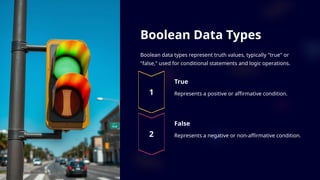
Boolean Data Types
Boolean data types represent truth values, typically "true" or
"false," used for conditional statements and logic operations.
True
Represents a positive or affirmative condition.
False
Represents a negative or non-affirmative condition.
Character Data Types
Character data types store individual characters like letters,
numbers, punctuation marks, and special symbols. They are
often used for representing single-character input or output.
Character Example Use Case
A Letter Text processing
5 Number Password
validation
* Punctuation Text formatting
String Data Types
String data types store sequences of characters, used for representing text,
labels, or messages. They are essential for handling text-based data.
Text
Store written content such as paragraphs or articles.
Labels
Provide descriptions or identifiers for various data elements.
Email Addresses
Store electronic mail addresses for communication.
Date and Time Data Types
Date and time data types store specific points in time, commonly
used for recording events, scheduling tasks, or managing
timestamps.
1 Date
Store year, month, and day.
2 Time
Store hours, minutes, and seconds.
3 Timestamp
Combine date and time for a precise point in time.
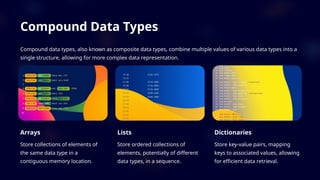
Compound Data Types
Compound data types, also known as composite data types, combine multiple values of various data types into a
single structure, allowing for more complex data representation.
Arrays
Store collections of elements of
the same data type in a
contiguous memory location.
Lists
Store ordered collections of
elements, potentially of different
data types, in a sequence.
Dictionaries
Store key-value pairs, mapping
keys to associated values, allowing
for efficient data retrieval.
Conclusion and Key Takeaways
Understanding data types is essential for effective programming. They provide a structured way to represent and
manipulate data, enabling efficient computations and logical operations.
1 Choice
Select appropriate data types
for each variable, considering
the type of data being stored
and its intended usage.
2 Operations
Perform operations based on
the data type, leveraging the
capabilities and limitations of
each type.
3 Efficiency
Use data types that optimize
storage and processing,
leading to improved
performance and resource
management.

Data Types -Introduction to Data types-Data Types-Types of Data

  • 1.
    Dr U Praveen AssistantProfessor Sri Ramakrishna College of Arts & Science Coimbatore Topic: Types of Data
  • 2.
    Introduction to Data Types Datatypes are crucial for understanding and representing information in computer programming. They define the kind of data a variable can hold, influencing how it's stored, processed, and manipulated.
  • 3.
    Numeric Data Types Numericdata types represent numerical values, forming the foundation of calculations and mathematical operations. They can be further categorized into integers and floating-point numbers. Integers Represent whole numbers without decimals, ideal for counting or discrete values. Floating-Point Represent numbers with decimals, suitable for precise measurements or scientific calculations.
  • 4.
    Integer Data Types Integersare whole numbers without fractions or decimals, used for representing counts, IDs, or positions. They can be positive, negative, or zero. 1 Examples Age, number of items in a shopping cart, student ID. 2 Advantages Efficient storage and faster calculations. 3 Limitations Inability to represent fractions or decimals.
  • 5.
    Floating-Point Data Types Floating-pointnumbers represent real numbers with decimals, often used for measurements, scientific calculations, or financial data. Precision Store numbers with a varying number of digits after the decimal point. Applications Suitable for calculations involving fractions or precise measurements. Example Temperature readings, currency values, scientific data analysis.
  • 6.
    Boolean Data Types Booleandata types represent truth values, typically "true" or "false," used for conditional statements and logic operations. True Represents a positive or affirmative condition. False Represents a negative or non-affirmative condition.
  • 7.
    Character Data Types Characterdata types store individual characters like letters, numbers, punctuation marks, and special symbols. They are often used for representing single-character input or output. Character Example Use Case A Letter Text processing 5 Number Password validation * Punctuation Text formatting
  • 8.
    String Data Types Stringdata types store sequences of characters, used for representing text, labels, or messages. They are essential for handling text-based data. Text Store written content such as paragraphs or articles. Labels Provide descriptions or identifiers for various data elements. Email Addresses Store electronic mail addresses for communication.
  • 9.
    Date and TimeData Types Date and time data types store specific points in time, commonly used for recording events, scheduling tasks, or managing timestamps. 1 Date Store year, month, and day. 2 Time Store hours, minutes, and seconds. 3 Timestamp Combine date and time for a precise point in time.
  • 10.
    Compound Data Types Compounddata types, also known as composite data types, combine multiple values of various data types into a single structure, allowing for more complex data representation. Arrays Store collections of elements of the same data type in a contiguous memory location. Lists Store ordered collections of elements, potentially of different data types, in a sequence. Dictionaries Store key-value pairs, mapping keys to associated values, allowing for efficient data retrieval.
  • 11.
    Conclusion and KeyTakeaways Understanding data types is essential for effective programming. They provide a structured way to represent and manipulate data, enabling efficient computations and logical operations. 1 Choice Select appropriate data types for each variable, considering the type of data being stored and its intended usage. 2 Operations Perform operations based on the data type, leveraging the capabilities and limitations of each type. 3 Efficiency Use data types that optimize storage and processing, leading to improved performance and resource management.