Do Now: Write down three examples of real-world
data that could be used in programming. For each
example, state what type of data it might
represent (e.g., numbers, text, true/false).
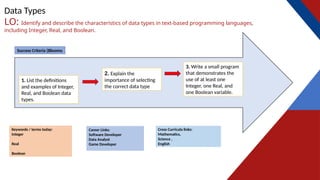
Data Types
LO: Identify and describe the characteristics of data types in text-based programming languages,
including Integer, Real, and Boolean.
Keywords / terms today:
Integer
Real
Boolean
Success Criteria (Blooms)
3. Write a small program
that demonstrates the
use of at least one
Integer, one Real, and
one Boolean variable.
Career Links:
Software Developer
Data Analyst
Game Developer
Cross Curricula links:
Mathematics,
Science ,
English
2. Explain the
importance of selecting
the correct data type
1. List the definitions
and examples of Integer,
Real, and Boolean data
types.
Understanding Data Types and Library Functions in Programming
• Why are data types important?
• How library functions simplify programming.
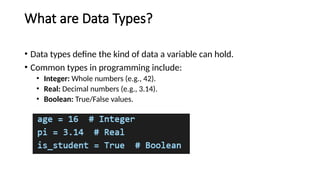
What are Data Types?
• Data types define the kind of data a variable can hold.
• Common types in programming include:
• Integer: Whole numbers (e.g., 42).
• Real: Decimal numbers (e.g., 3.14).
• Boolean: True/False values.
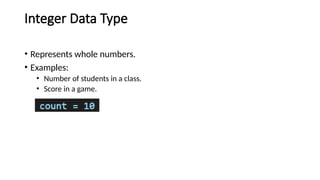
Integer Data Type
• Represents whole numbers.
• Examples:
• Number of students in a class.
• Score in a game.
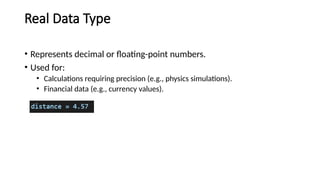
Real Data Type
• Represents decimal or floating-point numbers.
• Used for:
• Calculations requiring precision (e.g., physics simulations).
• Financial data (e.g., currency values).
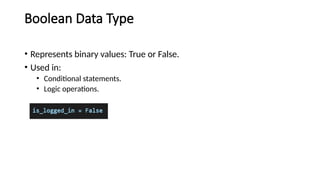
Boolean Data Type
• Represents binary values: True or False.
• Used in:
• Conditional statements.
• Logic operations.
Library Functions
• Predefined functions provided by programming languages.
• Advantages:
• Saves time.
• Reduces errors.
• Increases readability.
Examples:
• Math functions: sqrt(), round().
• String functions: len(), upper().
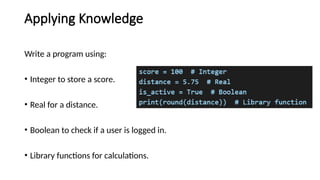
Applying Knowledge
Write a program using:
• Integer to store a score.
• Real for a distance.
• Boolean to check if a user is logged in.
• Library functions for calculations.
Examples
name = "Alice"
print(len(name)) # Output: 5
numbers = [1, 2, 3, 4]
print(len(numbers)) # Output: 4
number = 3.14159
print(round(number)) # Output: 3
print(round(number, 2)) # Output: 3.14
Conclusion and Reflection
• Data types and library functions are foundational in programming.
• Choosing the correct data type ensures:
• Efficiency.
• Accuracy.
• Reflection Task:
• How can library functions simplify real-world programming problems?

programming in computer science cambridge.pptx

  • 1.
    Do Now: Writedown three examples of real-world data that could be used in programming. For each example, state what type of data it might represent (e.g., numbers, text, true/false).
  • 2.
    Data Types LO: Identifyand describe the characteristics of data types in text-based programming languages, including Integer, Real, and Boolean. Keywords / terms today: Integer Real Boolean Success Criteria (Blooms) 3. Write a small program that demonstrates the use of at least one Integer, one Real, and one Boolean variable. Career Links: Software Developer Data Analyst Game Developer Cross Curricula links: Mathematics, Science , English 2. Explain the importance of selecting the correct data type 1. List the definitions and examples of Integer, Real, and Boolean data types.
  • 3.
    Understanding Data Typesand Library Functions in Programming • Why are data types important? • How library functions simplify programming.
  • 4.
    What are DataTypes? • Data types define the kind of data a variable can hold. • Common types in programming include: • Integer: Whole numbers (e.g., 42). • Real: Decimal numbers (e.g., 3.14). • Boolean: True/False values.
  • 5.
    Integer Data Type •Represents whole numbers. • Examples: • Number of students in a class. • Score in a game.
  • 6.
    Real Data Type •Represents decimal or floating-point numbers. • Used for: • Calculations requiring precision (e.g., physics simulations). • Financial data (e.g., currency values).
  • 7.
    Boolean Data Type •Represents binary values: True or False. • Used in: • Conditional statements. • Logic operations.
  • 8.
    Library Functions • Predefinedfunctions provided by programming languages. • Advantages: • Saves time. • Reduces errors. • Increases readability.
  • 9.
    Examples: • Math functions:sqrt(), round(). • String functions: len(), upper().
  • 10.
    Applying Knowledge Write aprogram using: • Integer to store a score. • Real for a distance. • Boolean to check if a user is logged in. • Library functions for calculations.
  • 11.
    Examples name = "Alice" print(len(name))# Output: 5 numbers = [1, 2, 3, 4] print(len(numbers)) # Output: 4 number = 3.14159 print(round(number)) # Output: 3 print(round(number, 2)) # Output: 3.14
  • 12.
    Conclusion and Reflection •Data types and library functions are foundational in programming. • Choosing the correct data type ensures: • Efficiency. • Accuracy. • Reflection Task: • How can library functions simplify real-world programming problems?