Department of Informatics
Facultyof Industrial Engineering
Universitas Pembangunan Nasional “Veteran” Yogyakarta
Data
Structure
Andi Nurkholis, S.Kom., M.Kom.
Learning
Contract
August 18, 2025
2.
Course Description
This coursediscusses the concepts, classifications, and objectives of data
structures as a foundation for efficient data management. Students will learn
and implement various types of linear data structures such as arrays, stacks,
queues, and deques, as well as non-linear data structures such as linked lists,
trees, and recursion.
This course also emphasizes students' ability to select and apply appropriate
data structures to solve various computational problems. Learning is conducted
through a theoretical and practical approach using programming languages, to
build a strong foundation in software and algorithm development.
3.
Competency Standards
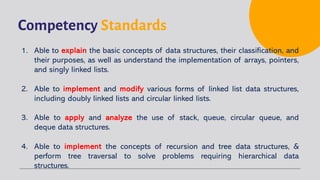
1. Ableto explain the basic concepts of data structures, their classification, and
their purposes, as well as understand the implementation of arrays, pointers,
and singly linked lists.
2. Able to implement and modify various forms of linked list data structures,
including doubly linked lists and circular linked lists.
3. Able to apply and analyze the use of stack, queue, circular queue, and
deque data structures.
4. Able to implement the concepts of recursion and tree data structures, &
perform tree traversal to solve problems requiring hierarchical data
structures.
4.
Supporting
References
1. Melladia, M.,Efendi, G., & Zahmi, A.
(2024). Algoritma dan Struktur Data
dengan Pemograman Pascal dan
Phyton. CV. Gita Lentera.
2. Purwono, P. (2023). Belajar Struktur
Data dengan Python. UHB Press, 2(1).
3. Buana, I. K. S., Kom, S., Nata, G. N. M.,
Kom, S., Arnawa, I. B. K. S., Kom, S., &
Kom, M. (2018). Struktur Data.
Penerbit Andi.
5.
Assessment Components
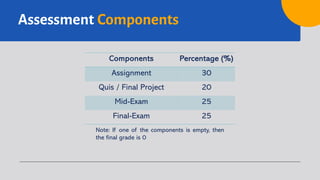
Components Percentage(%)
Assignment 30
Quis / Final Project 20
Mid-Exam 25
Final-Exam 25
Note: If one of the components is empty, then
the final grade is 0
6.
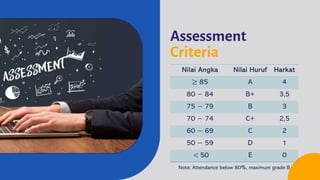
Assessment
Criteria
Nilai Angka NilaiHuruf Harkat
≥ 85 A 4
80 − 84 B+ 3,5
75 − 79 B 3
70 − 74 C+ 2,5
60 − 69 C 2
50 − 59 D 1
< 50 E 0
Note: Attendance below 80%, maximum grade B
7.
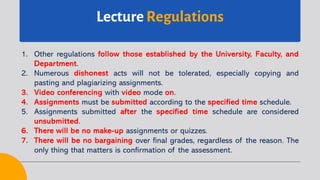
Lecture Regulations
1. Otherregulations follow those established by the University, Faculty, and
Department.
2. Numerous dishonest acts will not be tolerated, especially copying and
pasting and plagiarizing assignments.
3. Video conferencing with video mode on.
4. Assignments must be submitted according to the specified time schedule.
5. Assignments submitted after the specified time schedule are considered
unsubmitted.
6. There will be no make-up assignments or quizzes.
7. There will be no bargaining over final grades, regardless of the reason. The
only thing that matters is confirmation of the assessment.
8.
Sub
Chapter
1. Introduction toData Structures:
Concepts, Classification, and Purpose
2. Arrays: Concepts and Implementation
3. Pointers and Linked Lists Introduction
4. Advanced Linked Lists: Double &
Circular Linked Lists
5. Stack: Concepts and Implementation
9.
Sub
Chapter
6. Queue: Conceptand Implementation
7. Circular Queue and Double-Ended
Queue (Deque)
8. Recursion: Concept and
Implementation
9. Tree: Concept and Implementation
10. Tree Traversal
10.
Department of Informatics
Facultyof Industrial Engineering
Universitas Pembangunan Nasional “Veteran” Yogyakarta
Andi Nurkholis, S.Kom., M.Kom.
August 18, 2025
Done
Thank
You