DATA STRUCTURES
AND
ALGORITHMS
SKILL INNOVATIVE TASK – II
BY
Karthikeyan M
22BCM522
I-BSc.COMPUTER SCIENCE-’B’
APPLICATIONS OF DATA STRUCTURE
DATA STRUCTURE :
Data structure is a kind of data element set which
has certain logical relation, uses some kinds of storage structures
in computer, and encapsulates corresponding operation. Data
structure contains three aspects of content, logical relationships,
storage relationships and operations. The logical structure of data
can be divided into linear structure and nonlinear structure
roughly. A one-to-one relationship exists in the data elements of
linear structure, except the first and the last node; any other node
has only one direct precursor and descendant node. Linear
structures include linear tables, stacks, and queues. The tree, set
and graph are all nonlinear structures, in which the tree structure
simulates level, and the graph structure simulates symmetric and
asymmetric relation. The research data structure is the need of
program design to make the program design more robust and
efficient, and the development of the program more convenient .
APPLICATION OF DATA STRUCTURE :
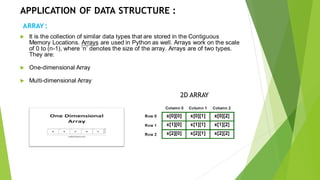
ARRAY :
 It is the collection of similar data types that are stored in the Contiguous
Memory Locations. Arrays are used in Python as well. Arrays work on the scale
of 0 to (n-1), where ‘n’ denotes the size of the array. Arrays are of two types.
They are:
 One-dimensional Array
 Multi-dimensional Array
2D ARRAY
LINKED LIST :
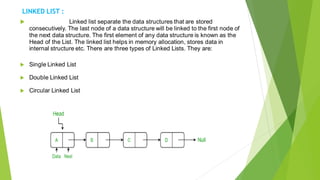
 Linked list separate the data structures that are stored
consecutively. The last node of a data structure will be linked to the first node of
the next data structure. The first element of any data structure is known as the
Head of the List. The linked list helps in memory allocation, stores data in
internal structure etc. There are three types of Linked Lists. They are:
 Single Linked List
 Double Linked List
 Circular Linked List
STACK :
 The linear data structure stores the data elements in the ‘first-in/ last-
out’ or the ‘last-in/ first out’ order. These orders are known as FILO and LIFO
orders, respectively. By using Stack, the element can be added and removed
simultaneously from the same end. In Python, Stack can be developed in the
following ways.
 Queue.LifoQueue
 List
 Collections.deque
QUEUE :
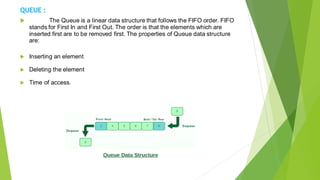
 The Queue is a linear data structure that follows the FIFO order. FIFO
stands for First In and First Out. The order is that the elements which are
inserted first are to be removed first. The properties of Queue data structure
are:
 Inserting an element
 Deleting the element
 Time of access.
TREE DATA STRUCTURE :
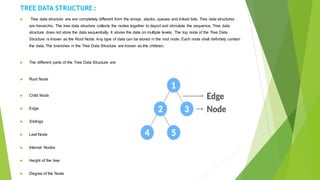
 Tree data structure are are completely different from the arrays, stacks, queues and linked lists. Tree data structures
are hierarchic. The tree data structure collects the nodes together to depict and stimulate the sequence. Tree data
structure does not store the data sequentially. It stores the data on multiple levels. The top node of the Tree Data
Structure is known as the Root Node. Any type of data can be stored in the root node. Each node shall definitely contain
the data. The branches in the Tree Data Structure are known as the children.
 The different parts of the Tree Data Structure are
 Root Node
 Child Node
 Edge
 Siblings
 Leaf Node
 Internal Nodes
 Height of the tree
 Degree of the Node
GRAPHS :
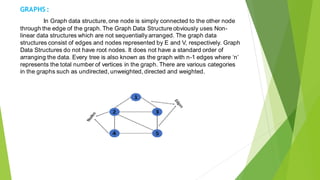
In Graph data structure, one node is simply connected to the other node
through the edge of the graph. The Graph Data Structure obviously uses Non-
linear data structures which are not sequentially arranged. The graph data
structures consist of edges and nodes represented by E and V, respectively. Graph
Data Structures do not have root nodes. It does not have a standard order of
arranging the data. Every tree is also known as the graph with n-1 edges where ‘n’
represents the total number of vertices in the graph. There are various categories
in the graphs such as undirected, unweighted, directed and weighted.
.DATA STRUCTURES

.DATA STRUCTURES

  • 1.
    DATA STRUCTURES AND ALGORITHMS SKILL INNOVATIVETASK – II BY Karthikeyan M 22BCM522 I-BSc.COMPUTER SCIENCE-’B’
  • 2.
    APPLICATIONS OF DATASTRUCTURE DATA STRUCTURE : Data structure is a kind of data element set which has certain logical relation, uses some kinds of storage structures in computer, and encapsulates corresponding operation. Data structure contains three aspects of content, logical relationships, storage relationships and operations. The logical structure of data can be divided into linear structure and nonlinear structure roughly. A one-to-one relationship exists in the data elements of linear structure, except the first and the last node; any other node has only one direct precursor and descendant node. Linear structures include linear tables, stacks, and queues. The tree, set and graph are all nonlinear structures, in which the tree structure simulates level, and the graph structure simulates symmetric and asymmetric relation. The research data structure is the need of program design to make the program design more robust and efficient, and the development of the program more convenient .
  • 3.
    APPLICATION OF DATASTRUCTURE : ARRAY :  It is the collection of similar data types that are stored in the Contiguous Memory Locations. Arrays are used in Python as well. Arrays work on the scale of 0 to (n-1), where ‘n’ denotes the size of the array. Arrays are of two types. They are:  One-dimensional Array  Multi-dimensional Array 2D ARRAY
  • 4.
    LINKED LIST : Linked list separate the data structures that are stored consecutively. The last node of a data structure will be linked to the first node of the next data structure. The first element of any data structure is known as the Head of the List. The linked list helps in memory allocation, stores data in internal structure etc. There are three types of Linked Lists. They are:  Single Linked List  Double Linked List  Circular Linked List
  • 5.
    STACK :  Thelinear data structure stores the data elements in the ‘first-in/ last- out’ or the ‘last-in/ first out’ order. These orders are known as FILO and LIFO orders, respectively. By using Stack, the element can be added and removed simultaneously from the same end. In Python, Stack can be developed in the following ways.  Queue.LifoQueue  List  Collections.deque
  • 6.
    QUEUE :  TheQueue is a linear data structure that follows the FIFO order. FIFO stands for First In and First Out. The order is that the elements which are inserted first are to be removed first. The properties of Queue data structure are:  Inserting an element  Deleting the element  Time of access.
  • 7.
    TREE DATA STRUCTURE:  Tree data structure are are completely different from the arrays, stacks, queues and linked lists. Tree data structures are hierarchic. The tree data structure collects the nodes together to depict and stimulate the sequence. Tree data structure does not store the data sequentially. It stores the data on multiple levels. The top node of the Tree Data Structure is known as the Root Node. Any type of data can be stored in the root node. Each node shall definitely contain the data. The branches in the Tree Data Structure are known as the children.  The different parts of the Tree Data Structure are  Root Node  Child Node  Edge  Siblings  Leaf Node  Internal Nodes  Height of the tree  Degree of the Node
  • 8.
    GRAPHS : In Graphdata structure, one node is simply connected to the other node through the edge of the graph. The Graph Data Structure obviously uses Non- linear data structures which are not sequentially arranged. The graph data structures consist of edges and nodes represented by E and V, respectively. Graph Data Structures do not have root nodes. It does not have a standard order of arranging the data. Every tree is also known as the graph with n-1 edges where ‘n’ represents the total number of vertices in the graph. There are various categories in the graphs such as undirected, unweighted, directed and weighted.