In today’s data-driven world, safeguarding data is critical. Effective data management
frameworks ensure that organizations not only handle data efficiently but also mitigate
risks related to data breaches and non-compliance. With rising data volumes, privacy
concerns, and evolving cyber threats, robust data risk management has become an
essential pillar for businesses. This article explores six major data risk management
strategies, best practices, and challenges, emphasizing the role of data management,
privacy-enhancing technologies, and adherence to global compliance standards.
Understanding the Data Management
Framework
A data management framework is the foundation for controlling, protecting, and optimizing data
across its lifecycle. It includes policies, processes, technologies, and roles to ensure data integrity
and security. This framework helps organizations standardize data handling, mitigate risks, and
ensure compliance with regulations like GDPR, HIPAA, and CCPA.
Key Components of a Data Management Framework
Data Governance: Establishing roles, policies, and responsibilities.
Data Quality Management: Ensuring data accuracy, consistency, and reliability.
Data Security: Implementing encryption, access control, and monitoring systems.
Compliance and Privacy: Aligning with regulatory requirements through privacy-enhancing
technologies (PETs) like anonymization and pseudonymization.
Identifying and Classifying Data Risks
A comprehensive risk assessment is essential in the data management framework. It
involves identifying potential threats to data, such as cyberattacks, insider threats, and
accidental exposure.
Types of Data Risks:
· Data Breaches: Unauthorized access leading to data theft or exposure.
· Data Integrity Issues: Corruption or manipulation of data.
· Compliance Violations: Failure to adhere to legal and regulatory standard.
Best practices involve classifying data based on its sensitivity (e.g., public confidential,
or restricted) and implementing tailored security measures for each category.
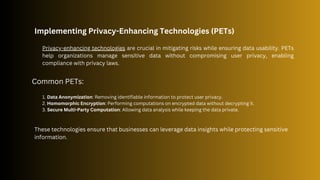
Implementing Privacy-Enhancing Technologies (PETs)
Privacy-enhancing technologies are crucial in mitigating risks while ensuring data usability. PETs
help organizations manage sensitive data without compromising user privacy, enabling
compliance with privacy laws.
1. Data Anonymization: Removing identifiable information to protect user privacy.
2. Homomorphic Encryption: Performing computations on encrypted data without decrypting it.
3. Secure Multi-Party Computation: Allowing data analysis while keeping the data private.
Common PETs:
These technologies ensure that businesses can leverage data insights while protecting sensitive
information.
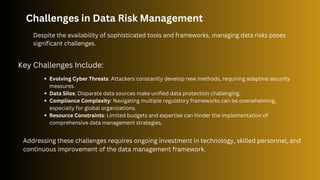
Challenges in Data Risk Management
Despite the availability of sophisticated tools and frameworks, managing data risks poses
significant challenges.
Key Challenges Include:
Evolving Cyber Threats: Attackers constantly develop new methods, requiring adaptive security
measures.
Data Silos: Disparate data sources make unified data protection challenging.
Compliance Complexity: Navigating multiple regulatory frameworks can be overwhelming,
especially for global organizations.
Resource Constraints: Limited budgets and expertise can hinder the implementation of
comprehensive data management strategies.
Addressing these challenges requires ongoing investment in technology, skilled personnel, and
continuous improvement of the data management framework.
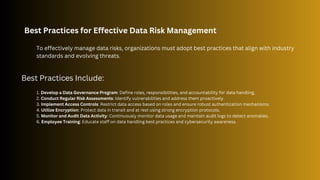
Best Practices for Effective Data Risk Management
To effectively manage data risks, organizations must adopt best practices that align with industry
standards and evolving threats.
Best Practices Include:
1. Develop a Data Governance Program: Define roles, responsibilities, and accountability for data handling.
2. Conduct Regular Risk Assessments: Identify vulnerabilities and address them proactively.
3. Implement Access Controls: Restrict data access based on roles and ensure robust authentication mechanisms.
4. Utilize Encryption: Protect data in transit and at rest using strong encryption protocols.
5. Monitor and Audit Data Activity: Continuously monitor data usage and maintain audit logs to detect anomalies.
6. Employee Training: Educate staff on data handling best practices and cybersecurity awareness.
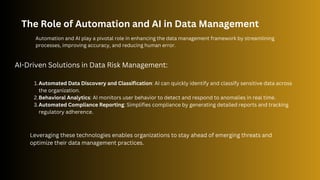
The Role of Automation and AI in Data Management
Automation and AI play a pivotal role in enhancing the data management framework by streamlining
processes, improving accuracy, and reducing human error.
AI-Driven Solutions in Data Risk Management:
Automated Data Discovery and Classification: AI can quickly identify and classify sensitive data across
the organization.
1.
Behavioral Analytics: AI monitors user behavior to detect and respond to anomalies in real time.
2.
Automated Compliance Reporting: Simplifies compliance by generating detailed reports and tracking
regulatory adherence.
3.
Leveraging these technologies enables organizations to stay ahead of emerging threats and
optimize their data management practices.
Conclusion
Effective data risk management is vital in today’s interconnected world. A well-structured data
management framework ensures the integrity, security, and compliance of data throughout its lifecycle. By
incorporating best practices, leveraging privacy-enhancing technologies, and embracing automation,
organizations can mitigate data risks while maximizing the value of their data assets. As data continues to
grow in volume and complexity, proactive data risk management will remain a cornerstone of organizational
success.
Adopting these strategies helps businesses navigate the challenges of data management, ensuring
resilience in the face of evolving risks and regulatory landscapes.
Contact us
Address :
Airoli Knowledge Park Road, Dighe, Green World,
vitawa, Airoli, Thane, Maharashtra 400708, India
Email:
Tejasvi@tejasviaddagada.com
Data Risk Management Framework- Tejasvi Addagada.pdf

Data Risk Management Framework- Tejasvi Addagada.pdf

  • 2.
    In today’s data-drivenworld, safeguarding data is critical. Effective data management frameworks ensure that organizations not only handle data efficiently but also mitigate risks related to data breaches and non-compliance. With rising data volumes, privacy concerns, and evolving cyber threats, robust data risk management has become an essential pillar for businesses. This article explores six major data risk management strategies, best practices, and challenges, emphasizing the role of data management, privacy-enhancing technologies, and adherence to global compliance standards.
  • 3.
    Understanding the DataManagement Framework A data management framework is the foundation for controlling, protecting, and optimizing data across its lifecycle. It includes policies, processes, technologies, and roles to ensure data integrity and security. This framework helps organizations standardize data handling, mitigate risks, and ensure compliance with regulations like GDPR, HIPAA, and CCPA. Key Components of a Data Management Framework Data Governance: Establishing roles, policies, and responsibilities. Data Quality Management: Ensuring data accuracy, consistency, and reliability. Data Security: Implementing encryption, access control, and monitoring systems. Compliance and Privacy: Aligning with regulatory requirements through privacy-enhancing technologies (PETs) like anonymization and pseudonymization.
  • 4.
    Identifying and ClassifyingData Risks A comprehensive risk assessment is essential in the data management framework. It involves identifying potential threats to data, such as cyberattacks, insider threats, and accidental exposure. Types of Data Risks: · Data Breaches: Unauthorized access leading to data theft or exposure. · Data Integrity Issues: Corruption or manipulation of data. · Compliance Violations: Failure to adhere to legal and regulatory standard. Best practices involve classifying data based on its sensitivity (e.g., public confidential, or restricted) and implementing tailored security measures for each category.
  • 5.
    Implementing Privacy-Enhancing Technologies(PETs) Privacy-enhancing technologies are crucial in mitigating risks while ensuring data usability. PETs help organizations manage sensitive data without compromising user privacy, enabling compliance with privacy laws. 1. Data Anonymization: Removing identifiable information to protect user privacy. 2. Homomorphic Encryption: Performing computations on encrypted data without decrypting it. 3. Secure Multi-Party Computation: Allowing data analysis while keeping the data private. Common PETs: These technologies ensure that businesses can leverage data insights while protecting sensitive information.
  • 6.
    Challenges in DataRisk Management Despite the availability of sophisticated tools and frameworks, managing data risks poses significant challenges. Key Challenges Include: Evolving Cyber Threats: Attackers constantly develop new methods, requiring adaptive security measures. Data Silos: Disparate data sources make unified data protection challenging. Compliance Complexity: Navigating multiple regulatory frameworks can be overwhelming, especially for global organizations. Resource Constraints: Limited budgets and expertise can hinder the implementation of comprehensive data management strategies. Addressing these challenges requires ongoing investment in technology, skilled personnel, and continuous improvement of the data management framework.
  • 7.
    Best Practices forEffective Data Risk Management To effectively manage data risks, organizations must adopt best practices that align with industry standards and evolving threats. Best Practices Include: 1. Develop a Data Governance Program: Define roles, responsibilities, and accountability for data handling. 2. Conduct Regular Risk Assessments: Identify vulnerabilities and address them proactively. 3. Implement Access Controls: Restrict data access based on roles and ensure robust authentication mechanisms. 4. Utilize Encryption: Protect data in transit and at rest using strong encryption protocols. 5. Monitor and Audit Data Activity: Continuously monitor data usage and maintain audit logs to detect anomalies. 6. Employee Training: Educate staff on data handling best practices and cybersecurity awareness.
  • 8.
    The Role ofAutomation and AI in Data Management Automation and AI play a pivotal role in enhancing the data management framework by streamlining processes, improving accuracy, and reducing human error. AI-Driven Solutions in Data Risk Management: Automated Data Discovery and Classification: AI can quickly identify and classify sensitive data across the organization. 1. Behavioral Analytics: AI monitors user behavior to detect and respond to anomalies in real time. 2. Automated Compliance Reporting: Simplifies compliance by generating detailed reports and tracking regulatory adherence. 3. Leveraging these technologies enables organizations to stay ahead of emerging threats and optimize their data management practices.
  • 9.
    Conclusion Effective data riskmanagement is vital in today’s interconnected world. A well-structured data management framework ensures the integrity, security, and compliance of data throughout its lifecycle. By incorporating best practices, leveraging privacy-enhancing technologies, and embracing automation, organizations can mitigate data risks while maximizing the value of their data assets. As data continues to grow in volume and complexity, proactive data risk management will remain a cornerstone of organizational success. Adopting these strategies helps businesses navigate the challenges of data management, ensuring resilience in the face of evolving risks and regulatory landscapes.
  • 10.
    Contact us Address : AiroliKnowledge Park Road, Dighe, Green World, vitawa, Airoli, Thane, Maharashtra 400708, India Email: Tejasvi@tejasviaddagada.com